CEMENT
Definition:
“Cement is a crystalline compound of calcium silicates and
other calcium compounds having hydraulic properties”
(Macfadyen, 2006).
Another Definition:
Cement is a powdery substance made by calcining lime and
clay, mixed with water to form mortar or mixed with sand,
gravel, and water to make concrete.
History:
Lime and clay have been used as cementing
material on constructions through many centuries.
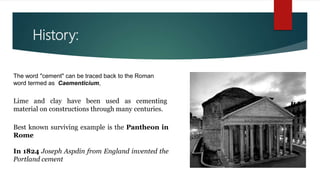
Best known surviving example is the Pantheon in
Rome
In 1824 Joseph Aspdin from England invented the
Portland cement
The word "cement" can be traced back to the Roman
word termed as Caementicium,
In Pakistan :
 The annual production of the cement at the time of the
creation of Pakistan was only 300000 tones per year.
 Pakistan has inexhaustible reserves of limestone and clay,
which can support the industry for another 50-60 years.
 At present there are more than 28 cement plants in Pakistan with
installed capacity of over 19.5 million tonnes per annum. The
present demand for cement in Pakistan is around 9.5 million
tonnes per annum.
PORTLAND CEMENT
Portland cement is the most common type of cement in
general use around the world, used as a basic ingredient of
concrete, mortar, stucco(plaster), and most non-speciality
grout.
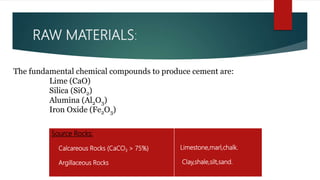
RAW MATERIALS:
The fundamental chemical compounds to produce cement are:
Lime (CaO)
Silica (SiO2)
Alumina (Al2O3)
Iron Oxide (Fe2O3)
RAW MATERIALS:Source Rocks:
Calcareous Rocks (CaCO3 > 75%)
Argillaceous Rocks
Limestone,marl,chalk.
Clay,shale,silt,sand.
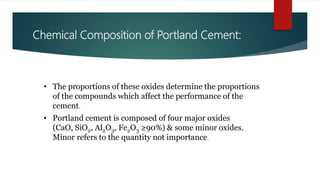
Chemical Composition of Portland Cement:
• Portland cement is composed of four major oxides
(CaO, SiO2, Al2O3, Fe2O3 ≥90%) & some minor oxides.
Minor refers to the quantity not importance.
• The proportions of these oxides determine the proportions
of the compounds which affect the performance of the
cement.
Compound Composition of Portland
Cement:
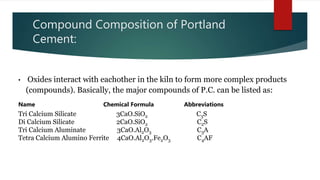
• Oxides interact with eachother in the kiln to form more complex products
(compounds). Basically, the major compounds of P.C. can be listed as:
Name Chemical Formula Abbreviations
Tri Calcium Silicate 3CaO.SiO2 C3S
Di Calcium Silicate 2CaO.SiO2 C2S
Tri Calcium Aluminate 3CaO.Al2O3 C3A
Tetra Calcium Alumino Ferrite 4CaO.Al2O3.Fe2O3 C4AF
Tricalcium aluminate, C3A:-
It liberates a lot of heat during the early stages of hydration, but has little
strength contribution. Gypsum slows down the hydration rate of C3A. Cement
low in C3A is sulfate resistant.
Tricalcium silicate, C3S:-
This compound hydrates and hardens rapidly. It is largely responsible for
portland cement’s initial set and early strength gain.
Dicalcium silicate, C2S:-
C2S hydrates and hardens slowly. It is largely responsible for strength gain
after one week.
Manufacturing Process of Cement:
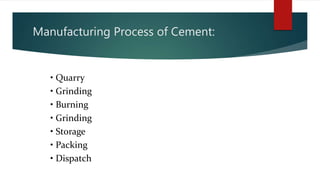
• Quarry
• Grinding
• Burning
• Grinding
• Storage
• Packing
• Dispatch
MINING METHODS:
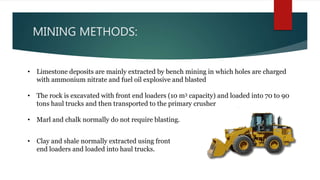
• Limestone deposits are mainly extracted by bench mining in which holes are charged
with ammonium nitrate and fuel oil explosive and blasted
• The rock is excavated with front end loaders (10 m3 capacity) and loaded into 70 to 90
tons haul trucks and then transported to the primary crusher
• Marl and chalk normally do not require blasting.
• Clay and shale normally extracted using front
end loaders and loaded into haul trucks.
Manfacturing Process :
Field Tests of Cement:
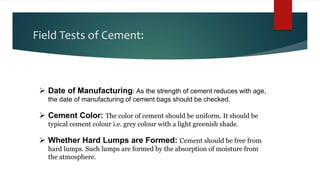
 Date of Manufacturing: As the strength of cement reduces with age,
the date of manufacturing of cement bags should be checked.
 Cement Color: The color of cement should be uniform. It should be
typical cement colour i.e. grey colour with a light greenish shade.
 Whether Hard Lumps are Formed: Cement should be free from
hard lumps. Such lumps are formed by the absorption of moisture from
the atmosphere.
Field Tests of Cement:
 Temperature Inside Cement Bag: If the hand is plunged into a
bag of cement, it should be cool inside the cement bag. If hydration
reaction takes place inside the bag, it will become warm.
 Smoothness Test: When cement is touched or rubbed in between
fingers, it should give smooth feeling. If it felt rough, it indicates
adulteration with sand.
 Water Sinking Test:. If a small quantity of cement is thrown to the
water, it should float some time before finally sinking
TYPES OF CEMENT:
 Rapid hardening cement:
The initial and final setting times of this cement are same as those of
ordinary cement. But it attains high strength in early days. It contains
high percentage of tricalcium silicate C3S to the extent of about 56%.
 Sulphate resisting cement:
In this cement, the percentage of tricalcium aluminate C3A is kept below 5
percent and it results in the increase in resisting power against sulphates.
TYPES OF CEMENT:
 Low heat cement:
The considerable heat is produced during the setting of cement. In order to
reduce the amount of heat, this type of cement is used. It contains lower
percentage of tricalcium aluminate C3A of about 5% and higher percentage
of dicalcium silicate C2S of about 46%.
 Pozzolana cement:
Pozzolana is a volcanic powder. It is found in Italy near Vesuvius. This type
of cement is used to prepare mass concrete of lean mix and for marine
structures. It is also used in sewage works ad for laying concrete under water
TYPES OF CEMENT:
 Coloured cement:
The cement of desired colour may be obtained by intimately mixing
mineral pigments with ordinary cement.
These types of coloured cement are widely used for finishing of
floors, external surfaces, artificial marble, window sill slabs,
textured panel faces, stair treads, etc.
White cement is prepared from such raw materials which are practically free
from colouring oxides of iron, manganese or chromium.
It is white in colour and is used for floor
finish, plaster work, ornament work, etc.
 White cement:
The difference between ordinary cement
and white cements
 The amount of chromium, manganese, iron compounds is
significantly less in white cement in comparison to gray cement
 Production of white cement consumes significantly more energy
in comparison to gray cement.
USES OF CEMENT:
 Cement is a very useful binding material in construction.
 It is used in mortar for plastering, masonry work, pointing, etc.
 It is used for making joints for drains and pipes.
 It is used for water tightness of structure.
 It is used in concrete for laying floors, roofs and constructing
lintels, beams, stairs, pillars etc.
USES:
 It is used for precast pipes manufacturing, piles, fencing posts etc.
 It is used in the construction of important engineering structures
such as bridges, culverts, dams, tunnels, light houses etc.
 It is used in the preparation of foundations, water tight floors,
footpaths etc.
 It is employed for the construction of wells, water tanks, tennis
courts, lamp posts, telephone cabins, roads etc.

Cement

  • 1.
  • 2.
    Definition: “Cement is acrystalline compound of calcium silicates and other calcium compounds having hydraulic properties” (Macfadyen, 2006).
  • 3.
    Another Definition: Cement isa powdery substance made by calcining lime and clay, mixed with water to form mortar or mixed with sand, gravel, and water to make concrete.
  • 4.
    History: Lime and clayhave been used as cementing material on constructions through many centuries. Best known surviving example is the Pantheon in Rome In 1824 Joseph Aspdin from England invented the Portland cement The word "cement" can be traced back to the Roman word termed as Caementicium,
  • 5.
    In Pakistan : The annual production of the cement at the time of the creation of Pakistan was only 300000 tones per year.  Pakistan has inexhaustible reserves of limestone and clay, which can support the industry for another 50-60 years.  At present there are more than 28 cement plants in Pakistan with installed capacity of over 19.5 million tonnes per annum. The present demand for cement in Pakistan is around 9.5 million tonnes per annum.
  • 6.
    PORTLAND CEMENT Portland cementis the most common type of cement in general use around the world, used as a basic ingredient of concrete, mortar, stucco(plaster), and most non-speciality grout.
  • 7.
    RAW MATERIALS: The fundamentalchemical compounds to produce cement are: Lime (CaO) Silica (SiO2) Alumina (Al2O3) Iron Oxide (Fe2O3) RAW MATERIALS:Source Rocks: Calcareous Rocks (CaCO3 > 75%) Argillaceous Rocks Limestone,marl,chalk. Clay,shale,silt,sand.
  • 8.
    Chemical Composition ofPortland Cement: • Portland cement is composed of four major oxides (CaO, SiO2, Al2O3, Fe2O3 ≥90%) & some minor oxides. Minor refers to the quantity not importance. • The proportions of these oxides determine the proportions of the compounds which affect the performance of the cement.
  • 9.
    Compound Composition ofPortland Cement: • Oxides interact with eachother in the kiln to form more complex products (compounds). Basically, the major compounds of P.C. can be listed as: Name Chemical Formula Abbreviations Tri Calcium Silicate 3CaO.SiO2 C3S Di Calcium Silicate 2CaO.SiO2 C2S Tri Calcium Aluminate 3CaO.Al2O3 C3A Tetra Calcium Alumino Ferrite 4CaO.Al2O3.Fe2O3 C4AF
  • 10.
    Tricalcium aluminate, C3A:- Itliberates a lot of heat during the early stages of hydration, but has little strength contribution. Gypsum slows down the hydration rate of C3A. Cement low in C3A is sulfate resistant. Tricalcium silicate, C3S:- This compound hydrates and hardens rapidly. It is largely responsible for portland cement’s initial set and early strength gain. Dicalcium silicate, C2S:- C2S hydrates and hardens slowly. It is largely responsible for strength gain after one week.
  • 11.
    Manufacturing Process ofCement: • Quarry • Grinding • Burning • Grinding • Storage • Packing • Dispatch
  • 12.
    MINING METHODS: • Limestonedeposits are mainly extracted by bench mining in which holes are charged with ammonium nitrate and fuel oil explosive and blasted • The rock is excavated with front end loaders (10 m3 capacity) and loaded into 70 to 90 tons haul trucks and then transported to the primary crusher • Marl and chalk normally do not require blasting. • Clay and shale normally extracted using front end loaders and loaded into haul trucks.
  • 13.
  • 14.
    Field Tests ofCement:  Date of Manufacturing: As the strength of cement reduces with age, the date of manufacturing of cement bags should be checked.  Cement Color: The color of cement should be uniform. It should be typical cement colour i.e. grey colour with a light greenish shade.  Whether Hard Lumps are Formed: Cement should be free from hard lumps. Such lumps are formed by the absorption of moisture from the atmosphere.
  • 15.
    Field Tests ofCement:  Temperature Inside Cement Bag: If the hand is plunged into a bag of cement, it should be cool inside the cement bag. If hydration reaction takes place inside the bag, it will become warm.  Smoothness Test: When cement is touched or rubbed in between fingers, it should give smooth feeling. If it felt rough, it indicates adulteration with sand.  Water Sinking Test:. If a small quantity of cement is thrown to the water, it should float some time before finally sinking
  • 16.
    TYPES OF CEMENT: Rapid hardening cement: The initial and final setting times of this cement are same as those of ordinary cement. But it attains high strength in early days. It contains high percentage of tricalcium silicate C3S to the extent of about 56%.  Sulphate resisting cement: In this cement, the percentage of tricalcium aluminate C3A is kept below 5 percent and it results in the increase in resisting power against sulphates.
  • 17.
    TYPES OF CEMENT: Low heat cement: The considerable heat is produced during the setting of cement. In order to reduce the amount of heat, this type of cement is used. It contains lower percentage of tricalcium aluminate C3A of about 5% and higher percentage of dicalcium silicate C2S of about 46%.  Pozzolana cement: Pozzolana is a volcanic powder. It is found in Italy near Vesuvius. This type of cement is used to prepare mass concrete of lean mix and for marine structures. It is also used in sewage works ad for laying concrete under water
  • 18.
    TYPES OF CEMENT: Coloured cement: The cement of desired colour may be obtained by intimately mixing mineral pigments with ordinary cement. These types of coloured cement are widely used for finishing of floors, external surfaces, artificial marble, window sill slabs, textured panel faces, stair treads, etc. White cement is prepared from such raw materials which are practically free from colouring oxides of iron, manganese or chromium. It is white in colour and is used for floor finish, plaster work, ornament work, etc.  White cement:
  • 19.
    The difference betweenordinary cement and white cements  The amount of chromium, manganese, iron compounds is significantly less in white cement in comparison to gray cement  Production of white cement consumes significantly more energy in comparison to gray cement.
  • 20.
    USES OF CEMENT: Cement is a very useful binding material in construction.  It is used in mortar for plastering, masonry work, pointing, etc.  It is used for making joints for drains and pipes.  It is used for water tightness of structure.  It is used in concrete for laying floors, roofs and constructing lintels, beams, stairs, pillars etc.
  • 21.
    USES:  It isused for precast pipes manufacturing, piles, fencing posts etc.  It is used in the construction of important engineering structures such as bridges, culverts, dams, tunnels, light houses etc.  It is used in the preparation of foundations, water tight floors, footpaths etc.  It is employed for the construction of wells, water tanks, tennis courts, lamp posts, telephone cabins, roads etc.