CONTENTS
1) Introduction
2) History
3) Composition
4) Manufacturing
5) Strength
6) Classifications
7) Test
8) Applications
9) Conclusion
INTRODUCTION
 The word cement has invent from the roman
word ‘opus caementicium’.
 Cement is the mixture of calcareous ,
siliceous, argillaceous and other
substances.
 Cement is used as a binding material in
mortar and concrete , etc.
HISTORY
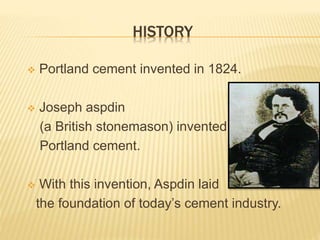
 Portland cement invented in 1824.
 Joseph aspdin
(a British stonemason) invented
Portland cement.
 With this invention, Aspdin laid
the foundation of today’s cement industry.
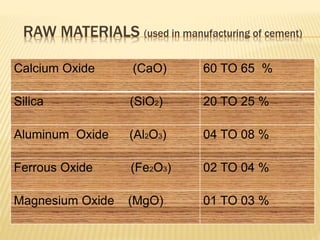
RAW MATERIALS (used in manufacturing of cement)
Calcium Oxide (CaO) 60 TO 65 %
Silica (SiO2) 20 TO 25 %
Aluminum Oxide (Al2O3) 04 TO 08 %
Ferrous Oxide (Fe2O3) 02 TO 04 %
Magnesium Oxide (MgO) 01 TO 03 %
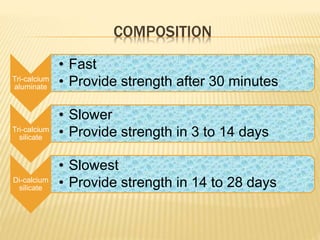
COMPOSITION
Tri-calcium
aluminate
• Fast
• Provide strength after 30 minutes
Tri-calcium
silicate
• Slower
• Provide strength in 3 to 14 days
Di-calcium
silicate
• Slowest
• Provide strength in 14 to 28 days
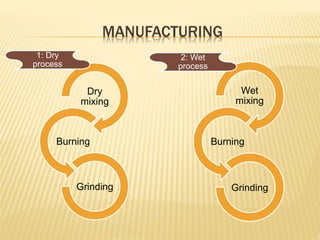
MANUFACTURING
Dry
mixing
Burning
Grinding
Wet
mixing
Burning
Grinding
1: Dry
process
2: Wet
process
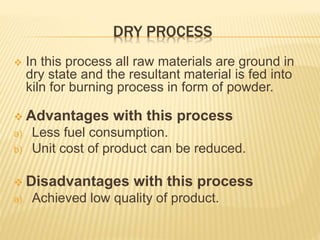
DRY PROCESS
 In this process all raw materials are ground in
dry state and the resultant material is fed into
kiln for burning process in form of powder.
 Advantages with this process
a) Less fuel consumption.
b) Unit cost of product can be reduced.
 Disadvantages with this process
a) Achieved low quality of product.
WET PROCESS
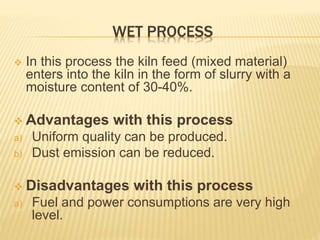
 In this process the kiln feed (mixed material)
enters into the kiln in the form of slurry with a
moisture content of 30-40%.
 Advantages with this process
a) Uniform quality can be produced.
b) Dust emission can be reduced.
 Disadvantages with this process
a) Fuel and power consumptions are very high
level.
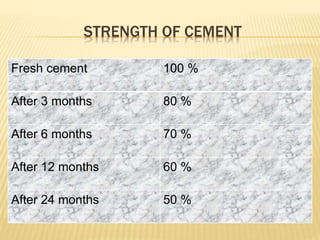
STRENGTH OF CEMENT
Fresh cement 100 %
After 3 months 80 %
After 6 months 70 %
After 12 months 60 %
After 24 months 50 %
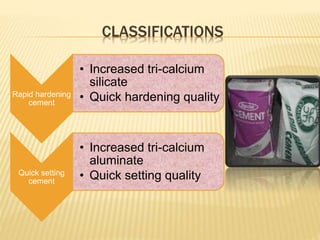
CLASSIFICATIONS
Rapid hardening
cement
• Increased tri-calcium
silicate
• Quick hardening quality
Quick setting
cement
• Increased tri-calcium
aluminate
• Quick setting quality
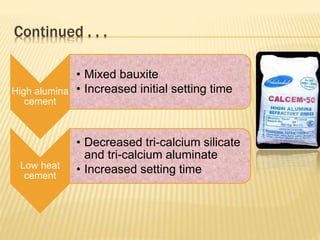
Continued . . .
High alumina
cement
• Mixed bauxite
• Increased initial setting time
Low heat
cement
• Decreased tri-calcium silicate
and tri-calcium aluminate
• Increased setting time
Continued . . .
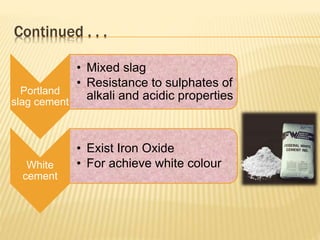
Portland
slag cement
• Mixed slag
• Resistance to sulphates of
alkali and acidic properties
White
cement
• Exist Iron Oxide
• For achieve white colour
Continued . . .
Water proofing
cement
• Mixed pudlo or impermo
• To used in water proofing structure
Air entraining
cement
• Mixed air entraining material
(resin,oils,fats) etc.
• To make mortar more workable
Continued . . .
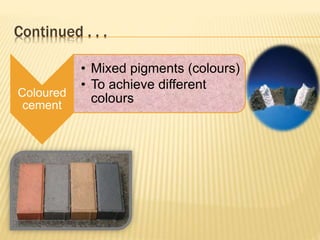
Coloured
cement
• Mixed pigments (colours)
• To achieve different
colours
TEST’S
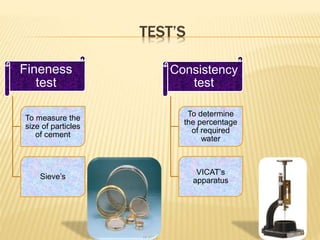
Fineness
test
To measure the
size of particles
of cement
Sieve’s
Consistency
test
To determine
the percentage
of required
water
VICAT’s
apparatus
Continued . . .
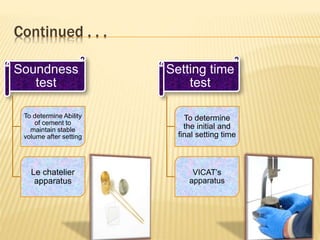
Soundness
test
To determine Ability
of cement to
maintain stable
volume after setting
Le chatelier
apparatus
Setting time
test
To determine
the initial and
final setting time
VICAT’s
apparatus
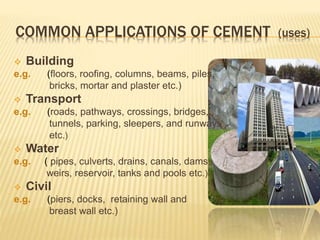
COMMON APPLICATIONS OF CEMENT (uses)
 Building
e.g. (floors, roofing, columns, beams, piles,
bricks, mortar and plaster etc.)
 Transport
e.g. (roads, pathways, crossings, bridges,
tunnels, parking, sleepers, and runways
etc.)
 Water
e.g. ( pipes, culverts, drains, canals, dams,
weirs, reservoir, tanks and pools etc.)
 Civil
e.g. (piers, docks, retaining wall and
breast wall etc.)
CONCLUSION
It is a binder that can sets and bind other materials together
Invented by Joseph aspdin in 1824 in England
It contains (calcium oxide, silica, aluminum oxide, ferrous
and magnesium oxides)
Manufacturing process consists of dry process and wet
process
Rapid hardening, high alumina, slag, white, coloured, air
entraining, and water proof are important types of cement
Most commonly used in building, irrigation, transportation,
and other civil structures
Presented by group five.
Muhammad Hamid
Muhammad Ahmed Asad
Muhammad Imran
Ali Raza Amin
Noman naveed
THANK YOU FOR YOUR ATTENTION
Prepared by : MUHAMMAD HAMID
Available on: WWW.SLIDESHARE.COM

cement ppt

  • 3.
    CONTENTS 1) Introduction 2) History 3)Composition 4) Manufacturing 5) Strength 6) Classifications 7) Test 8) Applications 9) Conclusion
  • 4.
    INTRODUCTION  The wordcement has invent from the roman word ‘opus caementicium’.  Cement is the mixture of calcareous , siliceous, argillaceous and other substances.  Cement is used as a binding material in mortar and concrete , etc.
  • 5.
    HISTORY  Portland cementinvented in 1824.  Joseph aspdin (a British stonemason) invented Portland cement.  With this invention, Aspdin laid the foundation of today’s cement industry.
  • 6.
    RAW MATERIALS (usedin manufacturing of cement) Calcium Oxide (CaO) 60 TO 65 % Silica (SiO2) 20 TO 25 % Aluminum Oxide (Al2O3) 04 TO 08 % Ferrous Oxide (Fe2O3) 02 TO 04 % Magnesium Oxide (MgO) 01 TO 03 %
  • 7.
    COMPOSITION Tri-calcium aluminate • Fast • Providestrength after 30 minutes Tri-calcium silicate • Slower • Provide strength in 3 to 14 days Di-calcium silicate • Slowest • Provide strength in 14 to 28 days
  • 8.
  • 9.
    DRY PROCESS  Inthis process all raw materials are ground in dry state and the resultant material is fed into kiln for burning process in form of powder.  Advantages with this process a) Less fuel consumption. b) Unit cost of product can be reduced.  Disadvantages with this process a) Achieved low quality of product.
  • 10.
    WET PROCESS  Inthis process the kiln feed (mixed material) enters into the kiln in the form of slurry with a moisture content of 30-40%.  Advantages with this process a) Uniform quality can be produced. b) Dust emission can be reduced.  Disadvantages with this process a) Fuel and power consumptions are very high level.
  • 11.
    STRENGTH OF CEMENT Freshcement 100 % After 3 months 80 % After 6 months 70 % After 12 months 60 % After 24 months 50 %
  • 12.
    CLASSIFICATIONS Rapid hardening cement • Increasedtri-calcium silicate • Quick hardening quality Quick setting cement • Increased tri-calcium aluminate • Quick setting quality
  • 13.
    Continued . .. High alumina cement • Mixed bauxite • Increased initial setting time Low heat cement • Decreased tri-calcium silicate and tri-calcium aluminate • Increased setting time
  • 14.
    Continued . .. Portland slag cement • Mixed slag • Resistance to sulphates of alkali and acidic properties White cement • Exist Iron Oxide • For achieve white colour
  • 15.
    Continued . .. Water proofing cement • Mixed pudlo or impermo • To used in water proofing structure Air entraining cement • Mixed air entraining material (resin,oils,fats) etc. • To make mortar more workable
  • 16.
    Continued . .. Coloured cement • Mixed pigments (colours) • To achieve different colours
  • 17.
    TEST’S Fineness test To measure the sizeof particles of cement Sieve’s Consistency test To determine the percentage of required water VICAT’s apparatus
  • 18.
    Continued . .. Soundness test To determine Ability of cement to maintain stable volume after setting Le chatelier apparatus Setting time test To determine the initial and final setting time VICAT’s apparatus
  • 19.
    COMMON APPLICATIONS OFCEMENT (uses)  Building e.g. (floors, roofing, columns, beams, piles, bricks, mortar and plaster etc.)  Transport e.g. (roads, pathways, crossings, bridges, tunnels, parking, sleepers, and runways etc.)  Water e.g. ( pipes, culverts, drains, canals, dams, weirs, reservoir, tanks and pools etc.)  Civil e.g. (piers, docks, retaining wall and breast wall etc.)
  • 20.
    CONCLUSION It is abinder that can sets and bind other materials together Invented by Joseph aspdin in 1824 in England It contains (calcium oxide, silica, aluminum oxide, ferrous and magnesium oxides) Manufacturing process consists of dry process and wet process Rapid hardening, high alumina, slag, white, coloured, air entraining, and water proof are important types of cement Most commonly used in building, irrigation, transportation, and other civil structures
  • 21.
    Presented by groupfive. Muhammad Hamid Muhammad Ahmed Asad Muhammad Imran Ali Raza Amin Noman naveed THANK YOU FOR YOUR ATTENTION Prepared by : MUHAMMAD HAMID Available on: WWW.SLIDESHARE.COM