
Presented by:-
Himanshu Chakravarti
LCI2016001
5th sem.
Introduction
Cement is the mixture of the calcerous,
argillacous, siliceous and other
substance.Cement is used as a binding
material in mortar,concrete and etc.
Background
Joseph Aspdin took out a patent in 1824 for
"PortlandCement," a material he produced by
firing finely-ground clay and limestone until
the limestone was calcined. He called it
Portland Cement because the concrete made
from it looked like Portland stone, a widely-
used building stone in England.
Name of Country Manufacture of cement
England 1825
Germany 1855
Belgium 1855
U.S.A 1972
India 1904
Note:-
The first cement factory in India was installed in Tamil-Nadu
in 1904 by South India Industry Limited
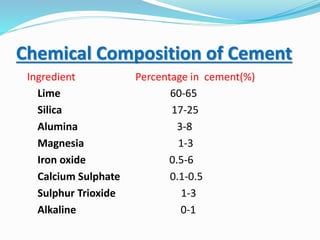
Chemical Composition of Cement
Ingredient Percentage in cement(%)
Lime 60-65
Silica 17-25
Alumina 3-8
Magnesia 1-3
Iron oxide 0.5-6
Calcium Sulphate 0.1-0.5
Sulphur Trioxide 1-3
Alkaline 0-1
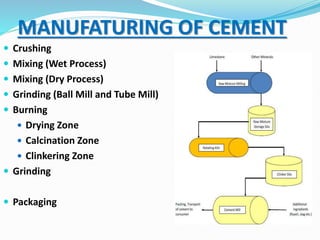
MANUFATURING OF CEMENT
 Crushing
 Mixing (Wet Process)
 Mixing (Dry Process)
 Grinding (Ball Mill and Tube Mill)
 Burning
 Drying Zone
 Calcination Zone
 Clinkering Zone
 Grinding
 Packaging
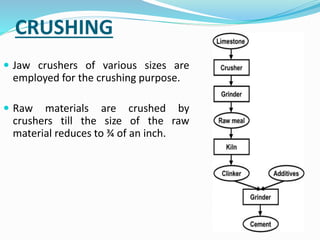
CRUSHING
 Jaw crushers of various sizes are
employed for the crushing purpose.
 Raw materials are crushed by
crushers till the size of the raw
material reduces to ¾ of an inch.
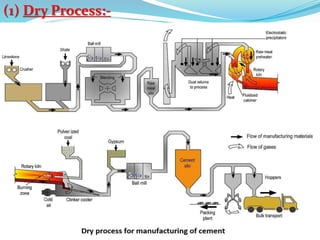
(1) Dry Process:-
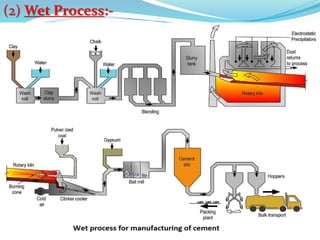
(2) Wet Process:-
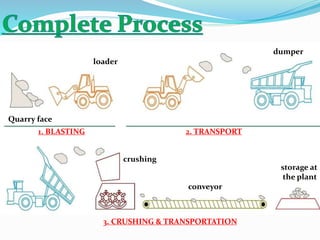
Quarry face
loader
1. BLASTING 2. TRANSPORT
dumper
3. CRUSHING & TRANSPORTATION
crushing
storage at
the plant
conveyor
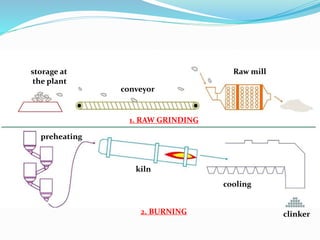
storage at
the plant
conveyor
Raw mill
1. RAW GRINDING
preheating
kiln
cooling
clinker2. BURNING
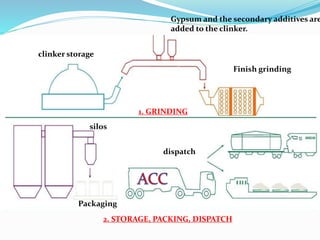
clinker storage
Gypsum and the secondary additives are
added to the clinker.
Finish grinding
1. GRINDING
silos
dispatch
2. STORAGE, PACKING, DISPATCH
Packaging
(3).Grinding:-
Grinding of clinker is done in the large tube mills.
After proper grinding gypsum (Calcium sulphate
CaSO4) in the ratio of 0.1-0.4 % is added for
controlling the setting time of cement.
Finally, fine ground cement is stored in storage
tanks from where it is drawn for packing.
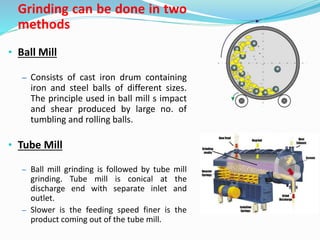
Grinding can be done in two
methods
• Ball Mill
– Consists of cast iron drum containing
iron and steel balls of different sizes.
The principle used in ball mill s impact
and shear produced by large no. of
tumbling and rolling balls.
• Tube Mill
– Ball mill grinding is followed by tube mill
grinding. Tube mill is conical at the
discharge end with separate inlet and
outlet.
– Slower is the feeding speed finer is the
product coming out of the tube mill.
(3).Burning Process:-
Corrected slurry is feed to a rotary kiln which is 150-500 ft
long,8-16 ft in diameter and temperature is up to 1500-
1650 degree C.At this temperature slurry losses moisture
and forms into small lumps after that changes to the
clinkers. Clinkers are cooled in another inclined tube similar
to the kiln but lesser in length
A. DRYING ZONE
 The upper part of the kiln is known as drying zone.
 The temperature is about 200-500°C.
 Most of the water gets evaporated from the slurry by
means of hot gases.
B. CALCINATING ZONE
 This the middle zone of the kiln with temperature
around 1000°C.
 Organic matter burns away and CaCO3 decomposes to
quick lime and CO2 escapes out. The material forms
small lumps called as nodules.
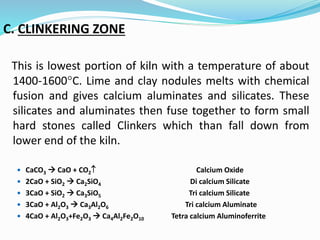
C. CLINKERING ZONE
This is lowest portion of kiln with a temperature of about
1400-1600°C. Lime and clay nodules melts with chemical
fusion and gives calcium aluminates and silicates. These
silicates and aluminates then fuse together to form small
hard stones called Clinkers which than fall down from
lower end of the kiln.
 CaCO3  CaO + CO2 Calcium Oxide
 2CaO + SiO2  Ca2SiO4 Di calcium Silicate
 3CaO + SiO2  Ca3SiO5 Tri calcium Silicate
 3CaO + Al2O3  Ca3Al2O6 Tri calcium Aluminate
 4CaO + Al2O3+Fe2O3  Ca4Al2Fe2O10 Tetra calcium Aluminoferrite
PACKAGING
The ground powder is
packed by automatic
machines in a 50kg bag.
This is then dispatched to
the markets where it is
sold for constructions of
cities.
TYPES OF CEMENT
1. Ordinary Portland Cement
2. Sulphate Resisting Cement
3. Rapid Hardening Cement
4. Quick Setting Cement
5. Low Heat Cement
6. High Alumina Cement
7. Air Entraining Cement
8. White Cement
TO CHECK THE QUALITY OF
CEMENT IN THE FIELD
 Colour is greenish grey.
 One feels cool by thrusting one’s
hand in the cement bag.
 It is smooth when rubbed in
between fingers.
 A hanndful of cement thrown in a
bucket of water should float.
QUALITY TESTS OF CEMENT
1) Fineness test
2) Consistency test
3) Setting Time Test
4) Compressive Strength Test
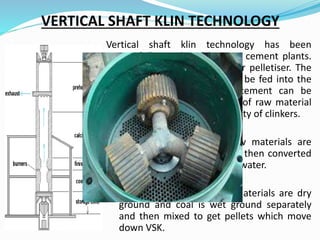
VERTICAL SHAFT KLIN TECHNOLOGY
Vertical shaft klin technology has been
successfully employed by mini cement plants.
The VSK have pan noduliser or pelletiser. The
uniform pellets so formed can be fed into the
vertical shaft Klin and the cement can be
produced. Proper proportions of raw material
must be taken to get good quality of clinkers.
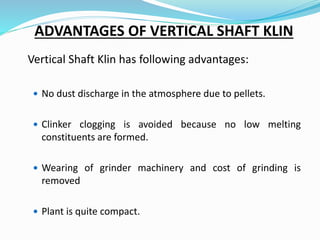
 Black Metal Process : Raw materials are
ground along with coal and then converted
into pellets with about 15% water.
 Fuel Slurry Process: Raw materials are dry
ground and coal is wet ground separately
and then mixed to get pellets which move
down VSK.
ADVANTAGES OF VERTICAL SHAFT KLIN
Vertical Shaft Klin has following advantages:
 No dust discharge in the atmosphere due to pellets.
 Clinker clogging is avoided because no low melting
constituents are formed.
 Wearing of grinder machinery and cost of grinding is
removed
 Plant is quite compact.
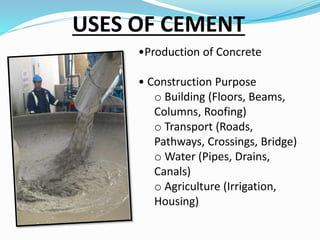
•Production of Concrete
• Construction Purpose
o Building (Floors, Beams,
Columns, Roofing)
o Transport (Roads,
Pathways, Crossings, Bridge)
o Water (Pipes, Drains,
Canals)
o Agriculture (Irrigation,
Housing)
USES OF CEMENT
DISADVATAGES
?
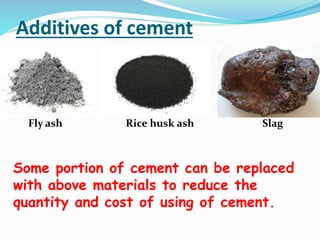
Additives of cement
Fly ash Rice husk ash Slag
Some portion of cement can be replaced
with above materials to reduce the
quantity and cost of using of cement.
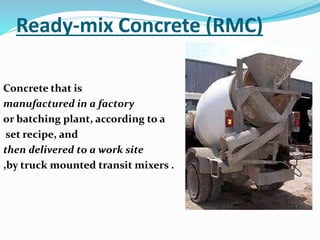
Ready-mix Concrete (RMC)
Concrete that is
manufactured in a factory
or batching plant, according to a
set recipe, and
then delivered to a work site
,by truck mounted transit mixers .
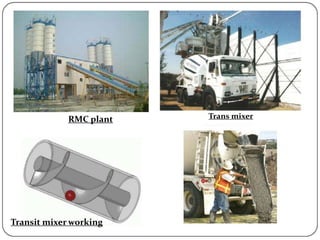
Trans mixerRMC plant
Transit mixer working
Why Cement ?
Easy to handle and use
Good Binder
Almost any kind of structure or finishing
can be obtained
High compressive Strength
Flexible & mouldable
Easily available
GLOBAL SCENARIO
•Today, it is estimated that there are around 1500 integrated
cement production plants in the world.
•It is estimated that world cement consumption is to rise on an
average between 3.6% and 4.8% per year in the coming years.
•Most of the growth is coming from Central and Eastern Europe
and Asia, growth in mature markets also looks healthy.
•The share of the four largest firms account only for 23% of the
overall demand.
•LAFARGE and CEMEX have become very strong global cement
players.
Why Burn Wastes?
A cement kiln is a proven technology for
recycling by beneficial REUSE of solid and
hazardous wastes.
The benefits are:
– energy recovery
– material recovery
– economics
– environmental preservation
Some leading cement manufacturers
 Lafarge
 Binani
 J K Lakxmi
 ESSROC
 ACC
 Birla
 Ambuja
 Prism
 Ultratech
 Jaypee
Cement

Cement

  • 1.
  • 2.
    Introduction Cement is themixture of the calcerous, argillacous, siliceous and other substance.Cement is used as a binding material in mortar,concrete and etc.
  • 3.
    Background Joseph Aspdin tookout a patent in 1824 for "PortlandCement," a material he produced by firing finely-ground clay and limestone until the limestone was calcined. He called it Portland Cement because the concrete made from it looked like Portland stone, a widely- used building stone in England.
  • 4.
    Name of CountryManufacture of cement England 1825 Germany 1855 Belgium 1855 U.S.A 1972 India 1904 Note:- The first cement factory in India was installed in Tamil-Nadu in 1904 by South India Industry Limited
  • 5.
    Chemical Composition ofCement Ingredient Percentage in cement(%) Lime 60-65 Silica 17-25 Alumina 3-8 Magnesia 1-3 Iron oxide 0.5-6 Calcium Sulphate 0.1-0.5 Sulphur Trioxide 1-3 Alkaline 0-1
  • 6.
    MANUFATURING OF CEMENT Crushing  Mixing (Wet Process)  Mixing (Dry Process)  Grinding (Ball Mill and Tube Mill)  Burning  Drying Zone  Calcination Zone  Clinkering Zone  Grinding  Packaging
  • 7.
    CRUSHING  Jaw crushersof various sizes are employed for the crushing purpose.  Raw materials are crushed by crushers till the size of the raw material reduces to ¾ of an inch.
  • 8.
  • 9.
  • 10.
    Quarry face loader 1. BLASTING2. TRANSPORT dumper 3. CRUSHING & TRANSPORTATION crushing storage at the plant conveyor
  • 11.
    storage at the plant conveyor Rawmill 1. RAW GRINDING preheating kiln cooling clinker2. BURNING
  • 12.
    clinker storage Gypsum andthe secondary additives are added to the clinker. Finish grinding 1. GRINDING silos dispatch 2. STORAGE, PACKING, DISPATCH Packaging
  • 13.
    (3).Grinding:- Grinding of clinkeris done in the large tube mills. After proper grinding gypsum (Calcium sulphate CaSO4) in the ratio of 0.1-0.4 % is added for controlling the setting time of cement. Finally, fine ground cement is stored in storage tanks from where it is drawn for packing.
  • 14.
    Grinding can bedone in two methods • Ball Mill – Consists of cast iron drum containing iron and steel balls of different sizes. The principle used in ball mill s impact and shear produced by large no. of tumbling and rolling balls. • Tube Mill – Ball mill grinding is followed by tube mill grinding. Tube mill is conical at the discharge end with separate inlet and outlet. – Slower is the feeding speed finer is the product coming out of the tube mill.
  • 15.
    (3).Burning Process:- Corrected slurryis feed to a rotary kiln which is 150-500 ft long,8-16 ft in diameter and temperature is up to 1500- 1650 degree C.At this temperature slurry losses moisture and forms into small lumps after that changes to the clinkers. Clinkers are cooled in another inclined tube similar to the kiln but lesser in length
  • 16.
    A. DRYING ZONE The upper part of the kiln is known as drying zone.  The temperature is about 200-500°C.  Most of the water gets evaporated from the slurry by means of hot gases. B. CALCINATING ZONE  This the middle zone of the kiln with temperature around 1000°C.  Organic matter burns away and CaCO3 decomposes to quick lime and CO2 escapes out. The material forms small lumps called as nodules.
  • 17.
    C. CLINKERING ZONE Thisis lowest portion of kiln with a temperature of about 1400-1600°C. Lime and clay nodules melts with chemical fusion and gives calcium aluminates and silicates. These silicates and aluminates then fuse together to form small hard stones called Clinkers which than fall down from lower end of the kiln.  CaCO3  CaO + CO2 Calcium Oxide  2CaO + SiO2  Ca2SiO4 Di calcium Silicate  3CaO + SiO2  Ca3SiO5 Tri calcium Silicate  3CaO + Al2O3  Ca3Al2O6 Tri calcium Aluminate  4CaO + Al2O3+Fe2O3  Ca4Al2Fe2O10 Tetra calcium Aluminoferrite
  • 18.
    PACKAGING The ground powderis packed by automatic machines in a 50kg bag. This is then dispatched to the markets where it is sold for constructions of cities.
  • 19.
    TYPES OF CEMENT 1.Ordinary Portland Cement 2. Sulphate Resisting Cement 3. Rapid Hardening Cement 4. Quick Setting Cement 5. Low Heat Cement 6. High Alumina Cement 7. Air Entraining Cement 8. White Cement
  • 20.
    TO CHECK THEQUALITY OF CEMENT IN THE FIELD  Colour is greenish grey.  One feels cool by thrusting one’s hand in the cement bag.  It is smooth when rubbed in between fingers.  A hanndful of cement thrown in a bucket of water should float.
  • 21.
    QUALITY TESTS OFCEMENT 1) Fineness test 2) Consistency test 3) Setting Time Test 4) Compressive Strength Test
  • 22.
    VERTICAL SHAFT KLINTECHNOLOGY Vertical shaft klin technology has been successfully employed by mini cement plants. The VSK have pan noduliser or pelletiser. The uniform pellets so formed can be fed into the vertical shaft Klin and the cement can be produced. Proper proportions of raw material must be taken to get good quality of clinkers.  Black Metal Process : Raw materials are ground along with coal and then converted into pellets with about 15% water.  Fuel Slurry Process: Raw materials are dry ground and coal is wet ground separately and then mixed to get pellets which move down VSK.
  • 23.
    ADVANTAGES OF VERTICALSHAFT KLIN Vertical Shaft Klin has following advantages:  No dust discharge in the atmosphere due to pellets.  Clinker clogging is avoided because no low melting constituents are formed.  Wearing of grinder machinery and cost of grinding is removed  Plant is quite compact.
  • 24.
    •Production of Concrete •Construction Purpose o Building (Floors, Beams, Columns, Roofing) o Transport (Roads, Pathways, Crossings, Bridge) o Water (Pipes, Drains, Canals) o Agriculture (Irrigation, Housing) USES OF CEMENT
  • 25.
  • 26.
    Additives of cement Flyash Rice husk ash Slag Some portion of cement can be replaced with above materials to reduce the quantity and cost of using of cement.
  • 27.
    Ready-mix Concrete (RMC) Concretethat is manufactured in a factory or batching plant, according to a set recipe, and then delivered to a work site ,by truck mounted transit mixers .
  • 28.
  • 29.
    Why Cement ? Easyto handle and use Good Binder Almost any kind of structure or finishing can be obtained High compressive Strength Flexible & mouldable Easily available
  • 30.
    GLOBAL SCENARIO •Today, itis estimated that there are around 1500 integrated cement production plants in the world. •It is estimated that world cement consumption is to rise on an average between 3.6% and 4.8% per year in the coming years. •Most of the growth is coming from Central and Eastern Europe and Asia, growth in mature markets also looks healthy. •The share of the four largest firms account only for 23% of the overall demand. •LAFARGE and CEMEX have become very strong global cement players.
  • 31.
    Why Burn Wastes? Acement kiln is a proven technology for recycling by beneficial REUSE of solid and hazardous wastes. The benefits are: – energy recovery – material recovery – economics – environmental preservation
  • 32.
    Some leading cementmanufacturers  Lafarge  Binani  J K Lakxmi  ESSROC  ACC  Birla  Ambuja  Prism  Ultratech  Jaypee

Editor's Notes

  • #31 Phillip Lasserre (2007). Globalization cement industry, global strategic management