CEMENT 
Cement is a finely ground, usually grey 
colored mineral powder. When mixed with 
water, cement acts as a glue to bind 
together the sand, gravel and crushed stone 
to form concrete, the most widely used 
construction material in the world
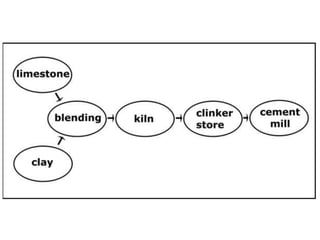
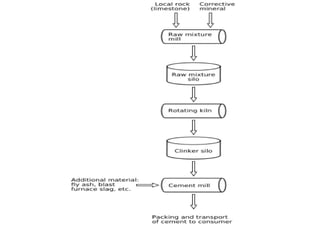
• Cement is typically made from limestone and clay or 
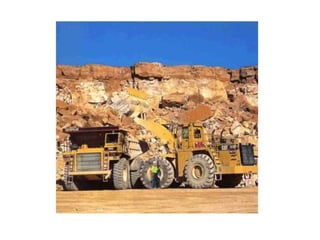
shale. These raw materials are extracted from the 
quarry crushed to a very fine powder and then 
blended in the correct proportions. 
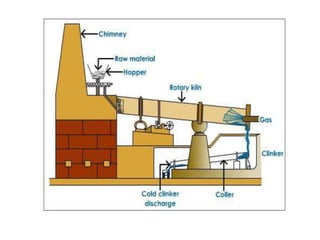
• This blended raw material is called the 'raw feed' or 
'kiln feed' and is heated in a rotary kiln where it 
reaches a temperature of about 14000 C to 15000 C. 
• The raw feed enters the kiln at the cool end and 
gradually passes down to the hot end, then falls out 
of the kiln and cools down.
• The material formed in the kiln is described as 
'clinker' and is typically composed of rounded 
nodules between 1mm and 25mm across. 
• After cooling, the clinker may be stored 
temporarily in a clinker store, or it may pass 
directly to the cement mill. 
• The cement mill grinds the clinker to a fine 
powder. A small amount of gypsum - a form of 
calcium sulfate - is normally ground up with 
the clinker. The gypsum controls the setting 
properties of the cement when water is 
added.
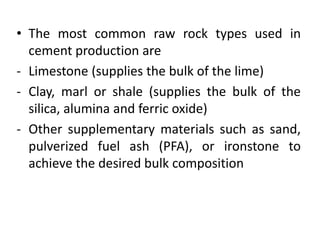
• The most common raw rock types used in 
cement production are 
- Limestone (supplies the bulk of the lime) 
- Clay, marl or shale (supplies the bulk of the 
silica, alumina and ferric oxide) 
- Other supplementary materials such as sand, 
pulverized fuel ash (PFA), or ironstone to 
achieve the desired bulk composition
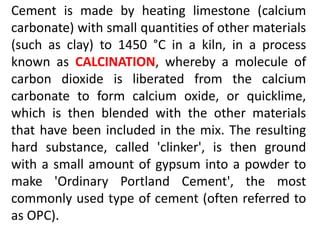
Cement is made by heating limestone (calcium 
carbonate) with small quantities of other materials 
(such as clay) to 1450 °C in a kiln, in a process 
known as CALCINATION, whereby a molecule of 
carbon dioxide is liberated from the calcium 
carbonate to form calcium oxide, or quicklime, 
which is then blended with the other materials 
that have been included in the mix. The resulting 
hard substance, called 'clinker', is then ground 
with a small amount of gypsum into a powder to 
make 'Ordinary Portland Cement', the most 
commonly used type of cement (often referred to 
as OPC).
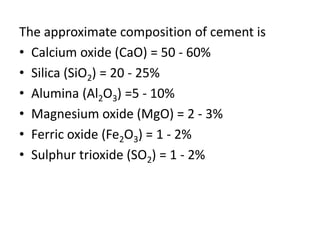
The approximate composition of cement is 
• Calcium oxide (CaO) = 50 - 60% 
• Silica (SiO2) = 20 - 25% 
• Alumina (Al2O3) =5 - 10% 
• Magnesium oxide (MgO) = 2 - 3% 
• Ferric oxide (Fe2O3) = 1 - 2% 
• Sulphur trioxide (SO2) = 1 - 2%
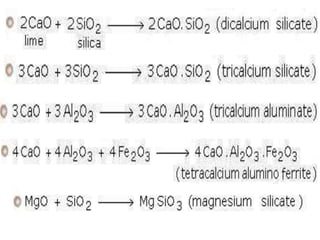
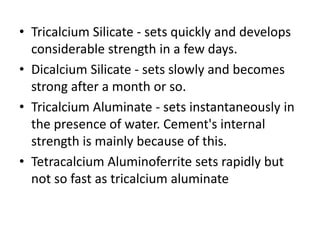
• Tricalcium Silicate - sets quickly and develops 
considerable strength in a few days. 
• Dicalcium Silicate - sets slowly and becomes 
strong after a month or so. 
• Tricalcium Aluminate - sets instantaneously in 
the presence of water. Cement's internal 
strength is mainly because of this. 
• Tetracalcium Aluminoferrite sets rapidly but 
not so fast as tricalcium aluminate
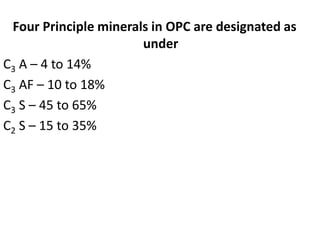
Four Principle minerals in OPC are designated as 
under 
C3 A – 4 to 14% 
C3 AF – 10 to 18% 
C3 S – 45 to 65% 
C2 S – 15 to 35%
• On hydration silicates and aluminates of 
calcium get converted to their respective 
hydrated colloidal gels. 
• At the same time, hydrolysis precipitates 
calcium hydroxide and aluminium hydroxide. 
• This calcium hydroxide binds calcium silicate 
particles together. On the other hand, 
aluminium hydroxide fills the interstices (an 
intervening space) rendering the mass 
impervious (not affording passage to a fluid).
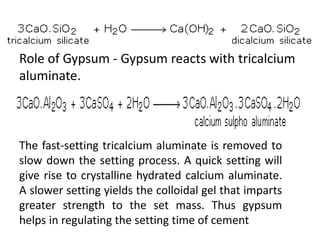
Role of Gypsum - Gypsum reacts with tricalcium 
aluminate. 
The fast-setting tricalcium aluminate is removed to 
slow down the setting process. A quick setting will 
give rise to crystalline hydrated calcium aluminate. 
A slower setting yields the colloidal gel that imparts 
greater strength to the set mass. Thus gypsum 
helps in regulating the setting time of cement
• Portland cement is a basic ingredient of 
concrete, mortar and most non-speciality 
grout. The most common use for Portland 
cement is in the production of concrete. 
Concrete is a composite material consisting of 
aggregate (gravel and sand), cement, and 
water. As a construction material, concrete 
can be cast in almost any shape desired, and 
once hardened, can become a structural (load 
bearing) element. Portland cement may be 
grey or white.
Portland Cement Blends 
Portland cement blends are often available as inter-ground 
mixtures from cement manufacturers, but 
similar formulations are often also mixed from the 
ground components at the concrete mixing plant. 
• Portland blastfurnace cement contains up to 70 % 
ground granulated blast furnace slag, with the rest 
Portland clinker and a little gypsum. All 
compositions produce high ultimate strength, but as 
slag content is increased, early strength is reduced, 
while sulfate resistance increases and heat 
evolution diminishes. Used as an economic 
alternative to Portland sulfate-resisting and low-heat 
cements
• Portland flyash cement contains up to 30 % fly ash. The 
fly ash is pozzolanic, so that ultimate strength is 
maintained. Because fly ash addition allows a lower 
concrete water content, early strength can also be 
maintained. Where good quality cheap fly ash is 
available, this can be an economic alternative to 
ordinary Portland cement. 
• Portland pozzolana cement includes fly ash cement, 
since fly ash is a pozzolana, but also includes cements 
made from other natural or artificial pozzolana. In 
countries where volcanic ashes are available (e.g. Italy, 
Chile, Mexico, the Philippines) these cements are often 
the most common form in use.
• Portland silica fume cement. Addition of silica 
fume can yield exceptionally high strengths, 
and cements containing 5–20 % silica fume 
are occasionally produced. However, silica 
fume is more usually added to Portland 
cement at the concrete mixer.
• White blended cements may be made using white 
clinker and white supplementary materials such as 
high-purity metakaolin. 
• Colored cements are used for decorative purposes. 
In some standards, the addition of pigments to 
produce "colored Portland cement" is allowed. In 
other standards (e.g. ASTM), pigments are not 
allowed constituents of Portland cement, and 
colored cements are sold as "blended hydraulic 
cements".
• Very finely ground cements are made from 
mixtures of cement with sand or with slag or 
other pozzolan type minerals that are 
extremely finely ground together. Such 
cements can have the same physical 
characteristics as normal cement but with 
50% less cement particularly due to their 
increased surface area for the chemical 
reaction. Even with intensive grinding they can 
use up to 50% less energy to fabricate than 
ordinary Portland cements
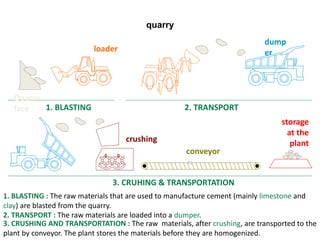
quarry 
loader 
1. BLASTING 2. TRANSPORT 
crushing 
conveyor 
3. CRUHING & TRANSPORTATION 
dump 
er 
storage 
at the 
plant 
Quarry 
face 
1. BLASTING : The raw materials that are used to manufacture cement (mainly limestone and 
clay) are blasted from the quarry. 
2. TRANSPORT : The raw materials are loaded into a dumper. 
3. CRUSHING AND TRANSPORTATION : The raw materials, after crushing, are transported to the 
plant by conveyor. The plant stores the materials before they are homogenized.
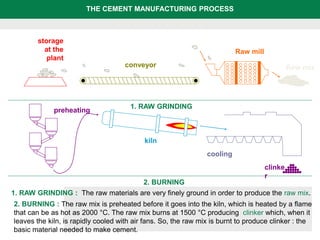
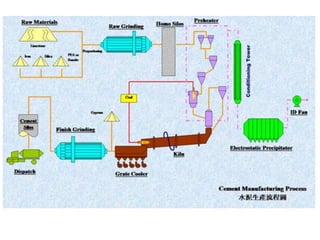
THE CEMENT MANUFACTURING PROCESS 
Raw grinding and burning 
Raw mill 
conveyor Raw mix 
1. RAW GRINDING 
kiln 
2. BURNING 
cooling 
storage 
at the 
plant 
preheating 
clinke 
r 
1. RAW GRINDING : The raw materials are very finely ground in order to produce the raw mix. 
2. BURNING : The raw mix is preheated before it goes into the kiln, which is heated by a flame 
that can be as hot as 2000 °C. The raw mix burns at 1500 °C producing clinker which, when it 
leaves the kiln, is rapidly cooled with air fans. So, the raw mix is burnt to produce clinker : the 
basic material needed to make cement.
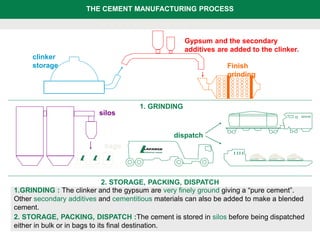
THE CEMENT MANUFACTURING PROCESS 
Grinding, storage, packing, dispatch 
1. GRINDING 
Gypsum and the secondary 
additives are added to the clinker. 
silos 
dispatch 
bags 
2. STORAGE, PACKING, DISPATCH 
clinker 
storage 
Finish 
grinding 
1.GRINDING : The clinker and the gypsum are very finely ground giving a “pure cement”. 
Other secondary additives and cementitious materials can also be added to make a blended 
cement. 
2. STORAGE, PACKING, DISPATCH :The cement is stored in silos before being dispatched 
either in bulk or in bags to its final destination.
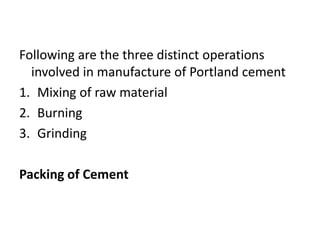
Following are the three distinct operations 
involved in manufacture of Portland cement 
1. Mixing of raw material 
2. Burning 
3. Grinding 
Packing of Cement
Test on Cement 
1. Chemical Composition 
2. Fineness of Cement 
3. Compressive Strength of Cement 
4. Tensile Strength of Cement 
5. Consistency of Cement 
6. Setting Time of Cement 
7. Soundness of Cement
Varieties of CEMENT 
1. Acid Resistance Cement 
2. Blast Furnace Cement 
3. Coloured Cement 
4. High Alumina Cement 
5. Pozzolana Cement 
6. Quick Setting Cement 
7. Rapid Hardening Cement 
8. Sulphate Resistance Cement 
9. White Cement

Cement manufacturing

  • 1.
    CEMENT Cement isa finely ground, usually grey colored mineral powder. When mixed with water, cement acts as a glue to bind together the sand, gravel and crushed stone to form concrete, the most widely used construction material in the world
  • 2.
    • Cement istypically made from limestone and clay or shale. These raw materials are extracted from the quarry crushed to a very fine powder and then blended in the correct proportions. • This blended raw material is called the 'raw feed' or 'kiln feed' and is heated in a rotary kiln where it reaches a temperature of about 14000 C to 15000 C. • The raw feed enters the kiln at the cool end and gradually passes down to the hot end, then falls out of the kiln and cools down.
  • 3.
    • The materialformed in the kiln is described as 'clinker' and is typically composed of rounded nodules between 1mm and 25mm across. • After cooling, the clinker may be stored temporarily in a clinker store, or it may pass directly to the cement mill. • The cement mill grinds the clinker to a fine powder. A small amount of gypsum - a form of calcium sulfate - is normally ground up with the clinker. The gypsum controls the setting properties of the cement when water is added.
  • 5.
    • The mostcommon raw rock types used in cement production are - Limestone (supplies the bulk of the lime) - Clay, marl or shale (supplies the bulk of the silica, alumina and ferric oxide) - Other supplementary materials such as sand, pulverized fuel ash (PFA), or ironstone to achieve the desired bulk composition
  • 6.
    Cement is madeby heating limestone (calcium carbonate) with small quantities of other materials (such as clay) to 1450 °C in a kiln, in a process known as CALCINATION, whereby a molecule of carbon dioxide is liberated from the calcium carbonate to form calcium oxide, or quicklime, which is then blended with the other materials that have been included in the mix. The resulting hard substance, called 'clinker', is then ground with a small amount of gypsum into a powder to make 'Ordinary Portland Cement', the most commonly used type of cement (often referred to as OPC).
  • 8.
    The approximate compositionof cement is • Calcium oxide (CaO) = 50 - 60% • Silica (SiO2) = 20 - 25% • Alumina (Al2O3) =5 - 10% • Magnesium oxide (MgO) = 2 - 3% • Ferric oxide (Fe2O3) = 1 - 2% • Sulphur trioxide (SO2) = 1 - 2%
  • 10.
    • Tricalcium Silicate- sets quickly and develops considerable strength in a few days. • Dicalcium Silicate - sets slowly and becomes strong after a month or so. • Tricalcium Aluminate - sets instantaneously in the presence of water. Cement's internal strength is mainly because of this. • Tetracalcium Aluminoferrite sets rapidly but not so fast as tricalcium aluminate
  • 11.
    Four Principle mineralsin OPC are designated as under C3 A – 4 to 14% C3 AF – 10 to 18% C3 S – 45 to 65% C2 S – 15 to 35%
  • 12.
    • On hydrationsilicates and aluminates of calcium get converted to their respective hydrated colloidal gels. • At the same time, hydrolysis precipitates calcium hydroxide and aluminium hydroxide. • This calcium hydroxide binds calcium silicate particles together. On the other hand, aluminium hydroxide fills the interstices (an intervening space) rendering the mass impervious (not affording passage to a fluid).
  • 13.
    Role of Gypsum- Gypsum reacts with tricalcium aluminate. The fast-setting tricalcium aluminate is removed to slow down the setting process. A quick setting will give rise to crystalline hydrated calcium aluminate. A slower setting yields the colloidal gel that imparts greater strength to the set mass. Thus gypsum helps in regulating the setting time of cement
  • 14.
    • Portland cementis a basic ingredient of concrete, mortar and most non-speciality grout. The most common use for Portland cement is in the production of concrete. Concrete is a composite material consisting of aggregate (gravel and sand), cement, and water. As a construction material, concrete can be cast in almost any shape desired, and once hardened, can become a structural (load bearing) element. Portland cement may be grey or white.
  • 15.
    Portland Cement Blends Portland cement blends are often available as inter-ground mixtures from cement manufacturers, but similar formulations are often also mixed from the ground components at the concrete mixing plant. • Portland blastfurnace cement contains up to 70 % ground granulated blast furnace slag, with the rest Portland clinker and a little gypsum. All compositions produce high ultimate strength, but as slag content is increased, early strength is reduced, while sulfate resistance increases and heat evolution diminishes. Used as an economic alternative to Portland sulfate-resisting and low-heat cements
  • 16.
    • Portland flyashcement contains up to 30 % fly ash. The fly ash is pozzolanic, so that ultimate strength is maintained. Because fly ash addition allows a lower concrete water content, early strength can also be maintained. Where good quality cheap fly ash is available, this can be an economic alternative to ordinary Portland cement. • Portland pozzolana cement includes fly ash cement, since fly ash is a pozzolana, but also includes cements made from other natural or artificial pozzolana. In countries where volcanic ashes are available (e.g. Italy, Chile, Mexico, the Philippines) these cements are often the most common form in use.
  • 17.
    • Portland silicafume cement. Addition of silica fume can yield exceptionally high strengths, and cements containing 5–20 % silica fume are occasionally produced. However, silica fume is more usually added to Portland cement at the concrete mixer.
  • 18.
    • White blendedcements may be made using white clinker and white supplementary materials such as high-purity metakaolin. • Colored cements are used for decorative purposes. In some standards, the addition of pigments to produce "colored Portland cement" is allowed. In other standards (e.g. ASTM), pigments are not allowed constituents of Portland cement, and colored cements are sold as "blended hydraulic cements".
  • 19.
    • Very finelyground cements are made from mixtures of cement with sand or with slag or other pozzolan type minerals that are extremely finely ground together. Such cements can have the same physical characteristics as normal cement but with 50% less cement particularly due to their increased surface area for the chemical reaction. Even with intensive grinding they can use up to 50% less energy to fabricate than ordinary Portland cements
  • 21.
    quarry loader 1.BLASTING 2. TRANSPORT crushing conveyor 3. CRUHING & TRANSPORTATION dump er storage at the plant Quarry face 1. BLASTING : The raw materials that are used to manufacture cement (mainly limestone and clay) are blasted from the quarry. 2. TRANSPORT : The raw materials are loaded into a dumper. 3. CRUSHING AND TRANSPORTATION : The raw materials, after crushing, are transported to the plant by conveyor. The plant stores the materials before they are homogenized.
  • 22.
    THE CEMENT MANUFACTURINGPROCESS Raw grinding and burning Raw mill conveyor Raw mix 1. RAW GRINDING kiln 2. BURNING cooling storage at the plant preheating clinke r 1. RAW GRINDING : The raw materials are very finely ground in order to produce the raw mix. 2. BURNING : The raw mix is preheated before it goes into the kiln, which is heated by a flame that can be as hot as 2000 °C. The raw mix burns at 1500 °C producing clinker which, when it leaves the kiln, is rapidly cooled with air fans. So, the raw mix is burnt to produce clinker : the basic material needed to make cement.
  • 23.
    THE CEMENT MANUFACTURINGPROCESS Grinding, storage, packing, dispatch 1. GRINDING Gypsum and the secondary additives are added to the clinker. silos dispatch bags 2. STORAGE, PACKING, DISPATCH clinker storage Finish grinding 1.GRINDING : The clinker and the gypsum are very finely ground giving a “pure cement”. Other secondary additives and cementitious materials can also be added to make a blended cement. 2. STORAGE, PACKING, DISPATCH :The cement is stored in silos before being dispatched either in bulk or in bags to its final destination.
  • 27.
    Following are thethree distinct operations involved in manufacture of Portland cement 1. Mixing of raw material 2. Burning 3. Grinding Packing of Cement
  • 28.
    Test on Cement 1. Chemical Composition 2. Fineness of Cement 3. Compressive Strength of Cement 4. Tensile Strength of Cement 5. Consistency of Cement 6. Setting Time of Cement 7. Soundness of Cement
  • 29.
    Varieties of CEMENT 1. Acid Resistance Cement 2. Blast Furnace Cement 3. Coloured Cement 4. High Alumina Cement 5. Pozzolana Cement 6. Quick Setting Cement 7. Rapid Hardening Cement 8. Sulphate Resistance Cement 9. White Cement