Presented By:Presented By:
Engineer LATIF HYDER WADHOEngineer LATIF HYDER WADHO
Mehran University of Engg: & Technology KhairpurMehran University of Engg: & Technology Khairpur
Civil Engineering MaterialsCivil Engineering Materials
11stst
Term 1Term 1stst
Year B.E.CivilYear B.E.Civil
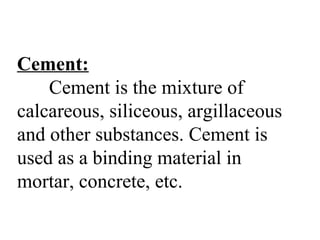
Cement:
Cement is the mixture of
calcareous, siliceous, argillaceous
and other substances. Cement is
used as a binding material in
mortar, concrete, etc.
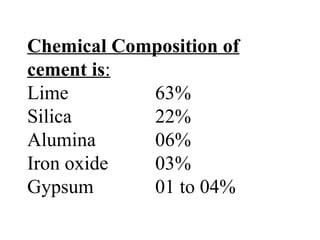
Chemical Composition of
cement is:
Lime 63%
Silica 22%
Alumina 06%
Iron oxide 03%
Gypsum 01 to 04%
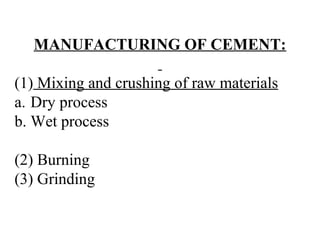
MANUFACTURING OF CEMENT:
(1) Mixing and crushing of raw materials
a. Dry process
b. Wet process
(2) Burning
(3) Grinding
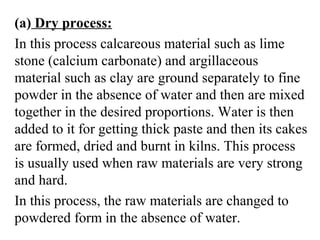
(a) Dry process:
In this process calcareous material such as lime
stone (calcium carbonate) and argillaceous
material such as clay are ground separately to fine
powder in the absence of water and then are mixed
together in the desired proportions. Water is then
added to it for getting thick paste and then its cakes
are formed, dried and burnt in kilns. This process
is usually used when raw materials are very strong
and hard.
In this process, the raw materials are changed to
powdered form in the absence of water.
(b) Wet process:
In this process, the raw materials are changed to
powdered form in the presence of water.
In this process, raw materials are pulverized by using
a Ball mill, which is a rotary steel cylinder with
hardened steel balls. When the mill rotates, steel
balls pulverize the raw materials which form slurry
(liquid mixture). The slurry is then passed into
storage tanks, where correct proportioning is done.
Proper composition of raw materials can be ensured
by using wet process than dry process. Corrected
slurry is then fed into rotary kiln for burning.
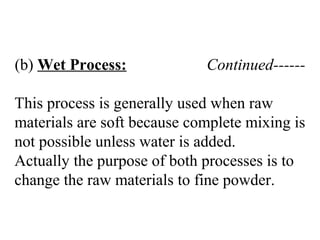
(b) Wet Process: Continued------
This process is generally used when raw
materials are soft because complete mixing is
not possible unless water is added.
Actually the purpose of both processes is to
change the raw materials to fine powder.
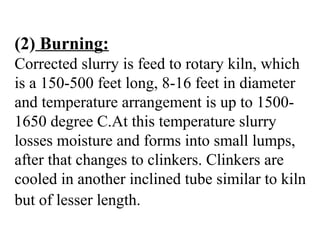
(2) Burning:
Corrected slurry is feed to rotary kiln, which
is a 150-500 feet long, 8-16 feet in diameter
and temperature arrangement is up to 1500-
1650 degree C.At this temperature slurry
losses moisture and forms into small lumps,
after that changes to clinkers. Clinkers are
cooled in another inclined tube similar to kiln
but of lesser length.
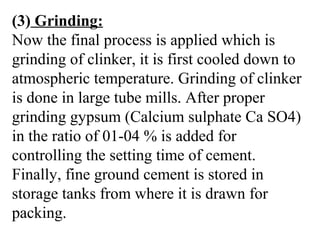
(3) Grinding:
Now the final process is applied which is
grinding of clinker, it is first cooled down to
atmospheric temperature. Grinding of clinker
is done in large tube mills. After proper
grinding gypsum (Calcium sulphate Ca SO4)
in the ratio of 01-04 % is added for
controlling the setting time of cement.
Finally, fine ground cement is stored in
storage tanks from where it is drawn for
packing.
TYPES OF CEMENT:
1. Ordinary Portland Cement
2. Sulphate Resisting Cement
3. Rapid Hardening Cement (or) High
Early Strength cement
4. Quick Setting Cement
5. Low Heat Cement
6. High Alumina Cement
7. Air Entraining Cement
8. White Cement
(1) ORDINARY PORTLAND CEMENT:
It is the variety of artificial cement. It is
called Portland cement because on
hardening (setting) its colour resembles to
rocks near Portland in England. It was first
of all introduced in 1824 by Joseph Asp din,
a bricklayer of Leeds, England.
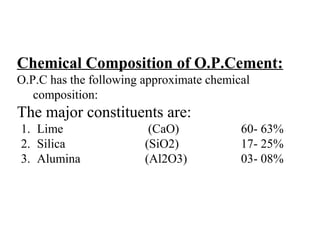
Chemical Composition of O.P.Cement:
O.P.C has the following approximate chemical
composition:
The major constituents are:
1. Lime (CaO) 60- 63%
2. Silica (SiO2) 17- 25%
3. Alumina (Al2O3) 03- 08%
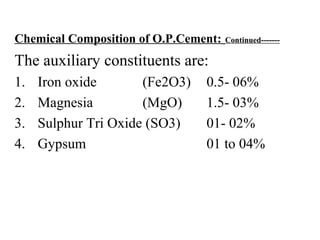
Chemical Composition of O.P.Cement: Continued-------
The auxiliary constituents are:
1. Iron oxide (Fe2O3) 0.5- 06%
2. Magnesia (MgO) 1.5- 03%
3. Sulphur Tri Oxide (SO3) 01- 02%
4. Gypsum 01 to 04%
Functions of Cement
Manufacturing
Constituents
(i) Lime (CaO):
Lime forms nearly two-third (2/3) of the
cement. Therefore sufficient quantity of the
lime must be in the raw materials for the
manufacturing of cement. Its proportion has
an important effect on the cement. Sufficient
quantity of lime forms di-calcium silicate
(C2SiO2) and tri-calcium silicate in the
manufacturing of cement.
Lime in excess, causes the cement to expand
and disintegrate.
(ii) Silica (SiO2):
The quantity of silica should be
enough to form di-calcium
silicate (C2SiO2) and tri-calcium
silicate in the manufacturing of
cement. Silica gives strength to
the cement. Silica in excess
causes the cement to set slowly.
(iii) Alumina (Al2O3):
Alumina supports to set quickly to
the cement. It also lowers the
clinkering temperature. Alumina in
excess, reduces the strength of the
cement.
(iv) Iron Oxide (Fe2O3):
Iron oxide gives colour to the
cement.
(v) Magnesia (MgO):
It also helps in giving colour to the cement.
Magnesium in excess makes the cement
unsound.
(vi) Calcium Sulphate (or) Gypsum (Ca
SO4) :
At the final stage of manufacturing,
gypsum is added to increase the setting of
cement.
(2) SULPHATE RESISTING CEMENT:
It is modified form of O.P.C and is specially
manufactured to resist the sulphates. In certain
regions/areas where water and soil may have alkaline
contents and O.P.C is liable to disintegrate, because of
unfavourable chemical reaction between cement and
water, S.R.C is used. This cement contains a low %age
of C3A not more than 05%.
This cement requires longer period of curing. This
cement is used for hydraulic structures in alkaline water
and for canal and water courses lining. It develops
strength slowly, but ultimately it is as strong as O.P.C.
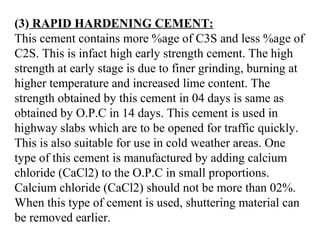
(3) RAPID HARDENING CEMENT:
This cement contains more %age of C3S and less %age of
C2S. This is infact high early strength cement. The high
strength at early stage is due to finer grinding, burning at
higher temperature and increased lime content. The
strength obtained by this cement in 04 days is same as
obtained by O.P.C in 14 days. This cement is used in
highway slabs which are to be opened for traffic quickly.
This is also suitable for use in cold weather areas. One
type of this cement is manufactured by adding calcium
chloride (CaCl2) to the O.P.C in small proportions.
Calcium chloride (CaCl2) should not be more than 02%.
When this type of cement is used, shuttering material can
be removed earlier.
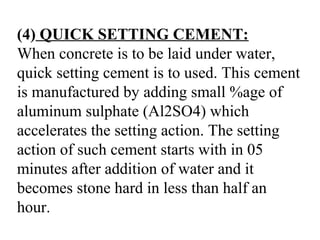
(4) QUICK SETTING CEMENT:
When concrete is to be laid under water,
quick setting cement is to used. This cement
is manufactured by adding small %age of
aluminum sulphate (Al2SO4) which
accelerates the setting action. The setting
action of such cement starts with in 05
minutes after addition of water and it
becomes stone hard in less than half an

hour.
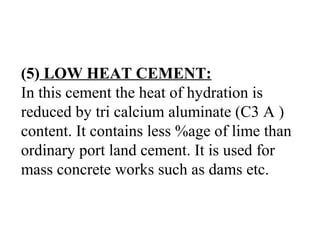
(5) LOW HEAT CEMENT:
In this cement the heat of hydration is
reduced by tri calcium aluminate (C3 A )
content. It contains less %age of lime than
ordinary port land cement. It is used for
mass concrete works such as dams etc.
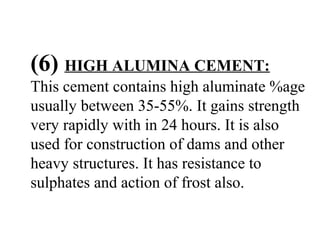
(6) HIGH ALUMINA CEMENT:
This cement contains high aluminate %age
usually between 35-55%. It gains strength
very rapidly with in 24 hours. It is also
used for construction of dams and other
heavy structures. It has resistance to
sulphates and action of frost also.
(7) AIR ENTRAINING CEMENT:
This type of cement was first of all developed in U.S.A
to produce such concrete which would have resistance
to weathering actions and particularly to the action of
frost. It is found that entrainment of air or gas bubbles
while applying cement, increases resistance to frost
action. Air entraining cement is produced by grinding
minute air entraining materials with clinker or the
materials are also added separately while making
concrete. Entrainment of air also improves workability
and durability. It is recommended that air contents
should be 03-04 % by volume.
Natural resins, fats, oils are used as air entraining
agents.
(8) WHITE CEMENT:
This cement is called snowcrete. As iron
oxide gives the grey colour to cement, it is
therefore necessary for white cement to keep
the content of iron oxide as low as possible.
Lime stone and china clay free from iron
oxide are suitable for its manufacturing. This
cement is costlier than O.P.C. It is mainly
used for architectural finishing in the
buildings.
TO CHECK THE QUALITY OF
CEMENT IN THE FILED:
1.Colour greenish grey.
2.One feels cool by thrusting one’s hand in
the cement bag.
3.It is smooth when rubbed in between
fingers.
4.A handful of cement thrown in a bucket of
water should float.
QUALITY TESTS OF CEMENT:
(1) Fineness Test,
(2) Consistency test / setting time test
(3) Setting Time Test
(4) Compressive strength test
(1) Fineness Test:
Finer cements react quicker with water and
develop early strength, though the ultimate
strength is not affected. However finer cements
increase the shrinkage and cracking of concrete.
The fineness is tested by:
By Sieve analysis:
Break with hands any lumps present in 100 grams
of cement placed in IS sieve No.9 and sieve it by
gentle motion of the wrist for 15 minutes
continuously. The residue when weighed should
not exceed 10 percent by weight of the cement
sample.
(2) Consistency Test /Setting Time Test :
This test is performed to determine the quantity
of water required to produce a cement paste of
standard or normal consistency.
Standard consistency of cement paste may be
defined as the consistency which permits the
Vicate’s plunger (10 mm, 40 to 50 mm in length)
to penetrate to a point 5 mm to 7 mm from the
bottom ( or 35 mm to 33 mm from top) of Vicat
mould. When the cement paste is tested within
the gauging time ( 3 to 5 minutes) after the
cement is thoroughly mixed with water.
Vicat apparatus is used for performing this test.
(3) Setting Time Test:
In cement hardening process, two instants are
very important, i.e. initial setting and final
setting.
Initial Setting Time:
The process elapsing between the time
when water is added to the cement and
the time at which the needle ( 1 mm
square or 1.13 mm dia., 50 mm in
length) fails to pierce the test block ( 80
mm dia. and 40 mm high) by about 5
mm, is known as Initial Setting Time of
Cement.
Final Setting Time:
The process elapsing between the time
when water is added to the cement and
the time at which a needle used for
testing final setting upon applying gently
to the surface of the test block, makes an
impression thereon, while the attachment
of the needle fails to do so, is known as
final Setting Time of Cement.
(4) Compressive Strength test of Cement:
This test is very important. In this test, three moulds
of (face area 50 cm2) are prepared and cured under
standard temperature conditions and each cube
tested by placing it between movable jaws of the
compressive strength testing machine. The rate of
increasing load is zero in the beginning and varies at
350 kg/cm2 per minute. The load at which the cube
gets fractured divided by the cross sectional area of
the cube, is the compressive strength of the cube.
The average of the compressive strengths of three
cubes is the required compressive strength of the
cement sample.
THE PLEASANT END

Cement

  • 2.
    Presented By:Presented By: EngineerLATIF HYDER WADHOEngineer LATIF HYDER WADHO Mehran University of Engg: & Technology KhairpurMehran University of Engg: & Technology Khairpur Civil Engineering MaterialsCivil Engineering Materials 11stst Term 1Term 1stst Year B.E.CivilYear B.E.Civil
  • 3.
    Cement: Cement is themixture of calcareous, siliceous, argillaceous and other substances. Cement is used as a binding material in mortar, concrete, etc.
  • 4.
    Chemical Composition of cementis: Lime 63% Silica 22% Alumina 06% Iron oxide 03% Gypsum 01 to 04%
  • 5.
    MANUFACTURING OF CEMENT: (1)Mixing and crushing of raw materials a. Dry process b. Wet process (2) Burning (3) Grinding
  • 6.
    (a) Dry process: Inthis process calcareous material such as lime stone (calcium carbonate) and argillaceous material such as clay are ground separately to fine powder in the absence of water and then are mixed together in the desired proportions. Water is then added to it for getting thick paste and then its cakes are formed, dried and burnt in kilns. This process is usually used when raw materials are very strong and hard. In this process, the raw materials are changed to powdered form in the absence of water.
  • 7.
    (b) Wet process: Inthis process, the raw materials are changed to powdered form in the presence of water. In this process, raw materials are pulverized by using a Ball mill, which is a rotary steel cylinder with hardened steel balls. When the mill rotates, steel balls pulverize the raw materials which form slurry (liquid mixture). The slurry is then passed into storage tanks, where correct proportioning is done. Proper composition of raw materials can be ensured by using wet process than dry process. Corrected slurry is then fed into rotary kiln for burning.
  • 8.
    (b) Wet Process:Continued------ This process is generally used when raw materials are soft because complete mixing is not possible unless water is added. Actually the purpose of both processes is to change the raw materials to fine powder.
  • 9.
    (2) Burning: Corrected slurryis feed to rotary kiln, which is a 150-500 feet long, 8-16 feet in diameter and temperature arrangement is up to 1500- 1650 degree C.At this temperature slurry losses moisture and forms into small lumps, after that changes to clinkers. Clinkers are cooled in another inclined tube similar to kiln but of lesser length.
  • 10.
    (3) Grinding: Now thefinal process is applied which is grinding of clinker, it is first cooled down to atmospheric temperature. Grinding of clinker is done in large tube mills. After proper grinding gypsum (Calcium sulphate Ca SO4) in the ratio of 01-04 % is added for controlling the setting time of cement. Finally, fine ground cement is stored in storage tanks from where it is drawn for packing.
  • 11.
    TYPES OF CEMENT: 1.Ordinary Portland Cement 2. Sulphate Resisting Cement 3. Rapid Hardening Cement (or) High Early Strength cement 4. Quick Setting Cement 5. Low Heat Cement 6. High Alumina Cement 7. Air Entraining Cement 8. White Cement
  • 12.
    (1) ORDINARY PORTLANDCEMENT: It is the variety of artificial cement. It is called Portland cement because on hardening (setting) its colour resembles to rocks near Portland in England. It was first of all introduced in 1824 by Joseph Asp din, a bricklayer of Leeds, England.
  • 13.
    Chemical Composition ofO.P.Cement: O.P.C has the following approximate chemical composition: The major constituents are: 1. Lime (CaO) 60- 63% 2. Silica (SiO2) 17- 25% 3. Alumina (Al2O3) 03- 08%
  • 14.
    Chemical Composition ofO.P.Cement: Continued------- The auxiliary constituents are: 1. Iron oxide (Fe2O3) 0.5- 06% 2. Magnesia (MgO) 1.5- 03% 3. Sulphur Tri Oxide (SO3) 01- 02% 4. Gypsum 01 to 04%
  • 15.
  • 16.
    (i) Lime (CaO): Limeforms nearly two-third (2/3) of the cement. Therefore sufficient quantity of the lime must be in the raw materials for the manufacturing of cement. Its proportion has an important effect on the cement. Sufficient quantity of lime forms di-calcium silicate (C2SiO2) and tri-calcium silicate in the manufacturing of cement. Lime in excess, causes the cement to expand and disintegrate.
  • 17.
    (ii) Silica (SiO2): Thequantity of silica should be enough to form di-calcium silicate (C2SiO2) and tri-calcium silicate in the manufacturing of cement. Silica gives strength to the cement. Silica in excess causes the cement to set slowly.
  • 18.
    (iii) Alumina (Al2O3): Aluminasupports to set quickly to the cement. It also lowers the clinkering temperature. Alumina in excess, reduces the strength of the cement.
  • 19.
    (iv) Iron Oxide(Fe2O3): Iron oxide gives colour to the cement.
  • 20.
    (v) Magnesia (MgO): Italso helps in giving colour to the cement. Magnesium in excess makes the cement unsound.
  • 21.
    (vi) Calcium Sulphate(or) Gypsum (Ca SO4) : At the final stage of manufacturing, gypsum is added to increase the setting of cement.
  • 22.
    (2) SULPHATE RESISTINGCEMENT: It is modified form of O.P.C and is specially manufactured to resist the sulphates. In certain regions/areas where water and soil may have alkaline contents and O.P.C is liable to disintegrate, because of unfavourable chemical reaction between cement and water, S.R.C is used. This cement contains a low %age of C3A not more than 05%. This cement requires longer period of curing. This cement is used for hydraulic structures in alkaline water and for canal and water courses lining. It develops strength slowly, but ultimately it is as strong as O.P.C.
  • 23.
    (3) RAPID HARDENINGCEMENT: This cement contains more %age of C3S and less %age of C2S. This is infact high early strength cement. The high strength at early stage is due to finer grinding, burning at higher temperature and increased lime content. The strength obtained by this cement in 04 days is same as obtained by O.P.C in 14 days. This cement is used in highway slabs which are to be opened for traffic quickly. This is also suitable for use in cold weather areas. One type of this cement is manufactured by adding calcium chloride (CaCl2) to the O.P.C in small proportions. Calcium chloride (CaCl2) should not be more than 02%. When this type of cement is used, shuttering material can be removed earlier.
  • 24.
    (4) QUICK SETTINGCEMENT: When concrete is to be laid under water, quick setting cement is to used. This cement is manufactured by adding small %age of aluminum sulphate (Al2SO4) which accelerates the setting action. The setting action of such cement starts with in 05 minutes after addition of water and it becomes stone hard in less than half an hour.
  • 25.
    (5) LOW HEATCEMENT: In this cement the heat of hydration is reduced by tri calcium aluminate (C3 A ) content. It contains less %age of lime than ordinary port land cement. It is used for mass concrete works such as dams etc.
  • 26.
    (6) HIGH ALUMINACEMENT: This cement contains high aluminate %age usually between 35-55%. It gains strength very rapidly with in 24 hours. It is also used for construction of dams and other heavy structures. It has resistance to sulphates and action of frost also.
  • 27.
    (7) AIR ENTRAININGCEMENT: This type of cement was first of all developed in U.S.A to produce such concrete which would have resistance to weathering actions and particularly to the action of frost. It is found that entrainment of air or gas bubbles while applying cement, increases resistance to frost action. Air entraining cement is produced by grinding minute air entraining materials with clinker or the materials are also added separately while making concrete. Entrainment of air also improves workability and durability. It is recommended that air contents should be 03-04 % by volume. Natural resins, fats, oils are used as air entraining agents.
  • 28.
    (8) WHITE CEMENT: Thiscement is called snowcrete. As iron oxide gives the grey colour to cement, it is therefore necessary for white cement to keep the content of iron oxide as low as possible. Lime stone and china clay free from iron oxide are suitable for its manufacturing. This cement is costlier than O.P.C. It is mainly used for architectural finishing in the buildings.
  • 29.
    TO CHECK THEQUALITY OF CEMENT IN THE FILED: 1.Colour greenish grey. 2.One feels cool by thrusting one’s hand in the cement bag. 3.It is smooth when rubbed in between fingers. 4.A handful of cement thrown in a bucket of water should float.
  • 30.
    QUALITY TESTS OFCEMENT: (1) Fineness Test, (2) Consistency test / setting time test (3) Setting Time Test (4) Compressive strength test
  • 31.
    (1) Fineness Test: Finercements react quicker with water and develop early strength, though the ultimate strength is not affected. However finer cements increase the shrinkage and cracking of concrete. The fineness is tested by: By Sieve analysis: Break with hands any lumps present in 100 grams of cement placed in IS sieve No.9 and sieve it by gentle motion of the wrist for 15 minutes continuously. The residue when weighed should not exceed 10 percent by weight of the cement sample.
  • 32.
    (2) Consistency Test/Setting Time Test : This test is performed to determine the quantity of water required to produce a cement paste of standard or normal consistency. Standard consistency of cement paste may be defined as the consistency which permits the Vicate’s plunger (10 mm, 40 to 50 mm in length) to penetrate to a point 5 mm to 7 mm from the bottom ( or 35 mm to 33 mm from top) of Vicat mould. When the cement paste is tested within the gauging time ( 3 to 5 minutes) after the cement is thoroughly mixed with water. Vicat apparatus is used for performing this test.
  • 33.
    (3) Setting TimeTest: In cement hardening process, two instants are very important, i.e. initial setting and final setting.
  • 34.
    Initial Setting Time: Theprocess elapsing between the time when water is added to the cement and the time at which the needle ( 1 mm square or 1.13 mm dia., 50 mm in length) fails to pierce the test block ( 80 mm dia. and 40 mm high) by about 5 mm, is known as Initial Setting Time of Cement.
  • 35.
    Final Setting Time: Theprocess elapsing between the time when water is added to the cement and the time at which a needle used for testing final setting upon applying gently to the surface of the test block, makes an impression thereon, while the attachment of the needle fails to do so, is known as final Setting Time of Cement.
  • 36.
    (4) Compressive Strengthtest of Cement: This test is very important. In this test, three moulds of (face area 50 cm2) are prepared and cured under standard temperature conditions and each cube tested by placing it between movable jaws of the compressive strength testing machine. The rate of increasing load is zero in the beginning and varies at 350 kg/cm2 per minute. The load at which the cube gets fractured divided by the cross sectional area of the cube, is the compressive strength of the cube. The average of the compressive strengths of three cubes is the required compressive strength of the cement sample.
  • 37.