Cellular
Technology
Overview
CFLEE - 20160308
Contents
• 1. Cellular Technology Roadmap
• 2. Cellular Architecture
• 3. Long Term Evolution (LTE)
• 4. Universal Mobile Telecommunication System
(UMTS)
1 . C E L L U L A R T E C H N O L O G Y
R O A D M A P
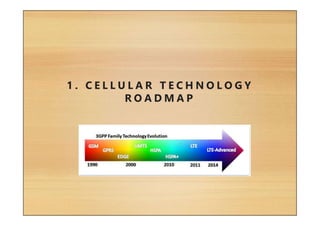
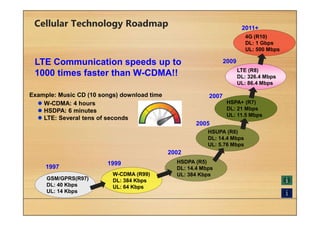
Cellular Technology Roadmap
W-CDMA (R99)
DL: 384 Kbps
UL: 64 Kbps
HSDPA (R5)
DL: 14.4 Mbps
UL: 384 Kbps
HSPA+ (R7)
DL: 21 Mbps
UL: 11.5 Mbps
LTE (R8)
DL: 326.4 Mbps
UL: 86.4 Mbps
1999
HSUPA (R6)
DL: 14.4 Mbps
UL: 5.76 Mbps
2002
2005
2007
2009LTE Communication speeds up to
1000 times faster than W-CDMA!!
 W-CDMA: 4 hours
 HSDPA: 6 minutes
 LTE: Several tens of seconds
Example: Music CD (10 songs) download time
4G (R10)
DL: 1 Gbps
UL: 500 Mbps
2011+
GSM/GPRS(R97)
DL: 40 Kbps
UL: 14 Kbps
1997
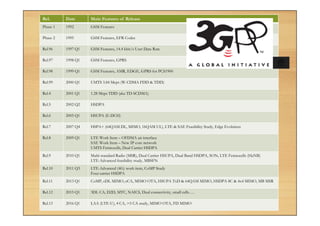
Rel. Date Main Features of Release
Phase 1 1992 GSM Features
Phase 2 1995 GSM Features, EFR Codec
Rel.96 1997 Q1 GSM Features, 14.4 kbit/s User Data Rate
Rel.97 1998 Q1 GSM Features, GPRS
Rel.98 1999 Q1 GSM Features, AMR, EDGE, GPRS for PCS1900
Rel.99 2000 Q1 UMTS 3.84 Mcps (W-CDMA FDD & TDD)
Rel.4 2001 Q1 1.28 Mcps TDD (aka TD-SCDMA)
Rel.5 2002 Q2 HSDPA
Rel.6 2005 Q1 HSUPA (E-DCH)
Rel.7 2007 Q4 HSPA+ (64QAM DL, MIMO, 16QAM UL), LTE & SAE Feasibility Study, Edge Evolution
Rel.8 2009 Q1 LTE Work Item – OFDMA air interface
SAE Work Item – New IP core network
UMTS Femtocells, Dual Carrier HSDPA
Rel.9 2010 Q1 Multi-standard Radio (MSR), Dual Carrier HSUPA, Dual Band HSDPA, SON, LTE Femtocells (HeNB)
LTE-Advanced feasibility study, MBSFN
Rel.10 2011 Q3 LTE-Advanced (4G) work item, CoMP Study
Four carrier HSDPA
Rel.11 2013 Q1 CoMP, eDL MIMO, eCA, MIMO OTA, HSUPA TxD & 64QAM MIMO, HSDPA 8C & 4x4 MIMO, MB MSR
Rel.12 2015 Q1 3DL CA, D2D, MTC, NAICS, Dual connectivity, small cells….
Rel.13 2016 Q1 LAA (LTE-U), 4 CA, >5 CA study, MIMO OTA, FD MIMO
2 . C E L L U L A R A R C H I T E C T U R E
Legacy Architecture
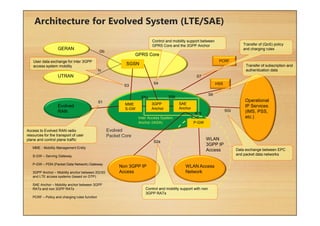
Architecture for Evolved System (LTE/SAE)
Evolved
Packet Core
GPRS Core
WLAN Access
Network
Inter Access System
Anchor (IASA)
Non 3GPP IP
Access
Evolved
RAN
UTRAN
GERAN
Operational
IP Services
(IMS, PSS,
etc.)
SGSN
3GPP
Anchor
SAE
Anchor
MME
S-GW
P-GW
WLAN
3GPP IP
Access
HSS
PCRF
Gb
Iu
S1
S3
S4
S7
S6
SGi
S2a
S5a S5b
S2b
MME - Mobility Management Entity
S-GW – Serving Gateway
P-GW – PDN (Packet Data Network) Gateway
3GPP Anchor – Mobility anchor between 2G/3G
and LTE access systems (based on GTP)
SAE Anchor – Mobility anchor between 3GPP
RATs and non 3GPP RATs
PCRF – Policy and charging rules function
User data exchange for inter 3GPP
access system mobility
Access to Evolved RAN radio
resources for the transport of user
plane and control plane traffic
Control and mobility support between
GPRS Core and the 3GPP Anchor Transfer of (QoS) policy
and charging rules
Transfer of subscription and
authentication data
Data exchange between EPC
and packet data networks
Control and mobility support with non
3GPP RATs
3 . L O N G T E R M E V O L U T I O N ( L T E )
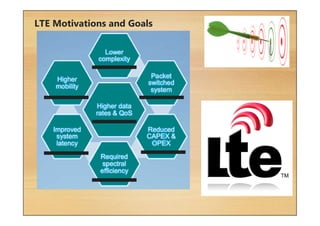
LTE Motivations and Goals
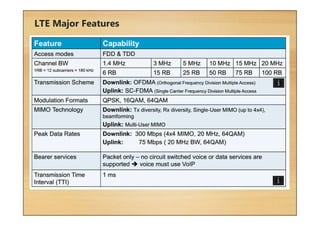
LTE Major Features
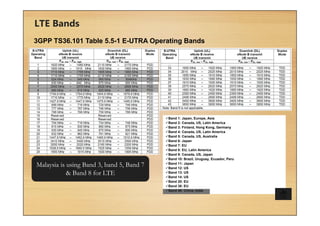
LTE Bands
Band 1: Japan, Europe, Asia
Band 2: Canada, US, Latin America
Band 3: Finland, Hong Kong, Germany
Band 4: Canada, US, Latin America
Band 5: Canada, US, Australia
Band 6: Japan
Band 7: EU
Band 8: EU, Latin America
Band 9: Canada, US, Japan
Band 10: Brazil, Uruguay, Ecuador, Peru
Band 11: Japan
Band 12: US
Band 13: US
Band 14: US
Band 20: EU
Band 38: EU
Band 40: China, India
3GPP TS36.101 Table 5.5-1 E-UTRA Operating Bands
Malaysia is using Band 3, band 5, Band 7
& Band 8 for LTE
LTE Key Technologies
OFDMA (Downlink Signal)
SC-FDMA (Uplink Signal)
MIMO
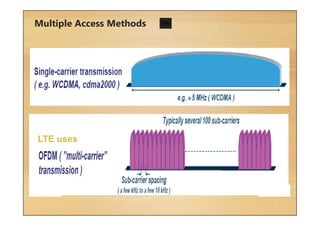
Multiple Access Methods
LTE uses
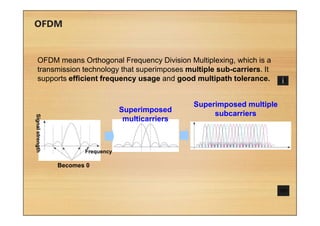
OFDM
OFDM means Orthogonal Frequency Division Multiplexing, which is a
transmission technology that superimposes multiple sub-carriers. It
supports efficient frequency usage and good multipath tolerance.
Becomes 0
Signalstrength
Frequency
Superimposed
multicarriers
Superimposed multiple
subcarriers
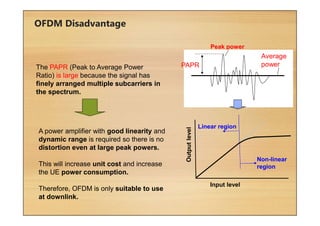
OFDM Disadvantage
The PAPR (Peak to Average Power
Ratio) is large because the signal has
finely arranged multiple subcarriers in
the spectrum.
A power amplifier with good linearity and
dynamic range is required so there is no
distortion even at large peak powers.
This will increase unit cost and increase
the UE power consumption.
Therefore, OFDM is only suitable to use
at downlink.
Peak power
PAPR
Average
power
Non-linear
region
Linear region
Input level
Outputlevel
OFDMA
: User A
: User B
: User C
Symbol (time)
Subcarrier
Sub-carrier
Symbol (time)
OFDMAOFDM
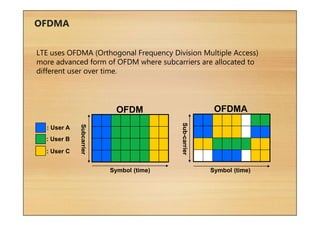
LTE uses OFDMA (Orthogonal Frequency Division Multiple Access)
more advanced form of OFDM where subcarriers are allocated to
different user over time.
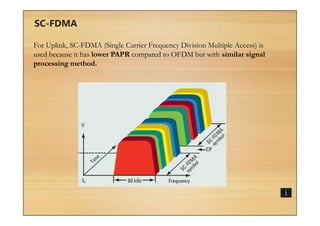
SC-FDMA
For Uplink, SC-FDMA (Single Carrier Frequency Division Multiple Access) is
used because it has lower PAPR compared to OFDM but with similar signal
processing method.
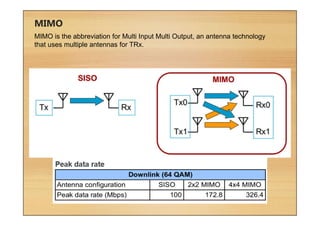
MIMO
MIMO is the abbreviation for Multi Input Multi Output, an antenna technology
that uses multiple antennas for TRx.
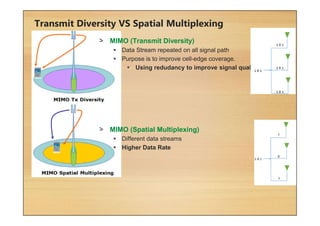
Transmit Diversity VS Spatial Multiplexing
MIMO (Transmit Diversity)
 Data Stream repeated on all signal path
 Purpose is to improve cell-edge coverage.
 Using redudancy to improve signal quality
MIMO (Spatial Multiplexing)
 Different data streams
 Higher Data Rate
Beyond LTE: LTE-Advanced (LTE-A)
The next step beyond LTE is LTE-Advanced
Next technology wave: “true” 4G, conforms with
ITU’s IMT-Advanced requirements
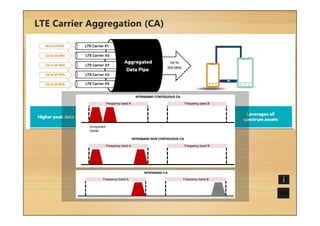
LTE Carrier Aggregation (CA)
4 . U N I V E R S A L M O B I L E
T E L E C O M M U N I C A T I O N S Y S T E M
( U M T S )
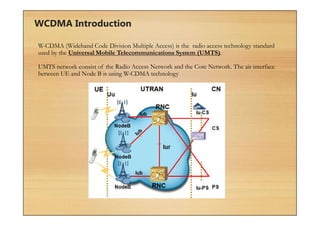
WCDMA Introduction
W-CDMA (Wideband Code Division Multiple Access) is the radio access technology standard
used by the Universal Mobile Telecommunications System (UMTS).
UMTS network consist of the Radio Access Network and the Core Network. The air interface
between UE and Node B is using W-CDMA technology
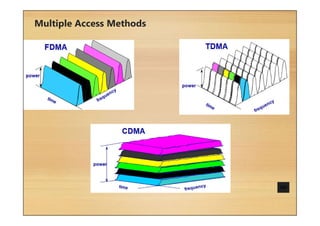
Multiple Access Methods
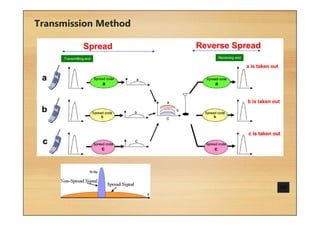
Transmission Method
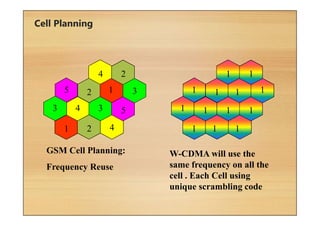
Cell Planning
1
1
2
2
2
3 3
3
4
4
4
5
5
GSM Cell Planning:
Frequency Reuse
1 1 1
1 1 1 1
1 1 1 1
1 1
W-CDMA will use the
same frequency on all the
cell . Each Cell using
unique scrambling code
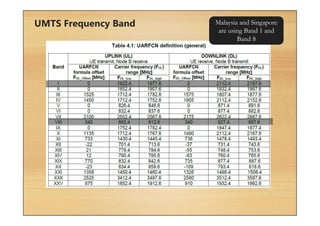
UMTS Frequency Band Malaysia and Singapore
are using Band 1 and
Band 8
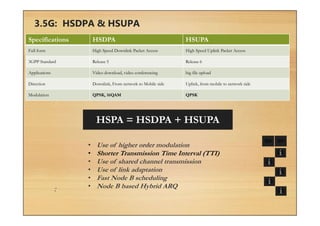
3.5G: HSDPA & HSUPA
Specifications HSDPA HSUPA
Full form High Speed Downlink Packet Access High Speed Uplink Packet Access
3GPP Standard Release 5 Release 6
Applications Video download, video conferencing big file upload
Direction Downlink, From network to Mobile side Uplink, from mobile to network side
Modulation QPSK, 16QAM QPSK
HSPA = HSDPA + HSUPA
• Use of higher order modulation
• Shorter Transmission Time Interval (TTI)
• Use of shared channel transmission
• Use of link adaptation
• Fast Node B scheduling
• Node B based Hybrid ARQ:
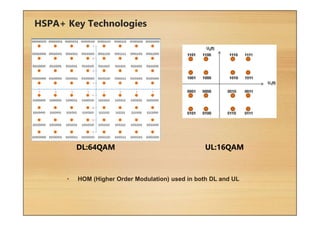
HSPA+ Key Technologies
• HOM (Higher Order Modulation) used in both DL and UL
DL:64QAM UL:16QAM
Thank you!
CFLEE - 20160308

Cellular technology overview

  • 1.
  • 2.
    Contents • 1. CellularTechnology Roadmap • 2. Cellular Architecture • 3. Long Term Evolution (LTE) • 4. Universal Mobile Telecommunication System (UMTS)
  • 3.
    1 . CE L L U L A R T E C H N O L O G Y R O A D M A P
  • 4.
    Cellular Technology Roadmap W-CDMA(R99) DL: 384 Kbps UL: 64 Kbps HSDPA (R5) DL: 14.4 Mbps UL: 384 Kbps HSPA+ (R7) DL: 21 Mbps UL: 11.5 Mbps LTE (R8) DL: 326.4 Mbps UL: 86.4 Mbps 1999 HSUPA (R6) DL: 14.4 Mbps UL: 5.76 Mbps 2002 2005 2007 2009LTE Communication speeds up to 1000 times faster than W-CDMA!!  W-CDMA: 4 hours  HSDPA: 6 minutes  LTE: Several tens of seconds Example: Music CD (10 songs) download time 4G (R10) DL: 1 Gbps UL: 500 Mbps 2011+ GSM/GPRS(R97) DL: 40 Kbps UL: 14 Kbps 1997
  • 5.
    Rel. Date MainFeatures of Release Phase 1 1992 GSM Features Phase 2 1995 GSM Features, EFR Codec Rel.96 1997 Q1 GSM Features, 14.4 kbit/s User Data Rate Rel.97 1998 Q1 GSM Features, GPRS Rel.98 1999 Q1 GSM Features, AMR, EDGE, GPRS for PCS1900 Rel.99 2000 Q1 UMTS 3.84 Mcps (W-CDMA FDD & TDD) Rel.4 2001 Q1 1.28 Mcps TDD (aka TD-SCDMA) Rel.5 2002 Q2 HSDPA Rel.6 2005 Q1 HSUPA (E-DCH) Rel.7 2007 Q4 HSPA+ (64QAM DL, MIMO, 16QAM UL), LTE & SAE Feasibility Study, Edge Evolution Rel.8 2009 Q1 LTE Work Item – OFDMA air interface SAE Work Item – New IP core network UMTS Femtocells, Dual Carrier HSDPA Rel.9 2010 Q1 Multi-standard Radio (MSR), Dual Carrier HSUPA, Dual Band HSDPA, SON, LTE Femtocells (HeNB) LTE-Advanced feasibility study, MBSFN Rel.10 2011 Q3 LTE-Advanced (4G) work item, CoMP Study Four carrier HSDPA Rel.11 2013 Q1 CoMP, eDL MIMO, eCA, MIMO OTA, HSUPA TxD & 64QAM MIMO, HSDPA 8C & 4x4 MIMO, MB MSR Rel.12 2015 Q1 3DL CA, D2D, MTC, NAICS, Dual connectivity, small cells…. Rel.13 2016 Q1 LAA (LTE-U), 4 CA, >5 CA study, MIMO OTA, FD MIMO
  • 6.
    2 . CE L L U L A R A R C H I T E C T U R E
  • 7.
  • 8.
    Architecture for EvolvedSystem (LTE/SAE) Evolved Packet Core GPRS Core WLAN Access Network Inter Access System Anchor (IASA) Non 3GPP IP Access Evolved RAN UTRAN GERAN Operational IP Services (IMS, PSS, etc.) SGSN 3GPP Anchor SAE Anchor MME S-GW P-GW WLAN 3GPP IP Access HSS PCRF Gb Iu S1 S3 S4 S7 S6 SGi S2a S5a S5b S2b MME - Mobility Management Entity S-GW – Serving Gateway P-GW – PDN (Packet Data Network) Gateway 3GPP Anchor – Mobility anchor between 2G/3G and LTE access systems (based on GTP) SAE Anchor – Mobility anchor between 3GPP RATs and non 3GPP RATs PCRF – Policy and charging rules function User data exchange for inter 3GPP access system mobility Access to Evolved RAN radio resources for the transport of user plane and control plane traffic Control and mobility support between GPRS Core and the 3GPP Anchor Transfer of (QoS) policy and charging rules Transfer of subscription and authentication data Data exchange between EPC and packet data networks Control and mobility support with non 3GPP RATs
  • 9.
    3 . LO N G T E R M E V O L U T I O N ( L T E )
  • 10.
  • 11.
  • 12.
    LTE Bands Band 1:Japan, Europe, Asia Band 2: Canada, US, Latin America Band 3: Finland, Hong Kong, Germany Band 4: Canada, US, Latin America Band 5: Canada, US, Australia Band 6: Japan Band 7: EU Band 8: EU, Latin America Band 9: Canada, US, Japan Band 10: Brazil, Uruguay, Ecuador, Peru Band 11: Japan Band 12: US Band 13: US Band 14: US Band 20: EU Band 38: EU Band 40: China, India 3GPP TS36.101 Table 5.5-1 E-UTRA Operating Bands Malaysia is using Band 3, band 5, Band 7 & Band 8 for LTE
  • 13.
    LTE Key Technologies OFDMA(Downlink Signal) SC-FDMA (Uplink Signal) MIMO
  • 14.
  • 15.
    OFDM OFDM means OrthogonalFrequency Division Multiplexing, which is a transmission technology that superimposes multiple sub-carriers. It supports efficient frequency usage and good multipath tolerance. Becomes 0 Signalstrength Frequency Superimposed multicarriers Superimposed multiple subcarriers
  • 16.
    OFDM Disadvantage The PAPR(Peak to Average Power Ratio) is large because the signal has finely arranged multiple subcarriers in the spectrum. A power amplifier with good linearity and dynamic range is required so there is no distortion even at large peak powers. This will increase unit cost and increase the UE power consumption. Therefore, OFDM is only suitable to use at downlink. Peak power PAPR Average power Non-linear region Linear region Input level Outputlevel
  • 17.
    OFDMA : User A :User B : User C Symbol (time) Subcarrier Sub-carrier Symbol (time) OFDMAOFDM LTE uses OFDMA (Orthogonal Frequency Division Multiple Access) more advanced form of OFDM where subcarriers are allocated to different user over time.
  • 18.
    SC-FDMA For Uplink, SC-FDMA(Single Carrier Frequency Division Multiple Access) is used because it has lower PAPR compared to OFDM but with similar signal processing method.
  • 19.
    MIMO MIMO is theabbreviation for Multi Input Multi Output, an antenna technology that uses multiple antennas for TRx.
  • 20.
    Transmit Diversity VSSpatial Multiplexing MIMO (Transmit Diversity)  Data Stream repeated on all signal path  Purpose is to improve cell-edge coverage.  Using redudancy to improve signal quality MIMO (Spatial Multiplexing)  Different data streams  Higher Data Rate
  • 21.
    Beyond LTE: LTE-Advanced(LTE-A) The next step beyond LTE is LTE-Advanced Next technology wave: “true” 4G, conforms with ITU’s IMT-Advanced requirements
  • 22.
  • 23.
    4 . UN I V E R S A L M O B I L E T E L E C O M M U N I C A T I O N S Y S T E M ( U M T S )
  • 24.
    WCDMA Introduction W-CDMA (WidebandCode Division Multiple Access) is the radio access technology standard used by the Universal Mobile Telecommunications System (UMTS). UMTS network consist of the Radio Access Network and the Core Network. The air interface between UE and Node B is using W-CDMA technology
  • 25.
  • 26.
  • 27.
    Cell Planning 1 1 2 2 2 3 3 3 4 4 4 5 5 GSMCell Planning: Frequency Reuse 1 1 1 1 1 1 1 1 1 1 1 1 1 W-CDMA will use the same frequency on all the cell . Each Cell using unique scrambling code
  • 28.
    UMTS Frequency BandMalaysia and Singapore are using Band 1 and Band 8
  • 29.
    3.5G: HSDPA &HSUPA Specifications HSDPA HSUPA Full form High Speed Downlink Packet Access High Speed Uplink Packet Access 3GPP Standard Release 5 Release 6 Applications Video download, video conferencing big file upload Direction Downlink, From network to Mobile side Uplink, from mobile to network side Modulation QPSK, 16QAM QPSK HSPA = HSDPA + HSUPA • Use of higher order modulation • Shorter Transmission Time Interval (TTI) • Use of shared channel transmission • Use of link adaptation • Fast Node B scheduling • Node B based Hybrid ARQ:
  • 30.
    HSPA+ Key Technologies •HOM (Higher Order Modulation) used in both DL and UL DL:64QAM UL:16QAM
  • 31.