GLOBAL SYSTEM
FOR MOBILE (GSM)


             PRESENTED BY:
             DHEERAJ RAJA
               ECE 4th YEAR
What ?
                         GSM
         GSM: Global System for Mobile Communications.
         Formerly: Group Special Mobile


When ?
         1982: GSM created to set standard.
         1988: Industrial development started.
         1991: First system deployed.


Why ?
         Higher digital voice quality.
         Low cost alternatives for making calls and sms.
GSM
ARCHITECTURE
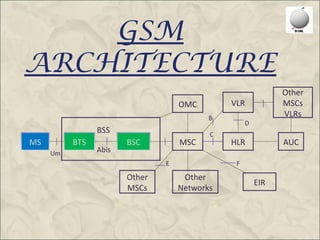
                                                             Other
                                   OMC        VLR            MSCs
                                          B
                                                             VLRs
                                                   D
                BSS            A          C
MS        BTS          BSC         MSC        HLR            AUC
     Um         Abis
                               E               F

                       Other        Other
                                                       EIR
                       MSCs        Networks
MOBILE STATION
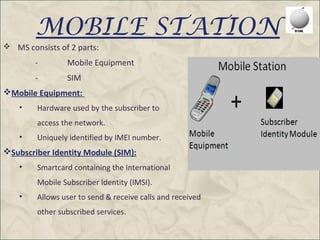
 MS consists of 2 parts:

        -       Mobile Equipment
        -       SIM
Mobile Equipment:
    •   Hardware used by the subscriber to
        access the network.
    •   Uniquely identified by IMEI number.
Subscriber Identity Module (SIM):
    •   Smartcard containing the International
        Mobile Subscriber Identity (IMSI).
    •   Allows user to send & receive calls and received
        other subscribed services.
BASE STATION SUB-
            SYSTEM (BSS)
   BSS connects the Mobile Station with MSC through A-interface.
   In charge of Transmission & Reception.
   Consists of 2 parts:
      -       Base Transceiver Station (BTS)
      -       Base Station Controller (BSC)
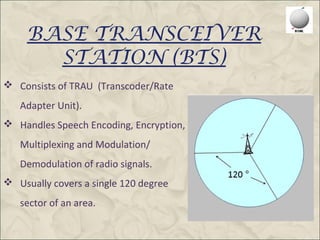
BASE TRANSCEIVER
       STATION (BTS)
 Consists of TRAU (Transcoder/Rate
   Adapter Unit).
 Handles Speech Encoding, Encryption,
   Multiplexing and Modulation/
   Demodulation of radio signals.
 Usually covers a single 120 degree
   sector of an area.
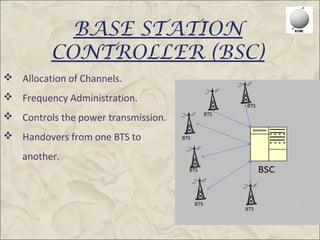
BASE STATION
          CONTROLLER (BSC)
 Allocation of Channels.
 Frequency Administration.
 Controls the power transmission.
 Handovers from one BTS to
    another.
NETWORK & SWITCHING
      SUB-SYSTEM (NSS)
 Manages communication between the mobile user with the other
    users.
 Consists of different components as:
      -      Mobile Switching Centre (MSC)
      -      Gateway Mobile Switching Centre (GMSC)
      -      HLR & VLR
      -      AuC & EIR
MOBILE SWITCHING
       CENTRE (MSC)
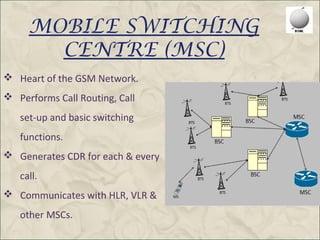
 Heart of the GSM Network.
 Performs Call Routing, Call
   set-up and basic switching
   functions.
 Generates CDR for each & every
   call.
 Communicates with HLR, VLR &
   other MSCs.
GATEWAY MOBILE
SWITCHING CENTRE (GMSC)
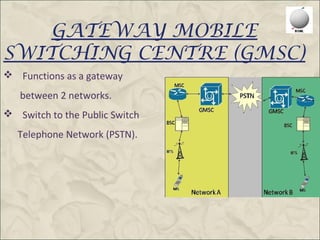
 Functions as a gateway
   between 2 networks.
 Switch to the Public Switch
   Telephone Network (PSTN).
HLR &VLR
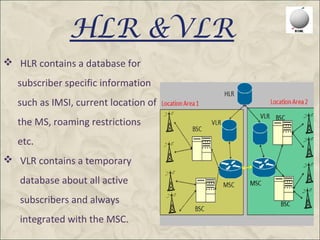
 HLR contains a database for
   subscriber specific information
   such as IMSI, current location of
   the MS, roaming restrictions
   etc.
 VLR contains a temporary
   database about all active
   subscribers and always
   integrated with the MSC.
EIR &AUC
 EIR is a database that keeps tracks of handsets on the Network
   using the IMEI number. It contains 3 lists:
       - White List
       - Grey List
       - Black List
 AuC handles the authentication and encryption task for the
   Network. It is mainly used for security reasons.
OPERATION &
          MAINTENANCE
          CENTRE (OMC)
 All the networks elements are connected to OMC.
 Keeps records of all the faults occurred.
 Provides a network overview and support the maintenance
   activities of different operations.
GSM FREQUENCY
 In India, GSM Network operates in 900 MHz & 1800 MHz bands.
 GSM- 900 uses
       - 890-915 MHz to send information from Mobile Station to the Base
         Station(Uplink).
       - 935-960 MHz for the other direction (Downlink).
       - Duplex Spacing is 45 MHz.
 GSM-1800 uses
       - 1710-1785 MHz for Uplink.
       - 1805-1880 MHz for downlink.
       - Duplex Spacing is 95 MHz.
 Providing 124 RF channels (Channel Numbers 1to 124) spaced at
   200 KHz.
THANK YOU

GSM Presentation

  • 1.
    GLOBAL SYSTEM FOR MOBILE(GSM) PRESENTED BY: DHEERAJ RAJA ECE 4th YEAR
  • 2.
    What ? GSM GSM: Global System for Mobile Communications. Formerly: Group Special Mobile When ? 1982: GSM created to set standard. 1988: Industrial development started. 1991: First system deployed. Why ? Higher digital voice quality. Low cost alternatives for making calls and sms.
  • 3.
    GSM ARCHITECTURE Other OMC VLR MSCs B VLRs D BSS A C MS BTS BSC MSC HLR AUC Um Abis E F Other Other EIR MSCs Networks
  • 4.
    MOBILE STATION  MSconsists of 2 parts: - Mobile Equipment - SIM Mobile Equipment: • Hardware used by the subscriber to access the network. • Uniquely identified by IMEI number. Subscriber Identity Module (SIM): • Smartcard containing the International Mobile Subscriber Identity (IMSI). • Allows user to send & receive calls and received other subscribed services.
  • 5.
    BASE STATION SUB- SYSTEM (BSS)  BSS connects the Mobile Station with MSC through A-interface.  In charge of Transmission & Reception.  Consists of 2 parts: - Base Transceiver Station (BTS) - Base Station Controller (BSC)
  • 6.
    BASE TRANSCEIVER STATION (BTS)  Consists of TRAU (Transcoder/Rate Adapter Unit).  Handles Speech Encoding, Encryption, Multiplexing and Modulation/ Demodulation of radio signals.  Usually covers a single 120 degree sector of an area.
  • 7.
    BASE STATION CONTROLLER (BSC)  Allocation of Channels.  Frequency Administration.  Controls the power transmission.  Handovers from one BTS to another.
  • 8.
    NETWORK & SWITCHING SUB-SYSTEM (NSS)  Manages communication between the mobile user with the other users.  Consists of different components as: - Mobile Switching Centre (MSC) - Gateway Mobile Switching Centre (GMSC) - HLR & VLR - AuC & EIR
  • 9.
    MOBILE SWITCHING CENTRE (MSC)  Heart of the GSM Network.  Performs Call Routing, Call set-up and basic switching functions.  Generates CDR for each & every call.  Communicates with HLR, VLR & other MSCs.
  • 10.
    GATEWAY MOBILE SWITCHING CENTRE(GMSC)  Functions as a gateway between 2 networks.  Switch to the Public Switch Telephone Network (PSTN).
  • 11.
    HLR &VLR  HLRcontains a database for subscriber specific information such as IMSI, current location of the MS, roaming restrictions etc.  VLR contains a temporary database about all active subscribers and always integrated with the MSC.
  • 12.
    EIR &AUC  EIRis a database that keeps tracks of handsets on the Network using the IMEI number. It contains 3 lists: - White List - Grey List - Black List  AuC handles the authentication and encryption task for the Network. It is mainly used for security reasons.
  • 13.
    OPERATION & MAINTENANCE CENTRE (OMC)  All the networks elements are connected to OMC.  Keeps records of all the faults occurred.  Provides a network overview and support the maintenance activities of different operations.
  • 14.
    GSM FREQUENCY  InIndia, GSM Network operates in 900 MHz & 1800 MHz bands.  GSM- 900 uses - 890-915 MHz to send information from Mobile Station to the Base Station(Uplink). - 935-960 MHz for the other direction (Downlink). - Duplex Spacing is 45 MHz.  GSM-1800 uses - 1710-1785 MHz for Uplink. - 1805-1880 MHz for downlink. - Duplex Spacing is 95 MHz.  Providing 124 RF channels (Channel Numbers 1to 124) spaced at 200 KHz.
  • 15.