Cells
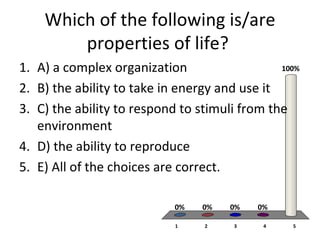
Which of the following is/are properties of life?  A) a complex organization   B) the ability to take in energy and use it   C) the ability to respond to stimuli from the environment   D) the ability to reproduce   E) All of the choices are correct.  
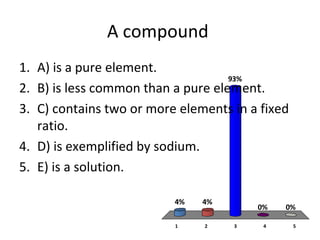
A compound  A) is a pure element.   B) is less common than a pure element.   C) contains two or more elements in a fixed ratio.   D) is exemplified by sodium.   E) is a solution.  
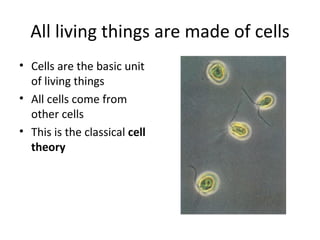
All living things are made of cells Cells are the basic unit of living things All cells come from other cells This is the classical  cell theory
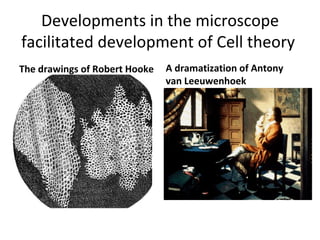
Developments in the microscope facilitated development of Cell theory  The drawings of Robert Hooke A dramatization of Antony van Leeuwenhoek
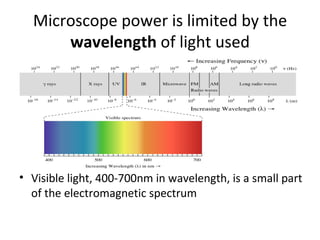
Microscope power is limited by the  wavelength  of light used Visible light, 400-700nm in wavelength, is a small part of the electromagnetic spectrum
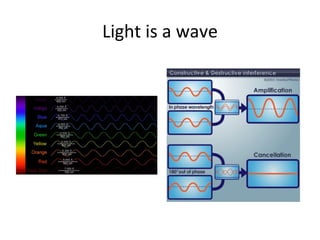
Light is a wave
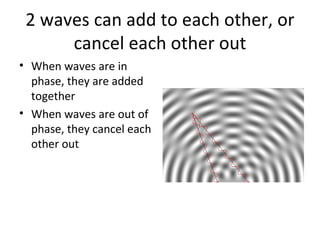
2 waves can add to each other, or cancel each other out When waves are in phase, they are added together When waves are out of phase, they cancel each other out
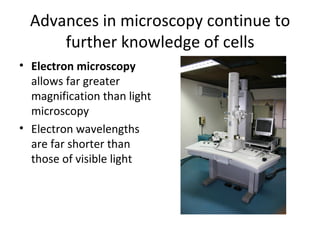
Advances in microscopy continue to further knowledge of cells Electron microscopy  allows far greater magnification than light microscopy Electron wavelengths are far shorter than those of visible light
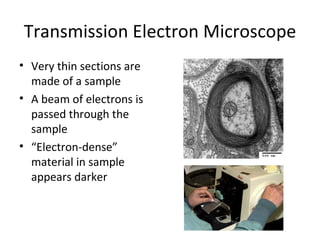
Transmission Electron Microscope Very thin sections are made of a sample A beam of electrons is passed through the sample “ Electron-dense” material in sample appears darker
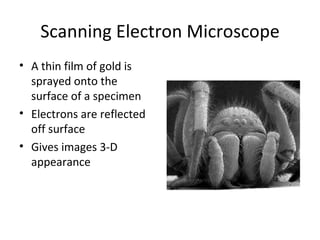
Scanning Electron Microscope A thin film of gold is sprayed onto the surface of a specimen Electrons are reflected off surface Gives images 3-D appearance
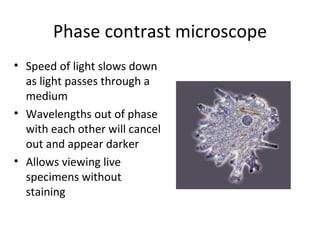
Phase contrast microscope Speed of light slows down as light passes through a medium Wavelengths out of phase with each other will cancel out and appear darker Allows viewing live specimens without staining
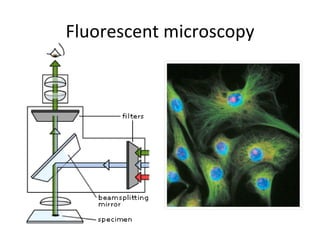
Fluorescent microscopy
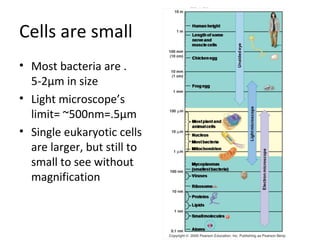
Cells are small Most bacteria are .5-2µm in size Light microscope’s limit= ~500nm=.5µm Single eukaryotic cells are larger, but still to small to see without magnification
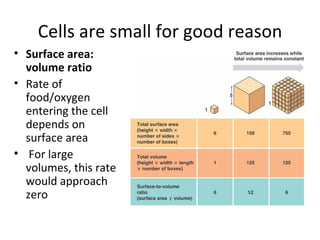
Cells are small for good reason Surface area: volume ratio Rate of food/oxygen entering the cell depends on surface area For large volumes, this rate would approach zero
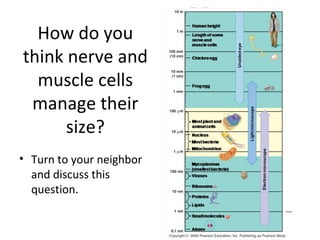
How do you think nerve and muscle cells manage their size? Turn to your neighbor and discuss this question.
Required for all cells: A  genome Separation of inside from outside Means of obtaining energy Means of utilizing energy Protection
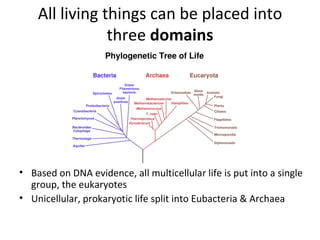
All living things can be placed into three  domains Based on DNA evidence, all multicellular life is put into a single group, the eukaryotes Unicellular, prokaryotic life split into Eubacteria & Archaea
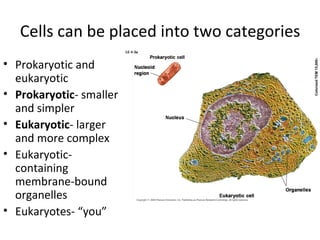
Cells can be placed into two categories Prokaryotic and eukaryotic Prokaryotic - smaller and simpler Eukaryotic - larger and more complex Eukaryotic- containing membrane-bound organelles Eukaryotes- “you”
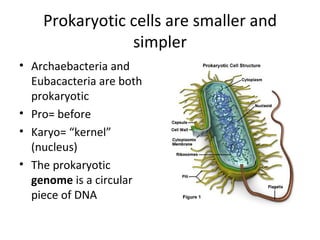
Prokaryotic cells are smaller and simpler Archaebacteria and Eubacacteria are both prokaryotic Pro= before Karyo= “kernel” (nucleus) The prokaryotic  genome  is a circular piece of DNA
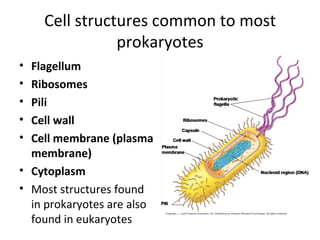
Cell structures common to most prokaryotes Flagellum Ribosomes Pili Cell wall Cell membrane (plasma membrane) Cytoplasm Most structures found in prokaryotes are also found in eukaryotes
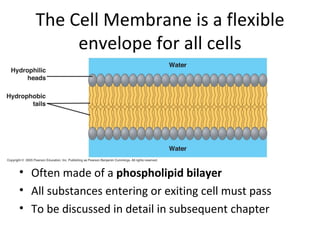
The Cell Membrane is a flexible envelope for all cells Often made of a  phospholipid bilayer All substances entering or exiting cell must pass To be discussed in detail in subsequent chapter
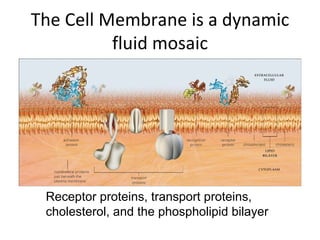
The Cell Membrane is a dynamic fluid mosaic Receptor proteins, transport proteins, cholesterol, and the phospholipid bilayer
The cell membrane works for: Containment Transport Communication Attachment
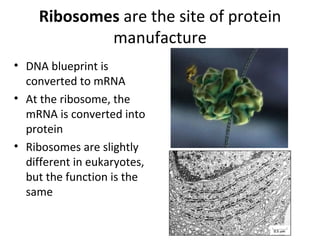
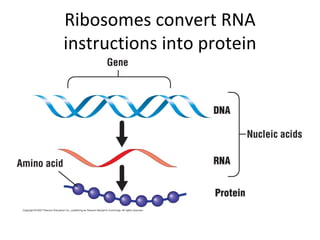
Ribosomes  are the site of protein manufacture DNA blueprint is converted to mRNA At the ribosome, the mRNA is converted into protein Ribosomes are slightly different in eukaryotes, but the function is the same
Ribosomes convert RNA instructions into protein
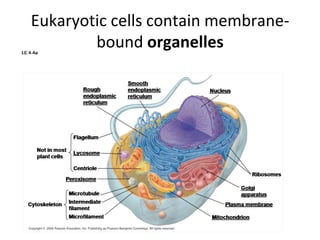
Eukaryotic cells contain membrane-bound  organelles
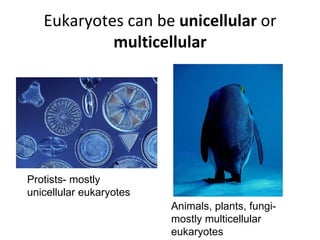
Eukaryotes can be  unicellular  or  multicellular Protists- mostly unicellular eukaryotes Animals, plants, fungi- mostly multicellular eukaryotes
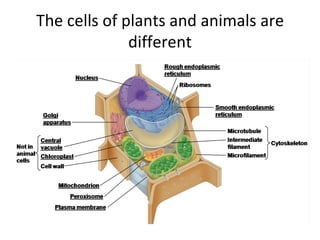
The cells of plants and animals are different
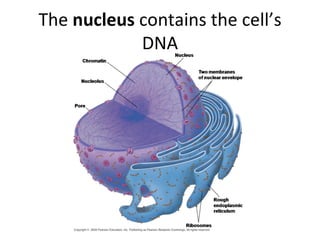
The  nucleus  contains the cell’s DNA
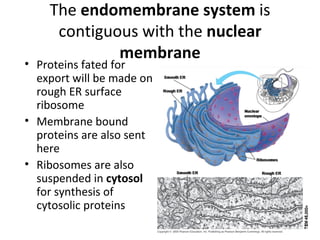
The  endomembrane system  is contiguous with the  nuclear membrane Proteins fated for export will be made on rough ER surface ribosome Membrane bound proteins are also sent here Ribosomes are also suspended in  cytosol  for synthesis of cytosolic proteins
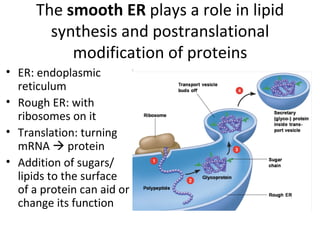
The  smooth ER  plays a role in lipid synthesis and postranslational modification of proteins ER: endoplasmic reticulum Rough ER: with ribosomes on it Translation: turning mRNA    protein Addition of sugars/ lipids to the surface of a protein can aid or change its function
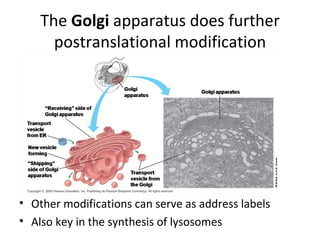
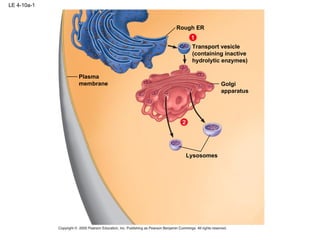
The  Golgi  apparatus does further postranslational modification Other modifications can serve as address labels Also key in the synthesis of lysosomes
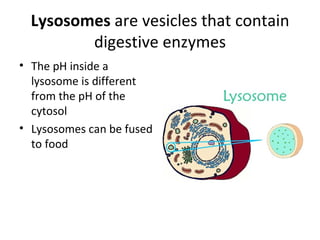
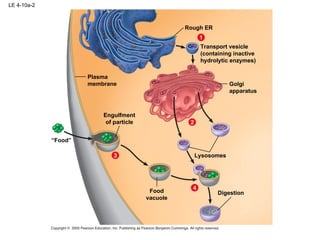
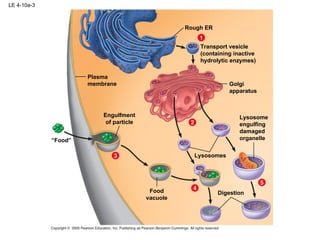
Lysosomes  are vesicles that contain digestive enzymes The pH inside a lysosome is different from the pH of the cytosol Lysosomes can be fused to food
LE 4-10a-1 Plasma membrane Rough ER Lysosomes Transport vesicle (containing inactive hydrolytic enzymes) Golgi apparatus
LE 4-10a-2 Plasma membrane Rough ER Lysosomes Transport vesicle (containing inactive hydrolytic enzymes) Golgi apparatus Engulfment of particle “ Food” Food vacuole Digestion
LE 4-10a-3 Plasma membrane Rough ER Lysosomes Transport vesicle (containing inactive hydrolytic enzymes) Golgi apparatus Engulfment of particle “ Food” Food vacuole Digestion Lysosome engulfing damaged organelle
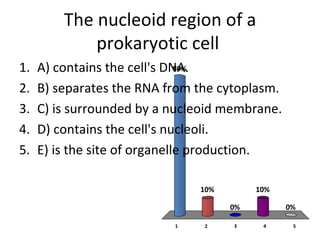
The nucleoid region of a prokaryotic cell  A) contains the cell's DNA.   B) separates the RNA from the cytoplasm.   C) is surrounded by a nucleoid membrane.   D) contains the cell's nucleoli.   E) is the site of organelle production.  
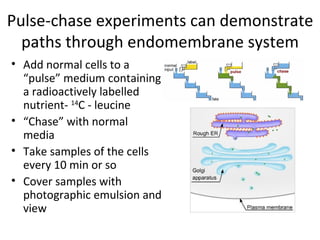
Pulse-chase experiments can demonstrate paths through endomembrane system Add normal cells to a “pulse” medium containing a radioactively labelled nutrient-  14 C - leucine “ Chase” with normal media Take samples of the cells every 10 min or so Cover samples with photographic emulsion and view
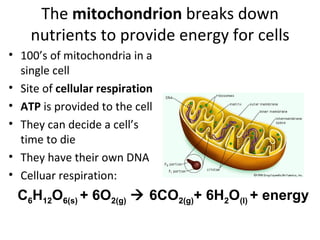
The  mitochondrion  breaks down nutrients to provide energy for cells 100’s of mitochondria in a single cell Site of  cellular   respiration ATP  is provided to the cell They can decide a cell’s time to die They have their own DNA Celluar respiration: C 6 H 12 O 6(s)  + 6O 2(g)     6CO 2(g) + 6H 2 O (l)  + energy
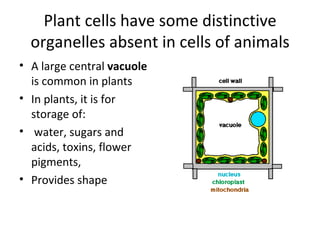
Plant cells have some distinctive organelles absent in cells of animals A large central  vacuole  is common in plants In plants, it is for storage of: water, sugars and acids, toxins, flower pigments,  Provides shape
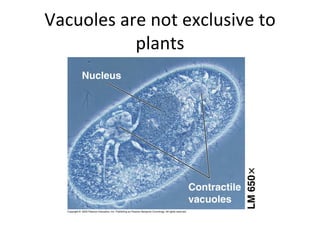
Vacuoles are not exclusive to plants
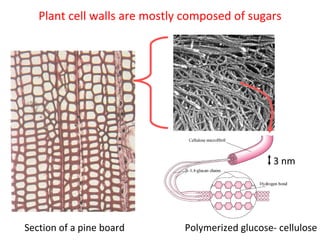
Plant cell walls are mostly composed of sugars Section of a pine board 3 nm Polymerized glucose- cellulose
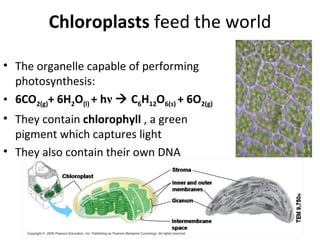
Chloroplasts  feed the world The organelle capable of performing photosynthesis: 6CO 2(g) + 6H 2 O (l)  + h ν     C 6 H 12 O 6(s)  + 6O 2(g)   They contain  chlorophyll  , a green pigment which captures light They also contain their own DNA
Why do you think chloroplasts and mitochondria have their own DNA?  Turn to a neighbor and discuss this question.
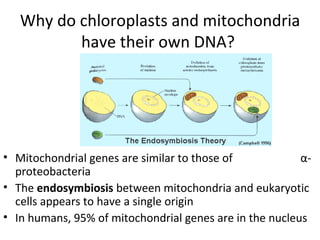
Why do chloroplasts and mitochondria have their own DNA?  Mitochondrial genes are similar to those of  α -proteobacteria The  endosymbiosis  between mitochondria and eukaryotic cells appears to have a single origin In humans, 95% of mitochondrial genes are in the nucleus
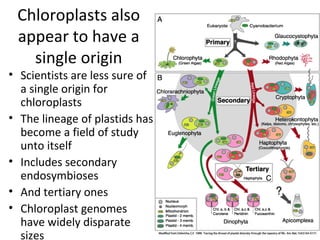
Scientists are less sure of a single origin for chloroplasts The lineage of plastids has become a field of study unto itself Includes secondary endosymbioses And tertiary ones Chloroplast genomes have widely disparate sizes Chloroplasts also appear to have a single origin
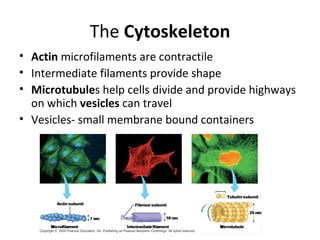
The  Cytoskeleton Actin  microfilaments are contractile Intermediate filaments provide shape Microtubule s help cells divide and provide highways on which  vesicles  can travel Vesicles- small membrane bound containers
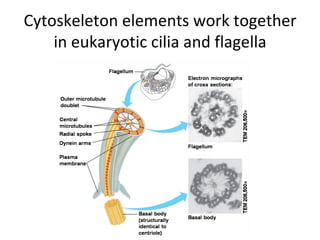
Cytoskeleton elements work together in eukaryotic cilia and flagella
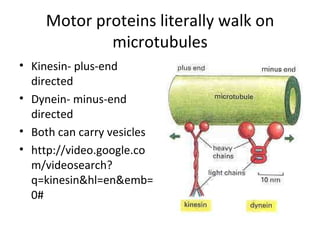
Motor proteins literally walk on microtubules Kinesin- plus-end directed Dynein- minus-end directed Both can carry vesicles http://video.google.com/videosearch?q=kinesin&hl=en&emb=0#
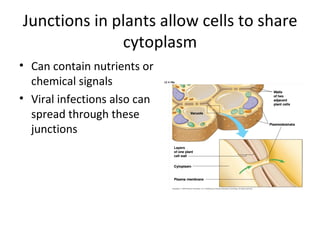
Junctions in plants allow cells to share cytoplasm Can contain nutrients or chemical signals Viral infections also can spread through these junctions
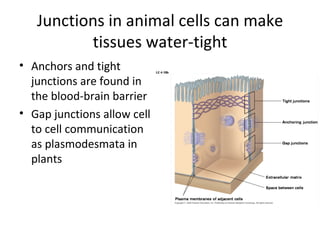
Junctions in animal cells can make tissues water-tight Anchors and tight junctions are found in the blood-brain barrier Gap junctions allow cell to cell communication as plasmodesmata in plants
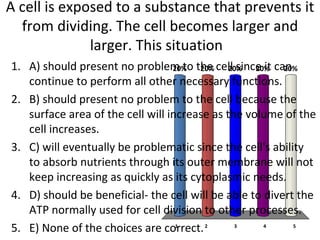
A cell is exposed to a substance that prevents it from dividing. The cell becomes larger and larger. This situation   A) should present no problem to the cell since it can continue to perform all other necessary functions.   B) should present no problem to the cell because the surface area of the cell will increase as the volume of the cell increases.   C) will eventually be problematic since the cell's ability to absorb nutrients through its outer membrane will not keep increasing as quickly as its cytoplasmic needs.   D) should be beneficial- the cell will be able to divert the ATP normally used for cell division to other processes.   E) None of the choices are correct.
Cells Bio 116

  • 1.
  • 2.
    Which of thefollowing is/are properties of life? A) a complex organization   B) the ability to take in energy and use it   C) the ability to respond to stimuli from the environment   D) the ability to reproduce   E) All of the choices are correct.  
  • 3.
    A compound A) is a pure element.   B) is less common than a pure element.   C) contains two or more elements in a fixed ratio.   D) is exemplified by sodium.   E) is a solution.  
  • 4.
    All living thingsare made of cells Cells are the basic unit of living things All cells come from other cells This is the classical cell theory
  • 5.
    Developments in themicroscope facilitated development of Cell theory The drawings of Robert Hooke A dramatization of Antony van Leeuwenhoek
  • 6.
    Microscope power islimited by the wavelength of light used Visible light, 400-700nm in wavelength, is a small part of the electromagnetic spectrum
  • 7.
  • 8.
    2 waves canadd to each other, or cancel each other out When waves are in phase, they are added together When waves are out of phase, they cancel each other out
  • 9.
    Advances in microscopycontinue to further knowledge of cells Electron microscopy allows far greater magnification than light microscopy Electron wavelengths are far shorter than those of visible light
  • 10.
    Transmission Electron MicroscopeVery thin sections are made of a sample A beam of electrons is passed through the sample “ Electron-dense” material in sample appears darker
  • 11.
    Scanning Electron MicroscopeA thin film of gold is sprayed onto the surface of a specimen Electrons are reflected off surface Gives images 3-D appearance
  • 12.
    Phase contrast microscopeSpeed of light slows down as light passes through a medium Wavelengths out of phase with each other will cancel out and appear darker Allows viewing live specimens without staining
  • 13.
  • 14.
    Cells are smallMost bacteria are .5-2µm in size Light microscope’s limit= ~500nm=.5µm Single eukaryotic cells are larger, but still to small to see without magnification
  • 15.
    Cells are smallfor good reason Surface area: volume ratio Rate of food/oxygen entering the cell depends on surface area For large volumes, this rate would approach zero
  • 16.
    How do youthink nerve and muscle cells manage their size? Turn to your neighbor and discuss this question.
  • 17.
    Required for allcells: A genome Separation of inside from outside Means of obtaining energy Means of utilizing energy Protection
  • 18.
    All living thingscan be placed into three domains Based on DNA evidence, all multicellular life is put into a single group, the eukaryotes Unicellular, prokaryotic life split into Eubacteria & Archaea
  • 19.
    Cells can beplaced into two categories Prokaryotic and eukaryotic Prokaryotic - smaller and simpler Eukaryotic - larger and more complex Eukaryotic- containing membrane-bound organelles Eukaryotes- “you”
  • 20.
    Prokaryotic cells aresmaller and simpler Archaebacteria and Eubacacteria are both prokaryotic Pro= before Karyo= “kernel” (nucleus) The prokaryotic genome is a circular piece of DNA
  • 21.
    Cell structures commonto most prokaryotes Flagellum Ribosomes Pili Cell wall Cell membrane (plasma membrane) Cytoplasm Most structures found in prokaryotes are also found in eukaryotes
  • 22.
    The Cell Membraneis a flexible envelope for all cells Often made of a phospholipid bilayer All substances entering or exiting cell must pass To be discussed in detail in subsequent chapter
  • 23.
    The Cell Membraneis a dynamic fluid mosaic Receptor proteins, transport proteins, cholesterol, and the phospholipid bilayer
  • 24.
    The cell membraneworks for: Containment Transport Communication Attachment
  • 25.
    Ribosomes arethe site of protein manufacture DNA blueprint is converted to mRNA At the ribosome, the mRNA is converted into protein Ribosomes are slightly different in eukaryotes, but the function is the same
  • 26.
    Ribosomes convert RNAinstructions into protein
  • 27.
    Eukaryotic cells containmembrane-bound organelles
  • 28.
    Eukaryotes can be unicellular or multicellular Protists- mostly unicellular eukaryotes Animals, plants, fungi- mostly multicellular eukaryotes
  • 29.
    The cells ofplants and animals are different
  • 30.
    The nucleus contains the cell’s DNA
  • 31.
    The endomembranesystem is contiguous with the nuclear membrane Proteins fated for export will be made on rough ER surface ribosome Membrane bound proteins are also sent here Ribosomes are also suspended in cytosol for synthesis of cytosolic proteins
  • 32.
    The smoothER plays a role in lipid synthesis and postranslational modification of proteins ER: endoplasmic reticulum Rough ER: with ribosomes on it Translation: turning mRNA  protein Addition of sugars/ lipids to the surface of a protein can aid or change its function
  • 33.
    The Golgi apparatus does further postranslational modification Other modifications can serve as address labels Also key in the synthesis of lysosomes
  • 34.
    Lysosomes arevesicles that contain digestive enzymes The pH inside a lysosome is different from the pH of the cytosol Lysosomes can be fused to food
  • 35.
    LE 4-10a-1 Plasmamembrane Rough ER Lysosomes Transport vesicle (containing inactive hydrolytic enzymes) Golgi apparatus
  • 36.
    LE 4-10a-2 Plasmamembrane Rough ER Lysosomes Transport vesicle (containing inactive hydrolytic enzymes) Golgi apparatus Engulfment of particle “ Food” Food vacuole Digestion
  • 37.
    LE 4-10a-3 Plasmamembrane Rough ER Lysosomes Transport vesicle (containing inactive hydrolytic enzymes) Golgi apparatus Engulfment of particle “ Food” Food vacuole Digestion Lysosome engulfing damaged organelle
  • 38.
    The nucleoid regionof a prokaryotic cell A) contains the cell's DNA.   B) separates the RNA from the cytoplasm.   C) is surrounded by a nucleoid membrane.   D) contains the cell's nucleoli.   E) is the site of organelle production.  
  • 39.
    Pulse-chase experiments candemonstrate paths through endomembrane system Add normal cells to a “pulse” medium containing a radioactively labelled nutrient- 14 C - leucine “ Chase” with normal media Take samples of the cells every 10 min or so Cover samples with photographic emulsion and view
  • 40.
    The mitochondrion breaks down nutrients to provide energy for cells 100’s of mitochondria in a single cell Site of cellular respiration ATP is provided to the cell They can decide a cell’s time to die They have their own DNA Celluar respiration: C 6 H 12 O 6(s) + 6O 2(g)  6CO 2(g) + 6H 2 O (l) + energy
  • 41.
    Plant cells havesome distinctive organelles absent in cells of animals A large central vacuole is common in plants In plants, it is for storage of: water, sugars and acids, toxins, flower pigments, Provides shape
  • 42.
    Vacuoles are notexclusive to plants
  • 43.
    Plant cell wallsare mostly composed of sugars Section of a pine board 3 nm Polymerized glucose- cellulose
  • 44.
    Chloroplasts feedthe world The organelle capable of performing photosynthesis: 6CO 2(g) + 6H 2 O (l) + h ν  C 6 H 12 O 6(s) + 6O 2(g) They contain chlorophyll , a green pigment which captures light They also contain their own DNA
  • 45.
    Why do youthink chloroplasts and mitochondria have their own DNA? Turn to a neighbor and discuss this question.
  • 46.
    Why do chloroplastsand mitochondria have their own DNA? Mitochondrial genes are similar to those of α -proteobacteria The endosymbiosis between mitochondria and eukaryotic cells appears to have a single origin In humans, 95% of mitochondrial genes are in the nucleus
  • 47.
    Scientists are lesssure of a single origin for chloroplasts The lineage of plastids has become a field of study unto itself Includes secondary endosymbioses And tertiary ones Chloroplast genomes have widely disparate sizes Chloroplasts also appear to have a single origin
  • 48.
    The CytoskeletonActin microfilaments are contractile Intermediate filaments provide shape Microtubule s help cells divide and provide highways on which vesicles can travel Vesicles- small membrane bound containers
  • 49.
    Cytoskeleton elements worktogether in eukaryotic cilia and flagella
  • 50.
    Motor proteins literallywalk on microtubules Kinesin- plus-end directed Dynein- minus-end directed Both can carry vesicles http://video.google.com/videosearch?q=kinesin&hl=en&emb=0#
  • 51.
    Junctions in plantsallow cells to share cytoplasm Can contain nutrients or chemical signals Viral infections also can spread through these junctions
  • 52.
    Junctions in animalcells can make tissues water-tight Anchors and tight junctions are found in the blood-brain barrier Gap junctions allow cell to cell communication as plasmodesmata in plants
  • 53.
    A cell isexposed to a substance that prevents it from dividing. The cell becomes larger and larger. This situation   A) should present no problem to the cell since it can continue to perform all other necessary functions.   B) should present no problem to the cell because the surface area of the cell will increase as the volume of the cell increases.   C) will eventually be problematic since the cell's ability to absorb nutrients through its outer membrane will not keep increasing as quickly as its cytoplasmic needs.   D) should be beneficial- the cell will be able to divert the ATP normally used for cell division to other processes.   E) None of the choices are correct.
Editor's Notes

  • #2 FIXES to this presentation: Do I need to go over metric prefixes in this lecture? Or can I cover it in lab? (I expect the latter)