Module 7

   Cellular Reproduction and
              DNA
Genetics
   What characteristics of your parents do
    you share?
   Do you look a lot like one parent or the
    other OR do you look like another
    relative?
   What about your siblings? Do you look
    alike or not? What characteristics do
    you share?
Genetics
   How can a set of brown-eyed, brown haired
    parents have a child with blue eyes and blond
    hair?
   What do you think about parents who have
    conducted in strength training or strenuous
    activities producing a strong child?
   Discuss - Genetics vs. God Given
    Temperament
Genetics
   Define Genetics
   The science that studies HOW
    characteristics get passed from
    parent to offspring
   Define Temperament
   The God given makeup of YOU –
    most people call it personality
    (but there is a difference)
Genetics
   Most of your “traits” and
    “characteristics” are governed by what
    kinds of proteins your cells make
   Eye color – dependent on what proteins
    are produced in some of the cells in
    your eyes – the special coding
   Your DNA determines your eye color
Genetics
   What is DNA?
   Deoxyribonucleic Acid
   Let’s watch a short video clip on DNA
   http://
    www.brainpop.com/health/geneticsgrowth
    /
Let’s Discuss
   Where in the cell is DNA found?
   In the cell’s nucleus
   Is everyone’s DNA different?
   Yes!
   How is DNA arranged in your body?
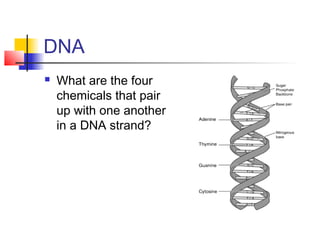
   In a spiral shape called a Double
    Helix with long strands called
    Chromosomes
DNA
   What are the four
    chemicals that pair
    up with one another
    in a DNA strand?
DNA
   Their pair up ONLY in this format:
   Adenine with Thymine – remember “AT”
   Guanine with Cytosine
DNA
   What are your thoughts on cloning
    people and/or animals?
   With a partner discuss the pros and
    cons of genetically modified plants (5
    minutes), then we’ll discuss
DNA
   How has the use of DNA helped us today?
       Diseases or malformations
            Cures or treatments for certain diseases
            Amniocentesis on babies
       Debunk evolutionists that we were created on
        purpose by our Creator and not evolved
       Paternity tests
       Forensic Science and Crime Scene Investigation –
        innocent or guilty??
Interesting DNA Trivia
   Human DNA contains about 3 billion base pairs
    arranged into 46 chromosomes
   Humans and E coli bacteria share about 7 percent of
    the same DNA
   A significant percent of DNA has no known function
    (so far as we know it…). Scientists call it “junk DNA”
    and may play a roll we just don’t understand yet
   Every minute, your body produces enough DNA that
    if the strands were stacked end to end, they’d be
    100,000 kilometers long (60,000 miles)
   The genetic difference between two unrelated people
    is about 0.2% of their DNA
DNA
   DNA is NOT the only factor in determining
    what kind of person you will be
   Scientifically, there are three factors in
    determining the characteristics of a person:
       Genetic Factors
       Environmental Factors
       Spiritual Factors
Genetic Factor
   The general guideline of traits
    determined by a person’s DNA
Environmental Factor
   Those “nonbiological” factors that are
    involved in a person’s surroundings
    such as the nature of the person’s
    parents, the person’s friends, and the
    person’s behavioral choices
   I call this character and personality
Spiritual Factor
   The factors in a person’s life that are
    determined by the quality of his or her
    relationship with God
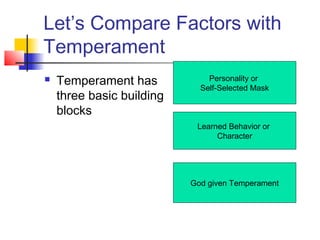
Let’s Compare Factors with
Temperament
   Temperament has            Personality or
                             Self-Selected Mask
    three basic building
    blocks
                            Learned Behavior or
                                 Character


                           God given Temperament
Genes
   The information for an organism’s DNA
    is split up into little groups known as
    genes
   Gene – a section of DNA that
    codes for the production of a
    protein or a portion of protein,
    thereby causing a trait
Let’s watch…
   http://www.youtube.com/watch?v
    =V9BZ3zx8b8I&feature=related
Question
   Two identical twins have exactly the
    same set of genes. They are separated
    at birth and grow up in different
    households. If a scientist were to study
    the twins as adults, would be find them
    to be identical in every way, since they
    have the same genes? Why or why
    not?

Module 7 part 1

  • 1.
    Module 7 Cellular Reproduction and DNA
  • 2.
    Genetics  What characteristics of your parents do you share?  Do you look a lot like one parent or the other OR do you look like another relative?  What about your siblings? Do you look alike or not? What characteristics do you share?
  • 3.
    Genetics  How can a set of brown-eyed, brown haired parents have a child with blue eyes and blond hair?  What do you think about parents who have conducted in strength training or strenuous activities producing a strong child?  Discuss - Genetics vs. God Given Temperament
  • 4.
    Genetics  Define Genetics  The science that studies HOW characteristics get passed from parent to offspring  Define Temperament  The God given makeup of YOU – most people call it personality (but there is a difference)
  • 5.
    Genetics  Most of your “traits” and “characteristics” are governed by what kinds of proteins your cells make  Eye color – dependent on what proteins are produced in some of the cells in your eyes – the special coding  Your DNA determines your eye color
  • 6.
    Genetics  What is DNA?  Deoxyribonucleic Acid  Let’s watch a short video clip on DNA  http:// www.brainpop.com/health/geneticsgrowth /
  • 7.
    Let’s Discuss  Where in the cell is DNA found?  In the cell’s nucleus  Is everyone’s DNA different?  Yes!  How is DNA arranged in your body?  In a spiral shape called a Double Helix with long strands called Chromosomes
  • 8.
    DNA  What are the four chemicals that pair up with one another in a DNA strand?
  • 9.
    DNA  Their pair up ONLY in this format:  Adenine with Thymine – remember “AT”  Guanine with Cytosine
  • 10.
    DNA  What are your thoughts on cloning people and/or animals?  With a partner discuss the pros and cons of genetically modified plants (5 minutes), then we’ll discuss
  • 11.
    DNA  How has the use of DNA helped us today?  Diseases or malformations  Cures or treatments for certain diseases  Amniocentesis on babies  Debunk evolutionists that we were created on purpose by our Creator and not evolved  Paternity tests  Forensic Science and Crime Scene Investigation – innocent or guilty??
  • 12.
    Interesting DNA Trivia  Human DNA contains about 3 billion base pairs arranged into 46 chromosomes  Humans and E coli bacteria share about 7 percent of the same DNA  A significant percent of DNA has no known function (so far as we know it…). Scientists call it “junk DNA” and may play a roll we just don’t understand yet  Every minute, your body produces enough DNA that if the strands were stacked end to end, they’d be 100,000 kilometers long (60,000 miles)  The genetic difference between two unrelated people is about 0.2% of their DNA
  • 13.
    DNA  DNA is NOT the only factor in determining what kind of person you will be  Scientifically, there are three factors in determining the characteristics of a person:  Genetic Factors  Environmental Factors  Spiritual Factors
  • 14.
    Genetic Factor  The general guideline of traits determined by a person’s DNA
  • 15.
    Environmental Factor  Those “nonbiological” factors that are involved in a person’s surroundings such as the nature of the person’s parents, the person’s friends, and the person’s behavioral choices  I call this character and personality
  • 16.
    Spiritual Factor  The factors in a person’s life that are determined by the quality of his or her relationship with God
  • 17.
    Let’s Compare Factorswith Temperament  Temperament has Personality or Self-Selected Mask three basic building blocks Learned Behavior or Character God given Temperament
  • 18.
    Genes  The information for an organism’s DNA is split up into little groups known as genes  Gene – a section of DNA that codes for the production of a protein or a portion of protein, thereby causing a trait
  • 19.
    Let’s watch…  http://www.youtube.com/watch?v =V9BZ3zx8b8I&feature=related
  • 20.
    Question  Two identical twins have exactly the same set of genes. They are separated at birth and grow up in different households. If a scientist were to study the twins as adults, would be find them to be identical in every way, since they have the same genes? Why or why not?