DNA Replication &
Repair
Abhishek Dahal
 DNA is a molecule that carries Genetic
information from generation to next.
 Also called as Reserve Bank Of Genetic
information.
 Central Dogma of life: Flow of information
from DNA to RNA to Protein synthesis.
3
Nitrogenous Bases
 Double ring PURINES
Adenine (A)
Guanine (G)
 Single ring PYRIMIDINES
Thymine (T)
Cytosine (C)
T or C
A or G
4
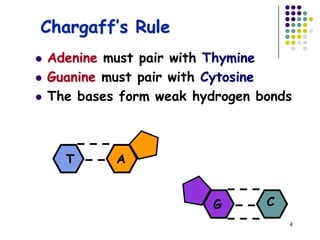
Chargaff’s Rule
 Adenine must pair with Thymine
 Guanine must pair with Cytosine
 The bases form weak hydrogen bonds
G C
T A
5
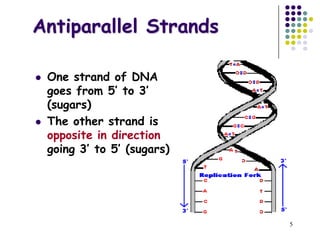
Antiparallel Strands
 One strand of DNA
goes from 5’ to 3’
(sugars)
 The other strand is
opposite in direction
going 3’ to 5’ (sugars)
6
DNA Replication
copyright cmassengale
7
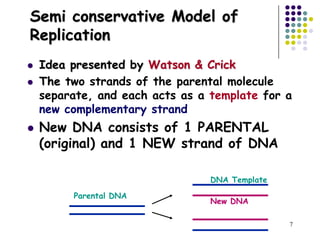
Semi conservative Model of
Replication
 Idea presented by Watson & Crick
 The two strands of the parental molecule
separate, and each acts as a template for a
new complementary strand
 New DNA consists of 1 PARENTAL
(original) and 1 NEW strand of DNA
Parental DNA
DNA Template
New DNA
8
DNA Replication
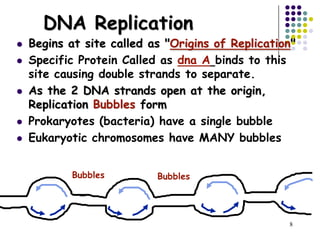
 Begins at site called as "Origins of Replication"
 Specific Protein Called as dna A binds to this
site causing double strands to separate.
 As the 2 DNA strands open at the origin,
Replication Bubbles form
 Prokaryotes (bacteria) have a single bubble
 Eukaryotic chromosomes have MANY bubbles
Bubbles Bubbles
9
DNA Replication
 Two strands open forming Replication Forks (Y-
shaped region)
 New strands grow at the forks
Replication
Fork
Parental DNA Molecule
3’
5’
3’
5’
10
DNA Replication
 Enzyme DNA Helicase unwinds
and separates the 2 DNA
strands by breaking the weak
hydrogen bonds.
 Single-Strand Binding Proteins
(SSBP) attach and keep the 2
DNA strands separated and
untwisted
11
Replication Requirement
 Before new DNA strands can form,
there must be RNA primers present to
start the addition of new nucleotides
 Primase is the enzyme that synthesizes
the RNA Primer
 DNA polymerase 3 can then add the
new nucleotides and forms new strand.
12
DNA Replication
 DNA polymerase can only add
nucleotides to the 3’ end of the DNA
 This causes the NEW strand to be built
in a 5’ to 3’ direction.
 DNA polymerase also checks for
incoming nucleotides and act as proof
reading.
13
Synthesis of the New DNA
Strands
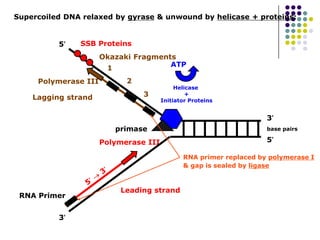
 Leading strand synthesized 5’ to 3’ in the
direction of the replication fork movement.
 It is continuous
 Requires a single RNA primer
 Lagging strand synthesized 5’ to 3’ in the
opposite direction.
 Discontinuous (i.e., not continuous)
 Requires many RNA primers , DNA is
synthesized in short fragments.
3
Polymerase III
Leading strand
base pairs
5’
5’
3’
3’
Supercoiled DNA relaxed by gyrase & unwound by helicase + proteins:
Helicase
+
Initiator Proteins
ATP
SSB Proteins
RNA Primer
primase
2Polymerase III
Lagging strand
Okazaki Fragments
1
RNA primer replaced by polymerase I
& gap is sealed by ligase
 DNA polymerase 1 removes the RNA primer
 The gap left behind is Sealed by Ligase and
new Daughter DNA is formed.
 Thus process of replication is ended.
DNA repair
 The process of replication is extremely
accurate but errors occurs sometime and
cells posses capacity to repair these errors.
 Damaged DNA must be repaired
 If the damage is passed on to subsequent
generations, then we use the evolutionary
term - mutation.
Damage from where?
 Consequences of DNA replication errors
 Chemical agents acting on the DNA
 UV light imparting energy into DNA molecule
 Spontaneous changes to the DNA
a) Base-excision repair
 Presence of the Uracil ,hypoxanthine and
xanthine in DNA is a great example base-
excision.
 N-glycosylase enzyme replace just the
defective base.
 snip out the defective base
 2cut the DNA strand
 Add fresh nucleotide via DNA Polymerase.
 Gap is sealed by LIGASE
b)Nucleotide-excision repair
 UV light and Ionization radiation causes modification
of bases, strand breaks, cross-linkage, etc.
 It recognizes more varieties of damage in DNA .
 Cutting of the defective piece by Exinuclease and its
removal (Degraded).
 Resynthesis of the cut part by DNA polymerase and
ligase.
 Defect in this mechanism leads to Xeroderma
pigmentosa
c) Mismatch repair
 These are normally caused by mismatched bases
i.e. AG and CT.
 Special enzymes scan the DNA for bulky alterations
in the DNA double helix.
 GATC endonuclease cuts the strand and the strand
is digested by Exonuclease.
 These gaps are excised and the DNA repaired by
ligase and polymerase enzyme respectively.
 Defect in this mechanism causes Lynch syndrome
i.e. patient are of high risk of developing Colon
cancer.
d) Double-strand break repair
 High energy radiation and free radicals
causes DNA breakage and leads to cell
death.
 Repair mechanism is of 2 type
 1) Non-homologous end joining(Yeast)
 2) Homologous end joining (mamals)
 Defect: Cancer and Immunodeficiency
syndrome.
THE END
 Thank you……..

DNA Replication & Repair.

  • 1.
  • 2.
     DNA isa molecule that carries Genetic information from generation to next.  Also called as Reserve Bank Of Genetic information.  Central Dogma of life: Flow of information from DNA to RNA to Protein synthesis.
  • 3.
    3 Nitrogenous Bases  Doublering PURINES Adenine (A) Guanine (G)  Single ring PYRIMIDINES Thymine (T) Cytosine (C) T or C A or G
  • 4.
    4 Chargaff’s Rule  Adeninemust pair with Thymine  Guanine must pair with Cytosine  The bases form weak hydrogen bonds G C T A
  • 5.
    5 Antiparallel Strands  Onestrand of DNA goes from 5’ to 3’ (sugars)  The other strand is opposite in direction going 3’ to 5’ (sugars)
  • 6.
  • 7.
    7 Semi conservative Modelof Replication  Idea presented by Watson & Crick  The two strands of the parental molecule separate, and each acts as a template for a new complementary strand  New DNA consists of 1 PARENTAL (original) and 1 NEW strand of DNA Parental DNA DNA Template New DNA
  • 8.
    8 DNA Replication  Beginsat site called as "Origins of Replication"  Specific Protein Called as dna A binds to this site causing double strands to separate.  As the 2 DNA strands open at the origin, Replication Bubbles form  Prokaryotes (bacteria) have a single bubble  Eukaryotic chromosomes have MANY bubbles Bubbles Bubbles
  • 9.
    9 DNA Replication  Twostrands open forming Replication Forks (Y- shaped region)  New strands grow at the forks Replication Fork Parental DNA Molecule 3’ 5’ 3’ 5’
  • 10.
    10 DNA Replication  EnzymeDNA Helicase unwinds and separates the 2 DNA strands by breaking the weak hydrogen bonds.  Single-Strand Binding Proteins (SSBP) attach and keep the 2 DNA strands separated and untwisted
  • 11.
    11 Replication Requirement  Beforenew DNA strands can form, there must be RNA primers present to start the addition of new nucleotides  Primase is the enzyme that synthesizes the RNA Primer  DNA polymerase 3 can then add the new nucleotides and forms new strand.
  • 12.
    12 DNA Replication  DNApolymerase can only add nucleotides to the 3’ end of the DNA  This causes the NEW strand to be built in a 5’ to 3’ direction.  DNA polymerase also checks for incoming nucleotides and act as proof reading.
  • 13.
    13 Synthesis of theNew DNA Strands  Leading strand synthesized 5’ to 3’ in the direction of the replication fork movement.  It is continuous  Requires a single RNA primer  Lagging strand synthesized 5’ to 3’ in the opposite direction.  Discontinuous (i.e., not continuous)  Requires many RNA primers , DNA is synthesized in short fragments.
  • 14.
    3 Polymerase III Leading strand basepairs 5’ 5’ 3’ 3’ Supercoiled DNA relaxed by gyrase & unwound by helicase + proteins: Helicase + Initiator Proteins ATP SSB Proteins RNA Primer primase 2Polymerase III Lagging strand Okazaki Fragments 1 RNA primer replaced by polymerase I & gap is sealed by ligase
  • 15.
     DNA polymerase1 removes the RNA primer  The gap left behind is Sealed by Ligase and new Daughter DNA is formed.  Thus process of replication is ended.
  • 16.
    DNA repair  Theprocess of replication is extremely accurate but errors occurs sometime and cells posses capacity to repair these errors.  Damaged DNA must be repaired  If the damage is passed on to subsequent generations, then we use the evolutionary term - mutation.
  • 17.
    Damage from where? Consequences of DNA replication errors  Chemical agents acting on the DNA  UV light imparting energy into DNA molecule  Spontaneous changes to the DNA
  • 18.
    a) Base-excision repair Presence of the Uracil ,hypoxanthine and xanthine in DNA is a great example base- excision.  N-glycosylase enzyme replace just the defective base.  snip out the defective base  2cut the DNA strand  Add fresh nucleotide via DNA Polymerase.  Gap is sealed by LIGASE
  • 19.
    b)Nucleotide-excision repair  UVlight and Ionization radiation causes modification of bases, strand breaks, cross-linkage, etc.  It recognizes more varieties of damage in DNA .  Cutting of the defective piece by Exinuclease and its removal (Degraded).  Resynthesis of the cut part by DNA polymerase and ligase.  Defect in this mechanism leads to Xeroderma pigmentosa
  • 20.
    c) Mismatch repair These are normally caused by mismatched bases i.e. AG and CT.  Special enzymes scan the DNA for bulky alterations in the DNA double helix.  GATC endonuclease cuts the strand and the strand is digested by Exonuclease.  These gaps are excised and the DNA repaired by ligase and polymerase enzyme respectively.  Defect in this mechanism causes Lynch syndrome i.e. patient are of high risk of developing Colon cancer.
  • 21.
    d) Double-strand breakrepair  High energy radiation and free radicals causes DNA breakage and leads to cell death.  Repair mechanism is of 2 type  1) Non-homologous end joining(Yeast)  2) Homologous end joining (mamals)  Defect: Cancer and Immunodeficiency syndrome.
  • 22.
    THE END  Thankyou……..