Endosymbiotic
Theory
p. 427-428
The Endosymbiotic Theory
 Review:
 What is a theory?
 What is the difference between prokaryotic and
eukaryotic cells?
 The endosymbiotic theory is the idea that a
long time ago, prokaryotic cells engulfed
other prokaryotic cells by endocytosis. This
resulted in the first eukaryotic cells.
 First proposed by Lynn Margulis
 Explains the origin of eukaryotic cells
 Explains the origin of certain membrane-bound
organelles
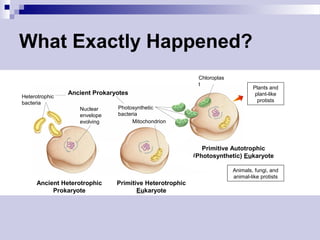
What Exactly Happened?
Heterotrophic
bacteria
Ancient Prokaryotes
Ancient Heterotrophic
Prokaryote
Primitive Heterotrophic
Eukaryote
Primitive Autotrophic
(Photosynthetic) Eukaryote
Chloroplas
t
Photosynthetic
bacteria
Nuclear
envelope
evolving Mitochondrion
Plants and
plant-like
protists
Animals, fungi, and
animal-like protists
Membrane-Bound Organelles
 Mitochondria =
membrane-bound
organelle that produces
energy for the cell
 Chloroplast =
membrane-bound
organelle that captures
sunlight and uses it to
make food for the cell
Evidence in support of the
endosymbiotic theory:
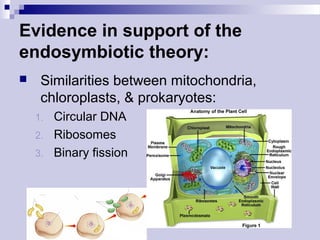
 Similarities between mitochondria,
chloroplasts, & prokaryotes:
1. Circular DNA
2. Ribosomes
3. Binary fission
Evidence in support of the
endosymbiotic theory:
 Similarities between mitochondria,
chloroplasts, & prokaryotes:
1. Circular DNA
2. Ribosomes
3. Binary fission

Endosymbiotic theory (2)

  • 1.
  • 2.
    The Endosymbiotic Theory Review:  What is a theory?  What is the difference between prokaryotic and eukaryotic cells?  The endosymbiotic theory is the idea that a long time ago, prokaryotic cells engulfed other prokaryotic cells by endocytosis. This resulted in the first eukaryotic cells.  First proposed by Lynn Margulis  Explains the origin of eukaryotic cells  Explains the origin of certain membrane-bound organelles
  • 3.
    What Exactly Happened? Heterotrophic bacteria AncientProkaryotes Ancient Heterotrophic Prokaryote Primitive Heterotrophic Eukaryote Primitive Autotrophic (Photosynthetic) Eukaryote Chloroplas t Photosynthetic bacteria Nuclear envelope evolving Mitochondrion Plants and plant-like protists Animals, fungi, and animal-like protists
  • 4.
    Membrane-Bound Organelles  Mitochondria= membrane-bound organelle that produces energy for the cell  Chloroplast = membrane-bound organelle that captures sunlight and uses it to make food for the cell
  • 5.
    Evidence in supportof the endosymbiotic theory:  Similarities between mitochondria, chloroplasts, & prokaryotes: 1. Circular DNA 2. Ribosomes 3. Binary fission
  • 6.
    Evidence in supportof the endosymbiotic theory:  Similarities between mitochondria, chloroplasts, & prokaryotes: 1. Circular DNA 2. Ribosomes 3. Binary fission