MARIAN UNIVERSITY COLLEGE
(A Constituents college of St. Augustine University of
Tanzania)
CYTOLOGY AND CELL PHYSIOLOGY
BIO 103
BY: EDDY TRAVELLER
eddyolotu3@gmail.com
0673189667
CONTENTS
Basic aspects of cell structure and function.
Structure organization of the cell.
Defining features of eukaryotic and prokaryotic
cell, Major cellular components, Organelles
typical of plant.
Cell surface specialization
Prokaryotic cell, bacteria, transport across the
membrane, Membrane structure lipid by layer,
fluid mosaic model.
Cell cycle, mitosis, meiosis, and energy capture in
cell.
COURSE BOOKS
Raven P. and Johnson G. (2008) Biology 8th
Edition.
Campbell and Reece (2008) 8th Edition.
Rastogi S. (2003) Cell and Molecular biology.
New age international publisher. New Delhi
COURSE ASSESMENT
Practical 20%
Test/Assignments/Quiz 20%
University Exam (U.E) 60%
Cell concept
• Cell is the basic unity of life.
• i.e. cell is the building block of life.

Evolution of Cell concept
There are scholars who put effort on the cell
concept, those are:-
Robert Hooke
Anton Van Leeuwenhoek
Mathias Schleiden
Theodor Schwann.
Rudolf Virchow
George Gey
Evolution of Cell Concept
Robert Hooke.
• He was British Microscopist
• He work on stoppers made up of cork (part of
bark of tree)
• He observe some pores on the cork by using
microscope.
• He called the pore the cells.
• In fact what he was observe was the empty cell
wall of dead plant tissue.
Evolution of Cell concept Cont.
Anton Van Leeuwenhoek.
• He was Dutch Trader.
• He use time to make microscope.
• He was the first to work on pond water which
he observe teeming animals he termed
“Animacules” (the modern bacteria and
protist )
Evolution of Cell concept Cont.
Mathias Schleiden.
• He was the German Lawyer, he then become
Botanist.
• He concluded that despite differences on the
structure of various tissues plants were made
up of cells.
• He stated that plant embryo arose from single
cell.
Evolution of Cell concept Cont.
Theodor Schwann.
• He was German Zoologist.
• He published work on the cellular basis of animal
life.
• He proposed the two tenets of the cell theory.
i. Every organism composed of a cell or cells,
ii. Cell is the structural unity of life.
Cell originated from non cellular materials by
spontaneous generation.
Evolution of Cell concept Cont.
Rudolf Virchow.
• German pathologist,
• In 1855 he made a convincing case for the
third tenet of the cell theory
• Cell arise only by division from pre existing
cell.
Evolution of Cell concept Cont.
George Gey.
• He was the first person to culture human cell.
• He obtained malignant tumor cell from
Herietta Lacks.
• He termed the cell HeLa after the donor
(Herietta Lacks)
• The in vitro grow cells (i.e. cells grow outside
the body) make the study of the cell easier
than the cells located in body.
Evolution of Cell concept Cont.
Requirements in Vitro Cell culture (White 1963)
a) Nutrients medium preparation, sterilization,
cleaning and storage of supplies.
b) Aseptic (no contamination) condition for
working the living material.
c) A controlled environmental conditions for
growth and development of cultures.
d) Observation and evolution of culture as hoped.
e) Recording the observations made during the
experiment.
Fundamental Properties of Cell
a) Self reproduction.
The ultimate thing a cell must do is to produce
copies of itself.
All cell are mortal, cell that do not produce will
go extinct.
Prior to division the genetic materials is
duplicated and each daughter cell receive a
complete and equal share of genetic
information.
Cell reproduce by division to form two daughter
cells.
Fundamental Properties of Cell Cont.
b) Cell posses a genetic program and the means
to use it.
• Organism are built according to information
encoded in a collection of genes in the DNA.
• Genes are more than storage locker for
information, they constitute the blueprints for
constructing cellular structure the direction
for running cellular activities and program for
making more of themselves.
Fundamental Properties of Cell Cont.
c) Cells are highly complex and organized.
The more complex the structure the
greater the number of part that must be
in their proper place, the more tolerance
the of errors in the nature and
interactions of parts and more regulation
or control that must be exerted to
maintain the system.
Fundamental Properties of Cell Cont.
d) Cells acquire and utilize energy.
• Developing and maintaining complexity
require the constant input of energy.
• The source of the energy required by life on
the earths surface is the EMR from the sun.
• It is trapped by light absorbing pigment.
• The light energy is converted by
photosynthesis.
Fundamental Properties of Cell Cont.
e) Cell carry out a variety of chemical reactions.
 Cell function like miniaturized chemical plants.
 Virtually all chemical changes that takes place
in cell require enzymes.
f) Cell engage in numerous mechanical
activities.
 Are site of building (liver, busy) activities.
 Transportation of material from place to place.
Fundamental Properties of Cell Cont.
 Structure are assembled and then rapidly disassembled
and in many cases the entire cell move itself from one
site to another.
g) Cell are able to respond to stimuli.
They are covered with receptors that are interact with
substances in the environment in highly specific ways.
Fore example, single cell protist move away from an
object in its path or move toward source of materials.
• Cell within a multicellular plant or animal respond to
stimuli less obviously.
Fundamental Properties of Cell Cont.
h) Ability to grow in an orderly way.
 Cell grow by adding more to its own tissue.
 If cell could not grow each generation of the cell could be
smaller than the last until cells become too small to do all
the necessary function.
i) Ability to synthesize the correct complex molecule.
• molecule synthesized by cell are such as protein, lipids,
DNA and Carbohydrate.
• They are made in the correct amount in the correct place
and in the correct times.
• Most of synthesis in the cell are directed by enzymes,
which are synthesized under the direction of genes.
TYPES OF THE CELLL
• There are two types of cell,
Eukaryotic cell
These are primitive cell whose nucleus and other
organelles are bounded in membrane.
Prokaryotic cell
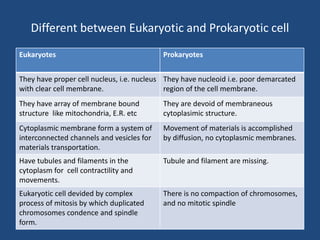
Different between Eukaryotic and Prokaryotic cell
Eukaryotes Prokaryotes
They have proper cell nucleus, i.e. nucleus
with clear cell membrane.
They have nucleoid i.e. poor demarcated
region of the cell membrane.
They have array of membrane bound
structure like mitochondria, E.R. etc
They are devoid of membraneous
cytoplasimic structure.
Cytoplasmic membrane form a system of
interconnected channels and vesicles for
materials transportation.
Movement of materials is accomplished
by diffusion, no cytoplasmic membranes.
Have tubules and filaments in the
cytoplasm for cell contractility and
movements.
Tubule and filament are missing.
Eukaryotic cell devided by complex
process of mitosis by which duplicated
chromosomes condence and spindle
form.
There is no compaction of chromosomes,
and no mitotic spindle
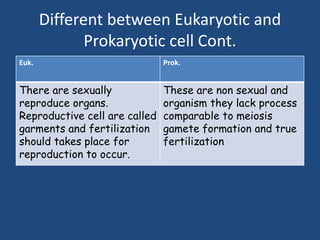
Different between Eukaryotic and
Prokaryotic cell Cont.
Euk. Prok.
There are sexually
reproduce organs.
Reproductive cell are called
garments and fertilization
should takes place for
reproduction to occur.
These are non sexual and
organism they lack process
comparable to meiosis
gamete formation and true
fertilization
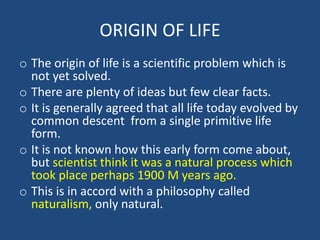
ORIGIN OF LIFE
o The origin of life is a scientific problem which is
not yet solved.
o There are plenty of ideas but few clear facts.
o It is generally agreed that all life today evolved by
common descent from a single primitive life
form.
o It is not known how this early form come about,
but scientist think it was a natural process which
took place perhaps 1900 M years ago.
o This is in accord with a philosophy called
naturalism, only natural.
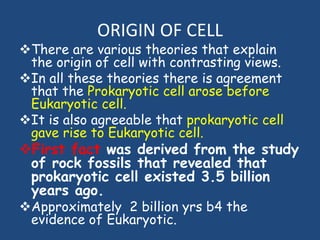
ORIGIN OF CELL
There are various theories that explain
the origin of cell with contrasting views.
In all these theories there is agreement
that the Prokaryotic cell arose before
Eukaryotic cell.
It is also agreeable that prokaryotic cell
gave rise to Eukaryotic cell.
First fact was derived from the study
of rock fossils that revealed that
prokaryotic cell existed 3.5 billion
years ago.
Approximately 2 billion yrs b4 the
evidence of Eukaryotic.
ORIGIN OF CELL Cont.
Second fact is that these cells are
related because they share many
complex traits.
 They have very similar genetic codes.
 The enzymes they poses are very
similar.
 Their plasma membrane are similar.
NB. With all this this cells must have
common evolution.
ORIGIN OF CELL Cont.
• From the year 1970 it was believed that
Eukaryotic cell originated from Prokaryotic
cell by the process called gradual evolution.
• In the process the organelles of
eukaryotic cell become progressively
complex.
• With growth of science and technology and
detail study of cell the ideas was refused.
• New idea came that certain organelles of
eukaryotic cell most notably mitochondria
and chloroplast evolved from smaller
prokaryotic cell that has taken residence
in large host cell.
SERIAL ENDOSYMBIOSIS THEORY
(S.E.T)
oIt explain how a simple composite
cell of greater complexity can
evolve from two or more separate
simple cells.
oThis composite cell live in a
symbiotic relationship with on
another.
oThe components of this theory are
described in stages
S.E.T Cont.
Firstly, Heterotrophic and anaerobic
eukaryotes ingested a small aerobic
prokaryotes.
The engulfed prokaryotes cell is said to
be ricketsia a modern group of micro
organisms that cause typhoid and other
diseases.
The endosymbiont evolve into
mitochondrion.
S.E.T Cont.
Second, the cell membrane
envarginated and formed nuclear
membrane and associated endoplasmic
reticulum.
S.E.T Cont.
Third, the resultant cell gave rise to two types
of eukaryotes.
1st were the animal cell fungi and
protists.
S.E.T Cont.
Fourth stage, In the other path the
primitive aerobic eukaryotes engulfed
photosynthetic prokaryotes that
become endosymbiont chloroplast.
The engulfed endosymbiont in this case
was cyano bacteria.
PROKARYOTIC CELL
• These are primitive cell whose nucleus
and other organelles are not bound in
membrane.
• They are grouped into two major groups
Archae bacteria
Eubacteria
Archae bacteria.
This are group of organism whose
evolution ties to one another as
revealed by similarities in the nucleic
acid sequence in the nucleotide.
PROKARYOTIC CELL Cont.
• The best known group of bacteria are the species
that live in the very hostile environments.
• They referred to as extremophites.
Examples
 Methanogens :- capable of converting carbon
dioxide and hydrogen into methane gas.
 Helophiles :- they live in extremely salty
environment i.e. dead sea.
 Acidophiles :- acid loving prokaryotes they live in
areas with PH as low as zero.
 Thermophiles :- prokaryotes that live at very high
temperature. E.g. Pyrolobus fumarii that live in
hydrothermal vent of the ocean floor.
they are able to reproduce in super heated water
of up to 113’C
PROKARYOTIC CELL Cont.
 Eubacteria.
• This domain include smallest living cells of up to
2um in diameter.
• They can occupy rock layer that are several km
beneath the earth surface.
• They carry out photosynthesis as other plant
species do. E.g. cynobacteria
• They can also perform nitrogen fixation.
• Being capable of photosynthesis and nitrogen
fixation bacteria can survive on harvest
resources.
• Cynobacteria being the classical example of
Eubacteria are usually the firstly to colonize
bare rock that are rendered life less by
scorching volcanic eruption.
EUKARYOTIC CELL
• Defn
• It has two groups
 Unicellular organism
 Mult-cellular organism
Unicellular organisms.
o These are single celled organisms that are
in most cases microscopic.
o They have all machinery required for the
complex activities they engage in, i.e.
sensing the environment, trapping food,
expelling excess fluid and avoiding
predators.
EUKARYOTIC CELL Cont.
 Mult-cellular organisms.
o These are organisms made up of many cells.
o A marked evolutionary trend with multicellular
organism is cell differentiation i.e. different
activities are performed by specialized cells.
o Soon after egg fertilization in vertebrates the
fertilized egg progress hundreds of possible
pathways.
o Some cell becomes part of particular digestive
gland.
o Other part of skeletal muscles
o Other become part of bones etc.
EUKARYOTIC CELL Cont.
o Unique to differentiation is that different type of cells
acquire unique distinctive appearance and contain unique
material for their roles.
o Example :
o Skeletal muscle cells = contain a network of precisely
aligned filaments composed of unique of contractile
protein.
o Cartilage cell = contain matrix with polysaccharide and
protein collagen for mechanical support.
o Red blood cells = they are disc shaped sacs, they contain
single protein haemoglobin with affinity to oxygen and
hence efficient in oxygen transport.
o Brow adipose tissue = convert energy, have high number of
mitochondria.
o Plasma cell = they are specialized for production of
antibodies, they posses few number of mitochondria but
extensive endoplasmic reticulum.
THE END
THANK YOU FOR BEING KEEN
MAY THE GOD BLESS YOU AND GUARANTEE
YOUR SUCCES.
MUCH THANX TO : EDDY TRAVELLER

Lecture 1.cell physiology

  • 1.
    MARIAN UNIVERSITY COLLEGE (AConstituents college of St. Augustine University of Tanzania) CYTOLOGY AND CELL PHYSIOLOGY BIO 103 BY: EDDY TRAVELLER eddyolotu3@gmail.com 0673189667
  • 2.
    CONTENTS Basic aspects ofcell structure and function. Structure organization of the cell. Defining features of eukaryotic and prokaryotic cell, Major cellular components, Organelles typical of plant. Cell surface specialization Prokaryotic cell, bacteria, transport across the membrane, Membrane structure lipid by layer, fluid mosaic model. Cell cycle, mitosis, meiosis, and energy capture in cell.
  • 3.
    COURSE BOOKS Raven P.and Johnson G. (2008) Biology 8th Edition. Campbell and Reece (2008) 8th Edition. Rastogi S. (2003) Cell and Molecular biology. New age international publisher. New Delhi
  • 4.
  • 5.
    Cell concept • Cellis the basic unity of life. • i.e. cell is the building block of life.
  • 6.
    Evolution of Cellconcept There are scholars who put effort on the cell concept, those are:- Robert Hooke Anton Van Leeuwenhoek Mathias Schleiden Theodor Schwann. Rudolf Virchow George Gey
  • 7.
    Evolution of CellConcept Robert Hooke. • He was British Microscopist • He work on stoppers made up of cork (part of bark of tree) • He observe some pores on the cork by using microscope. • He called the pore the cells. • In fact what he was observe was the empty cell wall of dead plant tissue.
  • 8.
    Evolution of Cellconcept Cont. Anton Van Leeuwenhoek. • He was Dutch Trader. • He use time to make microscope. • He was the first to work on pond water which he observe teeming animals he termed “Animacules” (the modern bacteria and protist )
  • 9.
    Evolution of Cellconcept Cont. Mathias Schleiden. • He was the German Lawyer, he then become Botanist. • He concluded that despite differences on the structure of various tissues plants were made up of cells. • He stated that plant embryo arose from single cell.
  • 10.
    Evolution of Cellconcept Cont. Theodor Schwann. • He was German Zoologist. • He published work on the cellular basis of animal life. • He proposed the two tenets of the cell theory. i. Every organism composed of a cell or cells, ii. Cell is the structural unity of life. Cell originated from non cellular materials by spontaneous generation.
  • 11.
    Evolution of Cellconcept Cont. Rudolf Virchow. • German pathologist, • In 1855 he made a convincing case for the third tenet of the cell theory • Cell arise only by division from pre existing cell.
  • 12.
    Evolution of Cellconcept Cont. George Gey. • He was the first person to culture human cell. • He obtained malignant tumor cell from Herietta Lacks. • He termed the cell HeLa after the donor (Herietta Lacks) • The in vitro grow cells (i.e. cells grow outside the body) make the study of the cell easier than the cells located in body.
  • 13.
    Evolution of Cellconcept Cont. Requirements in Vitro Cell culture (White 1963) a) Nutrients medium preparation, sterilization, cleaning and storage of supplies. b) Aseptic (no contamination) condition for working the living material. c) A controlled environmental conditions for growth and development of cultures. d) Observation and evolution of culture as hoped. e) Recording the observations made during the experiment.
  • 14.
    Fundamental Properties ofCell a) Self reproduction. The ultimate thing a cell must do is to produce copies of itself. All cell are mortal, cell that do not produce will go extinct. Prior to division the genetic materials is duplicated and each daughter cell receive a complete and equal share of genetic information. Cell reproduce by division to form two daughter cells.
  • 15.
    Fundamental Properties ofCell Cont. b) Cell posses a genetic program and the means to use it. • Organism are built according to information encoded in a collection of genes in the DNA. • Genes are more than storage locker for information, they constitute the blueprints for constructing cellular structure the direction for running cellular activities and program for making more of themselves.
  • 16.
    Fundamental Properties ofCell Cont. c) Cells are highly complex and organized. The more complex the structure the greater the number of part that must be in their proper place, the more tolerance the of errors in the nature and interactions of parts and more regulation or control that must be exerted to maintain the system.
  • 17.
    Fundamental Properties ofCell Cont. d) Cells acquire and utilize energy. • Developing and maintaining complexity require the constant input of energy. • The source of the energy required by life on the earths surface is the EMR from the sun. • It is trapped by light absorbing pigment. • The light energy is converted by photosynthesis.
  • 18.
    Fundamental Properties ofCell Cont. e) Cell carry out a variety of chemical reactions.  Cell function like miniaturized chemical plants.  Virtually all chemical changes that takes place in cell require enzymes. f) Cell engage in numerous mechanical activities.  Are site of building (liver, busy) activities.  Transportation of material from place to place.
  • 19.
    Fundamental Properties ofCell Cont.  Structure are assembled and then rapidly disassembled and in many cases the entire cell move itself from one site to another. g) Cell are able to respond to stimuli. They are covered with receptors that are interact with substances in the environment in highly specific ways. Fore example, single cell protist move away from an object in its path or move toward source of materials. • Cell within a multicellular plant or animal respond to stimuli less obviously.
  • 20.
    Fundamental Properties ofCell Cont. h) Ability to grow in an orderly way.  Cell grow by adding more to its own tissue.  If cell could not grow each generation of the cell could be smaller than the last until cells become too small to do all the necessary function. i) Ability to synthesize the correct complex molecule. • molecule synthesized by cell are such as protein, lipids, DNA and Carbohydrate. • They are made in the correct amount in the correct place and in the correct times. • Most of synthesis in the cell are directed by enzymes, which are synthesized under the direction of genes.
  • 21.
    TYPES OF THECELLL • There are two types of cell, Eukaryotic cell These are primitive cell whose nucleus and other organelles are bounded in membrane. Prokaryotic cell
  • 22.
    Different between Eukaryoticand Prokaryotic cell Eukaryotes Prokaryotes They have proper cell nucleus, i.e. nucleus with clear cell membrane. They have nucleoid i.e. poor demarcated region of the cell membrane. They have array of membrane bound structure like mitochondria, E.R. etc They are devoid of membraneous cytoplasimic structure. Cytoplasmic membrane form a system of interconnected channels and vesicles for materials transportation. Movement of materials is accomplished by diffusion, no cytoplasmic membranes. Have tubules and filaments in the cytoplasm for cell contractility and movements. Tubule and filament are missing. Eukaryotic cell devided by complex process of mitosis by which duplicated chromosomes condence and spindle form. There is no compaction of chromosomes, and no mitotic spindle
  • 23.
    Different between Eukaryoticand Prokaryotic cell Cont. Euk. Prok. There are sexually reproduce organs. Reproductive cell are called garments and fertilization should takes place for reproduction to occur. These are non sexual and organism they lack process comparable to meiosis gamete formation and true fertilization
  • 24.
    ORIGIN OF LIFE oThe origin of life is a scientific problem which is not yet solved. o There are plenty of ideas but few clear facts. o It is generally agreed that all life today evolved by common descent from a single primitive life form. o It is not known how this early form come about, but scientist think it was a natural process which took place perhaps 1900 M years ago. o This is in accord with a philosophy called naturalism, only natural.
  • 25.
    ORIGIN OF CELL Thereare various theories that explain the origin of cell with contrasting views. In all these theories there is agreement that the Prokaryotic cell arose before Eukaryotic cell. It is also agreeable that prokaryotic cell gave rise to Eukaryotic cell. First fact was derived from the study of rock fossils that revealed that prokaryotic cell existed 3.5 billion years ago. Approximately 2 billion yrs b4 the evidence of Eukaryotic.
  • 26.
    ORIGIN OF CELLCont. Second fact is that these cells are related because they share many complex traits.  They have very similar genetic codes.  The enzymes they poses are very similar.  Their plasma membrane are similar. NB. With all this this cells must have common evolution.
  • 27.
    ORIGIN OF CELLCont. • From the year 1970 it was believed that Eukaryotic cell originated from Prokaryotic cell by the process called gradual evolution. • In the process the organelles of eukaryotic cell become progressively complex. • With growth of science and technology and detail study of cell the ideas was refused. • New idea came that certain organelles of eukaryotic cell most notably mitochondria and chloroplast evolved from smaller prokaryotic cell that has taken residence in large host cell.
  • 28.
    SERIAL ENDOSYMBIOSIS THEORY (S.E.T) oItexplain how a simple composite cell of greater complexity can evolve from two or more separate simple cells. oThis composite cell live in a symbiotic relationship with on another. oThe components of this theory are described in stages
  • 29.
    S.E.T Cont. Firstly, Heterotrophicand anaerobic eukaryotes ingested a small aerobic prokaryotes. The engulfed prokaryotes cell is said to be ricketsia a modern group of micro organisms that cause typhoid and other diseases. The endosymbiont evolve into mitochondrion.
  • 30.
    S.E.T Cont. Second, thecell membrane envarginated and formed nuclear membrane and associated endoplasmic reticulum.
  • 31.
    S.E.T Cont. Third, theresultant cell gave rise to two types of eukaryotes. 1st were the animal cell fungi and protists.
  • 32.
    S.E.T Cont. Fourth stage,In the other path the primitive aerobic eukaryotes engulfed photosynthetic prokaryotes that become endosymbiont chloroplast. The engulfed endosymbiont in this case was cyano bacteria.
  • 33.
    PROKARYOTIC CELL • Theseare primitive cell whose nucleus and other organelles are not bound in membrane. • They are grouped into two major groups Archae bacteria Eubacteria Archae bacteria. This are group of organism whose evolution ties to one another as revealed by similarities in the nucleic acid sequence in the nucleotide.
  • 34.
    PROKARYOTIC CELL Cont. •The best known group of bacteria are the species that live in the very hostile environments. • They referred to as extremophites. Examples  Methanogens :- capable of converting carbon dioxide and hydrogen into methane gas.  Helophiles :- they live in extremely salty environment i.e. dead sea.  Acidophiles :- acid loving prokaryotes they live in areas with PH as low as zero.  Thermophiles :- prokaryotes that live at very high temperature. E.g. Pyrolobus fumarii that live in hydrothermal vent of the ocean floor. they are able to reproduce in super heated water of up to 113’C
  • 35.
    PROKARYOTIC CELL Cont. Eubacteria. • This domain include smallest living cells of up to 2um in diameter. • They can occupy rock layer that are several km beneath the earth surface. • They carry out photosynthesis as other plant species do. E.g. cynobacteria • They can also perform nitrogen fixation. • Being capable of photosynthesis and nitrogen fixation bacteria can survive on harvest resources. • Cynobacteria being the classical example of Eubacteria are usually the firstly to colonize bare rock that are rendered life less by scorching volcanic eruption.
  • 36.
    EUKARYOTIC CELL • Defn •It has two groups  Unicellular organism  Mult-cellular organism Unicellular organisms. o These are single celled organisms that are in most cases microscopic. o They have all machinery required for the complex activities they engage in, i.e. sensing the environment, trapping food, expelling excess fluid and avoiding predators.
  • 37.
    EUKARYOTIC CELL Cont. Mult-cellular organisms. o These are organisms made up of many cells. o A marked evolutionary trend with multicellular organism is cell differentiation i.e. different activities are performed by specialized cells. o Soon after egg fertilization in vertebrates the fertilized egg progress hundreds of possible pathways. o Some cell becomes part of particular digestive gland. o Other part of skeletal muscles o Other become part of bones etc.
  • 38.
    EUKARYOTIC CELL Cont. oUnique to differentiation is that different type of cells acquire unique distinctive appearance and contain unique material for their roles. o Example : o Skeletal muscle cells = contain a network of precisely aligned filaments composed of unique of contractile protein. o Cartilage cell = contain matrix with polysaccharide and protein collagen for mechanical support. o Red blood cells = they are disc shaped sacs, they contain single protein haemoglobin with affinity to oxygen and hence efficient in oxygen transport. o Brow adipose tissue = convert energy, have high number of mitochondria. o Plasma cell = they are specialized for production of antibodies, they posses few number of mitochondria but extensive endoplasmic reticulum.
  • 39.
    THE END THANK YOUFOR BEING KEEN MAY THE GOD BLESS YOU AND GUARANTEE YOUR SUCCES. MUCH THANX TO : EDDY TRAVELLER

Editor's Notes