Assignment on Mitosis Cell Division
Course Code- BAB-503
Course Title- Molecular Cell Biology
MASTER OF SEED SCIENCE AND
TECHNOLOGY
Division of Seed Science & Technology
DRPCAU – Dr. Rajendra prasad central agriculture university
pusa, Samastipur, Bihar
Submitte to-
Dr. Kumari Anjani
Presenting by
Dinesh Choudhary 2103211005
Cell
Cell is the structural and functional unit of all living organisms.
Rudolf Virchow (1855) first explained that cells divided and new cells are formed from pre-existing
cells(omnis cellula-e-cellula).
Cell division
 Cell division is the process by which a parent cell divides into two or more daughter cells.
Cell division in plant described by-E.Strasburger in 1875.
Cell division is a continuous process of all living organisms.
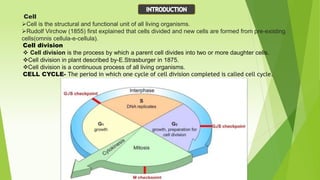
CELL CYCLE- The period in which one cycle of cell division completed is called cell cycle.
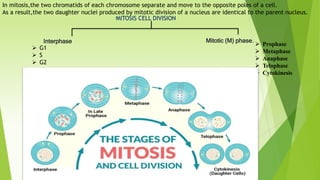
MITOSIS CELL DIVISION
Interphase Mitotic (M) phase.
 G1
 S
 G2
 Prophase
 Metaphase
 Anaphase
 Telophase
 Cytokinesis
In mitosis,the two chromatids of each chromosome separate and move to the opposite poles of a cell.
As a result,the two daughter nuclei produced by mitotic division of a nucleus are identical to the parent nucleus.
• During interphase, the cell grows and makes a copy of its DNA.
• During the mitotic (M) phase, the cell separates its DNA into two sets and divides its cytoplasm, forming two new
cells.
• It is longest stage of cell cycle.
• All the nondividing and differentiated cells are present in this stage ; such cells are enter in QUIESCENT(G0
stage.)
Interphase
•G1​ phase. During G1 phase also called the first gap phase
-the cell grows physically larger, copies organelles, and makes the molecular
building blocks it will need in later steps.
-It is tightly monitored by a biochemical checkpoint(G1checkpoint).
•S phase. In S phase, the cell synthesizes a complete copy of the DNA in its
nucleus.
-It also duplicates a microtubule-organizing structure called the centrosome.
-The centrosomes help separate DNA during M phase.
•G2phase. During the second gap phase, or G2 phase
-the cell grows more, makes proteins and organelles, and begins to reorganize its
contents in preparation for mitosis.
-G2 phase ends when mitosis begins.
-It is also tightly monitored by a biochemical checkpoint(G2 Checkpoint).
- Another checkpoint in between M-Phase of the cell cycle and it is known as M-
MITOTIC PHASE-
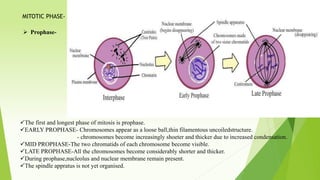
 Prophase-
The first and longest phase of mitosis is prophase.
EARLY PROPHASE- Chromosomes appear as a loose ball,thin filamentous uncoiledstructure.
- chromosomes become increasingly shoeter and thicker due to increased condensation.
MID PROPHASE-The two chromatids of each chromosome become visible.
LATE PROPHASE-All the chromosomes become considerably shorter and thicker.
During prophase,nucleolus and nuclear membrane remain present.
The spindle appratus is not yet organised.
Metaphase
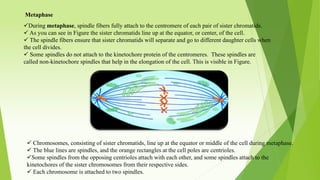
During metaphase, spindle fibers fully attach to the centromere of each pair of sister chromatids.
 As you can see in Figure the sister chromatids line up at the equator, or center, of the cell.
 The spindle fibers ensure that sister chromatids will separate and go to different daughter cells when
the cell divides.
 Some spindles do not attach to the kinetochore protein of the centromeres. These spindles are
called non-kinetochore spindles that help in the elongation of the cell. This is visible in Figure.
 Chromosomes, consisting of sister chromatids, line up at the equator or middle of the cell during metaphase.
 The blue lines are spindles, and the orange rectangles at the cell poles are centrioles.
Some spindles from the opposing centrioles attach with each other, and some spindles attach to the
kinetochores of the sister chromosomes from their respective sides.
 Each chromosome is attached to two spindles.
Anaphase
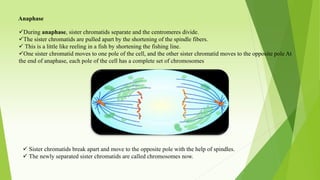
During anaphase, sister chromatids separate and the centromeres divide.
The sister chromatids are pulled apart by the shortening of the spindle fibers.
 This is a little like reeling in a fish by shortening the fishing line.
One sister chromatid moves to one pole of the cell, and the other sister chromatid moves to the opposite pole At
the end of anaphase, each pole of the cell has a complete set of chromosomes
 Sister chromatids break apart and move to the opposite pole with the help of spindles.
 The newly separated sister chromatids are called chromosomes now.
Telophase
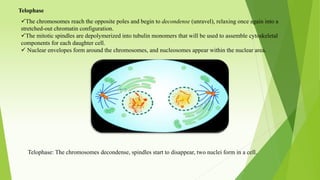
The chromosomes reach the opposite poles and begin to decondense (unravel), relaxing once again into a
stretched-out chromatin configuration.
The mitotic spindles are depolymerized into tubulin monomers that will be used to assemble cytoskeletal
components for each daughter cell.
 Nuclear envelopes form around the chromosomes, and nucleosomes appear within the nuclear area.
Telophase: The chromosomes decondense, spindles start to disappear, two nuclei form in a cell.
Cytokinesis
Cytokinesis is the final stage of cell division in eukaryotes as well as prokaryotes.
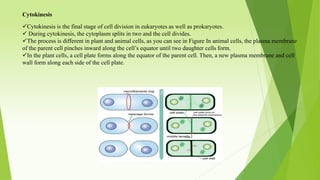
 During cytokinesis, the cytoplasm splits in two and the cell divides.
The process is different in plant and animal cells, as you can see in Figure In animal cells, the plasma membrane
of the parent cell pinches inward along the cell’s equator until two daughter cells form.
In the plant cells, a cell plate forms along the equator of the parent cell. Then, a new plasma membrane and cell
wall form along each side of the cell plate.
Importance of mitosis:-
They help in increasing the cell count or it is simply called as growth.
They help in repairing the damaged cells or regrowth of cells in cuts or wounds.
Production of new organs,e.g., root and shoot branches in plants.
It helps in asexual reproduction, where the maintenance of chromosomes in the
daughter cells is necessary.
In plants,production of male and female gamets through mitosis in micro and mega
spores respectively.
Mitosis maintains the genetic stability in the newly formed cells.
Refrence- Principles of genitics (Phundan singh)
Fundamentals of genetics (B.D Singh)
Images from WWW.google.com
DINESH CHOUDHARY.pptx

DINESH CHOUDHARY.pptx

  • 1.
    Assignment on MitosisCell Division Course Code- BAB-503 Course Title- Molecular Cell Biology MASTER OF SEED SCIENCE AND TECHNOLOGY Division of Seed Science & Technology DRPCAU – Dr. Rajendra prasad central agriculture university pusa, Samastipur, Bihar Submitte to- Dr. Kumari Anjani Presenting by Dinesh Choudhary 2103211005
  • 2.
    Cell Cell is thestructural and functional unit of all living organisms. Rudolf Virchow (1855) first explained that cells divided and new cells are formed from pre-existing cells(omnis cellula-e-cellula). Cell division  Cell division is the process by which a parent cell divides into two or more daughter cells. Cell division in plant described by-E.Strasburger in 1875. Cell division is a continuous process of all living organisms. CELL CYCLE- The period in which one cycle of cell division completed is called cell cycle.
  • 3.
    MITOSIS CELL DIVISION InterphaseMitotic (M) phase.  G1  S  G2  Prophase  Metaphase  Anaphase  Telophase  Cytokinesis In mitosis,the two chromatids of each chromosome separate and move to the opposite poles of a cell. As a result,the two daughter nuclei produced by mitotic division of a nucleus are identical to the parent nucleus.
  • 4.
    • During interphase,the cell grows and makes a copy of its DNA. • During the mitotic (M) phase, the cell separates its DNA into two sets and divides its cytoplasm, forming two new cells. • It is longest stage of cell cycle. • All the nondividing and differentiated cells are present in this stage ; such cells are enter in QUIESCENT(G0 stage.) Interphase •G1​ phase. During G1 phase also called the first gap phase -the cell grows physically larger, copies organelles, and makes the molecular building blocks it will need in later steps. -It is tightly monitored by a biochemical checkpoint(G1checkpoint). •S phase. In S phase, the cell synthesizes a complete copy of the DNA in its nucleus. -It also duplicates a microtubule-organizing structure called the centrosome. -The centrosomes help separate DNA during M phase. •G2phase. During the second gap phase, or G2 phase -the cell grows more, makes proteins and organelles, and begins to reorganize its contents in preparation for mitosis. -G2 phase ends when mitosis begins. -It is also tightly monitored by a biochemical checkpoint(G2 Checkpoint). - Another checkpoint in between M-Phase of the cell cycle and it is known as M-
  • 5.
    MITOTIC PHASE-  Prophase- Thefirst and longest phase of mitosis is prophase. EARLY PROPHASE- Chromosomes appear as a loose ball,thin filamentous uncoiledstructure. - chromosomes become increasingly shoeter and thicker due to increased condensation. MID PROPHASE-The two chromatids of each chromosome become visible. LATE PROPHASE-All the chromosomes become considerably shorter and thicker. During prophase,nucleolus and nuclear membrane remain present. The spindle appratus is not yet organised.
  • 6.
    Metaphase During metaphase, spindlefibers fully attach to the centromere of each pair of sister chromatids.  As you can see in Figure the sister chromatids line up at the equator, or center, of the cell.  The spindle fibers ensure that sister chromatids will separate and go to different daughter cells when the cell divides.  Some spindles do not attach to the kinetochore protein of the centromeres. These spindles are called non-kinetochore spindles that help in the elongation of the cell. This is visible in Figure.  Chromosomes, consisting of sister chromatids, line up at the equator or middle of the cell during metaphase.  The blue lines are spindles, and the orange rectangles at the cell poles are centrioles. Some spindles from the opposing centrioles attach with each other, and some spindles attach to the kinetochores of the sister chromosomes from their respective sides.  Each chromosome is attached to two spindles.
  • 7.
    Anaphase During anaphase, sisterchromatids separate and the centromeres divide. The sister chromatids are pulled apart by the shortening of the spindle fibers.  This is a little like reeling in a fish by shortening the fishing line. One sister chromatid moves to one pole of the cell, and the other sister chromatid moves to the opposite pole At the end of anaphase, each pole of the cell has a complete set of chromosomes  Sister chromatids break apart and move to the opposite pole with the help of spindles.  The newly separated sister chromatids are called chromosomes now.
  • 8.
    Telophase The chromosomes reachthe opposite poles and begin to decondense (unravel), relaxing once again into a stretched-out chromatin configuration. The mitotic spindles are depolymerized into tubulin monomers that will be used to assemble cytoskeletal components for each daughter cell.  Nuclear envelopes form around the chromosomes, and nucleosomes appear within the nuclear area. Telophase: The chromosomes decondense, spindles start to disappear, two nuclei form in a cell.
  • 9.
    Cytokinesis Cytokinesis is thefinal stage of cell division in eukaryotes as well as prokaryotes.  During cytokinesis, the cytoplasm splits in two and the cell divides. The process is different in plant and animal cells, as you can see in Figure In animal cells, the plasma membrane of the parent cell pinches inward along the cell’s equator until two daughter cells form. In the plant cells, a cell plate forms along the equator of the parent cell. Then, a new plasma membrane and cell wall form along each side of the cell plate.
  • 10.
    Importance of mitosis:- Theyhelp in increasing the cell count or it is simply called as growth. They help in repairing the damaged cells or regrowth of cells in cuts or wounds. Production of new organs,e.g., root and shoot branches in plants. It helps in asexual reproduction, where the maintenance of chromosomes in the daughter cells is necessary. In plants,production of male and female gamets through mitosis in micro and mega spores respectively. Mitosis maintains the genetic stability in the newly formed cells. Refrence- Principles of genitics (Phundan singh) Fundamentals of genetics (B.D Singh) Images from WWW.google.com