By: Suraj Choudhary II nd  B.pharm 2009-10
Homeostasis  : The “steady state” that cell exists in normally. An equilibrium of the cells with their environment    for adequate function. When disturbed there is a predisposal for the onset of  pathology.
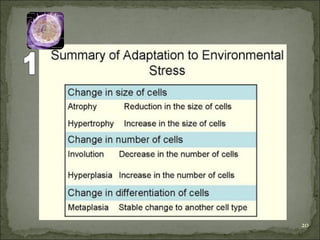
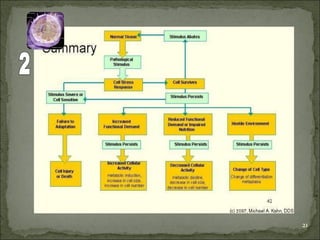
Cells adapt to changes (stimuli, stressors). Adaptations occur on a spectrum. Some are: helpful : hypertrophy or hyperplasia increase organ size so it can function better more  harm  than good. Example: increased organ size requires more blood supply. If that is not available, organ becomes ischemic 2. Adaptation can involve: change in cell size or number change to different type of cell
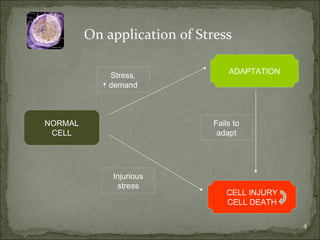
On application of Stress NORMAL CELL ADAPTATION CELL INJURY CELL DEATH Stress, demand Fails to adapt Injurious stress
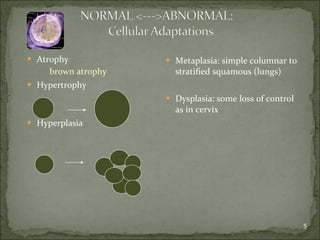
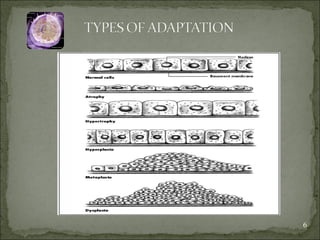
Atrophy brown atrophy Hypertrophy Hyperplasia Metaplasia: simple columnar to stratified squamous (lungs) Dysplasia: some loss of control as in cervix
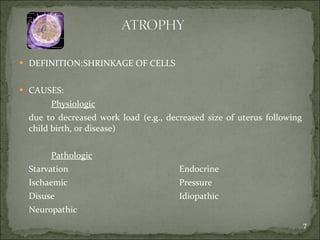
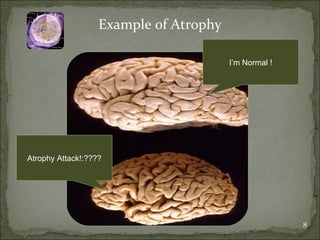
DEFINITION: SHRINKAGE OF CELLS CAUSES: Physiologic due to decreased work load (e.g., decreased size of uterus following child birth, or disease)  Pathologic Starvation Endocrine Ischaemic Pressure Disuse Idiopathic Neuropathic
Example of Atrophy I’m Normal ! Atrophy Attack!:????
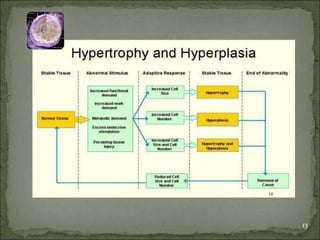
DEFINITION:  In the size of cells which results in enlargement of the organs , without any change in the no. of cells It is mostly seen in cells that cannot divide, such as skeletal muscle (pumping iron), and  cardiac muscle (hypertension).  These changes usually revert to normal if the cause is removed.  Hypertrophy is mediated by different mechanisms. Dividing cell  Hypertrophy + Hyperplasia Non-dividing cell Hypertrophy
Causes   of   Hypertrophy Physiologic Enlarged size of uterus in pregnancy Action of estrogenic hormones Pathologic Hypertrophy of cardiac muscle Hypertrophy of Smooth muscle Hypertrophy of skeletal muscle Compensatory Hypertrophy
DEFINITION:   Increased number of cells in an organ or tissue. Hyperplasia may sometimes co-exist with hypertrophy.  Hyperplasia can be classified as:  Physiologic --hormonal (e.g., breast and uterus during pregnancy)  Compensatory --regeneration of liver following partial hepatectomy. Various growth factors and interluekins are important in such hyperplasia.  Pathologic --excessive hormonal stimulation viral infection (papilloma viruses); neoplasms
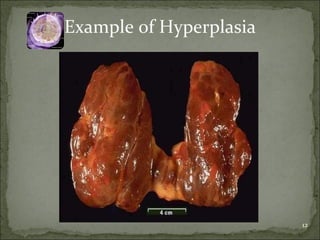
Example of Hyperplasia
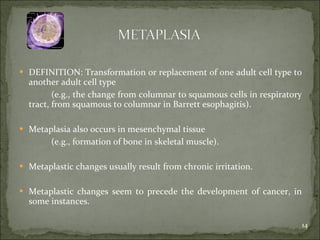
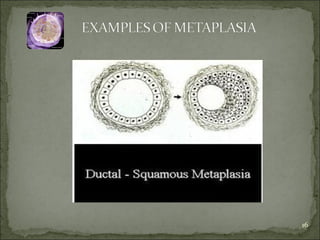
DEFINITION: Transformation or replacement of one adult cell type to another adult cell type  (e.g., the change from columnar to squamous cells in respiratory tract, from squamous to columnar in Barrett esophagitis).  Metaplasia also occurs in mesenchymal tissue  (e.g., formation of bone in skeletal muscle). Metaplastic changes usually result from chronic irritation. Metaplastic changes seem to precede the development of cancer, in some instances.
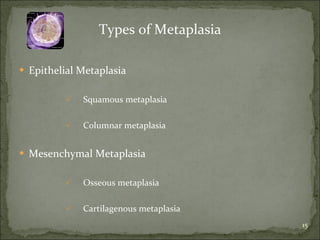
Types of Metaplasia Epithelial Metaplasia Squamous metaplasia Columnar metaplasia Mesenchymal Metaplasia Osseous metaplasia Cartilagenous metaplasia
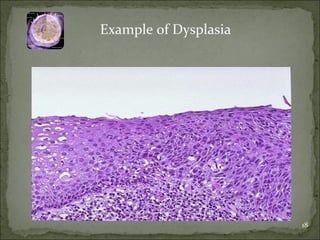
DYSPLASIA The term “dysplasia” means “disordered cellular development” It often accompanied by metaplasia & hyperplasia,thereby also referred as Atypical Hyperplaisa Short Duration Reversible Long Duration Carcinoma Cancer It may occurs due to Chronic Irritation or Prolonged inflammation.
Example of Dysplasia
Key Facts Adaptable within physiological limits. Heat Shock Proteins (HSPs):   Can respond to injury by producing cell stree proteins. Demand met by Hypertrophy & Hyperplasia. Demand met by Atrophy. Apoptosis :   Cell loss can be achieved from Programmed cell death Tissue can adapt to demand by a change in differentiation known as Metaplasia.
1
2
Cell Adaptation

Cell Adaptation

  • 1.
    By: Suraj ChoudharyII nd B.pharm 2009-10
  • 2.
    Homeostasis :The “steady state” that cell exists in normally. An equilibrium of the cells with their environment for adequate function. When disturbed there is a predisposal for the onset of pathology.
  • 3.
    Cells adapt tochanges (stimuli, stressors). Adaptations occur on a spectrum. Some are: helpful : hypertrophy or hyperplasia increase organ size so it can function better more harm than good. Example: increased organ size requires more blood supply. If that is not available, organ becomes ischemic 2. Adaptation can involve: change in cell size or number change to different type of cell
  • 4.
    On application ofStress NORMAL CELL ADAPTATION CELL INJURY CELL DEATH Stress, demand Fails to adapt Injurious stress
  • 5.
    Atrophy brown atrophyHypertrophy Hyperplasia Metaplasia: simple columnar to stratified squamous (lungs) Dysplasia: some loss of control as in cervix
  • 7.
    DEFINITION: SHRINKAGE OFCELLS CAUSES: Physiologic due to decreased work load (e.g., decreased size of uterus following child birth, or disease) Pathologic Starvation Endocrine Ischaemic Pressure Disuse Idiopathic Neuropathic
  • 8.
    Example of AtrophyI’m Normal ! Atrophy Attack!:????
  • 9.
    DEFINITION: Inthe size of cells which results in enlargement of the organs , without any change in the no. of cells It is mostly seen in cells that cannot divide, such as skeletal muscle (pumping iron), and cardiac muscle (hypertension). These changes usually revert to normal if the cause is removed. Hypertrophy is mediated by different mechanisms. Dividing cell Hypertrophy + Hyperplasia Non-dividing cell Hypertrophy
  • 10.
    Causes of Hypertrophy Physiologic Enlarged size of uterus in pregnancy Action of estrogenic hormones Pathologic Hypertrophy of cardiac muscle Hypertrophy of Smooth muscle Hypertrophy of skeletal muscle Compensatory Hypertrophy
  • 11.
    DEFINITION: Increased number of cells in an organ or tissue. Hyperplasia may sometimes co-exist with hypertrophy. Hyperplasia can be classified as: Physiologic --hormonal (e.g., breast and uterus during pregnancy) Compensatory --regeneration of liver following partial hepatectomy. Various growth factors and interluekins are important in such hyperplasia. Pathologic --excessive hormonal stimulation viral infection (papilloma viruses); neoplasms
  • 12.
  • 14.
    DEFINITION: Transformation orreplacement of one adult cell type to another adult cell type (e.g., the change from columnar to squamous cells in respiratory tract, from squamous to columnar in Barrett esophagitis). Metaplasia also occurs in mesenchymal tissue (e.g., formation of bone in skeletal muscle). Metaplastic changes usually result from chronic irritation. Metaplastic changes seem to precede the development of cancer, in some instances.
  • 15.
    Types of MetaplasiaEpithelial Metaplasia Squamous metaplasia Columnar metaplasia Mesenchymal Metaplasia Osseous metaplasia Cartilagenous metaplasia
  • 17.
    DYSPLASIA The term“dysplasia” means “disordered cellular development” It often accompanied by metaplasia & hyperplasia,thereby also referred as Atypical Hyperplaisa Short Duration Reversible Long Duration Carcinoma Cancer It may occurs due to Chronic Irritation or Prolonged inflammation.
  • 18.
  • 19.
    Key Facts Adaptablewithin physiological limits. Heat Shock Proteins (HSPs): Can respond to injury by producing cell stree proteins. Demand met by Hypertrophy & Hyperplasia. Demand met by Atrophy. Apoptosis : Cell loss can be achieved from Programmed cell death Tissue can adapt to demand by a change in differentiation known as Metaplasia.
  • 20.
  • 21.