1
Disturbances of growth of cells
(CANCER)
Prepared by:
Prof. Mirza Anwar Baig
AIKTC's School of Pharmacy
1
2
At the end of the chapter you should be
able to.....
Compare the benign and malignant tumor.
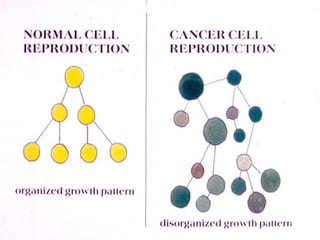
Describe the pathogenesis of cancer.
Enlist the causes of cancer.
3
DEFINITIONS
1. Cancer is a disease of the cell
2. Large group of diseases characterized by:
a. Abnormal cell structure (no differentiation)
b. Uncontrolled growth (proliferation)
c. Ability to spread (metastasis)
d. Ability to invade normal tissue (lack contact
inhibition)
3
4
Definations contd:
Neoplasm
“new plasma”…abnormal tissue growth with rapid
growth
Benign
no metastasis
Malignant
local invasion and destructive growth…”wicked”
Metastasis
spread form primary via lymphatic and/or
circulatory system
4
5
STATISTICS
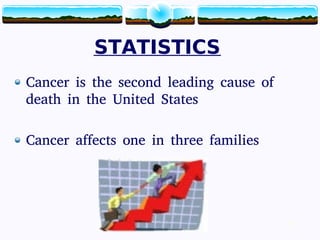
Cancer is the second leading cause of
death in the United States
Cancer affects one in three families
5
66
7
Cancer cells follow no rules
and have the ability to
stimulate the growth of a
new blood supply
7
8
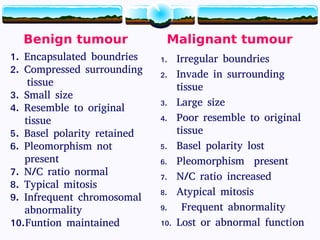
Benign tumour Malignant tumour
1. Encapsulated boundries
2. Compressed surrounding
tissue
3. Small size
4. Resemble to original
tissue
5. Basel polarity retained
6. Pleomorphism not
present
7. N/C ratio normal
8. Typical mitosis
9. Infrequent chromosomal
abnormality
10.Funtion maintained
1. Irregular boundries
2. Invade in surrounding
tissue
3. Large size
4. Poor resemble to original
tissue
5. Basel polarity lost
6. Pleomorphism present
7. N/C ratio increased
8. Atypical mitosis
9. Frequent abnormality
10. Lost or abnormal function8
9
Benign tumour Malignant tumour
8. Growth rate usually slow
9. No invasion in surrounding
10.Metastasis absent
11.Local complication present
8. Rapid growth
9. Invade the adjacent tissue
10.Metastasis present
11.Death by local and
metastatic complication
9
10
Incidence of cancer depends on
a) Predisposing factors
Familial and genetic factors
Racial and geographical factors
Environmental and cultural factors
Age
Sex
b) Chronic non neoplastic (pre-malignant) conditions- to
prevent occurrence, characterstics of morphological
changes
c) Hormones
- Oestrogen- for experimental induction,
oestrogen therapy
- hormonal contraceptive- breast cancer
- Anabolic steriod- in athletes-liver cancer 10
11
Spread of cancer
Local invasion
- Benign – pushing the surrounding tissue
- Malignant- invade and destruct surround tissue
Routes of metastasis
- Lymphatic spread – lymphatic permeation, lymp.
Emboli,modify behaviour of lymph
node
- Haematogenous spread- syst vein, portal vein, retrograde
- Spread along body cavities- organ to organ, within
organ ,CSF, Implantation
11
12
Classification of malignant tumour
(cancer)
I) Classification by site of origin
like breast cancer, lung cancer, prostate cancer,
liver cancer ,renal cell carcinoma (kidney
cancer), oral cancer, brain cancer etc.
II) Classification by tissue types
Based on tissue types cancers may be classified
into six major categories:
12
13
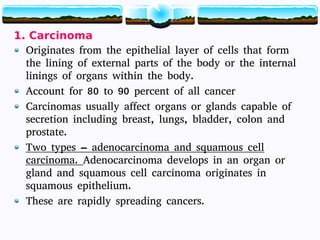
1. Carcinoma
Originates from the epithelial layer of cells that form
the lining of external parts of the body or the internal
linings of organs within the body.
Account for 80 to 90 percent of all cancer
Carcinomas usually affect organs or glands capable of
secretion including breast, lungs, bladder, colon and
prostate.
Two types – adenocarcinoma and squamous cell
carcinoma. Adenocarcinoma develops in an organ or
gland and squamous cell carcinoma originates in
squamous epithelium.
These are rapidly spreading cancers.
13
14
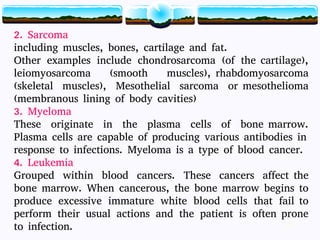
2. Sarcoma
including muscles, bones, cartilage and fat.
Other examples include chondrosarcoma (of the cartilage),
leiomyosarcoma (smooth muscles), rhabdomyosarcoma
(skeletal muscles), Mesothelial sarcoma or mesothelioma
(membranous lining of body cavities)
3. Myeloma
These originate in the plasma cells of bone marrow.
Plasma cells are capable of producing various antibodies in
response to infections. Myeloma is a type of blood cancer.
4. Leukemia
Grouped within blood cancers. These cancers affect the
bone marrow. When cancerous, the bone marrow begins to
produce excessive immature white blood cells that fail to
perform their usual actions and the patient is often prone
to infection. 14
15
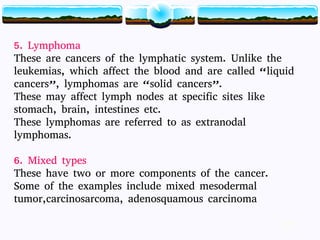
5. Lymphoma
These are cancers of the lymphatic system. Unlike the
leukemias, which affect the blood and are called “liquid
cancers”, lymphomas are “solid cancers”.
These may affect lymph nodes at specific sites like
stomach, brain, intestines etc.
These lymphomas are referred to as extranodal
lymphomas.
6. Mixed types
These have two or more components of the cancer.
Some of the examples include mixed mesodermal
tumor,carcinosarcoma, adenosquamous carcinoma
15
16
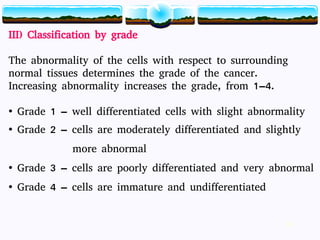
III) Classification by grade
The abnormality of the cells with respect to surrounding
normal tissues determines the grade of the cancer.
Increasing abnormality increases the grade, from 1–4.
• Grade 1 – well differentiated cells with slight abnormality
• Grade 2 – cells are moderately differentiated and slightly
more abnormal
• Grade 3 – cells are poorly differentiated and very abnormal
• Grade 4 – cells are immature and undifferentiated
16
17
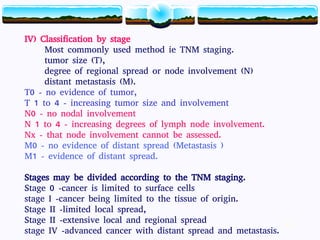
IV) Classification by stage
Most commonly used method ie TNM staging.
tumor size (T),
degree of regional spread or node involvement (N)
distant metastasis (M).
T0 - no evidence of tumor,
T 1 to 4 - increasing tumor size and involvement
N0 - no nodal involvement
N 1 to 4 - increasing degrees of lymph node involvement.
Nx - that node involvement cannot be assessed.
M0 - no evidence of distant spread (Metastasis )
M1 - evidence of distant spread.
Stages may be divided according to the TNM staging.
Stage 0 -cancer is limited to surface cells
stage I -cancer being limited to the tissue of origin.
Stage II -limited local spread,
Stage II -extensive local and regional spread
stage IV -advanced cancer with distant spread and metastasis.
17
18
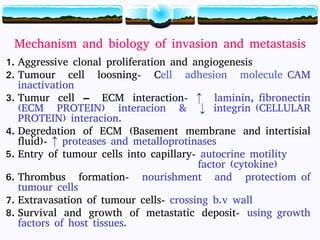
Mechanism and biology of invasion and metastasis
1. Aggressive clonal proliferation and angiogenesis
2. Tumour cell loosning- Cell adhesion molecule CAM
inactivation
3. Tumur cell – ECM interaction- ↑ laminin, fibronectin
(ECM PROTEIN) interacion & ↓ integrin (CELLULAR
PROTEIN) interacion.
4. Degredation of ECM (Basement membrane and intertisial
fluid)- ↑ proteases and metalloprotinases
5. Entry of tumour cells into capillary- autocrine motility
factor (cytokine)
6. Thrombus formation- nourishment and protectiom of
tumour cells
7. Extravasation of tumour cells- crossing b.v wall
8. Survival and growth of metastatic deposit- using growth
factors of host tissues. 18
19
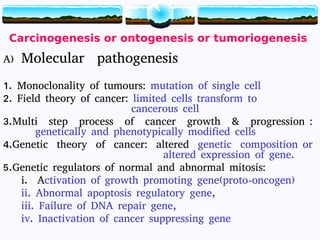
Carcinogenesis or ontogenesis or tumoriogenesis
A) Molecular pathogenesis
1. Monoclonality of tumours: mutation of single cell
2. Field theory of cancer: limited cells transform to
cancerous cell
3.Multi step process of cancer growth & progression :
genetically and phenotypically modified cells
4.Genetic theory of cancer: altered genetic composition or
altered expression of gene.
5.Genetic regulators of normal and abnormal mitosis:
i. Activation of growth promoting gene(proto-oncogen)
ii. Abnormal apoptosis regulatory gene,
iii. Failure of DNA repair gene,
iv. Inactivation of cancer suppressing gene 19
20
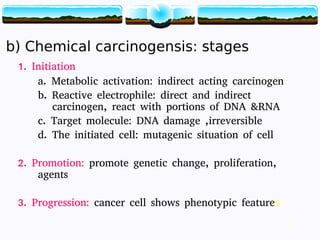
b) Chemical carcinogensis: stages
1. Initiation
a. Metabolic activation: indirect acting carcinogen
b. Reactive electrophile: direct and indirect
carcinogen, react with portions of DNA &RNA
c. Target molecule: DNA damage ,irreversible
d. The initiated cell: mutagenic situation of cell
2. Promotion: promote genetic change, proliferation,
agents
3. Progression: cancer cell shows phenotypic features
20
21
c) Physical carcinogenesis
1. radiation: UV, ionizing radiation:
UV light: main source is Sunlight,affect melanin causes mutation,
inhibit cell division,form pyrimidine dimer in dna, inactivate essential
enzymes,finally causes cell death.Examples: Mainly skin cancers
X ray, alpha, beta:
Common type of cancer is leukeamia and other cancers like cancer of
thyroid,lung, breast, uterus etc,
Examples:
Radiation dermititis- X ray radiotherapist
Oesteosarcoma- watch maker girls using radium
Japnese atom bomb- leukaemias & other cancers and
etc.
Mechanism: alter cellular DNA damage, generate free radicals.
21
22
2. Non radiation:
Mechanical injury of stone in gallbladder, UT.
Physical agents like plastics, glass cause cancer in animals.
d) Biological carcinogenesis
Parasite: schistosoma haematobium infection-squamous cell
carcinoma of urinary bladder,
Fungus: aspergillus flavus --hepatocellular carcinoma
Bacteria: helicobater pylori in gastric mucosa with prolonged
exposure causes gastric carcinoma.
Viral: 20% of all cancer, hepatitis B virus causes
hepatocellular carcinoma
22
23
GOALS OF CANCER
TREATMENT
CURE
CONTROL
PALLIATION
23
24
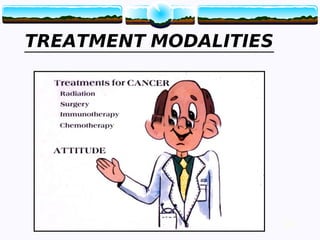
TREATMENT MODALITIES
24
25
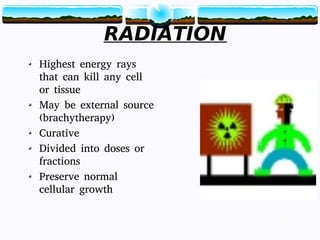
RADIATION
Highest energy rays
that can kill any cell
or tissue
May be external source
(brachytherapy)
Curative
Divided into doses or
fractions
Preserve normal
cellular growth
25
26
Chemotherapy
Cytotoxic drugs that destroy cancer cells
or prevent cellular replication by
interfering with DNA and RNA and vital
cellular proteins
Goal is to reduce the number of cells to a
small number that can be handled by
the immune system 26
27
BIOTHERAPY
Treatment that alters the body’s biological
response
Uses body’s own immune system to treat
cancer
Alters the immune system with either
stimulatory or suppressive effect
Produce anti-tumor activities
27
28
HORMONAL THERAPY
Used against hormonally sensitive
tumors like breast and prostate
Creates unfavorable growth
environment
28

Cancer

  • 1.
    1 Disturbances of growthof cells (CANCER) Prepared by: Prof. Mirza Anwar Baig AIKTC's School of Pharmacy 1
  • 2.
    2 At the endof the chapter you should be able to..... Compare the benign and malignant tumor. Describe the pathogenesis of cancer. Enlist the causes of cancer.
  • 3.
    3 DEFINITIONS 1. Cancer isa disease of the cell 2. Large group of diseases characterized by: a. Abnormal cell structure (no differentiation) b. Uncontrolled growth (proliferation) c. Ability to spread (metastasis) d. Ability to invade normal tissue (lack contact inhibition) 3
  • 4.
    4 Definations contd: Neoplasm “new plasma”…abnormaltissue growth with rapid growth Benign no metastasis Malignant local invasion and destructive growth…”wicked” Metastasis spread form primary via lymphatic and/or circulatory system 4
  • 5.
    5 STATISTICS Cancer is thesecond leading cause of death in the United States Cancer affects one in three families 5
  • 6.
  • 7.
    7 Cancer cells followno rules and have the ability to stimulate the growth of a new blood supply 7
  • 8.
    8 Benign tumour Malignanttumour 1. Encapsulated boundries 2. Compressed surrounding tissue 3. Small size 4. Resemble to original tissue 5. Basel polarity retained 6. Pleomorphism not present 7. N/C ratio normal 8. Typical mitosis 9. Infrequent chromosomal abnormality 10.Funtion maintained 1. Irregular boundries 2. Invade in surrounding tissue 3. Large size 4. Poor resemble to original tissue 5. Basel polarity lost 6. Pleomorphism present 7. N/C ratio increased 8. Atypical mitosis 9. Frequent abnormality 10. Lost or abnormal function8
  • 9.
    9 Benign tumour Malignanttumour 8. Growth rate usually slow 9. No invasion in surrounding 10.Metastasis absent 11.Local complication present 8. Rapid growth 9. Invade the adjacent tissue 10.Metastasis present 11.Death by local and metastatic complication 9
  • 10.
    10 Incidence of cancerdepends on a) Predisposing factors Familial and genetic factors Racial and geographical factors Environmental and cultural factors Age Sex b) Chronic non neoplastic (pre-malignant) conditions- to prevent occurrence, characterstics of morphological changes c) Hormones - Oestrogen- for experimental induction, oestrogen therapy - hormonal contraceptive- breast cancer - Anabolic steriod- in athletes-liver cancer 10
  • 11.
    11 Spread of cancer Localinvasion - Benign – pushing the surrounding tissue - Malignant- invade and destruct surround tissue Routes of metastasis - Lymphatic spread – lymphatic permeation, lymp. Emboli,modify behaviour of lymph node - Haematogenous spread- syst vein, portal vein, retrograde - Spread along body cavities- organ to organ, within organ ,CSF, Implantation 11
  • 12.
    12 Classification of malignanttumour (cancer) I) Classification by site of origin like breast cancer, lung cancer, prostate cancer, liver cancer ,renal cell carcinoma (kidney cancer), oral cancer, brain cancer etc. II) Classification by tissue types Based on tissue types cancers may be classified into six major categories: 12
  • 13.
    13 1. Carcinoma Originates fromthe epithelial layer of cells that form the lining of external parts of the body or the internal linings of organs within the body. Account for 80 to 90 percent of all cancer Carcinomas usually affect organs or glands capable of secretion including breast, lungs, bladder, colon and prostate. Two types – adenocarcinoma and squamous cell carcinoma. Adenocarcinoma develops in an organ or gland and squamous cell carcinoma originates in squamous epithelium. These are rapidly spreading cancers. 13
  • 14.
    14 2. Sarcoma including muscles,bones, cartilage and fat. Other examples include chondrosarcoma (of the cartilage), leiomyosarcoma (smooth muscles), rhabdomyosarcoma (skeletal muscles), Mesothelial sarcoma or mesothelioma (membranous lining of body cavities) 3. Myeloma These originate in the plasma cells of bone marrow. Plasma cells are capable of producing various antibodies in response to infections. Myeloma is a type of blood cancer. 4. Leukemia Grouped within blood cancers. These cancers affect the bone marrow. When cancerous, the bone marrow begins to produce excessive immature white blood cells that fail to perform their usual actions and the patient is often prone to infection. 14
  • 15.
    15 5. Lymphoma These arecancers of the lymphatic system. Unlike the leukemias, which affect the blood and are called “liquid cancers”, lymphomas are “solid cancers”. These may affect lymph nodes at specific sites like stomach, brain, intestines etc. These lymphomas are referred to as extranodal lymphomas. 6. Mixed types These have two or more components of the cancer. Some of the examples include mixed mesodermal tumor,carcinosarcoma, adenosquamous carcinoma 15
  • 16.
    16 III) Classification bygrade The abnormality of the cells with respect to surrounding normal tissues determines the grade of the cancer. Increasing abnormality increases the grade, from 1–4. • Grade 1 – well differentiated cells with slight abnormality • Grade 2 – cells are moderately differentiated and slightly more abnormal • Grade 3 – cells are poorly differentiated and very abnormal • Grade 4 – cells are immature and undifferentiated 16
  • 17.
    17 IV) Classification bystage Most commonly used method ie TNM staging. tumor size (T), degree of regional spread or node involvement (N) distant metastasis (M). T0 - no evidence of tumor, T 1 to 4 - increasing tumor size and involvement N0 - no nodal involvement N 1 to 4 - increasing degrees of lymph node involvement. Nx - that node involvement cannot be assessed. M0 - no evidence of distant spread (Metastasis ) M1 - evidence of distant spread. Stages may be divided according to the TNM staging. Stage 0 -cancer is limited to surface cells stage I -cancer being limited to the tissue of origin. Stage II -limited local spread, Stage II -extensive local and regional spread stage IV -advanced cancer with distant spread and metastasis. 17
  • 18.
    18 Mechanism and biologyof invasion and metastasis 1. Aggressive clonal proliferation and angiogenesis 2. Tumour cell loosning- Cell adhesion molecule CAM inactivation 3. Tumur cell – ECM interaction- ↑ laminin, fibronectin (ECM PROTEIN) interacion & ↓ integrin (CELLULAR PROTEIN) interacion. 4. Degredation of ECM (Basement membrane and intertisial fluid)- ↑ proteases and metalloprotinases 5. Entry of tumour cells into capillary- autocrine motility factor (cytokine) 6. Thrombus formation- nourishment and protectiom of tumour cells 7. Extravasation of tumour cells- crossing b.v wall 8. Survival and growth of metastatic deposit- using growth factors of host tissues. 18
  • 19.
    19 Carcinogenesis or ontogenesisor tumoriogenesis A) Molecular pathogenesis 1. Monoclonality of tumours: mutation of single cell 2. Field theory of cancer: limited cells transform to cancerous cell 3.Multi step process of cancer growth & progression : genetically and phenotypically modified cells 4.Genetic theory of cancer: altered genetic composition or altered expression of gene. 5.Genetic regulators of normal and abnormal mitosis: i. Activation of growth promoting gene(proto-oncogen) ii. Abnormal apoptosis regulatory gene, iii. Failure of DNA repair gene, iv. Inactivation of cancer suppressing gene 19
  • 20.
    20 b) Chemical carcinogensis:stages 1. Initiation a. Metabolic activation: indirect acting carcinogen b. Reactive electrophile: direct and indirect carcinogen, react with portions of DNA &RNA c. Target molecule: DNA damage ,irreversible d. The initiated cell: mutagenic situation of cell 2. Promotion: promote genetic change, proliferation, agents 3. Progression: cancer cell shows phenotypic features 20
  • 21.
    21 c) Physical carcinogenesis 1.radiation: UV, ionizing radiation: UV light: main source is Sunlight,affect melanin causes mutation, inhibit cell division,form pyrimidine dimer in dna, inactivate essential enzymes,finally causes cell death.Examples: Mainly skin cancers X ray, alpha, beta: Common type of cancer is leukeamia and other cancers like cancer of thyroid,lung, breast, uterus etc, Examples: Radiation dermititis- X ray radiotherapist Oesteosarcoma- watch maker girls using radium Japnese atom bomb- leukaemias & other cancers and etc. Mechanism: alter cellular DNA damage, generate free radicals. 21
  • 22.
    22 2. Non radiation: Mechanicalinjury of stone in gallbladder, UT. Physical agents like plastics, glass cause cancer in animals. d) Biological carcinogenesis Parasite: schistosoma haematobium infection-squamous cell carcinoma of urinary bladder, Fungus: aspergillus flavus --hepatocellular carcinoma Bacteria: helicobater pylori in gastric mucosa with prolonged exposure causes gastric carcinoma. Viral: 20% of all cancer, hepatitis B virus causes hepatocellular carcinoma 22
  • 23.
  • 24.
  • 25.
    25 RADIATION Highest energy rays thatcan kill any cell or tissue May be external source (brachytherapy) Curative Divided into doses or fractions Preserve normal cellular growth 25
  • 26.
    26 Chemotherapy Cytotoxic drugs thatdestroy cancer cells or prevent cellular replication by interfering with DNA and RNA and vital cellular proteins Goal is to reduce the number of cells to a small number that can be handled by the immune system 26
  • 27.
    27 BIOTHERAPY Treatment that altersthe body’s biological response Uses body’s own immune system to treat cancer Alters the immune system with either stimulatory or suppressive effect Produce anti-tumor activities 27
  • 28.
    28 HORMONAL THERAPY Used againsthormonally sensitive tumors like breast and prostate Creates unfavorable growth environment 28