Diagnostic Criteria of celiac
disease
Dr. Virendra Kumar Gupta
MD Pediatrics,MIAP
Fellowship In pediatric Gastroentero-Hepatology & Liver Transplantation
Assistant Professor
Institute of Paediatric Gastroenterology
Nims University Jaipur
DEFINITION
• An immune-mediated systemic disorder
• Elicited by gluten and related prolamines
• In genetically (mainly HLA) susceptible individuals
• Characterized by a combination of:
gluten dependent clinical manifestations
anti-tissue transglutaminase (TG2) antibodies
enteropathy
Husby et al. JPGN 2012
CLINICAL SPECTRUM
• Symptomatic CD
– Frank clinical features
• Silent CD
– No symptoms but +ve serology and HPE.
– In most cases identified by serologic screening in at-risk groups
• Latent CD
– Normal HPE but before or after have shown Gluten dependent enteropathy
• Potential CD
– Normal HPE but Positive serology .
– It might or might not be symptomatic
ESPGHAN Guidelines for Diagnosis of Coeliac Disease
PREVALENCE IN CHILDREN BETWEEN
2.5 AND 15 YEARS OF AGE:
3 to 13 per 1000 children
or
approximately 1 in 300 to 1 in 80 children
CDHNF/NASPGHAN guidelines on the Diagnosis and Treatment of Celiac
Disease in Children JPGN ©2005; Volume 40, Number 1 (Jan): pages1-19.
Increased prevalence of CD in
children with
• Type 1 diabetes 2–12 %
• Autoimmune liver disease 12-13 %
• Autoimmune thyroid disease up to 7 %
• IgA deficiency 2-8 %
• Down’s syndrome 5-12 %
• Turner syndrome 2-5 %
• Williams’ syndrome up to 9 %
• First degree relatives with CD 10-20 %
Garampazzi A, Rapa A, Mura S, et al. Clinical pattern of celiac diseaseis
still changing. J Pediatr Gastroenterol Nutr 2007;45:611–4.
Prevalent, But Under Diagnosed
– Those not diagnosed have a higher death rate
– Raise awareness
IMPROVE
SCREENING
Celiac disease as a multiorgan autoimmune disease
General:
Puberty & growth
delay
Malignancies
Anemia
GI system:
Diarrhea, vomiting
Distension, pain
Malnutrition,
weight loss
Hepatitis,
cholangitis
Bone:
Osteoporosis,
fractures
Arthritis
Dental anomalies
Skin & mucosa:
Dermatitis
herpetiformis
Aphtous
stomatitis
Hair loss
Heart:
Carditis
CNS:
Ataxia, seizures
Depression
Reproductive
system:
Miscarriage
Infertility
EVIDENCE-BASED
GUIDELINES FOR CD DIAGNOSIS
• AHRQ (USA, 2004)
Adults and children
Rostom A, et al.. Celiac Disease. EvidenceReport/ Technology
AssessmentNo. 104. AHRQ Publication No. 04-E029-2, 2004
• NICE guidelines (UK, 2009)
Adults and children
For GP’s and general paediatricians
NICE Clinical Guidelines 86. Coeliac Disease: Recognition
and assessment of coeliac disease. UK, May 2009
Guidelines: AHRQ (USA, 2004)
Main issues
1. Sensitivity/specificity of
serological tests
2. Prevalence / incidence
of CD
3. CD associated lymphoma
4. Consequences of testing
for CD
5. Interventions for
adherence to a gluten free
diet
Conclusions
1. Sensitivity and specificity
of EMA and TG2 are quite
high
2. CD common, prevalence
in the general population
likely close to 1:100
3. Education/participation in
coeliac societies improves
compliance with a GFD
Rostom A, et al.. Celiac Disease. Evidence Report/Technology
Assessment No. 104.AHRQ Publication No. 04‐E029‐2, 2004
Who Should Be Tested for CD?
Group 1:
unexplained symptoms and signs
chronic or intermittent diarrhoea,
failure to thrive, weight loss,
stunted growth, delayed puberty,
amenorrhoea, iron-deficiency
anaemia, nausea or vomiting,
chronic abdominal pain, cramping
or distension, chronic
constipation, chronic fatigue,
recurrent aphthous stomatitis
(mouth ulcers), dermatitis
herpetiformis–like rash,
fracture With inadequate
traumas/osteopenia/osteoporosi
, and abnormal liver biochemistry.
Group 2:
Asymptomatic increased risk
for CD
Type 1 diabetes mellitus
(T1DM)
Autoimmune thyroid disease
Autoimmune liver disease
IgA deficiency
Down syndrome
Turner syndrome
Williams syndrome
First-degree relatives
DIAGNOSTIC TOOLS
• CD-specific Antibody Tests
• Histological Analysis of Duodenal Biopsies
• HLA Testing for HLA-DQ2 and HLA-DQ8
ANTIBODIES
• Anti-tTG /TG2 (tissue transglutaminase)
• Anti-EMA (Endomysial antibody)
• Anti- DGP ( deamidated Gliadin Peptides)
– IgA level should be done with EMA/tTG
• Anti- Gliadin/Anti- Reticulin
SENSITIVITY/SPECIFICITY
Test % Sensitivity % Specificity Age
tTG-IgA 90-100 94-100 Children
84-100 91-100 Combined
EMA-IgA 87-95 95-100 Adults
88-100 90-100 Children
91-98 99-100 Combined
DGP 91 98 Combined
Am J Gastroenterol. 2009 Jan;104(1):154-63.
False Positive tTG/ Serology
– Other autoimmune conditions
– Infections
– Tumors
– Tissue damage
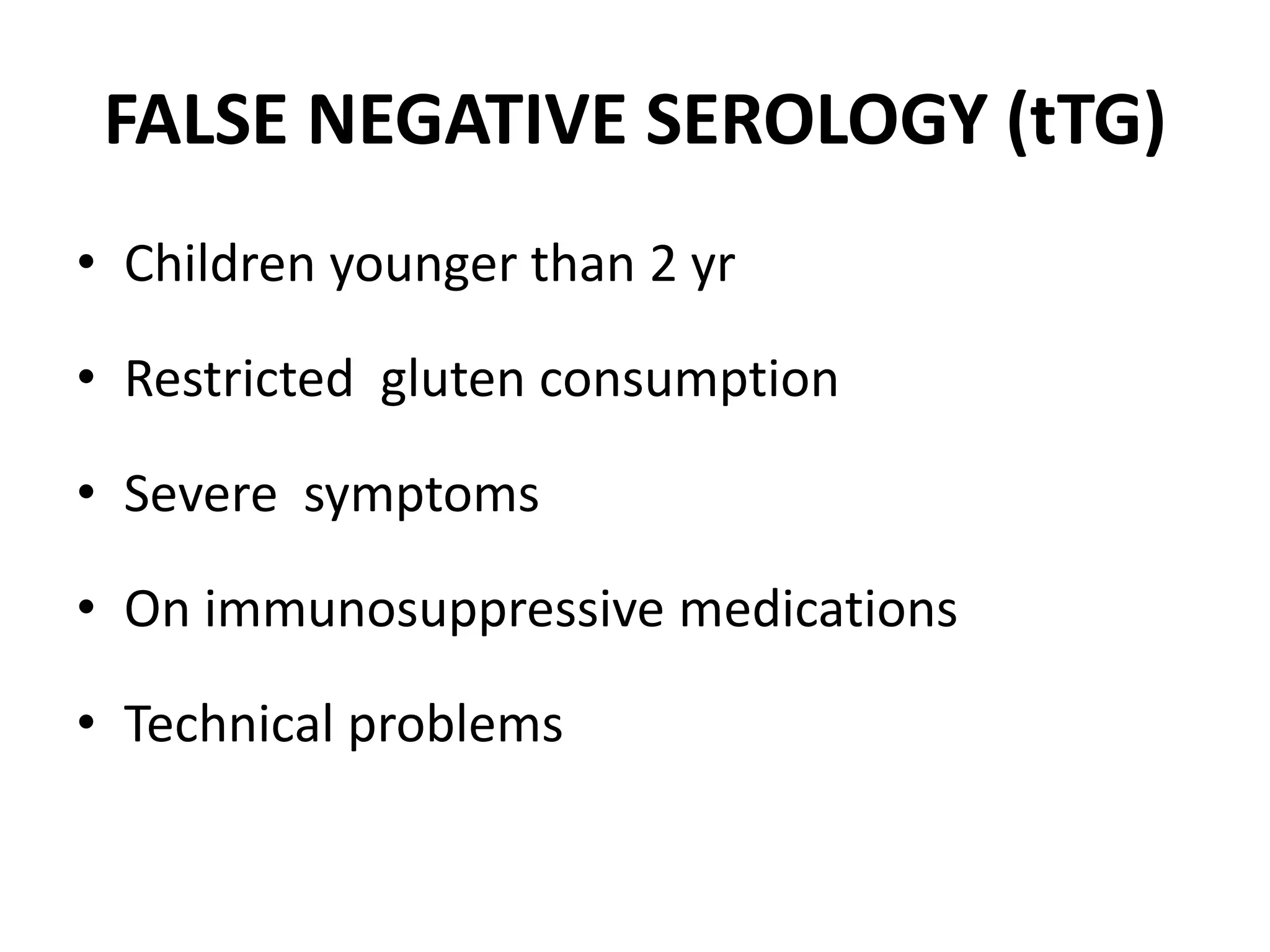
FALSE NEGATIVE SEROLOGY (tTG)
• Children younger than 2 yr
• Restricted gluten consumption
• Severe symptoms
• On immunosuppressive medications
• Technical problems
HISTOPATHOLOGY
• Crypt Hyperplasia
• Crypt to villous ratio is increased
• Intra-Epithelial Lymphocytosis
• Abnormal surface epithelium
• Subtotal to total villous atrophy
ENDOSCOPY & BIOPSY
Biopsies should be taken preferably during
upper endoscopy
bulb (at least 1 biopsy)
second or third portion of duodenum (at least 4
biopsies)
19
Normal small bowel Celiac disease
Gluten
Gluten-free diet
MARSH Staging
Causes of Flat Mucosa (Villous Atrophy)
• Celiac Disease
• Giardiasis
• HIV Enteropathy
• PEM
• CMPI
• Bacterial Overgrowth
• Primary immunodeficiency
• Tropical sprue
• Chemotherapy & irradiation
• Eosinophilic Gastroenteritis
• Multiple genes involved
• The most consistent genetic component
depends on the presence of HLA-DQ
(DQ2 and/or DQ8) genes
• One or both of these genes are found in 95%
of celiac patients
• Having one or more of these genes doesn’t
mean you will develop celiac, but if you have
the disease you likely have the gene.
HLA
?? ?
?
Gluten
Celiac Disease
+
Genes
Genetics
22
HLA TYPING
• HLA DQ2 and DQ8
– Strong negative predictive value
– Present in > 95 % patients of CD
– Present in > 30% normal population
– Weak positive predictive value
• Diagnosis without biopsy is still not recommended in
India & Developing countries
• Reliable HLA testing and EMA estimation is not widely
available
• Secondly tTG is being done by various labs with
different kits and their standardization is doubtful, so
>10 times criteria is also difficult to implement.
Anti‐TG2 & total IgA*
Anti‐TG2
positive
Anti‐TG2
negative
Paed. GI discusses with family the 2 diagnostic
pathways and consequences considering patient’s
history & anti‐TG2 titers
Consider further diagnostic testing if:
IgA deficient
Age: < 2 years
History: ‐ low gluten intake
‐ drug pretreatment
-severe symptoms
-associated diseasesPositive Anti‐TG2
> 10 x normal
EMA & HLA testing for DQ2/DQ8
Positive Anti‐TG2
<10 xnormal
OEGD & biopsies
Not
available
Not CD
EMA+v
HLA +v
EMA+v
HLA -v
EMA-v
HLA -v
EMA-v
HLA +v
Marsh 0‐1 Marsh 2 or 3
CD+
GFD
& F/u
Consider
false neg.
HLA test
Consider
biopsies
Consider
false pos.
Anti‐TG2
Unclear case
Consider:
false pos. serology
false neg. biopsy or
potential CD
Extended evaluation of
HLA/serology/biopsies
GFD
& F/u
CD+
Child / Adolescent with Symptoms suggestive of CD
*or specific IgG based tests
HLA DQ testing (+/‐Anti‐TG2)
Consider retesting in intervals or
if symptomatic
HLA positive for
DQ2 and/or DQ8
Anti‐TG2 & total IgA*
EMA
Not CD,
no risk
Positive Anti‐TG2
> 3x normal
Marsh 2 or 3
CD+
GFD
& F/u
Consider:
Transient / false pos.
anti‐TG2
F/u on normal diet with
further serological
testing
Consider:
age, false neg. results,
exclude IgA deficiency and
history
of low gluten intake or drugs
Asymptomatic Person at Genetic Risk for CD
Explain implication of positive test result(s) and get consent for testing
HLA negative for
DQ2 and/or DQ8
Anti‐TG2 negativePositive Anti‐TG2
< 3x normal
Not CD
EMA negativeEMA positive
OEGD & biopsies:
1 x bulbus & 4 x pars
descendens, proper
histological work up
Unclear case
F/u on normal diet
Consider: false pos.
serology, false neg.
biopsy or potential CD
Marsh 0-‐1
*or specific IgG based tests
CELIAC DISEASE
Gluten Free Diet
Nutritional Education
Dietician
Periodic assessment of
Symptoms, Diet & Serology
Serology
Abnormal
?
Reinforce
adherence
Symptoms
Present ?
Evaluate for other causes
of symptoms
Consider Re- Biopsy
FOLLOW UP
Yes No
Yes
No
GLUTEN CHALLENGE- When and How ?
• Performed under special circumstances- Doubt exists about the initial
• Gluten challenge should be discouraged
Before a child is 5 years old
During the pubertal growth spurt
• Gluten challenge always should be performed
Under strict medical supervision
Preferably by a paediatric gastroenterologist
Preceded by HLA testing /assessment of duodenal histology
Ensuring that a normal amount of gluten in the diet is ingested
IgA anti-tTg antibody should be measured during the challenge period
Challenge for practical purposes is considered-Complete after 2 years
Follow-up should be continued -relapse may occur at a later time.
Why different algorithms for symptomatic and
asymptomatic (at risk) patients?
1. False positive or transient TG2 antibody levels
more frequent in genetically at risk persons
than symptomatic cases
2. TG2 titres with normal histology (Marsh 0) are
often of low titre (<3 x upper limit of normal)
3. In asymptomatic patients with low antibody
levels there no urgency to perform biopsies
compared to symptomatic patients with the
same low levels.
Treatment
• GLUTEN FREE DIET (dietician consult)
• Identification and treatment of
nutritional deficiencies
• Pneumococcal vaccine
“A New Hope For CD
Sufferers?”
• New study, no conclusions yet
• Pills that break down gluten
• Immunotherapy: training the immune system
to tolerate gluten through injections
+ ?
CONCLUSION
• CD is common
• IgA tTG -good screening test for CD. ( exceptions
< 2 years)
• A gluten-free diet (GFD) should be introduced
only after the completion of the diagnostic
process, when a conclusive diagnosis has been
made( expensive and lifelong diet ).
THANKS

Celiac disease

  • 1.
    Diagnostic Criteria ofceliac disease Dr. Virendra Kumar Gupta MD Pediatrics,MIAP Fellowship In pediatric Gastroentero-Hepatology & Liver Transplantation Assistant Professor Institute of Paediatric Gastroenterology Nims University Jaipur
  • 2.
    DEFINITION • An immune-mediatedsystemic disorder • Elicited by gluten and related prolamines • In genetically (mainly HLA) susceptible individuals • Characterized by a combination of: gluten dependent clinical manifestations anti-tissue transglutaminase (TG2) antibodies enteropathy Husby et al. JPGN 2012
  • 3.
    CLINICAL SPECTRUM • SymptomaticCD – Frank clinical features • Silent CD – No symptoms but +ve serology and HPE. – In most cases identified by serologic screening in at-risk groups • Latent CD – Normal HPE but before or after have shown Gluten dependent enteropathy • Potential CD – Normal HPE but Positive serology . – It might or might not be symptomatic ESPGHAN Guidelines for Diagnosis of Coeliac Disease
  • 4.
    PREVALENCE IN CHILDRENBETWEEN 2.5 AND 15 YEARS OF AGE: 3 to 13 per 1000 children or approximately 1 in 300 to 1 in 80 children CDHNF/NASPGHAN guidelines on the Diagnosis and Treatment of Celiac Disease in Children JPGN ©2005; Volume 40, Number 1 (Jan): pages1-19.
  • 5.
    Increased prevalence ofCD in children with • Type 1 diabetes 2–12 % • Autoimmune liver disease 12-13 % • Autoimmune thyroid disease up to 7 % • IgA deficiency 2-8 % • Down’s syndrome 5-12 % • Turner syndrome 2-5 % • Williams’ syndrome up to 9 % • First degree relatives with CD 10-20 % Garampazzi A, Rapa A, Mura S, et al. Clinical pattern of celiac diseaseis still changing. J Pediatr Gastroenterol Nutr 2007;45:611–4.
  • 6.
    Prevalent, But UnderDiagnosed – Those not diagnosed have a higher death rate – Raise awareness IMPROVE SCREENING
  • 7.
    Celiac disease asa multiorgan autoimmune disease General: Puberty & growth delay Malignancies Anemia GI system: Diarrhea, vomiting Distension, pain Malnutrition, weight loss Hepatitis, cholangitis Bone: Osteoporosis, fractures Arthritis Dental anomalies Skin & mucosa: Dermatitis herpetiformis Aphtous stomatitis Hair loss Heart: Carditis CNS: Ataxia, seizures Depression Reproductive system: Miscarriage Infertility
  • 8.
    EVIDENCE-BASED GUIDELINES FOR CDDIAGNOSIS • AHRQ (USA, 2004) Adults and children Rostom A, et al.. Celiac Disease. EvidenceReport/ Technology AssessmentNo. 104. AHRQ Publication No. 04-E029-2, 2004 • NICE guidelines (UK, 2009) Adults and children For GP’s and general paediatricians NICE Clinical Guidelines 86. Coeliac Disease: Recognition and assessment of coeliac disease. UK, May 2009
  • 9.
    Guidelines: AHRQ (USA,2004) Main issues 1. Sensitivity/specificity of serological tests 2. Prevalence / incidence of CD 3. CD associated lymphoma 4. Consequences of testing for CD 5. Interventions for adherence to a gluten free diet Conclusions 1. Sensitivity and specificity of EMA and TG2 are quite high 2. CD common, prevalence in the general population likely close to 1:100 3. Education/participation in coeliac societies improves compliance with a GFD Rostom A, et al.. Celiac Disease. Evidence Report/Technology Assessment No. 104.AHRQ Publication No. 04‐E029‐2, 2004
  • 10.
    Who Should BeTested for CD? Group 1: unexplained symptoms and signs chronic or intermittent diarrhoea, failure to thrive, weight loss, stunted growth, delayed puberty, amenorrhoea, iron-deficiency anaemia, nausea or vomiting, chronic abdominal pain, cramping or distension, chronic constipation, chronic fatigue, recurrent aphthous stomatitis (mouth ulcers), dermatitis herpetiformis–like rash, fracture With inadequate traumas/osteopenia/osteoporosi , and abnormal liver biochemistry. Group 2: Asymptomatic increased risk for CD Type 1 diabetes mellitus (T1DM) Autoimmune thyroid disease Autoimmune liver disease IgA deficiency Down syndrome Turner syndrome Williams syndrome First-degree relatives
  • 11.
    DIAGNOSTIC TOOLS • CD-specificAntibody Tests • Histological Analysis of Duodenal Biopsies • HLA Testing for HLA-DQ2 and HLA-DQ8
  • 12.
    ANTIBODIES • Anti-tTG /TG2(tissue transglutaminase) • Anti-EMA (Endomysial antibody) • Anti- DGP ( deamidated Gliadin Peptides) – IgA level should be done with EMA/tTG • Anti- Gliadin/Anti- Reticulin
  • 13.
    SENSITIVITY/SPECIFICITY Test % Sensitivity% Specificity Age tTG-IgA 90-100 94-100 Children 84-100 91-100 Combined EMA-IgA 87-95 95-100 Adults 88-100 90-100 Children 91-98 99-100 Combined DGP 91 98 Combined Am J Gastroenterol. 2009 Jan;104(1):154-63.
  • 14.
    False Positive tTG/Serology – Other autoimmune conditions – Infections – Tumors – Tissue damage
  • 15.
    FALSE NEGATIVE SEROLOGY(tTG) • Children younger than 2 yr • Restricted gluten consumption • Severe symptoms • On immunosuppressive medications • Technical problems
  • 16.
    HISTOPATHOLOGY • Crypt Hyperplasia •Crypt to villous ratio is increased • Intra-Epithelial Lymphocytosis • Abnormal surface epithelium • Subtotal to total villous atrophy
  • 17.
    ENDOSCOPY & BIOPSY Biopsiesshould be taken preferably during upper endoscopy bulb (at least 1 biopsy) second or third portion of duodenum (at least 4 biopsies)
  • 19.
    19 Normal small bowelCeliac disease Gluten Gluten-free diet
  • 20.
  • 21.
    Causes of FlatMucosa (Villous Atrophy) • Celiac Disease • Giardiasis • HIV Enteropathy • PEM • CMPI • Bacterial Overgrowth • Primary immunodeficiency • Tropical sprue • Chemotherapy & irradiation • Eosinophilic Gastroenteritis
  • 22.
    • Multiple genesinvolved • The most consistent genetic component depends on the presence of HLA-DQ (DQ2 and/or DQ8) genes • One or both of these genes are found in 95% of celiac patients • Having one or more of these genes doesn’t mean you will develop celiac, but if you have the disease you likely have the gene. HLA ?? ? ? Gluten Celiac Disease + Genes Genetics 22
  • 23.
    HLA TYPING • HLADQ2 and DQ8 – Strong negative predictive value – Present in > 95 % patients of CD – Present in > 30% normal population – Weak positive predictive value
  • 24.
    • Diagnosis withoutbiopsy is still not recommended in India & Developing countries • Reliable HLA testing and EMA estimation is not widely available • Secondly tTG is being done by various labs with different kits and their standardization is doubtful, so >10 times criteria is also difficult to implement.
  • 25.
    Anti‐TG2 & totalIgA* Anti‐TG2 positive Anti‐TG2 negative Paed. GI discusses with family the 2 diagnostic pathways and consequences considering patient’s history & anti‐TG2 titers Consider further diagnostic testing if: IgA deficient Age: < 2 years History: ‐ low gluten intake ‐ drug pretreatment -severe symptoms -associated diseasesPositive Anti‐TG2 > 10 x normal EMA & HLA testing for DQ2/DQ8 Positive Anti‐TG2 <10 xnormal OEGD & biopsies Not available Not CD EMA+v HLA +v EMA+v HLA -v EMA-v HLA -v EMA-v HLA +v Marsh 0‐1 Marsh 2 or 3 CD+ GFD & F/u Consider false neg. HLA test Consider biopsies Consider false pos. Anti‐TG2 Unclear case Consider: false pos. serology false neg. biopsy or potential CD Extended evaluation of HLA/serology/biopsies GFD & F/u CD+ Child / Adolescent with Symptoms suggestive of CD *or specific IgG based tests
  • 26.
    HLA DQ testing(+/‐Anti‐TG2) Consider retesting in intervals or if symptomatic HLA positive for DQ2 and/or DQ8 Anti‐TG2 & total IgA* EMA Not CD, no risk Positive Anti‐TG2 > 3x normal Marsh 2 or 3 CD+ GFD & F/u Consider: Transient / false pos. anti‐TG2 F/u on normal diet with further serological testing Consider: age, false neg. results, exclude IgA deficiency and history of low gluten intake or drugs Asymptomatic Person at Genetic Risk for CD Explain implication of positive test result(s) and get consent for testing HLA negative for DQ2 and/or DQ8 Anti‐TG2 negativePositive Anti‐TG2 < 3x normal Not CD EMA negativeEMA positive OEGD & biopsies: 1 x bulbus & 4 x pars descendens, proper histological work up Unclear case F/u on normal diet Consider: false pos. serology, false neg. biopsy or potential CD Marsh 0-‐1 *or specific IgG based tests
  • 27.
    CELIAC DISEASE Gluten FreeDiet Nutritional Education Dietician Periodic assessment of Symptoms, Diet & Serology Serology Abnormal ? Reinforce adherence Symptoms Present ? Evaluate for other causes of symptoms Consider Re- Biopsy FOLLOW UP Yes No Yes No
  • 28.
    GLUTEN CHALLENGE- Whenand How ? • Performed under special circumstances- Doubt exists about the initial • Gluten challenge should be discouraged Before a child is 5 years old During the pubertal growth spurt • Gluten challenge always should be performed Under strict medical supervision Preferably by a paediatric gastroenterologist Preceded by HLA testing /assessment of duodenal histology Ensuring that a normal amount of gluten in the diet is ingested IgA anti-tTg antibody should be measured during the challenge period Challenge for practical purposes is considered-Complete after 2 years Follow-up should be continued -relapse may occur at a later time.
  • 29.
    Why different algorithmsfor symptomatic and asymptomatic (at risk) patients? 1. False positive or transient TG2 antibody levels more frequent in genetically at risk persons than symptomatic cases 2. TG2 titres with normal histology (Marsh 0) are often of low titre (<3 x upper limit of normal) 3. In asymptomatic patients with low antibody levels there no urgency to perform biopsies compared to symptomatic patients with the same low levels.
  • 30.
    Treatment • GLUTEN FREEDIET (dietician consult) • Identification and treatment of nutritional deficiencies • Pneumococcal vaccine
  • 31.
    “A New HopeFor CD Sufferers?” • New study, no conclusions yet • Pills that break down gluten • Immunotherapy: training the immune system to tolerate gluten through injections + ?
  • 32.
    CONCLUSION • CD iscommon • IgA tTG -good screening test for CD. ( exceptions < 2 years) • A gluten-free diet (GFD) should be introduced only after the completion of the diagnostic process, when a conclusive diagnosis has been made( expensive and lifelong diet ).
  • 33.