CELIAC DISEASE
What is the celiac disease?
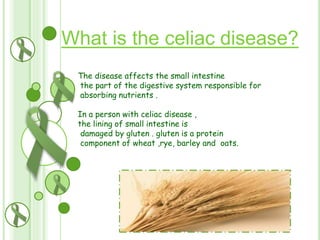
The disease affects the small intestine
the part of the digestive system responsible for
absorbing nutrients .
In a person with celiac disease ,
the lining of small intestine is
damaged by gluten . gluten is a protein
component of wheat ,rye, barley and oats.
Celiac disease is caused by an interaction between gluten (
the protein portion of wheat) and the small bowel lining in
people susceptible to the disease.
The cause damage to lining which results in a reduction in
the surface area of the villi or finger-like projections of
the bowel lining .
History of Celiac Disease
Celiac disease was first described in the second century but
it wasn't until the 20th century that primary factors were
identified .The first description of childhood and adult
coeliac disease was written in Greek by the physician
Aretaeus of Cappodocia. His writings survived and were
translated into English by Francis Adams for the Sydenham
Society in 1856.
Epidemiology
The “old” Celiac Disease Epidemiology:
_ Was considered a rare disorder .
_ A disease of essentially European origin
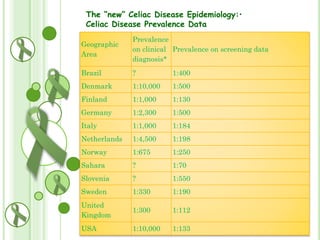
The “new” Celiac Disease Epidemiology:•
Celiac Disease Prevalence Data
Geographic
Area

Prevalence
on clinical Prevalence on screening data
diagnosis*

Brazil

?

1:400

Denmark

1:10,000

1:500

Finland

1:1,000

1:130

Germany

1:2,300

1:500

Italy

1:1,000

1:184

Netherlands

1:4,500

1:198

Norway

1:675

1:250

Sahara

?

1:70

Slovenia

?

1:550

Sweden

1:330

1:190

United
Kingdom

1:300

1:112

USA

1:10,000

1:133
•Given the prevalence of celiac disease of 1:100, there are
populations that are at an increased risk for disease,
including patients with type 1 diabetes, autoimmune thyroid
disease (both hyper- and hypothyroidism), relatives of
patients with celiac disease and type 1 diabetes and
patients with Turner and Down syndromes. Rates of celiac
disease in these populations range from 5–10%.
What Causes Celiac Disease?
The exact cause of the disease is still being researched by
the scientists but broadly it is said to be caused by a
combination of environmental and genetic factors. When the
person is sensitive towards gluten, the body’s immune system
reacts adversely to the food containing it. Pertaining to the
disease, the small finger-like projections in the small
intestine, known as vili, get damaged and destroyed, leading to
inability in digesting and absorbing the nutrients of the meal.
Celiac disease runs in families. If the parent suffers from it,
the probability of the child acquiring it is manifold.
the immune response mechanism
Celiac Sprue (celiac disease, coeliac disease, and non-tropic
sprue) is a common, lifelong disorder with an incidence of about
1:100. The disease results from both a food hypersensitivity and
an autoimmune condition; genetically predisposed individuals
suffer an intestinal inflammatory response to ingested gluten
from wheat and related proteins from barley and rye.
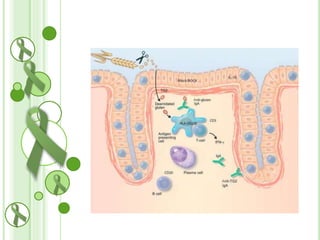
Long, proline-rich fragments of gluten survive digestion by
luminal and brush-border enzymes; as a result, they are able to
gain access to the lamina propria. Most gluten peptides that
survive gastrointestinal breakdown are excellent substrates for
transglutaminase 2 (TG2). The resulting deamidated products
are recognized by CD4-positive T cells, when bound to Human
leucocyte antigen (HLA)-DQ2 or HLA-DQ8 molecules on the cell
surface of antigen-presenting cells.
Upon activation, gluten-reactive CD4-positive T cells produce
interferon-gamma (IFN-gamma), which is a major Schematic
depiction of factors that contribute to the development of
celiac disease contributor to the development of the coeliac
lesion; IFN-gamma is also produced by intra-epithelial T cells.
Similarly, interleukin-15 (IL-15), produced by either
mononuclear cells in the lamina propria or by enterocytes
themselves, attracts T cells with the capacity to kill
enterocytes. IL-15 production is stimulated by gluten in the
intestine in coeliac disease.
Finally, B cells receive help from T cells to differentiate into
plasma cells, which then produce autoantibodies against TG2.
Currently, the only treatment for Celiac Sprue is adherence to
a strict gluten-free diet. Such a diet is difficult to maintain as
gluten is the second most common food additive behind sucrose.
Thus, there is an unmet need for alternative, nondietary
therapies for coeliac disease.
Signs and Symptoms

Gastrointestinal
(“classical”)

Non-gastrointestinal

( “atypical”)
Gastrointestinal
(“Classic”)
Most common age of presentation: 6-24
months
1- Chronic or recurrent diarrhea
2- Abdominal distension
3- Anorexia
4- Abdominal pain
5- Vomiting
6- Constipation
7- weight loss
Nongastrointestinal
( “atypical”)
Most common age of presentation: older
child to adult
1- Dermatitis Herpetiformis
2- Osteopenia/Osteoporosis
3- Iron-deficient anemia
4- Hepatitis
5- Arthritis
6- Delayed Puberty
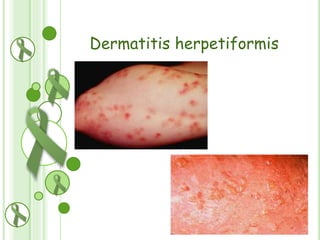
Dermatitis herpetiformis
Complications list for Celiac
Disease

Complications of Celiac Disease: Damage to the small intestine
and the resulting problems with nutrient absorption put a person
with celiac disease at risk for several diseases and health
problems.
The list of complications that have been mentioned in various
sources for Celiac Disease includes:
Lymphoma
Adenocarcinoma
Osteoporosis
Miscarriage
Congenital defects - in babies born to celiac mothers
Short stature - if celiac causes malnutrition in childhood
Seizures
Anemia
Lymphoma and adenocarcinoma are types of cancer that can
develop in the intestine.
Osteoporosis is a condition in which the bones become weak,
brittle, and prone to breaking. Poor calcium absorption is a
contributing factor to osteoporosis.
How is Celiac Disease Diagnosed?

Antibody Testing: Only A First Step

To help diagnose celiac disease, physicians first test blood to
measure levels of certain antibodies. These antibodies are
anti-endomysium and anti-tissue transglutaminase. A positive
antibody test indicates only that a person needs a biopsy; it is
not a diagnosis in and of itself.
Antibody tests measure your immune system’s response to
gluten in the food you eat. Your doctor may order a panel of
tests to aid in diagnosis, or order one or several to see if you
may need further evaluation. The blood for these tests are
usually sent to one of only a few labs in the country that are
best suited for conducting the test and interpreting the
results.
Tests
1- Total Serum IgA to test for IgA deficiency (this
r:
health condition can affect accuracy of antibody test)
2- Anti-endomysial antibody test (EMA-IgA) EMA-IgA
are very specific for celiac disease but they are not as
sensitive as the tTG-IgA.
Which tests do I need?
If my positive antibody test suggests I may have
celiac disease, how do I find out for sure?
If antibody tests and/or symptoms suggest celiac disease,
the physician needs to establish the diagnosis by obtaining
tiny pieces of tissue from the small intestine to check for
damage to the villi. This is done in an endoscopic biopsy
procedure. The physician eases a long, thin tube called an
endoscope through the mouth and stomach into the small
intestine, and then takes samples of the tissue using
instruments passed through the endoscope.
Biopsy of the small intestine is the only way to diagnose
celiac disease.

Why is it necessary to have the endoscopic
biopsy?

It is important to know that the blood testing can
only confirm that you do not have celiac disease. This
is why the biopsy is necessary if your test results are
positive, to confirm the results.
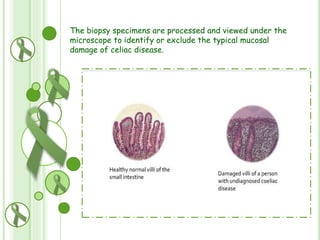
The biopsy specimens are processed and viewed under the
microscope to identify or exclude the typical mucosal
damage of celiac disease.
Mutated gene for CELIAC
DISEASE
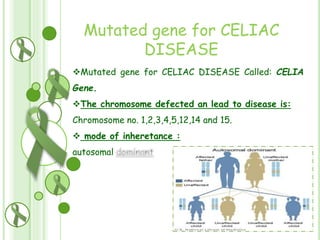
Mutated gene for CELIAC DISEASE Called: CELIA
Gene.
The chromosome defected an lead to disease is:
Chromosome no. 1,2,3,4,5,12,14 and 15.
 mode of inheretance :
autosomal
What is the effect of celiac disease on
growth and glycemic control in patients
with type 1 diabetes ?
Celiac.com 09/19/2012 - Researchers have documented rising
rates of celiac disease in patients with type 1 diabetes (T1D).
A research team recently tried to assess the effect of celiac
disease on growth and glycemic control in patients with T1D,
and to determine the effects of a gluten-free diet on these
parameters.
The research team included I. Taler, M. Phillip, Y. Lebenthal, L.
de Vries, R. Shamir, and S. Shalitin. They are affiliated with
the Department of Pediatrics B, Schneider Children's Medical
Center of Israel in Petach Tikva, Israel.
To do so, they conducted a longitudinal retrospective casecontrol study, in which they reviewed the medical data on 68
patients with T1D and duodenal-biopsy-confirmed celiac
disease. They looked at weight, height, hemoglobin A1c
(HbA1c), frequency of diabetic ketoacidosis (DKA), and severe
hypoglycemic events before and after diagnosis and treatment
of celiac disease.
They then compared their findings with 131 patients with T1D
alone, who were all matched for age, gender, and duration of
diabetes.
In all, 5.5% patients with T1D who attended the center during
the study period were diagnosed with celiac disease, while 26%
of the patients with celiac disease were symptomatic.
The data showed no significant differences in glycemic control
or frequency of severe hypoglycemia or DKA events between
the study group and control subjects.
Body mass index-standard deviation score (SDS), height-SDS,
and HbA1c values were insignificantly higher in the control
group than in the study group, and similar in celiac disease
patients with good or fair/poor adherence to a gluten-free diet
during follow-up.
Patients with T1D and celiac disease and following a gluten-free
diet have growth and metabolic control similar to those with
T1D with no celiac disease.
To determine whether a gluten-free diet is appropriate for
asymptomatic celiac patients or only symptomatic patients must
be assessed against possible short- and long-term consequences
of no intervention, and the decision should be based on more
evidence from larger randomized studies.
What is the treatment of celiac
disease?

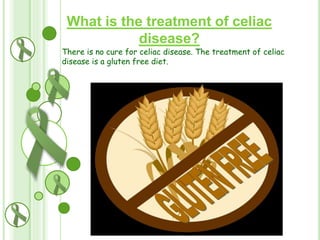
There is no cure for celiac disease. The treatment of celiac
disease is a gluten free diet.
The principles of a gluten free diet include:
1- Avoid all foods made from wheat, rye, and barley. Examples
are breads, cereals, pasta, crackers, cakes, pies, cookies, and
gravies.
2- Pay attention to processed foods that may contain
gluten. Wheat flour is a common ingredient in many
processed foods. Examples of foods that may contain
gluten, to name only a few, include:
-ice cream
-Ketchup
-Mustard
-sausages
-pasta
3- It is alright to consume fish, fresh meats, rice, corn,
soybean, potato, poultry, fruits, vegetables, and dairy
products
References
http://www.medicinenet.com/celiac_disease/page8.htm
http://www.cureresearch.com/c/celiac_disease/complic.htm
http://www.nhs.uk/Conditions/Coeliacdisease/Pages/Diagnosis.aspx http://omim.org/entry/212750
http://www.stanford.edu/group/khosla/Celiac_Sprue.html
http://www.celiac.com/articles/23040/1/What-is-the-Effectof-Celiac-Disease-on-Growth-and-Glycemic-Control-inPatients-with-Type-1-Diabetes/Page1.html
Done by :
Fatimah Al-Homrani
Amal Al-Ghamdi
Medical laboratory students at king Abdulaziz
university #MED11

Fatimah & amal : celiac disease

  • 1.
  • 2.
    What is theceliac disease? The disease affects the small intestine the part of the digestive system responsible for absorbing nutrients . In a person with celiac disease , the lining of small intestine is damaged by gluten . gluten is a protein component of wheat ,rye, barley and oats.
  • 3.
    Celiac disease iscaused by an interaction between gluten ( the protein portion of wheat) and the small bowel lining in people susceptible to the disease. The cause damage to lining which results in a reduction in the surface area of the villi or finger-like projections of the bowel lining .
  • 4.
    History of CeliacDisease Celiac disease was first described in the second century but it wasn't until the 20th century that primary factors were identified .The first description of childhood and adult coeliac disease was written in Greek by the physician Aretaeus of Cappodocia. His writings survived and were translated into English by Francis Adams for the Sydenham Society in 1856.
  • 5.
    Epidemiology The “old” CeliacDisease Epidemiology: _ Was considered a rare disorder . _ A disease of essentially European origin
  • 6.
    The “new” CeliacDisease Epidemiology:• Celiac Disease Prevalence Data Geographic Area Prevalence on clinical Prevalence on screening data diagnosis* Brazil ? 1:400 Denmark 1:10,000 1:500 Finland 1:1,000 1:130 Germany 1:2,300 1:500 Italy 1:1,000 1:184 Netherlands 1:4,500 1:198 Norway 1:675 1:250 Sahara ? 1:70 Slovenia ? 1:550 Sweden 1:330 1:190 United Kingdom 1:300 1:112 USA 1:10,000 1:133
  • 7.
    •Given the prevalenceof celiac disease of 1:100, there are populations that are at an increased risk for disease, including patients with type 1 diabetes, autoimmune thyroid disease (both hyper- and hypothyroidism), relatives of patients with celiac disease and type 1 diabetes and patients with Turner and Down syndromes. Rates of celiac disease in these populations range from 5–10%.
  • 8.
    What Causes CeliacDisease? The exact cause of the disease is still being researched by the scientists but broadly it is said to be caused by a combination of environmental and genetic factors. When the person is sensitive towards gluten, the body’s immune system reacts adversely to the food containing it. Pertaining to the disease, the small finger-like projections in the small intestine, known as vili, get damaged and destroyed, leading to inability in digesting and absorbing the nutrients of the meal. Celiac disease runs in families. If the parent suffers from it, the probability of the child acquiring it is manifold.
  • 9.
    the immune responsemechanism Celiac Sprue (celiac disease, coeliac disease, and non-tropic sprue) is a common, lifelong disorder with an incidence of about 1:100. The disease results from both a food hypersensitivity and an autoimmune condition; genetically predisposed individuals suffer an intestinal inflammatory response to ingested gluten from wheat and related proteins from barley and rye. Long, proline-rich fragments of gluten survive digestion by luminal and brush-border enzymes; as a result, they are able to gain access to the lamina propria. Most gluten peptides that survive gastrointestinal breakdown are excellent substrates for transglutaminase 2 (TG2). The resulting deamidated products are recognized by CD4-positive T cells, when bound to Human leucocyte antigen (HLA)-DQ2 or HLA-DQ8 molecules on the cell surface of antigen-presenting cells.
  • 10.
    Upon activation, gluten-reactiveCD4-positive T cells produce interferon-gamma (IFN-gamma), which is a major Schematic depiction of factors that contribute to the development of celiac disease contributor to the development of the coeliac lesion; IFN-gamma is also produced by intra-epithelial T cells. Similarly, interleukin-15 (IL-15), produced by either mononuclear cells in the lamina propria or by enterocytes themselves, attracts T cells with the capacity to kill enterocytes. IL-15 production is stimulated by gluten in the intestine in coeliac disease. Finally, B cells receive help from T cells to differentiate into plasma cells, which then produce autoantibodies against TG2. Currently, the only treatment for Celiac Sprue is adherence to a strict gluten-free diet. Such a diet is difficult to maintain as gluten is the second most common food additive behind sucrose. Thus, there is an unmet need for alternative, nondietary therapies for coeliac disease.
  • 12.
  • 13.
    Gastrointestinal (“Classic”) Most common ageof presentation: 6-24 months 1- Chronic or recurrent diarrhea 2- Abdominal distension 3- Anorexia 4- Abdominal pain 5- Vomiting 6- Constipation 7- weight loss
  • 14.
    Nongastrointestinal ( “atypical”) Most commonage of presentation: older child to adult 1- Dermatitis Herpetiformis 2- Osteopenia/Osteoporosis 3- Iron-deficient anemia 4- Hepatitis 5- Arthritis 6- Delayed Puberty
  • 15.
  • 16.
    Complications list forCeliac Disease Complications of Celiac Disease: Damage to the small intestine and the resulting problems with nutrient absorption put a person with celiac disease at risk for several diseases and health problems. The list of complications that have been mentioned in various sources for Celiac Disease includes: Lymphoma Adenocarcinoma Osteoporosis Miscarriage Congenital defects - in babies born to celiac mothers Short stature - if celiac causes malnutrition in childhood Seizures Anemia Lymphoma and adenocarcinoma are types of cancer that can develop in the intestine. Osteoporosis is a condition in which the bones become weak, brittle, and prone to breaking. Poor calcium absorption is a contributing factor to osteoporosis.
  • 17.
    How is CeliacDisease Diagnosed? Antibody Testing: Only A First Step To help diagnose celiac disease, physicians first test blood to measure levels of certain antibodies. These antibodies are anti-endomysium and anti-tissue transglutaminase. A positive antibody test indicates only that a person needs a biopsy; it is not a diagnosis in and of itself. Antibody tests measure your immune system’s response to gluten in the food you eat. Your doctor may order a panel of tests to aid in diagnosis, or order one or several to see if you may need further evaluation. The blood for these tests are usually sent to one of only a few labs in the country that are best suited for conducting the test and interpreting the results.
  • 18.
    Tests 1- Total SerumIgA to test for IgA deficiency (this r: health condition can affect accuracy of antibody test) 2- Anti-endomysial antibody test (EMA-IgA) EMA-IgA are very specific for celiac disease but they are not as sensitive as the tTG-IgA. Which tests do I need? If my positive antibody test suggests I may have celiac disease, how do I find out for sure?
  • 19.
    If antibody testsand/or symptoms suggest celiac disease, the physician needs to establish the diagnosis by obtaining tiny pieces of tissue from the small intestine to check for damage to the villi. This is done in an endoscopic biopsy procedure. The physician eases a long, thin tube called an endoscope through the mouth and stomach into the small intestine, and then takes samples of the tissue using instruments passed through the endoscope. Biopsy of the small intestine is the only way to diagnose celiac disease. Why is it necessary to have the endoscopic biopsy? It is important to know that the blood testing can only confirm that you do not have celiac disease. This is why the biopsy is necessary if your test results are positive, to confirm the results.
  • 20.
    The biopsy specimensare processed and viewed under the microscope to identify or exclude the typical mucosal damage of celiac disease.
  • 21.
    Mutated gene forCELIAC DISEASE Mutated gene for CELIAC DISEASE Called: CELIA Gene. The chromosome defected an lead to disease is: Chromosome no. 1,2,3,4,5,12,14 and 15.  mode of inheretance : autosomal
  • 22.
    What is theeffect of celiac disease on growth and glycemic control in patients with type 1 diabetes ?
  • 23.
    Celiac.com 09/19/2012 -Researchers have documented rising rates of celiac disease in patients with type 1 diabetes (T1D). A research team recently tried to assess the effect of celiac disease on growth and glycemic control in patients with T1D, and to determine the effects of a gluten-free diet on these parameters. The research team included I. Taler, M. Phillip, Y. Lebenthal, L. de Vries, R. Shamir, and S. Shalitin. They are affiliated with the Department of Pediatrics B, Schneider Children's Medical Center of Israel in Petach Tikva, Israel. To do so, they conducted a longitudinal retrospective casecontrol study, in which they reviewed the medical data on 68 patients with T1D and duodenal-biopsy-confirmed celiac disease. They looked at weight, height, hemoglobin A1c (HbA1c), frequency of diabetic ketoacidosis (DKA), and severe hypoglycemic events before and after diagnosis and treatment of celiac disease. They then compared their findings with 131 patients with T1D alone, who were all matched for age, gender, and duration of diabetes. In all, 5.5% patients with T1D who attended the center during the study period were diagnosed with celiac disease, while 26% of the patients with celiac disease were symptomatic.
  • 24.
    The data showedno significant differences in glycemic control or frequency of severe hypoglycemia or DKA events between the study group and control subjects. Body mass index-standard deviation score (SDS), height-SDS, and HbA1c values were insignificantly higher in the control group than in the study group, and similar in celiac disease patients with good or fair/poor adherence to a gluten-free diet during follow-up. Patients with T1D and celiac disease and following a gluten-free diet have growth and metabolic control similar to those with T1D with no celiac disease. To determine whether a gluten-free diet is appropriate for asymptomatic celiac patients or only symptomatic patients must be assessed against possible short- and long-term consequences of no intervention, and the decision should be based on more evidence from larger randomized studies.
  • 25.
    What is thetreatment of celiac disease? There is no cure for celiac disease. The treatment of celiac disease is a gluten free diet.
  • 26.
    The principles ofa gluten free diet include: 1- Avoid all foods made from wheat, rye, and barley. Examples are breads, cereals, pasta, crackers, cakes, pies, cookies, and gravies. 2- Pay attention to processed foods that may contain gluten. Wheat flour is a common ingredient in many processed foods. Examples of foods that may contain gluten, to name only a few, include: -ice cream -Ketchup -Mustard -sausages -pasta 3- It is alright to consume fish, fresh meats, rice, corn, soybean, potato, poultry, fruits, vegetables, and dairy products
  • 27.
  • 28.
    Done by : FatimahAl-Homrani Amal Al-Ghamdi Medical laboratory students at king Abdulaziz university #MED11