CELIAC DISEASE
CELIAC DISEASE IN CHILDREN
Historical Aspect:
2,000 yrs ago, a Greek physician
named Aretaeus the Cappadocian
provided the 1st known description of
adult patients with celiac disease. The
name ‘celiac’ is derived from the
Greek for ‘suffering in the bowels’.
In October 5, 1887, Dr. Samuel Gee,
an English Medical Lecturer gave to
medical students a lecture on the
‘celiac affection’ & this constitutes the
modern ‘rediscovery’ of celiac disease.
Page 2
Definition:
Celiac disease is an inflammatory autoimmune
condition of the small intestine, triggered by gluten in
genetically susceptible individuals.
It has diverse multi-systemic clinical manifestations
rather than being a 1ry intestinal disease.
Other terms for celiac disease include: Gluten Sensitive
Enteropathy, Non-Tropical Sprue & Celiac Sprue.
Page 3
What is gluten?
THE Protein flour that form the structure of
dough
Specific peptide fraction of Protein Found in:
Wheat Rye Barely
Secalinus Hordenis
Glutenins,
Gliadins.
Epidemiology:
Celiac disease is more commonly found among white
Europeans or those of European descent.
It is recognized as a common disorder that can be diagnosed
at any age but commonly occurs at the age of 1-5 yrs old.
Estimates vary from one in 5,000 to as many as one in every
300 individuals.
Celiac disease is 20 times more common among type 1
diabetes patients than in the general population, that it
became recommended to apply screening programs for celiac
disease among children recently diagnosed with type 1
d
d
5iabetes.
Pathogenesis:
Genetic predisposition
HLA-DQ(DQ2 &/or DQ8) genes
Environmental trigger
Dietary
Non-dietary??
Page 6
Immune Response in Celiac Disease
Page 7
8
Pathological Spectrum of Small Intestine
The classic pathology changes of celiac disease in the small bowel are
categorized by "Marsh Classification":
Marsh stage 0: normal mucosa
Marsh stage 1: ↑ intra-epithelial lymphocytes >20/100 enterocytes
Marsh stage 2: proliferation of the crypts of Lieberkuhn
Marsh stage 3: partial or complete villous atrophy
Marsh stage 4: hypoplasia of the small bowel architecture
Page
Pathology of Celiac Disease
Page 9
Cross-sections of the villi, which
line the small intestine.
Normal lining of the small bowel,
versus the damaged lining.
Typical Celiac Disease
• Age 2 to 10 yrs
• Recurrent / chronic Diarrhea
• Malabsorption
• Abdominal distension
• Anemia
• Failure to thrive
• Poor weight gain
• Short stature
WHAT ARE THE
SYMPTOMS?
 diarrhea
 weight loss
 abdominal pain
 chronic fatigue
 weakness
 malnutrition
 In children
failure to thrive
irritability
diarrhea and
bloating
 osteoporosis
 arthritis and joint pain
 anemia
 infertility
 frequent miscarriage
 chronic fatigue
syndrome
 depression
 behavioral changes
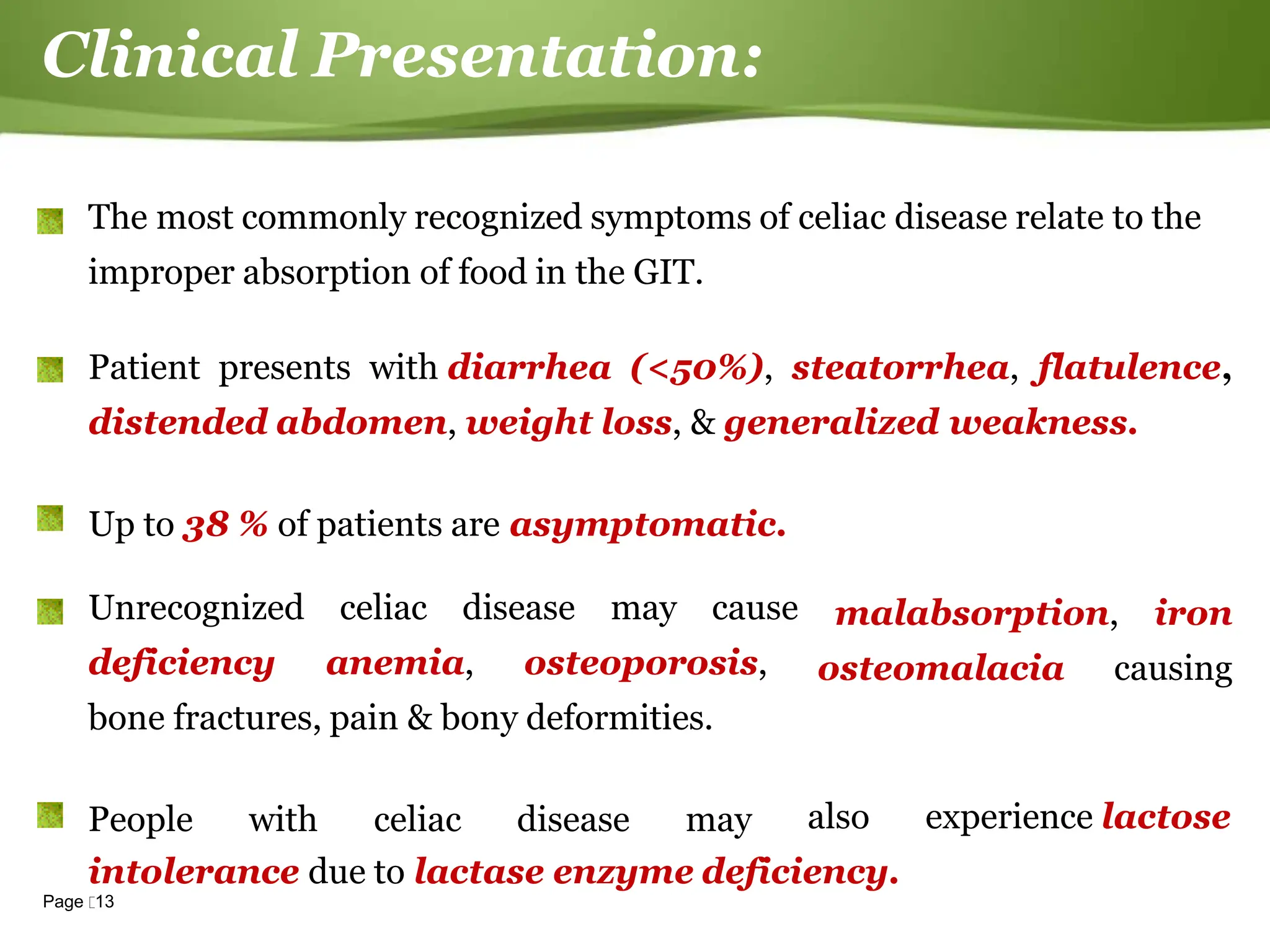
Clinical Presentation:
The most commonly recognized symptoms of celiac disease relate to the
improper absorption of food in the GIT.
Patient presents with diarrhea (<50%), steatorrhea, flatulence,
distended abdomen, weight loss, & generalized weakness.
Up to 38 % of patients are asymptomatic.
Unrecognized celiac disease may cause
deficiency anemia, osteoporosis,
bone fractures, pain & bony deformities.
People with celiac disease may
malabsorption, iron
osteomalacia causing
also
Page 13
experience lactose
intolerance due to lactase enzyme deficiency.
Dermatitis Hypertiformis
Dermatitis herpetiformis (DH) is the skin
manifestation of celiac disease.
It is an intensely itchy rash that occurs in the hands,
fingers, forearms, buttocks or scalp or anywhere on the body.
The rash typically consists of intensely itchy, small red dots
that may develop into blisters or pimples.
Approximately 10% of patients with celiac disease have DH,
& it is estimated that > 85% of patients with DH have celiac
disease .
Page 14
Dermatitis Hypertiformis
Page 15
Celiac Disease & the Lung:
The association between celiac disease & diffuse
interstitial pulmonary disease has been suspected
since 1970.
Extrinsic allergic alveolitis was found in combination
with celiac disease & it may be considered that both these
diseases are based on one common immunologic disorder.
The association between pulmonary hemosiderosis &
celiac disease have been reported 9 times in literature as
an extremely rare combination.
Page 16
Other Presentations of Celiac Disease:
Neurological symptoms e.g., peripheral neuropathy,
ataxia or epilepsy.
Apthous ulcers in the mouth is considered to be an
autoimmune disorder associated with celiac disease.
Dental enamel defects are frequent.
Patients with celiac disease may have liver diseases.
Abnormal liver tests are common at diagnosis & usually
improve with treatment.
Page 17
The Celiac Iceberg
Symptomatic
Celiac Disease
Silent Celiac
Disease
Latent Celiac Disease
Genetic susceptibility: - DQ2, DQ8
Manifest
mucosal lesion
Normal
Mucosa
Positive serology
Page 18
Diagnosis: Serology
Serum IgA endomysial antibodies (EMA) & serum
IgA tissue transglutaminase (tTG) antibodies have
both sensitivity & specificity > 95%.
Testing for
recommended
gliadin antibodies is no longer
because of its low sensitivity &
specificity for celiac disease.
The tTG antibody is the recommended single
serologic test for celiac disease screening.
Page 19
Diagnosis: Small Bowel Biopsy
Required to confirm the diagnosis of celiac disease.
Should also be considered in patients with negative
serologic test results who are at high risk or in whom the
physician strongly suspects celiac disease.
Mucosal changes may vary from partial to total villous
atrophy, or may be characterized by subtle crypt
lengthening or increased epithelial lymphocytes.
To avoid false-negative results on endoscopic biopsy, it is
recommend to obtain at least 4 tissue samples to increase
Page t
t1
h
7 e sensitivity of the test.
Endoscopy & Biopsy in Celiac Disease
Normal small intestine
Page 21
Celiac Disease
Normal Villi
Villous Atrophy
Diagnosis: HLA Genetic Typing
Antibody testing & HLA testing have similar accuracies.
Test Sensitivity Specificity
HLA-DQ2 94% 73%
HLA-DQ8 12% 81%
Page 22
Evaluation of Celiac Disease
Page 23
HOW IS CELIAC DISEASE
DIAGNOSED?
 Blood tests
Check for anti-body levels in the blood
Called a “celiac panel”
 Endoscopy and biopsy of the small intestine
Final diagnosis based on biopsy before starting a
gluten-free diet
 Can be diagnosed even if there are no symptoms
Treatment Options:
Option #1:
Remove the genes
Page 25
Option #2:
Remove the grains
Dietary Management in Celiac Disease
At present, the only effective treatment is
a life-long gluten-free diet (GFD).
No medication exists that will prevent
damage or prevent the body from
attacking the gut when gluten is present.
Strict adherence to the diet allows the
intestines to heal, leading to resolution
of all symptoms in most cases and,
depending on how soon the diet is
begun, can also eliminate theincreased
Pagr
e
ri2
s
3k of complications.
Page 24
Dietary Management in Celiac Disease
Follow-Up:
Serologic markers (serum
compliance with GFD.
IgA tTG) used to monitor
Antibody levels return to normal within 3-12 months of
starting a GFD but may take up to 30 months if the initial
titers are high.
Repetition of small bowel biopsy 3-4 months after
initiation of a GFD is not necessary if the patient responds
appropriately to therapy.
If the patient does not respond as expected → revise the
patient’s adherence to GFD, then the physician should Pag
c
c
eo2
n
5
sider other differential diagnosis.
GLUTEN-FREE
LIFESTYLE
 All food, cosmetics, bath products, medications
must be gluten-free
No wheat-based ingredients
Not processed around wheat, barley, or rye
 Contamination causes reaction
Even small amounts of gluten in food will affect a celiac
Contamination examples
 eating a piece of fruit that was served on a plate which previously
held bread
 inhaling and swallowing air-borne wheat flour at a bakery
Page 26
Prognosis:
Treating CD with a strict GFD is always completely effective.
Gastrointestinal complaints & other symptoms resolve in almost all
patients.
Once the diet has been followed for several years, individuals with CD have
similar mortality rates as the general population. However, about 10
% of patients with celiac disease develop lymphoma & small bowel
adenocarcinoma.
A few patients develop a refractory type of CD, in which the GFD no
longer seems effective.
Experts emphasize the need for lifelong adherence to the GFD to
avoid the long-term complications of this disorder. They point out that
although the disease may have symptom-free periods if the diet is not
followed, silent damage continues to occur.
According to medical authorities, CD cannot be outgrown or cured.
American Gastroenterological Association Institute
Recommendations for Celiac Disease Screening
Consider testing in symptomatic patients at high risk
for Celiac Disease with any of the following conditions:
Autoimmune hepatitis
Down syndrome
Premature onset of osteoporosis
Primary biliary cirrhosis
Unexplained elevations in liver transaminase levels
Unexplained iron deficiency anemia
Type 1 DM
Page 31
References:
Presutti J,Cangemi J, Cassidy H, Hill D,
American Family Physician. December
1802.
Celiac Disease.
15, 2007: 1795-
Hadithi M, von Blomberg BM, Crusius JB, et al. (2007).
"Accuracy of serologic tests and HLA-DQ typing for
diagnosing celiac disease". Ann. Intern. Med. 147: 294–
302.
Hood J, Mason AMS. Diffuse pulmonary disease with
transfer defect occurring in coeliac disease. Lancet
1970;1:445-47.
Page 32
Thank You

GI system-celiac disease in children.pptx

  • 1.
  • 2.
    Historical Aspect: 2,000 yrsago, a Greek physician named Aretaeus the Cappadocian provided the 1st known description of adult patients with celiac disease. The name ‘celiac’ is derived from the Greek for ‘suffering in the bowels’. In October 5, 1887, Dr. Samuel Gee, an English Medical Lecturer gave to medical students a lecture on the ‘celiac affection’ & this constitutes the modern ‘rediscovery’ of celiac disease. Page 2
  • 3.
    Definition: Celiac disease isan inflammatory autoimmune condition of the small intestine, triggered by gluten in genetically susceptible individuals. It has diverse multi-systemic clinical manifestations rather than being a 1ry intestinal disease. Other terms for celiac disease include: Gluten Sensitive Enteropathy, Non-Tropical Sprue & Celiac Sprue. Page 3
  • 4.
    What is gluten? THEProtein flour that form the structure of dough Specific peptide fraction of Protein Found in: Wheat Rye Barely Secalinus Hordenis Glutenins, Gliadins.
  • 5.
    Epidemiology: Celiac disease ismore commonly found among white Europeans or those of European descent. It is recognized as a common disorder that can be diagnosed at any age but commonly occurs at the age of 1-5 yrs old. Estimates vary from one in 5,000 to as many as one in every 300 individuals. Celiac disease is 20 times more common among type 1 diabetes patients than in the general population, that it became recommended to apply screening programs for celiac disease among children recently diagnosed with type 1 d d 5iabetes.
  • 6.
    Pathogenesis: Genetic predisposition HLA-DQ(DQ2 &/orDQ8) genes Environmental trigger Dietary Non-dietary?? Page 6
  • 7.
    Immune Response inCeliac Disease Page 7
  • 8.
    8 Pathological Spectrum ofSmall Intestine The classic pathology changes of celiac disease in the small bowel are categorized by "Marsh Classification": Marsh stage 0: normal mucosa Marsh stage 1: ↑ intra-epithelial lymphocytes >20/100 enterocytes Marsh stage 2: proliferation of the crypts of Lieberkuhn Marsh stage 3: partial or complete villous atrophy Marsh stage 4: hypoplasia of the small bowel architecture Page
  • 9.
    Pathology of CeliacDisease Page 9
  • 10.
    Cross-sections of thevilli, which line the small intestine. Normal lining of the small bowel, versus the damaged lining.
  • 11.
    Typical Celiac Disease •Age 2 to 10 yrs • Recurrent / chronic Diarrhea • Malabsorption • Abdominal distension • Anemia • Failure to thrive • Poor weight gain • Short stature
  • 12.
    WHAT ARE THE SYMPTOMS? diarrhea  weight loss  abdominal pain  chronic fatigue  weakness  malnutrition  In children failure to thrive irritability diarrhea and bloating  osteoporosis  arthritis and joint pain  anemia  infertility  frequent miscarriage  chronic fatigue syndrome  depression  behavioral changes
  • 13.
    Clinical Presentation: The mostcommonly recognized symptoms of celiac disease relate to the improper absorption of food in the GIT. Patient presents with diarrhea (<50%), steatorrhea, flatulence, distended abdomen, weight loss, & generalized weakness. Up to 38 % of patients are asymptomatic. Unrecognized celiac disease may cause deficiency anemia, osteoporosis, bone fractures, pain & bony deformities. People with celiac disease may malabsorption, iron osteomalacia causing also Page 13 experience lactose intolerance due to lactase enzyme deficiency.
  • 14.
    Dermatitis Hypertiformis Dermatitis herpetiformis(DH) is the skin manifestation of celiac disease. It is an intensely itchy rash that occurs in the hands, fingers, forearms, buttocks or scalp or anywhere on the body. The rash typically consists of intensely itchy, small red dots that may develop into blisters or pimples. Approximately 10% of patients with celiac disease have DH, & it is estimated that > 85% of patients with DH have celiac disease . Page 14
  • 15.
  • 16.
    Celiac Disease &the Lung: The association between celiac disease & diffuse interstitial pulmonary disease has been suspected since 1970. Extrinsic allergic alveolitis was found in combination with celiac disease & it may be considered that both these diseases are based on one common immunologic disorder. The association between pulmonary hemosiderosis & celiac disease have been reported 9 times in literature as an extremely rare combination. Page 16
  • 17.
    Other Presentations ofCeliac Disease: Neurological symptoms e.g., peripheral neuropathy, ataxia or epilepsy. Apthous ulcers in the mouth is considered to be an autoimmune disorder associated with celiac disease. Dental enamel defects are frequent. Patients with celiac disease may have liver diseases. Abnormal liver tests are common at diagnosis & usually improve with treatment. Page 17
  • 18.
    The Celiac Iceberg Symptomatic CeliacDisease Silent Celiac Disease Latent Celiac Disease Genetic susceptibility: - DQ2, DQ8 Manifest mucosal lesion Normal Mucosa Positive serology Page 18
  • 19.
    Diagnosis: Serology Serum IgAendomysial antibodies (EMA) & serum IgA tissue transglutaminase (tTG) antibodies have both sensitivity & specificity > 95%. Testing for recommended gliadin antibodies is no longer because of its low sensitivity & specificity for celiac disease. The tTG antibody is the recommended single serologic test for celiac disease screening. Page 19
  • 20.
    Diagnosis: Small BowelBiopsy Required to confirm the diagnosis of celiac disease. Should also be considered in patients with negative serologic test results who are at high risk or in whom the physician strongly suspects celiac disease. Mucosal changes may vary from partial to total villous atrophy, or may be characterized by subtle crypt lengthening or increased epithelial lymphocytes. To avoid false-negative results on endoscopic biopsy, it is recommend to obtain at least 4 tissue samples to increase Page t t1 h 7 e sensitivity of the test.
  • 21.
    Endoscopy & Biopsyin Celiac Disease Normal small intestine Page 21 Celiac Disease Normal Villi Villous Atrophy
  • 22.
    Diagnosis: HLA GeneticTyping Antibody testing & HLA testing have similar accuracies. Test Sensitivity Specificity HLA-DQ2 94% 73% HLA-DQ8 12% 81% Page 22
  • 23.
    Evaluation of CeliacDisease Page 23
  • 24.
    HOW IS CELIACDISEASE DIAGNOSED?  Blood tests Check for anti-body levels in the blood Called a “celiac panel”  Endoscopy and biopsy of the small intestine Final diagnosis based on biopsy before starting a gluten-free diet  Can be diagnosed even if there are no symptoms
  • 25.
    Treatment Options: Option #1: Removethe genes Page 25 Option #2: Remove the grains
  • 26.
    Dietary Management inCeliac Disease At present, the only effective treatment is a life-long gluten-free diet (GFD). No medication exists that will prevent damage or prevent the body from attacking the gut when gluten is present. Strict adherence to the diet allows the intestines to heal, leading to resolution of all symptoms in most cases and, depending on how soon the diet is begun, can also eliminate theincreased Pagr e ri2 s 3k of complications.
  • 27.
    Page 24 Dietary Managementin Celiac Disease
  • 28.
    Follow-Up: Serologic markers (serum compliancewith GFD. IgA tTG) used to monitor Antibody levels return to normal within 3-12 months of starting a GFD but may take up to 30 months if the initial titers are high. Repetition of small bowel biopsy 3-4 months after initiation of a GFD is not necessary if the patient responds appropriately to therapy. If the patient does not respond as expected → revise the patient’s adherence to GFD, then the physician should Pag c c eo2 n 5 sider other differential diagnosis.
  • 29.
    GLUTEN-FREE LIFESTYLE  All food,cosmetics, bath products, medications must be gluten-free No wheat-based ingredients Not processed around wheat, barley, or rye  Contamination causes reaction Even small amounts of gluten in food will affect a celiac Contamination examples  eating a piece of fruit that was served on a plate which previously held bread  inhaling and swallowing air-borne wheat flour at a bakery
  • 30.
    Page 26 Prognosis: Treating CDwith a strict GFD is always completely effective. Gastrointestinal complaints & other symptoms resolve in almost all patients. Once the diet has been followed for several years, individuals with CD have similar mortality rates as the general population. However, about 10 % of patients with celiac disease develop lymphoma & small bowel adenocarcinoma. A few patients develop a refractory type of CD, in which the GFD no longer seems effective. Experts emphasize the need for lifelong adherence to the GFD to avoid the long-term complications of this disorder. They point out that although the disease may have symptom-free periods if the diet is not followed, silent damage continues to occur. According to medical authorities, CD cannot be outgrown or cured.
  • 31.
    American Gastroenterological AssociationInstitute Recommendations for Celiac Disease Screening Consider testing in symptomatic patients at high risk for Celiac Disease with any of the following conditions: Autoimmune hepatitis Down syndrome Premature onset of osteoporosis Primary biliary cirrhosis Unexplained elevations in liver transaminase levels Unexplained iron deficiency anemia Type 1 DM Page 31
  • 32.
    References: Presutti J,Cangemi J,Cassidy H, Hill D, American Family Physician. December 1802. Celiac Disease. 15, 2007: 1795- Hadithi M, von Blomberg BM, Crusius JB, et al. (2007). "Accuracy of serologic tests and HLA-DQ typing for diagnosing celiac disease". Ann. Intern. Med. 147: 294– 302. Hood J, Mason AMS. Diffuse pulmonary disease with transfer defect occurring in coeliac disease. Lancet 1970;1:445-47. Page 32
  • 33.