DOCTORS SHOULD BE
OBSERVANT,LIKE A DETECTIVE
“CONAN DOYLE”
Introduction
• Introduce yourself
• Ask permission to examine
• Ask if any pain anywhere
• Are they comfortable lying flat?
DEFINITION
A physical assessment is the systematic
collection of objective information that is directly
observed or is elicited through examination
techniques
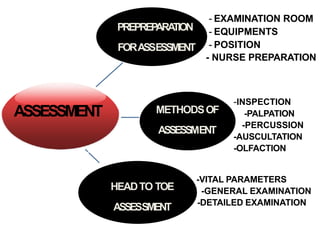
PREPREPARATION
FORASS•ESSMENT
- EXAMINATION ROOM
- EQUIPMENTS
- POSITION
- NURSE PREPARATION
METHODSOF
ASSESSM•ENT
-INSPECTION
-PALPATION
-PERCUSSION
-AUSCULTATION
-OLFACTION
HEADTO TOE
•
•
ASSES•SMENT
-VITAL PARAMETERS
-GENERAL EXAMINATION
-DETAILED EXAMINATION
ASSESSMENT
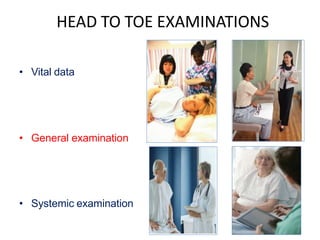
HEAD TO TOE EXAMINATIONS
• Vital data
• General examination
• Systemic examination
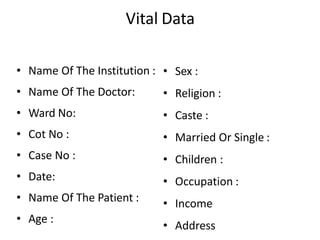
Vital Data
• Name Of The Institution :
• Name Of The Doctor:
• Ward No:
• Cot No :
• Case No :
• Date:
• Name Of The Patient :
• Age :
• Sex :
• Religion :
• Caste :
• Married Or Single :
• Children :
• Occupation :
• Income
• Address
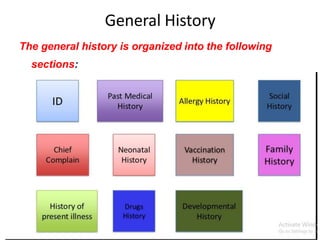
General History
The general history is organized into the following
sections:
• Identifying data (ID)
• Chief complaint (CC)
• History of the present illness (HPI)
• Past medical history (PMHx)
• Family history (FHx)
• Medications (MEDS) and Allergies (ALL)
• Social history (SHx)
• Review of systems or functional inquiry (ROS/FI)
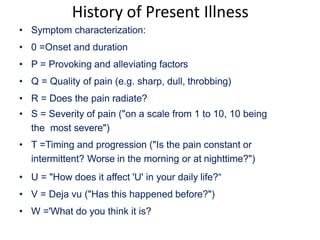
History of Present Illness
• Symptom characterization:
• 0 =Onset and duration
• P = Provoking and alleviating factors
• Q = Quality of pain (e.g. sharp, dull, throbbing)
• R = Does the pain radiate?
• S = Severity of pain ("on a scale from 1 to 10, 10 being
the most severe")
• T =Timing and progression ("Is the pain constant or
intermittent? Worse in the morning or at nighttime?")
• U = "How does it affect 'U' in your daily life?“
• V = Deja vu ("Has this happened before?")
• W ='What do you think it is?
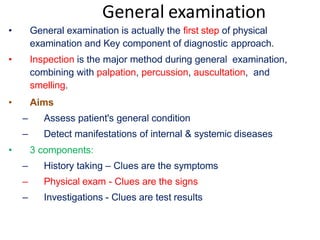
General examination
• General examination is actually the first step of physical
examination and Key component of diagnostic approach.
• Inspection is the major method during general examination,
combining with palpation, percussion, auscultation, and
smelling.
• Aims
– Assess patient's general condition
– Detect manifestations of internal & systemic diseases
• 3 components:
– History taking – Clues are the symptoms
– Physical exam - Clues are the signs
– Investigations - Clues are test results
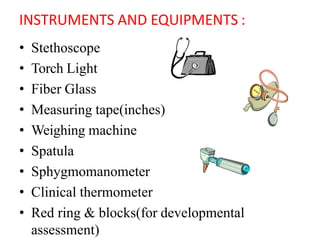
INSTRUMENTS AND EQUIPMENTS :
• Stethoscope
• Torch Light
• Fiber Glass
• Measuring tape(inches)
• Weighing machine
• Spatula
• Sphygmomanometer
• Clinical thermometer
• Red ring & blocks(for developmental
assessment)
Prerequisites:
• Examination environment
• Hand Washing
• Proper light
• Privacy & Confidentiality
• Presence of a chaperon when examining
female patients
• Correct position of Doctor & Patient - Ideally
examiner should be on right side of patient
• Proper Exposure
• Ensure your hands are warm
GENERAL EXAMINATION
– Head to Toe
 Skin
 Hair & Head
 Face
 Eyes/Ear/Nose
 Mouth
 Neck
 Nail & Limbs
 Pallor
 Icterus
 Cyanosis
 Oedema
 Lymph nodes
--Genitalia
– General Appearence
– Anthropometery
 Weight
 HC/CC/AG/MAC
 Height/length
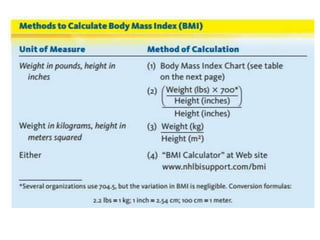
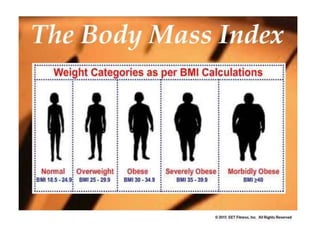
 BMI
– Vital Signs
 Temperature
 Arterial pulse
 Respiration
 Blood pressure
 Capillary refill time
 Hydration
 Oxygen saturation
General Appearance
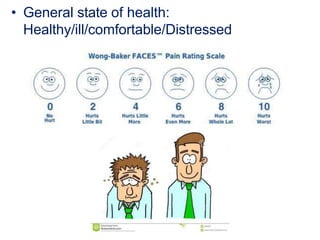
• General state of health: Healthy/ill/comfortable/Distressed
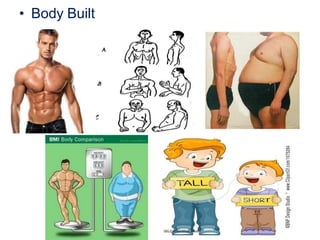
• Body Built and Nutritional status
– Obese/lean
– Tall/short
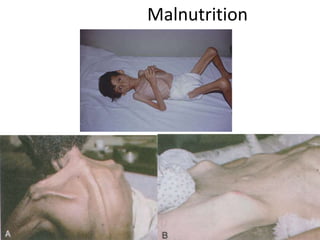
– Muscular/Asthenic/Cachexic
• State of awareness or level of consciousness
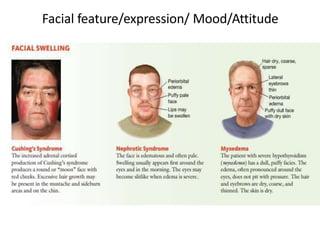
• Facial feature/expression/ Mood/Attitude
• Speech(tone/voice)
• Position/posture and Gait
• Personal Hygiene
• Breath/Odor
• General state of health:
Healthy/ill/comfortable/Distressed
• Body Built
Malnutrition
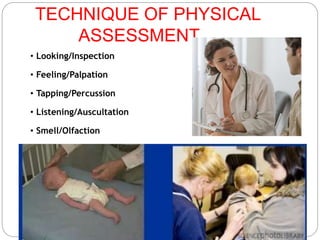
TECHNIQUE OF PHYSICAL
ASSESSMENT
• Looking/Inspection
• Feeling/Palpation
• Tapping/Percussion
• Listening/Auscultation
• Smell/Olfaction
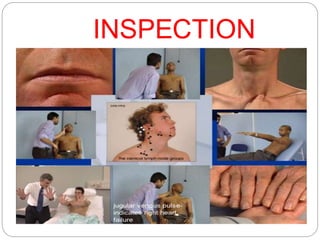
INSPECTION
GENERAL INSPECTION OF A
CLIENT FOCUSES ON
• Overall appearance of health or illness
• Signs of distress
• Facial expression and mood
• Body size
• Grooming and personal hygiene
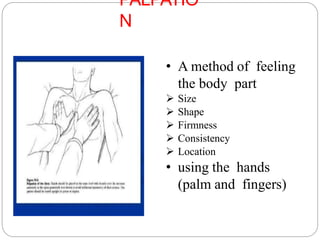
PALPATIO
N
• A method of feeling
the body part
 Size
 Shape
 Firmness
 Consistency
 Location
• using the hands
(palm and fingers)
PRINCIPLES OF PALPATION
• You should have short fingernails.
• You should warm your hands prior to placing them on the
patient.
• Encourage the patient to continue to breathe normally
throughout the palpation.
• If pain is experienced during the palpation.
discontinue the palpation immediately.
• Inform the patient where, when, and how the touch will occur,
especially when the patient cannot see what you are doing.
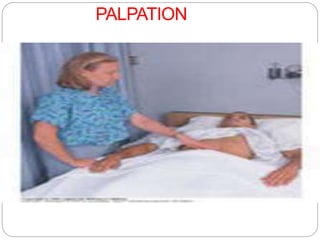
PALPATION
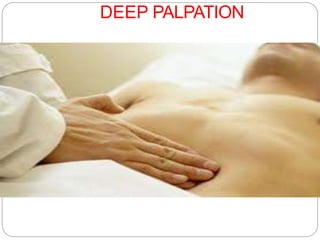
DEEP PALPATION
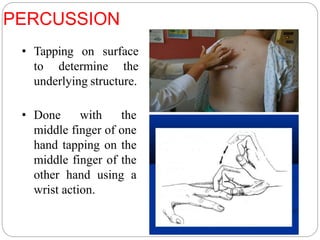
PERCUSSION
• Tapping on surface
to determine the
underlying structure.
• Done with the
middle finger of one
hand tapping on the
middle finger of the
other hand using a
wrist action.
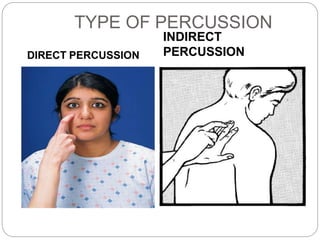
TYPE OF PERCUSSION
DIRECT PERCUSSION
INDIRECT
PERCUSSION
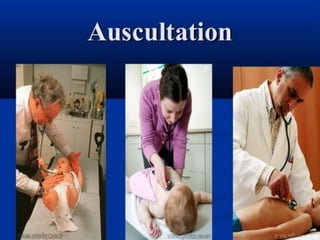
AUSCULTATION
FOUR CHARACTERISTICS
• 1.Pitch (ranging from high and
low):frequency or number of oscillations
generated per second by vibrating object
• 2. Loudness (ranging from soft to loud):
amplitude of sound
• 3. Quality (gurgling or swishing)
• 4. Duration (short, medium or long)
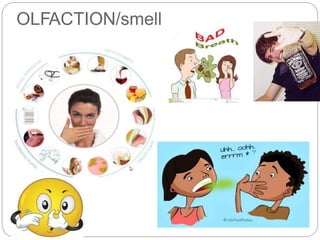
OLFACTION/smell
HEAD TO TOE EXAMINATION…..
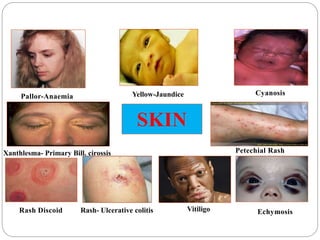
SKIN
Pallor-Anaemia
EchymosisRash Discoid Rash- Ulcerative colitis
Petechial Rash
CyanosisYellow-Jaundice
Xanthlesma- Primary Bill. cirossis
Vitiligo
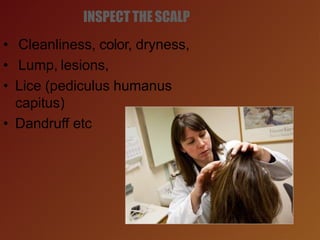
INSPECT THESCALP
• Cleanliness, color, dryness,
• Lump, lesions,
• Lice (pediculus humanus
capitus)
• Dandruff etc
HAIR
• ALOPECIA
• Non-scarring
-alopecia areta
-scalp ring worm
-traction alopecia
• Scarring
-burns,radiation,lupoid erythema,sarcoidosis
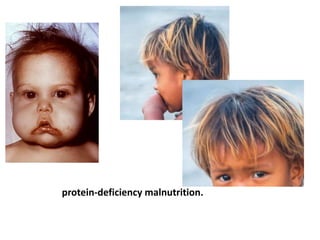
protein-deficiency malnutrition.
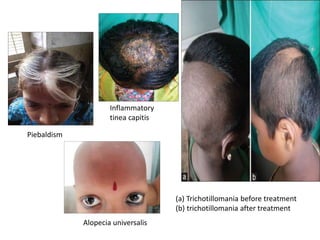
Piebaldism
Inflammatory
tinea capitis
Alopecia universalis
(a) Trichotillomania before treatment
(b) trichotillomania after treatment
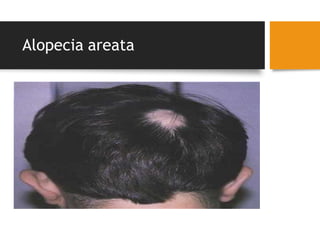
Alopecia areata
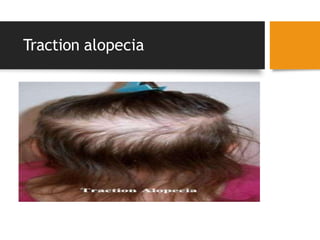
Traction alopecia
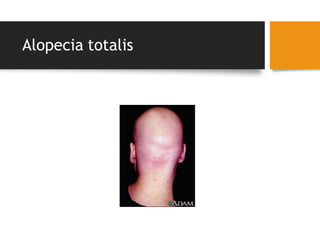
Alopecia totalis
HEAD AND NECK
• ASSESSING THE SKULL
• for size, symmetry
• any nodules or masses
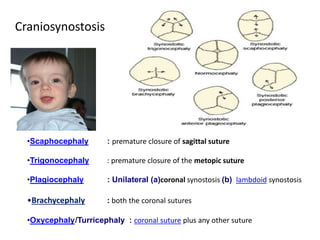
Craniosynostosis
•Scaphocephaly : premature closure of sagittal suture
•Trigonocephaly : premature closure of the metopic suture
•Plagiocephaly : Unilateral (a)coronal synostosis (b) lambdoid synostosis
•Brachycephaly : both the coronal sutures
•Oxycephaly/Turricephaly : coronal suture plus any other suture
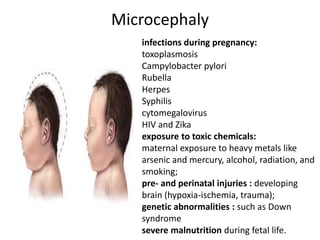
Microcephaly
infections during pregnancy:
toxoplasmosis
Campylobacter pylori
Rubella
Herpes
Syphilis
cytomegalovirus
HIV and Zika
exposure to toxic chemicals:
maternal exposure to heavy metals like
arsenic and mercury, alcohol, radiation, and
smoking;
pre- and perinatal injuries : developing
brain (hypoxia-ischemia, trauma);
genetic abnormalities : such as Down
syndrome
severe malnutrition during fetal life.
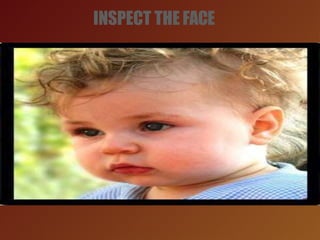
INSPECT THE FACE
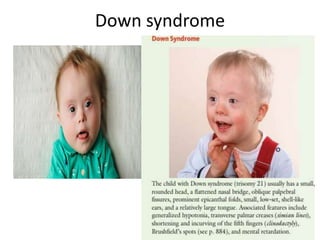
Down syndrome
Small Chin
Slanted Eyes
Poor Muscle Tone
Nasal Bridge
Single Crease Of The Palm
Protruding
Small Mouth
Large Tongue
Obstructive Sleep Apnea
Flat And Wide Face
Short Neck
Excessive Joint Flexibility
Extra Space Between Big Toe And
Second Toe
Short Fingers
Hip Dislocations
Short
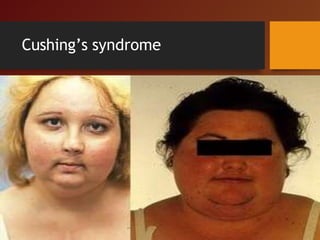
Cushing’s syndrome
Facial feature/expression/ Mood/Attitude
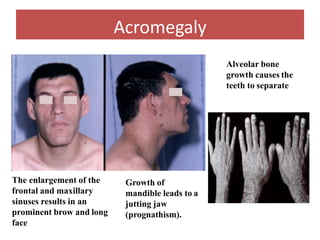
Acromegaly
The enlargement of the
frontal and maxillary
sinuses results in an
prominent brow and long
face
Growth of
mandible leads to a
jutting jaw
(prognathism).
Alveolar bone
growth causes the
teeth to separate
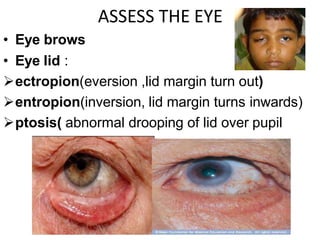
ASSESS THE EYE
• Eye brows
• Eye lid :
ectropion(eversion ,lid margin turn out)
entropion(inversion, lid margin turns inwards)
ptosis( abnormal drooping of lid over pupil
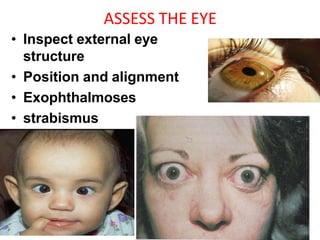
ASSESS THE EYE
• Inspect external eye
structure
• Position and alignment
• Exophthalmoses
• strabismus
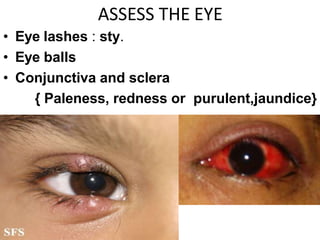
ASSESS THE EYE
• Eye lashes : sty.
• Eye balls
• Conjunctiva and sclera
{ Paleness, redness or purulent,jaundice}
ASSESS THE EYE
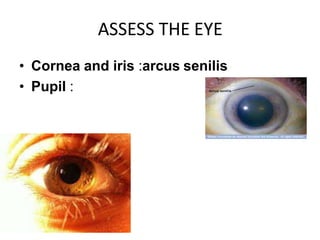
• Cornea and iris :arcus senilis
• Pupil :
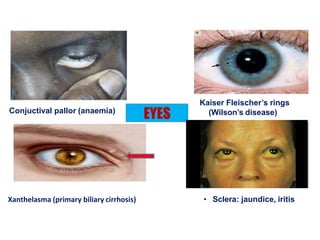
Xanthelasma (primary biliary cirrhosis)
EYESConjuctival pallor (anaemia)
• Sclera: jaundice, iritis
Kaiser Fleischer’s rings
(Wilson’s disease)
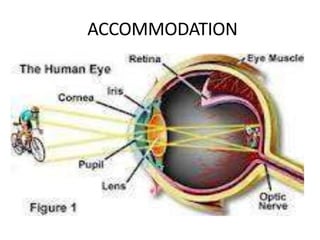
ACCOMMODATION
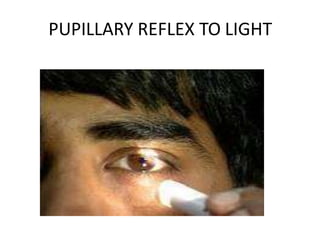
PUPILLARY REFLEX TO LIGHT
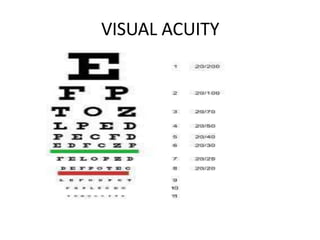
VISUAL ACUITY
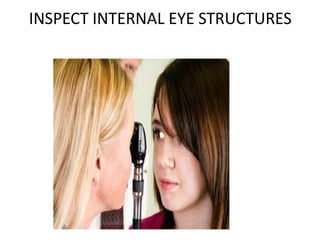
INSPECT INTERNAL EYE STRUCTURES
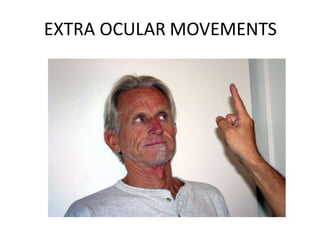
EXTRA OCULAR MOVEMENTS
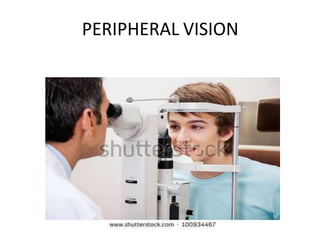
PERIPHERAL VISION
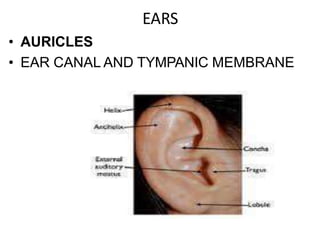
EARS
• AURICLES
• EAR CANAL AND TYMPANIC MEMBRANE
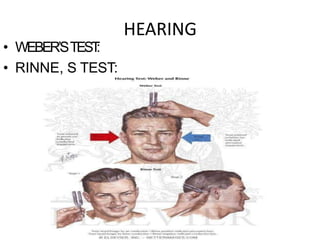
HEARING
• WEBER’STEST:
• RINNE, S TEST:
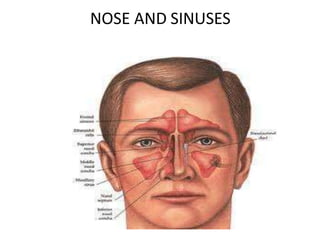
NOSE AND SINUSES
Oral cavity
• The teeth and breath
• Check the oral cavity looking for
• MOUTH ULCERS
-Aphtous,drugs and trauma
-gastrointestinal disease;inflammatory bowel disease,coeliac disease
-rheumatological;Behcets syndrome,reiter
• -erythema multiforme
-infections;herpes zoster,simplex,syphilis,tuberculosis
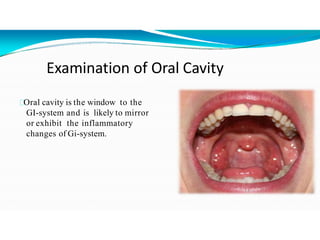
Examination of Oral Cavity
Oral cavity is the window to the
GI-system and is likely to mirror
or exhibit the inflammatory
changes of Gi-system.
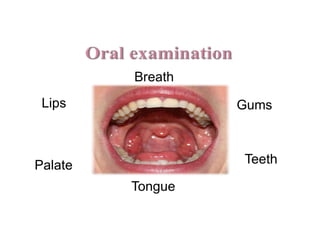
Lips Gums
Teeth
Tongue
Palate
Breath
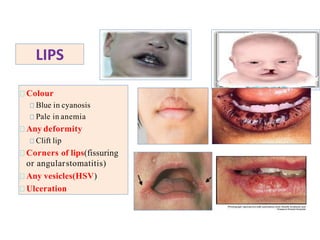
LIPS
Colour
Blue in cyanosis
Pale in anemia
Any deformity
Clift lip
Corners of lips(fissuring
or angularstomatitis)
Any vesicles(HSV)
Ulceration
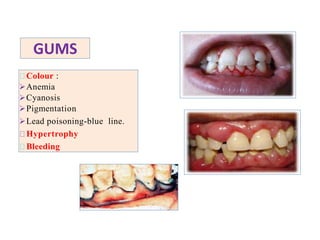
GUMS
Colour :
Anemia
Cyanosis
Pigmentation
Lead poisoning-blue line.
Hypertrophy
Bleeding
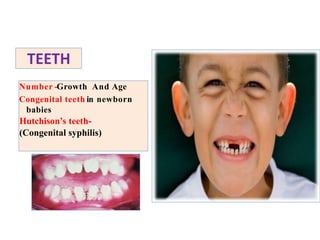
TEETH
Number -Growth And Age
Congenital teeth in newborn
babies
Hutchison’s teeth-
(Congenital syphilis)
TONGUE
 Colour
 Size
 Symmetry
 Dry(dehydration)or wet
 Surface of tongue(coated or raw)
 Bald tongue (Smooth tongue)in Vit-B12 deficiency,IDA
 Strawberry tongue in scarlet fever and kawaski disease
 Scrotal tongue in down syndrome
 Geographical tongue isbenign
 Tongue tie(ankyloglossia)
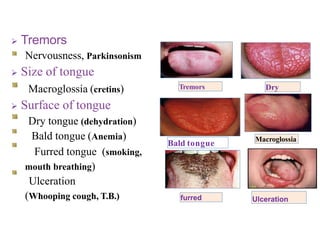
Tremors Dry
Macroglossia
 Tremors
Nervousness, Parkinsonism
 Size of tongue
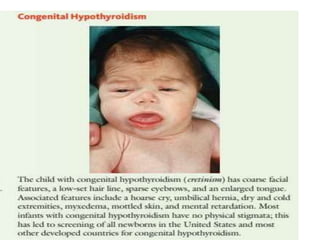
Macroglossia (cretins)
 Surface of tongue
Dry tongue (dehydration)
Bald tongue (Anemia)
Furred tongue (smoking,
mouth breathing)
Ulceration
(Whooping cough, T.B.) furred Ulceration
Bald tongue
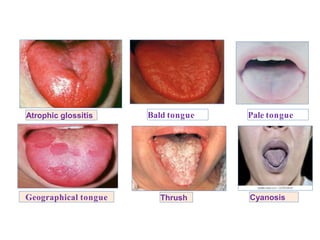
Atrophic glossitis
ThrushGeographical tongue
Bald tongue Pale tongue
Cyanosis
PALATES,ORO-PHARYNX MOUTH
Oral cavity and oro-pharynx is examined with the help of a tongue
depressor for:
• Colour
• Ulcers
• Deformity
• Inflammatory changes
Thrush(oral candidiasis)
Membranouspharyngitis in strep,diphtheria,infecious mononucleosis
NECK
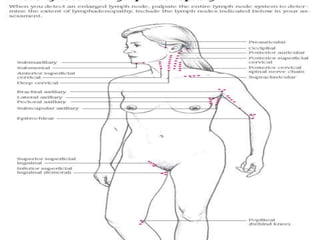
• During palpation of lymph nodes the following
features should be considered;
• SITE
-Localised or generalised?
-palpable lymph node areas are;
Epitrochlear,axillary,cervical and
occipital,supraclavicular,para-aortic,inguinal
and popliteal.
lymphadenopathy
SIZE
CONSISTENCY
Hard -suggestive of carcinoma
Soft- may be normal
Rubbery may be due to Lymphoma
Tenderness-Acute infection of inflammation
Fixation--If fixed to the underlying structures its most likely
malignant
Overlying Skin-if inflamed then its suggestive of
infection,teethered suggests carcinoma.
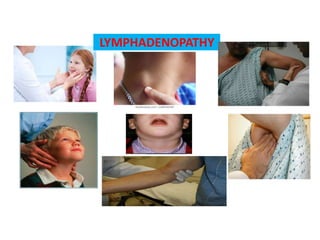
LYMPHADENOPATHY
CAUSES OF LYMPHADENOPATHY
GENERALISED
-lymphoma
-leukemia
-infections
-viral;infectious mononucleosis,CMV,HIV
-bacterial;tuberculosis,syphilis
-protozoal;toxoplasmosis
-connective tissue disease
-infitration;sarcoidosis
-drugs;phenytoin
PALLOR
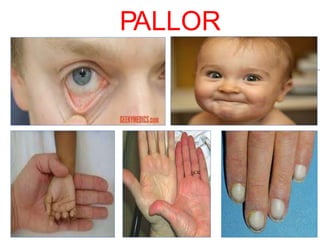
• Deficiency of haemoglobin can produce pallor of the skin.
• Should be noticeable especially in the mucous membranes of
the sclerae if the anaemia is severe- Hb of less than 7g/L.
• Facial pallor can also be seen in patients with shock,due to
the reduction of cardiac output. These patients usually
appear cold and clammy and significantly hypotensive.
localised
PALLOR
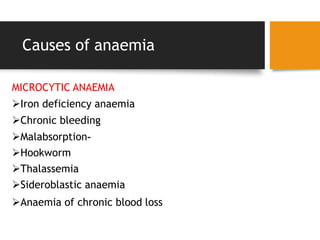
Causes of anaemia
MICROCYTIC ANAEMIA
Iron deficiency anaemia
Chronic bleeding
Malabsorption-
Hookworm
Thalassemia
Sideroblastic anaemia
Anaemia of chronic blood loss
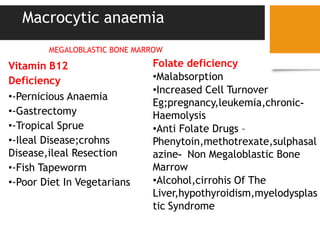
Macrocytic anaemia
Vitamin B12
Deficiency
•-Pernicious Anaemia
•-Gastrectomy
•-Tropical Sprue
•-Ileal Disease;crohns
Disease,ileal Resection
•-Fish Tapeworm
•-Poor Diet In Vegetarians
MEGALOBLASTIC BONE MARROW
Folate deficiency
•Malabsorption
•Increased Cell Turnover
Eg;pregnancy,leukemia,chronic-
Haemolysis
•Anti Folate Drugs –
Phenytoin,methotrexate,sulphasal
azine- Non Megaloblastic Bone
Marrow
•Alcohol,cirrohis Of The
Liver,hypothyroidism,myelodysplas
tic Syndrome
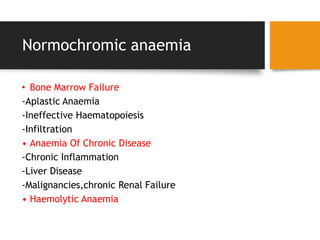
Normochromic anaemia
• Bone Marrow Failure
-Aplastic Anaemia
-Ineffective Haematopoiesis
-Infiltration
• Anaemia Of Chronic Disease
-Chronic Inflammation
-Liver Disease
-Malignancies,chronic Renal Failure
• Haemolytic Anaemia
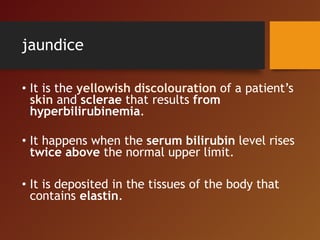
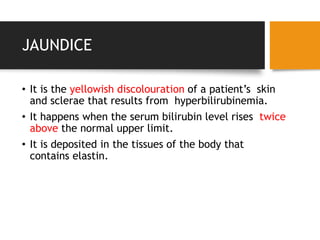
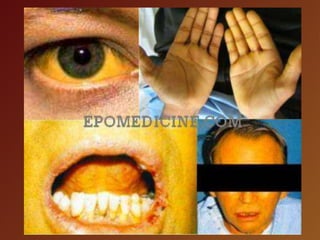
jaundice
• It is the yellowish discolouration of a patient’s
skin and sclerae that results from
hyperbilirubinemia.
• It happens when the serum bilirubin level rises
twice above the normal upper limit.
• It is deposited in the tissues of the body that
contains elastin.
JAUNDICE
• It is the yellowish discolouration of a patient’s skin
and sclerae that results from hyperbilirubinemia.
• It happens when the serum bilirubin level rises twice
above the normal upper limit.
• It is deposited in the tissues of the body that
contains elastin.
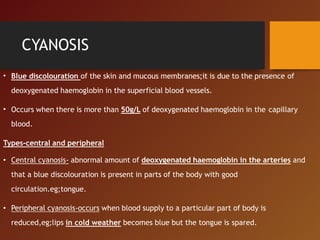
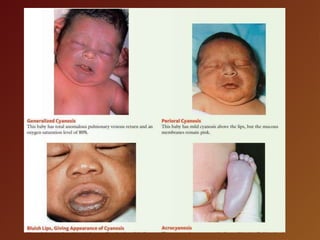
CYANOSIS
• Blue discolouration of the skin and mucous membranes;it is due to the presence of
deoxygenated haemoglobin in the superficial blood vessels.
• Occurs when there is more than 50g/L of deoxygenated haemoglobin in the capillary
blood.
Types-central and peripheral
• Central cyanosis- abnormal amount of deoxygenated haemoglobin in the arteries and
that a blue discolouration is present in parts of the body with good
circulation.eg;tongue.
• Peripheral cyanosis-occurs when blood supply to a particular part of body is
reduced,eg;lips in cold weather becomes blue but the tongue is spared.
Causes of cyanosis
• Central Cyanosis
1)decreased Arterial
Oyygen Saturation.
-High Altitude
-Lung Disease
-Right To Left Cardiac
Shunt 2)polycythaemia
3)haemoglobin
Abnormalities;methaemoglobinemi
A,sulphaemoglobinemia
• Peripheral CYANOSIS
1)all THE CAUSES OF CENTRAL
CYANOSIS 2)exposure TO COLD
3)reduced Cardiac Output
-Left Ventricular Failure
-shock
4)Arterial or venous obstruction
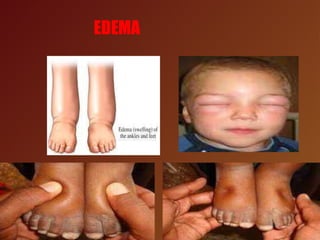
EDEMA
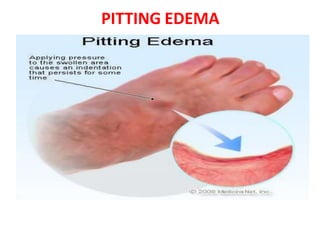
PITTING EDEMA
PITTING EDEMA
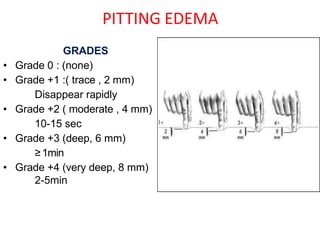
GRADES
• Grade 0 : (none)
• Grade +1 :( trace , 2 mm)
Disappear rapidly
• Grade +2 ( moderate , 4 mm)
10-15 sec
• Grade +3 (deep, 6 mm)
≥1min
• Grade +4 (very deep, 8 mm)
2-5min
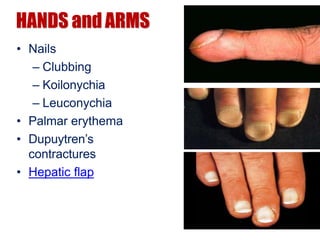
HANDS and ARMS
• Nails
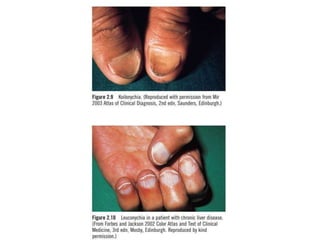
– Clubbing
– Koilonychia
– Leuconychia
• Palmar erythema
• Dupuytren’s
contractures
• Hepatic flap
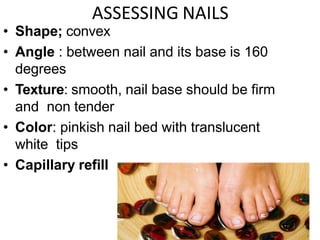
ASSESSING NAILS
• Shape; convex
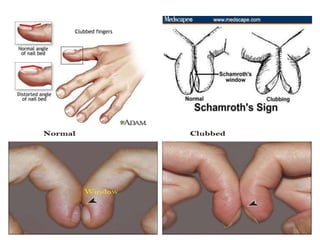
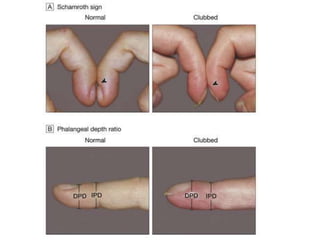
• Angle : between nail and its base is 160
degrees
• Texture: smooth, nail base should be firm
and non tender
• Color: pinkish nail bed with translucent
white tips
• Capillary refill
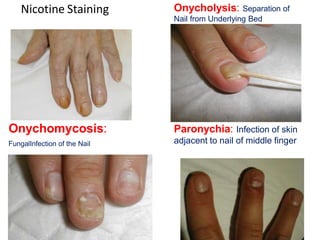
Nicotine Staining Onycholysis: Separation of
Nail from Underlying Bed
Onychomycosis:
FungalInfection of the Nail
Paronychia: Infection of skin
adjacent to nail of middle finger
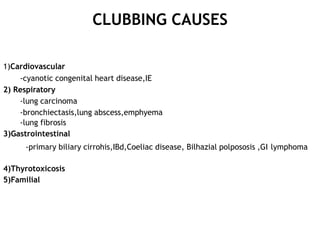
CLUBBING CAUSES
1)Cardiovascular
-cyanotic congenital heart disease,IE
2) Respiratory
-lung carcinoma
-bronchiectasis,lung abscess,emphyema
-lung fibrosis
3)Gastrointestinal
-primary biliary cirrohis,IBd,Coeliac disease, Bilhazial polpososis ,GI lymphoma
4)Thyrotoxicosis
5)Familial
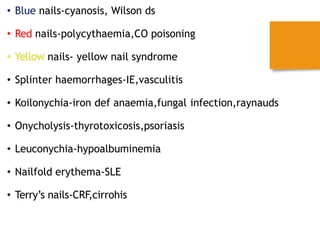
• Blue nails-cyanosis, Wilson ds
• Red nails-polycythaemia,CO poisoning
nails- yellow nail syndrome
• Splinter haemorrhages-IE,vasculitis
• Koilonychia-iron def anaemia,fungal infection,raynauds
• Onycholysis-thyrotoxicosis,psoriasis
• Leuconychia-hypoalbuminemia
• Nailfold erythema-SLE
• Terry’s nails-CRF,cirrohis
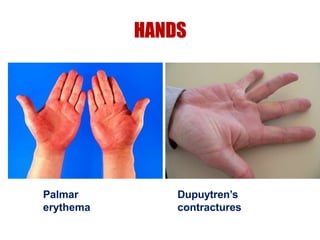
HANDS
Palmar
erythema
Dupuytren’s
contractures
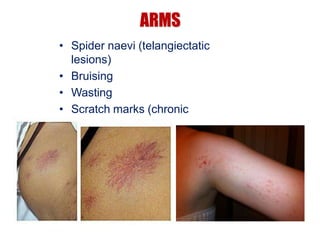
ARMS
• Spider naevi (telangiectatic
lesions)
• Bruising
• Wasting
• Scratch marks (chronic
cholestasis)
Thank
You

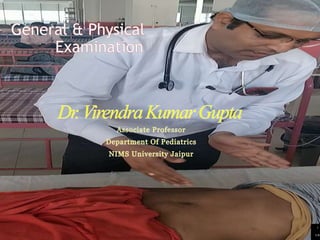
General physical Examination

  • 2.
    DOCTORS SHOULD BE OBSERVANT,LIKEA DETECTIVE “CONAN DOYLE” Introduction • Introduce yourself • Ask permission to examine • Ask if any pain anywhere • Are they comfortable lying flat?
  • 3.
    DEFINITION A physical assessmentis the systematic collection of objective information that is directly observed or is elicited through examination techniques
  • 4.
    PREPREPARATION FORASS•ESSMENT - EXAMINATION ROOM -EQUIPMENTS - POSITION - NURSE PREPARATION METHODSOF ASSESSM•ENT -INSPECTION -PALPATION -PERCUSSION -AUSCULTATION -OLFACTION HEADTO TOE • • ASSES•SMENT -VITAL PARAMETERS -GENERAL EXAMINATION -DETAILED EXAMINATION ASSESSMENT
  • 5.
    HEAD TO TOEEXAMINATIONS • Vital data • General examination • Systemic examination
  • 6.
    Vital Data • NameOf The Institution : • Name Of The Doctor: • Ward No: • Cot No : • Case No : • Date: • Name Of The Patient : • Age : • Sex : • Religion : • Caste : • Married Or Single : • Children : • Occupation : • Income • Address
  • 7.
    General History The generalhistory is organized into the following sections: • Identifying data (ID) • Chief complaint (CC) • History of the present illness (HPI) • Past medical history (PMHx) • Family history (FHx) • Medications (MEDS) and Allergies (ALL) • Social history (SHx) • Review of systems or functional inquiry (ROS/FI)
  • 8.
    History of PresentIllness • Symptom characterization: • 0 =Onset and duration • P = Provoking and alleviating factors • Q = Quality of pain (e.g. sharp, dull, throbbing) • R = Does the pain radiate? • S = Severity of pain ("on a scale from 1 to 10, 10 being the most severe") • T =Timing and progression ("Is the pain constant or intermittent? Worse in the morning or at nighttime?") • U = "How does it affect 'U' in your daily life?“ • V = Deja vu ("Has this happened before?") • W ='What do you think it is?
  • 9.
    General examination • Generalexamination is actually the first step of physical examination and Key component of diagnostic approach. • Inspection is the major method during general examination, combining with palpation, percussion, auscultation, and smelling. • Aims – Assess patient's general condition – Detect manifestations of internal & systemic diseases • 3 components: – History taking – Clues are the symptoms – Physical exam - Clues are the signs – Investigations - Clues are test results
  • 10.
    INSTRUMENTS AND EQUIPMENTS: • Stethoscope • Torch Light • Fiber Glass • Measuring tape(inches) • Weighing machine • Spatula • Sphygmomanometer • Clinical thermometer • Red ring & blocks(for developmental assessment)
  • 11.
    Prerequisites: • Examination environment •Hand Washing • Proper light • Privacy & Confidentiality • Presence of a chaperon when examining female patients • Correct position of Doctor & Patient - Ideally examiner should be on right side of patient • Proper Exposure • Ensure your hands are warm
  • 12.
    GENERAL EXAMINATION – Headto Toe  Skin  Hair & Head  Face  Eyes/Ear/Nose  Mouth  Neck  Nail & Limbs  Pallor  Icterus  Cyanosis  Oedema  Lymph nodes --Genitalia – General Appearence – Anthropometery  Weight  HC/CC/AG/MAC  Height/length  BMI – Vital Signs  Temperature  Arterial pulse  Respiration  Blood pressure  Capillary refill time  Hydration  Oxygen saturation
  • 13.
    General Appearance • Generalstate of health: Healthy/ill/comfortable/Distressed • Body Built and Nutritional status – Obese/lean – Tall/short – Muscular/Asthenic/Cachexic • State of awareness or level of consciousness • Facial feature/expression/ Mood/Attitude • Speech(tone/voice) • Position/posture and Gait • Personal Hygiene • Breath/Odor
  • 14.
    • General stateof health: Healthy/ill/comfortable/Distressed
  • 15.
  • 16.
  • 19.
    TECHNIQUE OF PHYSICAL ASSESSMENT •Looking/Inspection • Feeling/Palpation • Tapping/Percussion • Listening/Auscultation • Smell/Olfaction
  • 20.
  • 21.
    GENERAL INSPECTION OFA CLIENT FOCUSES ON • Overall appearance of health or illness • Signs of distress • Facial expression and mood • Body size • Grooming and personal hygiene
  • 22.
    PALPATIO N • A methodof feeling the body part  Size  Shape  Firmness  Consistency  Location • using the hands (palm and fingers)
  • 23.
    PRINCIPLES OF PALPATION •You should have short fingernails. • You should warm your hands prior to placing them on the patient. • Encourage the patient to continue to breathe normally throughout the palpation. • If pain is experienced during the palpation. discontinue the palpation immediately. • Inform the patient where, when, and how the touch will occur, especially when the patient cannot see what you are doing.
  • 24.
  • 25.
  • 26.
    PERCUSSION • Tapping onsurface to determine the underlying structure. • Done with the middle finger of one hand tapping on the middle finger of the other hand using a wrist action.
  • 27.
    TYPE OF PERCUSSION DIRECTPERCUSSION INDIRECT PERCUSSION
  • 28.
  • 29.
    FOUR CHARACTERISTICS • 1.Pitch(ranging from high and low):frequency or number of oscillations generated per second by vibrating object • 2. Loudness (ranging from soft to loud): amplitude of sound • 3. Quality (gurgling or swishing) • 4. Duration (short, medium or long)
  • 30.
  • 31.
    HEAD TO TOEEXAMINATION…..
  • 32.
    SKIN Pallor-Anaemia EchymosisRash Discoid Rash-Ulcerative colitis Petechial Rash CyanosisYellow-Jaundice Xanthlesma- Primary Bill. cirossis Vitiligo
  • 33.
    INSPECT THESCALP • Cleanliness,color, dryness, • Lump, lesions, • Lice (pediculus humanus capitus) • Dandruff etc
  • 34.
    HAIR • ALOPECIA • Non-scarring -alopeciaareta -scalp ring worm -traction alopecia • Scarring -burns,radiation,lupoid erythema,sarcoidosis
  • 35.
  • 36.
    Piebaldism Inflammatory tinea capitis Alopecia universalis (a)Trichotillomania before treatment (b) trichotillomania after treatment
  • 37.
  • 38.
  • 39.
  • 40.
    HEAD AND NECK •ASSESSING THE SKULL • for size, symmetry • any nodules or masses
  • 41.
    Craniosynostosis •Scaphocephaly : prematureclosure of sagittal suture •Trigonocephaly : premature closure of the metopic suture •Plagiocephaly : Unilateral (a)coronal synostosis (b) lambdoid synostosis •Brachycephaly : both the coronal sutures •Oxycephaly/Turricephaly : coronal suture plus any other suture
  • 42.
    Microcephaly infections during pregnancy: toxoplasmosis Campylobacterpylori Rubella Herpes Syphilis cytomegalovirus HIV and Zika exposure to toxic chemicals: maternal exposure to heavy metals like arsenic and mercury, alcohol, radiation, and smoking; pre- and perinatal injuries : developing brain (hypoxia-ischemia, trauma); genetic abnormalities : such as Down syndrome severe malnutrition during fetal life.
  • 44.
  • 45.
    Down syndrome Small Chin SlantedEyes Poor Muscle Tone Nasal Bridge Single Crease Of The Palm Protruding Small Mouth Large Tongue Obstructive Sleep Apnea Flat And Wide Face Short Neck Excessive Joint Flexibility Extra Space Between Big Toe And Second Toe Short Fingers Hip Dislocations Short
  • 47.
  • 48.
  • 49.
    Acromegaly The enlargement ofthe frontal and maxillary sinuses results in an prominent brow and long face Growth of mandible leads to a jutting jaw (prognathism). Alveolar bone growth causes the teeth to separate
  • 50.
    ASSESS THE EYE •Eye brows • Eye lid : ectropion(eversion ,lid margin turn out) entropion(inversion, lid margin turns inwards) ptosis( abnormal drooping of lid over pupil
  • 51.
    ASSESS THE EYE •Inspect external eye structure • Position and alignment • Exophthalmoses • strabismus
  • 52.
    ASSESS THE EYE •Eye lashes : sty. • Eye balls • Conjunctiva and sclera { Paleness, redness or purulent,jaundice}
  • 53.
    ASSESS THE EYE •Cornea and iris :arcus senilis • Pupil :
  • 54.
    Xanthelasma (primary biliarycirrhosis) EYESConjuctival pallor (anaemia) • Sclera: jaundice, iritis Kaiser Fleischer’s rings (Wilson’s disease)
  • 55.
  • 56.
  • 57.
  • 58.
  • 59.
  • 60.
  • 61.
    EARS • AURICLES • EARCANAL AND TYMPANIC MEMBRANE
  • 62.
  • 63.
  • 64.
    Oral cavity • Theteeth and breath • Check the oral cavity looking for • MOUTH ULCERS -Aphtous,drugs and trauma -gastrointestinal disease;inflammatory bowel disease,coeliac disease -rheumatological;Behcets syndrome,reiter • -erythema multiforme -infections;herpes zoster,simplex,syphilis,tuberculosis
  • 65.
    Examination of OralCavity Oral cavity is the window to the GI-system and is likely to mirror or exhibit the inflammatory changes of Gi-system.
  • 66.
  • 67.
    LIPS Colour Blue in cyanosis Palein anemia Any deformity Clift lip Corners of lips(fissuring or angularstomatitis) Any vesicles(HSV) Ulceration
  • 68.
  • 69.
    TEETH Number -Growth AndAge Congenital teeth in newborn babies Hutchison’s teeth- (Congenital syphilis)
  • 70.
    TONGUE  Colour  Size Symmetry  Dry(dehydration)or wet  Surface of tongue(coated or raw)  Bald tongue (Smooth tongue)in Vit-B12 deficiency,IDA  Strawberry tongue in scarlet fever and kawaski disease  Scrotal tongue in down syndrome  Geographical tongue isbenign  Tongue tie(ankyloglossia)
  • 71.
    Tremors Dry Macroglossia  Tremors Nervousness,Parkinsonism  Size of tongue Macroglossia (cretins)  Surface of tongue Dry tongue (dehydration) Bald tongue (Anemia) Furred tongue (smoking, mouth breathing) Ulceration (Whooping cough, T.B.) furred Ulceration Bald tongue
  • 72.
  • 73.
    PALATES,ORO-PHARYNX MOUTH Oral cavityand oro-pharynx is examined with the help of a tongue depressor for: • Colour • Ulcers • Deformity • Inflammatory changes Thrush(oral candidiasis) Membranouspharyngitis in strep,diphtheria,infecious mononucleosis
  • 74.
    NECK • During palpationof lymph nodes the following features should be considered; • SITE -Localised or generalised? -palpable lymph node areas are; Epitrochlear,axillary,cervical and occipital,supraclavicular,para-aortic,inguinal and popliteal.
  • 75.
    lymphadenopathy SIZE CONSISTENCY Hard -suggestive ofcarcinoma Soft- may be normal Rubbery may be due to Lymphoma Tenderness-Acute infection of inflammation Fixation--If fixed to the underlying structures its most likely malignant Overlying Skin-if inflamed then its suggestive of infection,teethered suggests carcinoma.
  • 76.
  • 78.
    CAUSES OF LYMPHADENOPATHY GENERALISED -lymphoma -leukemia -infections -viral;infectiousmononucleosis,CMV,HIV -bacterial;tuberculosis,syphilis -protozoal;toxoplasmosis -connective tissue disease -infitration;sarcoidosis -drugs;phenytoin
  • 79.
    PALLOR • Deficiency ofhaemoglobin can produce pallor of the skin. • Should be noticeable especially in the mucous membranes of the sclerae if the anaemia is severe- Hb of less than 7g/L. • Facial pallor can also be seen in patients with shock,due to the reduction of cardiac output. These patients usually appear cold and clammy and significantly hypotensive.
  • 80.
  • 81.
    Causes of anaemia MICROCYTICANAEMIA Iron deficiency anaemia Chronic bleeding Malabsorption- Hookworm Thalassemia Sideroblastic anaemia Anaemia of chronic blood loss
  • 82.
    Macrocytic anaemia Vitamin B12 Deficiency •-PerniciousAnaemia •-Gastrectomy •-Tropical Sprue •-Ileal Disease;crohns Disease,ileal Resection •-Fish Tapeworm •-Poor Diet In Vegetarians MEGALOBLASTIC BONE MARROW Folate deficiency •Malabsorption •Increased Cell Turnover Eg;pregnancy,leukemia,chronic- Haemolysis •Anti Folate Drugs – Phenytoin,methotrexate,sulphasal azine- Non Megaloblastic Bone Marrow •Alcohol,cirrohis Of The Liver,hypothyroidism,myelodysplas tic Syndrome
  • 83.
    Normochromic anaemia • BoneMarrow Failure -Aplastic Anaemia -Ineffective Haematopoiesis -Infiltration • Anaemia Of Chronic Disease -Chronic Inflammation -Liver Disease -Malignancies,chronic Renal Failure • Haemolytic Anaemia
  • 84.
    jaundice • It isthe yellowish discolouration of a patient’s skin and sclerae that results from hyperbilirubinemia. • It happens when the serum bilirubin level rises twice above the normal upper limit. • It is deposited in the tissues of the body that contains elastin.
  • 85.
    JAUNDICE • It isthe yellowish discolouration of a patient’s skin and sclerae that results from hyperbilirubinemia. • It happens when the serum bilirubin level rises twice above the normal upper limit. • It is deposited in the tissues of the body that contains elastin.
  • 87.
    CYANOSIS • Blue discolourationof the skin and mucous membranes;it is due to the presence of deoxygenated haemoglobin in the superficial blood vessels. • Occurs when there is more than 50g/L of deoxygenated haemoglobin in the capillary blood. Types-central and peripheral • Central cyanosis- abnormal amount of deoxygenated haemoglobin in the arteries and that a blue discolouration is present in parts of the body with good circulation.eg;tongue. • Peripheral cyanosis-occurs when blood supply to a particular part of body is reduced,eg;lips in cold weather becomes blue but the tongue is spared.
  • 89.
    Causes of cyanosis •Central Cyanosis 1)decreased Arterial Oyygen Saturation. -High Altitude -Lung Disease -Right To Left Cardiac Shunt 2)polycythaemia 3)haemoglobin Abnormalities;methaemoglobinemi A,sulphaemoglobinemia • Peripheral CYANOSIS 1)all THE CAUSES OF CENTRAL CYANOSIS 2)exposure TO COLD 3)reduced Cardiac Output -Left Ventricular Failure -shock 4)Arterial or venous obstruction
  • 90.
  • 91.
  • 92.
    PITTING EDEMA GRADES • Grade0 : (none) • Grade +1 :( trace , 2 mm) Disappear rapidly • Grade +2 ( moderate , 4 mm) 10-15 sec • Grade +3 (deep, 6 mm) ≥1min • Grade +4 (very deep, 8 mm) 2-5min
  • 93.
    HANDS and ARMS •Nails – Clubbing – Koilonychia – Leuconychia • Palmar erythema • Dupuytren’s contractures • Hepatic flap
  • 94.
    ASSESSING NAILS • Shape;convex • Angle : between nail and its base is 160 degrees • Texture: smooth, nail base should be firm and non tender • Color: pinkish nail bed with translucent white tips • Capillary refill
  • 98.
    Nicotine Staining Onycholysis:Separation of Nail from Underlying Bed Onychomycosis: FungalInfection of the Nail Paronychia: Infection of skin adjacent to nail of middle finger
  • 99.
    CLUBBING CAUSES 1)Cardiovascular -cyanotic congenitalheart disease,IE 2) Respiratory -lung carcinoma -bronchiectasis,lung abscess,emphyema -lung fibrosis 3)Gastrointestinal -primary biliary cirrohis,IBd,Coeliac disease, Bilhazial polpososis ,GI lymphoma 4)Thyrotoxicosis 5)Familial
  • 100.
    • Blue nails-cyanosis,Wilson ds • Red nails-polycythaemia,CO poisoning nails- yellow nail syndrome • Splinter haemorrhages-IE,vasculitis • Koilonychia-iron def anaemia,fungal infection,raynauds • Onycholysis-thyrotoxicosis,psoriasis • Leuconychia-hypoalbuminemia • Nailfold erythema-SLE • Terry’s nails-CRF,cirrohis
  • 101.
  • 103.
    ARMS • Spider naevi(telangiectatic lesions) • Bruising • Wasting • Scratch marks (chronic cholestasis)
  • 104.