presented By:Evana AL Youssef Supervisor: Dr.Sana Janakat   14-12-2011 Celiac Disease Jordan University of Science and Technology Faculty of Agriculture Department of Nutrition and Food science
Outline: What is Celiac Disease? What is gluten Signs and Symptoms Mechanism Of Action Risk Factors for Celiac Disease Diagnosis Pathology
Outline…..cont: Treatment Follow-up Summary References
Celiac Disease: Malabsorption   damaged  small intestine Inherited  Autoimmune Disorder  Intolerance to Gluten  Wheat , Ray and Barley
Celiac Disease −Cause Algorithm content developed by John Anderson, PhD, and Sanford C. Garner, PhD, 2000. Updated by Peter L. Beyer, 2002.
What is gluten? THE Protein flour that form the structure of dough  Specific peptide fraction of Protein Found in: Wheat  Rye  Barely Glutenins,  Secalinus  Hordenis  Gliadins.
 
What are symptoms of CD:
Small Intestine villi: Absorption Normal villi Flattened   villi Malabsorption
Celiac Disease − Pathophysiology (Adapted from Bray GA. Gray DS, Obesity, part 1: Pathogenisis. West J Med 149:429, 1988; and Lew EA, Garfinkle L; Variations in mortality by weight among 750,000 men and women. J Clin Epidemiol 32:563, 1979.) Algorithm content developed by John Anderson, PhD, and Sanford C. Garner, PhD, 2000. Updated by Peter L. Beyer, 2002.
Mechanism: Body attacks normal tissue resulting in damage to lining of small intestinal villi Villi contain blood vessels which absorb nutrients Villi increase area for absorption of nutrients
Mechanism…..cont.: Digested nutrients are carried away by circulating blood If villi are damaged, vitamins, minerals, calcium, carbohydrates, protein, and fats are not absorbed well
Mechanisms:
Mechanism:
Risk Factor of CD Malignant disease: lymphomas Deficiencies in folic acid, vitamin B12, fat-soluble & vitamins Increased mortality due to increased risk of malignancy Type 1 diabetes mellitus Arthritis, Osteoporosis
Risk Factor….cont: endomysial antibody negative few respond to steroids Down syndrome Unexplained iron-deficiency anemia Dermatitis herpetiformis
Dermatitis Herpetiformis:
Differential Diagnosis of Celiac Disease  Anorexia nervosa Autoimmune enteropathy Bacterial overgrowth Collagenous sprue Crohn's disease Human immunodeficiency virus enteropathy Infective gastroenteritis Irritable bowel syndrome Ischemic enteritis Lactose intolerance Pancreatic insufficiency Soy protein intolerance Intestinal lymphoma
Haw is celiac disease diagnosed: Initial Blood Tests Historical evaluated  Serology tests Biopsy of small intestine
Other Ways CD can Present: Dermatitis Herpetiformis  Silent Celiac  Latent Celiac  .Blood test  + .Biopsy  - .Clinical  -  symptoms . Biopsy  + .Clinical  - symptoms .Blood test  + . skin Manifestation  . 90% have no GI symptoms
Serology Tests Kind subscription Anti-tissue transglutaminase antibody (tTG – IgA and IgG) most sensitive  Anti-endomysial antibody (EMA-IgA highly specific marker  Anti-deaminated gliadin peptide (DGP – IgA and IgG) (-) tTG or EMA OR IgA deficient Anti-gliadin antibody (AgA – IgG and IgA)  used for children < 2 yr
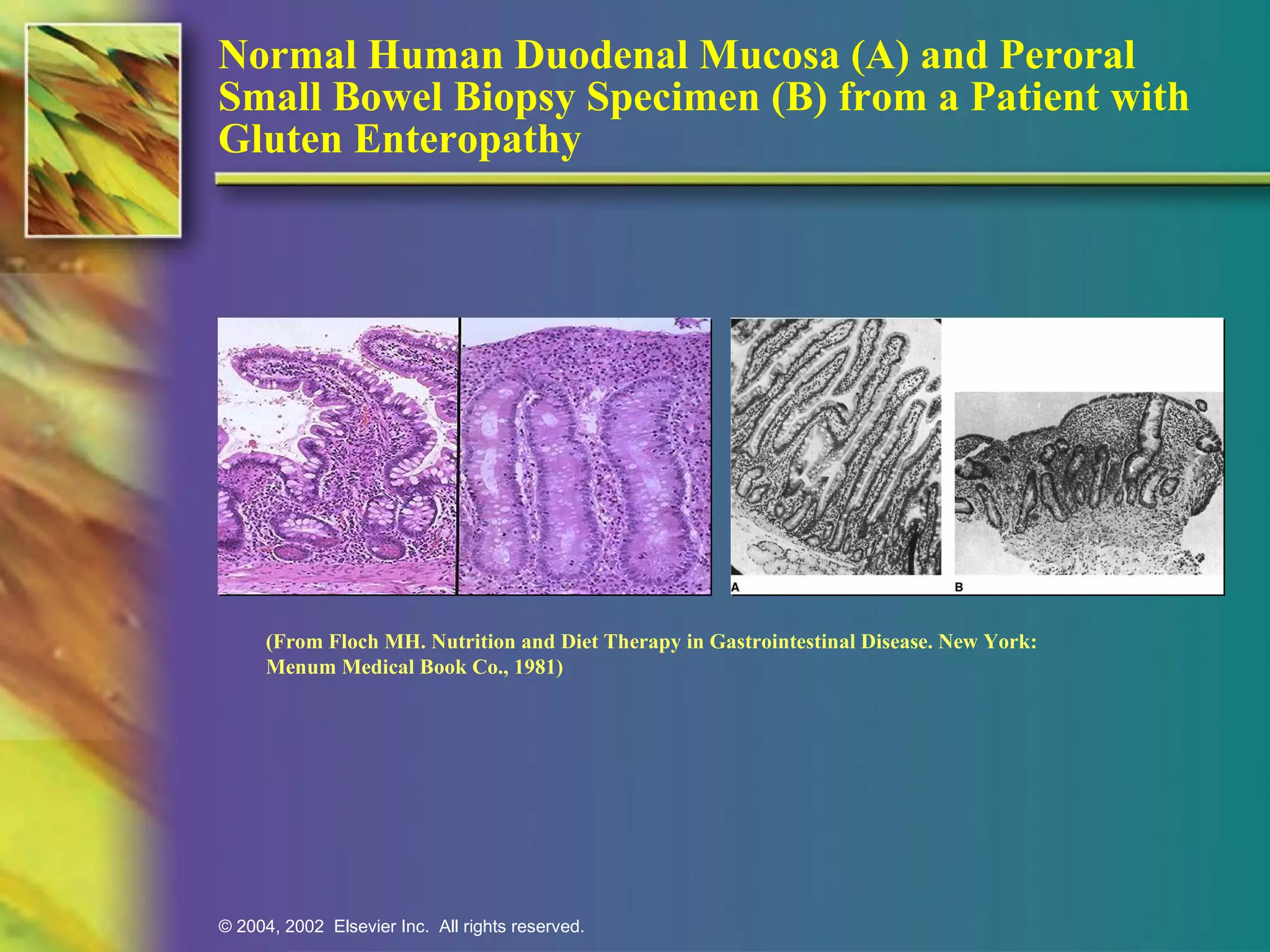
Endoscopic and biopsy findings in patients with and without celiac disease Normal small intestine Celiac Disease Normal villi Villous atrophy
Normal Human Duodenal Mucosa (A) and Peroral Small Bowel Biopsy Specimen (B) from a Patient with Gluten Enteropathy (From Floch MH. Nutrition and Diet Therapy in Gastrointestinal Disease. New York: Menum Medical Book Co., 1981)
Diagnostic:
COROLLARY: ALWAYS TEST FOR TOTAL SERUM IGA WHEN LOOKING FOR CELIAC DISEASE In this subset of patients, research shows that IgG-EMA and IgG-TTG can be detected and are as sensitive and as specific for the diagnosis of celiac disease.
Pathology: many mucosal enzymes are altered due to the damage to the absorptive cells decrease in disaccharides, peptidases, alkaline phosphatase, ATPase, and esterase Length of small intestine varies from patient to patient correlates with severity of clinical symptoms usually proximal small intestine more severely involved
Pathology: Loss of normal villous structure increase in the number of intraepithelial lymphocytes and gamma/delta T cells These changes decrease the amount of epithelial surface available for digestion and absorption in the involved bowel
Treatment:  THE GLUTEN FREE DIET CAN BE LOW IN: High protein High calorie High Iron , folic acid, vit B12 , A, K, and D as water soluble B vitamins (thiamine, riboflavin, niacin, folate) Calcium Zinc Magnesium Fiber
Treatment: The only treatment is the lifelong adherence to the gluten-free diet.  Gluten  small intestine start to heal  overall health improves
Fallow Up: Serologic markers (serum IgA tTG) used to monitor compliance with a gluten-free diet Antibody levels return to normal within three to 12 months of starting a gluten-free diet. A repeat small bowel biopsy three to four months after initiation of a gluten-free diet is not necessary if the patient responds appropriately to therapy.  If the patient does not respond as expected despite adherence to a gluten-free diet, the physician should consider diseases that may mimic celiac disease .
Celiac Disease − Medical and Nutritional Management Algorithm content developed by John Anderson, PhD, and Sanford C. Garner, PhD, 2000. Updated by Peter L. Beyer, 2002.
Summary: People with celiac disease cannot tolerate gluten, a protein in wheat, rye, and barley. Untreated celiac disease damages the small intestine and interferes with nutrient absorption. Without treatment, people with celiac disease can develop complications such as osteoporosis, anemia, and cancer. A person with celiac disease may or may not have symptoms.
Summary: Celiac disease is treated by eliminating all gluten from the diet. The gluten-free diet is a lifetime requirement. A dietitian can teach a person with celiac disease about food selection, label reading, and other strategies to help manage the disease. If villi are damaged, vitamins, minerals, calcium, carbohydrates, protein, and fats are not absorbed well Diagnosis involves blood tests and, in most cases, a biopsy of the small intestine.
References: Celiac Disease: Diagnostic clues to Unmaskan Imposter Malnick, Stephen, MD. Postgraduate  Medicine  1997; 101: 239-244 Presutti J,Cangemi J, Cassidy H, Hill D,  Celiac Disease. American Family Physician. December  15, 2007: 1795-1802  Lancet. 2003 Aug 2;362(9381):383-91.Celiac disease. Green PH, Jabri B. Department of Medicine, Columbia University College of Physicians and Surgeons, New York 10032, USA  [email_address] Celiac Disease: Diagnostic clues to Unmaskan Imposter Malnick, Stephen, MD.  Postgraduate Medicine 1997; 101: 239-244 Krause's book 2008. 681-684 (1352)-Disease of the small intestine-celiac disease
Reference:  Presutti J,Cangemi J, Cassidy H, Hill D,  Celiac Disease. American Family Physician. December  15, 2007: 1795-1802. 5. 1981.) Celiac disease: http://www.nature.com/mi/journal/v2/n1/fig_tab/mi200875f1.html#figure-title. INSERM U793, University Paris Descartes, Paris, France Correspondence: N Cerf-Bensussan, ( nadine.cerfbensussan@inserm.fr)  Received 8 October 2008; Accepted 8 October 2008; Published online 29 October 2008. From Floch MH. Nutrition and Diet Therapy in Gastrointestinal Disease. New York: Menum Medical Book Co.,
Reference: www.CeliacHealth.org www.Celiac.org www.glutenfree.com U.S. DEPARTMENT OF HEALTH AND HUMAN SERVICES National Institutes of Health NIH Publication No. 08–4269 September 2008 1Fasano A, Berti I, Gerarduzzi T, et al. Prevalence of celiac disease in at-risk and not-at-risk groups in the United States. Archives of Internal Medicine. 2003;163(3):268–292. 2Ibid.
Thanks For listening:

celiac disease

  • 1.
    presented By:Evana ALYoussef Supervisor: Dr.Sana Janakat 14-12-2011 Celiac Disease Jordan University of Science and Technology Faculty of Agriculture Department of Nutrition and Food science
  • 2.
    Outline: What isCeliac Disease? What is gluten Signs and Symptoms Mechanism Of Action Risk Factors for Celiac Disease Diagnosis Pathology
  • 3.
  • 4.
    Celiac Disease: Malabsorption damaged small intestine Inherited Autoimmune Disorder Intolerance to Gluten Wheat , Ray and Barley
  • 5.
    Celiac Disease −CauseAlgorithm content developed by John Anderson, PhD, and Sanford C. Garner, PhD, 2000. Updated by Peter L. Beyer, 2002.
  • 6.
    What is gluten?THE Protein flour that form the structure of dough Specific peptide fraction of Protein Found in: Wheat Rye Barely Glutenins, Secalinus Hordenis Gliadins.
  • 7.
  • 8.
  • 9.
    Small Intestine villi:Absorption Normal villi Flattened villi Malabsorption
  • 10.
    Celiac Disease −Pathophysiology (Adapted from Bray GA. Gray DS, Obesity, part 1: Pathogenisis. West J Med 149:429, 1988; and Lew EA, Garfinkle L; Variations in mortality by weight among 750,000 men and women. J Clin Epidemiol 32:563, 1979.) Algorithm content developed by John Anderson, PhD, and Sanford C. Garner, PhD, 2000. Updated by Peter L. Beyer, 2002.
  • 11.
    Mechanism: Body attacksnormal tissue resulting in damage to lining of small intestinal villi Villi contain blood vessels which absorb nutrients Villi increase area for absorption of nutrients
  • 12.
    Mechanism…..cont.: Digested nutrientsare carried away by circulating blood If villi are damaged, vitamins, minerals, calcium, carbohydrates, protein, and fats are not absorbed well
  • 13.
  • 14.
  • 15.
    Risk Factor ofCD Malignant disease: lymphomas Deficiencies in folic acid, vitamin B12, fat-soluble & vitamins Increased mortality due to increased risk of malignancy Type 1 diabetes mellitus Arthritis, Osteoporosis
  • 16.
    Risk Factor….cont: endomysialantibody negative few respond to steroids Down syndrome Unexplained iron-deficiency anemia Dermatitis herpetiformis
  • 17.
  • 18.
    Differential Diagnosis ofCeliac Disease Anorexia nervosa Autoimmune enteropathy Bacterial overgrowth Collagenous sprue Crohn's disease Human immunodeficiency virus enteropathy Infective gastroenteritis Irritable bowel syndrome Ischemic enteritis Lactose intolerance Pancreatic insufficiency Soy protein intolerance Intestinal lymphoma
  • 19.
    Haw is celiacdisease diagnosed: Initial Blood Tests Historical evaluated Serology tests Biopsy of small intestine
  • 20.
    Other Ways CDcan Present: Dermatitis Herpetiformis Silent Celiac Latent Celiac .Blood test + .Biopsy - .Clinical - symptoms . Biopsy + .Clinical - symptoms .Blood test + . skin Manifestation . 90% have no GI symptoms
  • 21.
    Serology Tests Kindsubscription Anti-tissue transglutaminase antibody (tTG – IgA and IgG) most sensitive Anti-endomysial antibody (EMA-IgA highly specific marker Anti-deaminated gliadin peptide (DGP – IgA and IgG) (-) tTG or EMA OR IgA deficient Anti-gliadin antibody (AgA – IgG and IgA) used for children < 2 yr
  • 22.
    Endoscopic and biopsyfindings in patients with and without celiac disease Normal small intestine Celiac Disease Normal villi Villous atrophy
  • 23.
    Normal Human DuodenalMucosa (A) and Peroral Small Bowel Biopsy Specimen (B) from a Patient with Gluten Enteropathy (From Floch MH. Nutrition and Diet Therapy in Gastrointestinal Disease. New York: Menum Medical Book Co., 1981)
  • 24.
  • 25.
    COROLLARY: ALWAYS TESTFOR TOTAL SERUM IGA WHEN LOOKING FOR CELIAC DISEASE In this subset of patients, research shows that IgG-EMA and IgG-TTG can be detected and are as sensitive and as specific for the diagnosis of celiac disease.
  • 26.
    Pathology: many mucosalenzymes are altered due to the damage to the absorptive cells decrease in disaccharides, peptidases, alkaline phosphatase, ATPase, and esterase Length of small intestine varies from patient to patient correlates with severity of clinical symptoms usually proximal small intestine more severely involved
  • 27.
    Pathology: Loss ofnormal villous structure increase in the number of intraepithelial lymphocytes and gamma/delta T cells These changes decrease the amount of epithelial surface available for digestion and absorption in the involved bowel
  • 28.
    Treatment: THEGLUTEN FREE DIET CAN BE LOW IN: High protein High calorie High Iron , folic acid, vit B12 , A, K, and D as water soluble B vitamins (thiamine, riboflavin, niacin, folate) Calcium Zinc Magnesium Fiber
  • 29.
    Treatment: The onlytreatment is the lifelong adherence to the gluten-free diet. Gluten small intestine start to heal overall health improves
  • 30.
    Fallow Up: Serologicmarkers (serum IgA tTG) used to monitor compliance with a gluten-free diet Antibody levels return to normal within three to 12 months of starting a gluten-free diet. A repeat small bowel biopsy three to four months after initiation of a gluten-free diet is not necessary if the patient responds appropriately to therapy. If the patient does not respond as expected despite adherence to a gluten-free diet, the physician should consider diseases that may mimic celiac disease .
  • 31.
    Celiac Disease −Medical and Nutritional Management Algorithm content developed by John Anderson, PhD, and Sanford C. Garner, PhD, 2000. Updated by Peter L. Beyer, 2002.
  • 32.
    Summary: People withceliac disease cannot tolerate gluten, a protein in wheat, rye, and barley. Untreated celiac disease damages the small intestine and interferes with nutrient absorption. Without treatment, people with celiac disease can develop complications such as osteoporosis, anemia, and cancer. A person with celiac disease may or may not have symptoms.
  • 33.
    Summary: Celiac diseaseis treated by eliminating all gluten from the diet. The gluten-free diet is a lifetime requirement. A dietitian can teach a person with celiac disease about food selection, label reading, and other strategies to help manage the disease. If villi are damaged, vitamins, minerals, calcium, carbohydrates, protein, and fats are not absorbed well Diagnosis involves blood tests and, in most cases, a biopsy of the small intestine.
  • 34.
    References: Celiac Disease:Diagnostic clues to Unmaskan Imposter Malnick, Stephen, MD. Postgraduate Medicine 1997; 101: 239-244 Presutti J,Cangemi J, Cassidy H, Hill D, Celiac Disease. American Family Physician. December 15, 2007: 1795-1802 Lancet. 2003 Aug 2;362(9381):383-91.Celiac disease. Green PH, Jabri B. Department of Medicine, Columbia University College of Physicians and Surgeons, New York 10032, USA [email_address] Celiac Disease: Diagnostic clues to Unmaskan Imposter Malnick, Stephen, MD. Postgraduate Medicine 1997; 101: 239-244 Krause's book 2008. 681-684 (1352)-Disease of the small intestine-celiac disease
  • 35.
    Reference: PresuttiJ,Cangemi J, Cassidy H, Hill D, Celiac Disease. American Family Physician. December 15, 2007: 1795-1802. 5. 1981.) Celiac disease: http://www.nature.com/mi/journal/v2/n1/fig_tab/mi200875f1.html#figure-title. INSERM U793, University Paris Descartes, Paris, France Correspondence: N Cerf-Bensussan, ( nadine.cerfbensussan@inserm.fr) Received 8 October 2008; Accepted 8 October 2008; Published online 29 October 2008. From Floch MH. Nutrition and Diet Therapy in Gastrointestinal Disease. New York: Menum Medical Book Co.,
  • 36.
    Reference: www.CeliacHealth.org www.Celiac.orgwww.glutenfree.com U.S. DEPARTMENT OF HEALTH AND HUMAN SERVICES National Institutes of Health NIH Publication No. 08–4269 September 2008 1Fasano A, Berti I, Gerarduzzi T, et al. Prevalence of celiac disease in at-risk and not-at-risk groups in the United States. Archives of Internal Medicine. 2003;163(3):268–292. 2Ibid.
  • 37.