Case presentation by Dr Asad Abbasi
A 4year old child admitted with C/O of Loose stools for
6months, diffuse crampy abdominal pain for 3months and
lethargic, failure to thrive. O/E he is pale with mild
abdominal distension. Weight and height are below the
normal for his age below 3rd centile. Labs revealed
microcytic anemia and iron-deficiency anemia and Anti-
Tissue transglutaminase IgA antibody positive.
CELIAC DISEASE
What is Celiac Disease ?
Autoimmune Condition.
Occurs in genetically susceptible individuals.
A unique autoimmune disorder because;
Environmental trigger (gluten) and the auto-antigen (tissue-transglutaminase ) are known.
Elimination of the environmental trigger leads to a complete resolution of the disease
Permanent sensitivity to gluten.
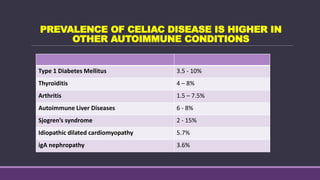
PREVALENCE OF CELIAC DISEASE IS HIGHER IN
OTHER AUTOIMMUNE CONDITIONS
Type 1 Diabetes Mellitus 3.5 - 10%
Thyroiditis 4 – 8%
Arthritis 1.5 – 7.5%
Autoimmune Liver Diseases 6 - 8%
Sjogren’s syndrome 2 - 15%
Idiopathic dilated cardiomyopathy 5.7%
igA nephropathy 3.6%
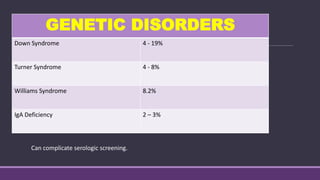
Can complicate serologic screening.
GENETIC DISORDERS
Down Syndrome 4 - 19%
Turner Syndrome 4 - 8%
Williams Syndrome 8.2%
IgA Deficiency 2 – 3%
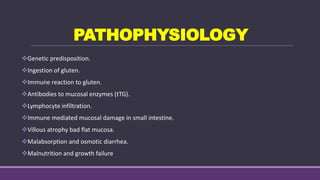
PATHOPHYSIOLOGY
Genetic predisposition.
Ingestion of gluten.
Immune reaction to gluten.
Antibodies to mucosal enzymes (tTG).
Lymphocyte infiltration.
Immune mediated mucosal damage in small intestine.
Villous atrophy bad flat mucosa.
Malabsorption and osmotic diarrhea.
Malnutrition and growth failure
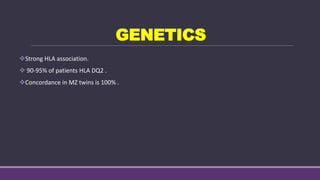
GENETICS
Strong HLA association.
 90-95% of patients HLA DQ2 .
Concordance in MZ twins is 100% .
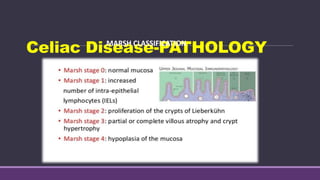
Celiac Disease-PATHOLOGY
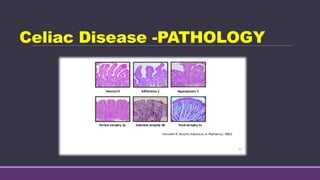
MARSH CLASSIFICATION
Celiac Disease -PATHOLOGY
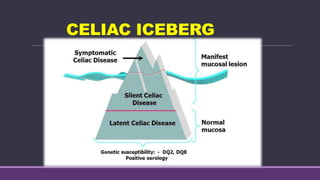
CELIAC ICEBERG
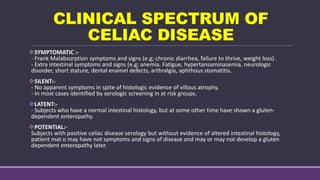
CLINICAL SPECTRUM OF
CELIAC DISEASE
SYMPTOMATIC :-
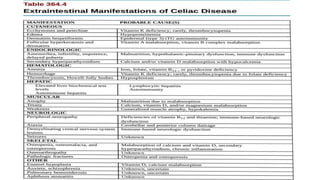
- Frank Malabsorption symptoms and signs (e.g; chronic diarrhea, failure to thrive, weight loss).
- Extra intestinal symptoms and signs (e.g; anemia. Fatigue, hypertansaminasemia, neurologic
disorder, short stature, dental enamel defects, arthralgia, aphthous stomatitis.
SILENT:-
- No apparent symptoms in spite of histologic evidence of villous atrophy.
- In most cases identified by serologic screening in at risk groups.
LATENT:-
- Subjects who have a normal intestinal histology, but at some other time have shown a gluten-
dependent enteropathy.
POTENTIAL:-
Subjects with positive celiac disease serology but without evidence of altered intestinal histology,
patient mat o may have not symptoms and signs of disease and may or may not develop a gluten
dependent enteropathy later.
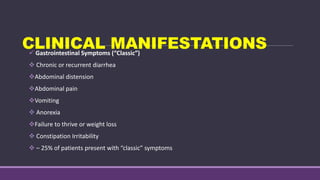
CLINICAL MANIFESTATIONS
 Gastrointestinal Symptoms (“Classic”)
 Chronic or recurrent diarrhea
Abdominal distension
Abdominal pain
Vomiting
 Anorexia
Failure to thrive or weight loss
 Constipation Irritability
 – 25% of patients present with “classic” symptoms
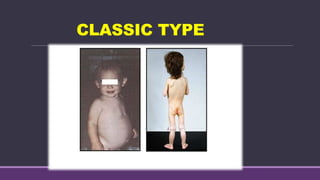
CLASSIC TYPE
SHORT STATURE /
DELAYED PUBERTY
Short Stature/Delayed Puberty Short stature in
children/teens: About 10% of short children and teens
have evidence of celiac disease Delayed menarche Higher
prevalence in teens with untreated celiac disease.
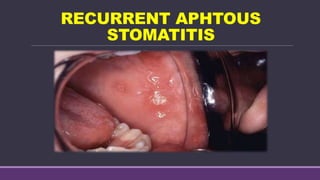
RECURRENT APHTOUS
STOMATITIS
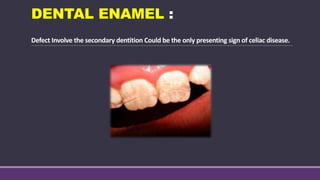
DENTAL ENAMEL :
Defect Involve the secondary dentition Could be the only presenting sign of celiac disease.
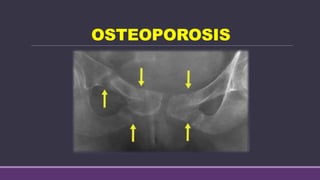
OSTEOPOROSIS
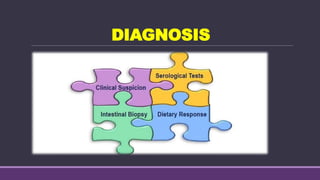
DIAGNOSIS
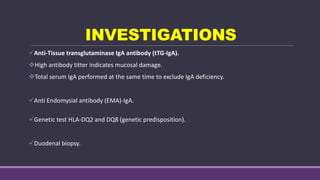
INVESTIGATIONS
Anti-Tissue transglutaminase IgA antibody (tTG-IgA).
High antibody titter indicates mucosal damage.
Total serum IgA performed at the same time to exclude IgA deficiency.
Anti Endomysial antibody (EMA)-IgA.
Genetic test HLA-DQ2 and DQ8 (genetic predisposition).
Duodenal biopsy.
TREATMENT
Only treatment for Celiac Disease is a
gluten-free diet (GFD)
Strict, lifelong diet
 AVOID:
Wheat
Rye
Barley
Oats
Why is adherence important?
Good evidence to suggest that when children with symptomatic celiac disease adhere to a
GFD it results in resolution of GI symptoms, improved growth in height and weight, and
normalization of haematological and biochemical parameters. Celiac disease is associated
with an overall increased risk of mortality in adults which is primarily the result of GI
malignancies. When CD is diagnosed in childhood and GFD is initiated, there appears to be
no increased cancer risk and reduced risk of other autoimmune diseases.
SOME POTENTIAL SOURCES
OF HIDDEN GLUTEN
Beers, ales, other fermented beverages (distilled beverages acceptable)
Bouillon and soups
Candy
Communion wafers
Drink mixes
Gravy and sauces
Herbal Tea
Imitation meat and seafood
Nutritional supplements
Play – Doh
Salad dressing and marinades
Self - basting turkeys
Soy sauces
GLUTEN FREE FOODS
Cereals-Rice,
Corn
Millet( Bajra )
Sorghum(Jowar )
Fruits.
Vegetables.
Meat and poultry.
Fish and seafood.
Milk and dairy products.
Beans and legumes.
SUPPORTIVE TREATMENT
Micronutrients (vitamin A, Zinc, folic acid ) help in mucosal repair.
Adequate calories app 100-200 Cal/kg/day to prevent malnutrition.
Foods intake should be gluten free and well tolerated.
CELIAC CRISIS
Life threatening complication.
Acute onset or rapid progression of GI symptoms of celiac disease.
Profuse diarrhea and severe dehydration.
SAM (Marasmus and Kwashiorkor).
Hypoproteinemia (s.albumin <3g/DL).
Electrolyte imbalance (hypokalaemia , hypernatremia hypocalcaemia
hypomagnesaemia).
Metabolic acidosis (<7.35).
Renal impairment (Cr >2.0 mg/d).
Neurological dysfunction.
MANAGEMENT
Manage on the protocols of SAM.
IV rehydration by ringer lactate.
Monitor and treat hypoglycaemia.
Monitor and treat electrolyte imbalance (IV potassium Calcium gluconate
magnesium sulphate).
Micronutrients.
Corticosteroids.
Antibiotics.
Gluten and lactose free diet.
Blood products if needed.
CELIAC DISEASE by Dr Asad Abbasi.pptx

CELIAC DISEASE by Dr Asad Abbasi.pptx

  • 1.
    Case presentation byDr Asad Abbasi
  • 2.
    A 4year oldchild admitted with C/O of Loose stools for 6months, diffuse crampy abdominal pain for 3months and lethargic, failure to thrive. O/E he is pale with mild abdominal distension. Weight and height are below the normal for his age below 3rd centile. Labs revealed microcytic anemia and iron-deficiency anemia and Anti- Tissue transglutaminase IgA antibody positive.
  • 3.
  • 4.
    What is CeliacDisease ? Autoimmune Condition. Occurs in genetically susceptible individuals. A unique autoimmune disorder because; Environmental trigger (gluten) and the auto-antigen (tissue-transglutaminase ) are known. Elimination of the environmental trigger leads to a complete resolution of the disease Permanent sensitivity to gluten.
  • 5.
    PREVALENCE OF CELIACDISEASE IS HIGHER IN OTHER AUTOIMMUNE CONDITIONS Type 1 Diabetes Mellitus 3.5 - 10% Thyroiditis 4 – 8% Arthritis 1.5 – 7.5% Autoimmune Liver Diseases 6 - 8% Sjogren’s syndrome 2 - 15% Idiopathic dilated cardiomyopathy 5.7% igA nephropathy 3.6%
  • 6.
    Can complicate serologicscreening. GENETIC DISORDERS Down Syndrome 4 - 19% Turner Syndrome 4 - 8% Williams Syndrome 8.2% IgA Deficiency 2 – 3%
  • 7.
    PATHOPHYSIOLOGY Genetic predisposition. Ingestion ofgluten. Immune reaction to gluten. Antibodies to mucosal enzymes (tTG). Lymphocyte infiltration. Immune mediated mucosal damage in small intestine. Villous atrophy bad flat mucosa. Malabsorption and osmotic diarrhea. Malnutrition and growth failure
  • 8.
    GENETICS Strong HLA association. 90-95% of patients HLA DQ2 . Concordance in MZ twins is 100% .
  • 9.
  • 10.
  • 11.
  • 12.
    CLINICAL SPECTRUM OF CELIACDISEASE SYMPTOMATIC :- - Frank Malabsorption symptoms and signs (e.g; chronic diarrhea, failure to thrive, weight loss). - Extra intestinal symptoms and signs (e.g; anemia. Fatigue, hypertansaminasemia, neurologic disorder, short stature, dental enamel defects, arthralgia, aphthous stomatitis. SILENT:- - No apparent symptoms in spite of histologic evidence of villous atrophy. - In most cases identified by serologic screening in at risk groups. LATENT:- - Subjects who have a normal intestinal histology, but at some other time have shown a gluten- dependent enteropathy. POTENTIAL:- Subjects with positive celiac disease serology but without evidence of altered intestinal histology, patient mat o may have not symptoms and signs of disease and may or may not develop a gluten dependent enteropathy later.
  • 13.
    CLINICAL MANIFESTATIONS  GastrointestinalSymptoms (“Classic”)  Chronic or recurrent diarrhea Abdominal distension Abdominal pain Vomiting  Anorexia Failure to thrive or weight loss  Constipation Irritability  – 25% of patients present with “classic” symptoms
  • 14.
  • 16.
    SHORT STATURE / DELAYEDPUBERTY Short Stature/Delayed Puberty Short stature in children/teens: About 10% of short children and teens have evidence of celiac disease Delayed menarche Higher prevalence in teens with untreated celiac disease.
  • 17.
  • 18.
    DENTAL ENAMEL : DefectInvolve the secondary dentition Could be the only presenting sign of celiac disease.
  • 19.
  • 20.
  • 21.
    INVESTIGATIONS Anti-Tissue transglutaminase IgAantibody (tTG-IgA). High antibody titter indicates mucosal damage. Total serum IgA performed at the same time to exclude IgA deficiency. Anti Endomysial antibody (EMA)-IgA. Genetic test HLA-DQ2 and DQ8 (genetic predisposition). Duodenal biopsy.
  • 22.
    TREATMENT Only treatment forCeliac Disease is a gluten-free diet (GFD) Strict, lifelong diet  AVOID: Wheat Rye Barley Oats
  • 23.
    Why is adherenceimportant? Good evidence to suggest that when children with symptomatic celiac disease adhere to a GFD it results in resolution of GI symptoms, improved growth in height and weight, and normalization of haematological and biochemical parameters. Celiac disease is associated with an overall increased risk of mortality in adults which is primarily the result of GI malignancies. When CD is diagnosed in childhood and GFD is initiated, there appears to be no increased cancer risk and reduced risk of other autoimmune diseases.
  • 24.
    SOME POTENTIAL SOURCES OFHIDDEN GLUTEN Beers, ales, other fermented beverages (distilled beverages acceptable) Bouillon and soups Candy Communion wafers Drink mixes Gravy and sauces Herbal Tea Imitation meat and seafood Nutritional supplements Play – Doh Salad dressing and marinades Self - basting turkeys Soy sauces
  • 25.
    GLUTEN FREE FOODS Cereals-Rice, Corn Millet(Bajra ) Sorghum(Jowar ) Fruits. Vegetables. Meat and poultry. Fish and seafood. Milk and dairy products. Beans and legumes.
  • 26.
    SUPPORTIVE TREATMENT Micronutrients (vitaminA, Zinc, folic acid ) help in mucosal repair. Adequate calories app 100-200 Cal/kg/day to prevent malnutrition. Foods intake should be gluten free and well tolerated.
  • 27.
    CELIAC CRISIS Life threateningcomplication. Acute onset or rapid progression of GI symptoms of celiac disease. Profuse diarrhea and severe dehydration. SAM (Marasmus and Kwashiorkor). Hypoproteinemia (s.albumin <3g/DL). Electrolyte imbalance (hypokalaemia , hypernatremia hypocalcaemia hypomagnesaemia). Metabolic acidosis (<7.35). Renal impairment (Cr >2.0 mg/d). Neurological dysfunction.
  • 28.
    MANAGEMENT Manage on theprotocols of SAM. IV rehydration by ringer lactate. Monitor and treat hypoglycaemia. Monitor and treat electrolyte imbalance (IV potassium Calcium gluconate magnesium sulphate). Micronutrients. Corticosteroids. Antibiotics. Gluten and lactose free diet. Blood products if needed.