Case Study: Celiac
Disease
By: Hunter Schleske
Consider the following patient
• Concerned parents bring their 8 year old son Johnny into the clinic. The boy
is experiencing abnormal weight loss and abdominal discomfort. He also
experiences abdominal distension, flatulence, and fowl smelling loose stool.
Johnny's Medical History
• Johnny was diagnosed with type I diabetes at age 2 after a severe episode of
DKA (diabetic ketoacidosis). Johnny’s parents inform you that there has
been some concern about his thyroid function, but no definitive diagnosis
has been made.
Initial thoughts.
• After reviewing Johnny’s medical history, and completing an assessment,
what would be your first assumption regarding Johnny’s medical condition?
Tests
• As Johnny’s health care provider, what labs would you order to be drawn?
What tests would you order to be completed?
Case study
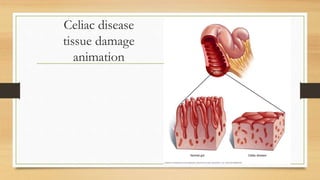
• Celiac disease is diagnosed by histologic evidence. This is done by taking a
biopsy from a portion of the small intestine.
• The test if positive for Celiac disease will display evidence of flattened mucosa and
noticeable loss of villi.
• Serologic testing for immunoglobulin A (IgA) anti-tissue transglutaminase, as
well as IgA endomysial antibody.
• This test is also used for diagnosis but is not considered the gold standard.
Etiology
• Celiac disease is more common in Europeans, affecting 1% of the US.
• Higher risk is seen in those with first or second degree relatives affected by
Celiac disease.
• Symptoms typically occur in childhood.
• Celiac disease is often associated with other autoimmune diseases including
rheumatoid arthritis, type I diabetes, and thyroid disease.
Pathophysiology of Celiac Disease
• Three factors needed to develop Celiac disease are genetic predisposition,
gluten ingestion, and immune mediated response.
• As with any autoimmune disease, Celiac disease is the result of chronic
inflammation.
Pathophysiology continued…
• Patients with celiac disease may or may not possess genetic markers such as
Human Leukocyte Antigen alleles HLA-DQ2 and/or HLA-DQ8.
• Approximately 90-95% of patients have the HLA-DQ2 allele.
Pathophysiology continued..
• The Chronic Inflammation associated with celiac disease is the result of
ingestion of gluten found in wheat, rye, and barley.
• Gluten contains peptides called prolamines. In genetically predisposed
patients, partial digestion of gluten releases prolamine peptides which are
then absorbed into the intestinal submucosa.
• The peptides then bond to the HLA-DQ2/HLA-DQ8 alleles, activating the
inflammatory process, damaging the microvilli and the brush border of the
small intestine.
DQ2-CLIP in association with HLA-DQ2
Celiac disease
tissue damage
animation
Treatments
• Gluten free diet.
• Patients need to avoid wheat, barley, oats, rye, flour (unless gluten free), baked goods,
bread, pizza, pasta, and bagels.
• Substitutions for gluten in the diet include flax, corn, rice, and soy products.
• Patients need to maintain a gluten free diet the rest of their life, but will start
to see recovery within 3-6 months of treatment.
Treatments
continued…
Sources
• Medical-Surgical Nursing 9th ed. Assessment and Management of Clinical Problems
Lewis, Dirksen, Heitkemper, Bucher. Copyright 2014, pgs. 997-999.
• http://www.mayoclinic.org/diseases-conditions/celiac-disease/home/ovc-
20214625
• https://celiac.org/celiac-disease/understanding-celiac-disease-2/diagnosing-celiac-
disease/
• http://www.medicinenet.com/celiac_disease_gluten_enteropathy/page2.htm
• https://www.ncbi.nlm.nih.gov/pmc/articles/PMC2491419/

Case study: Celiac disease

  • 1.
  • 2.
    Consider the followingpatient • Concerned parents bring their 8 year old son Johnny into the clinic. The boy is experiencing abnormal weight loss and abdominal discomfort. He also experiences abdominal distension, flatulence, and fowl smelling loose stool.
  • 3.
    Johnny's Medical History •Johnny was diagnosed with type I diabetes at age 2 after a severe episode of DKA (diabetic ketoacidosis). Johnny’s parents inform you that there has been some concern about his thyroid function, but no definitive diagnosis has been made.
  • 4.
    Initial thoughts. • Afterreviewing Johnny’s medical history, and completing an assessment, what would be your first assumption regarding Johnny’s medical condition?
  • 5.
    Tests • As Johnny’shealth care provider, what labs would you order to be drawn? What tests would you order to be completed?
  • 6.
    Case study • Celiacdisease is diagnosed by histologic evidence. This is done by taking a biopsy from a portion of the small intestine. • The test if positive for Celiac disease will display evidence of flattened mucosa and noticeable loss of villi. • Serologic testing for immunoglobulin A (IgA) anti-tissue transglutaminase, as well as IgA endomysial antibody. • This test is also used for diagnosis but is not considered the gold standard.
  • 7.
    Etiology • Celiac diseaseis more common in Europeans, affecting 1% of the US. • Higher risk is seen in those with first or second degree relatives affected by Celiac disease. • Symptoms typically occur in childhood. • Celiac disease is often associated with other autoimmune diseases including rheumatoid arthritis, type I diabetes, and thyroid disease.
  • 8.
    Pathophysiology of CeliacDisease • Three factors needed to develop Celiac disease are genetic predisposition, gluten ingestion, and immune mediated response. • As with any autoimmune disease, Celiac disease is the result of chronic inflammation.
  • 9.
    Pathophysiology continued… • Patientswith celiac disease may or may not possess genetic markers such as Human Leukocyte Antigen alleles HLA-DQ2 and/or HLA-DQ8. • Approximately 90-95% of patients have the HLA-DQ2 allele.
  • 10.
    Pathophysiology continued.. • TheChronic Inflammation associated with celiac disease is the result of ingestion of gluten found in wheat, rye, and barley. • Gluten contains peptides called prolamines. In genetically predisposed patients, partial digestion of gluten releases prolamine peptides which are then absorbed into the intestinal submucosa. • The peptides then bond to the HLA-DQ2/HLA-DQ8 alleles, activating the inflammatory process, damaging the microvilli and the brush border of the small intestine.
  • 11.
  • 12.
  • 13.
    Treatments • Gluten freediet. • Patients need to avoid wheat, barley, oats, rye, flour (unless gluten free), baked goods, bread, pizza, pasta, and bagels. • Substitutions for gluten in the diet include flax, corn, rice, and soy products. • Patients need to maintain a gluten free diet the rest of their life, but will start to see recovery within 3-6 months of treatment.
  • 14.
  • 15.
    Sources • Medical-Surgical Nursing9th ed. Assessment and Management of Clinical Problems Lewis, Dirksen, Heitkemper, Bucher. Copyright 2014, pgs. 997-999. • http://www.mayoclinic.org/diseases-conditions/celiac-disease/home/ovc- 20214625 • https://celiac.org/celiac-disease/understanding-celiac-disease-2/diagnosing-celiac- disease/ • http://www.medicinenet.com/celiac_disease_gluten_enteropathy/page2.htm • https://www.ncbi.nlm.nih.gov/pmc/articles/PMC2491419/