Dr. Virendra Kumar Gupta
MD Pediatrics
Fellowship In pediatric Gastroentero-Hepatology & Liver Transplantation
Assistant Professor
Department Of pediatrics
NIMS Medical College & Hospital , Jaipur
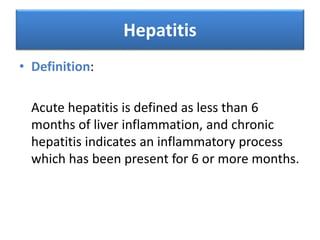
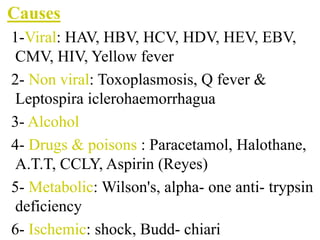
Hepatitis
Hepatitis
• Definition:
Acute hepatitis is defined as less than 6
months of liver inflammation, and chronic
hepatitis indicates an inflammatory process
which has been present for 6 or more months.
Causes
1-Viral: HAV, HBV, HCV, HDV, HEV, EBV,
CMV, HIV, Yellow fever
2- Non viral: Toxoplasmosis, Q fever &
Leptospira iclerohaemorrhagua
3- Alcohol
4- Drugs & poisons : Paracetamol, Halothane,
A.T.T, CCLY, Aspirin (Reyes)
5- Metabolic: Wilson's, alpha- one anti- trypsin
deficiency
6- Ischemic: shock, Budd- chiari
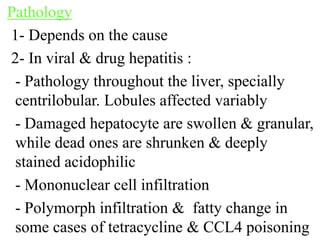
Pathology
1- Depends on the cause
2- In viral & drug hepatitis :
- Pathology throughout the liver, specially
centrilobular. Lobules affected variably
- Damaged hepatocyte are swollen & granular,
while dead ones are shrunken & deeply
stained acidophilic
- Mononuclear cell infiltration
- Polymorph infiltration & fatty change in
some cases of tetracycline & CCL4 poisoning
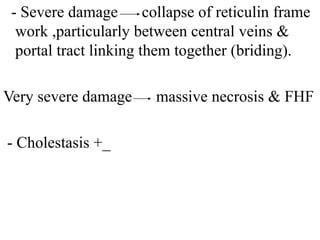
- Severe damage collapse of reticulin frame
work ,particularly between central veins &
portal tract linking them together (briding).
Very severe damage massive necrosis & FHF
- Cholestasis +_
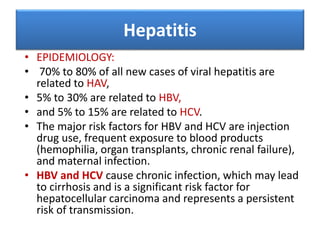
• EPIDEMIOLOGY:
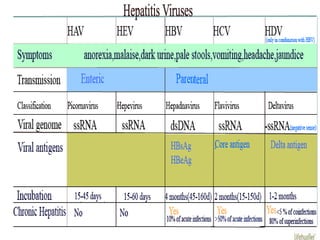
• 70% to 80% of all new cases of viral hepatitis are
related to HAV,
• 5% to 30% are related to HBV,
• and 5% to 15% are related to HCV.
• The major risk factors for HBV and HCV are injection
drug use, frequent exposure to blood products
(hemophilia, organ transplants, chronic renal failure),
and maternal infection.
• HBV and HCV cause chronic infection, which may lead
to cirrhosis and is a significant risk factor for
hepatocellular carcinoma and represents a persistent
risk of transmission.
Hepatitis
• CLINICAL MANIFESTATIONS :
• There is considerable overlap in the characteristic clinical courses
for HAV, HBV, and HCV .
• The preicteric phase, which lasts approximately 1 week, is
characterized by headache, anorexia, malaise, abdominal
discomfort, nausea, and vomiting and usually precedes the onset of
clinically detectable disease.
• Jaundice and tender hepatomegaly are the most common physical
findings and are characteristic of the icteric phase. Prodromal
symptoms, particularly in children, may abate during the icteric
phase.
• Asymptomatic or mild, nonspecific illness without icterus is
common with HAV, HBV, and HCV, especially in young children.
• Hepatitic enzymes may increase 15-fold to 20-fold.
• Resolution of the hyperbilirubinemia and normalization of the
transaminases may take 6 to 8 weeks.
Clinical picture of viral hepatitis
1- Prodromal symptoms preceed clinical
Jaundice by 1-2 W
2- Hepatomegaly which is tender
3- Rarely spleenomegaly & lymphoadenopathy
in children
4- Arthralgia, vasculitis, rash, myocarditis and
G.N specially with HBV
5- Yellow sclerae & dark urine.
6- Pale stool with cholastasis
7- Most (95%) recover in 3-6 W
8- Few relapse
9- An icteric hepatitis occur in 65%
10- Massive hepatic necrosis occur in 1%
causing F.H.F
1- High ALT & AST(> 400U/L)
2- High Serum bilirubin
3- ALP rarely > 250U/L except in cholastasis
4- Normal serum alb
5- Prolong PT
6- Bilirubinuria.
7- Normal or low TWC with lymphsytosis
8- Viral markers
9- Mild proteinuria
LABORATORY AND IMAGING STUDIES
• Hepatitis A : The diagnosis of viral hepatitis is confirmed by
characteristic serologic testing .
• The presence of IgM-specific antibody to HAV with low or
absent IgG antibody to HAV is presumptive evidence of
HAV.
• There is no chronic carrier state of HAV.
• Hepatitis C :
• Seroconversion after HCV infection may occur 6 months
after infection.
• A positive result of HCV ELISA should be confirmed with the
more specific recombinant immunoblot assay, which
detects antibodies to multiple HCV antigens.
• Detection of HCV RNA by PCR is a sensitive marker for
active infection, and results of this test may be positive 3
days after inoculation.
• Hepatitis B:
• The presence of HBsAg signifies acute or chronic infection with HBV.
• Antigenemia appears early in the illness and is usually transient, but
also is diagnostic of the carrier state.
• Hepatitis B e antigen (HBeAg) appears in the serum with acute HBV.
• The continued presence of HBsAg and HBeAg in the absence of
antibody to e antigen (anti-HBe) indicates high risk of
transmissibility that is associated with ongoing viral replication.
• Clearance of HBsAg from the serum precedes a variable window
period followed by the emergence of the antibody to surface
antigen (anti-HBs), which indicates development of lifelong
immunity.
• Antibody to core antigen (anti-HBc) a useful marker for recognizing
HBV infection during the window phase (when HBsAg has
disappeared, but before the appearance of anti-HBs).
• Anti-HBe is useful in predicting a low degree of infectivity during the
carrier state.
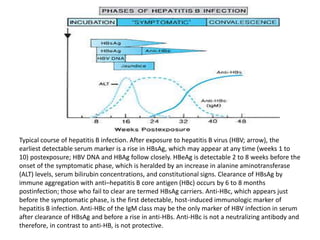
Typical course of hepatitis B infection. After exposure to hepatitis B virus (HBV; arrow), the
earliest detectable serum marker is a rise in HBsAg, which may appear at any time (weeks 1 to
10) postexposure; HBV DNA and HBAg follow closely. HBeAg is detectable 2 to 8 weeks before the
onset of the symptomatic phase, which is heralded by an increase in alanine aminotransferase
(ALT) levels, serum bilirubin concentrations, and constitutional signs. Clearance of HBsAg by
immune aggregation with anti–hepatitis B core antigen (HBc) occurs by 6 to 8 months
postinfection; those who fail to clear are termed HBsAg carriers. Anti-HBc, which appears just
before the symptomatic phase, is the first detectable, host-induced immunologic marker of
hepatitis B infection. Anti-HBc of the IgM class may be the only marker of HBV infection in serum
after clearance of HBsAg and before a rise in anti-HBs. Anti-HBc is not a neutralizing antibody and
therefore, in contrast to anti-HB, is not protective.
TREATMENT
• The treatment of acute hepatitis is largely supportive
and involves rest, hydration, and adequate dietary
intake.
• Hospitalization is indicated for persons with severe
vomiting and dehydration, a prolonged prothrombin
time, or signs of hepatic encephalopathy.
• When the diagnosis of viral hepatitis is established,
attention should be directed toward preventing its
spread to close contacts.
• For HAV, hygienic measures include hand washing and
careful disposal of excreta, contaminated diapers or
clothing, needles, and other blood-contaminated
items.
• Chronic HBV infection may be treated with
interferon alfa-2b or lamivudine,
• and HCV may be treated with interferon alfa
alone or more often in combination with oral
ribavirin.
TREATMENT
1- F.H.F
2- Relapsing hepatitis (biochem. OR clinical)
3- Cholestasis
4- Post-hepatic syndrome
5- Unconjugated hyperbilirubinaemia (Gilbert)
6- A plastic anaemia (HAV, HCV, HEV)
7- Connective tissue disease
8- G.N & renal failure
9- H.Sch. purpura
10- Papular acrodermatitis
11- Chronic hepatitis, liver cirrhosis and HCC
wz HBV &HCV.
COMPLICATIONS
PROGNOSIS
• Most cases of acute viral hepatitis resolve without specific therapy,
with less than 0.1% of cases progressing to fulminant hepatic
necrosis.
• HBV, HCV, and HDV may persist as chronic infection with chronic
inflammation, fibrosis, and cirrhosis and the associated risk of
hepatocellular carcinoma.
• Five percent to 10% of adults with HBV develop persistent infection,
defined by persistence of HBsAg in the blood for more than 6
months compared with 90% of children who acquire HBV by
perinatal transmission.
• Approximately 85% of persons infected with HCV remain chronically
infected, which is characterized by fluctuating transaminase levels.
• Approximately 20% of persons with chronic infection develop
cirrhosis, and approximately 25% of those develop hepatocellular
carcinoma.
Prevention of hepatitis B
• Hepatitis B vaccine and hepatitis B
immunoglobulin (HBIG) are available for
prevention of HBV infection.
• Hepatitis B Immunoglobulin
• HBIG is indicated only for specific postexposure
circumstances and provides only temporary
protection (3-6 mo) . It plays a pivotal role in
preventing perinatal transmission when
administered within 12 h of birth.
• Two single antigen vaccines (Recombivax HB and
Engerix-B) are approved for children and are the only
preparations approved for infants <6 mo old.
• Three combination vaccines can be used for
subsequent immunization dosing and enable
integration of the HBV vaccine into the regular
immunization schedule.
• Seropositivity is >95% with all vaccines, achieved after
the 2nd dose in most patients. The 3rd dose serves as a
booster and may have an effect on maintaining long-
term immunity.
• In immunosuppressed patients and infants <2,000 g
birthweight, a 4th dose is recommended, as is checking
for seroconversion.
HbsAg-positive mothers?
• To prevent perinatal transmission through improved maternal screening
and immunoprophylaxis of infants born to HbsAg-positive mothers, infants
born to HBsAg-positive women should receive vaccine at birth, 1-2 mo,
and 6 mo of age.
• The first dose should be accompanied by administration of 0.5 mL of HBIG
as soon after delivery as possible (within 12 hr) because the effectiveness
decreases rapidly with increased time after birth.
• Post-vaccination testing for HBsAg and anti-HBs should be done at 9-
18 mo.
• If the result is positive for anti-HBs, the child is immune to HBV.
• If the result is positive for HBsAg only, the parent should be counseled and
the child evaluated by a pediatric gastroenterologist.
• If the result is negative for both HBsAg and anti-HBs, a 2nd complete
hepatitis B vaccine series should be administered, followed by testing for
anti-HBs to determine if subsequent doses are needed.
Acute (Fulminat) hepatic failure
1- Rare condition in which Biochemical evidence of
acute liver injury (usually <8 week duration); no
evidence of chronic liver disease ; and hepatic
based coaguolopathy defined as a PT > 15 sec or
INR > 1.5 not corrected by vitamin K in the
presence of clinical hepatic encephalopathy, or a
PT > 20 sec or INR > 2 regardless of the presence
of clinical hepatic encephalopathy.
2- If it occur 8-12W = sub acute FHF
3- Rare but 90% mortality following acute hepatitis
from any cause
4- Causes include
- viral infection (HAV , HBV , HDV)
- drugs (pracetamol , aspirin , halothane ,
ATT)
- poisons (mushroom , CCL4)
- acute fatty liver of pregnancy
- shock & cardiac failure
- bud- chiari syndrome
- leptospirosis
- Wilson's disease
5-Pathologically
- There is extensive liver cell necrosis with
severe fatty degeneration being characteristic
of tetracycline , pregnancy & Reyes
- There is cerebral aedema & disruption of
BBB
6- Clinically
Low alertness , poor conc. , restlessness ,
aggression, drowsiness , disorientation ,
change of sleep rhythm & coma
-Slurred speech , yawning , hiccough and
seizures.
- Asterixis (Flapping tremers) & foeter
hepaticus are other features
- Myoclonus , spalicity , decorticate rigidity
may be seen
- Papilla edema is very late (high I.C.P)
- Fever , vomiting , hypotension and
hypoglythemia may occur
- Jaundice & small liver size
- Fluid retention & spleenomegaly are
uncommon
7- Investigation
Markedly deranged LFT , ECG ,CBC , BUN &
electrolytes , U/S ,viral markers , toxicity ,
screening , Auto-antibodies , CXR , se cu &
caeruloplasmin
8- Management
1- No specific treatment except liver transplant
2- Support life & monitor
3- Ranitol , vitK , H2RA ,antibiotics
4-Treatment of cardio-respiratory arrest & fail.
5- Exchange transfusion , plasmapheres &
charcoal haemoperfusion
Thank you 

Acute hepatitis in pediatrics

  • 1.
    Dr. Virendra KumarGupta MD Pediatrics Fellowship In pediatric Gastroentero-Hepatology & Liver Transplantation Assistant Professor Department Of pediatrics NIMS Medical College & Hospital , Jaipur
  • 2.
  • 3.
    Hepatitis • Definition: Acute hepatitisis defined as less than 6 months of liver inflammation, and chronic hepatitis indicates an inflammatory process which has been present for 6 or more months.
  • 4.
    Causes 1-Viral: HAV, HBV,HCV, HDV, HEV, EBV, CMV, HIV, Yellow fever 2- Non viral: Toxoplasmosis, Q fever & Leptospira iclerohaemorrhagua 3- Alcohol 4- Drugs & poisons : Paracetamol, Halothane, A.T.T, CCLY, Aspirin (Reyes) 5- Metabolic: Wilson's, alpha- one anti- trypsin deficiency 6- Ischemic: shock, Budd- chiari
  • 6.
    Pathology 1- Depends onthe cause 2- In viral & drug hepatitis : - Pathology throughout the liver, specially centrilobular. Lobules affected variably - Damaged hepatocyte are swollen & granular, while dead ones are shrunken & deeply stained acidophilic - Mononuclear cell infiltration - Polymorph infiltration & fatty change in some cases of tetracycline & CCL4 poisoning
  • 7.
    - Severe damagecollapse of reticulin frame work ,particularly between central veins & portal tract linking them together (briding). Very severe damage massive necrosis & FHF - Cholestasis +_
  • 8.
    • EPIDEMIOLOGY: • 70%to 80% of all new cases of viral hepatitis are related to HAV, • 5% to 30% are related to HBV, • and 5% to 15% are related to HCV. • The major risk factors for HBV and HCV are injection drug use, frequent exposure to blood products (hemophilia, organ transplants, chronic renal failure), and maternal infection. • HBV and HCV cause chronic infection, which may lead to cirrhosis and is a significant risk factor for hepatocellular carcinoma and represents a persistent risk of transmission. Hepatitis
  • 9.
    • CLINICAL MANIFESTATIONS: • There is considerable overlap in the characteristic clinical courses for HAV, HBV, and HCV . • The preicteric phase, which lasts approximately 1 week, is characterized by headache, anorexia, malaise, abdominal discomfort, nausea, and vomiting and usually precedes the onset of clinically detectable disease. • Jaundice and tender hepatomegaly are the most common physical findings and are characteristic of the icteric phase. Prodromal symptoms, particularly in children, may abate during the icteric phase. • Asymptomatic or mild, nonspecific illness without icterus is common with HAV, HBV, and HCV, especially in young children. • Hepatitic enzymes may increase 15-fold to 20-fold. • Resolution of the hyperbilirubinemia and normalization of the transaminases may take 6 to 8 weeks.
  • 10.
    Clinical picture ofviral hepatitis 1- Prodromal symptoms preceed clinical Jaundice by 1-2 W 2- Hepatomegaly which is tender 3- Rarely spleenomegaly & lymphoadenopathy in children 4- Arthralgia, vasculitis, rash, myocarditis and G.N specially with HBV 5- Yellow sclerae & dark urine. 6- Pale stool with cholastasis
  • 11.
    7- Most (95%)recover in 3-6 W 8- Few relapse 9- An icteric hepatitis occur in 65% 10- Massive hepatic necrosis occur in 1% causing F.H.F
  • 12.
    1- High ALT& AST(> 400U/L) 2- High Serum bilirubin 3- ALP rarely > 250U/L except in cholastasis 4- Normal serum alb 5- Prolong PT 6- Bilirubinuria. 7- Normal or low TWC with lymphsytosis 8- Viral markers 9- Mild proteinuria LABORATORY AND IMAGING STUDIES
  • 13.
    • Hepatitis A: The diagnosis of viral hepatitis is confirmed by characteristic serologic testing . • The presence of IgM-specific antibody to HAV with low or absent IgG antibody to HAV is presumptive evidence of HAV. • There is no chronic carrier state of HAV. • Hepatitis C : • Seroconversion after HCV infection may occur 6 months after infection. • A positive result of HCV ELISA should be confirmed with the more specific recombinant immunoblot assay, which detects antibodies to multiple HCV antigens. • Detection of HCV RNA by PCR is a sensitive marker for active infection, and results of this test may be positive 3 days after inoculation.
  • 14.
    • Hepatitis B: •The presence of HBsAg signifies acute or chronic infection with HBV. • Antigenemia appears early in the illness and is usually transient, but also is diagnostic of the carrier state. • Hepatitis B e antigen (HBeAg) appears in the serum with acute HBV. • The continued presence of HBsAg and HBeAg in the absence of antibody to e antigen (anti-HBe) indicates high risk of transmissibility that is associated with ongoing viral replication. • Clearance of HBsAg from the serum precedes a variable window period followed by the emergence of the antibody to surface antigen (anti-HBs), which indicates development of lifelong immunity. • Antibody to core antigen (anti-HBc) a useful marker for recognizing HBV infection during the window phase (when HBsAg has disappeared, but before the appearance of anti-HBs). • Anti-HBe is useful in predicting a low degree of infectivity during the carrier state.
  • 15.
    Typical course ofhepatitis B infection. After exposure to hepatitis B virus (HBV; arrow), the earliest detectable serum marker is a rise in HBsAg, which may appear at any time (weeks 1 to 10) postexposure; HBV DNA and HBAg follow closely. HBeAg is detectable 2 to 8 weeks before the onset of the symptomatic phase, which is heralded by an increase in alanine aminotransferase (ALT) levels, serum bilirubin concentrations, and constitutional signs. Clearance of HBsAg by immune aggregation with anti–hepatitis B core antigen (HBc) occurs by 6 to 8 months postinfection; those who fail to clear are termed HBsAg carriers. Anti-HBc, which appears just before the symptomatic phase, is the first detectable, host-induced immunologic marker of hepatitis B infection. Anti-HBc of the IgM class may be the only marker of HBV infection in serum after clearance of HBsAg and before a rise in anti-HBs. Anti-HBc is not a neutralizing antibody and therefore, in contrast to anti-HB, is not protective.
  • 16.
    TREATMENT • The treatmentof acute hepatitis is largely supportive and involves rest, hydration, and adequate dietary intake. • Hospitalization is indicated for persons with severe vomiting and dehydration, a prolonged prothrombin time, or signs of hepatic encephalopathy. • When the diagnosis of viral hepatitis is established, attention should be directed toward preventing its spread to close contacts. • For HAV, hygienic measures include hand washing and careful disposal of excreta, contaminated diapers or clothing, needles, and other blood-contaminated items.
  • 17.
    • Chronic HBVinfection may be treated with interferon alfa-2b or lamivudine, • and HCV may be treated with interferon alfa alone or more often in combination with oral ribavirin. TREATMENT
  • 18.
    1- F.H.F 2- Relapsinghepatitis (biochem. OR clinical) 3- Cholestasis 4- Post-hepatic syndrome 5- Unconjugated hyperbilirubinaemia (Gilbert) 6- A plastic anaemia (HAV, HCV, HEV) 7- Connective tissue disease 8- G.N & renal failure 9- H.Sch. purpura 10- Papular acrodermatitis 11- Chronic hepatitis, liver cirrhosis and HCC wz HBV &HCV. COMPLICATIONS
  • 19.
    PROGNOSIS • Most casesof acute viral hepatitis resolve without specific therapy, with less than 0.1% of cases progressing to fulminant hepatic necrosis. • HBV, HCV, and HDV may persist as chronic infection with chronic inflammation, fibrosis, and cirrhosis and the associated risk of hepatocellular carcinoma. • Five percent to 10% of adults with HBV develop persistent infection, defined by persistence of HBsAg in the blood for more than 6 months compared with 90% of children who acquire HBV by perinatal transmission. • Approximately 85% of persons infected with HCV remain chronically infected, which is characterized by fluctuating transaminase levels. • Approximately 20% of persons with chronic infection develop cirrhosis, and approximately 25% of those develop hepatocellular carcinoma.
  • 20.
    Prevention of hepatitisB • Hepatitis B vaccine and hepatitis B immunoglobulin (HBIG) are available for prevention of HBV infection. • Hepatitis B Immunoglobulin • HBIG is indicated only for specific postexposure circumstances and provides only temporary protection (3-6 mo) . It plays a pivotal role in preventing perinatal transmission when administered within 12 h of birth.
  • 21.
    • Two singleantigen vaccines (Recombivax HB and Engerix-B) are approved for children and are the only preparations approved for infants <6 mo old. • Three combination vaccines can be used for subsequent immunization dosing and enable integration of the HBV vaccine into the regular immunization schedule. • Seropositivity is >95% with all vaccines, achieved after the 2nd dose in most patients. The 3rd dose serves as a booster and may have an effect on maintaining long- term immunity. • In immunosuppressed patients and infants <2,000 g birthweight, a 4th dose is recommended, as is checking for seroconversion.
  • 22.
    HbsAg-positive mothers? • Toprevent perinatal transmission through improved maternal screening and immunoprophylaxis of infants born to HbsAg-positive mothers, infants born to HBsAg-positive women should receive vaccine at birth, 1-2 mo, and 6 mo of age. • The first dose should be accompanied by administration of 0.5 mL of HBIG as soon after delivery as possible (within 12 hr) because the effectiveness decreases rapidly with increased time after birth. • Post-vaccination testing for HBsAg and anti-HBs should be done at 9- 18 mo. • If the result is positive for anti-HBs, the child is immune to HBV. • If the result is positive for HBsAg only, the parent should be counseled and the child evaluated by a pediatric gastroenterologist. • If the result is negative for both HBsAg and anti-HBs, a 2nd complete hepatitis B vaccine series should be administered, followed by testing for anti-HBs to determine if subsequent doses are needed.
  • 23.
    Acute (Fulminat) hepaticfailure 1- Rare condition in which Biochemical evidence of acute liver injury (usually <8 week duration); no evidence of chronic liver disease ; and hepatic based coaguolopathy defined as a PT > 15 sec or INR > 1.5 not corrected by vitamin K in the presence of clinical hepatic encephalopathy, or a PT > 20 sec or INR > 2 regardless of the presence of clinical hepatic encephalopathy. 2- If it occur 8-12W = sub acute FHF 3- Rare but 90% mortality following acute hepatitis from any cause
  • 24.
    4- Causes include -viral infection (HAV , HBV , HDV) - drugs (pracetamol , aspirin , halothane , ATT) - poisons (mushroom , CCL4) - acute fatty liver of pregnancy - shock & cardiac failure - bud- chiari syndrome - leptospirosis - Wilson's disease
  • 25.
    5-Pathologically - There isextensive liver cell necrosis with severe fatty degeneration being characteristic of tetracycline , pregnancy & Reyes - There is cerebral aedema & disruption of BBB 6- Clinically Low alertness , poor conc. , restlessness , aggression, drowsiness , disorientation , change of sleep rhythm & coma
  • 26.
    -Slurred speech ,yawning , hiccough and seizures. - Asterixis (Flapping tremers) & foeter hepaticus are other features - Myoclonus , spalicity , decorticate rigidity may be seen - Papilla edema is very late (high I.C.P) - Fever , vomiting , hypotension and hypoglythemia may occur - Jaundice & small liver size - Fluid retention & spleenomegaly are uncommon
  • 27.
    7- Investigation Markedly derangedLFT , ECG ,CBC , BUN & electrolytes , U/S ,viral markers , toxicity , screening , Auto-antibodies , CXR , se cu & caeruloplasmin 8- Management 1- No specific treatment except liver transplant 2- Support life & monitor 3- Ranitol , vitK , H2RA ,antibiotics 4-Treatment of cardio-respiratory arrest & fail. 5- Exchange transfusion , plasmapheres & charcoal haemoperfusion
  • 28.