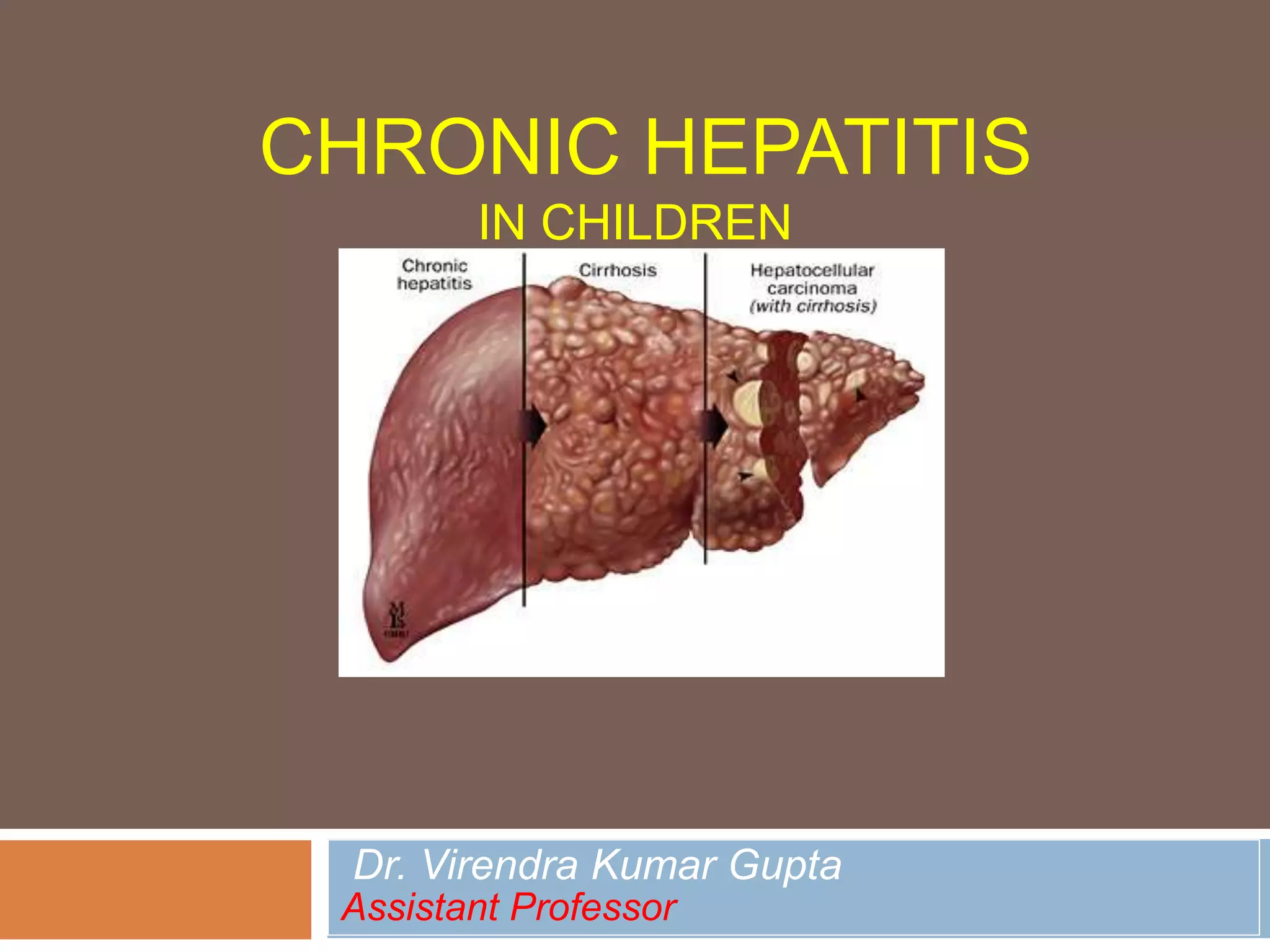

CHRONIC HEPATITIS
IN CHILDREN
Dr. Virendra Kumar Gupta
Assistant Professor
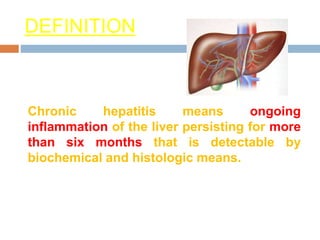
DEFINITION
Chronic hepatitis means ongoing
inflammation of the liver persisting for more
than six months that is detectable by
biochemical and histologic means.
CAUSES
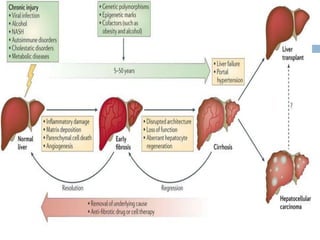
1.Chronic viral hepatitis
 Hepatitis B, C, D
2.Autoimmune liver disease
 Autoimmune hepatitis
 Sclerosing cholangitis/primary biliary cirrhosis
 Overlap syndrome with sclerosing
cholangitis and autoantibodies
 Systemic lupus erythematosus
 Coeliac disease
3.Drug-induced hepatitis
4.Metabolic disorders associated with chronic
liver disease
 Wilson disease
 Nonalcoholic steatohepatitis
 α1-Antitrypsin deficiency
 Tyrosinemia
 Niemann-Pick disease type 2
 Glycogen storage disease type iv
 Cystic fibrosis
 Galactosemia
 Bile acid biosynthetic abnormalities
Clinical presentation
 Can present with acute decompensation
 Asymptomatic
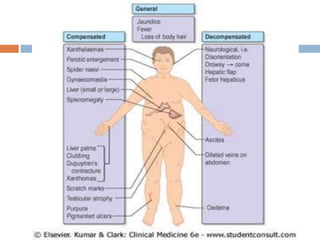
 Signs of chronic liver disease/failure
Hepatitis B
 Chronic hepatitis : HBsAg positivity for >6 mo
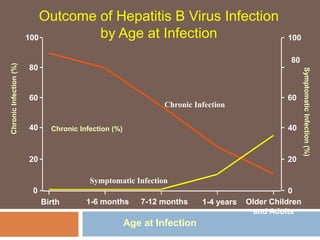
 Risk : >90% infected <1yr , 30% children &
2% of adults infected will become chronic
carriers.
 Three phases of this chronic infection include
1. Immunotolerant phase - active viral
replication and minimal liver damage.HBsAg &
HBeAg are positive and anti Hbe is negative.
HBV DNA load is high. ALT normal
2. Immuno active phase- host tries to resolve
infection HBsAg & HBeAg are positive and anti
Hbe is negative.
HBV DNA load is low. ALT high & with flares
3. Inactive carrier phase- HBsAg & anti Hbe are
positive and HBeAg is negative.
HBV DNA load is very low. ALT normal.
Sometimes may lead to resolution with HBsAg
being negative and Anti HBs positive.
Symptomatic Infection
Chronic Infection
Age at Infection
Chronic Infection (%)
SymptomaticInfection(%)
Birth 1-6 months 7-12 months 1-4 years Older Children
and Adults
0
20
40
60
80
100100
80
60
40
20
0
Outcome of Hepatitis B Virus Infection
by Age at Infection
ChronicInfection(%)
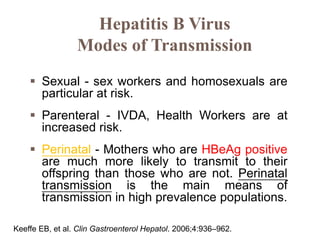
 Sexual - sex workers and homosexuals are
particular at risk.
 Parenteral - IVDA, Health Workers are at
increased risk.
 Perinatal - Mothers who are HBeAg positive
are much more likely to transmit to their
offspring than those who are not. Perinatal
transmission is the main means of
transmission in high prevalence populations.
Hepatitis B Virus
Modes of Transmission
Keeffe EB, et al. Clin Gastroenterol Hepatol. 2006;4:936–962.
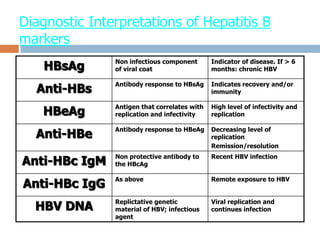
Diagnostic Interpretations of Hepatitis B
markers
HBsAg Non infectious component
of viral coat
Indicator of disease. If > 6
months: chronic HBV
Anti-HBs Antibody response to HBsAg Indicates recovery and/or
immunity
HBeAg Antigen that correlates with
replication and infectivity
High level of infectivity and
replication
Anti-HBe Antibody response to HBeAg Decreasing level of
replication
Remission/resolution
Anti-HBc IgM Non protective antibody to
the HBcAg
Recent HBV infection
Anti-HBc IgG As above Remote exposure to HBV
HBV DNA Replictative genetic
material of HBV; infectious
agent
Viral replication and
continues infection
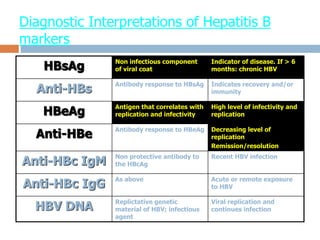
Diagnostic Interpretations of Hepatitis B
markers
HBsAg Non infectious component
of viral coat
Indicator of disease. If > 6
months: chronic HBV
Anti-HBs Antibody response to HBsAg Indicates recovery and/or
immunity
HBeAg Antigen that correlates with
replication and infectivity
High level of infectivity and
replication
Anti-HBe Antibody response to HBeAg Decreasing level of
replication
Remission/resolution
Anti-HBc IgM Non protective antibody to
the HBcAg
Recent HBV infection
Anti-HBc IgG As above Acute or remote exposure
to HBV
HBV DNA Replictative genetic
material of HBV; infectious
agent
Viral replication and
continues infection
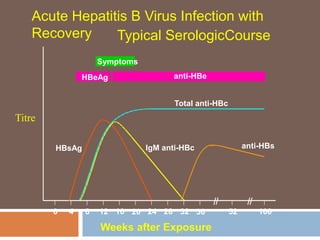
Symptoms
HBeAg anti-HBe
Total anti-HBc
IgM anti-HBc anti-HBsHBsAg
0 4 8 12 16 20 24 28 32 36 52 100
Acute Hepatitis B Virus Infection with
Recovery Typical SerologicCourse
Weeks after Exposure
Titre
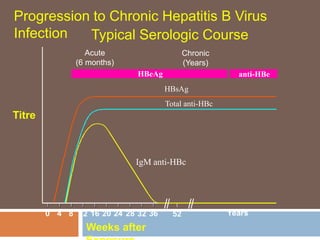
IgM anti-HBc
Total anti-HBc
HBsAg
Acute
(6 months)
HBeAg
Chronic
(Years)
anti-HBe
0 4 8 12 16 20 24 28 32 36 52 Years
Weeks after
Titre
Progression to Chronic Hepatitis B Virus
Infection Typical Serologic Course
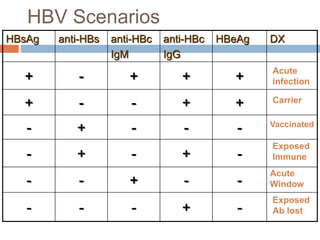
HBV Scenarios
HBsAg anti-HBs anti-HBc
IgM
anti-HBc
IgG
HBeAg DX
+ - + + +
+ - - + +
- + - - -
- + - + -
- - + - -
- - - + -
Acute
infection
Carrier
Vaccinated
Exposed
Immune
Acute
Window
Exposed
Ab lost
17
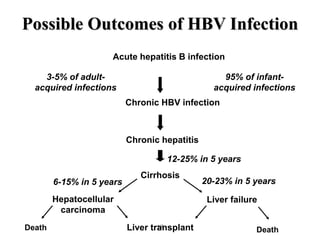
Possible Outcomes of HBV Infection
Acute hepatitis B infection
Chronic HBV infection
3-5% of adult-
acquired infections
95% of infant-
acquired infections
Cirrhosis
Chronic hepatitis
12-25% in 5 years
Liver failureHepatocellular
carcinoma
Liver transplant
6-15% in 5 years 20-23% in 5 years
DeathDeath
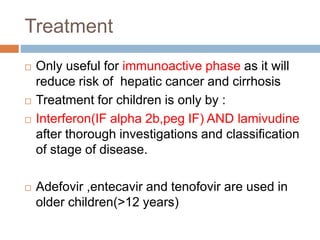
Treatment
 Only useful for immunoactive phase as it will
reduce risk of hepatic cancer and cirrhosis
 Treatment for children is only by :
 Interferon(IF alpha 2b,peg IF) AND lamivudine
after thorough investigations and classification
of stage of disease.
 Adefovir ,entecavir and tenofovir are used in
older children(>12 years)
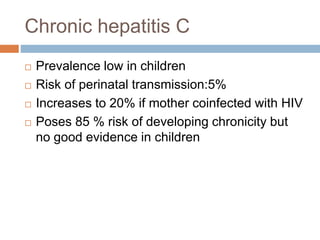
Chronic hepatitis C
 Prevalence low in children
 Risk of perinatal transmission:5%
 Increases to 20% if mother coinfected with HIV
 Poses 85 % risk of developing chronicity but
no good evidence in children
 Mostly asymptomatic with fluctuating /normal
transaminases levels
 Slow progression to fibrosis/cirrhosis/CLD
 Associated with extrahepatic manifestations
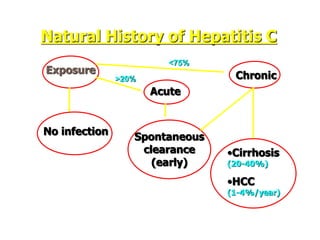
Natural History of Hepatitis C
Exposure
No infection
Acute
Chronic
Spontaneous
clearance
(early)
•Cirrhosis
(20-40%)
•HCC
(1-4%/year)
<75%
>20%
 Diagnosis: HCV RNA and genotype , liver
biopsy
 Treatment:
PEG INTERFERON ALPHA 2b and
RIBAVIRIN
(in > 3yrs of age) for 2 year duration
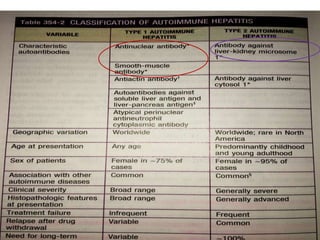
Autoimmune liver disease
Autoimmune liver disease is a clinical
constellation that suggests an immune-
mediated process characterized by :
 hypergammaglobulinemia,
 circulating autoimmune antibodies,
 necro inflammatory histology &
 responsive to immunosuppressive therapy .
 They include autoimmune hepatitis,
autoimmune sclerosing cholangitis & de
novo hepatitis.
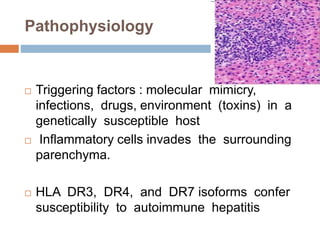
Pathophysiology
 Triggering factors : molecular mimicry,
infections, drugs, environment (toxins) in a
genetically susceptible host
 Inflammatory cells invades the surrounding
parenchyma.
 HLA DR3, DR4, and DR7 isoforms confer
susceptibility to autoimmune hepatitis
Clinical manifestations
 Acute viral hepatitis like picture(40%) can
progress to ALF esp in Type 2
 Insidious onset of liver disease with fatigue,
relapsing or prolonged jaundice.
 Chronic liver disease and its complications
 Extrahepatic manifestations: arthritis,
vasculitis, nephritis, throiditis, anemia, rash
Management
 Diagnosis is done by:
elevated transaminases, positive auto
antibodies , raised gammaglobulins and IgG
levels, liver biopsy, absence of known etiology
and response to immunosuppressive drugs.
 Steroids, Azathioprine are first line drugs
 Cyclosporine and mycophenolate mofetil are
second line drugs
 Liver transplantation as and when required.
Drug induced liver disease
 Drugs commonly used in children that can
cause chronic liver injury include isoniazid,
methyldopa, pemoline, nitrofurantoin,
dantrolene, minocycline, pemoline, and the
sulfonamides.
 Anti tubercular and anticonvulsant drugs are
major causes
 Can be chemical hepatotoxicity/idiosyncratic
heapatotoxicity
 They can mimic any form of liver
disease(acute &chronic hepatitis, ALF, portal
hypertension)
 Good history taking and high index of
suspicion is required
 Treatment is by withdrawal of drug and
supportive care
Metabolic causes
 Can account for 15-20% of liver diseases in
India
 Most common is Wilsons disease.
 Most symptoms are due o hepatocyte injury or
secondary to hypoglycemia or
hyperammonemia
 Treatment is cause specific.
Wilsons disease
 a/k/a hepatolenticular degeneration
 Toxic accumulation of copper in
liver,brain,cornea and other tissues
 Due to abnormal gene, ATP 7B in
chromosome 13
Clinical features
 Various forms of hepatic disease:
 Asymptomatic hepatomegaly
 subacute/chronic hepatitis
 Acute hepatic failure with/without hemolytic
anemia
 Others: neuropsychiatric disease, KF
Ring,sunflower cataract , coombs negative
hemolytic anemia, arthritis, pancreatitis,
nephrolithiasis, cardiomyopathy
,endocrinopathies
diagnosis
 Serum ceruloplasmin(<20mg/dl)
 24 hr urinary copper excretion(>100mcg/day)
with penicillamine challenge
test(>1600mcg/day)
 KF ring(slit lamp)
 Liver biopsy: hepatic copper (>250mcg/g)
 Family screening
Treatment
 Dietary restriction of copper
 Copper chelating
agents(penicillamine/triethylene tetramine
hydrochloride, zinc, ammonium
tetrathiomolybdenate)
 Liver transplantation
Nonalcoholic steatohepatitis
 Usually associated with obesity and insulin
resistance
 Most children are asymptomatic
 May have vague abdominal pain.
 o/e: hepatomegaly , features of insulin
resistance like striae, acanthosis nigricans
obesity and hepatomegaly.
 It can progress to cirrhosis.
 Diagnosis is usually clinicopathological
correlation . Other causes to be excluded
 Treatment is by weight reduction and dietary
modifications.
 Ursodeoxycholic acid and vitamin E have
promising results
THANK YOU

Chronic hepatits in children

  • 1.
    CHRONIC HEPATITIS IN CHILDREN Dr.Virendra Kumar Gupta Assistant Professor
  • 2.
    DEFINITION Chronic hepatitis meansongoing inflammation of the liver persisting for more than six months that is detectable by biochemical and histologic means.
  • 3.
    CAUSES 1.Chronic viral hepatitis Hepatitis B, C, D 2.Autoimmune liver disease  Autoimmune hepatitis  Sclerosing cholangitis/primary biliary cirrhosis  Overlap syndrome with sclerosing cholangitis and autoantibodies  Systemic lupus erythematosus  Coeliac disease
  • 4.
    3.Drug-induced hepatitis 4.Metabolic disordersassociated with chronic liver disease  Wilson disease  Nonalcoholic steatohepatitis  α1-Antitrypsin deficiency  Tyrosinemia  Niemann-Pick disease type 2  Glycogen storage disease type iv  Cystic fibrosis  Galactosemia  Bile acid biosynthetic abnormalities
  • 6.
    Clinical presentation  Canpresent with acute decompensation  Asymptomatic  Signs of chronic liver disease/failure
  • 8.
    Hepatitis B  Chronichepatitis : HBsAg positivity for >6 mo  Risk : >90% infected <1yr , 30% children & 2% of adults infected will become chronic carriers.  Three phases of this chronic infection include 1. Immunotolerant phase - active viral replication and minimal liver damage.HBsAg & HBeAg are positive and anti Hbe is negative. HBV DNA load is high. ALT normal
  • 9.
    2. Immuno activephase- host tries to resolve infection HBsAg & HBeAg are positive and anti Hbe is negative. HBV DNA load is low. ALT high & with flares 3. Inactive carrier phase- HBsAg & anti Hbe are positive and HBeAg is negative. HBV DNA load is very low. ALT normal. Sometimes may lead to resolution with HBsAg being negative and Anti HBs positive.
  • 10.
    Symptomatic Infection Chronic Infection Ageat Infection Chronic Infection (%) SymptomaticInfection(%) Birth 1-6 months 7-12 months 1-4 years Older Children and Adults 0 20 40 60 80 100100 80 60 40 20 0 Outcome of Hepatitis B Virus Infection by Age at Infection ChronicInfection(%)
  • 11.
     Sexual -sex workers and homosexuals are particular at risk.  Parenteral - IVDA, Health Workers are at increased risk.  Perinatal - Mothers who are HBeAg positive are much more likely to transmit to their offspring than those who are not. Perinatal transmission is the main means of transmission in high prevalence populations. Hepatitis B Virus Modes of Transmission Keeffe EB, et al. Clin Gastroenterol Hepatol. 2006;4:936–962.
  • 12.
    Diagnostic Interpretations ofHepatitis B markers HBsAg Non infectious component of viral coat Indicator of disease. If > 6 months: chronic HBV Anti-HBs Antibody response to HBsAg Indicates recovery and/or immunity HBeAg Antigen that correlates with replication and infectivity High level of infectivity and replication Anti-HBe Antibody response to HBeAg Decreasing level of replication Remission/resolution Anti-HBc IgM Non protective antibody to the HBcAg Recent HBV infection Anti-HBc IgG As above Remote exposure to HBV HBV DNA Replictative genetic material of HBV; infectious agent Viral replication and continues infection
  • 13.
    Diagnostic Interpretations ofHepatitis B markers HBsAg Non infectious component of viral coat Indicator of disease. If > 6 months: chronic HBV Anti-HBs Antibody response to HBsAg Indicates recovery and/or immunity HBeAg Antigen that correlates with replication and infectivity High level of infectivity and replication Anti-HBe Antibody response to HBeAg Decreasing level of replication Remission/resolution Anti-HBc IgM Non protective antibody to the HBcAg Recent HBV infection Anti-HBc IgG As above Acute or remote exposure to HBV HBV DNA Replictative genetic material of HBV; infectious agent Viral replication and continues infection
  • 14.
    Symptoms HBeAg anti-HBe Total anti-HBc IgManti-HBc anti-HBsHBsAg 0 4 8 12 16 20 24 28 32 36 52 100 Acute Hepatitis B Virus Infection with Recovery Typical SerologicCourse Weeks after Exposure Titre
  • 15.
    IgM anti-HBc Total anti-HBc HBsAg Acute (6months) HBeAg Chronic (Years) anti-HBe 0 4 8 12 16 20 24 28 32 36 52 Years Weeks after Titre Progression to Chronic Hepatitis B Virus Infection Typical Serologic Course
  • 16.
    HBV Scenarios HBsAg anti-HBsanti-HBc IgM anti-HBc IgG HBeAg DX + - + + + + - - + + - + - - - - + - + - - - + - - - - - + - Acute infection Carrier Vaccinated Exposed Immune Acute Window Exposed Ab lost
  • 17.
    17 Possible Outcomes ofHBV Infection Acute hepatitis B infection Chronic HBV infection 3-5% of adult- acquired infections 95% of infant- acquired infections Cirrhosis Chronic hepatitis 12-25% in 5 years Liver failureHepatocellular carcinoma Liver transplant 6-15% in 5 years 20-23% in 5 years DeathDeath
  • 18.
    Treatment  Only usefulfor immunoactive phase as it will reduce risk of hepatic cancer and cirrhosis  Treatment for children is only by :  Interferon(IF alpha 2b,peg IF) AND lamivudine after thorough investigations and classification of stage of disease.  Adefovir ,entecavir and tenofovir are used in older children(>12 years)
  • 19.
    Chronic hepatitis C Prevalence low in children  Risk of perinatal transmission:5%  Increases to 20% if mother coinfected with HIV  Poses 85 % risk of developing chronicity but no good evidence in children
  • 20.
     Mostly asymptomaticwith fluctuating /normal transaminases levels  Slow progression to fibrosis/cirrhosis/CLD  Associated with extrahepatic manifestations
  • 21.
    Natural History ofHepatitis C Exposure No infection Acute Chronic Spontaneous clearance (early) •Cirrhosis (20-40%) •HCC (1-4%/year) <75% >20%
  • 22.
     Diagnosis: HCVRNA and genotype , liver biopsy  Treatment: PEG INTERFERON ALPHA 2b and RIBAVIRIN (in > 3yrs of age) for 2 year duration
  • 23.
    Autoimmune liver disease Autoimmuneliver disease is a clinical constellation that suggests an immune- mediated process characterized by :  hypergammaglobulinemia,  circulating autoimmune antibodies,  necro inflammatory histology &  responsive to immunosuppressive therapy .  They include autoimmune hepatitis, autoimmune sclerosing cholangitis & de novo hepatitis.
  • 24.
    Pathophysiology  Triggering factors: molecular mimicry, infections, drugs, environment (toxins) in a genetically susceptible host  Inflammatory cells invades the surrounding parenchyma.  HLA DR3, DR4, and DR7 isoforms confer susceptibility to autoimmune hepatitis
  • 26.
    Clinical manifestations  Acuteviral hepatitis like picture(40%) can progress to ALF esp in Type 2  Insidious onset of liver disease with fatigue, relapsing or prolonged jaundice.  Chronic liver disease and its complications  Extrahepatic manifestations: arthritis, vasculitis, nephritis, throiditis, anemia, rash
  • 27.
    Management  Diagnosis isdone by: elevated transaminases, positive auto antibodies , raised gammaglobulins and IgG levels, liver biopsy, absence of known etiology and response to immunosuppressive drugs.  Steroids, Azathioprine are first line drugs  Cyclosporine and mycophenolate mofetil are second line drugs  Liver transplantation as and when required.
  • 28.
    Drug induced liverdisease  Drugs commonly used in children that can cause chronic liver injury include isoniazid, methyldopa, pemoline, nitrofurantoin, dantrolene, minocycline, pemoline, and the sulfonamides.  Anti tubercular and anticonvulsant drugs are major causes  Can be chemical hepatotoxicity/idiosyncratic heapatotoxicity
  • 29.
     They canmimic any form of liver disease(acute &chronic hepatitis, ALF, portal hypertension)  Good history taking and high index of suspicion is required  Treatment is by withdrawal of drug and supportive care
  • 30.
    Metabolic causes  Canaccount for 15-20% of liver diseases in India  Most common is Wilsons disease.  Most symptoms are due o hepatocyte injury or secondary to hypoglycemia or hyperammonemia  Treatment is cause specific.
  • 31.
    Wilsons disease  a/k/ahepatolenticular degeneration  Toxic accumulation of copper in liver,brain,cornea and other tissues  Due to abnormal gene, ATP 7B in chromosome 13
  • 32.
    Clinical features  Variousforms of hepatic disease:  Asymptomatic hepatomegaly  subacute/chronic hepatitis  Acute hepatic failure with/without hemolytic anemia  Others: neuropsychiatric disease, KF Ring,sunflower cataract , coombs negative hemolytic anemia, arthritis, pancreatitis, nephrolithiasis, cardiomyopathy ,endocrinopathies
  • 33.
    diagnosis  Serum ceruloplasmin(<20mg/dl) 24 hr urinary copper excretion(>100mcg/day) with penicillamine challenge test(>1600mcg/day)  KF ring(slit lamp)  Liver biopsy: hepatic copper (>250mcg/g)  Family screening
  • 34.
    Treatment  Dietary restrictionof copper  Copper chelating agents(penicillamine/triethylene tetramine hydrochloride, zinc, ammonium tetrathiomolybdenate)  Liver transplantation
  • 35.
    Nonalcoholic steatohepatitis  Usuallyassociated with obesity and insulin resistance  Most children are asymptomatic  May have vague abdominal pain.  o/e: hepatomegaly , features of insulin resistance like striae, acanthosis nigricans obesity and hepatomegaly.  It can progress to cirrhosis.
  • 36.
     Diagnosis isusually clinicopathological correlation . Other causes to be excluded  Treatment is by weight reduction and dietary modifications.  Ursodeoxycholic acid and vitamin E have promising results
  • 37.