© 2007 Cisco Systems, Inc. All rights reserved. Cisco Public
ITE PC v4.0
Chapter 1 1
Introduction to Dynamic
Routing Protocol
Routing Protocols and
Concepts – Chapter 3
ITE PC v4.0
Chapter 1 2© 2007 Cisco Systems, Inc. All rights reserved. Cisco Public
Objectives
 Describe the role of dynamic routing protocols and
place these protocols in the context of modern
network design.
 Identify several ways to classify routing protocols.
 Describe how metrics are used by routing protocols
and identify the metric types used by dynamic routing
protocols.
 Determine the administrative distance of a route and
describe its importance in the routing process.
 Identify the different elements of the routing table.
ITE PC v4.0
Chapter 1 3© 2007 Cisco Systems, Inc. All rights reserved. Cisco Public
Dynamic Routing Protocols
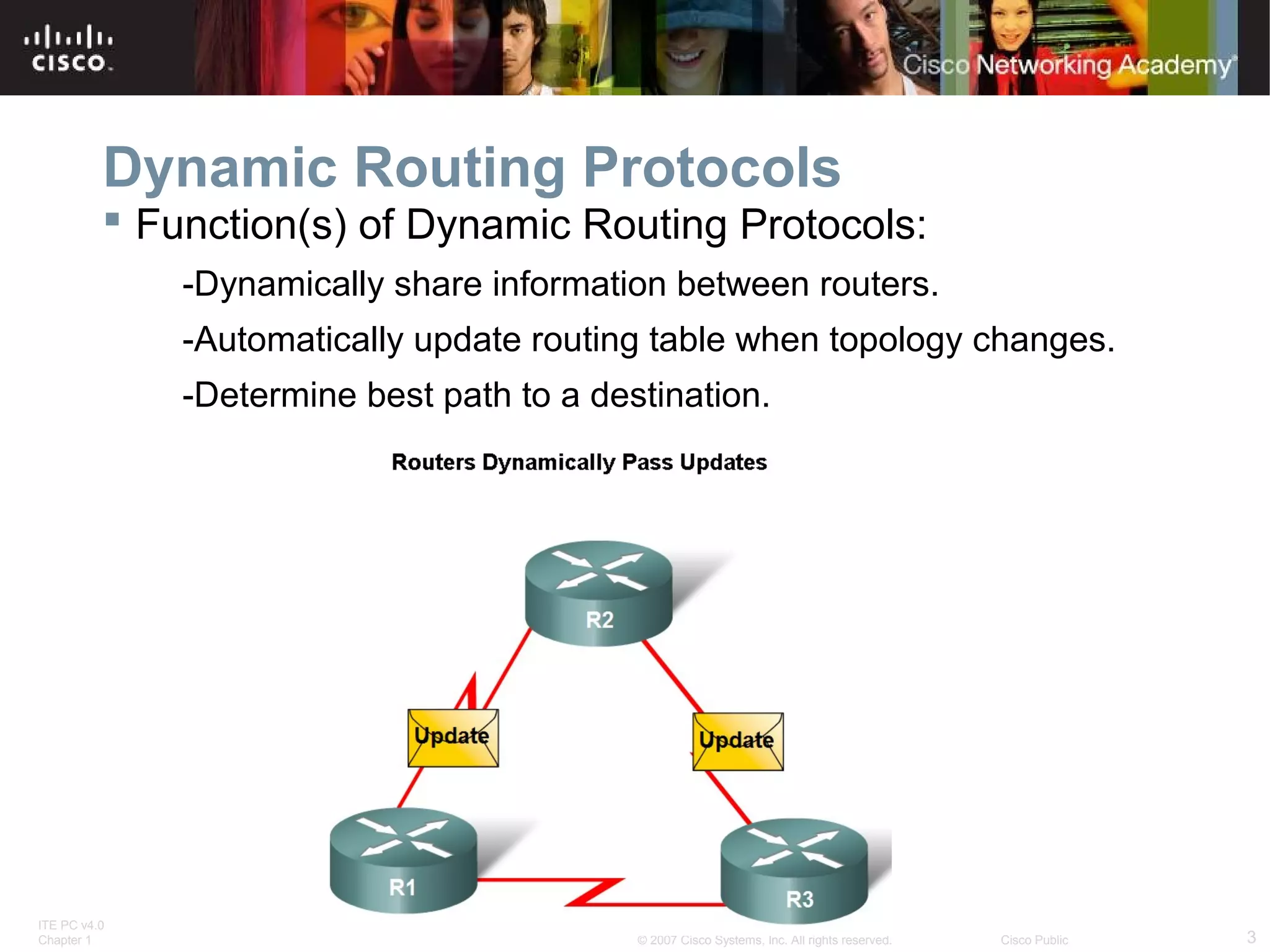
 Function(s) of Dynamic Routing Protocols:
-Dynamically share information between routers.
-Automatically update routing table when topology changes.
-Determine best path to a destination.
ITE PC v4.0
Chapter 1 4© 2007 Cisco Systems, Inc. All rights reserved. Cisco Public
Dynamic Routing Protocols
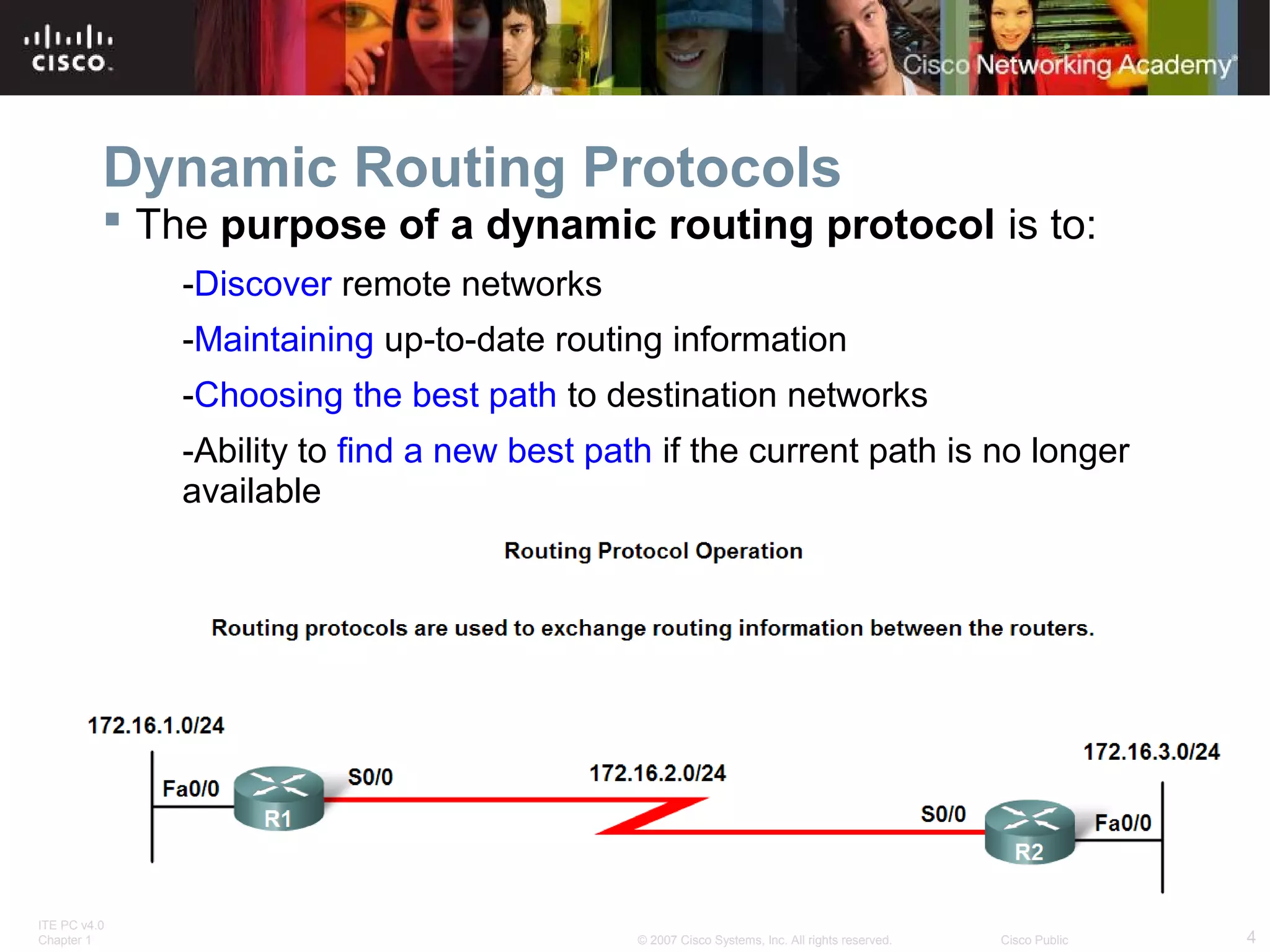
 The purpose of a dynamic routing protocol is to:
-Discover remote networks
-Maintaining up-to-date routing information
-Choosing the best path to destination networks
-Ability to find a new best path if the current path is no longer
available
ITE PC v4.0
Chapter 1 5© 2007 Cisco Systems, Inc. All rights reserved. Cisco Public
Dynamic Routing Protocols
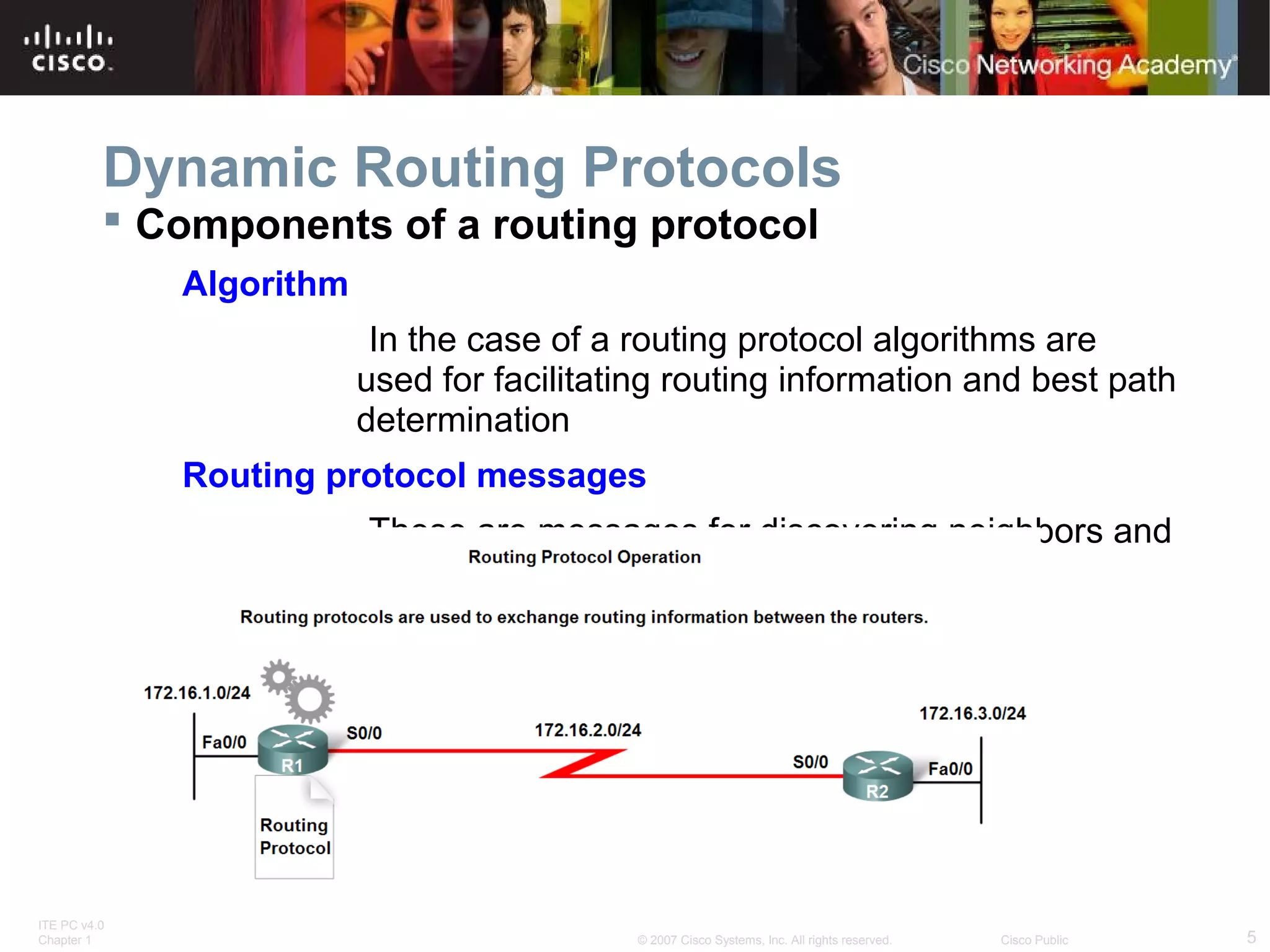
 Components of a routing protocol
Algorithm
In the case of a routing protocol algorithms are
used for facilitating routing information and best path
determination
Routing protocol messages
These are messages for discovering neighbors and
exchange of routing information
ITE PC v4.0
Chapter 1 6© 2007 Cisco Systems, Inc. All rights reserved. Cisco Public
Dynamic Routing Protocols
 Advantages of static routing
-It can backup multiple interfaces/networks on a router
-Easy to configure
-No extra resources are needed
-More secure
 Disadvantages of static routing
-Network changes require manual reconfiguration
-Does not scale well in large topologies
ITE PC v4.0
Chapter 1 7© 2007 Cisco Systems, Inc. All rights reserved. Cisco Public
Classifying Routing Protocols
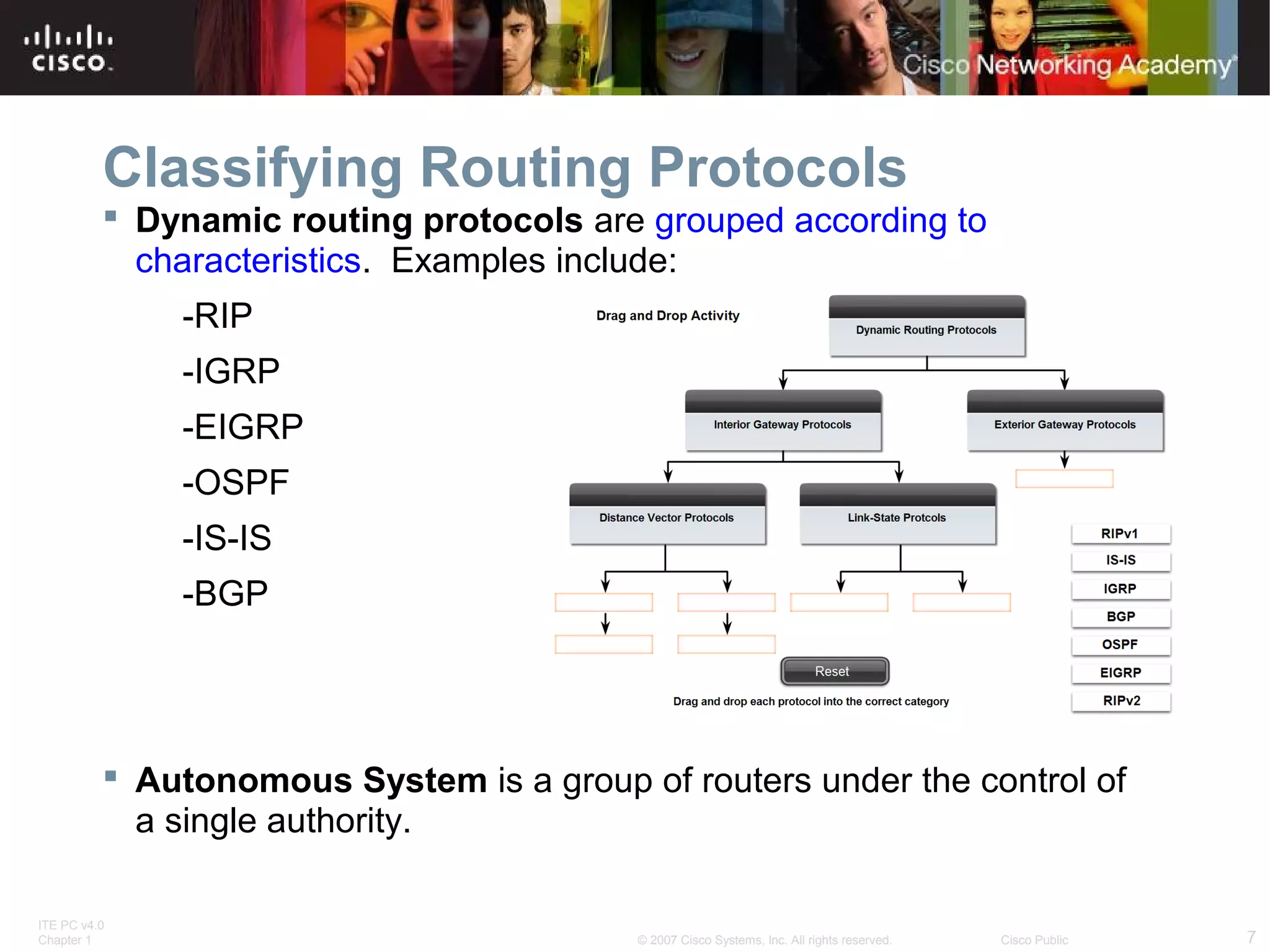
 Dynamic routing protocols are grouped according to
characteristics. Examples include:
-RIP
-IGRP
-EIGRP
-OSPF
-IS-IS
-BGP
 Autonomous System is a group of routers under the control of
a single authority.
ITE PC v4.0
Chapter 1 8© 2007 Cisco Systems, Inc. All rights reserved. Cisco Public
Classifying Routing Protocols
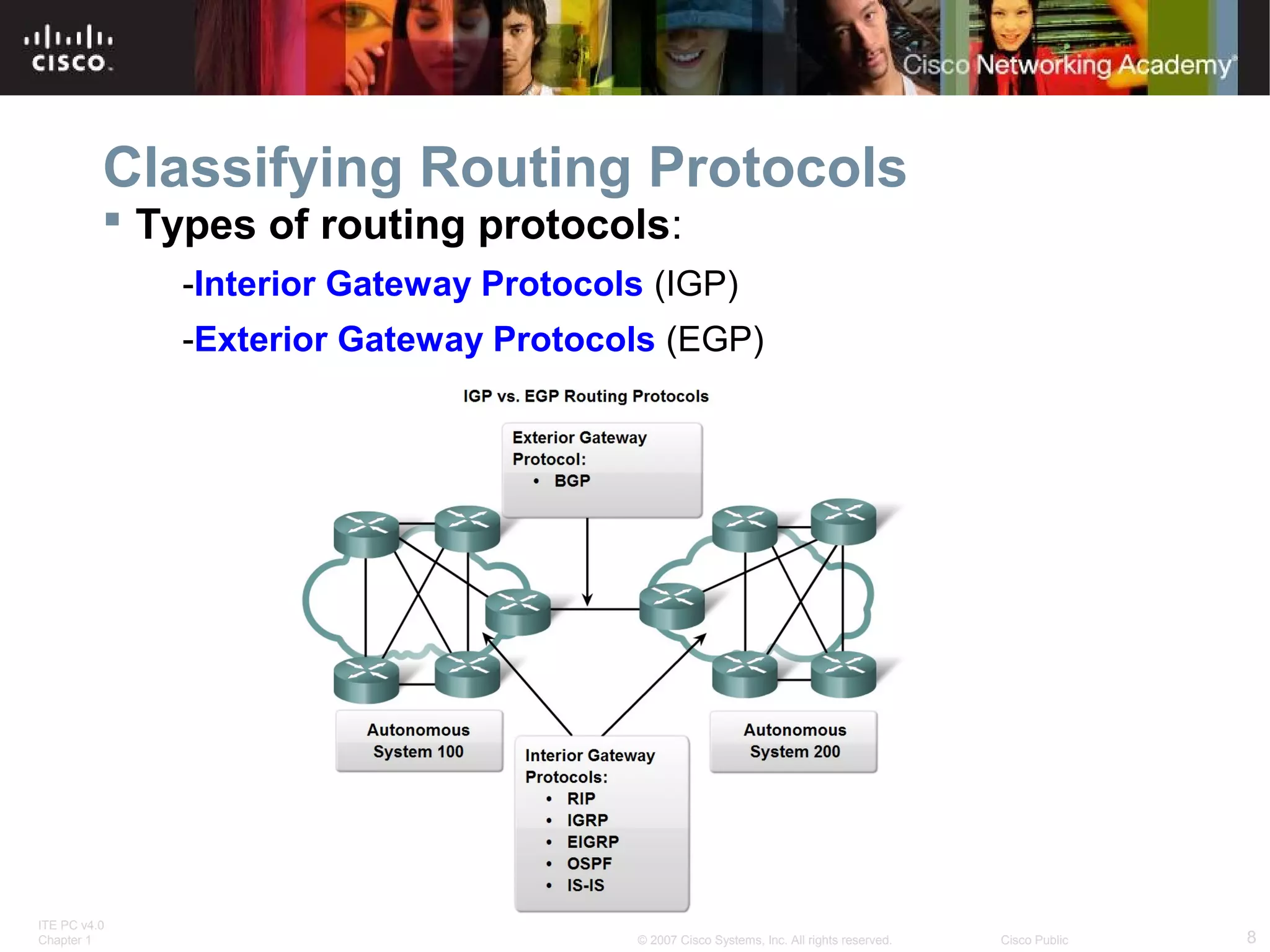
 Types of routing protocols:
-Interior Gateway Protocols (IGP)
-Exterior Gateway Protocols (EGP)
ITE PC v4.0
Chapter 1 9© 2007 Cisco Systems, Inc. All rights reserved. Cisco Public
Classifying Routing Protocols
 Interior Gateway Routing Protocols (IGP)
-Used for routing inside an autonomous system & used to route
within the individual networks themselves.
-Examples: RIP, EIGRP, OSPF
 Exterior Routing Protocols (EGP)
-Used for routing between autonomous systems
-Example: BGPv4
ITE PC v4.0
Chapter 1 10© 2007 Cisco Systems, Inc. All rights reserved. Cisco Public
Classifying Routing Protocols
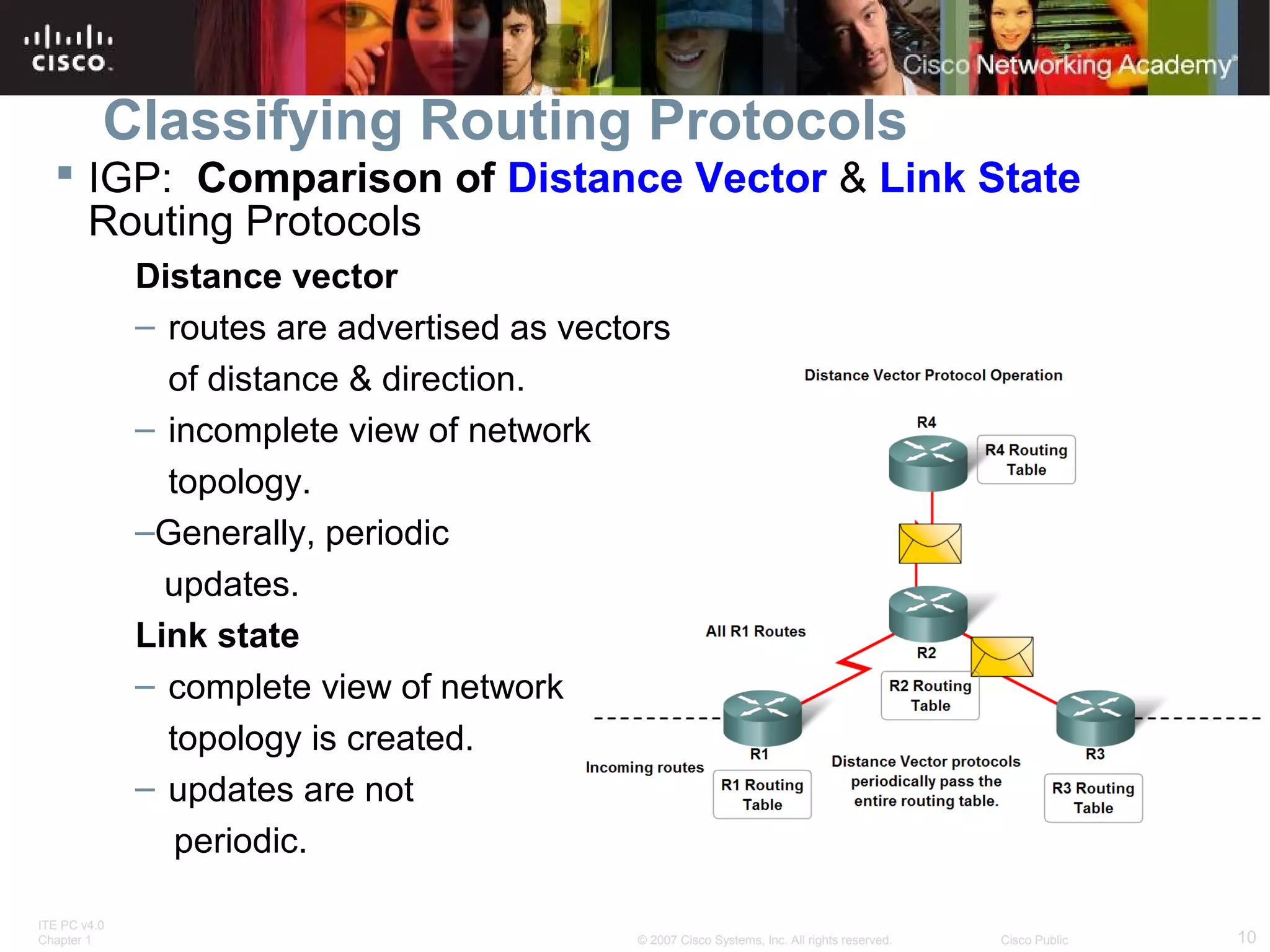
 IGP: Comparison of Distance Vector & Link State
Routing Protocols
Distance vector
– routes are advertised as vectors
of distance & direction.
– incomplete view of network
topology.
–Generally, periodic
updates.
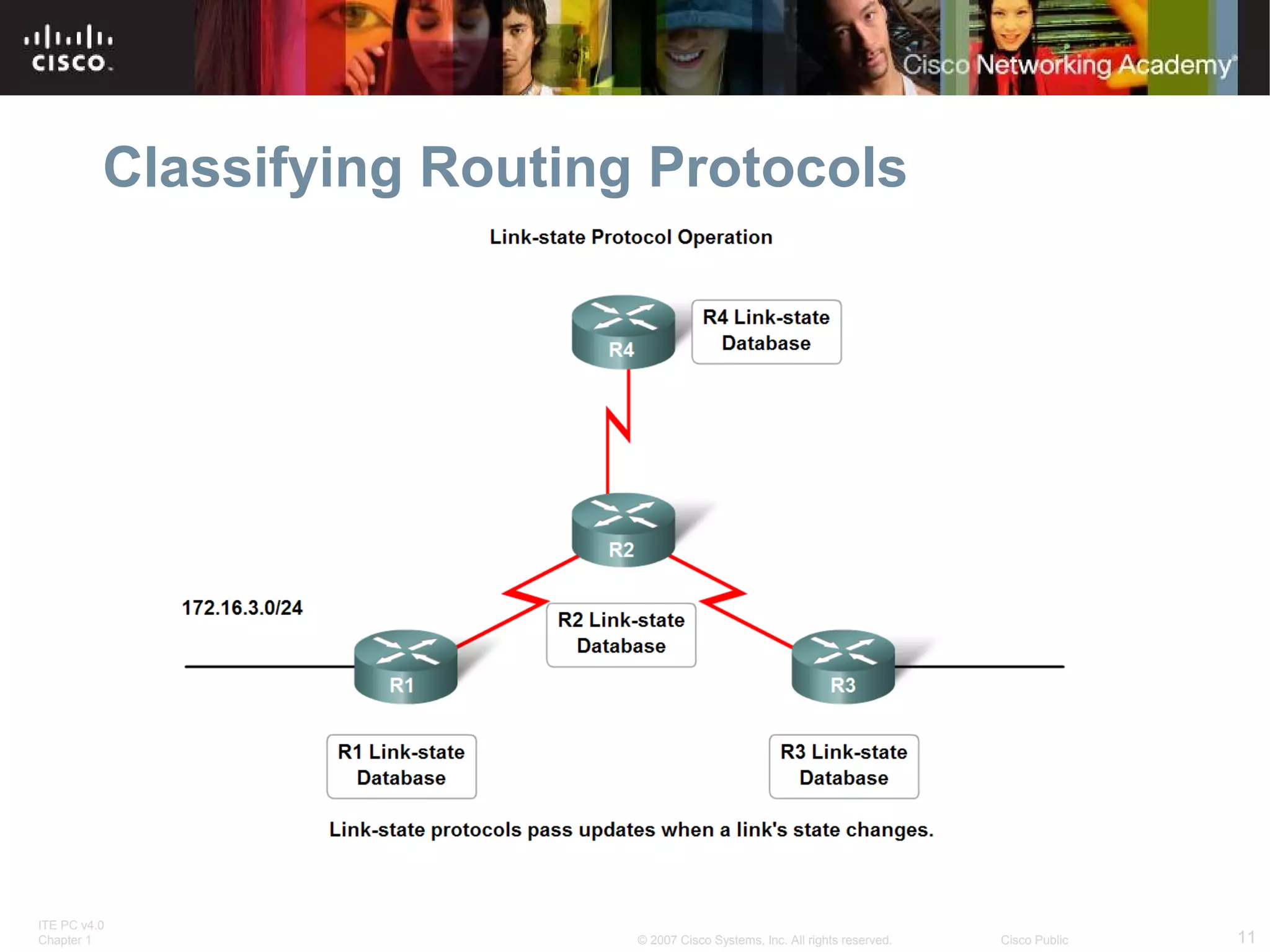
Link state
– complete view of network
topology is created.
– updates are not
periodic.
ITE PC v4.0
Chapter 1 11© 2007 Cisco Systems, Inc. All rights reserved. Cisco Public
Classifying Routing Protocols
ITE PC v4.0
Chapter 1 12© 2007 Cisco Systems, Inc. All rights reserved. Cisco Public
Classifying Routing Protocols
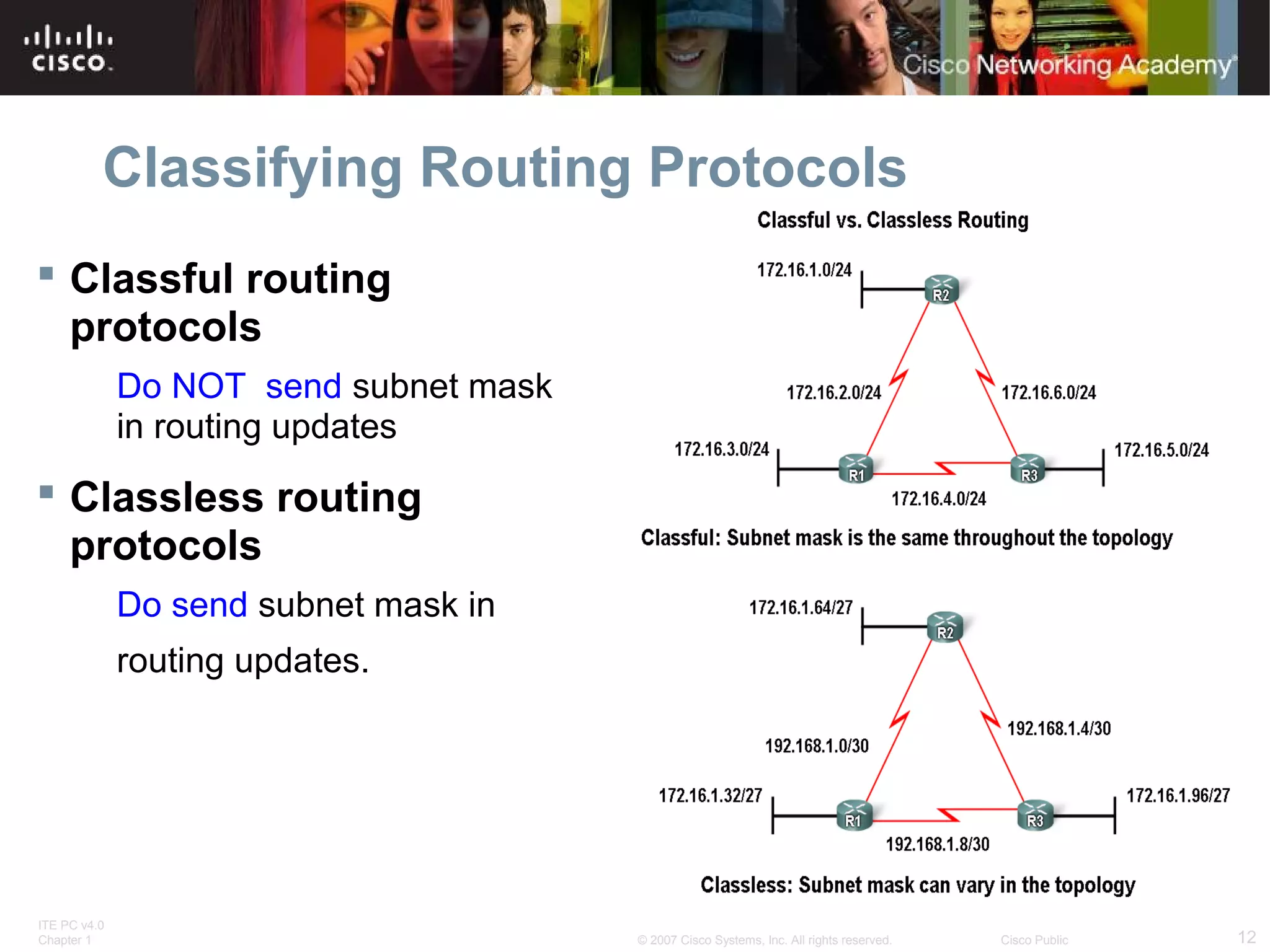
 Classful routing
protocols
Do NOT send subnet mask
in routing updates
 Classless routing
protocols
Do send subnet mask in
routing updates.
ITE PC v4.0
Chapter 1 13© 2007 Cisco Systems, Inc. All rights reserved. Cisco Public
Classifying Routing Protocols
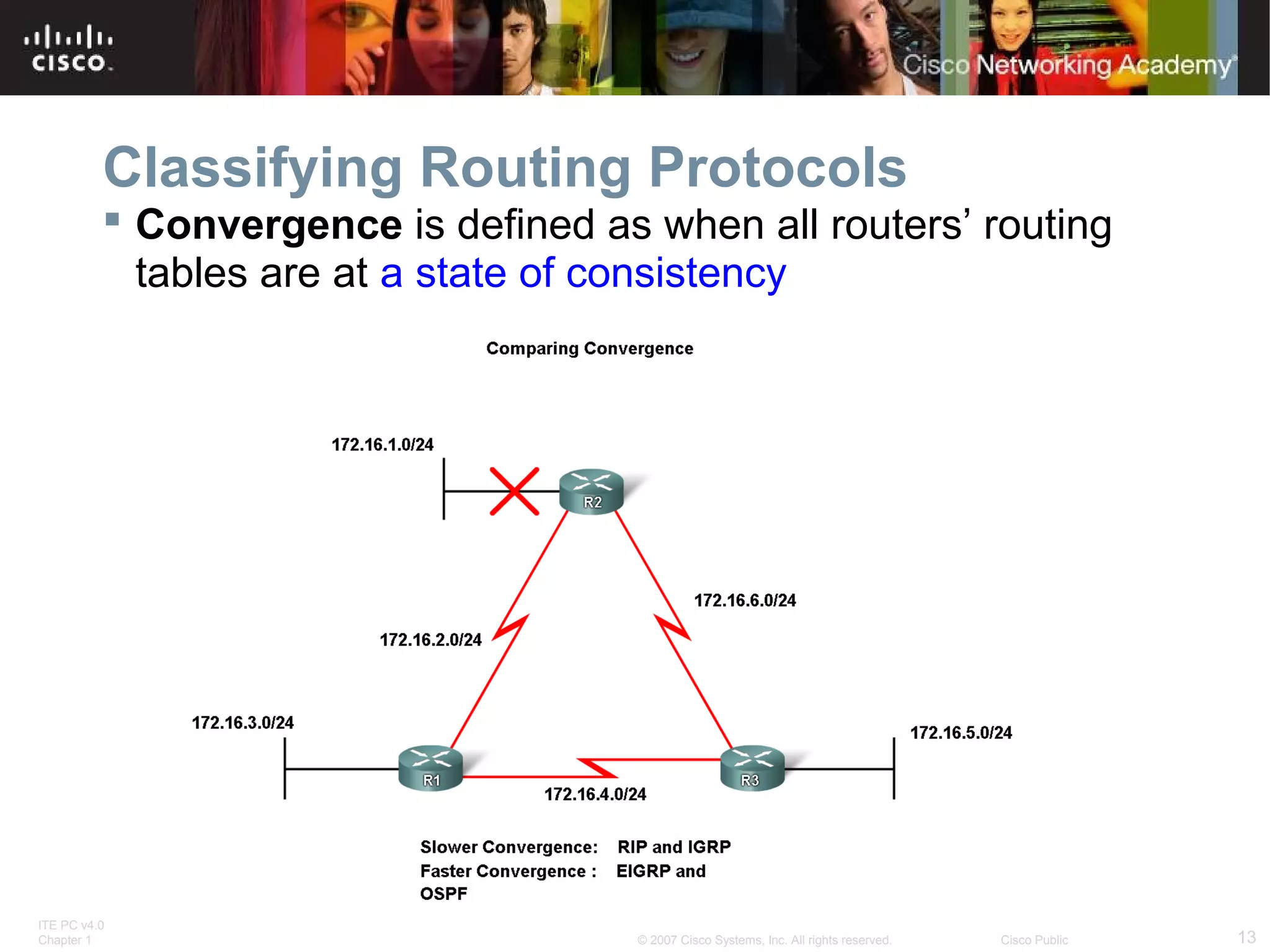
 Convergence is defined as when all routers’ routing
tables are at a state of consistency
ITE PC v4.0
Chapter 1 14© 2007 Cisco Systems, Inc. All rights reserved. Cisco Public
Routing Protocols Metrics
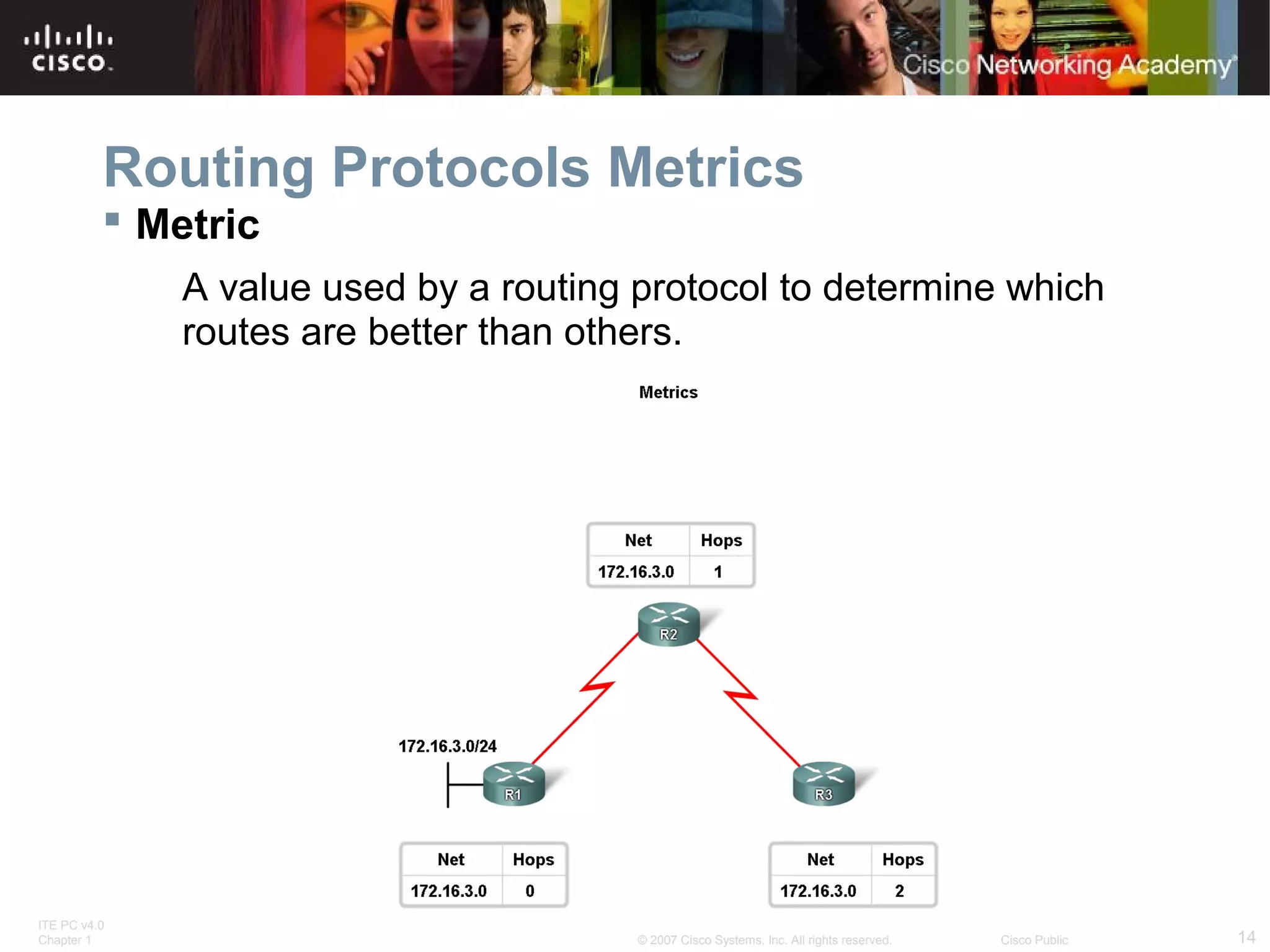
 Metric
A value used by a routing protocol to determine which
routes are better than others.
ITE PC v4.0
Chapter 1 15© 2007 Cisco Systems, Inc. All rights reserved. Cisco Public
Routing Protocols Metrics
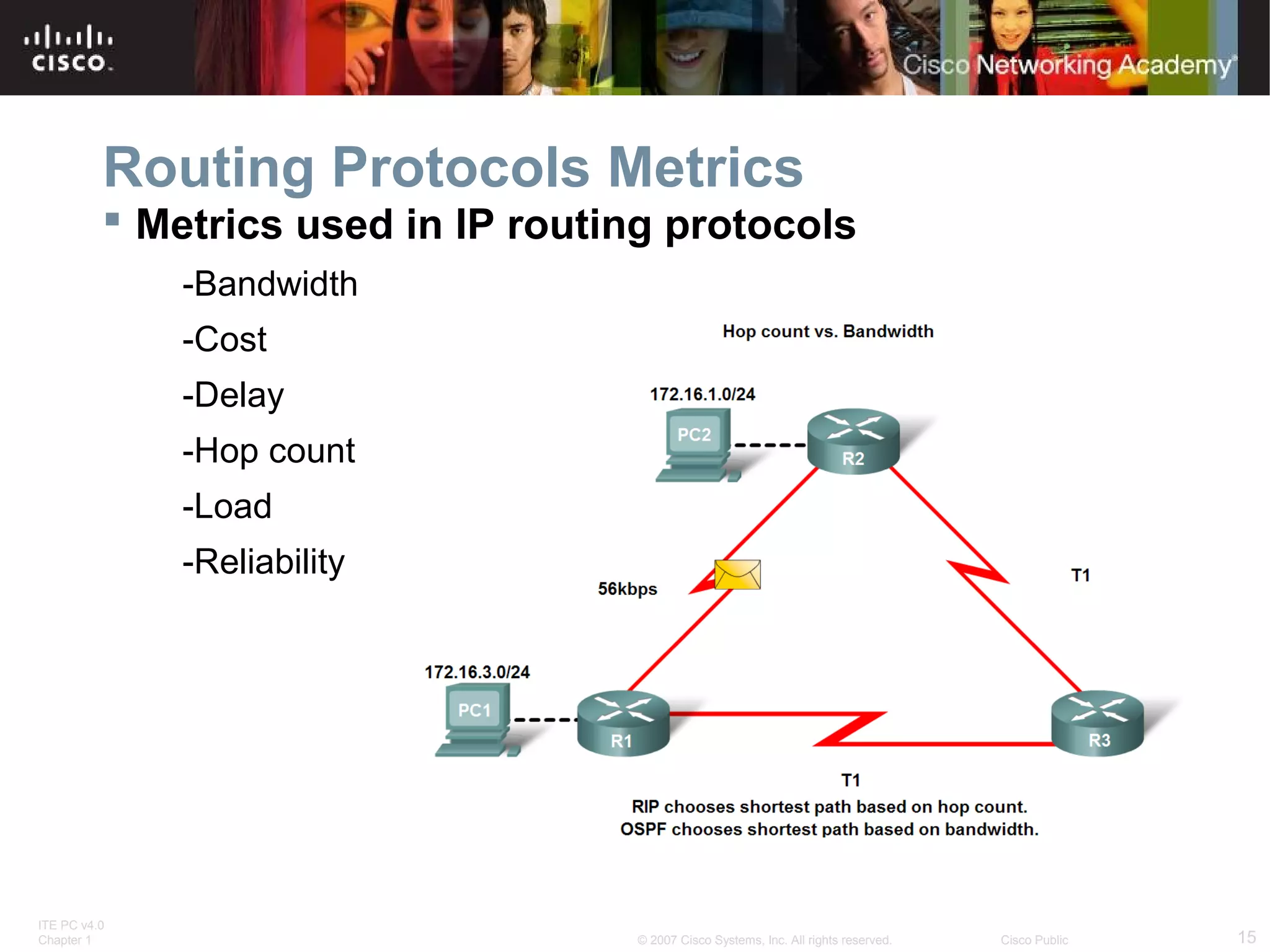
 Metrics used in IP routing protocols
-Bandwidth
-Cost
-Delay
-Hop count
-Load
-Reliability
ITE PC v4.0
Chapter 1 16© 2007 Cisco Systems, Inc. All rights reserved. Cisco Public
Routing Protocols Metrics
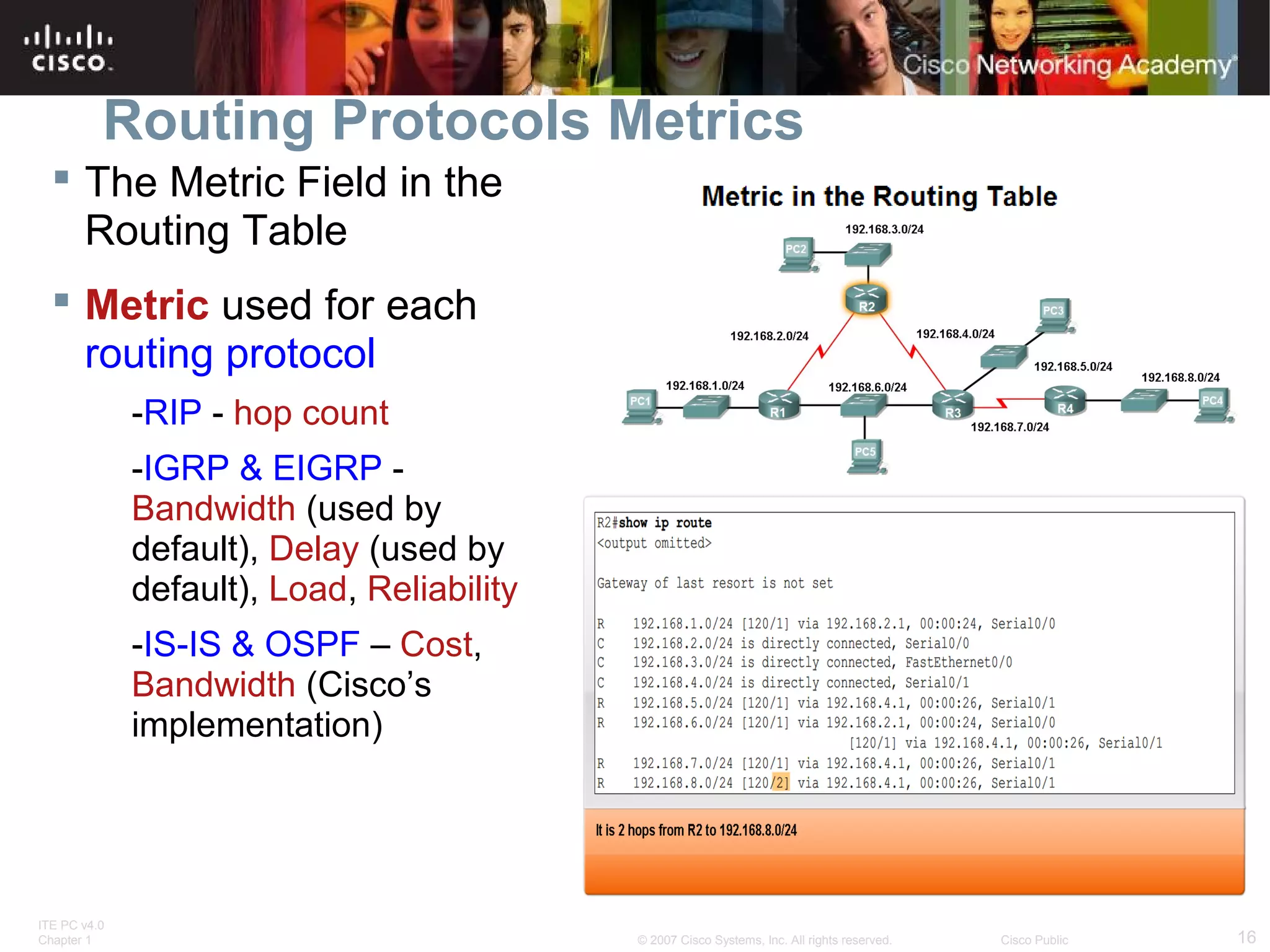
 The Metric Field in the
Routing Table
 Metric used for each
routing protocol
-RIP - hop count
-IGRP & EIGRP -
Bandwidth (used by
default), Delay (used by
default), Load, Reliability
-IS-IS & OSPF – Cost,
Bandwidth (Cisco’s
implementation)
ITE PC v4.0
Chapter 1 17© 2007 Cisco Systems, Inc. All rights reserved. Cisco Public
Routing Protocols Metrics
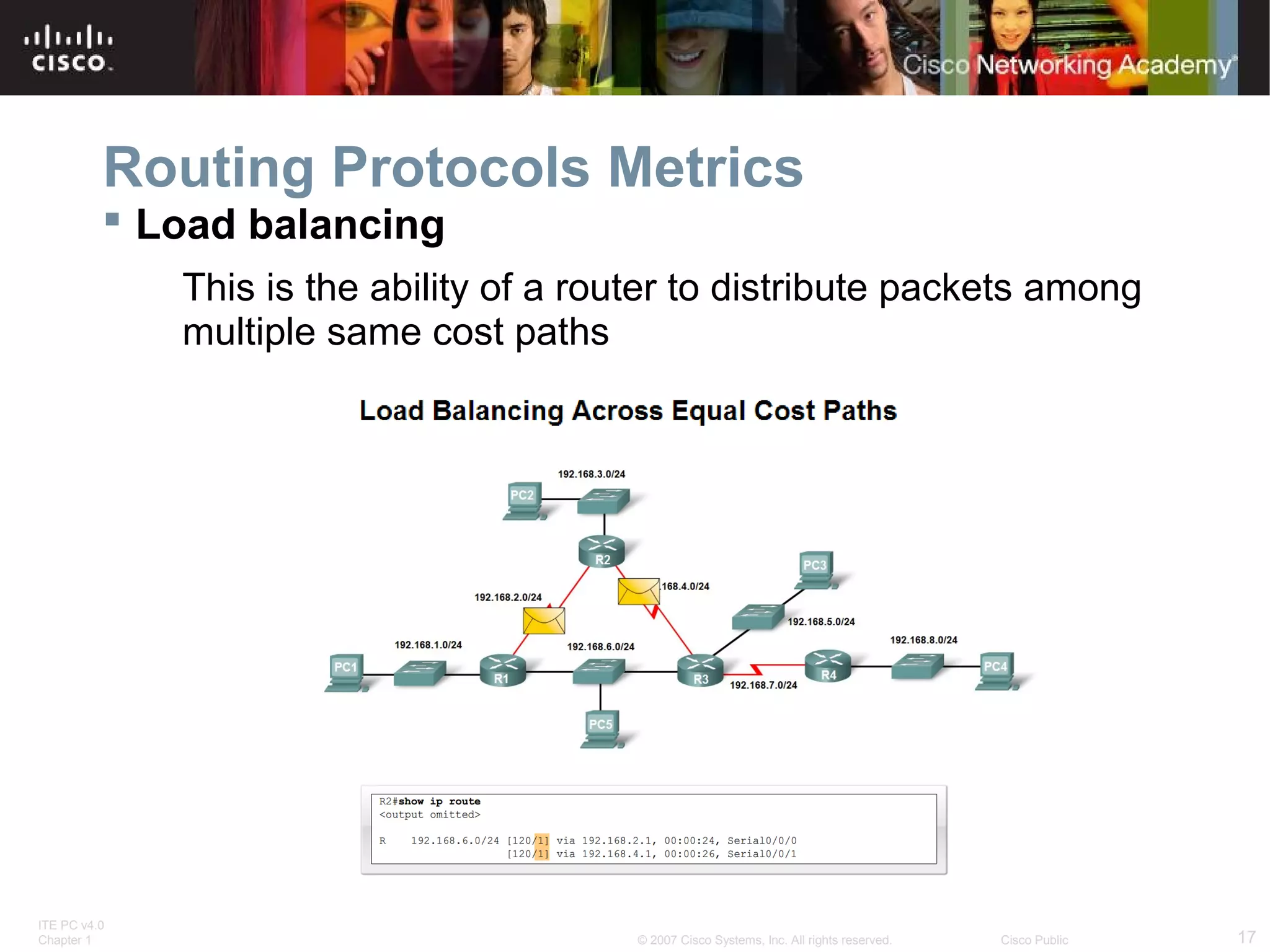
 Load balancing
This is the ability of a router to distribute packets among
multiple same cost paths
ITE PC v4.0
Chapter 1 18© 2007 Cisco Systems, Inc. All rights reserved. Cisco Public
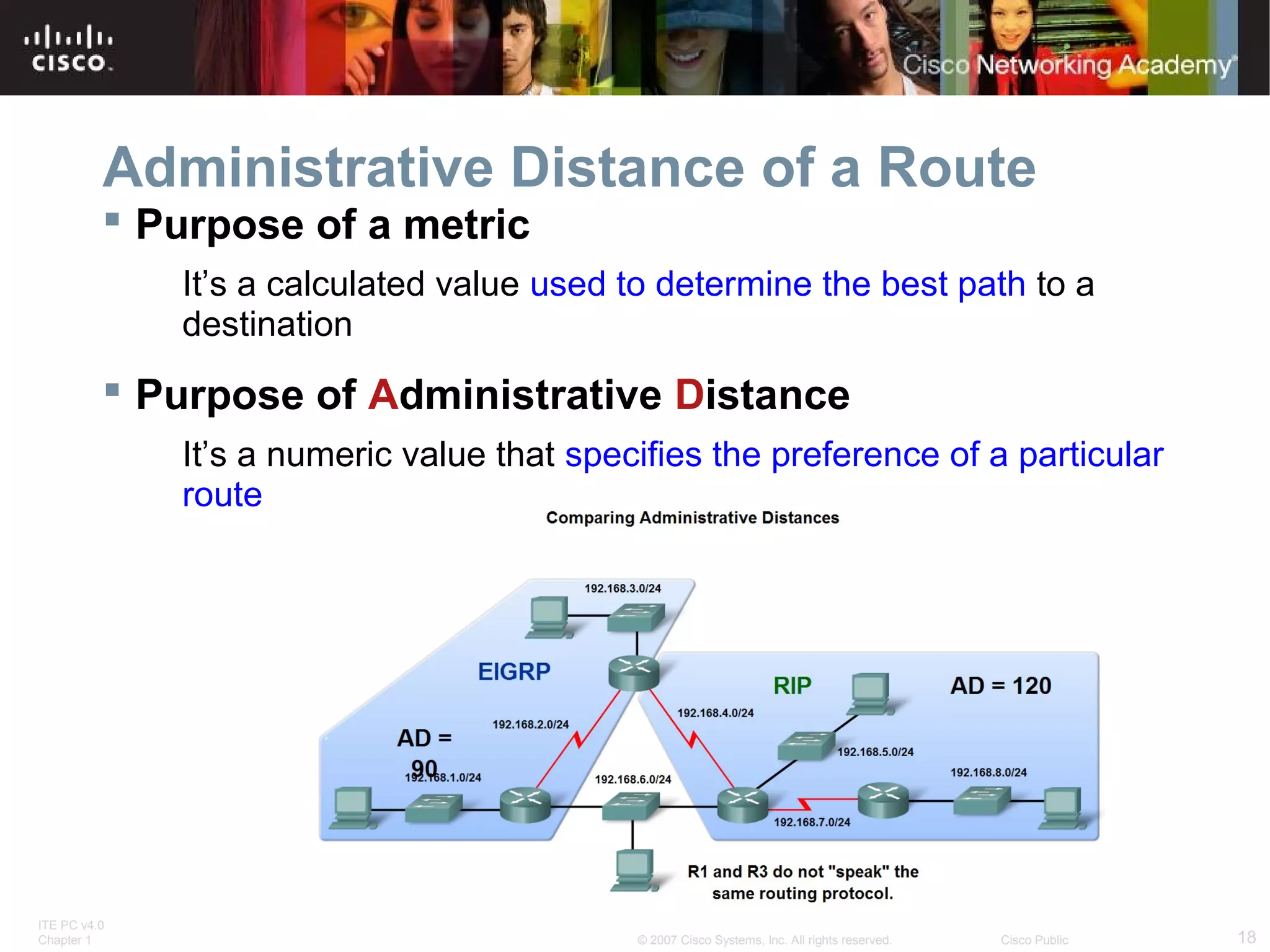
Administrative Distance of a Route
 Purpose of a metric
It’s a calculated value used to determine the best path to a
destination
 Purpose of Administrative Distance
It’s a numeric value that specifies the preference of a particular
route
ITE PC v4.0
Chapter 1 19© 2007 Cisco Systems, Inc. All rights reserved. Cisco Public
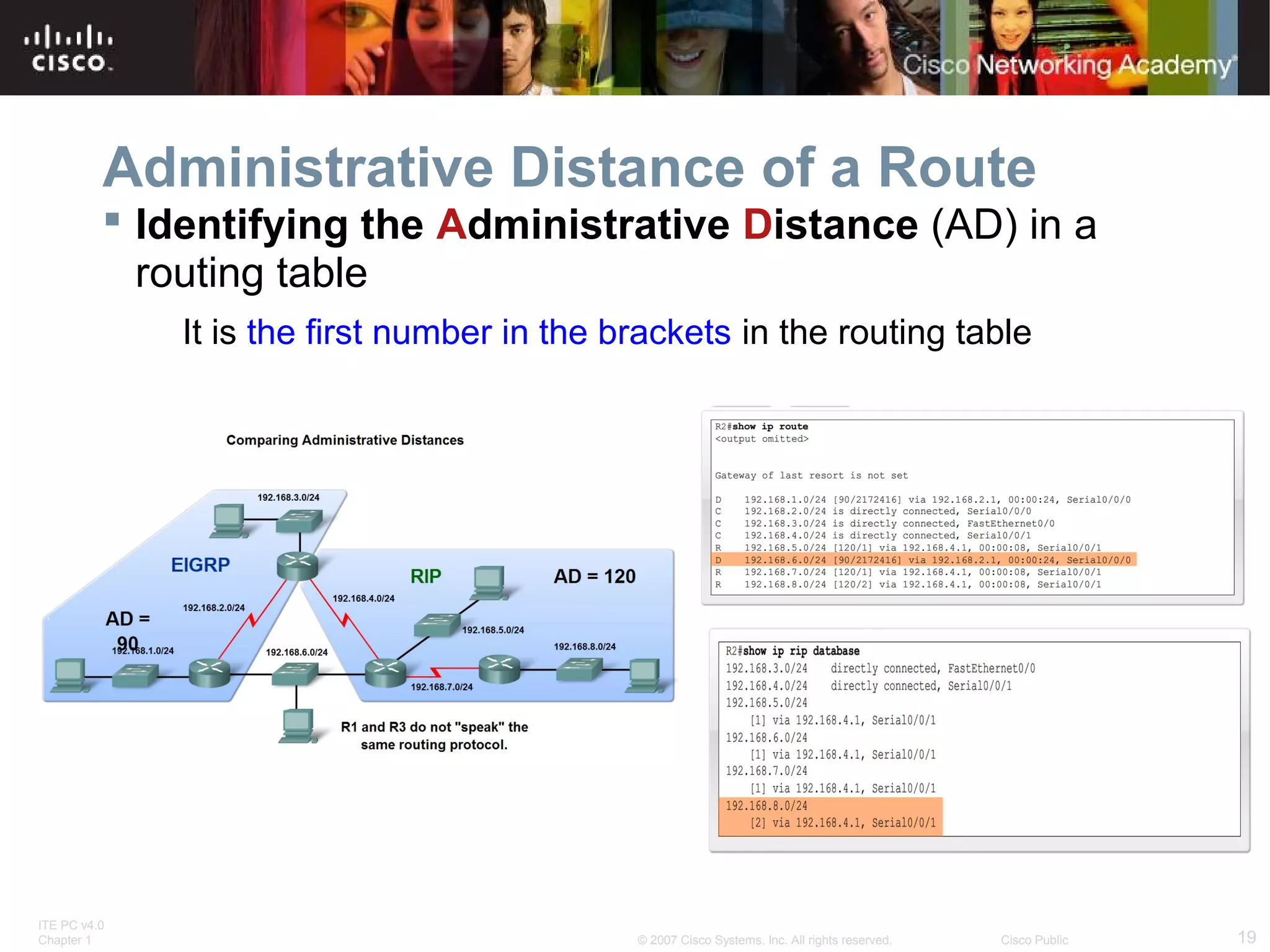
Administrative Distance of a Route
 Identifying the Administrative Distance (AD) in a
routing table
It is the first number in the brackets in the routing table
ITE PC v4.0
Chapter 1 20© 2007 Cisco Systems, Inc. All rights reserved. Cisco Public
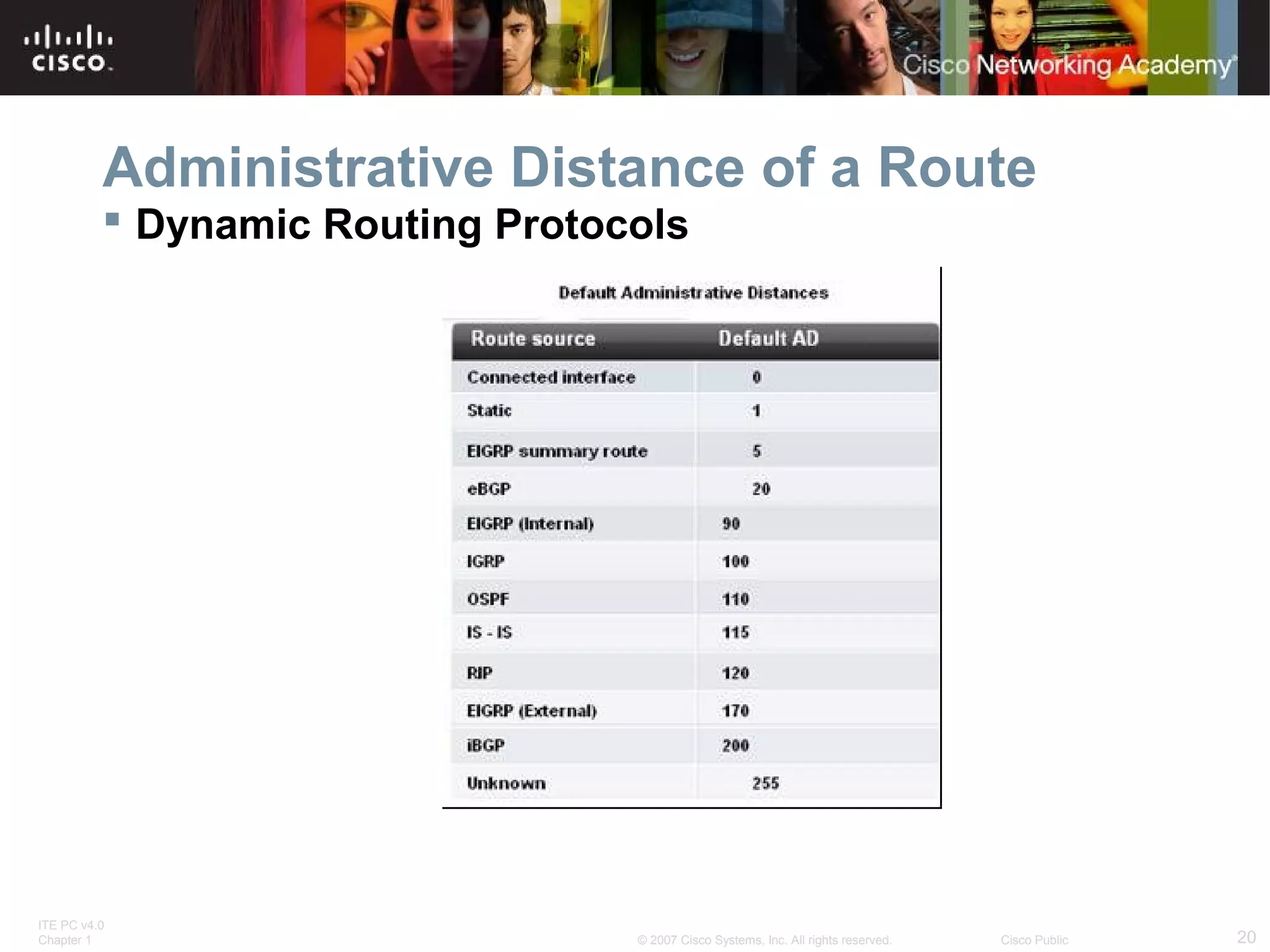
Administrative Distance of a Route
 Dynamic Routing Protocols
ITE PC v4.0
Chapter 1 21© 2007 Cisco Systems, Inc. All rights reserved. Cisco Public
Administrative Distance of a Route
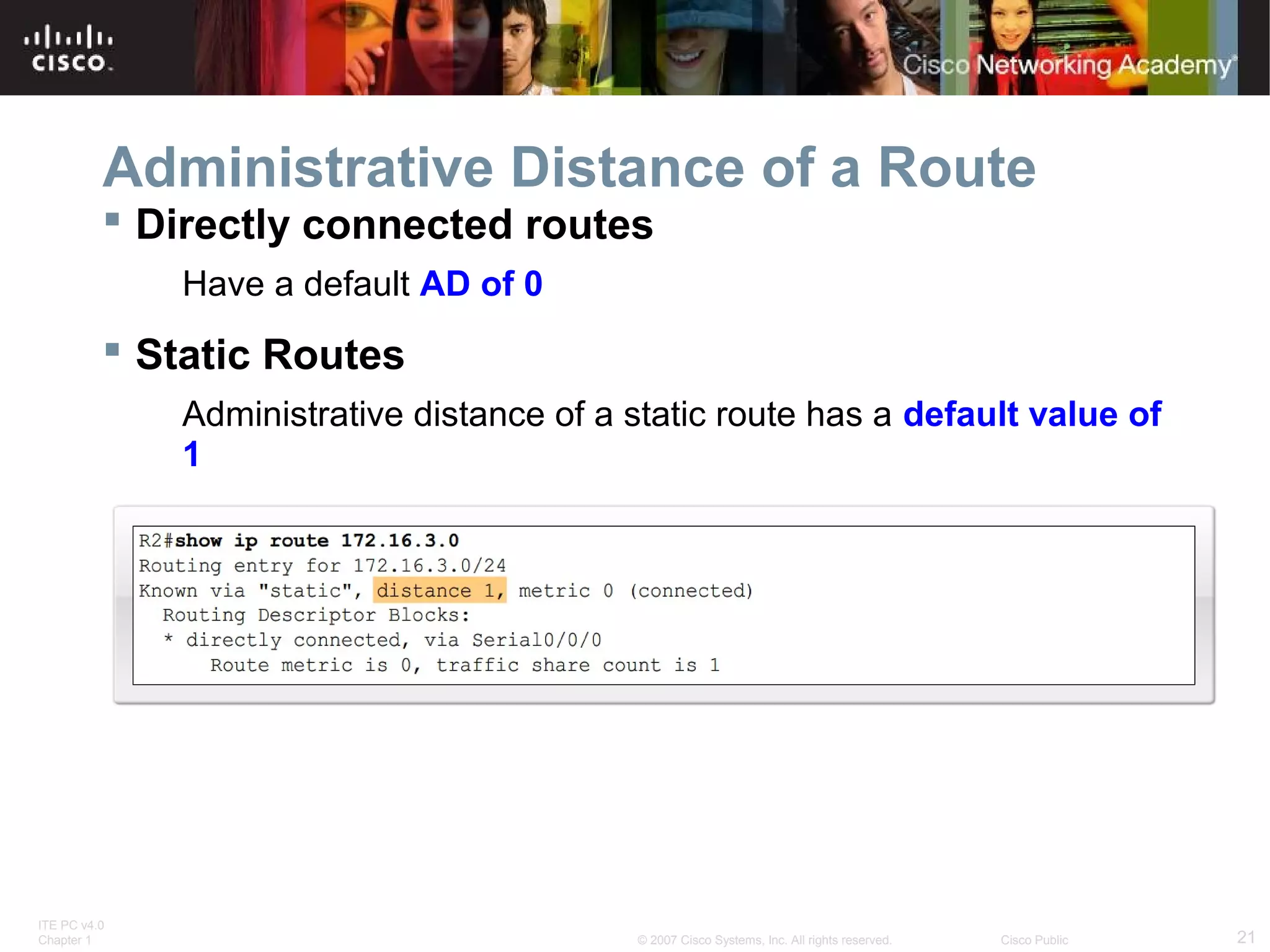
 Directly connected routes
Have a default AD of 0
 Static Routes
Administrative distance of a static route has a default value of
1
ITE PC v4.0
Chapter 1 22© 2007 Cisco Systems, Inc. All rights reserved. Cisco Public
Administrative Distance of a Route
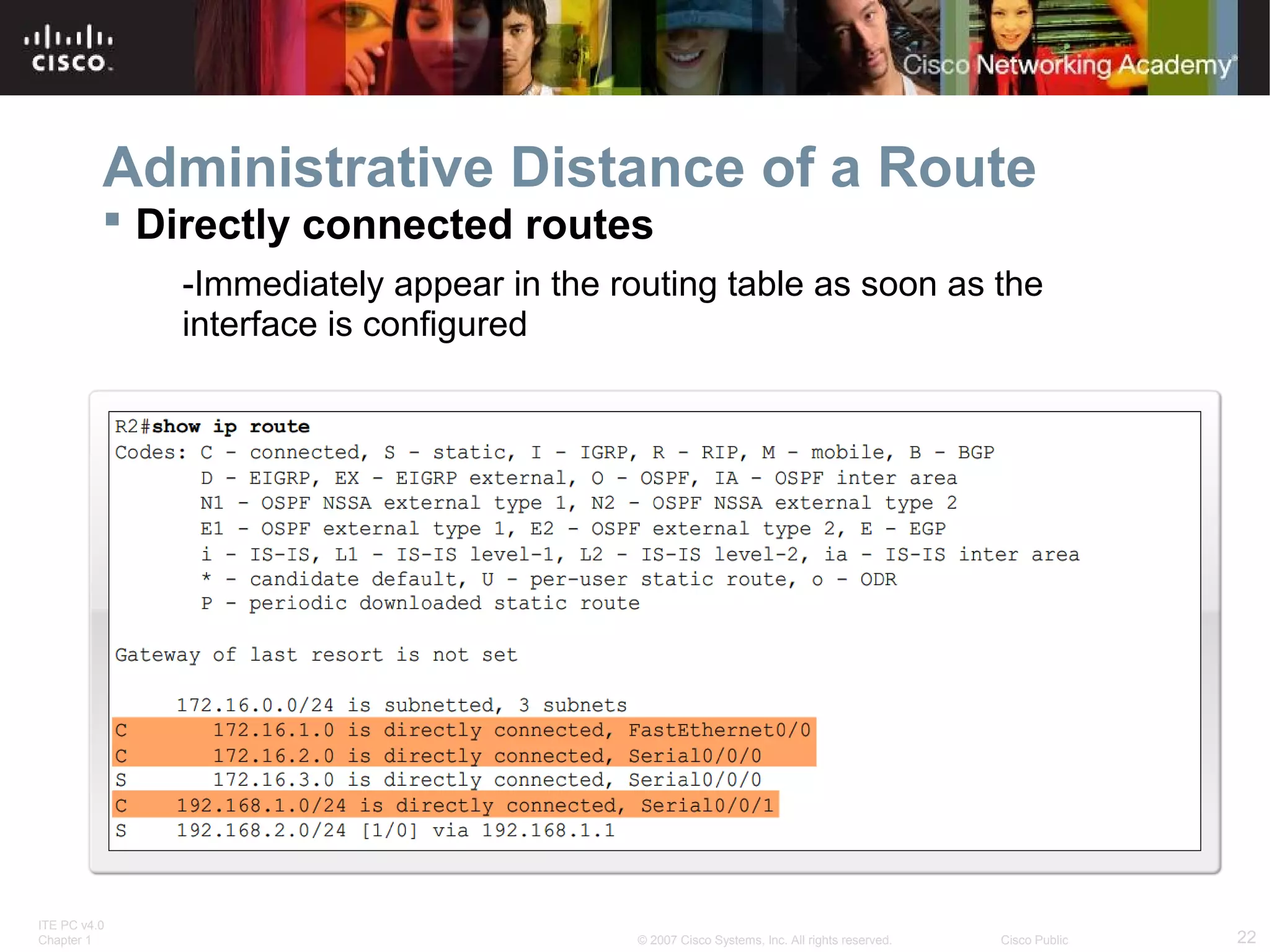
 Directly connected routes
-Immediately appear in the routing table as soon as the
interface is configured
ITE PC v4.0
Chapter 1 23© 2007 Cisco Systems, Inc. All rights reserved. Cisco Public
Summary
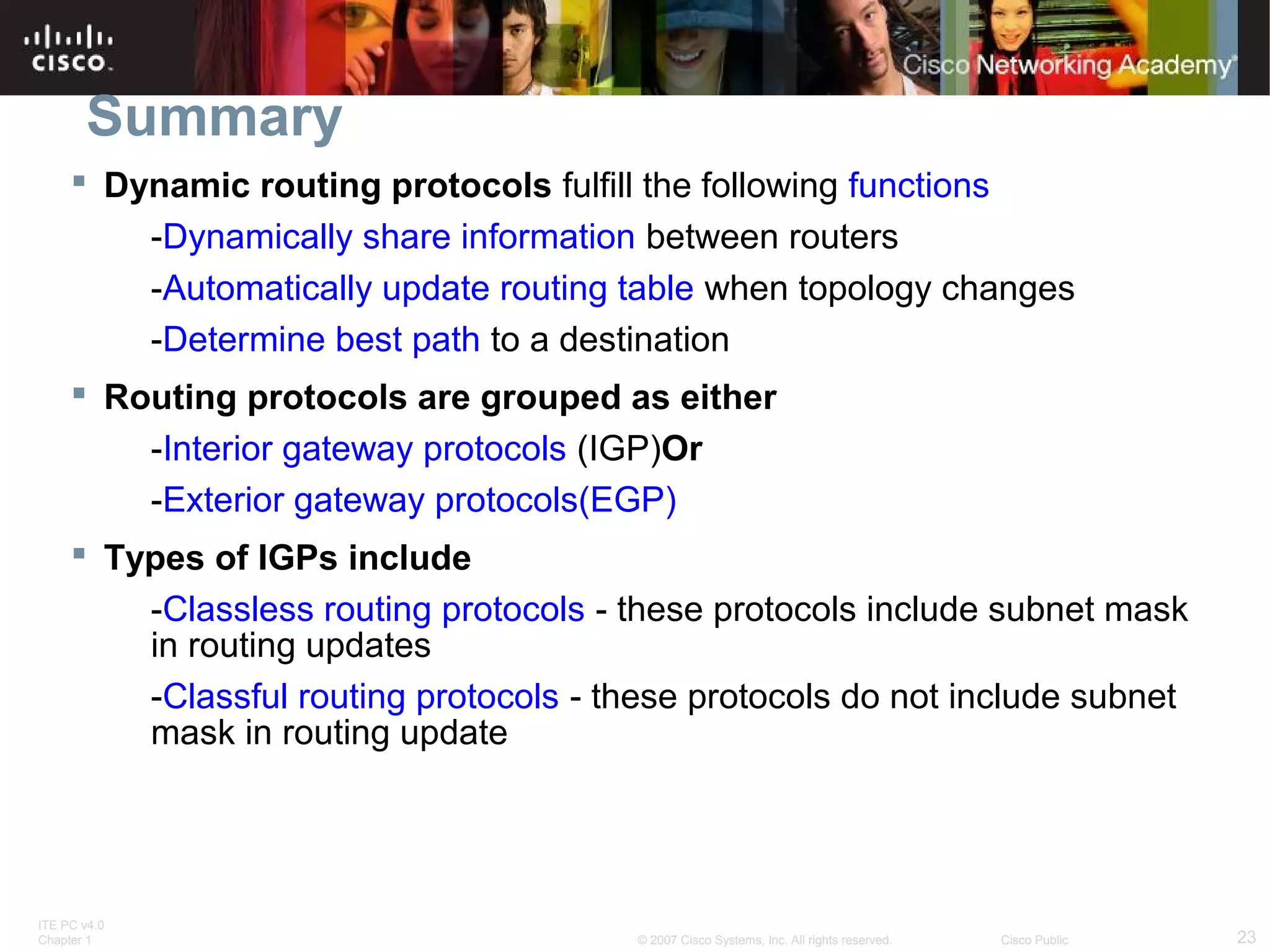
 Dynamic routing protocols fulfill the following functions
-Dynamically share information between routers
-Automatically update routing table when topology changes
-Determine best path to a destination
 Routing protocols are grouped as either
-Interior gateway protocols (IGP)Or
-Exterior gateway protocols(EGP)
 Types of IGPs include
-Classless routing protocols - these protocols include subnet mask
in routing updates
-Classful routing protocols - these protocols do not include subnet
mask in routing update
ITE PC v4.0
Chapter 1 24© 2007 Cisco Systems, Inc. All rights reserved. Cisco Public
Summary
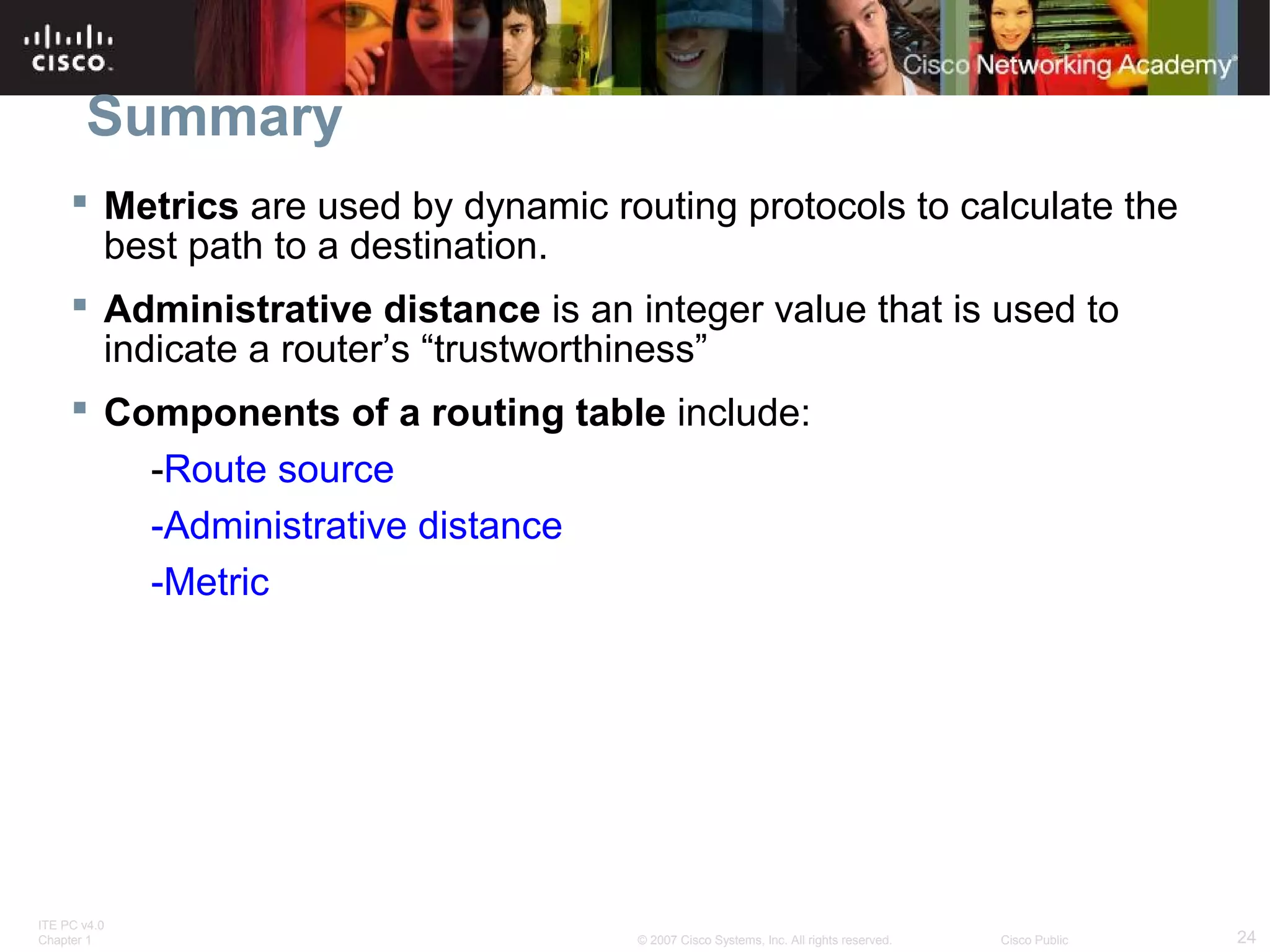
 Metrics are used by dynamic routing protocols to calculate the
best path to a destination.
 Administrative distance is an integer value that is used to
indicate a router’s “trustworthiness”
 Components of a routing table include:
-Route source
-Administrative distance
-Metric
ITE PC v4.0
Chapter 1 25© 2007 Cisco Systems, Inc. All rights reserved. Cisco Public

CCNA Exploration 2 - Chapter 3

  • 1.
    © 2007 CiscoSystems, Inc. All rights reserved. Cisco Public ITE PC v4.0 Chapter 1 1 Introduction to Dynamic Routing Protocol Routing Protocols and Concepts – Chapter 3
  • 2.
    ITE PC v4.0 Chapter1 2© 2007 Cisco Systems, Inc. All rights reserved. Cisco Public Objectives  Describe the role of dynamic routing protocols and place these protocols in the context of modern network design.  Identify several ways to classify routing protocols.  Describe how metrics are used by routing protocols and identify the metric types used by dynamic routing protocols.  Determine the administrative distance of a route and describe its importance in the routing process.  Identify the different elements of the routing table.
  • 3.
    ITE PC v4.0 Chapter1 3© 2007 Cisco Systems, Inc. All rights reserved. Cisco Public Dynamic Routing Protocols  Function(s) of Dynamic Routing Protocols: -Dynamically share information between routers. -Automatically update routing table when topology changes. -Determine best path to a destination.
  • 4.
    ITE PC v4.0 Chapter1 4© 2007 Cisco Systems, Inc. All rights reserved. Cisco Public Dynamic Routing Protocols  The purpose of a dynamic routing protocol is to: -Discover remote networks -Maintaining up-to-date routing information -Choosing the best path to destination networks -Ability to find a new best path if the current path is no longer available
  • 5.
    ITE PC v4.0 Chapter1 5© 2007 Cisco Systems, Inc. All rights reserved. Cisco Public Dynamic Routing Protocols  Components of a routing protocol Algorithm In the case of a routing protocol algorithms are used for facilitating routing information and best path determination Routing protocol messages These are messages for discovering neighbors and exchange of routing information
  • 6.
    ITE PC v4.0 Chapter1 6© 2007 Cisco Systems, Inc. All rights reserved. Cisco Public Dynamic Routing Protocols  Advantages of static routing -It can backup multiple interfaces/networks on a router -Easy to configure -No extra resources are needed -More secure  Disadvantages of static routing -Network changes require manual reconfiguration -Does not scale well in large topologies
  • 7.
    ITE PC v4.0 Chapter1 7© 2007 Cisco Systems, Inc. All rights reserved. Cisco Public Classifying Routing Protocols  Dynamic routing protocols are grouped according to characteristics. Examples include: -RIP -IGRP -EIGRP -OSPF -IS-IS -BGP  Autonomous System is a group of routers under the control of a single authority.
  • 8.
    ITE PC v4.0 Chapter1 8© 2007 Cisco Systems, Inc. All rights reserved. Cisco Public Classifying Routing Protocols  Types of routing protocols: -Interior Gateway Protocols (IGP) -Exterior Gateway Protocols (EGP)
  • 9.
    ITE PC v4.0 Chapter1 9© 2007 Cisco Systems, Inc. All rights reserved. Cisco Public Classifying Routing Protocols  Interior Gateway Routing Protocols (IGP) -Used for routing inside an autonomous system & used to route within the individual networks themselves. -Examples: RIP, EIGRP, OSPF  Exterior Routing Protocols (EGP) -Used for routing between autonomous systems -Example: BGPv4
  • 10.
    ITE PC v4.0 Chapter1 10© 2007 Cisco Systems, Inc. All rights reserved. Cisco Public Classifying Routing Protocols  IGP: Comparison of Distance Vector & Link State Routing Protocols Distance vector – routes are advertised as vectors of distance & direction. – incomplete view of network topology. –Generally, periodic updates. Link state – complete view of network topology is created. – updates are not periodic.
  • 11.
    ITE PC v4.0 Chapter1 11© 2007 Cisco Systems, Inc. All rights reserved. Cisco Public Classifying Routing Protocols
  • 12.
    ITE PC v4.0 Chapter1 12© 2007 Cisco Systems, Inc. All rights reserved. Cisco Public Classifying Routing Protocols  Classful routing protocols Do NOT send subnet mask in routing updates  Classless routing protocols Do send subnet mask in routing updates.
  • 13.
    ITE PC v4.0 Chapter1 13© 2007 Cisco Systems, Inc. All rights reserved. Cisco Public Classifying Routing Protocols  Convergence is defined as when all routers’ routing tables are at a state of consistency
  • 14.
    ITE PC v4.0 Chapter1 14© 2007 Cisco Systems, Inc. All rights reserved. Cisco Public Routing Protocols Metrics  Metric A value used by a routing protocol to determine which routes are better than others.
  • 15.
    ITE PC v4.0 Chapter1 15© 2007 Cisco Systems, Inc. All rights reserved. Cisco Public Routing Protocols Metrics  Metrics used in IP routing protocols -Bandwidth -Cost -Delay -Hop count -Load -Reliability
  • 16.
    ITE PC v4.0 Chapter1 16© 2007 Cisco Systems, Inc. All rights reserved. Cisco Public Routing Protocols Metrics  The Metric Field in the Routing Table  Metric used for each routing protocol -RIP - hop count -IGRP & EIGRP - Bandwidth (used by default), Delay (used by default), Load, Reliability -IS-IS & OSPF – Cost, Bandwidth (Cisco’s implementation)
  • 17.
    ITE PC v4.0 Chapter1 17© 2007 Cisco Systems, Inc. All rights reserved. Cisco Public Routing Protocols Metrics  Load balancing This is the ability of a router to distribute packets among multiple same cost paths
  • 18.
    ITE PC v4.0 Chapter1 18© 2007 Cisco Systems, Inc. All rights reserved. Cisco Public Administrative Distance of a Route  Purpose of a metric It’s a calculated value used to determine the best path to a destination  Purpose of Administrative Distance It’s a numeric value that specifies the preference of a particular route
  • 19.
    ITE PC v4.0 Chapter1 19© 2007 Cisco Systems, Inc. All rights reserved. Cisco Public Administrative Distance of a Route  Identifying the Administrative Distance (AD) in a routing table It is the first number in the brackets in the routing table
  • 20.
    ITE PC v4.0 Chapter1 20© 2007 Cisco Systems, Inc. All rights reserved. Cisco Public Administrative Distance of a Route  Dynamic Routing Protocols
  • 21.
    ITE PC v4.0 Chapter1 21© 2007 Cisco Systems, Inc. All rights reserved. Cisco Public Administrative Distance of a Route  Directly connected routes Have a default AD of 0  Static Routes Administrative distance of a static route has a default value of 1
  • 22.
    ITE PC v4.0 Chapter1 22© 2007 Cisco Systems, Inc. All rights reserved. Cisco Public Administrative Distance of a Route  Directly connected routes -Immediately appear in the routing table as soon as the interface is configured
  • 23.
    ITE PC v4.0 Chapter1 23© 2007 Cisco Systems, Inc. All rights reserved. Cisco Public Summary  Dynamic routing protocols fulfill the following functions -Dynamically share information between routers -Automatically update routing table when topology changes -Determine best path to a destination  Routing protocols are grouped as either -Interior gateway protocols (IGP)Or -Exterior gateway protocols(EGP)  Types of IGPs include -Classless routing protocols - these protocols include subnet mask in routing updates -Classful routing protocols - these protocols do not include subnet mask in routing update
  • 24.
    ITE PC v4.0 Chapter1 24© 2007 Cisco Systems, Inc. All rights reserved. Cisco Public Summary  Metrics are used by dynamic routing protocols to calculate the best path to a destination.  Administrative distance is an integer value that is used to indicate a router’s “trustworthiness”  Components of a routing table include: -Route source -Administrative distance -Metric
  • 25.
    ITE PC v4.0 Chapter1 25© 2007 Cisco Systems, Inc. All rights reserved. Cisco Public