
© 2007 Cisco Systems, Inc. All rights reserved. Cisco Public 1
Addressing the Network
– IPv4
Network Fundamentals – Chapter 6
2© 2007 Cisco Systems, Inc. All rights reserved. Cisco Public
Objectives
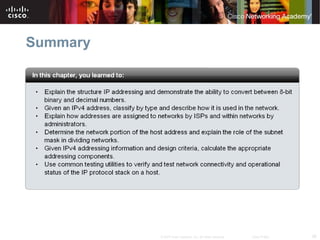
 Explain the structure IP addressing and demonstrate the ability
to convert between 8-bit binary and decimal numbers.
 Given an IPv4 address, classify by type and describe how it is
used in the network
 Explain how addresses are assigned to networks by ISPs and
within networks by administrators
 Determine the network portion of the host address and explain
the role of the subnet mask in dividing networks.
 Given IPv4 addressing information and design criteria, calculate
the appropriate addressing components.
 Use common testing utilities to verify and test network
connectivity and operational status of the IP protocol stack on a
host.
3© 2007 Cisco Systems, Inc. All rights reserved. Cisco Public
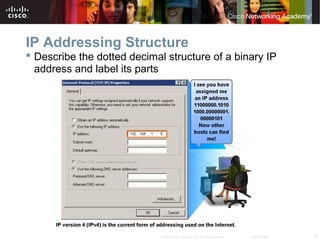
IP Addressing Structure
 Describe the dotted decimal structure of a binary IP
address and label its parts
4© 2007 Cisco Systems, Inc. All rights reserved. Cisco Public
IP Addressing Structure
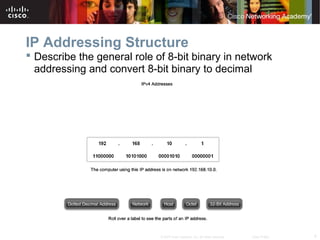
 Describe the general role of 8-bit binary in network
addressing and convert 8-bit binary to decimal
5© 2007 Cisco Systems, Inc. All rights reserved. Cisco Public
IP Addressing Structure
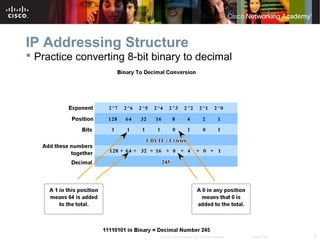
 Practice converting 8-bit binary to decimal
6© 2007 Cisco Systems, Inc. All rights reserved. Cisco Public
IP Addressing Structure
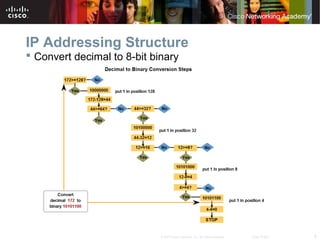
 Convert decimal to 8-bit binary
7© 2007 Cisco Systems, Inc. All rights reserved. Cisco Public
IP Addressing Structure
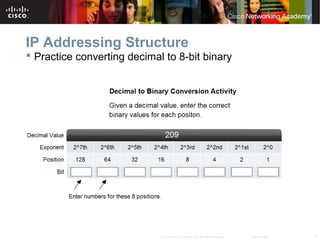
 Practice converting decimal to 8-bit binary
8© 2007 Cisco Systems, Inc. All rights reserved. Cisco Public
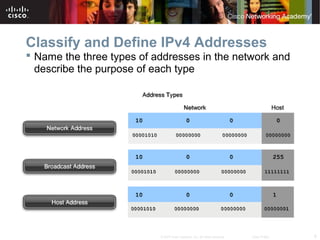
Classify and Define IPv4 Addresses
 Name the three types of addresses in the network and
describe the purpose of each type
9© 2007 Cisco Systems, Inc. All rights reserved. Cisco Public
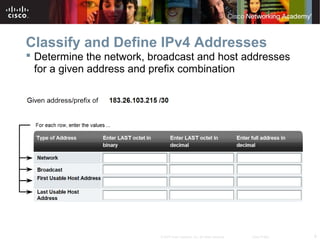
Classify and Define IPv4 Addresses
 Determine the network, broadcast and host addresses
for a given address and prefix combination
10© 2007 Cisco Systems, Inc. All rights reserved. Cisco Public
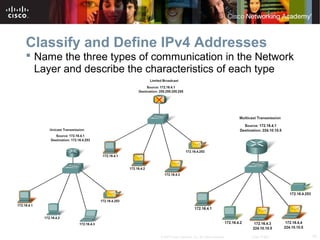
Classify and Define IPv4 Addresses
 Name the three types of communication in the Network
Layer and describe the characteristics of each type
11© 2007 Cisco Systems, Inc. All rights reserved. Cisco Public
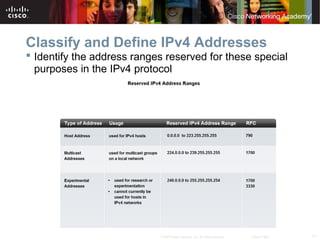
Classify and Define IPv4 Addresses
 Identify the address ranges reserved for these special
purposes in the IPv4 protocol
12© 2007 Cisco Systems, Inc. All rights reserved. Cisco Public
Classify and Define IPv4 Addresses
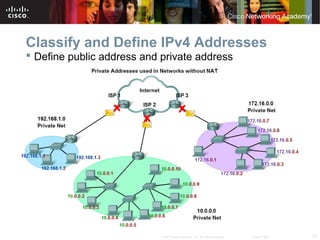
 Define public address and private address
13© 2007 Cisco Systems, Inc. All rights reserved. Cisco Public
Classify and Define IPv4 Addresses
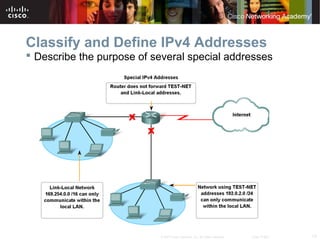
 Describe the purpose of several special addresses
14© 2007 Cisco Systems, Inc. All rights reserved. Cisco Public
Classify and Define IPv4 Addresses
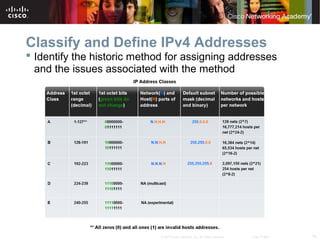
 Identify the historic method for assigning addresses
and the issues associated with the method
15© 2007 Cisco Systems, Inc. All rights reserved. Cisco Public
Assigning Addresses
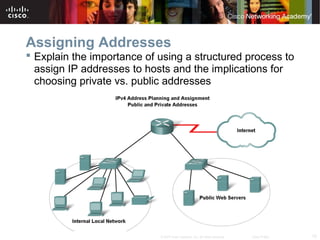
 Explain the importance of using a structured process to
assign IP addresses to hosts and the implications for
choosing private vs. public addresses
16© 2007 Cisco Systems, Inc. All rights reserved. Cisco Public
Assigning Addresses
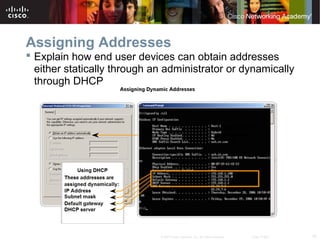
 Explain how end user devices can obtain addresses
either statically through an administrator or dynamically
through DHCP
17© 2007 Cisco Systems, Inc. All rights reserved. Cisco Public
Assigning Addresses
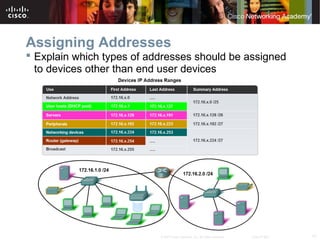
 Explain which types of addresses should be assigned
to devices other than end user devices
18© 2007 Cisco Systems, Inc. All rights reserved. Cisco Public
Assigning Addresses
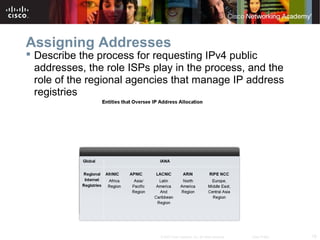
 Describe the process for requesting IPv4 public
addresses, the role ISPs play in the process, and the
role of the regional agencies that manage IP address
registries
19© 2007 Cisco Systems, Inc. All rights reserved. Cisco Public
Assigning Addresses
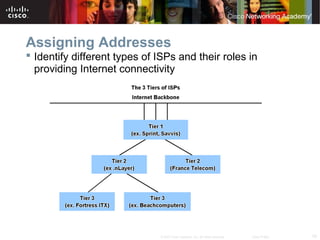
 Identify different types of ISPs and their roles in
providing Internet connectivity
20© 2007 Cisco Systems, Inc. All rights reserved. Cisco Public
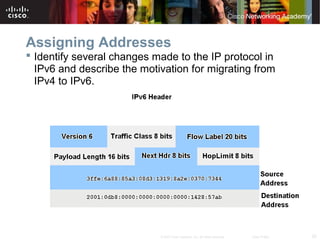
Assigning Addresses
 Identify several changes made to the IP protocol in
IPv6 and describe the motivation for migrating from
IPv4 to IPv6.
21© 2007 Cisco Systems, Inc. All rights reserved. Cisco Public
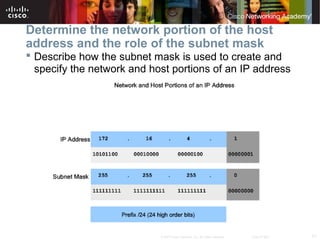
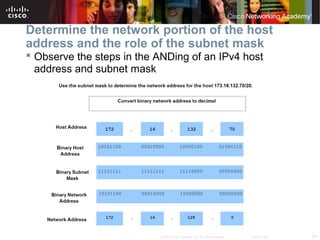
Determine the network portion of the host
address and the role of the subnet mask
 Describe how the subnet mask is used to create and
specify the network and host portions of an IP address
22© 2007 Cisco Systems, Inc. All rights reserved. Cisco Public
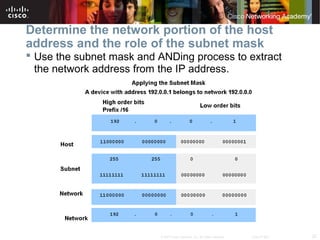
Determine the network portion of the host
address and the role of the subnet mask
 Use the subnet mask and ANDing process to extract
the network address from the IP address.
23© 2007 Cisco Systems, Inc. All rights reserved. Cisco Public
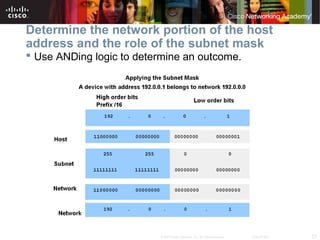
Determine the network portion of the host
address and the role of the subnet mask
 Use ANDing logic to determine an outcome.
24© 2007 Cisco Systems, Inc. All rights reserved. Cisco Public
Determine the network portion of the host
address and the role of the subnet mask
 Observe the steps in the ANDing of an IPv4 host
address and subnet mask
25© 2007 Cisco Systems, Inc. All rights reserved. Cisco Public
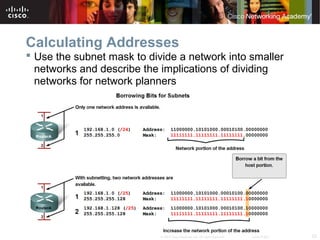
Calculating Addresses
 Use the subnet mask to divide a network into smaller
networks and describe the implications of dividing
networks for network planners
26© 2007 Cisco Systems, Inc. All rights reserved. Cisco Public
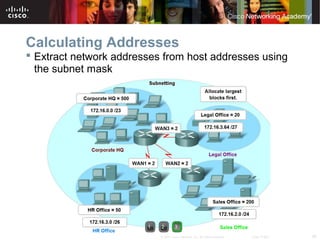
Calculating Addresses
 Extract network addresses from host addresses using
the subnet mask
27© 2007 Cisco Systems, Inc. All rights reserved. Cisco Public
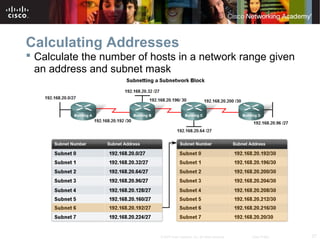
Calculating Addresses
 Calculate the number of hosts in a network range given
an address and subnet mask
28© 2007 Cisco Systems, Inc. All rights reserved. Cisco Public
Calculating Addresses
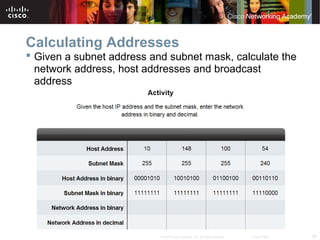
 Given a subnet address and subnet mask, calculate the
network address, host addresses and broadcast
address
29© 2007 Cisco Systems, Inc. All rights reserved. Cisco Public
Calculating Addresses
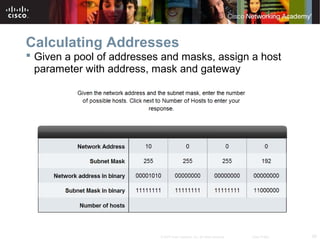
 Given a pool of addresses and masks, assign a host
parameter with address, mask and gateway
30© 2007 Cisco Systems, Inc. All rights reserved. Cisco Public
Calculating Addresses
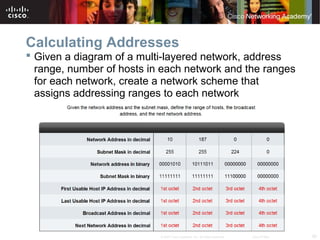
 Given a diagram of a multi-layered network, address
range, number of hosts in each network and the ranges
for each network, create a network scheme that
assigns addressing ranges to each network
31© 2007 Cisco Systems, Inc. All rights reserved. Cisco Public
Testing the Network Layer
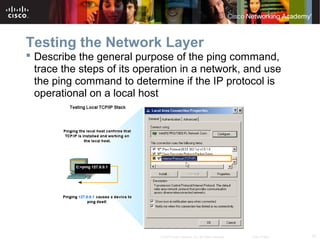
 Describe the general purpose of the ping command,
trace the steps of its operation in a network, and use
the ping command to determine if the IP protocol is
operational on a local host
32© 2007 Cisco Systems, Inc. All rights reserved. Cisco Public
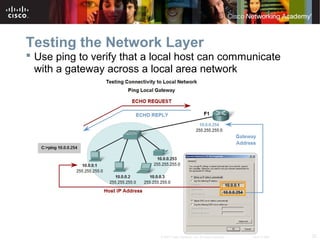
Testing the Network Layer
 Use ping to verify that a local host can communicate
with a gateway across a local area network
33© 2007 Cisco Systems, Inc. All rights reserved. Cisco Public
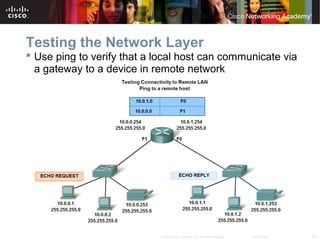
Testing the Network Layer
 Use ping to verify that a local host can communicate via
a gateway to a device in remote network
34© 2007 Cisco Systems, Inc. All rights reserved. Cisco Public
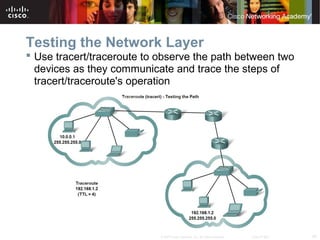
Testing the Network Layer
 Use tracert/traceroute to observe the path between two
devices as they communicate and trace the steps of
tracert/traceroute's operation
35© 2007 Cisco Systems, Inc. All rights reserved. Cisco Public
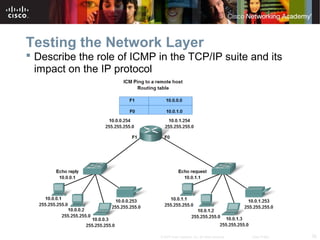
Testing the Network Layer
 Describe the role of ICMP in the TCP/IP suite and its
impact on the IP protocol
36© 2007 Cisco Systems, Inc. All rights reserved. Cisco Public
Summary
37© 2007 Cisco Systems, Inc. All rights reserved. Cisco Public

CCNA Exploration 1 - Chapter 6

  • 1.
    © 2007 CiscoSystems, Inc. All rights reserved. Cisco Public 1 Addressing the Network – IPv4 Network Fundamentals – Chapter 6
  • 2.
    2© 2007 CiscoSystems, Inc. All rights reserved. Cisco Public Objectives  Explain the structure IP addressing and demonstrate the ability to convert between 8-bit binary and decimal numbers.  Given an IPv4 address, classify by type and describe how it is used in the network  Explain how addresses are assigned to networks by ISPs and within networks by administrators  Determine the network portion of the host address and explain the role of the subnet mask in dividing networks.  Given IPv4 addressing information and design criteria, calculate the appropriate addressing components.  Use common testing utilities to verify and test network connectivity and operational status of the IP protocol stack on a host.
  • 3.
    3© 2007 CiscoSystems, Inc. All rights reserved. Cisco Public IP Addressing Structure  Describe the dotted decimal structure of a binary IP address and label its parts
  • 4.
    4© 2007 CiscoSystems, Inc. All rights reserved. Cisco Public IP Addressing Structure  Describe the general role of 8-bit binary in network addressing and convert 8-bit binary to decimal
  • 5.
    5© 2007 CiscoSystems, Inc. All rights reserved. Cisco Public IP Addressing Structure  Practice converting 8-bit binary to decimal
  • 6.
    6© 2007 CiscoSystems, Inc. All rights reserved. Cisco Public IP Addressing Structure  Convert decimal to 8-bit binary
  • 7.
    7© 2007 CiscoSystems, Inc. All rights reserved. Cisco Public IP Addressing Structure  Practice converting decimal to 8-bit binary
  • 8.
    8© 2007 CiscoSystems, Inc. All rights reserved. Cisco Public Classify and Define IPv4 Addresses  Name the three types of addresses in the network and describe the purpose of each type
  • 9.
    9© 2007 CiscoSystems, Inc. All rights reserved. Cisco Public Classify and Define IPv4 Addresses  Determine the network, broadcast and host addresses for a given address and prefix combination
  • 10.
    10© 2007 CiscoSystems, Inc. All rights reserved. Cisco Public Classify and Define IPv4 Addresses  Name the three types of communication in the Network Layer and describe the characteristics of each type
  • 11.
    11© 2007 CiscoSystems, Inc. All rights reserved. Cisco Public Classify and Define IPv4 Addresses  Identify the address ranges reserved for these special purposes in the IPv4 protocol
  • 12.
    12© 2007 CiscoSystems, Inc. All rights reserved. Cisco Public Classify and Define IPv4 Addresses  Define public address and private address
  • 13.
    13© 2007 CiscoSystems, Inc. All rights reserved. Cisco Public Classify and Define IPv4 Addresses  Describe the purpose of several special addresses
  • 14.
    14© 2007 CiscoSystems, Inc. All rights reserved. Cisco Public Classify and Define IPv4 Addresses  Identify the historic method for assigning addresses and the issues associated with the method
  • 15.
    15© 2007 CiscoSystems, Inc. All rights reserved. Cisco Public Assigning Addresses  Explain the importance of using a structured process to assign IP addresses to hosts and the implications for choosing private vs. public addresses
  • 16.
    16© 2007 CiscoSystems, Inc. All rights reserved. Cisco Public Assigning Addresses  Explain how end user devices can obtain addresses either statically through an administrator or dynamically through DHCP
  • 17.
    17© 2007 CiscoSystems, Inc. All rights reserved. Cisco Public Assigning Addresses  Explain which types of addresses should be assigned to devices other than end user devices
  • 18.
    18© 2007 CiscoSystems, Inc. All rights reserved. Cisco Public Assigning Addresses  Describe the process for requesting IPv4 public addresses, the role ISPs play in the process, and the role of the regional agencies that manage IP address registries
  • 19.
    19© 2007 CiscoSystems, Inc. All rights reserved. Cisco Public Assigning Addresses  Identify different types of ISPs and their roles in providing Internet connectivity
  • 20.
    20© 2007 CiscoSystems, Inc. All rights reserved. Cisco Public Assigning Addresses  Identify several changes made to the IP protocol in IPv6 and describe the motivation for migrating from IPv4 to IPv6.
  • 21.
    21© 2007 CiscoSystems, Inc. All rights reserved. Cisco Public Determine the network portion of the host address and the role of the subnet mask  Describe how the subnet mask is used to create and specify the network and host portions of an IP address
  • 22.
    22© 2007 CiscoSystems, Inc. All rights reserved. Cisco Public Determine the network portion of the host address and the role of the subnet mask  Use the subnet mask and ANDing process to extract the network address from the IP address.
  • 23.
    23© 2007 CiscoSystems, Inc. All rights reserved. Cisco Public Determine the network portion of the host address and the role of the subnet mask  Use ANDing logic to determine an outcome.
  • 24.
    24© 2007 CiscoSystems, Inc. All rights reserved. Cisco Public Determine the network portion of the host address and the role of the subnet mask  Observe the steps in the ANDing of an IPv4 host address and subnet mask
  • 25.
    25© 2007 CiscoSystems, Inc. All rights reserved. Cisco Public Calculating Addresses  Use the subnet mask to divide a network into smaller networks and describe the implications of dividing networks for network planners
  • 26.
    26© 2007 CiscoSystems, Inc. All rights reserved. Cisco Public Calculating Addresses  Extract network addresses from host addresses using the subnet mask
  • 27.
    27© 2007 CiscoSystems, Inc. All rights reserved. Cisco Public Calculating Addresses  Calculate the number of hosts in a network range given an address and subnet mask
  • 28.
    28© 2007 CiscoSystems, Inc. All rights reserved. Cisco Public Calculating Addresses  Given a subnet address and subnet mask, calculate the network address, host addresses and broadcast address
  • 29.
    29© 2007 CiscoSystems, Inc. All rights reserved. Cisco Public Calculating Addresses  Given a pool of addresses and masks, assign a host parameter with address, mask and gateway
  • 30.
    30© 2007 CiscoSystems, Inc. All rights reserved. Cisco Public Calculating Addresses  Given a diagram of a multi-layered network, address range, number of hosts in each network and the ranges for each network, create a network scheme that assigns addressing ranges to each network
  • 31.
    31© 2007 CiscoSystems, Inc. All rights reserved. Cisco Public Testing the Network Layer  Describe the general purpose of the ping command, trace the steps of its operation in a network, and use the ping command to determine if the IP protocol is operational on a local host
  • 32.
    32© 2007 CiscoSystems, Inc. All rights reserved. Cisco Public Testing the Network Layer  Use ping to verify that a local host can communicate with a gateway across a local area network
  • 33.
    33© 2007 CiscoSystems, Inc. All rights reserved. Cisco Public Testing the Network Layer  Use ping to verify that a local host can communicate via a gateway to a device in remote network
  • 34.
    34© 2007 CiscoSystems, Inc. All rights reserved. Cisco Public Testing the Network Layer  Use tracert/traceroute to observe the path between two devices as they communicate and trace the steps of tracert/traceroute's operation
  • 35.
    35© 2007 CiscoSystems, Inc. All rights reserved. Cisco Public Testing the Network Layer  Describe the role of ICMP in the TCP/IP suite and its impact on the IP protocol
  • 36.
    36© 2007 CiscoSystems, Inc. All rights reserved. Cisco Public Summary
  • 37.
    37© 2007 CiscoSystems, Inc. All rights reserved. Cisco Public