© 2007 Cisco Systems, Inc. All rights reserved. Cisco Public
ITE PC v4.0
Chapter 1 1
EIGRP
Routing Protocols and
Concepts – Chapter 9
ITE PC v4.0
Chapter 1 2© 2007 Cisco Systems, Inc. All rights reserved. Cisco Public
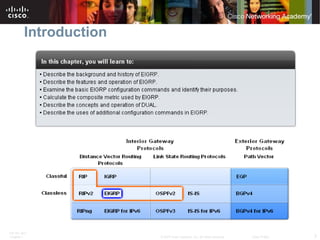
Objectives
 Describe the background and history of Enhanced
Interior Gateway Routing Protocol (EIGRP).
 Examine the basic EIGRP configuration commands
and identify their purposes.
 Calculate the composite metric used by EIGRP.
 Describe the concepts and operation of DUAL.
 Describe the uses of additional configuration
commands in EIGRP.
ITE PC v4.0
Chapter 1 3© 2007 Cisco Systems, Inc. All rights reserved. Cisco Public
Introduction
ITE PC v4.0
Chapter 1 4© 2007 Cisco Systems, Inc. All rights reserved. Cisco Public
EIGRP
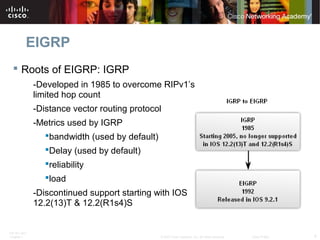
 Roots of EIGRP: IGRP
-Developed in 1985 to overcome RIPv1’s
limited hop count
-Distance vector routing protocol
-Metrics used by IGRP
bandwidth (used by default)
Delay (used by default)
reliability
load
-Discontinued support starting with IOS
12.2(13)T & 12.2(R1s4)S
ITE PC v4.0
Chapter 1 5© 2007 Cisco Systems, Inc. All rights reserved. Cisco Public
EIGRP
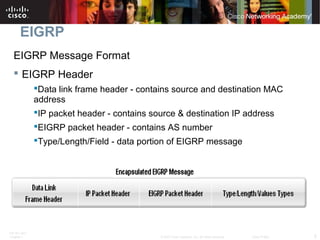
EIGRP Message Format
 EIGRP Header
Data link frame header - contains source and destination MAC
address
IP packet header - contains source & destination IP address
EIGRP packet header - contains AS number
Type/Length/Field - data portion of EIGRP message
ITE PC v4.0
Chapter 1 6© 2007 Cisco Systems, Inc. All rights reserved. Cisco Public
EIGRP
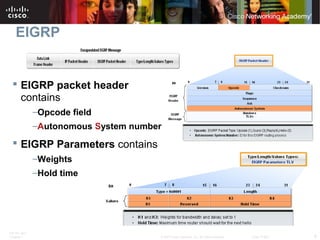
 EIGRP packet header
contains
–Opcode field
–Autonomous System number
 EIGRP Parameters contains
–Weights
–Hold time
ITE PC v4.0
Chapter 1 7© 2007 Cisco Systems, Inc. All rights reserved. Cisco Public
EIGRP
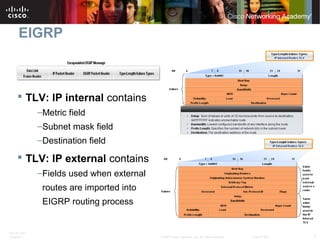
 TLV: IP internal contains
–Metric field
–Subnet mask field
–Destination field
 TLV: IP external contains
–Fields used when external
routes are imported into
EIGRP routing process
ITE PC v4.0
Chapter 1 8© 2007 Cisco Systems, Inc. All rights reserved. Cisco Public
EIGRP
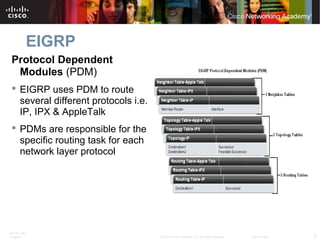
Protocol Dependent
Modules (PDM)
 EIGRP uses PDM to route
several different protocols i.e.
IP, IPX & AppleTalk
 PDMs are responsible for the
specific routing task for each
network layer protocol
ITE PC v4.0
Chapter 1 9© 2007 Cisco Systems, Inc. All rights reserved. Cisco Public
EIGRP
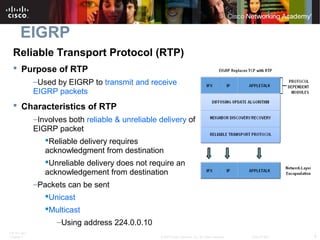
Reliable Transport Protocol (RTP)
 Purpose of RTP
–Used by EIGRP to transmit and receive
EIGRP packets
 Characteristics of RTP
–Involves both reliable & unreliable delivery of
EIGRP packet
Reliable delivery requires
acknowledgment from destination
Unreliable delivery does not require an
acknowledgement from destination
–Packets can be sent
Unicast
Multicast
–Using address 224.0.0.10
ITE PC v4.0
Chapter 1 10© 2007 Cisco Systems, Inc. All rights reserved. Cisco Public
EIGRP
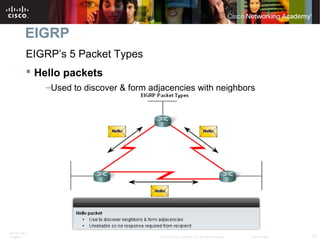
EIGRP’s 5 Packet Types
 Hello packets
–Used to discover & form adjacencies with neighbors
ITE PC v4.0
Chapter 1 11© 2007 Cisco Systems, Inc. All rights reserved. Cisco Public
EIGRP
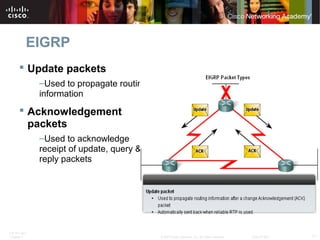
 Update packets
–Used to propagate routing
information
 Acknowledgement
packets
–Used to acknowledge
receipt of update, query &
reply packets
ITE PC v4.0
Chapter 1 12© 2007 Cisco Systems, Inc. All rights reserved. Cisco Public
EIGRP
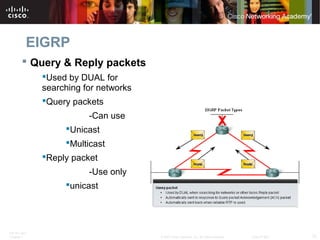
 Query & Reply packets
Used by DUAL for
searching for networks
Query packets
-Can use
Unicast
Multicast
Reply packet
-Use only
unicast
ITE PC v4.0
Chapter 1 13© 2007 Cisco Systems, Inc. All rights reserved. Cisco Public
EIGRP
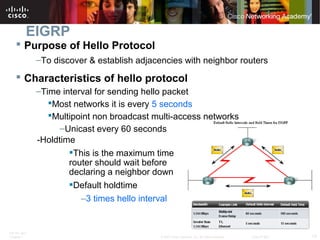
 Purpose of Hello Protocol
–To discover & establish adjacencies with neighbor routers
 Characteristics of hello protocol
–Time interval for sending hello packet
Most networks it is every 5 seconds
Multipoint non broadcast multi-access networks
–Unicast every 60 seconds
-Holdtime
This is the maximum time
router should wait before
declaring a neighbor down
Default holdtime
–3 times hello interval
ITE PC v4.0
Chapter 1 14© 2007 Cisco Systems, Inc. All rights reserved. Cisco Public
EIGRP
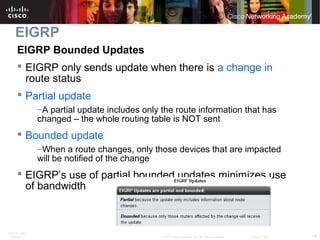
EIGRP Bounded Updates
 EIGRP only sends update when there is a change in
route status
 Partial update
–A partial update includes only the route information that has
changed – the whole routing table is NOT sent
 Bounded update
–When a route changes, only those devices that are impacted
will be notified of the change
 EIGRP’s use of partial bounded updates minimizes use
of bandwidth
ITE PC v4.0
Chapter 1 15© 2007 Cisco Systems, Inc. All rights reserved. Cisco Public
EIGRP
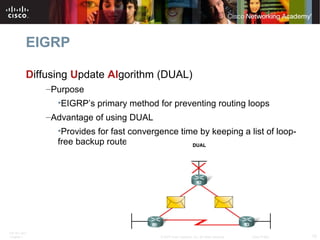
Diffusing Update Algorithm (DUAL)
–Purpose
•EIGRP’s primary method for preventing routing loops
–Advantage of using DUAL
•Provides for fast convergence time by keeping a list of loop-
free backup routes
ITE PC v4.0
Chapter 1 16© 2007 Cisco Systems, Inc. All rights reserved. Cisco Public
EIGRP
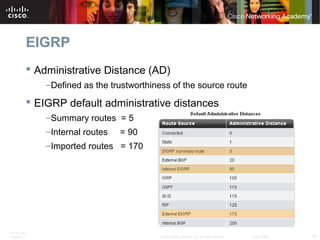
 Administrative Distance (AD)
–Defined as the trustworthiness of the source route
 EIGRP default administrative distances
–Summary routes = 5
–Internal routes = 90
–Imported routes = 170
ITE PC v4.0
Chapter 1 17© 2007 Cisco Systems, Inc. All rights reserved. Cisco Public
EIGRP
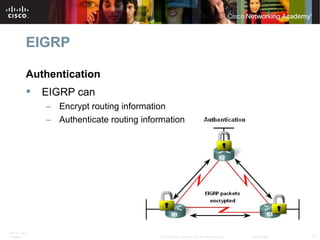
Authentication
 EIGRP can
– Encrypt routing information
– Authenticate routing information
ITE PC v4.0
Chapter 1 18© 2007 Cisco Systems, Inc. All rights reserved. Cisco Public
EIGRP
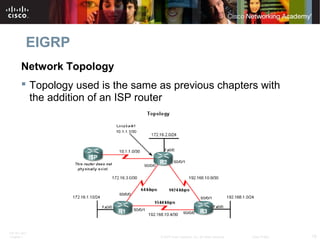
Network Topology
 Topology used is the same as previous chapters with
the addition of an ISP router
ITE PC v4.0
Chapter 1 19© 2007 Cisco Systems, Inc. All rights reserved. Cisco Public
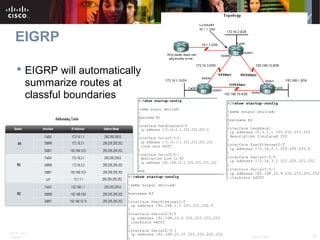
EIGRP
 EIGRP will automatically
summarize routes at
classful boundaries
ITE PC v4.0
Chapter 1 20© 2007 Cisco Systems, Inc. All rights reserved. Cisco Public
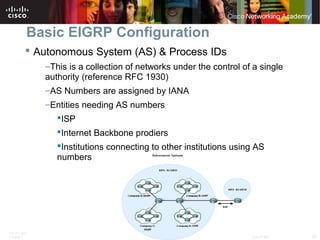
Basic EIGRP Configuration
 Autonomous System (AS) & Process IDs
–This is a collection of networks under the control of a single
authority (reference RFC 1930)
–AS Numbers are assigned by IANA
–Entities needing AS numbers
ISP
Internet Backbone prodiers
Institutions connecting to other institutions using AS
numbers
ITE PC v4.0
Chapter 1 21© 2007 Cisco Systems, Inc. All rights reserved. Cisco Public
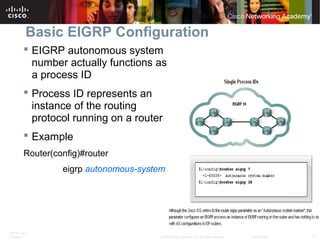
Basic EIGRP Configuration
 EIGRP autonomous system
number actually functions as
a process ID
 Process ID represents an
instance of the routing
protocol running on a router
 Example
Router(config)#router
eigrp autonomous-system
ITE PC v4.0
Chapter 1 22© 2007 Cisco Systems, Inc. All rights reserved. Cisco Public
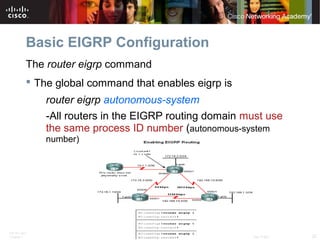
Basic EIGRP Configuration
The router eigrp command
 The global command that enables eigrp is
router eigrp autonomous-system
-All routers in the EIGRP routing domain must use
the same process ID number (autonomous-system
number)
ITE PC v4.0
Chapter 1 23© 2007 Cisco Systems, Inc. All rights reserved. Cisco Public
Basic EIGRP Configuration
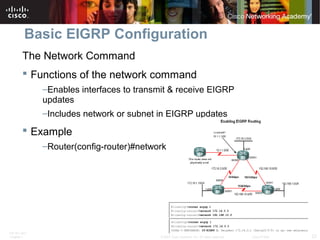
The Network Command
 Functions of the network command
–Enables interfaces to transmit & receive EIGRP
updates
–Includes network or subnet in EIGRP updates
 Example
–Router(config-router)#network network-address
ITE PC v4.0
Chapter 1 24© 2007 Cisco Systems, Inc. All rights reserved. Cisco Public
Basic EIGRP Configuration
 The network Command with a Wildcard Mask
-This option is used when you want to configure EIGRP
to advertise specific subnets
-Example
Router(config-router)#network network-address [wildcard-mask]
ITE PC v4.0
Chapter 1 25© 2007 Cisco Systems, Inc. All rights reserved. Cisco Public
Basic EIGRP Configuration
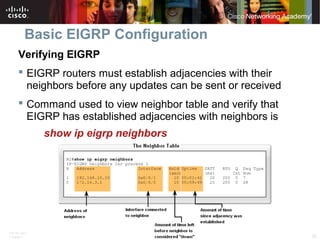
Verifying EIGRP
 EIGRP routers must establish adjacencies with their
neighbors before any updates can be sent or received
 Command used to view neighbor table and verify that
EIGRP has established adjacencies with neighbors is
show ip eigrp neighbors
ITE PC v4.0
Chapter 1 26© 2007 Cisco Systems, Inc. All rights reserved. Cisco Public
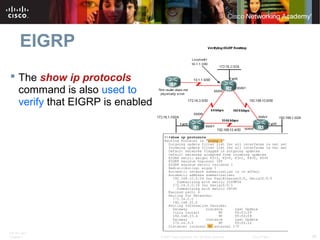
EIGRP
 The show ip protocols
command is also used to
verify that EIGRP is enabled
ITE PC v4.0
Chapter 1 27© 2007 Cisco Systems, Inc. All rights reserved. Cisco Public
Basic EIGRP Configuration
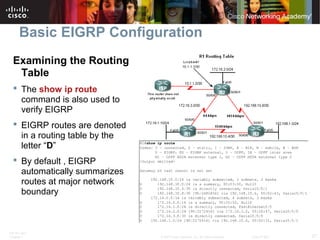
Examining the Routing
Table
 The show ip route
command is also used to
verify EIGRP
 EIGRP routes are denoted
in a routing table by the
letter “D”
 By default , EIGRP
automatically summarizes
routes at major network
boundary
ITE PC v4.0
Chapter 1 28© 2007 Cisco Systems, Inc. All rights reserved. Cisco Public
Basic EIGRP Configuration
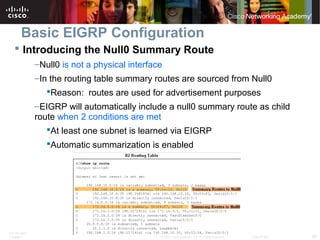
 Introducing the Null0 Summary Route
–Null0 is not a physical interface
–In the routing table summary routes are sourced from Null0
Reason: routes are used for advertisement purposes
–EIGRP will automatically include a null0 summary route as child
route when 2 conditions are met
At least one subnet is learned via EIGRP
Automatic summarization is enabled
ITE PC v4.0
Chapter 1 29© 2007 Cisco Systems, Inc. All rights reserved. Cisco Public
Basic EIGRP Configuration
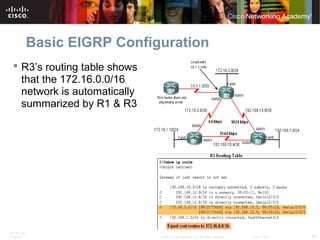
 R3’s routing table shows
that the 172.16.0.0/16
network is automatically
summarized by R1 & R3
ITE PC v4.0
Chapter 1 30© 2007 Cisco Systems, Inc. All rights reserved. Cisco Public
EIGRP Metric Calculation
EIGRP Composite Metric & the K Values
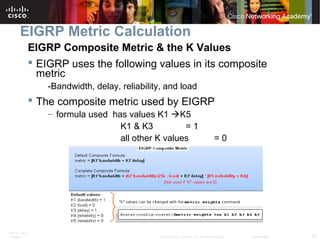
 EIGRP uses the following values in its composite
metric
-Bandwidth, delay, reliability, and load
 The composite metric used by EIGRP
– formula used has values K1 K5
K1 & K3 = 1
all other K values = 0
ITE PC v4.0
Chapter 1 31© 2007 Cisco Systems, Inc. All rights reserved. Cisco Public
EIGRP Metric Calculation
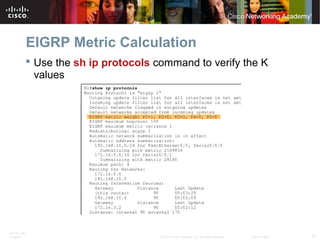
 Use the sh ip protocols command to verify the K
values
ITE PC v4.0
Chapter 1 32© 2007 Cisco Systems, Inc. All rights reserved. Cisco Public
EIGRP Metric Calculation
EIGRP Metrics
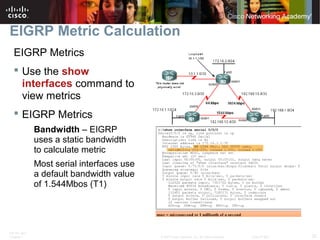
 Use the show
interfaces command to
view metrics
 EIGRP Metrics
Bandwidth – EIGRP
uses a static bandwidth
to calculate metric
Most serial interfaces use
a default bandwidth value
of 1.544Mbos (T1)
ITE PC v4.0
Chapter 1 33© 2007 Cisco Systems, Inc. All rights reserved. Cisco Public
EIGRP Metric Calculation
EIGRP Metrics
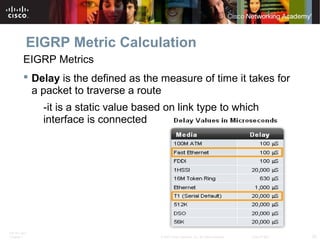
 Delay is the defined as the measure of time it takes for
a packet to traverse a route
-it is a static value based on link type to which
interface is connected
ITE PC v4.0
Chapter 1 34© 2007 Cisco Systems, Inc. All rights reserved. Cisco Public
EIGRP Metric Calculation
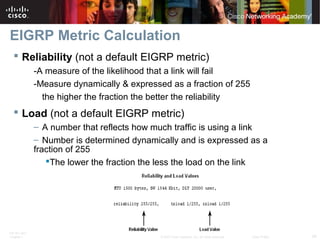
 Reliability (not a default EIGRP metric)
-A measure of the likelihood that a link will fail
-Measure dynamically & expressed as a fraction of 255
the higher the fraction the better the reliability
 Load (not a default EIGRP metric)
– A number that reflects how much traffic is using a link
– Number is determined dynamically and is expressed as a
fraction of 255
The lower the fraction the less the load on the link
ITE PC v4.0
Chapter 1 35© 2007 Cisco Systems, Inc. All rights reserved. Cisco Public
EIGRP Metric Calculation
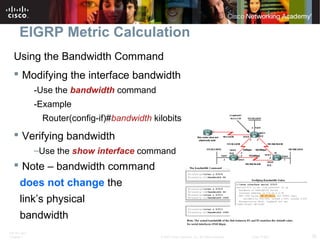
Using the Bandwidth Command
 Modifying the interface bandwidth
-Use the bandwidth command
-Example
Router(config-if)#bandwidth kilobits
 Verifying bandwidth
–Use the show interface command
 Note – bandwidth command
does not change the
link’s physical
bandwidth
ITE PC v4.0
Chapter 1 36© 2007 Cisco Systems, Inc. All rights reserved. Cisco Public
EIGRP Metric Calculation
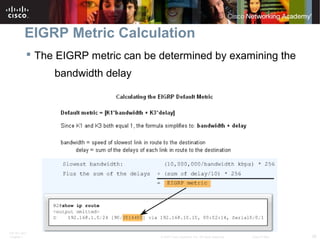
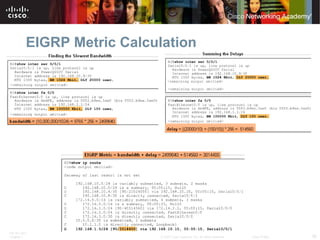
 The EIGRP metric can be determined by examining the
bandwidth delay
ITE PC v4.0
Chapter 1 37© 2007 Cisco Systems, Inc. All rights reserved. Cisco Public
EIGRP Metric Calculation
 EIGRP uses the lowest bandwidth (BW)in its metric
calculation
Calculated BW = reference BW / lowest BW(kbps)
 Delay – EIGRP uses the cumulative sum of all outgoing
interfaces
Calculated Delay = the sum of outgoing interface delays
 EIGRP Metric = calculated BW + calculated delay
ITE PC v4.0
Chapter 1 38© 2007 Cisco Systems, Inc. All rights reserved. Cisco Public
EIGRP Metric Calculation
ITE PC v4.0
Chapter 1 39© 2007 Cisco Systems, Inc. All rights reserved. Cisco Public
DUAL Concepts
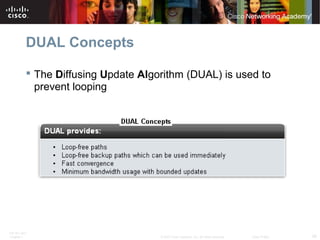
 The Diffusing Update Algorithm (DUAL) is used to
prevent looping
ITE PC v4.0
Chapter 1 40© 2007 Cisco Systems, Inc. All rights reserved. Cisco Public
DUAL Concepts
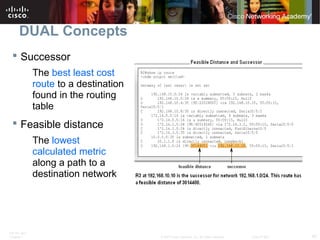
 Successor
The best least cost
route to a destination
found in the routing
table
 Feasible distance
The lowest
calculated metric
along a path to a
destination network
ITE PC v4.0
Chapter 1 41© 2007 Cisco Systems, Inc. All rights reserved. Cisco Public
DUAL Concepts
Feasible Successors, Feasibility Condition & Reported
Distance
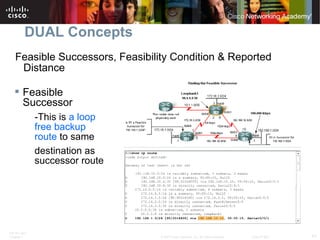
 Feasible
Successor
-This is a loop
free backup
route to same
destination as
successor route
ITE PC v4.0
Chapter 1 42© 2007 Cisco Systems, Inc. All rights reserved. Cisco Public
DUAL Concepts
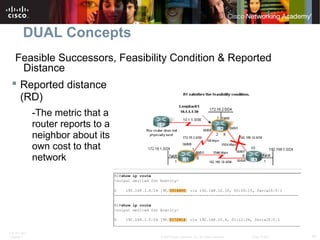
 Reported distance
(RD)
-The metric that a
router reports to a
neighbor about its
own cost to that
network
Feasible Successors, Feasibility Condition & Reported
Distance
ITE PC v4.0
Chapter 1 43© 2007 Cisco Systems, Inc. All rights reserved. Cisco Public
DUAL Concepts
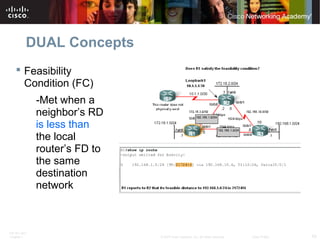
 Feasibility
Condition (FC)
-Met when a
neighbor’s RD
is less than
the local
router’s FD to
the same
destination
network
ITE PC v4.0
Chapter 1 44© 2007 Cisco Systems, Inc. All rights reserved. Cisco Public
DUAL Concepts
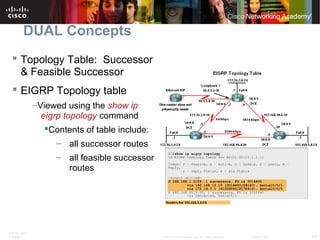
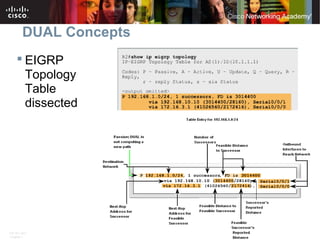
 Topology Table: Successor
& Feasible Successor
 EIGRP Topology table
–Viewed using the show ip
eigrp topology command
Contents of table include:
– all successor routes
– all feasible successor
routes
ITE PC v4.0
Chapter 1 45© 2007 Cisco Systems, Inc. All rights reserved. Cisco Public
DUAL Concepts
 EIGRP
Topology
Table
dissected
ITE PC v4.0
Chapter 1 46© 2007 Cisco Systems, Inc. All rights reserved. Cisco Public
DUAL Concepts
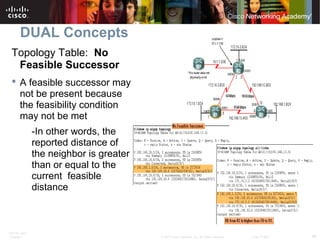
Topology Table: No
Feasible Successor
 A feasible successor may
not be present because
the feasibility condition
may not be met
-In other words, the
reported distance of
the neighbor is greater
than or equal to the
current feasible
distance
ITE PC v4.0
Chapter 1 47© 2007 Cisco Systems, Inc. All rights reserved. Cisco Public
DUAL Concepts
 Finite Sate Machine (FSM)
–An abstract machine that defines a set of possible
states something can go through, what event
causes those states and what events result form
those states
–FSMs are used to describe how a device, computer
program, or routing algorithm will react to a set of
input events
ITE PC v4.0
Chapter 1 48© 2007 Cisco Systems, Inc. All rights reserved. Cisco Public
DUAL Concepts
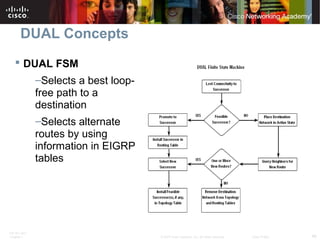
 DUAL FSM
–Selects a best loop-
free path to a
destination
–Selects alternate
routes by using
information in EIGRP
tables
ITE PC v4.0
Chapter 1 49© 2007 Cisco Systems, Inc. All rights reserved. Cisco Public
DUAL Concepts
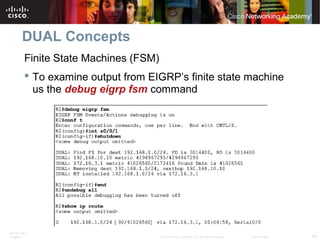
Finite State Machines (FSM)
 To examine output from EIGRP’s finite state machine
us the debug eigrp fsm command
ITE PC v4.0
Chapter 1 50© 2007 Cisco Systems, Inc. All rights reserved. Cisco Public
More EIGRP Configurations
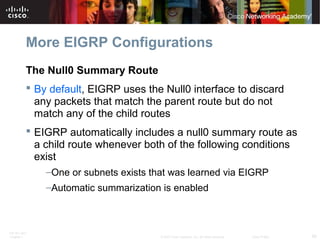
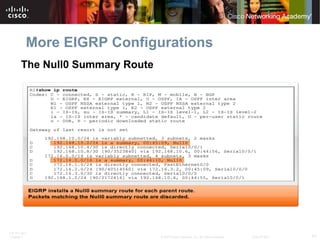
The Null0 Summary Route
 By default, EIGRP uses the Null0 interface to discard
any packets that match the parent route but do not
match any of the child routes
 EIGRP automatically includes a null0 summary route as
a child route whenever both of the following conditions
exist
–One or subnets exists that was learned via EIGRP
–Automatic summarization is enabled
ITE PC v4.0
Chapter 1 51© 2007 Cisco Systems, Inc. All rights reserved. Cisco Public
More EIGRP Configurations
The Null0 Summary Route
ITE PC v4.0
Chapter 1 52© 2007 Cisco Systems, Inc. All rights reserved. Cisco Public
More EIGRP Configurations
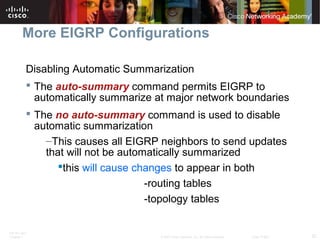
Disabling Automatic Summarization
 The auto-summary command permits EIGRP to
automatically summarize at major network boundaries
 The no auto-summary command is used to disable
automatic summarization
–This causes all EIGRP neighbors to send updates
that will not be automatically summarized
this will cause changes to appear in both
-routing tables
-topology tables
ITE PC v4.0
Chapter 1 53© 2007 Cisco Systems, Inc. All rights reserved. Cisco Public
More EIGRP Configurations
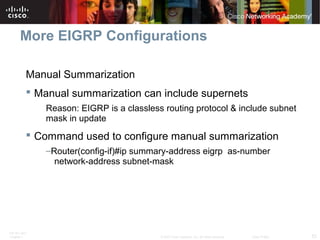
Manual Summarization
 Manual summarization can include supernets
Reason: EIGRP is a classless routing protocol & include subnet
mask in update
 Command used to configure manual summarization
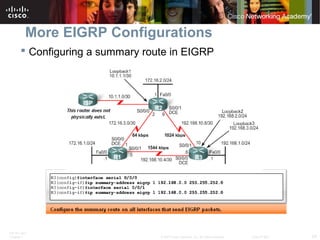
–Router(config-if)#ip summary-address eigrp as-number
network-address subnet-mask
ITE PC v4.0
Chapter 1 54© 2007 Cisco Systems, Inc. All rights reserved. Cisco Public
More EIGRP Configurations
 Configuring a summary route in EIGRP
ITE PC v4.0
Chapter 1 55© 2007 Cisco Systems, Inc. All rights reserved. Cisco Public
More EIGRP Configurations
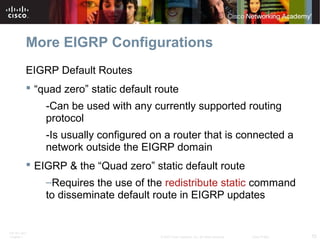
EIGRP Default Routes
 “quad zero” static default route
-Can be used with any currently supported routing
protocol
-Is usually configured on a router that is connected a
network outside the EIGRP domain
 EIGRP & the “Quad zero” static default route
–Requires the use of the redistribute static command
to disseminate default route in EIGRP updates
ITE PC v4.0
Chapter 1 56© 2007 Cisco Systems, Inc. All rights reserved. Cisco Public
More EIGRP Configurations
Fine-Tuning EIGRP
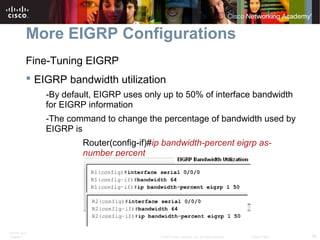
 EIGRP bandwidth utilization
-By default, EIGRP uses only up to 50% of interface bandwidth
for EIGRP information
-The command to change the percentage of bandwidth used by
EIGRP is
Router(config-if)#ip bandwidth-percent eigrp as-
number percent
ITE PC v4.0
Chapter 1 57© 2007 Cisco Systems, Inc. All rights reserved. Cisco Public
More EIGRP Configurations
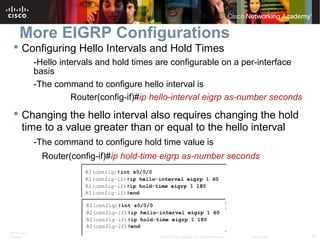
 Configuring Hello Intervals and Hold Times
-Hello intervals and hold times are configurable on a per-interface
basis
-The command to configure hello interval is
Router(config-if)#ip hello-interval eigrp as-number seconds
 Changing the hello interval also requires changing the hold
time to a value greater than or equal to the hello interval
-The command to configure hold time value is
Router(config-if)#ip hold-time eigrp as-number seconds
ITE PC v4.0
Chapter 1 58© 2007 Cisco Systems, Inc. All rights reserved. Cisco Public
Summary
 Background & History
–EIGRP is a derivative of IGRP
EIGRP is a Cisco proprietary distance vector routing
protocol released in 1994
 EIGRP terms and characteristics
–EIGPR uses RTP to transmit & receive EIGRP packets
–EIGRP has 5 packet type:
Hello packets
Update packets
Acknowledgement packets
Query packets
Reply packets
–Supports VLSM & CIDR
ITE PC v4.0
Chapter 1 59© 2007 Cisco Systems, Inc. All rights reserved. Cisco Public
Summary
 EIGRP terms and characteristics
–EIGRP uses a hello protocol
Purpose of hello protocol is to discover & establish
adjacencies
–EIGRP routing updates
Aperiodic
Partial and bounded
Fast convergence
ITE PC v4.0
Chapter 1 60© 2007 Cisco Systems, Inc. All rights reserved. Cisco Public
Summary
 EIGRP commands
–The following commands are used for EIGRP
configuration
RtrA(config)#router eigrp [autonomous-system #]
RtrA(config-router)#network network-number
–The following commands can be used to verify EIGRP
Show ip protocols
Show ip eigrp neighbors
Show ip route
ITE PC v4.0
Chapter 1 61© 2007 Cisco Systems, Inc. All rights reserved. Cisco Public
Summary
 EIGRP metrics include
–Bandwidth (default)
–Delay (default)
–Reliability
–Load
ITE PC v4.0
Chapter 1 62© 2007 Cisco Systems, Inc. All rights reserved. Cisco Public
Summary
 DUAL
–Purpose of DUAL
To prevent routing loops
–Successor
Primary route to a destination
–Feasible successor
Backup route to a destination
–Feasible distance
Lowest calculated metric to a destination
–Reported distance
The distance towards a destination as advertised
by an upstream neighbor
ITE PC v4.0
Chapter 1 63© 2007 Cisco Systems, Inc. All rights reserved. Cisco Public
Summary
 Choosing the best route
–After router has received all updates from directly
connected neighbors, it can calculate its DUAL
1st
metric is calculated for each route
2nd
route with lowest metric is designated
successor & is placed in routing table
3rd
feasible successor is found
–Criteria for feasible successor: it must have
lower reported distance to the destination than
the installed route’s feasible distance
–Feasible routes are maintained in topology
table
ITE PC v4.0
Chapter 1 64© 2007 Cisco Systems, Inc. All rights reserved. Cisco Public
Summary
 Automatic summarization
–On by default
–Summarizes routes on classful boundary
–Summarization can be disabled using the following
command
RtrA(config-if)#no auto-summary
ITE PC v4.0
Chapter 1 65© 2007 Cisco Systems, Inc. All rights reserved. Cisco Public

CCNA Exploration 2 - Chapter 9

  • 1.
    © 2007 CiscoSystems, Inc. All rights reserved. Cisco Public ITE PC v4.0 Chapter 1 1 EIGRP Routing Protocols and Concepts – Chapter 9
  • 2.
    ITE PC v4.0 Chapter1 2© 2007 Cisco Systems, Inc. All rights reserved. Cisco Public Objectives  Describe the background and history of Enhanced Interior Gateway Routing Protocol (EIGRP).  Examine the basic EIGRP configuration commands and identify their purposes.  Calculate the composite metric used by EIGRP.  Describe the concepts and operation of DUAL.  Describe the uses of additional configuration commands in EIGRP.
  • 3.
    ITE PC v4.0 Chapter1 3© 2007 Cisco Systems, Inc. All rights reserved. Cisco Public Introduction
  • 4.
    ITE PC v4.0 Chapter1 4© 2007 Cisco Systems, Inc. All rights reserved. Cisco Public EIGRP  Roots of EIGRP: IGRP -Developed in 1985 to overcome RIPv1’s limited hop count -Distance vector routing protocol -Metrics used by IGRP bandwidth (used by default) Delay (used by default) reliability load -Discontinued support starting with IOS 12.2(13)T & 12.2(R1s4)S
  • 5.
    ITE PC v4.0 Chapter1 5© 2007 Cisco Systems, Inc. All rights reserved. Cisco Public EIGRP EIGRP Message Format  EIGRP Header Data link frame header - contains source and destination MAC address IP packet header - contains source & destination IP address EIGRP packet header - contains AS number Type/Length/Field - data portion of EIGRP message
  • 6.
    ITE PC v4.0 Chapter1 6© 2007 Cisco Systems, Inc. All rights reserved. Cisco Public EIGRP  EIGRP packet header contains –Opcode field –Autonomous System number  EIGRP Parameters contains –Weights –Hold time
  • 7.
    ITE PC v4.0 Chapter1 7© 2007 Cisco Systems, Inc. All rights reserved. Cisco Public EIGRP  TLV: IP internal contains –Metric field –Subnet mask field –Destination field  TLV: IP external contains –Fields used when external routes are imported into EIGRP routing process
  • 8.
    ITE PC v4.0 Chapter1 8© 2007 Cisco Systems, Inc. All rights reserved. Cisco Public EIGRP Protocol Dependent Modules (PDM)  EIGRP uses PDM to route several different protocols i.e. IP, IPX & AppleTalk  PDMs are responsible for the specific routing task for each network layer protocol
  • 9.
    ITE PC v4.0 Chapter1 9© 2007 Cisco Systems, Inc. All rights reserved. Cisco Public EIGRP Reliable Transport Protocol (RTP)  Purpose of RTP –Used by EIGRP to transmit and receive EIGRP packets  Characteristics of RTP –Involves both reliable & unreliable delivery of EIGRP packet Reliable delivery requires acknowledgment from destination Unreliable delivery does not require an acknowledgement from destination –Packets can be sent Unicast Multicast –Using address 224.0.0.10
  • 10.
    ITE PC v4.0 Chapter1 10© 2007 Cisco Systems, Inc. All rights reserved. Cisco Public EIGRP EIGRP’s 5 Packet Types  Hello packets –Used to discover & form adjacencies with neighbors
  • 11.
    ITE PC v4.0 Chapter1 11© 2007 Cisco Systems, Inc. All rights reserved. Cisco Public EIGRP  Update packets –Used to propagate routing information  Acknowledgement packets –Used to acknowledge receipt of update, query & reply packets
  • 12.
    ITE PC v4.0 Chapter1 12© 2007 Cisco Systems, Inc. All rights reserved. Cisco Public EIGRP  Query & Reply packets Used by DUAL for searching for networks Query packets -Can use Unicast Multicast Reply packet -Use only unicast
  • 13.
    ITE PC v4.0 Chapter1 13© 2007 Cisco Systems, Inc. All rights reserved. Cisco Public EIGRP  Purpose of Hello Protocol –To discover & establish adjacencies with neighbor routers  Characteristics of hello protocol –Time interval for sending hello packet Most networks it is every 5 seconds Multipoint non broadcast multi-access networks –Unicast every 60 seconds -Holdtime This is the maximum time router should wait before declaring a neighbor down Default holdtime –3 times hello interval
  • 14.
    ITE PC v4.0 Chapter1 14© 2007 Cisco Systems, Inc. All rights reserved. Cisco Public EIGRP EIGRP Bounded Updates  EIGRP only sends update when there is a change in route status  Partial update –A partial update includes only the route information that has changed – the whole routing table is NOT sent  Bounded update –When a route changes, only those devices that are impacted will be notified of the change  EIGRP’s use of partial bounded updates minimizes use of bandwidth
  • 15.
    ITE PC v4.0 Chapter1 15© 2007 Cisco Systems, Inc. All rights reserved. Cisco Public EIGRP Diffusing Update Algorithm (DUAL) –Purpose •EIGRP’s primary method for preventing routing loops –Advantage of using DUAL •Provides for fast convergence time by keeping a list of loop- free backup routes
  • 16.
    ITE PC v4.0 Chapter1 16© 2007 Cisco Systems, Inc. All rights reserved. Cisco Public EIGRP  Administrative Distance (AD) –Defined as the trustworthiness of the source route  EIGRP default administrative distances –Summary routes = 5 –Internal routes = 90 –Imported routes = 170
  • 17.
    ITE PC v4.0 Chapter1 17© 2007 Cisco Systems, Inc. All rights reserved. Cisco Public EIGRP Authentication  EIGRP can – Encrypt routing information – Authenticate routing information
  • 18.
    ITE PC v4.0 Chapter1 18© 2007 Cisco Systems, Inc. All rights reserved. Cisco Public EIGRP Network Topology  Topology used is the same as previous chapters with the addition of an ISP router
  • 19.
    ITE PC v4.0 Chapter1 19© 2007 Cisco Systems, Inc. All rights reserved. Cisco Public EIGRP  EIGRP will automatically summarize routes at classful boundaries
  • 20.
    ITE PC v4.0 Chapter1 20© 2007 Cisco Systems, Inc. All rights reserved. Cisco Public Basic EIGRP Configuration  Autonomous System (AS) & Process IDs –This is a collection of networks under the control of a single authority (reference RFC 1930) –AS Numbers are assigned by IANA –Entities needing AS numbers ISP Internet Backbone prodiers Institutions connecting to other institutions using AS numbers
  • 21.
    ITE PC v4.0 Chapter1 21© 2007 Cisco Systems, Inc. All rights reserved. Cisco Public Basic EIGRP Configuration  EIGRP autonomous system number actually functions as a process ID  Process ID represents an instance of the routing protocol running on a router  Example Router(config)#router eigrp autonomous-system
  • 22.
    ITE PC v4.0 Chapter1 22© 2007 Cisco Systems, Inc. All rights reserved. Cisco Public Basic EIGRP Configuration The router eigrp command  The global command that enables eigrp is router eigrp autonomous-system -All routers in the EIGRP routing domain must use the same process ID number (autonomous-system number)
  • 23.
    ITE PC v4.0 Chapter1 23© 2007 Cisco Systems, Inc. All rights reserved. Cisco Public Basic EIGRP Configuration The Network Command  Functions of the network command –Enables interfaces to transmit & receive EIGRP updates –Includes network or subnet in EIGRP updates  Example –Router(config-router)#network network-address
  • 24.
    ITE PC v4.0 Chapter1 24© 2007 Cisco Systems, Inc. All rights reserved. Cisco Public Basic EIGRP Configuration  The network Command with a Wildcard Mask -This option is used when you want to configure EIGRP to advertise specific subnets -Example Router(config-router)#network network-address [wildcard-mask]
  • 25.
    ITE PC v4.0 Chapter1 25© 2007 Cisco Systems, Inc. All rights reserved. Cisco Public Basic EIGRP Configuration Verifying EIGRP  EIGRP routers must establish adjacencies with their neighbors before any updates can be sent or received  Command used to view neighbor table and verify that EIGRP has established adjacencies with neighbors is show ip eigrp neighbors
  • 26.
    ITE PC v4.0 Chapter1 26© 2007 Cisco Systems, Inc. All rights reserved. Cisco Public EIGRP  The show ip protocols command is also used to verify that EIGRP is enabled
  • 27.
    ITE PC v4.0 Chapter1 27© 2007 Cisco Systems, Inc. All rights reserved. Cisco Public Basic EIGRP Configuration Examining the Routing Table  The show ip route command is also used to verify EIGRP  EIGRP routes are denoted in a routing table by the letter “D”  By default , EIGRP automatically summarizes routes at major network boundary
  • 28.
    ITE PC v4.0 Chapter1 28© 2007 Cisco Systems, Inc. All rights reserved. Cisco Public Basic EIGRP Configuration  Introducing the Null0 Summary Route –Null0 is not a physical interface –In the routing table summary routes are sourced from Null0 Reason: routes are used for advertisement purposes –EIGRP will automatically include a null0 summary route as child route when 2 conditions are met At least one subnet is learned via EIGRP Automatic summarization is enabled
  • 29.
    ITE PC v4.0 Chapter1 29© 2007 Cisco Systems, Inc. All rights reserved. Cisco Public Basic EIGRP Configuration  R3’s routing table shows that the 172.16.0.0/16 network is automatically summarized by R1 & R3
  • 30.
    ITE PC v4.0 Chapter1 30© 2007 Cisco Systems, Inc. All rights reserved. Cisco Public EIGRP Metric Calculation EIGRP Composite Metric & the K Values  EIGRP uses the following values in its composite metric -Bandwidth, delay, reliability, and load  The composite metric used by EIGRP – formula used has values K1 K5 K1 & K3 = 1 all other K values = 0
  • 31.
    ITE PC v4.0 Chapter1 31© 2007 Cisco Systems, Inc. All rights reserved. Cisco Public EIGRP Metric Calculation  Use the sh ip protocols command to verify the K values
  • 32.
    ITE PC v4.0 Chapter1 32© 2007 Cisco Systems, Inc. All rights reserved. Cisco Public EIGRP Metric Calculation EIGRP Metrics  Use the show interfaces command to view metrics  EIGRP Metrics Bandwidth – EIGRP uses a static bandwidth to calculate metric Most serial interfaces use a default bandwidth value of 1.544Mbos (T1)
  • 33.
    ITE PC v4.0 Chapter1 33© 2007 Cisco Systems, Inc. All rights reserved. Cisco Public EIGRP Metric Calculation EIGRP Metrics  Delay is the defined as the measure of time it takes for a packet to traverse a route -it is a static value based on link type to which interface is connected
  • 34.
    ITE PC v4.0 Chapter1 34© 2007 Cisco Systems, Inc. All rights reserved. Cisco Public EIGRP Metric Calculation  Reliability (not a default EIGRP metric) -A measure of the likelihood that a link will fail -Measure dynamically & expressed as a fraction of 255 the higher the fraction the better the reliability  Load (not a default EIGRP metric) – A number that reflects how much traffic is using a link – Number is determined dynamically and is expressed as a fraction of 255 The lower the fraction the less the load on the link
  • 35.
    ITE PC v4.0 Chapter1 35© 2007 Cisco Systems, Inc. All rights reserved. Cisco Public EIGRP Metric Calculation Using the Bandwidth Command  Modifying the interface bandwidth -Use the bandwidth command -Example Router(config-if)#bandwidth kilobits  Verifying bandwidth –Use the show interface command  Note – bandwidth command does not change the link’s physical bandwidth
  • 36.
    ITE PC v4.0 Chapter1 36© 2007 Cisco Systems, Inc. All rights reserved. Cisco Public EIGRP Metric Calculation  The EIGRP metric can be determined by examining the bandwidth delay
  • 37.
    ITE PC v4.0 Chapter1 37© 2007 Cisco Systems, Inc. All rights reserved. Cisco Public EIGRP Metric Calculation  EIGRP uses the lowest bandwidth (BW)in its metric calculation Calculated BW = reference BW / lowest BW(kbps)  Delay – EIGRP uses the cumulative sum of all outgoing interfaces Calculated Delay = the sum of outgoing interface delays  EIGRP Metric = calculated BW + calculated delay
  • 38.
    ITE PC v4.0 Chapter1 38© 2007 Cisco Systems, Inc. All rights reserved. Cisco Public EIGRP Metric Calculation
  • 39.
    ITE PC v4.0 Chapter1 39© 2007 Cisco Systems, Inc. All rights reserved. Cisco Public DUAL Concepts  The Diffusing Update Algorithm (DUAL) is used to prevent looping
  • 40.
    ITE PC v4.0 Chapter1 40© 2007 Cisco Systems, Inc. All rights reserved. Cisco Public DUAL Concepts  Successor The best least cost route to a destination found in the routing table  Feasible distance The lowest calculated metric along a path to a destination network
  • 41.
    ITE PC v4.0 Chapter1 41© 2007 Cisco Systems, Inc. All rights reserved. Cisco Public DUAL Concepts Feasible Successors, Feasibility Condition & Reported Distance  Feasible Successor -This is a loop free backup route to same destination as successor route
  • 42.
    ITE PC v4.0 Chapter1 42© 2007 Cisco Systems, Inc. All rights reserved. Cisco Public DUAL Concepts  Reported distance (RD) -The metric that a router reports to a neighbor about its own cost to that network Feasible Successors, Feasibility Condition & Reported Distance
  • 43.
    ITE PC v4.0 Chapter1 43© 2007 Cisco Systems, Inc. All rights reserved. Cisco Public DUAL Concepts  Feasibility Condition (FC) -Met when a neighbor’s RD is less than the local router’s FD to the same destination network
  • 44.
    ITE PC v4.0 Chapter1 44© 2007 Cisco Systems, Inc. All rights reserved. Cisco Public DUAL Concepts  Topology Table: Successor & Feasible Successor  EIGRP Topology table –Viewed using the show ip eigrp topology command Contents of table include: – all successor routes – all feasible successor routes
  • 45.
    ITE PC v4.0 Chapter1 45© 2007 Cisco Systems, Inc. All rights reserved. Cisco Public DUAL Concepts  EIGRP Topology Table dissected
  • 46.
    ITE PC v4.0 Chapter1 46© 2007 Cisco Systems, Inc. All rights reserved. Cisco Public DUAL Concepts Topology Table: No Feasible Successor  A feasible successor may not be present because the feasibility condition may not be met -In other words, the reported distance of the neighbor is greater than or equal to the current feasible distance
  • 47.
    ITE PC v4.0 Chapter1 47© 2007 Cisco Systems, Inc. All rights reserved. Cisco Public DUAL Concepts  Finite Sate Machine (FSM) –An abstract machine that defines a set of possible states something can go through, what event causes those states and what events result form those states –FSMs are used to describe how a device, computer program, or routing algorithm will react to a set of input events
  • 48.
    ITE PC v4.0 Chapter1 48© 2007 Cisco Systems, Inc. All rights reserved. Cisco Public DUAL Concepts  DUAL FSM –Selects a best loop- free path to a destination –Selects alternate routes by using information in EIGRP tables
  • 49.
    ITE PC v4.0 Chapter1 49© 2007 Cisco Systems, Inc. All rights reserved. Cisco Public DUAL Concepts Finite State Machines (FSM)  To examine output from EIGRP’s finite state machine us the debug eigrp fsm command
  • 50.
    ITE PC v4.0 Chapter1 50© 2007 Cisco Systems, Inc. All rights reserved. Cisco Public More EIGRP Configurations The Null0 Summary Route  By default, EIGRP uses the Null0 interface to discard any packets that match the parent route but do not match any of the child routes  EIGRP automatically includes a null0 summary route as a child route whenever both of the following conditions exist –One or subnets exists that was learned via EIGRP –Automatic summarization is enabled
  • 51.
    ITE PC v4.0 Chapter1 51© 2007 Cisco Systems, Inc. All rights reserved. Cisco Public More EIGRP Configurations The Null0 Summary Route
  • 52.
    ITE PC v4.0 Chapter1 52© 2007 Cisco Systems, Inc. All rights reserved. Cisco Public More EIGRP Configurations Disabling Automatic Summarization  The auto-summary command permits EIGRP to automatically summarize at major network boundaries  The no auto-summary command is used to disable automatic summarization –This causes all EIGRP neighbors to send updates that will not be automatically summarized this will cause changes to appear in both -routing tables -topology tables
  • 53.
    ITE PC v4.0 Chapter1 53© 2007 Cisco Systems, Inc. All rights reserved. Cisco Public More EIGRP Configurations Manual Summarization  Manual summarization can include supernets Reason: EIGRP is a classless routing protocol & include subnet mask in update  Command used to configure manual summarization –Router(config-if)#ip summary-address eigrp as-number network-address subnet-mask
  • 54.
    ITE PC v4.0 Chapter1 54© 2007 Cisco Systems, Inc. All rights reserved. Cisco Public More EIGRP Configurations  Configuring a summary route in EIGRP
  • 55.
    ITE PC v4.0 Chapter1 55© 2007 Cisco Systems, Inc. All rights reserved. Cisco Public More EIGRP Configurations EIGRP Default Routes  “quad zero” static default route -Can be used with any currently supported routing protocol -Is usually configured on a router that is connected a network outside the EIGRP domain  EIGRP & the “Quad zero” static default route –Requires the use of the redistribute static command to disseminate default route in EIGRP updates
  • 56.
    ITE PC v4.0 Chapter1 56© 2007 Cisco Systems, Inc. All rights reserved. Cisco Public More EIGRP Configurations Fine-Tuning EIGRP  EIGRP bandwidth utilization -By default, EIGRP uses only up to 50% of interface bandwidth for EIGRP information -The command to change the percentage of bandwidth used by EIGRP is Router(config-if)#ip bandwidth-percent eigrp as- number percent
  • 57.
    ITE PC v4.0 Chapter1 57© 2007 Cisco Systems, Inc. All rights reserved. Cisco Public More EIGRP Configurations  Configuring Hello Intervals and Hold Times -Hello intervals and hold times are configurable on a per-interface basis -The command to configure hello interval is Router(config-if)#ip hello-interval eigrp as-number seconds  Changing the hello interval also requires changing the hold time to a value greater than or equal to the hello interval -The command to configure hold time value is Router(config-if)#ip hold-time eigrp as-number seconds
  • 58.
    ITE PC v4.0 Chapter1 58© 2007 Cisco Systems, Inc. All rights reserved. Cisco Public Summary  Background & History –EIGRP is a derivative of IGRP EIGRP is a Cisco proprietary distance vector routing protocol released in 1994  EIGRP terms and characteristics –EIGPR uses RTP to transmit & receive EIGRP packets –EIGRP has 5 packet type: Hello packets Update packets Acknowledgement packets Query packets Reply packets –Supports VLSM & CIDR
  • 59.
    ITE PC v4.0 Chapter1 59© 2007 Cisco Systems, Inc. All rights reserved. Cisco Public Summary  EIGRP terms and characteristics –EIGRP uses a hello protocol Purpose of hello protocol is to discover & establish adjacencies –EIGRP routing updates Aperiodic Partial and bounded Fast convergence
  • 60.
    ITE PC v4.0 Chapter1 60© 2007 Cisco Systems, Inc. All rights reserved. Cisco Public Summary  EIGRP commands –The following commands are used for EIGRP configuration RtrA(config)#router eigrp [autonomous-system #] RtrA(config-router)#network network-number –The following commands can be used to verify EIGRP Show ip protocols Show ip eigrp neighbors Show ip route
  • 61.
    ITE PC v4.0 Chapter1 61© 2007 Cisco Systems, Inc. All rights reserved. Cisco Public Summary  EIGRP metrics include –Bandwidth (default) –Delay (default) –Reliability –Load
  • 62.
    ITE PC v4.0 Chapter1 62© 2007 Cisco Systems, Inc. All rights reserved. Cisco Public Summary  DUAL –Purpose of DUAL To prevent routing loops –Successor Primary route to a destination –Feasible successor Backup route to a destination –Feasible distance Lowest calculated metric to a destination –Reported distance The distance towards a destination as advertised by an upstream neighbor
  • 63.
    ITE PC v4.0 Chapter1 63© 2007 Cisco Systems, Inc. All rights reserved. Cisco Public Summary  Choosing the best route –After router has received all updates from directly connected neighbors, it can calculate its DUAL 1st metric is calculated for each route 2nd route with lowest metric is designated successor & is placed in routing table 3rd feasible successor is found –Criteria for feasible successor: it must have lower reported distance to the destination than the installed route’s feasible distance –Feasible routes are maintained in topology table
  • 64.
    ITE PC v4.0 Chapter1 64© 2007 Cisco Systems, Inc. All rights reserved. Cisco Public Summary  Automatic summarization –On by default –Summarizes routes on classful boundary –Summarization can be disabled using the following command RtrA(config-if)#no auto-summary
  • 65.
    ITE PC v4.0 Chapter1 65© 2007 Cisco Systems, Inc. All rights reserved. Cisco Public