
© 2007 Cisco Systems, Inc. All rights reserved. Cisco Public
ITE PC v4.0
Chapter 1 1
Link-State Routing
Protocols
Routing Protocols and
Concepts – Chapter 10
ITE PC v4.0
Chapter 1 2© 2007 Cisco Systems, Inc. All rights reserved. Cisco Public
Objectives
ď‚§ Describe the basic features & concepts of link-state
routing protocols.
ď‚§ List the benefits and requirements of link-state routing
protocols.
ITE PC v4.0
Chapter 1 3© 2007 Cisco Systems, Inc. All rights reserved. Cisco Public
Introduction
ITE PC v4.0
Chapter 1 4© 2007 Cisco Systems, Inc. All rights reserved. Cisco Public
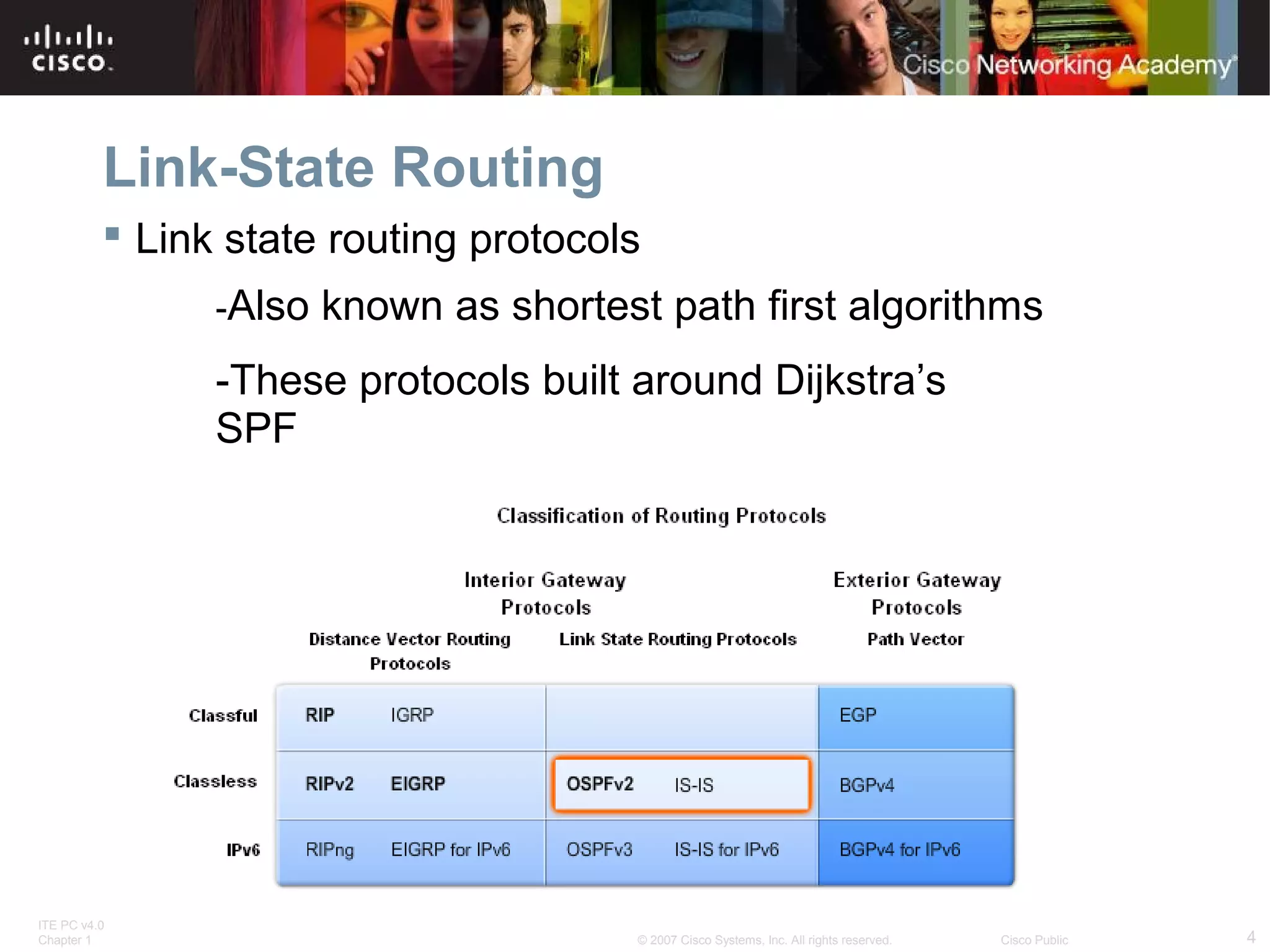
Link-State Routing
ď‚§ Link state routing protocols
-Also known as shortest path first algorithms
-These protocols built around Dijkstra’s
SPF
ITE PC v4.0
Chapter 1 5© 2007 Cisco Systems, Inc. All rights reserved. Cisco Public
Link-State Routing
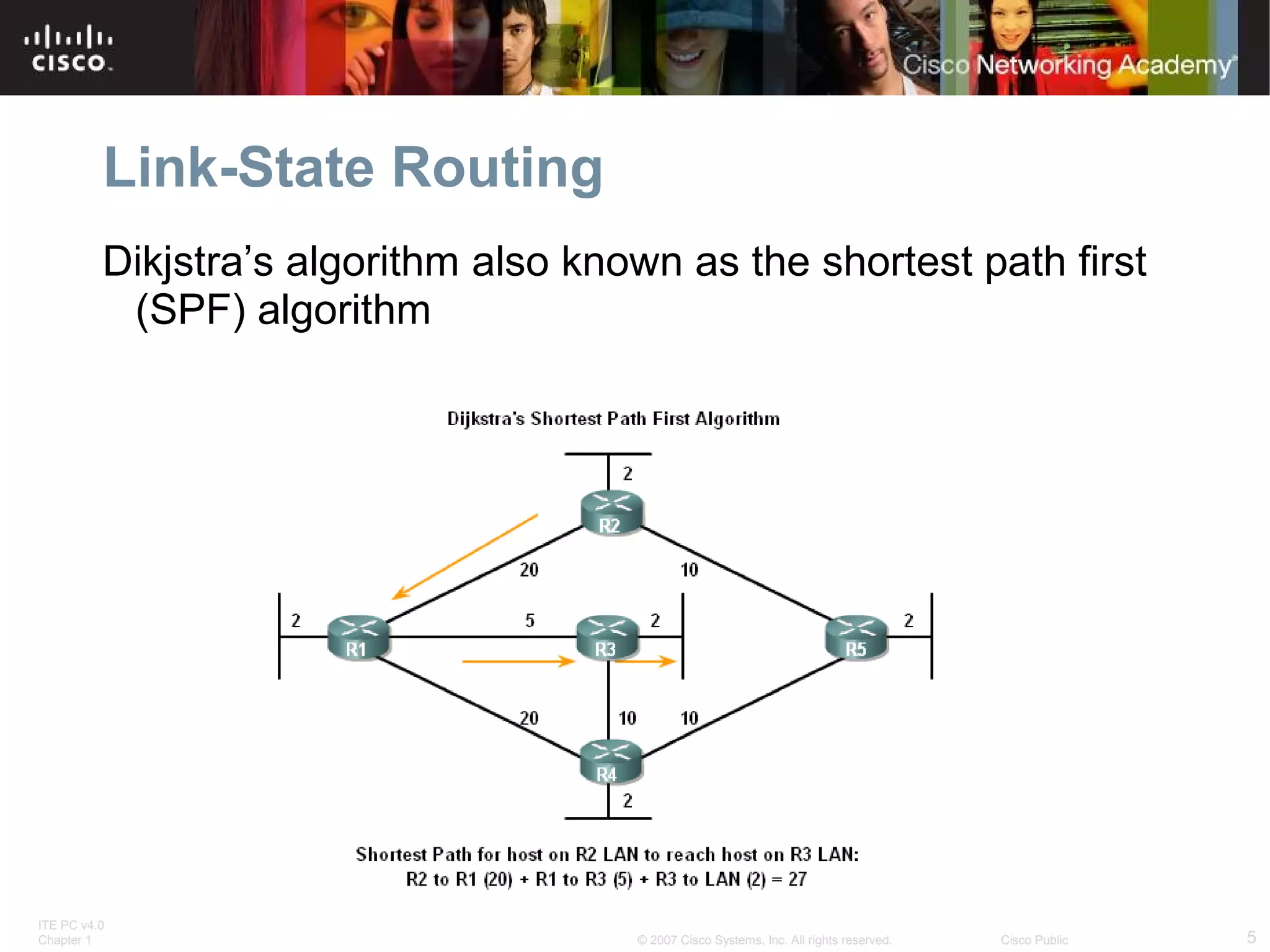
Dikjstra’s algorithm also known as the shortest path first
(SPF) algorithm
ITE PC v4.0
Chapter 1 6© 2007 Cisco Systems, Inc. All rights reserved. Cisco Public
Link-State Routing
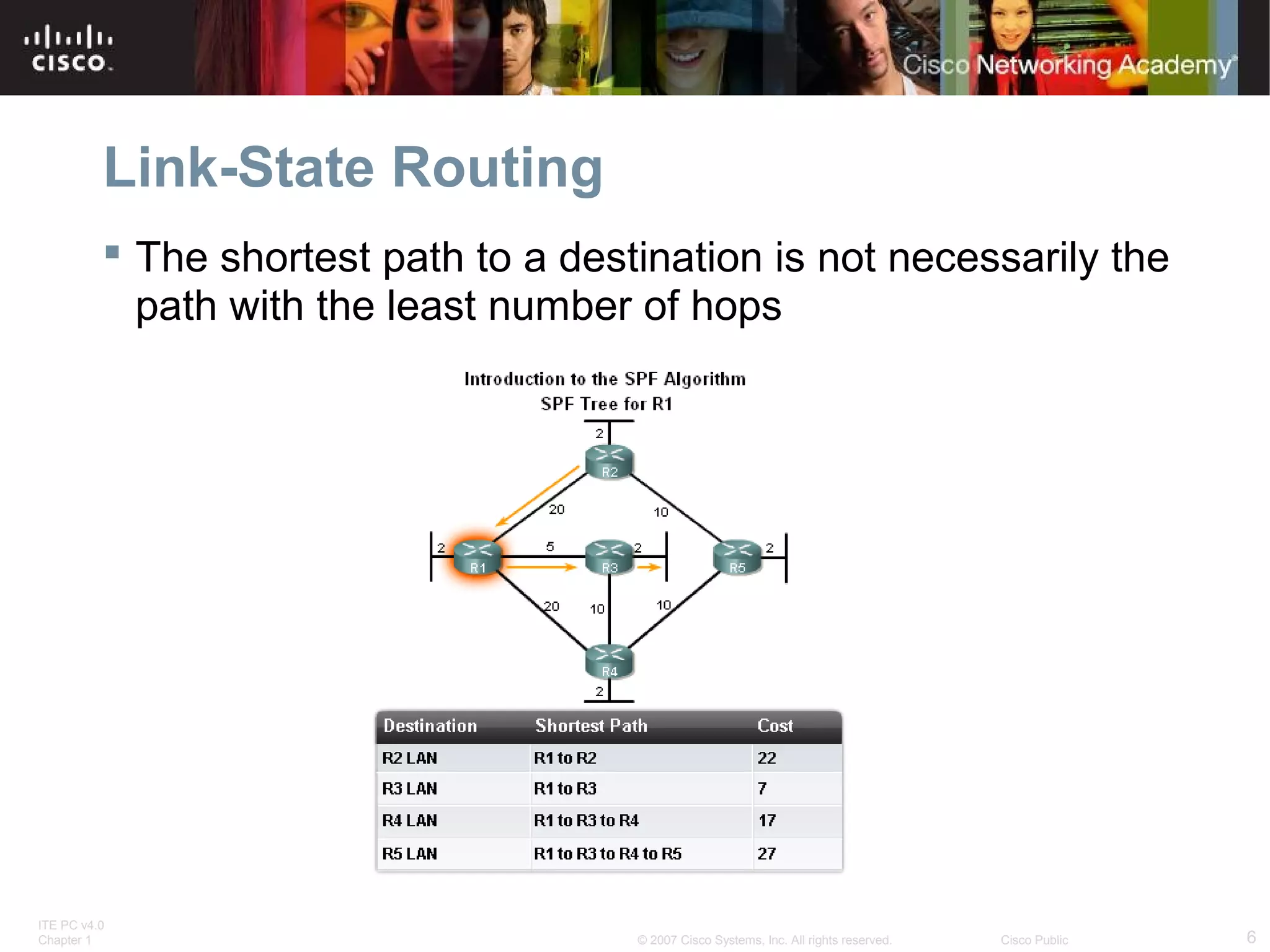
ď‚§ The shortest path to a destination is not necessarily the
path with the least number of hops
ITE PC v4.0
Chapter 1 7© 2007 Cisco Systems, Inc. All rights reserved. Cisco Public
Link-State Routing
Link-State Routing Process
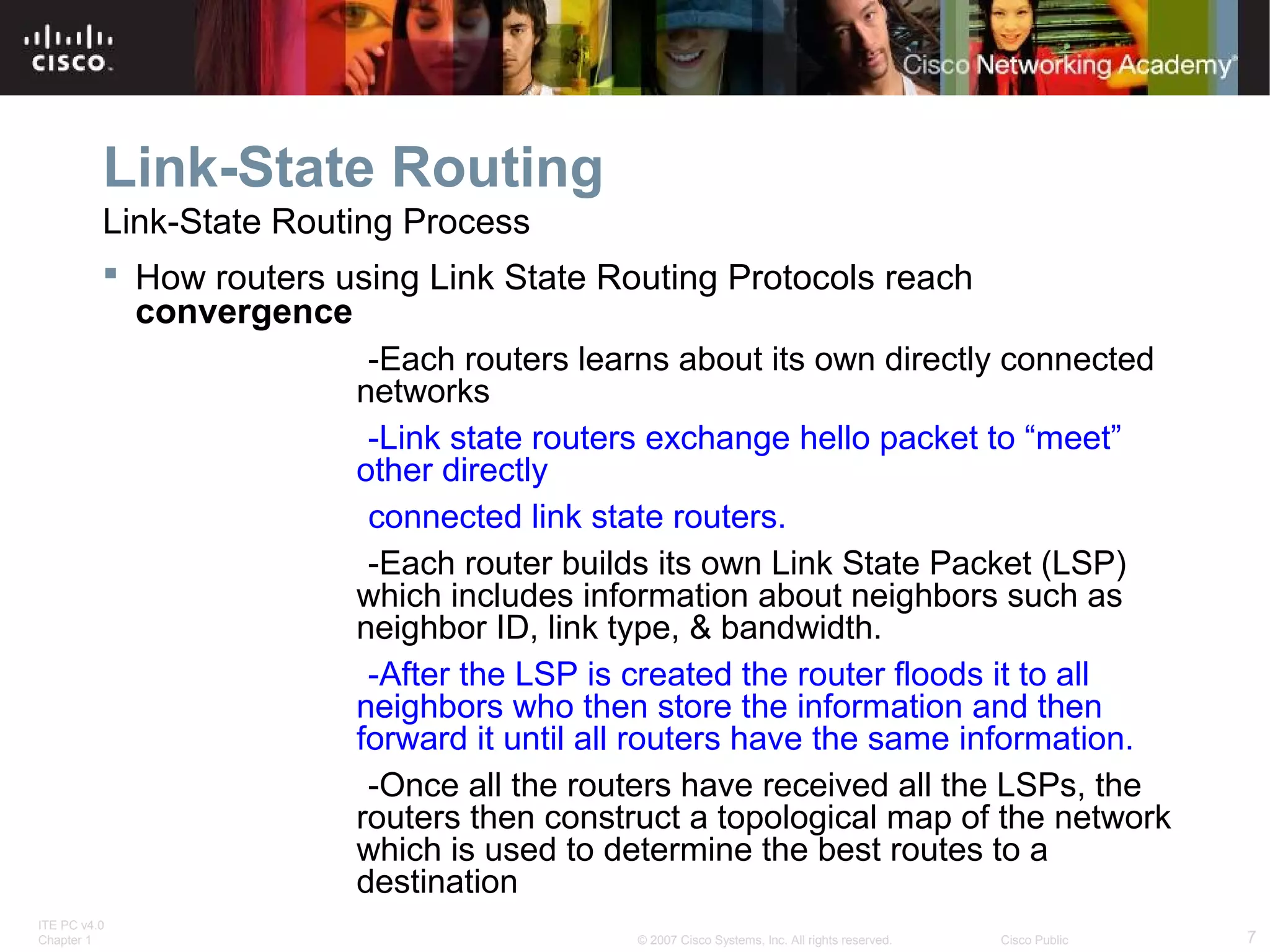
ď‚§ How routers using Link State Routing Protocols reach
convergence
-Each routers learns about its own directly connected
networks
-Link state routers exchange hello packet to “meet”
other directly
connected link state routers.
-Each router builds its own Link State Packet (LSP)
which includes information about neighbors such as
neighbor ID, link type, & bandwidth.
-After the LSP is created the router floods it to all
neighbors who then store the information and then
forward it until all routers have the same information.
-Once all the routers have received all the LSPs, the
routers then construct a topological map of the network
which is used to determine the best routes to a
destination
ITE PC v4.0
Chapter 1 8© 2007 Cisco Systems, Inc. All rights reserved. Cisco Public
Link-State Routing
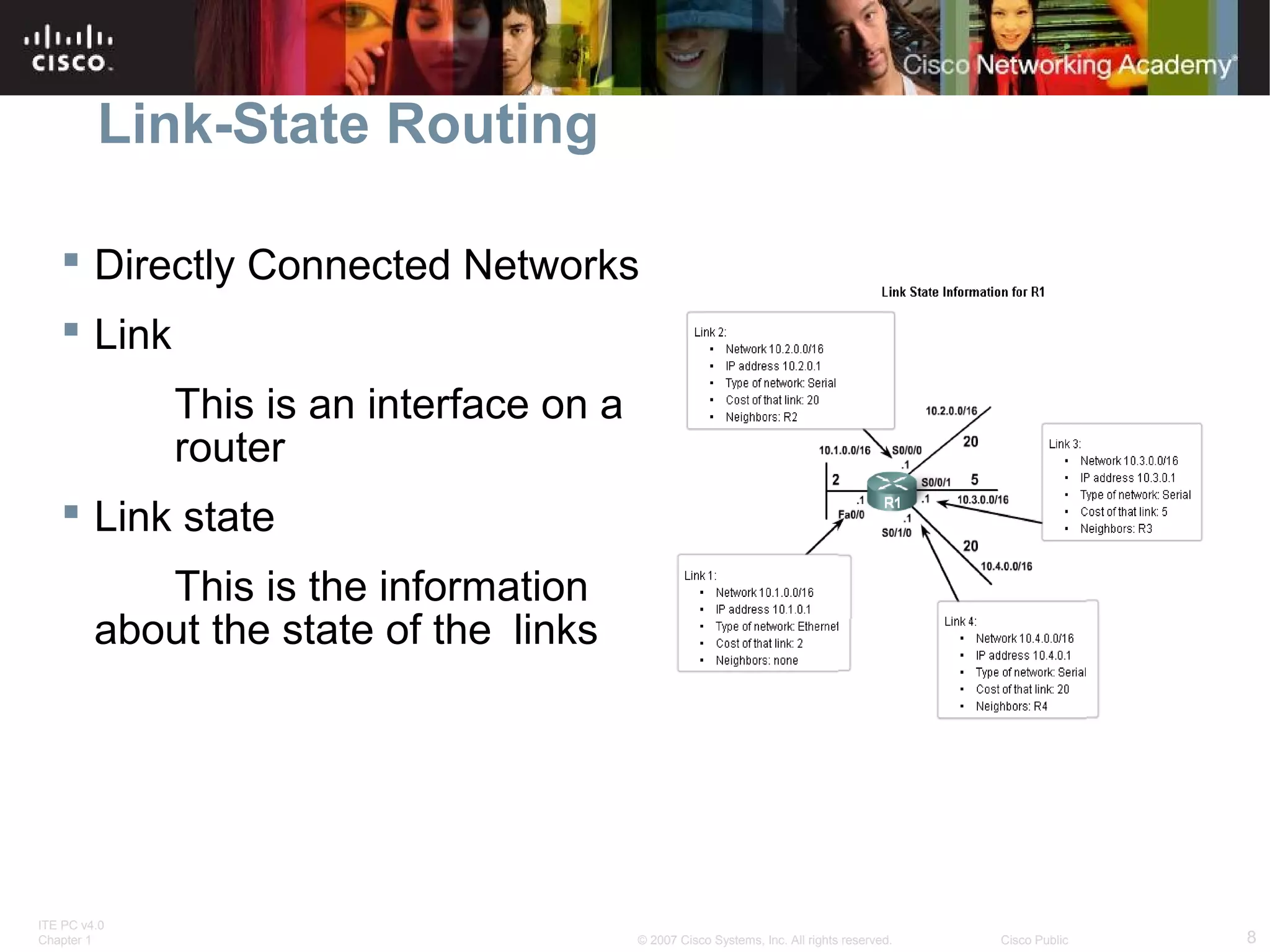
ď‚§ Directly Connected Networks
ď‚§ Link
This is an interface on a
router
ď‚§ Link state
This is the information
about the state of the links
ITE PC v4.0
Chapter 1 9© 2007 Cisco Systems, Inc. All rights reserved. Cisco Public
Link-State Routing
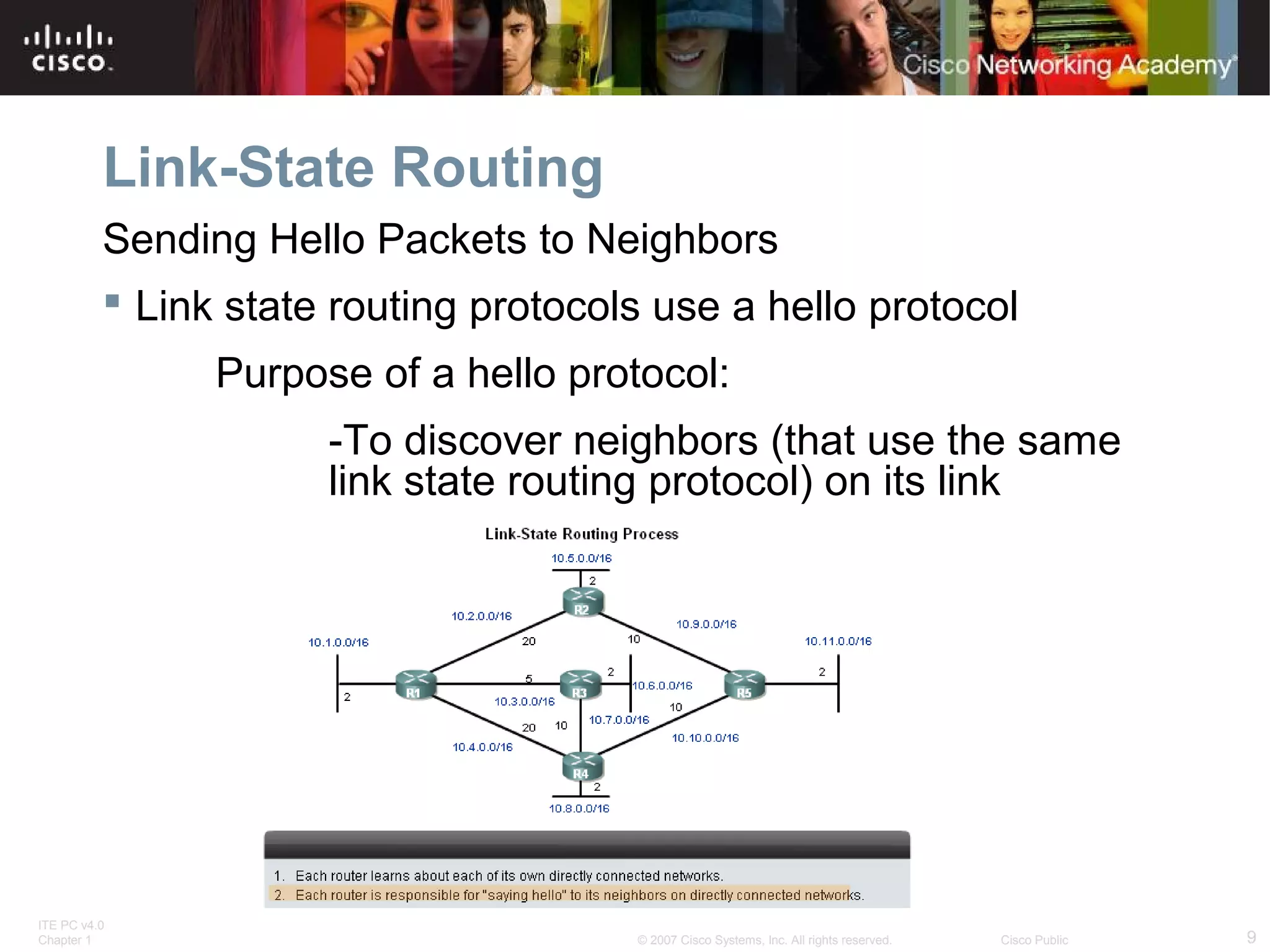
Sending Hello Packets to Neighbors
ď‚§ Link state routing protocols use a hello protocol
Purpose of a hello protocol:
-To discover neighbors (that use the same
link state routing protocol) on its link
ITE PC v4.0
Chapter 1 10© 2007 Cisco Systems, Inc. All rights reserved. Cisco Public
Link-State Routing
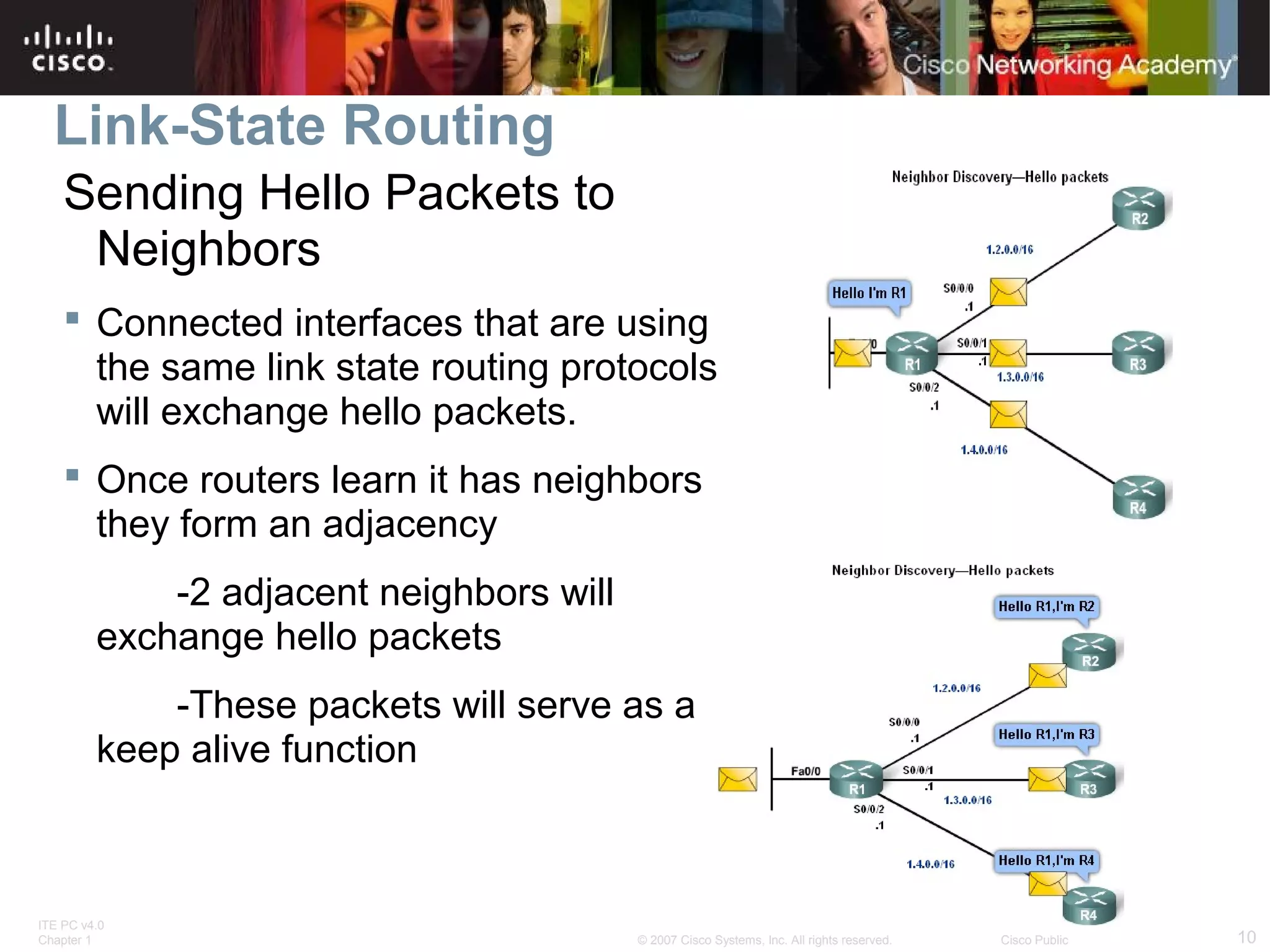
Sending Hello Packets to
Neighbors
ď‚§ Connected interfaces that are using
the same link state routing protocols
will exchange hello packets.
ď‚§ Once routers learn it has neighbors
they form an adjacency
-2 adjacent neighbors will
exchange hello packets
-These packets will serve as a
keep alive function
ITE PC v4.0
Chapter 1 11© 2007 Cisco Systems, Inc. All rights reserved. Cisco Public
Link-State Routing
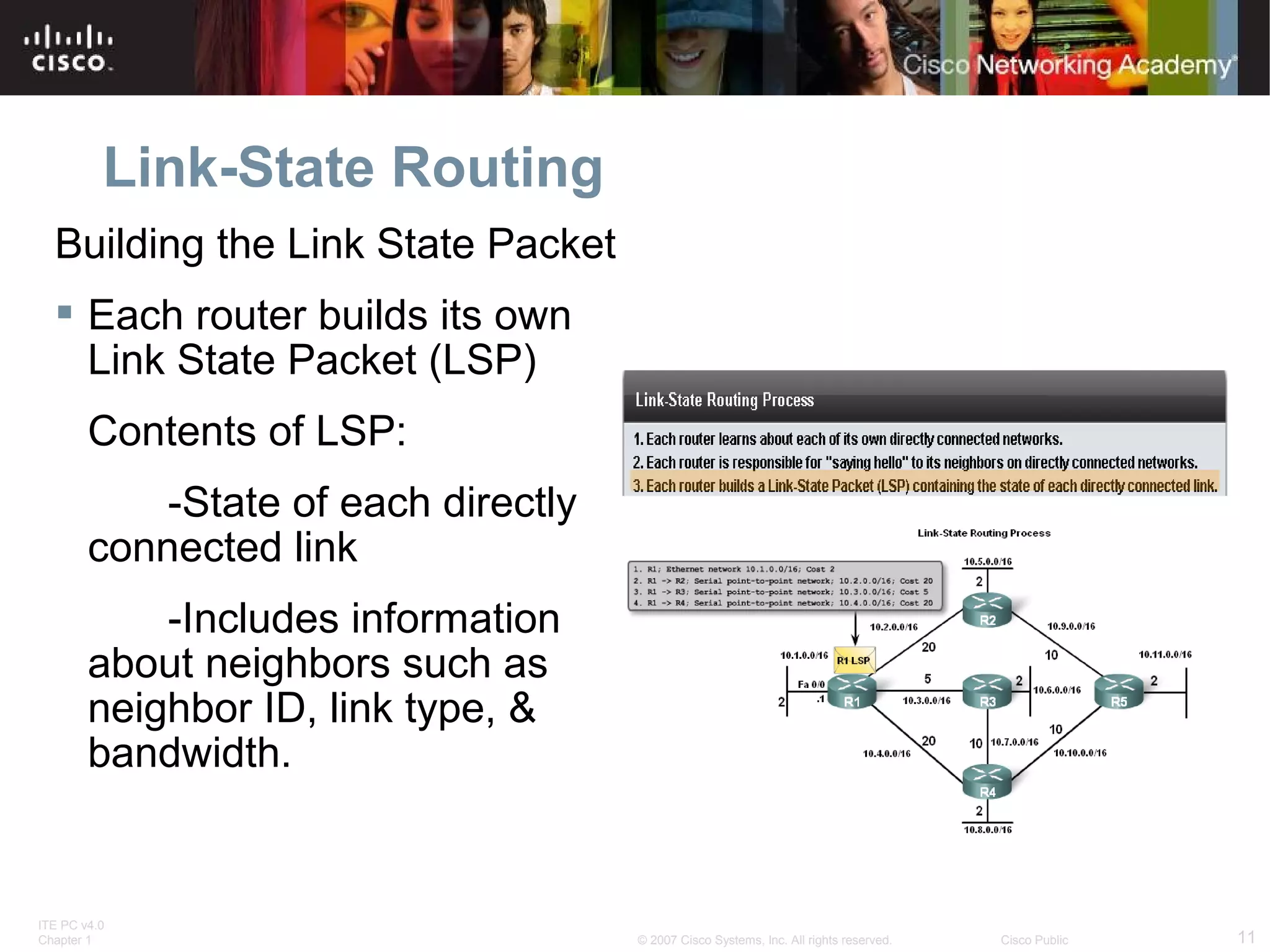
Building the Link State Packet
ď‚§ Each router builds its own
Link State Packet (LSP)
Contents of LSP:
-State of each directly
connected link
-Includes information
about neighbors such as
neighbor ID, link type, &
bandwidth.
ITE PC v4.0
Chapter 1 12© 2007 Cisco Systems, Inc. All rights reserved. Cisco Public
Link-State Routing
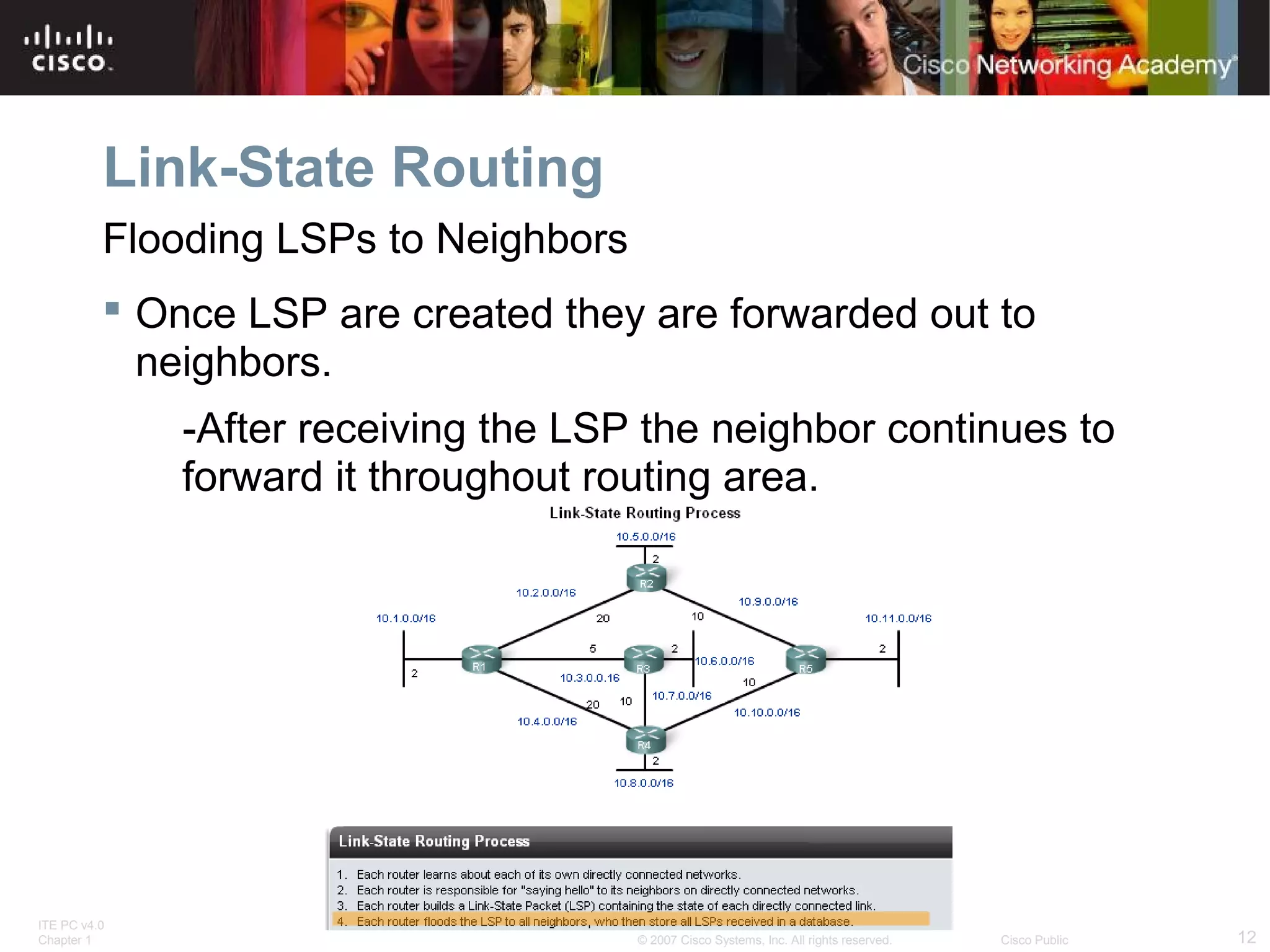
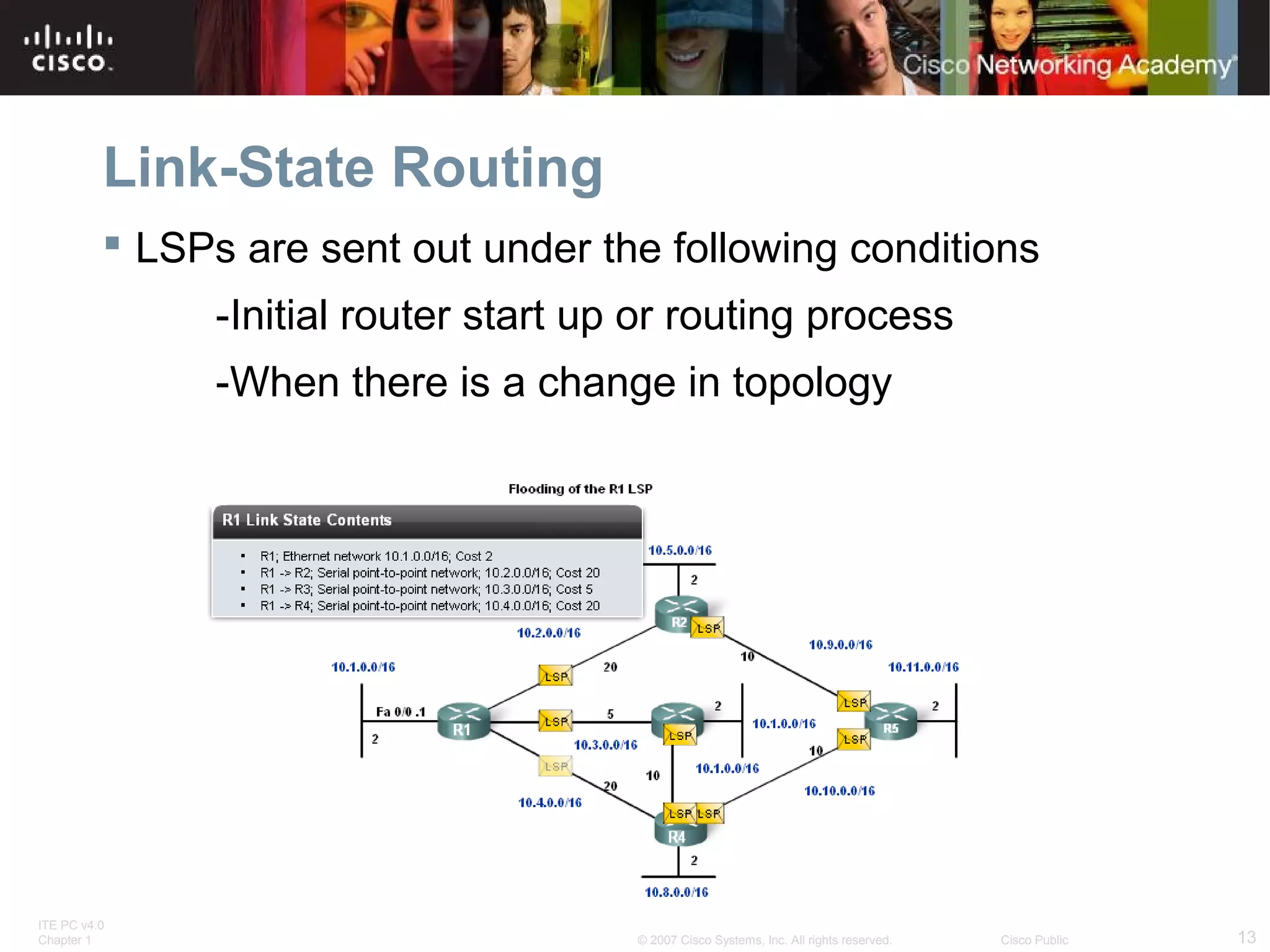
Flooding LSPs to Neighbors
ď‚§ Once LSP are created they are forwarded out to
neighbors.
-After receiving the LSP the neighbor continues to
forward it throughout routing area.
ITE PC v4.0
Chapter 1 13© 2007 Cisco Systems, Inc. All rights reserved. Cisco Public
Link-State Routing
ď‚§ LSPs are sent out under the following conditions
-Initial router start up or routing process
-When there is a change in topology
ITE PC v4.0
Chapter 1 14© 2007 Cisco Systems, Inc. All rights reserved. Cisco Public
Link-State Routing
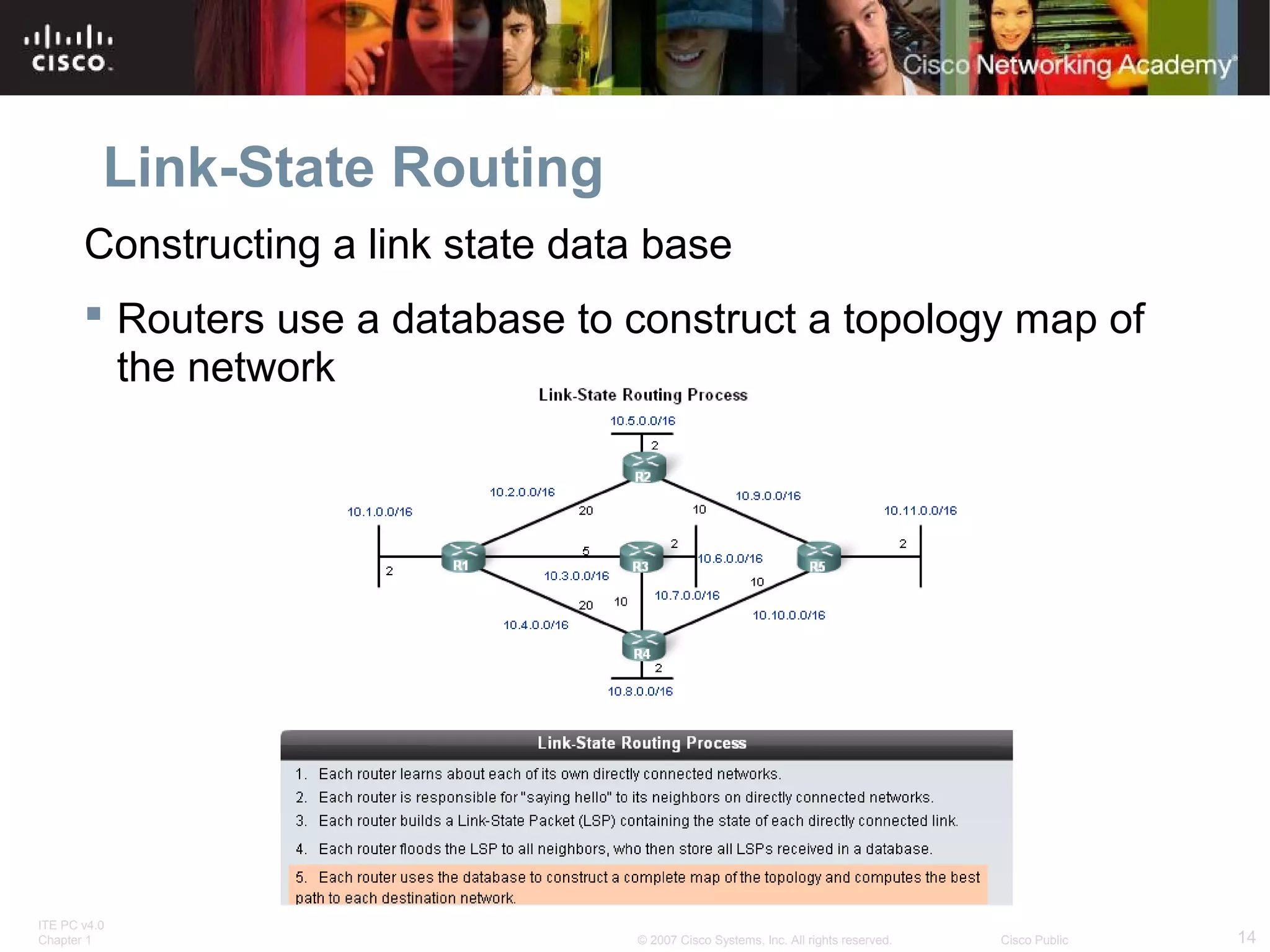
Constructing a link state data base
ď‚§ Routers use a database to construct a topology map of
the network
ITE PC v4.0
Chapter 1 15© 2007 Cisco Systems, Inc. All rights reserved. Cisco Public
Link-State Routing
ITE PC v4.0
Chapter 1 16© 2007 Cisco Systems, Inc. All rights reserved. Cisco Public
Link-State Routing
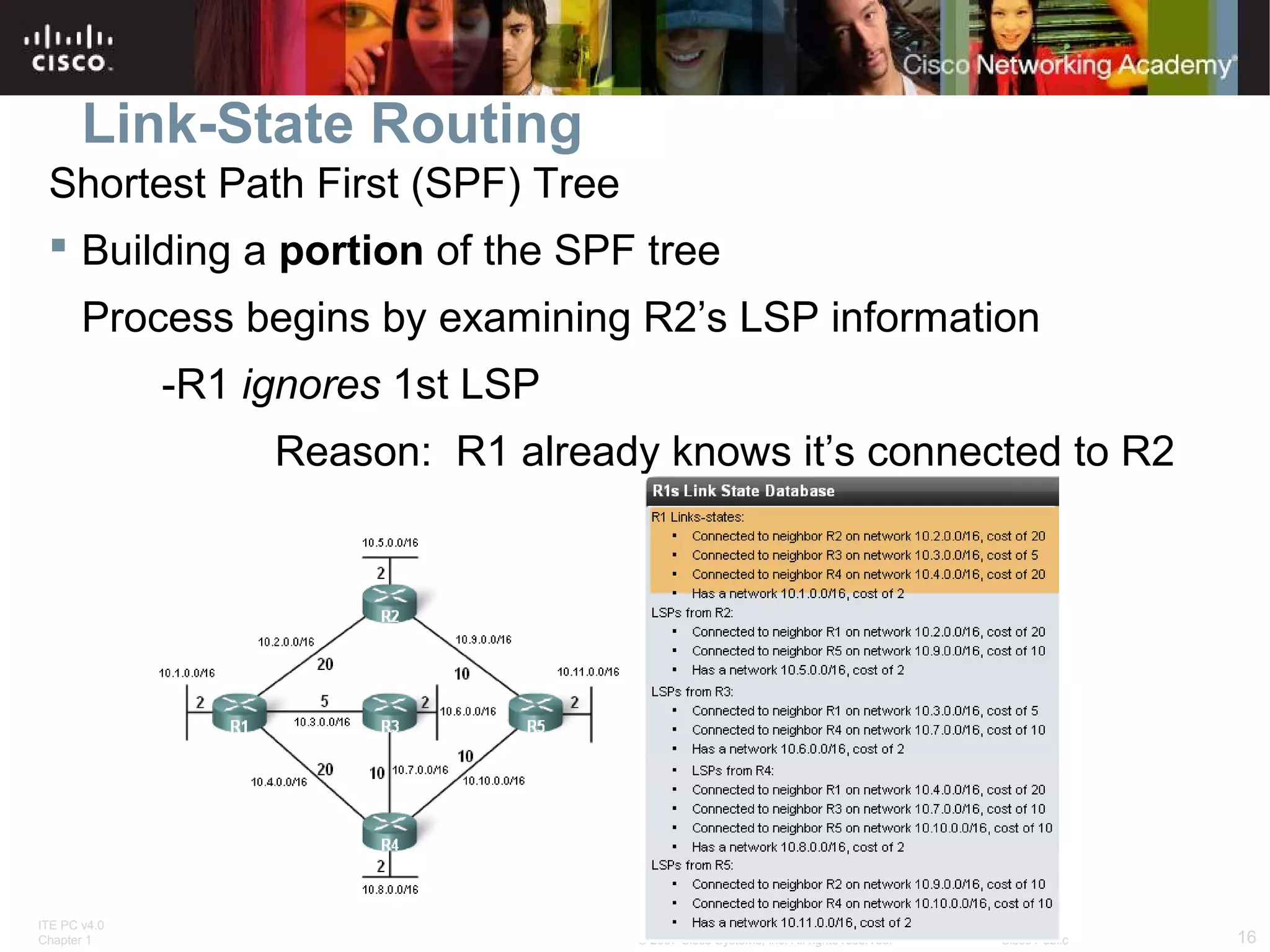
Shortest Path First (SPF) Tree
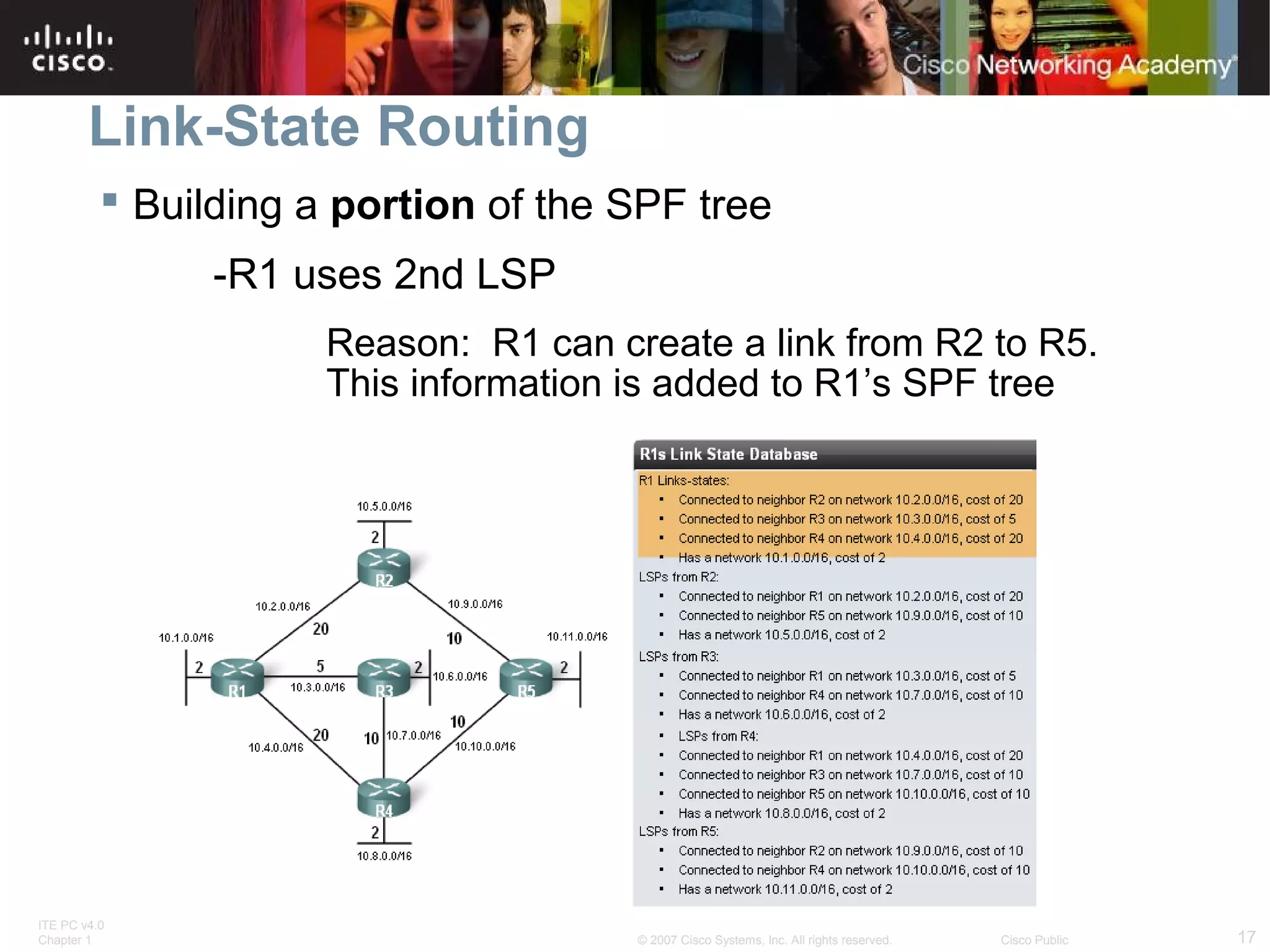
ď‚§ Building a portion of the SPF tree
Process begins by examining R2’s LSP information
-R1 ignores 1st LSP
Reason: R1 already knows it’s connected to R2
ITE PC v4.0
Chapter 1 17© 2007 Cisco Systems, Inc. All rights reserved. Cisco Public
Link-State Routing
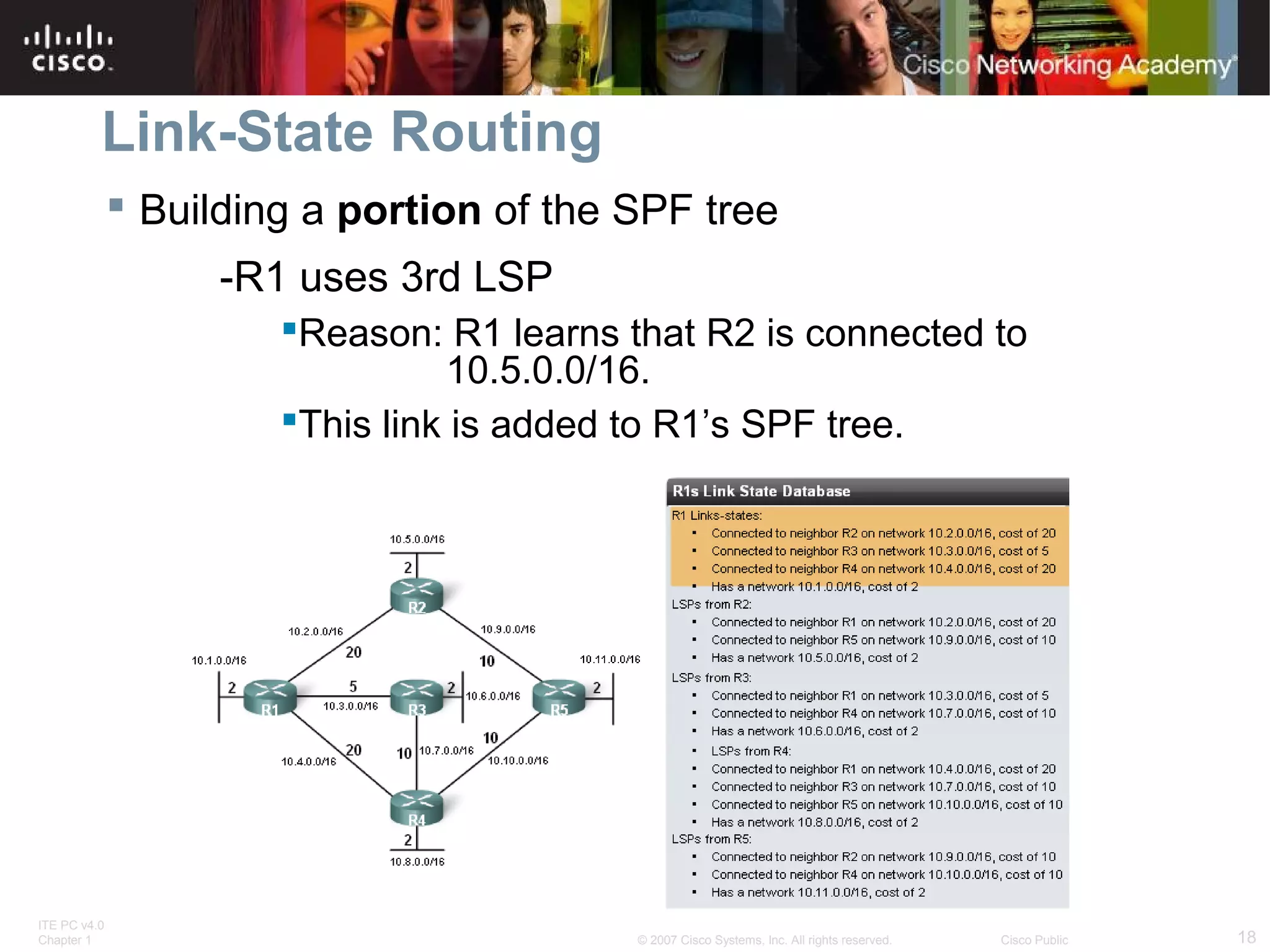
ď‚§ Building a portion of the SPF tree
-R1 uses 2nd LSP
Reason: R1 can create a link from R2 to R5.
This information is added to R1’s SPF tree
ITE PC v4.0
Chapter 1 18© 2007 Cisco Systems, Inc. All rights reserved. Cisco Public
Link-State Routing
ď‚§ Building a portion of the SPF tree
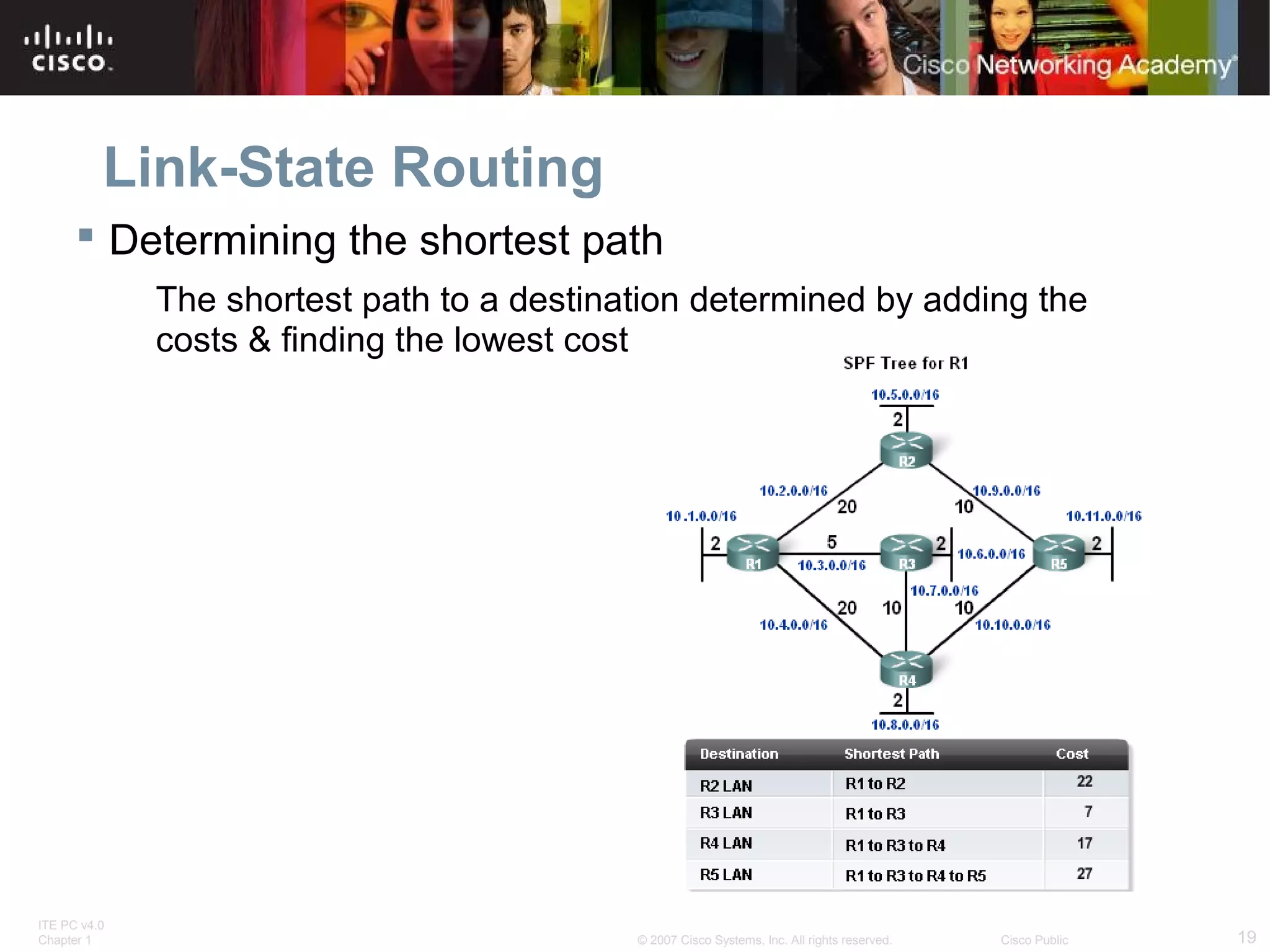
-R1 uses 3rd LSP
ď‚§Reason: R1 learns that R2 is connected to
10.5.0.0/16.
This link is added to R1’s SPF tree.
ITE PC v4.0
Chapter 1 19© 2007 Cisco Systems, Inc. All rights reserved. Cisco Public
Link-State Routing
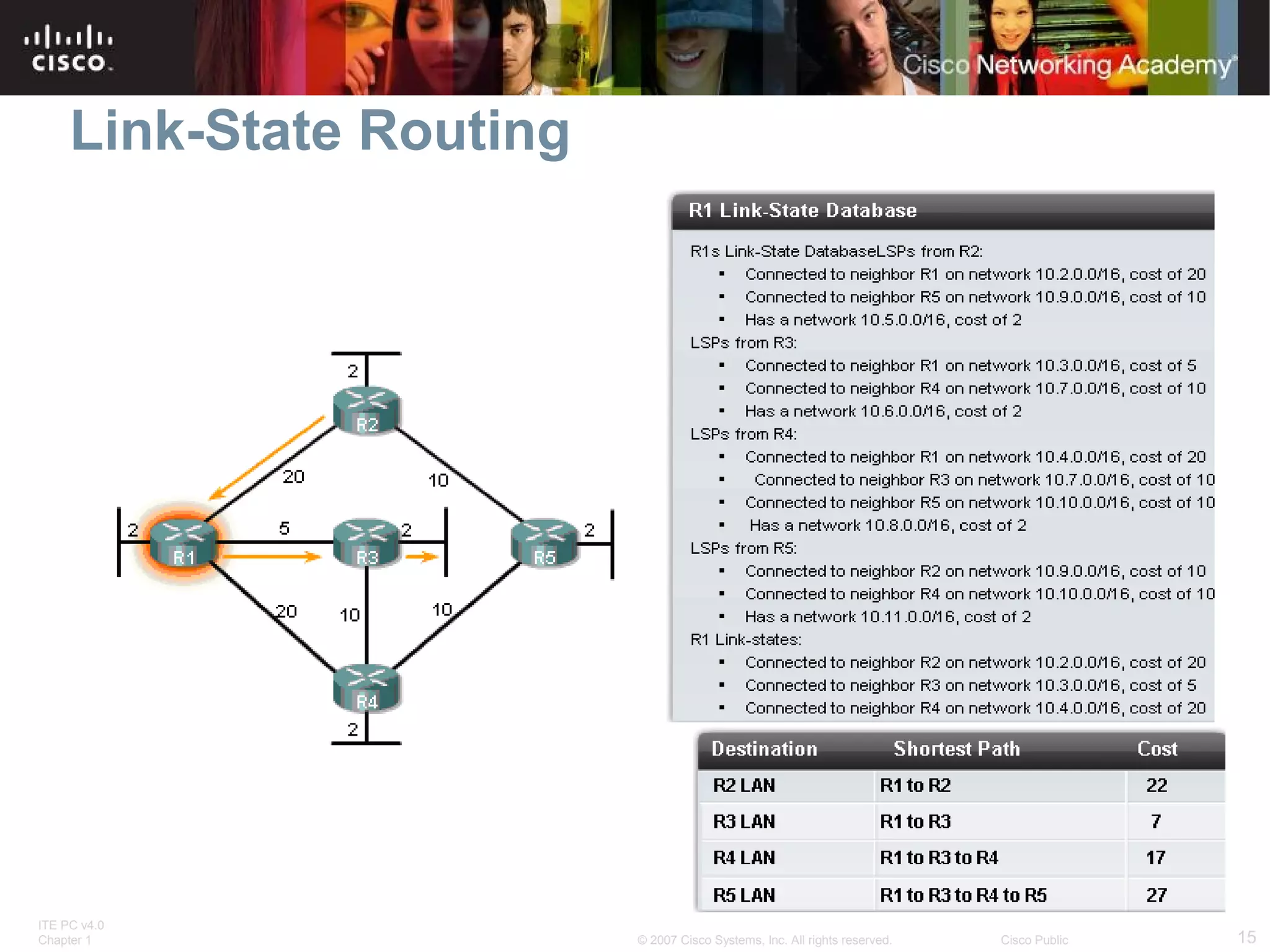
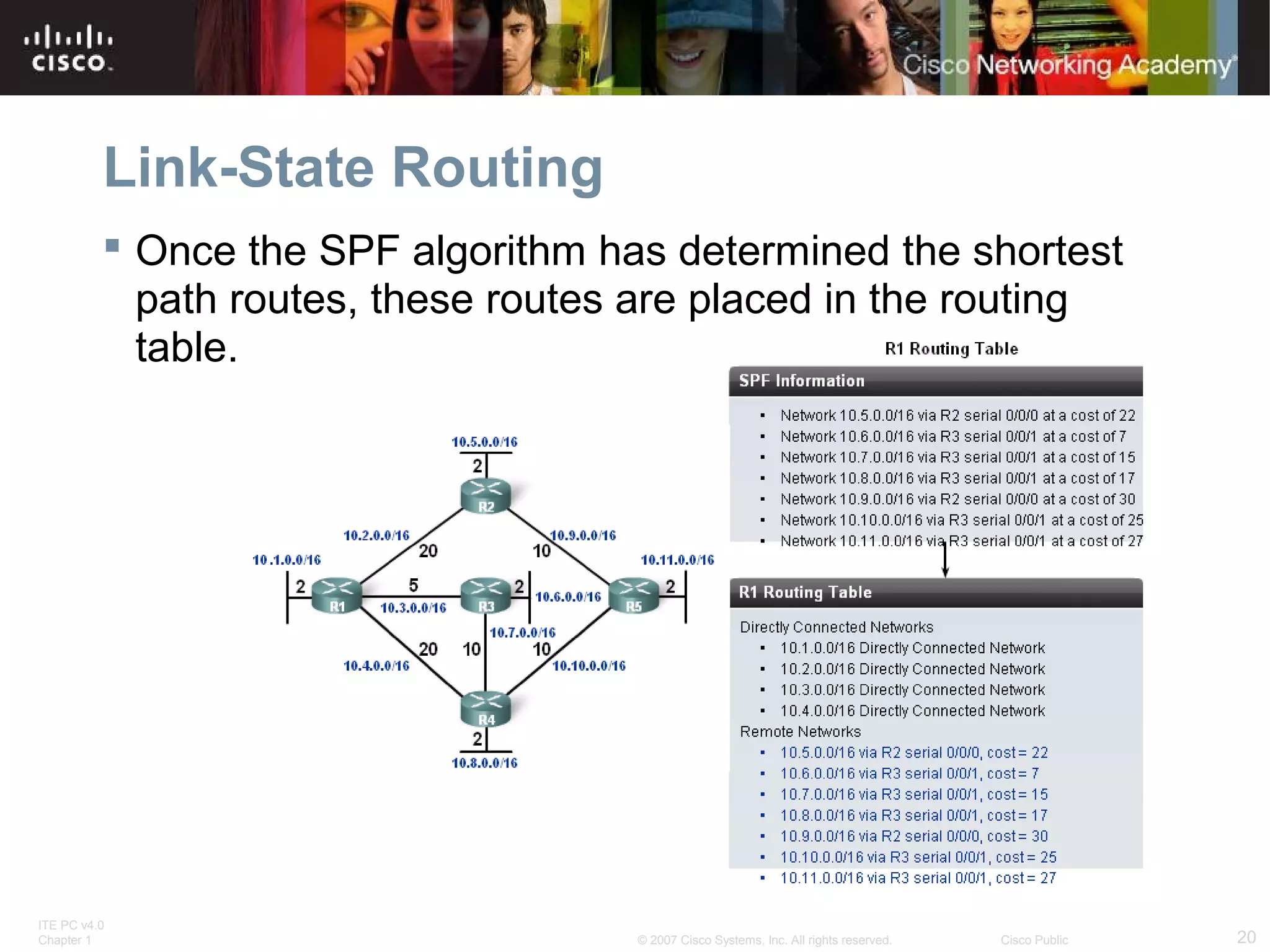
ď‚§ Determining the shortest path
The shortest path to a destination determined by adding the
costs & finding the lowest cost
ITE PC v4.0
Chapter 1 20© 2007 Cisco Systems, Inc. All rights reserved. Cisco Public
Link-State Routing
ď‚§ Once the SPF algorithm has determined the shortest
path routes, these routes are placed in the routing
table.
ITE PC v4.0
Chapter 1 21© 2007 Cisco Systems, Inc. All rights reserved. Cisco Public
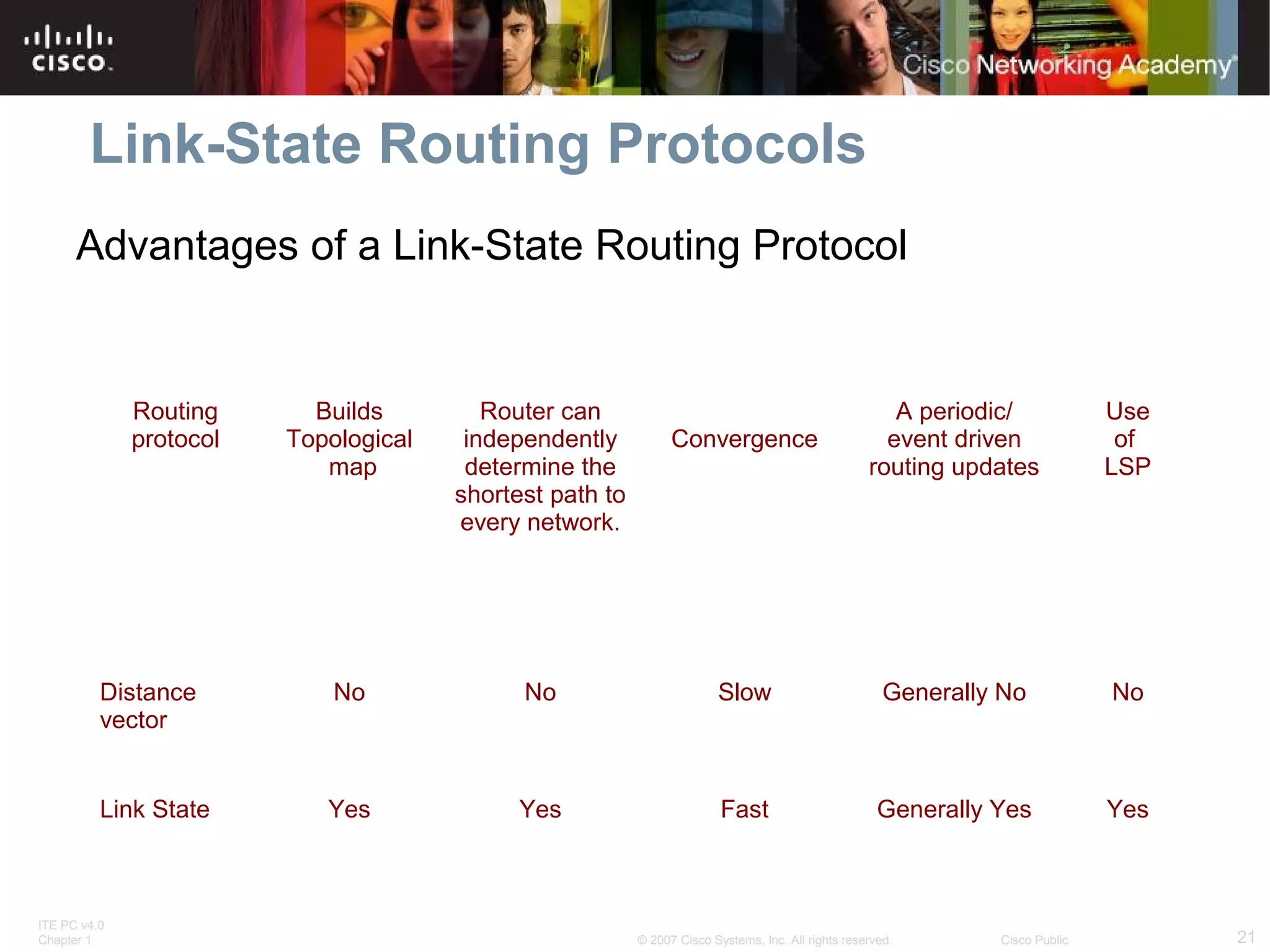
Link-State Routing Protocols
Routing
protocol
Builds
Topological
map
Router can
independently
determine the
shortest path to
every network.
Convergence
A periodic/
event driven
routing updates
Use
of
LSP
Distance
vector
No No Slow Generally No No
Link State Yes Yes Fast Generally Yes Yes
Advantages of a Link-State Routing Protocol
ITE PC v4.0
Chapter 1 22© 2007 Cisco Systems, Inc. All rights reserved. Cisco Public
Link-State Routing Protocols
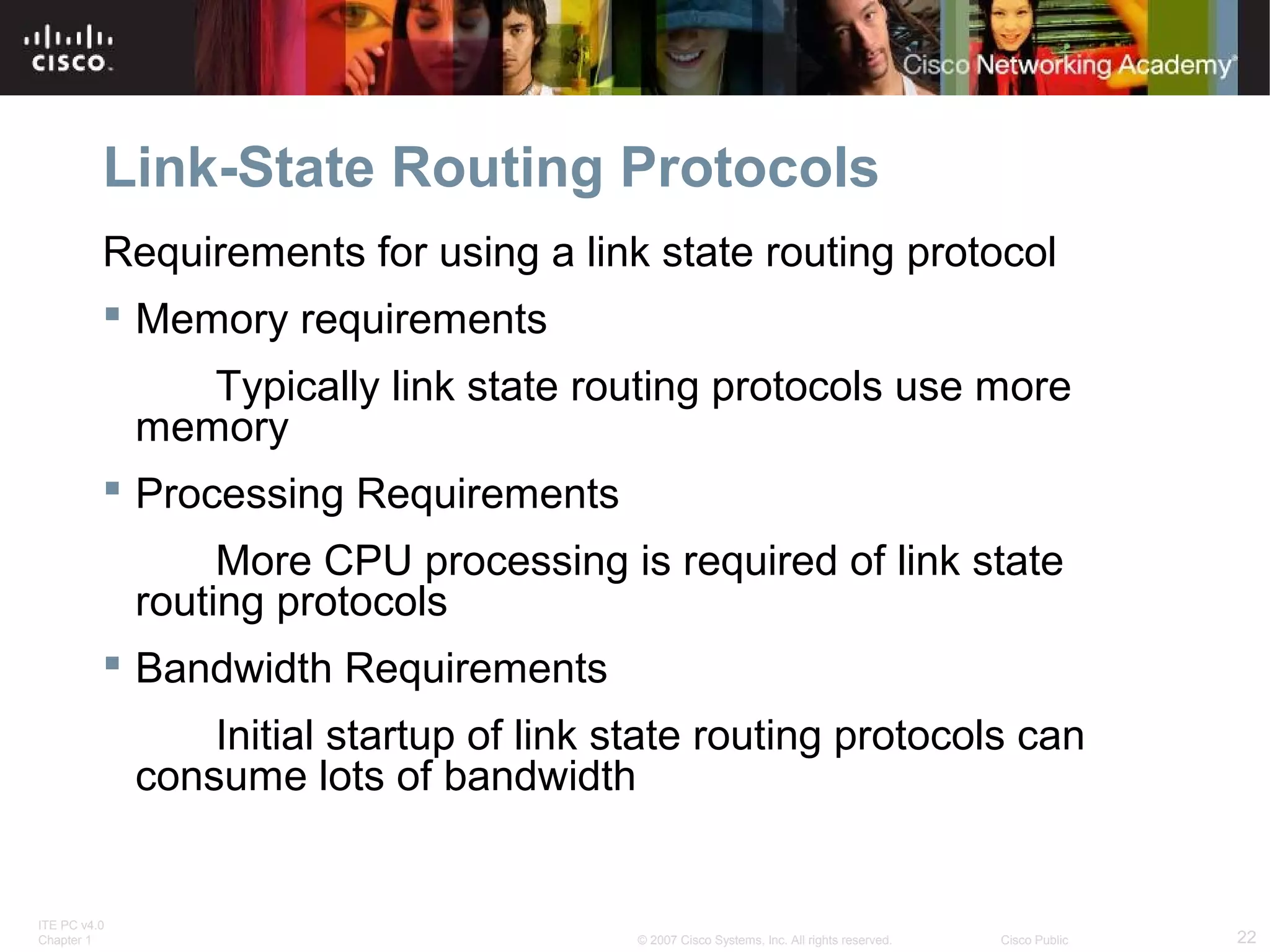
Requirements for using a link state routing protocol
ď‚§ Memory requirements
Typically link state routing protocols use more
memory
ď‚§ Processing Requirements
More CPU processing is required of link state
routing protocols
ď‚§ Bandwidth Requirements
Initial startup of link state routing protocols can
consume lots of bandwidth
ITE PC v4.0
Chapter 1 23© 2007 Cisco Systems, Inc. All rights reserved. Cisco Public
Link-State Routing Protocols
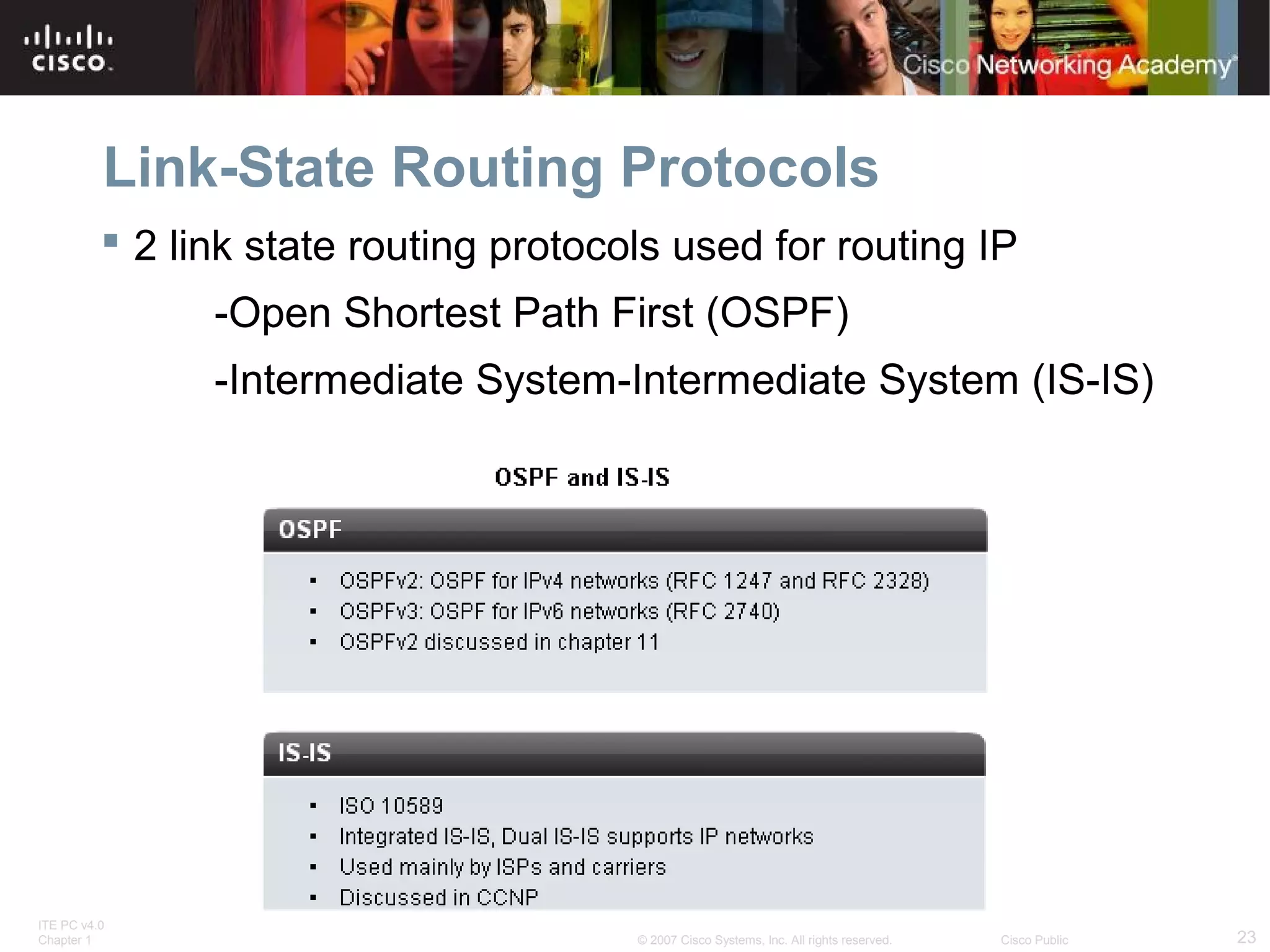
ď‚§ 2 link state routing protocols used for routing IP
-Open Shortest Path First (OSPF)
-Intermediate System-Intermediate System (IS-IS)
ITE PC v4.0
Chapter 1 24© 2007 Cisco Systems, Inc. All rights reserved. Cisco Public
Summary
ď‚§ Link State Routing protocols are also known as
Shortest Path First protocols
ď‚§ Summarizing the link state process
-Routers 1ST learn of directly connected networks
-Routers then say “hello” to neighbors
-Routers then build link state packets
-Routers then flood LSPs to all neighbors
-Routers use LSP database to build a network topology
map & calculate the best path to each destination
ITE PC v4.0
Chapter 1 25© 2007 Cisco Systems, Inc. All rights reserved. Cisco Public
Summary
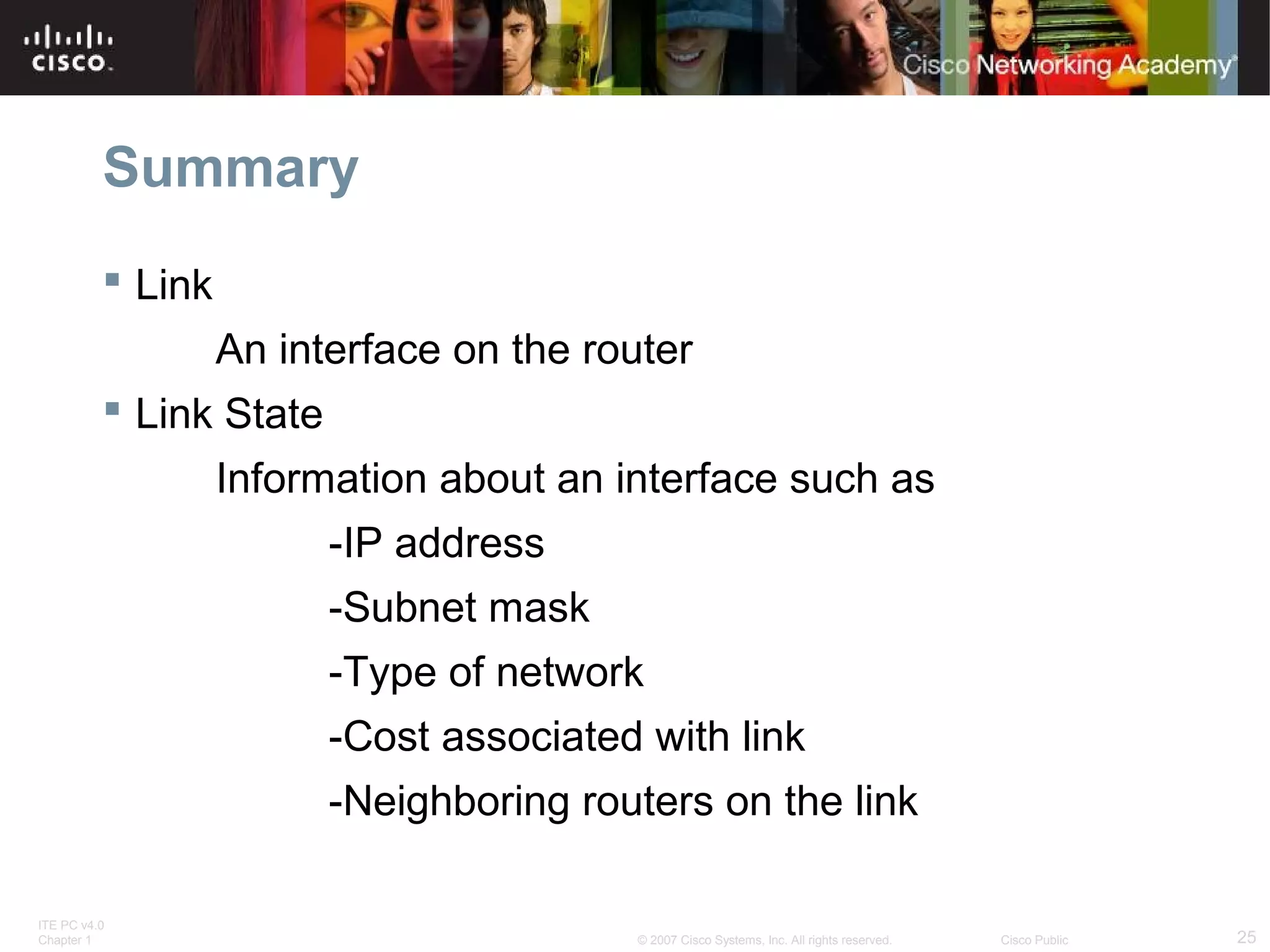
ď‚§ Link
An interface on the router
ď‚§ Link State
Information about an interface such as
-IP address
-Subnet mask
-Type of network
-Cost associated with link
-Neighboring routers on the link
ITE PC v4.0
Chapter 1 26© 2007 Cisco Systems, Inc. All rights reserved. Cisco Public
Summary
ď‚§ Link State Packets
After initial flooding, additional LSP are sent out
when a change in topology occurs
ď‚§ Examples of link state routing protocols
-Open shortest path first
-IS-IS
ITE PC v4.0
Chapter 1 27© 2007 Cisco Systems, Inc. All rights reserved. Cisco Public

CCNA Exploration 2 - Chapter 10

  • 1.
    © 2007 CiscoSystems, Inc. All rights reserved. Cisco Public ITE PC v4.0 Chapter 1 1 Link-State Routing Protocols Routing Protocols and Concepts – Chapter 10
  • 2.
    ITE PC v4.0 Chapter1 2© 2007 Cisco Systems, Inc. All rights reserved. Cisco Public Objectives  Describe the basic features & concepts of link-state routing protocols.  List the benefits and requirements of link-state routing protocols.
  • 3.
    ITE PC v4.0 Chapter1 3© 2007 Cisco Systems, Inc. All rights reserved. Cisco Public Introduction
  • 4.
    ITE PC v4.0 Chapter1 4© 2007 Cisco Systems, Inc. All rights reserved. Cisco Public Link-State Routing  Link state routing protocols -Also known as shortest path first algorithms -These protocols built around Dijkstra’s SPF
  • 5.
    ITE PC v4.0 Chapter1 5© 2007 Cisco Systems, Inc. All rights reserved. Cisco Public Link-State Routing Dikjstra’s algorithm also known as the shortest path first (SPF) algorithm
  • 6.
    ITE PC v4.0 Chapter1 6© 2007 Cisco Systems, Inc. All rights reserved. Cisco Public Link-State Routing  The shortest path to a destination is not necessarily the path with the least number of hops
  • 7.
    ITE PC v4.0 Chapter1 7© 2007 Cisco Systems, Inc. All rights reserved. Cisco Public Link-State Routing Link-State Routing Process  How routers using Link State Routing Protocols reach convergence -Each routers learns about its own directly connected networks -Link state routers exchange hello packet to “meet” other directly connected link state routers. -Each router builds its own Link State Packet (LSP) which includes information about neighbors such as neighbor ID, link type, & bandwidth. -After the LSP is created the router floods it to all neighbors who then store the information and then forward it until all routers have the same information. -Once all the routers have received all the LSPs, the routers then construct a topological map of the network which is used to determine the best routes to a destination
  • 8.
    ITE PC v4.0 Chapter1 8© 2007 Cisco Systems, Inc. All rights reserved. Cisco Public Link-State Routing  Directly Connected Networks  Link This is an interface on a router  Link state This is the information about the state of the links
  • 9.
    ITE PC v4.0 Chapter1 9© 2007 Cisco Systems, Inc. All rights reserved. Cisco Public Link-State Routing Sending Hello Packets to Neighbors  Link state routing protocols use a hello protocol Purpose of a hello protocol: -To discover neighbors (that use the same link state routing protocol) on its link
  • 10.
    ITE PC v4.0 Chapter1 10© 2007 Cisco Systems, Inc. All rights reserved. Cisco Public Link-State Routing Sending Hello Packets to Neighbors  Connected interfaces that are using the same link state routing protocols will exchange hello packets.  Once routers learn it has neighbors they form an adjacency -2 adjacent neighbors will exchange hello packets -These packets will serve as a keep alive function
  • 11.
    ITE PC v4.0 Chapter1 11© 2007 Cisco Systems, Inc. All rights reserved. Cisco Public Link-State Routing Building the Link State Packet  Each router builds its own Link State Packet (LSP) Contents of LSP: -State of each directly connected link -Includes information about neighbors such as neighbor ID, link type, & bandwidth.
  • 12.
    ITE PC v4.0 Chapter1 12© 2007 Cisco Systems, Inc. All rights reserved. Cisco Public Link-State Routing Flooding LSPs to Neighbors  Once LSP are created they are forwarded out to neighbors. -After receiving the LSP the neighbor continues to forward it throughout routing area.
  • 13.
    ITE PC v4.0 Chapter1 13© 2007 Cisco Systems, Inc. All rights reserved. Cisco Public Link-State Routing  LSPs are sent out under the following conditions -Initial router start up or routing process -When there is a change in topology
  • 14.
    ITE PC v4.0 Chapter1 14© 2007 Cisco Systems, Inc. All rights reserved. Cisco Public Link-State Routing Constructing a link state data base  Routers use a database to construct a topology map of the network
  • 15.
    ITE PC v4.0 Chapter1 15© 2007 Cisco Systems, Inc. All rights reserved. Cisco Public Link-State Routing
  • 16.
    ITE PC v4.0 Chapter1 16© 2007 Cisco Systems, Inc. All rights reserved. Cisco Public Link-State Routing Shortest Path First (SPF) Tree  Building a portion of the SPF tree Process begins by examining R2’s LSP information -R1 ignores 1st LSP Reason: R1 already knows it’s connected to R2
  • 17.
    ITE PC v4.0 Chapter1 17© 2007 Cisco Systems, Inc. All rights reserved. Cisco Public Link-State Routing  Building a portion of the SPF tree -R1 uses 2nd LSP Reason: R1 can create a link from R2 to R5. This information is added to R1’s SPF tree
  • 18.
    ITE PC v4.0 Chapter1 18© 2007 Cisco Systems, Inc. All rights reserved. Cisco Public Link-State Routing  Building a portion of the SPF tree -R1 uses 3rd LSP Reason: R1 learns that R2 is connected to 10.5.0.0/16. This link is added to R1’s SPF tree.
  • 19.
    ITE PC v4.0 Chapter1 19© 2007 Cisco Systems, Inc. All rights reserved. Cisco Public Link-State Routing  Determining the shortest path The shortest path to a destination determined by adding the costs & finding the lowest cost
  • 20.
    ITE PC v4.0 Chapter1 20© 2007 Cisco Systems, Inc. All rights reserved. Cisco Public Link-State Routing  Once the SPF algorithm has determined the shortest path routes, these routes are placed in the routing table.
  • 21.
    ITE PC v4.0 Chapter1 21© 2007 Cisco Systems, Inc. All rights reserved. Cisco Public Link-State Routing Protocols Routing protocol Builds Topological map Router can independently determine the shortest path to every network. Convergence A periodic/ event driven routing updates Use of LSP Distance vector No No Slow Generally No No Link State Yes Yes Fast Generally Yes Yes Advantages of a Link-State Routing Protocol
  • 22.
    ITE PC v4.0 Chapter1 22© 2007 Cisco Systems, Inc. All rights reserved. Cisco Public Link-State Routing Protocols Requirements for using a link state routing protocol  Memory requirements Typically link state routing protocols use more memory  Processing Requirements More CPU processing is required of link state routing protocols  Bandwidth Requirements Initial startup of link state routing protocols can consume lots of bandwidth
  • 23.
    ITE PC v4.0 Chapter1 23© 2007 Cisco Systems, Inc. All rights reserved. Cisco Public Link-State Routing Protocols  2 link state routing protocols used for routing IP -Open Shortest Path First (OSPF) -Intermediate System-Intermediate System (IS-IS)
  • 24.
    ITE PC v4.0 Chapter1 24© 2007 Cisco Systems, Inc. All rights reserved. Cisco Public Summary  Link State Routing protocols are also known as Shortest Path First protocols  Summarizing the link state process -Routers 1ST learn of directly connected networks -Routers then say “hello” to neighbors -Routers then build link state packets -Routers then flood LSPs to all neighbors -Routers use LSP database to build a network topology map & calculate the best path to each destination
  • 25.
    ITE PC v4.0 Chapter1 25© 2007 Cisco Systems, Inc. All rights reserved. Cisco Public Summary  Link An interface on the router  Link State Information about an interface such as -IP address -Subnet mask -Type of network -Cost associated with link -Neighboring routers on the link
  • 26.
    ITE PC v4.0 Chapter1 26© 2007 Cisco Systems, Inc. All rights reserved. Cisco Public Summary  Link State Packets After initial flooding, additional LSP are sent out when a change in topology occurs  Examples of link state routing protocols -Open shortest path first -IS-IS
  • 27.
    ITE PC v4.0 Chapter1 27© 2007 Cisco Systems, Inc. All rights reserved. Cisco Public