Welcome to Applied Mycology: Role of Fungi
in Biotechnology by N.Sannigrahi, Associate
Professor, Department of Botany, Nistarini
College, Purulia (W.B) 723101, India
Science & Society are two parts of a same coin. The
human beings are benefitted directly or indirectly by
the fruits of science about in every sphere of life.
Staring from the non-living to living entities, science
has contributed a lot for the overall development of
social life. The fungal kingdom, ubiquitous in nature
found almost in every ecological niche contributes a
lot since the time immemorial for the mankind-either
as a food, medicine or ecological attributes by its
applied blessings.
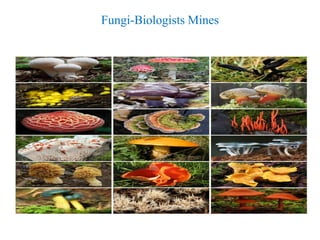
Fungi-Biologists Mines
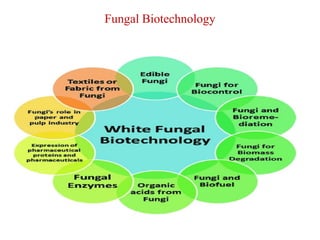
Fungal Biotechnology
Biotechnology definition
• Biotechnology is“the formation of new combinations of
heritable material by the insertion of nucleic acid
molecules produced by whatever means outside the cell,
into any virus, bacterial plasmid or other vector system so
as to allow their incorporation into a host organism in
which they do not naturally occur but in which they are
capable of continued propagation”.(Smith,1996).
• Biotechnology is the "Controlled use of biological agents
such as microorganisms or cellular components for
beneficial us”( U. N. Science Federation). In a word, it is
the art & science of the manipulation of DNA for the
betterment of human welfare by man made engineered
skills and delicacy.
Application of fungi in Food industry
• Fungi play an important role in fermentation, baking,
organic acids, enzymes, mycoproteins, flavor of food
& its texture with the help of the manipulation of
nucleic acids.
• Fermentation: Fermentation is the anaerobic process
releasing end products alcohol or organic acids with
little bit Carbon-di-oxide and fungi play an important
role. Alcoholic beverages like wine, Beer, Rum,
whisky, sake are some of the products marketed in the
trade name. Fungi like Aspergillus oryzae,
Endomyces lactis, Mucor sp, Neurospora crassa,
Rhizopus sp, Saccharomyces beticus, S.cerevisae,
S.oviformis, Torula sp, Trichosporium cutaneum etc.
Baking
• Baking & Bakery are intertwined to each other.
Yeasts acts as a leavening agent in baking industry
because of its ability to ferment sugar in the dough
vigorously and to grow rapidly. Mostly unicellular
fungi, Yeasts are used in this industry. Fungi used in
fermenting wide variety of foods , including soy
sauce, tempeh, nd cheeses. Cheese has its distinctive
appearance and flavors because of the fungus
growing through it. Besides Yeasts, Aspergillus niger
also used in bakery. Rice beer , Pachai , a product of
Mucor or Aspergillus used in this regard.
Organic acids production
• Organic acids like Citric acid are produced through the
metabolisms of carbohydrate and they accumulate in
broth of fermenter, wherefrom they are separated and
purified. The organic acids are the terminal products of
EMP pathway ( glycolysis) like lactic acid, propionic
acids or the production of incomplete oxidation of sugar
like citric acid, Kojic acid, Gallic acid, itaconic acid and
gluconic acid. A third type of product is also obtained
from the dehydrogenation of alcohol in the presence of
oxygen i.e. acetic acid(Riviere,1977).The species of
Penicillium & Aspergillus play a very important role in
the production of organic acids through biotechnological
application.
Enzymes & Fungi
• Aspergillus flavus-oryzae series introduced a number of
enzymes like Digestin, Polyzime, Taka diastase are some
of the enzymes in this regard. Enzymes & Sources of
fungal origin given below:
• Urate oxidase- Aspergilus flavus, Amylases, Protease,
Pectinase, Glucose oxidase – A.niger, Amylases, Lipases,
Protease by A.oryzae, Esterase, Invertase by
Aureobasidium pullulans, Lipase by Candila lipolytica,
Rennet by Mucor micheli & M.pusillus, Trysinase by
Neurospora crassa,Dextrinase by Penicillum
funiculosum, are some of the enzymes having commercial
values are extracted with the help of biotechnological
attributes.
Enzymes & Fungi
• Glucose oxidase by Penicillium notatum, Lipase by
Rhizopus sp, Invertase by Saccharomyces cerevisiae
& S.fragilis, Cellulase by Trichodema reesei &
T.viride are also to be deserved mentioning and
enzyme engineering are used for mass production
making cost-effective. Since genes encode enzymes,
the changes in gene certainly bring about alteration in
enzyme structure. In addition to methods available for
gene manipulation, alteration of genes by site directed
mutagenesis for enzyme engineering has become
much popular. Thus, site directed mutagenesis
produces single amino acid substitution in the
primary structure enzymes. In recent years. The
enzyme engineering is used to denote the
Continuation
• Modification of enzyme structure by the alteration of
genes coding enzymes. An enzyme produced by a
modified gene is structurally new which great
promise to create a new enzyme. Enzyme
Engineering embraces the (1) production of enzymes,
(2)study of the structural features related to
stability,(3) increase in stability by changing amino
acids composition & (4) production of stable
enzymes by genetically engineered fungal cells. The
enzymes have an awesome promises due to its
therapeutic uses, analytical uses, manipulative &
industrial uses.
MYCOPROTEINS
• The dried cells of micro-organisms (algae, bacteria,
actinomycetes & fungi)are used as food or feed
collectively known as ‘microbial protein’ including
SCP extracted from mostly algae. But Fungal protein
termed as mycoprotein as introduced by Ranks Hovis
McDougall(RHM) in the UK for protein produced
on glucose or starch substrates by fungi. Many fungi
are used for extraction of myco-proteins-
• Nocardia & Thermomonospora fusca(Actinomycetes),
Candida lypolytica, C.utilis, Saccharomyces
cerevisiae, S.fragalis, Rhodotorula glutinis &
Torulopsis(Yeasts), Aspergilus niger,
Contd-------
• Trichoderma viride, Paecilomyces varioti(Moulds)
and Agaricus campestris, Morchella
crassipes(Mushrooms) are some of the examples to
speak about the mycoprotein sources using different
types of substrates like cellulose pulp, Potato starch
waste, Molasses, Sulphite liquor, Beer, Milk whey,
domestic sewage, Methanol, Straw, starch, n-alkanes,
glucose, cheese whey, etc for the aforesaid purpose.
Strains of some moulds like Aspergilus niger,
A.fumigatus, Fusarium graminearum are very much
toxic not to be recommended for SCP production.
Flavor of food & Texture
• Many flavours of food are due to bacteria & fungi
including trepans, menthol and lactones. Fungi
produce compounds that deodorise offensive and
neutralize bitter flavours which is important area of
industrial uses. The red wine contains a pigments ,
polyketides that are insoluble in acid conditions. Beta
carotene is produced by range of Mucorales.This can
be added a variety of foods. Recombinant DNA
technology is a very promising field that can
contribute a lot for bringing about a new chapter in
the transformation of food flavour an d texture of
food having market potentiality.
AGRICULTURE: Bio-fertilizers
• Bio-fertilizers’ denotes all the “nutrient inputs of
biological origin for plant growth”(Subba
Rao,1982).Microbial inoculants like bacteria,
Mycorrhiza, Cynobaceria (Frankia) having capacity
to fix atmospheric nitrogen is widely used as bio-
fertilizers. Mycorrhiza, fungus roots having distinct
morphological structure develops as a result of
mutualistic symbiosis between some root-specific
inhibiting fungi & plant roots. Plant grow in the
nutrient scarcity region generally benefited by such
association irrespective of their morphological &
ecological status.
Mycorrhiza
• Mostly the inoculums of Ectomycorrhizal fungi,
VAM are used in this purposes.Pisolithus
tinctorius,Laccaria laccata, Discolea maculata,
Hebeloma are some of the ectomycorrhiza used
commercially. In VAM, Glomus, Scleocystis,
Gigaspora, Scutellospora, Acaulospora,
Entrophospora etc are some the members in the host
plants like Sudan grass, strawberry, Sorghum, maize,
onion, citrus for large scale production.Biofertilizers
are cost effective, ecofriendly, capacity to retain
physico-chemical properties and ability grow plants
absorption area have made it commercially viable in
the agricultural fields.
BIOLOGICAL CONTROL- Mycofungicides,
Mmycoherbicides, Mycoinsecticides &
Myconemaicides
• Due to adverse effect of synthetic chemicals on the crop
ecology, different microorganisms can destroy or
minimize the effects of weeds, insect & nematodes
causing damage of the standing crops. Various fungal
species can be used as biological control agents effective
against pathogenic microorganisms.Trichoderma
harzianum –a species with bio-control potential against
Botrytis cineria, Fusarium, Pythium, Rhizoctonia;
Ampelomyces quisqualis- a hyperparasite of powdery
mildew, Chaetomium globosum against root rot disease
caused by Fusarium, Phytopthora & Pythium.
Mycoherbicides
• Biological control of plant pathogens are being
realized recent years due to its manifold interest.
Weeds are the unwanted plants in standing crops ant
weeds control can be minimized by the sporulation of
fungi. Some of the examples in this regard as follows.
• Sida spinosa by Colletotricnum malvarum, sorghum
halpense by C.graminicola, crotalaria spectabilis
byC.dematium, Diospora virgiana by Acremonium
disspyri, Perthenium hysteriphorous by Selerotium
rolfsii, Fusarium oxysporum,water hyacinth by
Cercospora rodmanii, Morrenia odorata by
Phytopyhora citrophthora etc.
Mycoherbicides
• Mycoherbicides are done by blending the fungal
spores with inactive ingredients such as wheat straw,
kaolin clay, sodium alginate ,cornmeal , infected oat
& other ingredients. Mycoherbicides are produced by
submerged liquid fermentation but in many cases,
solid state, airlift fermentation& plant substrate
remains are also used in this regard.
• “Microbial control refers to the exploitation of
disease causing microorganisms to reduce the
population of insect pests below the injury level “. A
number of fungi almost all the classes are used in this
regard as below:
Classification of Entomopathogenic fungi
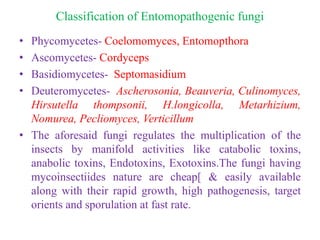
• Phycomycetes- Coelomomyces, Entomopthora
• Ascomycetes- Cordyceps
• Basidiomycetes- Septomasidium
• Deuteromycetes- Ascherosonia, Beauveria, Culinomyces,
Hirsutella thompsonii, H.longicolla, Metarhizium,
Nomurea, Pecliomyces, Verticillum
• The aforesaid fungi regulates the multiplication of the
insects by manifold activities like catabolic toxins,
anabolic toxins, Endotoxins, Exotoxins.The fungi having
mycoinsectiides nature are cheap[ & easily available
along with their rapid growth, high pathogenesis, target
orients and sporulation at fast rate.
Mycoinsecticides
• A number of fungi and its spores are used as
myconsecticides in this regard as follows.
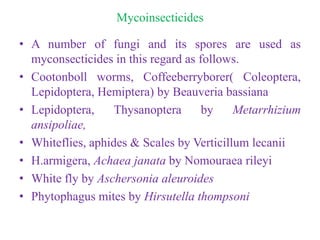
• Cootonboll worms, Coffeeberryborer( Coleoptera,
Lepidoptera, Hemiptera) by Beauveria bassiana
• Lepidoptera, Thysanoptera by Metarrhizium
ansipoliae,
• Whiteflies, aphides & Scales by Verticillum lecanii
• H.armigera, Achaea janata by Nomouraea rileyi
• White fly by Aschersonia aleuroides
• Phytophagus mites by Hirsutella thompsoni
MEDICAL MYCOLOGY
• Fungi responsible for number of human diseases as
classified:
• Superficial mycoses-skin, Nail & hairs,
• Subcutaneous mycoses- Myetoma
• Systemic mycoses- Aspergillosis
• Dermatophytes mainly infect superficial keratinised
tissues-skin, nail, hair, break down and utilizes
keratin , my be Trichophyton(Hair, skin,
nail),Microsporum(Hair, Skin), Epidermophyton(skin
& Nail), causes a number of health hazards even
death due to the attack of Aspergilus on the lungs
causing aspergillosis.
CONCLUSION
• Fungi envisages a wide uses in the near future in the
downstream processing of the agriculture based industries
with the help of the Recombinant DNA technology or
Genetic engineering. In addition of that, the
environmental biotechnology is also one of the most
coveted field of research in this regard. Mycoherbicides,
Mycoinsecicides, Mycofungicides & Myconematicides
are the very important domain for having eco-friendly &
sustainable development for the 21st century when a
number of threats are knocking at the door particularly on
the agriculture based economy like India, my motherland.
Better late than never”-let us have an optimistic future for
the green earth.
Hope, you have enjoyed this journey. Thanks a lot for your
patience to explore the beauty of so called unsung world.

Application of Fungi in Human Welfare

  • 1.
    Welcome to AppliedMycology: Role of Fungi in Biotechnology by N.Sannigrahi, Associate Professor, Department of Botany, Nistarini College, Purulia (W.B) 723101, India Science & Society are two parts of a same coin. The human beings are benefitted directly or indirectly by the fruits of science about in every sphere of life. Staring from the non-living to living entities, science has contributed a lot for the overall development of social life. The fungal kingdom, ubiquitous in nature found almost in every ecological niche contributes a lot since the time immemorial for the mankind-either as a food, medicine or ecological attributes by its applied blessings.
  • 2.
  • 3.
  • 4.
    Biotechnology definition • Biotechnologyis“the formation of new combinations of heritable material by the insertion of nucleic acid molecules produced by whatever means outside the cell, into any virus, bacterial plasmid or other vector system so as to allow their incorporation into a host organism in which they do not naturally occur but in which they are capable of continued propagation”.(Smith,1996). • Biotechnology is the "Controlled use of biological agents such as microorganisms or cellular components for beneficial us”( U. N. Science Federation). In a word, it is the art & science of the manipulation of DNA for the betterment of human welfare by man made engineered skills and delicacy.
  • 5.
    Application of fungiin Food industry • Fungi play an important role in fermentation, baking, organic acids, enzymes, mycoproteins, flavor of food & its texture with the help of the manipulation of nucleic acids. • Fermentation: Fermentation is the anaerobic process releasing end products alcohol or organic acids with little bit Carbon-di-oxide and fungi play an important role. Alcoholic beverages like wine, Beer, Rum, whisky, sake are some of the products marketed in the trade name. Fungi like Aspergillus oryzae, Endomyces lactis, Mucor sp, Neurospora crassa, Rhizopus sp, Saccharomyces beticus, S.cerevisae, S.oviformis, Torula sp, Trichosporium cutaneum etc.
  • 6.
    Baking • Baking &Bakery are intertwined to each other. Yeasts acts as a leavening agent in baking industry because of its ability to ferment sugar in the dough vigorously and to grow rapidly. Mostly unicellular fungi, Yeasts are used in this industry. Fungi used in fermenting wide variety of foods , including soy sauce, tempeh, nd cheeses. Cheese has its distinctive appearance and flavors because of the fungus growing through it. Besides Yeasts, Aspergillus niger also used in bakery. Rice beer , Pachai , a product of Mucor or Aspergillus used in this regard.
  • 7.
    Organic acids production •Organic acids like Citric acid are produced through the metabolisms of carbohydrate and they accumulate in broth of fermenter, wherefrom they are separated and purified. The organic acids are the terminal products of EMP pathway ( glycolysis) like lactic acid, propionic acids or the production of incomplete oxidation of sugar like citric acid, Kojic acid, Gallic acid, itaconic acid and gluconic acid. A third type of product is also obtained from the dehydrogenation of alcohol in the presence of oxygen i.e. acetic acid(Riviere,1977).The species of Penicillium & Aspergillus play a very important role in the production of organic acids through biotechnological application.
  • 8.
    Enzymes & Fungi •Aspergillus flavus-oryzae series introduced a number of enzymes like Digestin, Polyzime, Taka diastase are some of the enzymes in this regard. Enzymes & Sources of fungal origin given below: • Urate oxidase- Aspergilus flavus, Amylases, Protease, Pectinase, Glucose oxidase – A.niger, Amylases, Lipases, Protease by A.oryzae, Esterase, Invertase by Aureobasidium pullulans, Lipase by Candila lipolytica, Rennet by Mucor micheli & M.pusillus, Trysinase by Neurospora crassa,Dextrinase by Penicillum funiculosum, are some of the enzymes having commercial values are extracted with the help of biotechnological attributes.
  • 9.
    Enzymes & Fungi •Glucose oxidase by Penicillium notatum, Lipase by Rhizopus sp, Invertase by Saccharomyces cerevisiae & S.fragilis, Cellulase by Trichodema reesei & T.viride are also to be deserved mentioning and enzyme engineering are used for mass production making cost-effective. Since genes encode enzymes, the changes in gene certainly bring about alteration in enzyme structure. In addition to methods available for gene manipulation, alteration of genes by site directed mutagenesis for enzyme engineering has become much popular. Thus, site directed mutagenesis produces single amino acid substitution in the primary structure enzymes. In recent years. The enzyme engineering is used to denote the
  • 10.
    Continuation • Modification ofenzyme structure by the alteration of genes coding enzymes. An enzyme produced by a modified gene is structurally new which great promise to create a new enzyme. Enzyme Engineering embraces the (1) production of enzymes, (2)study of the structural features related to stability,(3) increase in stability by changing amino acids composition & (4) production of stable enzymes by genetically engineered fungal cells. The enzymes have an awesome promises due to its therapeutic uses, analytical uses, manipulative & industrial uses.
  • 11.
    MYCOPROTEINS • The driedcells of micro-organisms (algae, bacteria, actinomycetes & fungi)are used as food or feed collectively known as ‘microbial protein’ including SCP extracted from mostly algae. But Fungal protein termed as mycoprotein as introduced by Ranks Hovis McDougall(RHM) in the UK for protein produced on glucose or starch substrates by fungi. Many fungi are used for extraction of myco-proteins- • Nocardia & Thermomonospora fusca(Actinomycetes), Candida lypolytica, C.utilis, Saccharomyces cerevisiae, S.fragalis, Rhodotorula glutinis & Torulopsis(Yeasts), Aspergilus niger,
  • 12.
    Contd------- • Trichoderma viride,Paecilomyces varioti(Moulds) and Agaricus campestris, Morchella crassipes(Mushrooms) are some of the examples to speak about the mycoprotein sources using different types of substrates like cellulose pulp, Potato starch waste, Molasses, Sulphite liquor, Beer, Milk whey, domestic sewage, Methanol, Straw, starch, n-alkanes, glucose, cheese whey, etc for the aforesaid purpose. Strains of some moulds like Aspergilus niger, A.fumigatus, Fusarium graminearum are very much toxic not to be recommended for SCP production.
  • 13.
    Flavor of food& Texture • Many flavours of food are due to bacteria & fungi including trepans, menthol and lactones. Fungi produce compounds that deodorise offensive and neutralize bitter flavours which is important area of industrial uses. The red wine contains a pigments , polyketides that are insoluble in acid conditions. Beta carotene is produced by range of Mucorales.This can be added a variety of foods. Recombinant DNA technology is a very promising field that can contribute a lot for bringing about a new chapter in the transformation of food flavour an d texture of food having market potentiality.
  • 14.
    AGRICULTURE: Bio-fertilizers • Bio-fertilizers’denotes all the “nutrient inputs of biological origin for plant growth”(Subba Rao,1982).Microbial inoculants like bacteria, Mycorrhiza, Cynobaceria (Frankia) having capacity to fix atmospheric nitrogen is widely used as bio- fertilizers. Mycorrhiza, fungus roots having distinct morphological structure develops as a result of mutualistic symbiosis between some root-specific inhibiting fungi & plant roots. Plant grow in the nutrient scarcity region generally benefited by such association irrespective of their morphological & ecological status.
  • 15.
    Mycorrhiza • Mostly theinoculums of Ectomycorrhizal fungi, VAM are used in this purposes.Pisolithus tinctorius,Laccaria laccata, Discolea maculata, Hebeloma are some of the ectomycorrhiza used commercially. In VAM, Glomus, Scleocystis, Gigaspora, Scutellospora, Acaulospora, Entrophospora etc are some the members in the host plants like Sudan grass, strawberry, Sorghum, maize, onion, citrus for large scale production.Biofertilizers are cost effective, ecofriendly, capacity to retain physico-chemical properties and ability grow plants absorption area have made it commercially viable in the agricultural fields.
  • 16.
    BIOLOGICAL CONTROL- Mycofungicides, Mmycoherbicides,Mycoinsecticides & Myconemaicides • Due to adverse effect of synthetic chemicals on the crop ecology, different microorganisms can destroy or minimize the effects of weeds, insect & nematodes causing damage of the standing crops. Various fungal species can be used as biological control agents effective against pathogenic microorganisms.Trichoderma harzianum –a species with bio-control potential against Botrytis cineria, Fusarium, Pythium, Rhizoctonia; Ampelomyces quisqualis- a hyperparasite of powdery mildew, Chaetomium globosum against root rot disease caused by Fusarium, Phytopthora & Pythium.
  • 17.
    Mycoherbicides • Biological controlof plant pathogens are being realized recent years due to its manifold interest. Weeds are the unwanted plants in standing crops ant weeds control can be minimized by the sporulation of fungi. Some of the examples in this regard as follows. • Sida spinosa by Colletotricnum malvarum, sorghum halpense by C.graminicola, crotalaria spectabilis byC.dematium, Diospora virgiana by Acremonium disspyri, Perthenium hysteriphorous by Selerotium rolfsii, Fusarium oxysporum,water hyacinth by Cercospora rodmanii, Morrenia odorata by Phytopyhora citrophthora etc.
  • 18.
    Mycoherbicides • Mycoherbicides aredone by blending the fungal spores with inactive ingredients such as wheat straw, kaolin clay, sodium alginate ,cornmeal , infected oat & other ingredients. Mycoherbicides are produced by submerged liquid fermentation but in many cases, solid state, airlift fermentation& plant substrate remains are also used in this regard. • “Microbial control refers to the exploitation of disease causing microorganisms to reduce the population of insect pests below the injury level “. A number of fungi almost all the classes are used in this regard as below:
  • 19.
    Classification of Entomopathogenicfungi • Phycomycetes- Coelomomyces, Entomopthora • Ascomycetes- Cordyceps • Basidiomycetes- Septomasidium • Deuteromycetes- Ascherosonia, Beauveria, Culinomyces, Hirsutella thompsonii, H.longicolla, Metarhizium, Nomurea, Pecliomyces, Verticillum • The aforesaid fungi regulates the multiplication of the insects by manifold activities like catabolic toxins, anabolic toxins, Endotoxins, Exotoxins.The fungi having mycoinsectiides nature are cheap[ & easily available along with their rapid growth, high pathogenesis, target orients and sporulation at fast rate.
  • 20.
    Mycoinsecticides • A numberof fungi and its spores are used as myconsecticides in this regard as follows. • Cootonboll worms, Coffeeberryborer( Coleoptera, Lepidoptera, Hemiptera) by Beauveria bassiana • Lepidoptera, Thysanoptera by Metarrhizium ansipoliae, • Whiteflies, aphides & Scales by Verticillum lecanii • H.armigera, Achaea janata by Nomouraea rileyi • White fly by Aschersonia aleuroides • Phytophagus mites by Hirsutella thompsoni
  • 21.
    MEDICAL MYCOLOGY • Fungiresponsible for number of human diseases as classified: • Superficial mycoses-skin, Nail & hairs, • Subcutaneous mycoses- Myetoma • Systemic mycoses- Aspergillosis • Dermatophytes mainly infect superficial keratinised tissues-skin, nail, hair, break down and utilizes keratin , my be Trichophyton(Hair, skin, nail),Microsporum(Hair, Skin), Epidermophyton(skin & Nail), causes a number of health hazards even death due to the attack of Aspergilus on the lungs causing aspergillosis.
  • 22.
    CONCLUSION • Fungi envisagesa wide uses in the near future in the downstream processing of the agriculture based industries with the help of the Recombinant DNA technology or Genetic engineering. In addition of that, the environmental biotechnology is also one of the most coveted field of research in this regard. Mycoherbicides, Mycoinsecicides, Mycofungicides & Myconematicides are the very important domain for having eco-friendly & sustainable development for the 21st century when a number of threats are knocking at the door particularly on the agriculture based economy like India, my motherland. Better late than never”-let us have an optimistic future for the green earth.
  • 23.
    Hope, you haveenjoyed this journey. Thanks a lot for your patience to explore the beauty of so called unsung world.