

Causality and Causal Modelling
in the Social Science
Federica Russo
Philosophy | Humanities | Amsterdam
russofederica.wordpress.com | @federicarusso
© Federica Russo
Staff for a
New University
@rethinkuva
Rethink UvA
2
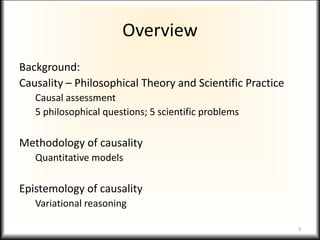
Overview
Background:
Causality – Philosophical Theory and Scientific Practice
Causal assessment
5 philosophical questions; 5 scientific problems
Methodology of causality
Quantitative models
Epistemology of causality
Variational reasoning
3
PHILOSOPHICAL THEORY AND
SCIENTIFIC PRACTICE
4
Causal assessment
‘What Causes What’
Different things we may want to establish:
what’s the cause of a patient’s illness
who is (legally / morally) responsible for some state of affairs
what are the causes of unemployment
what causes marriage dissolution or migration behaviour
what causes dysfunction in an organisation
which pathways explain some cellular behaviour
…
5
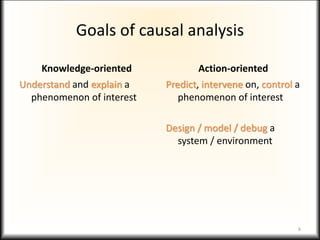
Goals of causal analysis
Knowledge-oriented
Understand and explain a
phenomenon of interest
Action-oriented
Predict, intervene on, control a
phenomenon of interest
Design / model / debug a
system / environment
6
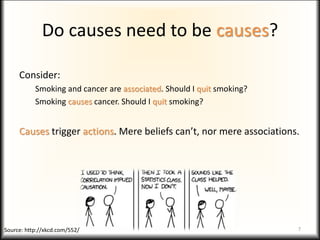
Do causes need to be causes?
Consider:
Smoking and cancer are associated. Should I quit smoking?
Smoking causes cancer. Should I quit smoking?
Causes trigger actions. Mere beliefs can’t, nor mere associations.
7
Source: http://xkcd.com/552/
Scientific practice first
CitS / PSP / PI
Philosophical questions about causation (and other
topics) are motivated by methodological and
practical problems in real science
Start from scientific practice to bottom up
philosophy
Partly descriptive and partly normative
No conceptual ‘straightjacket’
8
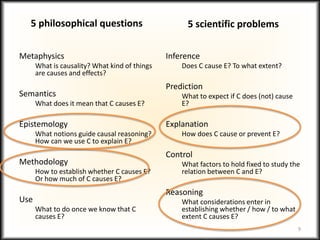
5 philosophical questions
Metaphysics
What is causality? What kind of things
are causes and effects?
Semantics
What does it mean that C causes E?
Epistemology
What notions guide causal reasoning?
How can we use C to explain E?
Methodology
How to establish whether C causes E?
Or how much of C causes E?
Use
What to do once we know that C
causes E?
5 scientific problems
Inference
Does C cause E? To what extent?
Prediction
What to expect if C does (not) cause
E?
Explanation
How does C cause or prevent E?
Control
What factors to hold fixed to study the
relation between C and E?
Reasoning
What considerations enter in
establishing whether / how / to what
extent C causes E?
9
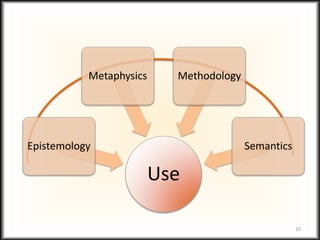
Use
Epistemology
Metaphysics Methodology
Semantics
10
How many concepts? Many!
Causality
Polysemic, thick concept
Causal verbs
Pulling, pushing, binding, …
Causal methods
Tracking what varies with what
Understanding what produces what, and how, and when
Different sources of evidence
Evidence of difference making, of production
…
11
12
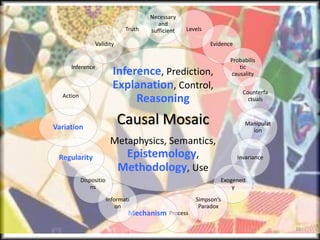
Causal pluralism:
Causality cannot be reduced to one single concept
but has to be analysed using several concepts
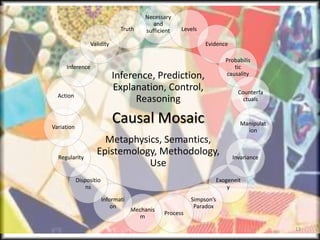
Inference, Prediction,
Explanation, Control,
Reasoning
Causal Mosaic
Metaphysics, Semantics,
Epistemology, Methodology,
Use
Necessary
and
sufficient Levels
Evidence
Probabilis
tic
causality
Counterfa
ctuals
Manipulat
ion
Invariance
Exogeneit
y
Simpson’s
Paradox
Process
Mechanis
m
Informati
on
Dispositio
ns
Regularity
Variation
Action
Inference
Validity
Truth
13
METHODOLOGY OF CAUSALITY
14
Causal models
Structural equation models, covariance
structure models, contingency tables, multilevel
models, regression models, Bayesian networks,
potential outcome models, quasi-experimental
models, spatial models …
Quantitative models: statistical models
15
‘Statistical’ causes
Gather a large number of observations,
organise them in variables
E.g. socio-biological characteristics (exposure) and cancer
rates (disease)
Study the (in)dependencies between variables,
robustness and stability of correlations
Establish stable patterns of (in)dependencies
to identify risk factors and possible interventions
16
What does a causal model do?
A causal model:
models the properties of a (social) system
detects (causal) relations between the properties of
the system
explains the functioning of the system through its
causes
17
18
54
4
13
34
12
2
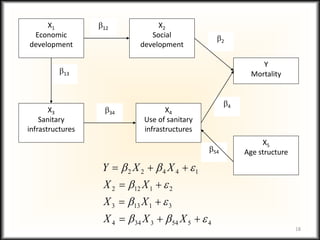
X1
Economic
development
X2
Social
development
X3
Sanitary
infrastructures
X4
Use of sanitary
infrastructures
X5
Age structure
Y
Mortality
4
5
54
3
34
4
3
1
13
3
2
1
12
2
1
4
4
2
2




















X
X
X
X
X
X
X
X
X
Y
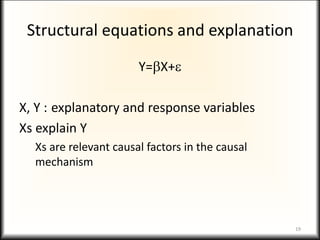
Structural equations and explanation
Y=X+
X, Y : explanatory and response variables
Xs explain Y
Xs are relevant causal factors in the causal
mechanism
19
EPISTEMOLOGY OF CAUSALITY
20
Causal discovery is reasoning about variations.
To establish causes we need difference.
21
‘Statistical’ variations
“Gather data about socio-economic status, occupation,
diet, smoking behaviour and see how steadily they
are associated with cancer”
Study how variations in exposure are related to
variations in disease
How different levels of exposure change the probability
of disease
Statistical reasoning: search for those factors explaining
the variance of the outcome
22
FOUNDATIONS
23
Variations in Mill
Agreement:
comparing different instances in which the
phenomenon occurs.
Difference:
comparing instances in which the
phenomenon does occur with similar
instances in which it does not.
Residues:
subducting from any given phenomenon all
the portions which can be assigned to
known causes, the remainder will be the
effect of the antecedents which had been
overlooked or of which the effect was as
yet an un-known quantity.
Concomitant Variation:
in presence of permanent causes or
indestructible natural agents that are
impossible either to exclude or to isolate,
we can neither hinder them from being
present nor contrive that they shall be
present alone. Comparison between
concomitant variations will enable us to
detect the causes.
Mill (1843), System of Logic
The experimental method is based
on the Baconian rule of varying
the circumstances
The Four Methods are all based on
the evaluation of variations
24
Variations in Durkheim
Durkheim (1897), Le suicide
A study into the variability of suicide rate
A search for the causes making suicide rate vary
Durkheim (1885), Les règles de la méthode sociologique
The method of concomitant variations
makes sociology scientific
25
Learning ‘ordinary’ causes
Humean regularity
Instances of smoke follow instances of fire
Can’t establish logical, necessary link
Create expectation, project causal belief onto the future
Epistemology of causal modelling seems to be at
variance with the Humean account
See next
26
Learning ‘scientific’ causes
Causal discovery (experiments, statistics)
Search for differences
Explaining differences
Variation, difference, comes first
27
Regularity too
Statistical regularity
Causal methodology needs regularity as a constraint on
variations, differences
Scientific causes are ‘generic’
Population-level, repeatable
Hence we need regularity to establish generic level
28
TO SUM UP AND CONCLUDE
29
Inference, Prediction,
Explanation, Control,
Reasoning
Causal Mosaic
Metaphysics, Semantics,
Epistemology,
Methodology, Use
Necessary
and
sufficient Levels
Evidence
Probabilis
tic
causality
Counterfa
ctuals
Manipulat
ion
Invariance
Exogeneit
y
Simpson’s
Paradox
Process
Mechanism
Informati
on
Dispositio
ns
Regularity
Variation
Action
Inference
Validity
Truth
30
Philosophical theory meets scientific practice
Scientific practice first
Then, be precise about your question, target specific
scientific challenges
Causal pluralism, in the form of ‘causal mosaic’, is a
sophisticated philosophical view
Methodology of causality is rich and diverse
Choose the method best adapted to your problem
Epistemology of causality is about how we find out about
causes
Variation guides causal reasoning in various forms
31

Causality and causal modelling in the social sciences

  • 1.
    Causality and CausalModelling in the Social Science Federica Russo Philosophy | Humanities | Amsterdam russofederica.wordpress.com | @federicarusso © Federica Russo
  • 2.
    Staff for a NewUniversity @rethinkuva Rethink UvA 2
  • 3.
    Overview Background: Causality – PhilosophicalTheory and Scientific Practice Causal assessment 5 philosophical questions; 5 scientific problems Methodology of causality Quantitative models Epistemology of causality Variational reasoning 3
  • 4.
  • 5.
    Causal assessment ‘What CausesWhat’ Different things we may want to establish: what’s the cause of a patient’s illness who is (legally / morally) responsible for some state of affairs what are the causes of unemployment what causes marriage dissolution or migration behaviour what causes dysfunction in an organisation which pathways explain some cellular behaviour … 5
  • 6.
    Goals of causalanalysis Knowledge-oriented Understand and explain a phenomenon of interest Action-oriented Predict, intervene on, control a phenomenon of interest Design / model / debug a system / environment 6
  • 7.
    Do causes needto be causes? Consider: Smoking and cancer are associated. Should I quit smoking? Smoking causes cancer. Should I quit smoking? Causes trigger actions. Mere beliefs can’t, nor mere associations. 7 Source: http://xkcd.com/552/
  • 8.
    Scientific practice first CitS/ PSP / PI Philosophical questions about causation (and other topics) are motivated by methodological and practical problems in real science Start from scientific practice to bottom up philosophy Partly descriptive and partly normative No conceptual ‘straightjacket’ 8
  • 9.
    5 philosophical questions Metaphysics Whatis causality? What kind of things are causes and effects? Semantics What does it mean that C causes E? Epistemology What notions guide causal reasoning? How can we use C to explain E? Methodology How to establish whether C causes E? Or how much of C causes E? Use What to do once we know that C causes E? 5 scientific problems Inference Does C cause E? To what extent? Prediction What to expect if C does (not) cause E? Explanation How does C cause or prevent E? Control What factors to hold fixed to study the relation between C and E? Reasoning What considerations enter in establishing whether / how / to what extent C causes E? 9
  • 10.
  • 11.
    How many concepts?Many! Causality Polysemic, thick concept Causal verbs Pulling, pushing, binding, … Causal methods Tracking what varies with what Understanding what produces what, and how, and when Different sources of evidence Evidence of difference making, of production … 11
  • 12.
    12 Causal pluralism: Causality cannotbe reduced to one single concept but has to be analysed using several concepts
  • 13.
    Inference, Prediction, Explanation, Control, Reasoning CausalMosaic Metaphysics, Semantics, Epistemology, Methodology, Use Necessary and sufficient Levels Evidence Probabilis tic causality Counterfa ctuals Manipulat ion Invariance Exogeneit y Simpson’s Paradox Process Mechanis m Informati on Dispositio ns Regularity Variation Action Inference Validity Truth 13
  • 14.
  • 15.
    Causal models Structural equationmodels, covariance structure models, contingency tables, multilevel models, regression models, Bayesian networks, potential outcome models, quasi-experimental models, spatial models … Quantitative models: statistical models 15
  • 16.
    ‘Statistical’ causes Gather alarge number of observations, organise them in variables E.g. socio-biological characteristics (exposure) and cancer rates (disease) Study the (in)dependencies between variables, robustness and stability of correlations Establish stable patterns of (in)dependencies to identify risk factors and possible interventions 16
  • 17.
    What does acausal model do? A causal model: models the properties of a (social) system detects (causal) relations between the properties of the system explains the functioning of the system through its causes 17
  • 18.
    18 54 4 13 34 12 2 X1 Economic development X2 Social development X3 Sanitary infrastructures X4 Use of sanitary infrastructures X5 Agestructure Y Mortality 4 5 54 3 34 4 3 1 13 3 2 1 12 2 1 4 4 2 2                     X X X X X X X X X Y
  • 19.
    Structural equations andexplanation Y=X+ X, Y : explanatory and response variables Xs explain Y Xs are relevant causal factors in the causal mechanism 19
  • 20.
  • 21.
    Causal discovery isreasoning about variations. To establish causes we need difference. 21
  • 22.
    ‘Statistical’ variations “Gather dataabout socio-economic status, occupation, diet, smoking behaviour and see how steadily they are associated with cancer” Study how variations in exposure are related to variations in disease How different levels of exposure change the probability of disease Statistical reasoning: search for those factors explaining the variance of the outcome 22
  • 23.
  • 24.
    Variations in Mill Agreement: comparingdifferent instances in which the phenomenon occurs. Difference: comparing instances in which the phenomenon does occur with similar instances in which it does not. Residues: subducting from any given phenomenon all the portions which can be assigned to known causes, the remainder will be the effect of the antecedents which had been overlooked or of which the effect was as yet an un-known quantity. Concomitant Variation: in presence of permanent causes or indestructible natural agents that are impossible either to exclude or to isolate, we can neither hinder them from being present nor contrive that they shall be present alone. Comparison between concomitant variations will enable us to detect the causes. Mill (1843), System of Logic The experimental method is based on the Baconian rule of varying the circumstances The Four Methods are all based on the evaluation of variations 24
  • 25.
    Variations in Durkheim Durkheim(1897), Le suicide A study into the variability of suicide rate A search for the causes making suicide rate vary Durkheim (1885), Les règles de la méthode sociologique The method of concomitant variations makes sociology scientific 25
  • 26.
    Learning ‘ordinary’ causes Humeanregularity Instances of smoke follow instances of fire Can’t establish logical, necessary link Create expectation, project causal belief onto the future Epistemology of causal modelling seems to be at variance with the Humean account See next 26
  • 27.
    Learning ‘scientific’ causes Causaldiscovery (experiments, statistics) Search for differences Explaining differences Variation, difference, comes first 27
  • 28.
    Regularity too Statistical regularity Causalmethodology needs regularity as a constraint on variations, differences Scientific causes are ‘generic’ Population-level, repeatable Hence we need regularity to establish generic level 28
  • 29.
    TO SUM UPAND CONCLUDE 29
  • 30.
    Inference, Prediction, Explanation, Control, Reasoning CausalMosaic Metaphysics, Semantics, Epistemology, Methodology, Use Necessary and sufficient Levels Evidence Probabilis tic causality Counterfa ctuals Manipulat ion Invariance Exogeneit y Simpson’s Paradox Process Mechanism Informati on Dispositio ns Regularity Variation Action Inference Validity Truth 30
  • 31.
    Philosophical theory meetsscientific practice Scientific practice first Then, be precise about your question, target specific scientific challenges Causal pluralism, in the form of ‘causal mosaic’, is a sophisticated philosophical view Methodology of causality is rich and diverse Choose the method best adapted to your problem Epistemology of causality is about how we find out about causes Variation guides causal reasoning in various forms 31