
Evidence as
semantic
information
Federica Russo
Professor of Ethics and Philosophy of Techno-
Science, Freudenthal Institute, Utrecht
University
Fellow at KHK Cultures of Research, RWTH
Aachen
SOLARIS, project coordinator
The
evidence
turn
2
This Photo by Unknown Author is licensed under CC BY-SA
Questions
at the
core of
phil sci
What do we know?
A question about scientific knowledge,
about the claims the sciences make
And how do we know what we claim we
know?
A question about the concepts and
methods that allow us to establish
scientific knowledge
3
Traditional
strategies
to the core
questions
Debates in the fields of scientific realism and
modelling
Science aims to establish truth
There is a true reality out there to be
discovered
Our models improve and approximate to
this truth
4
The ‘practice
turn’ in phil
sci
Models are part of scientific
practices
These, and other practices, allow
us to gather evidence
It is on the basis of evidence that
we establish scientific claims
5
Evidence is
ubiquitous
In the sciences
Because ultimately any scientific
practice is about gathering,
processing, and assessing evidence
But also in phil sci
Many debates now about evidence
Evidence-based medicine
Evidence of mechanisms
Data and evidence
…
6
An
underexplore
d question
Many of these debates try to discuss
Whether evidence comes into
categories
How evidence supports scientific
claims
How evidence is gathered
What to do with missing/poor
evidence
But what is evidence?
7
What evidence is
8
Formal
approache
s
Evidence is what allows certain formal
(probabilistic) relations to hold,
especially with respect to (scientific)
hypotheses
Example questions
How does the p(H) change given some E?
When is H confirmed by E?
When is belief in H justified by E?
9
Formal
approache
s
An established tradition in analytic phil
sci
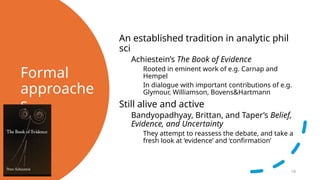
Achiestein’s The Book of Evidence
Rooted in eminent work of e.g. Carnap and
Hempel
In dialogue with important contributions of e.g.
Glymour, Williamson, Bovens&Hartmann
Still alive and active
Bandyopadhyay, Brittan, and Taper’s Belief,
Evidence, and Uncertainty
They attempt to reassess the debate, and take a
fresh look at ‘evidence’ and ‘confirmation’
10
Evidential
pluralism
Evidence is what allows one to
establish (causal) claims (in medicine,
and elsewhere)
Causal claims are to be established
based on multiple sources of evidence
Evidence of difference-making and of
mechanisms label the most important
categories of what we seek evidence of
11
Evidential
pluralism
A debate that originated in questions
of medical methodology sciences
Trying to establish relevance of phil
sci to the practice of science
See EBM+ and the tools for
assessing evidence of
mechanisms
Expanding to other scientific areas
(e.g. social science)
12
In sum:
• Formal approaches are … formal and
leave largely unspecified what ‘E’ is (and
that’s OK)
• Evidential pluralism fixes what ‘E’ is in a
rather specific way (and that’s OK)
• We are stuck between <no> or <too
much> specification of what E is
• What I’m interested in:
• what the content of evidence is,
• how is evidence generated in the
context of modelling,
[which role(s) epistemic agents have in
the practice of evidence generation]
13
Evidence:
an informational
approach
14
Sketch of
an idea
• Evidence is ubiquitous
• Evidence means different things in different
research contexts
• How best to account for
• Generality?
• Variety?
• Intuitively: various methods to generate
information about problem X
• Not a loose, common-sense meaning of
information
• Information as developed in the philosophy
of information
15
Brief
interlude:
Why going
informational?
PI: a sub-
field
within
philosoph
y
Information’ is a central notion, to be
investigated in its ontological,
epistemological, methodological significance
Making ‘information’ central to philosophy
allows us to re-design our conceptual
apparatus
Knowledge, Truth, Modelling, … All
require redesigning
All this is (partly) motivated by the digital
revolution
17
PI: a
philosophic
al
methodolog
y
The ‘method of the levels of abstraction’ (LoA)
Borrowed from computer science to analyse
systems and their models
Applied to philosophical questions: specify the
‘level’ at which a question is asked, and an
answer given
Avoid ambiguity, enhance rigour, facilitate
comparison
Constructionism
A general approach to describe the relations
between us epistemic agents and the outside
world
It is in between realism and
constructivism; we “in-scribe” reality, not
just de-scribe or pre-scribe
18
19
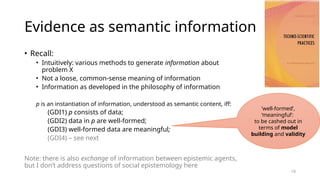
Evidence as semantic information
• Recall:
• Intuitively: various methods to generate information about
problem X
• Not a loose, common-sense meaning of information
• Information as developed in the philosophy of information
p is an instantiation of information, understood as semantic content, iff:
(GDI1) p consists of data;
(GDI2) data in p are well-formed;
(GDI3) well-formed data are meaningful;
(GDI4) – see next
Note: there is also exchange of information between epistemic agents,
but I don’t address questions of social epistemology here
'well-formed’,
‘meaningful’:
to be cashed out in
terms of model
building and validity
20
Floridi’s work is
modelled on ordinary
language +
computational
approach.
I extend it to modelling
practices
Establishing evidence claims:
a correctness approach to truth
• To establish an evidence claim is to establish that a given claim is true
• p is an instantiation of information, understood as semantic content, iff:
(GDI1) p consists of data;
(GDI2) data in p are well-formed;
(GDI3) well-formed data are meaningful.
(GDI4) meaningful well-formed data are truthful.
• A truthful expression is one that is correct within the modelled system.
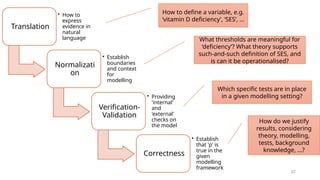
• 5 steps in PI approach to correctness:
• Translation > Polarization > Normalization > Verification and Validation >
Correctness
Truth:
metaphysically
light, model-based
The problem of correspondence
• The classic approach to correspondence:
• “The snow is white” iff the snow is white
• Find correspondence between facts and language
• Sophisticated metaphysical stories about truth makers but not quite
fitting modelling practices
• Think of: “Smoking causes cancer” iff smoking causes cancer
• What smoking? How much? By whom? What if quitting for some time?
• Correctness theory of truth is no simplistic approach to correspondence!
• To repeat: an evidence claim is true within a given modelling approach
21
22
Translation
• How to
express
evidence in
natural
language
Normalizati
on
• Establish
boundaries
and context
for
modelling
Verification-
Validation
• Providing
'internal'
and
'external'
checks on
the model
Correctness
• Establish
that 'p' is
true in the
given
modelling
framework
How to define a variable, e.g.
‘vitamin D deficiency’, ‘SES’, …
What thresholds are meaningful for
‘deficiency’? What theory supports
such-and-such definition of SES, and
is can it be operationalised?
Which specific tests are in place
in a given modelling setting?
How do we justify
results, considering
theory, modelling,
tests, background
knowledge, …?
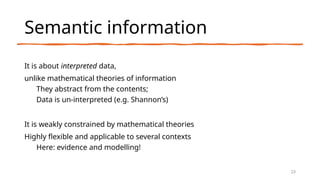
Semantic information
It is about interpreted data,
unlike mathematical theories of information
They abstract from the contents;
Data is un-interpreted (e.g. Shannon’s)
It is weakly constrained by mathematical theories
Highly flexible and applicable to several contexts
Here: evidence and modelling!
23
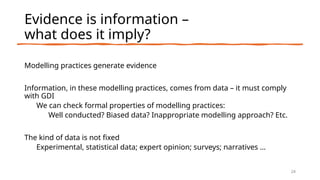
Evidence is information –
what does it imply?
Modelling practices generate evidence
Information, in these modelling practices, comes from data – it must comply
with GDI
We can check formal properties of modelling practices:
Well conducted? Biased data? Inappropriate modelling approach? Etc.
The kind of data is not fixed
Experimental, statistical data; expert opinion; surveys; narratives …
24
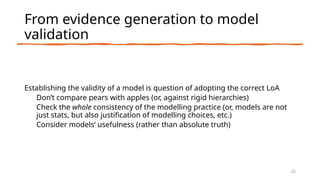
From evidence generation to model
validation
Establishing the validity of a model is question of adopting the correct LoA
Don’t compare pears with apples (or, against rigid hierarchies)
Check the whole consistency of the modelling practice (or, models are not
just stats, but also justification of modelling choices, etc.)
Consider models’ usefulness (rather than absolute truth)
25
To sum up and
conclude
26
27
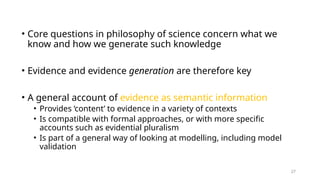
• Core questions in philosophy of science concern what we
know and how we generate such knowledge
• Evidence and evidence generation are therefore key
• A general account of evidence as semantic information
• Provides ‘content’ to evidence in a variety of contexts
• Is compatible with formal approaches, or with more specific
accounts such as evidential pluralism
• Is part of a general way of looking at modelling, including model
validation
Evidence as
semantic
information
Federica Russo
Professor of Ethics and Philosophy of Techno-
Science, Freudenthal Institute, Utrecht
University
Fellow at KHK Cultures of Research, RWTH
Aachen
SOLARIS, project coordinator
Thanks for your
attention

Russo-Evidence-semantic-information.pptx

  • 1.
    Evidence as semantic information Federica Russo Professorof Ethics and Philosophy of Techno- Science, Freudenthal Institute, Utrecht University Fellow at KHK Cultures of Research, RWTH Aachen SOLARIS, project coordinator
  • 2.
    The evidence turn 2 This Photo byUnknown Author is licensed under CC BY-SA
  • 3.
    Questions at the core of philsci What do we know? A question about scientific knowledge, about the claims the sciences make And how do we know what we claim we know? A question about the concepts and methods that allow us to establish scientific knowledge 3
  • 4.
    Traditional strategies to the core questions Debatesin the fields of scientific realism and modelling Science aims to establish truth There is a true reality out there to be discovered Our models improve and approximate to this truth 4
  • 5.
    The ‘practice turn’ inphil sci Models are part of scientific practices These, and other practices, allow us to gather evidence It is on the basis of evidence that we establish scientific claims 5
  • 6.
    Evidence is ubiquitous In thesciences Because ultimately any scientific practice is about gathering, processing, and assessing evidence But also in phil sci Many debates now about evidence Evidence-based medicine Evidence of mechanisms Data and evidence … 6
  • 7.
    An underexplore d question Many ofthese debates try to discuss Whether evidence comes into categories How evidence supports scientific claims How evidence is gathered What to do with missing/poor evidence But what is evidence? 7
  • 8.
  • 9.
    Formal approache s Evidence is whatallows certain formal (probabilistic) relations to hold, especially with respect to (scientific) hypotheses Example questions How does the p(H) change given some E? When is H confirmed by E? When is belief in H justified by E? 9
  • 10.
    Formal approache s An established traditionin analytic phil sci Achiestein’s The Book of Evidence Rooted in eminent work of e.g. Carnap and Hempel In dialogue with important contributions of e.g. Glymour, Williamson, Bovens&Hartmann Still alive and active Bandyopadhyay, Brittan, and Taper’s Belief, Evidence, and Uncertainty They attempt to reassess the debate, and take a fresh look at ‘evidence’ and ‘confirmation’ 10
  • 11.
    Evidential pluralism Evidence is whatallows one to establish (causal) claims (in medicine, and elsewhere) Causal claims are to be established based on multiple sources of evidence Evidence of difference-making and of mechanisms label the most important categories of what we seek evidence of 11
  • 12.
    Evidential pluralism A debate thatoriginated in questions of medical methodology sciences Trying to establish relevance of phil sci to the practice of science See EBM+ and the tools for assessing evidence of mechanisms Expanding to other scientific areas (e.g. social science) 12
  • 13.
    In sum: • Formalapproaches are … formal and leave largely unspecified what ‘E’ is (and that’s OK) • Evidential pluralism fixes what ‘E’ is in a rather specific way (and that’s OK) • We are stuck between <no> or <too much> specification of what E is • What I’m interested in: • what the content of evidence is, • how is evidence generated in the context of modelling, [which role(s) epistemic agents have in the practice of evidence generation] 13
  • 14.
  • 15.
    Sketch of an idea •Evidence is ubiquitous • Evidence means different things in different research contexts • How best to account for • Generality? • Variety? • Intuitively: various methods to generate information about problem X • Not a loose, common-sense meaning of information • Information as developed in the philosophy of information 15
  • 16.
  • 17.
    PI: a sub- field within philosoph y Information’is a central notion, to be investigated in its ontological, epistemological, methodological significance Making ‘information’ central to philosophy allows us to re-design our conceptual apparatus Knowledge, Truth, Modelling, … All require redesigning All this is (partly) motivated by the digital revolution 17
  • 18.
    PI: a philosophic al methodolog y The ‘methodof the levels of abstraction’ (LoA) Borrowed from computer science to analyse systems and their models Applied to philosophical questions: specify the ‘level’ at which a question is asked, and an answer given Avoid ambiguity, enhance rigour, facilitate comparison Constructionism A general approach to describe the relations between us epistemic agents and the outside world It is in between realism and constructivism; we “in-scribe” reality, not just de-scribe or pre-scribe 18
  • 19.
    19 Evidence as semanticinformation • Recall: • Intuitively: various methods to generate information about problem X • Not a loose, common-sense meaning of information • Information as developed in the philosophy of information p is an instantiation of information, understood as semantic content, iff: (GDI1) p consists of data; (GDI2) data in p are well-formed; (GDI3) well-formed data are meaningful; (GDI4) – see next Note: there is also exchange of information between epistemic agents, but I don’t address questions of social epistemology here 'well-formed’, ‘meaningful’: to be cashed out in terms of model building and validity
  • 20.
    20 Floridi’s work is modelledon ordinary language + computational approach. I extend it to modelling practices Establishing evidence claims: a correctness approach to truth • To establish an evidence claim is to establish that a given claim is true • p is an instantiation of information, understood as semantic content, iff: (GDI1) p consists of data; (GDI2) data in p are well-formed; (GDI3) well-formed data are meaningful. (GDI4) meaningful well-formed data are truthful. • A truthful expression is one that is correct within the modelled system. • 5 steps in PI approach to correctness: • Translation > Polarization > Normalization > Verification and Validation > Correctness Truth: metaphysically light, model-based
  • 21.
    The problem ofcorrespondence • The classic approach to correspondence: • “The snow is white” iff the snow is white • Find correspondence between facts and language • Sophisticated metaphysical stories about truth makers but not quite fitting modelling practices • Think of: “Smoking causes cancer” iff smoking causes cancer • What smoking? How much? By whom? What if quitting for some time? • Correctness theory of truth is no simplistic approach to correspondence! • To repeat: an evidence claim is true within a given modelling approach 21
  • 22.
    22 Translation • How to express evidencein natural language Normalizati on • Establish boundaries and context for modelling Verification- Validation • Providing 'internal' and 'external' checks on the model Correctness • Establish that 'p' is true in the given modelling framework How to define a variable, e.g. ‘vitamin D deficiency’, ‘SES’, … What thresholds are meaningful for ‘deficiency’? What theory supports such-and-such definition of SES, and is can it be operationalised? Which specific tests are in place in a given modelling setting? How do we justify results, considering theory, modelling, tests, background knowledge, …?
  • 23.
    Semantic information It isabout interpreted data, unlike mathematical theories of information They abstract from the contents; Data is un-interpreted (e.g. Shannon’s) It is weakly constrained by mathematical theories Highly flexible and applicable to several contexts Here: evidence and modelling! 23
  • 24.
    Evidence is information– what does it imply? Modelling practices generate evidence Information, in these modelling practices, comes from data – it must comply with GDI We can check formal properties of modelling practices: Well conducted? Biased data? Inappropriate modelling approach? Etc. The kind of data is not fixed Experimental, statistical data; expert opinion; surveys; narratives … 24
  • 25.
    From evidence generationto model validation Establishing the validity of a model is question of adopting the correct LoA Don’t compare pears with apples (or, against rigid hierarchies) Check the whole consistency of the modelling practice (or, models are not just stats, but also justification of modelling choices, etc.) Consider models’ usefulness (rather than absolute truth) 25
  • 26.
    To sum upand conclude 26
  • 27.
    27 • Core questionsin philosophy of science concern what we know and how we generate such knowledge • Evidence and evidence generation are therefore key • A general account of evidence as semantic information • Provides ‘content’ to evidence in a variety of contexts • Is compatible with formal approaches, or with more specific accounts such as evidential pluralism • Is part of a general way of looking at modelling, including model validation
  • 28.
    Evidence as semantic information Federica Russo Professorof Ethics and Philosophy of Techno- Science, Freudenthal Institute, Utrecht University Fellow at KHK Cultures of Research, RWTH Aachen SOLARIS, project coordinator Thanks for your attention

Editor's Notes

  • #1 Thanks, apologies, grateful can do it online What I’m trying to do: go a step up in the conceptualization of evidence. Startig point: ubiquitous, very different things. Not rejecting any of what I’ve done in the past, specificially evidential pluralism ===== An informational approach to evidence Scientific claims are based on evidence. This is hardly contested. What is evidence, instead, is far more contentious. In philosophy of science, one approach to evidence is to analyse the formal and probabilistic relations between evidence (E) and hypotheses (H). However, such an approach remains largely silent about these E and H amounts to. Another approach, evidential pluralism, puts forward an epistemological and methodological thesis according to which evidence of correlation and of mechanisms is needed in order to establish causal claims. This approach is very specific about to the object of evidence needed (of correlation, of mechanisms) and about the purpose (establishing a causal claim). Is it possible to provide a more general and widely applicable account of what evidence is? In this talk, I explore the prospects of an informational approach to evidence and I sketch the consequences this might have on concepts such as model validation. ===OLD=== Evidence and Modelling super classic notions in phil sci. Longstanding, old, debates on either. Also new perspectives (see e.g. EBM, EBM+, …) Exercise here: see whether anything changes once: Practice approach PI approach Are adopted. Focus on EVIDENCE, but clearly need to step back and start from modelling, and anticipate consequences on truth and knowledge. So clearly not self-contained. It cannot be. Once you start doing PA, PI approaches, the interrelations between difference concepts emerge to the surface and cannot be ignored.
  • #2 Framing questions of evidence in more general Phil Sci debates
  • #8 Again, not going against things I’ve argued for in the past. Also trying to systematize debates in Phil Sci
  • #13 Explain I don’t go into questions of role of epistemic agents, this also involves discussing human vs artificial agents, and the then Q of social epistemology. Not for this talk.
  • #20 Say I’ll skip polarization, not very useful in the context of modelling
  • #22 Translation Core Idea. Many things, not always expressed in natural language, may count as Si. We need to ensure that they can be translated into natural language and convey the same semantic content. For instance: statistical results, results of machine/lab analyses, emotions of interviewees filmed or photographed, field work records (pictures, objects, . . . ), and so on. To treat these pieces of Si, we translate them, more or less explicitly, into natural language. Normalization When we specify purpose and context of a model, these have to make implicit reference to the available and meaningful possibilities. In techno-scientific contexts, it is part of the practice of model validation to establish which possibilities are available and meaningful. Verification Validation Core Idea. Verification and validation are terms borrowed from software engineering and computer science. Verification means to check that the specifications set at the start are satisfied; this is an “internal” check, based on formal aspects of the model. Validation means to check that the require- ments (or the purpose) are satisfied; this is an “external” check, based on whether the model would return “good” results against empirical data of some kind. In any of these modeling practices, we are confronted with two moments: specifying the requirements of the model and checking whether the requirements are satisfied. It is therefore useful to retain this step, but with a broader understanding of “verification” and “validation.” Correctness Core Idea. Correctness expresses the way in which, after verification and validation, Q+R produce an adequate model M of a system S. An adequate model means that M acts as a proxy to S, and via M we can gain access to the system S, and thus establishes truth. In techno-scientific practices, this effectively means that the truth of any claim is established within a given modeling practice. With verified, validated, and correct modeling practices we can access particular features of a system being modeled, and so the process of verification and validation, plus correctness, is what allows us to establish truth. But this is not a direct correspondence between propositions and reality; it is instead one that is fundamentally constructed through the techno- scientific practices in place.
  • #28  ===== An informational approach to evidence Scientific claims are based on evidence. This is hardly contested. What is evidence, instead, is far more contentious. In philosophy of science, one approach to evidence is to analyse the formal and probabilistic relations between evidence (E) and hypotheses (H). However, such an approach remains largely silent about these E and H amounts to. Another approach, evidential pluralism, puts forward an epistemological and methodological thesis according to which evidence of correlation and of mechanisms is needed in order to establish causal claims. This approach is very specific about to the object of evidence needed (of correlation, of mechanisms) and about the purpose (establishing a causal claim). Is it possible to provide a more general and widely applicable account of what evidence is? In this talk, I explore the prospects of an informational approach to evidence and I sketch the consequences this might have on concepts such as model validation. ===OLD=== Evidence and Modelling super classic notions in phil sci. Longstanding, old, debates on either. Also new perspectives (see e.g. EBM, EBM+, …) Exercise here: see whether anything changes once: Practice approach PI approach Are adopted. Focus on EVIDENCE, but clearly need to step back and start from modelling, and anticipate consequences on truth and knowledge. So clearly not self-contained. It cannot be. Once you start doing PA, PI approaches, the interrelations between difference concepts emerge to the surface and cannot be ignored.