Are causal relations invariant or regular?
Or both.
Federica Russo
Philosophy | Humanities | Amsterdam
russofederica.wordpress.com | @federicarusso
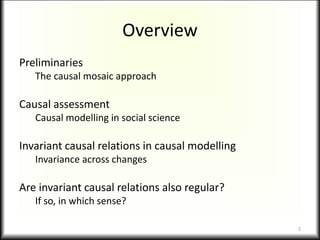
Overview
Preliminaries
The causal mosaic approach
Causal assessment
Causal modelling in social science
Invariant causal relations in causal modelling
Invariance across changes
Are invariant causal relations also regular?
If so, in which sense?
2
THE CAUSAL MOSAIC
3
4
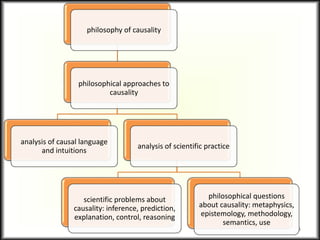
philosophy of causality
philosophical approaches to
causality
analysis of causal language
and intuitions
analysis of scientific practice
scientific problems about
causality: inference, prediction,
explanation, control, reasoning
philosophical questions
about causality: metaphysics,
epistemology, methodology,
semantics, use
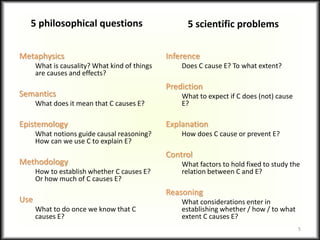
5 philosophical questions
Metaphysics
What is causality? What kind of things
are causes and effects?
Semantics
What does it mean that C causes E?
Epistemology
What notions guide causal reasoning?
How can we use C to explain E?
Methodology
How to establish whether C causes E?
Or how much of C causes E?
Use
What to do once we know that C
causes E?
5 scientific problems
Inference
Does C cause E? To what extent?
Prediction
What to expect if C does (not) cause
E?
Explanation
How does C cause or prevent E?
Control
What factors to hold fixed to study the
relation between C and E?
Reasoning
What considerations enter in
establishing whether / how / to what
extent C causes E?
5
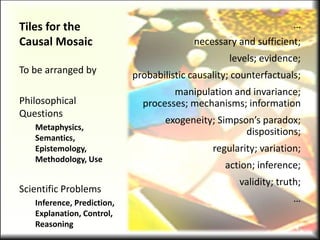
Tiles for the
Causal Mosaic
…
necessary and sufficient;
levels; evidence;
probabilistic causality; counterfactuals;
manipulation and invariance;
processes; mechanisms; information
exogeneity; Simpson’s paradox;
dispositions;
regularity; variation;
action; inference;
validity; truth;
…
To be arranged by
Philosophical
Questions
Metaphysics,
Semantics,
Epistemology,
Methodology, Use
Scientific Problems
Inference, Prediction,
Explanation, Control,
Reasoning 6
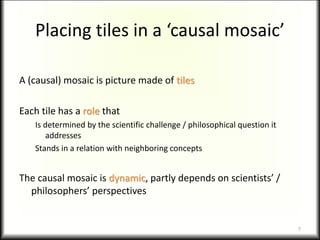
Placing tiles in a ‘causal mosaic’
A (causal) mosaic is picture made of tiles
Each tile has a role that
Is determined by the scientific challenge / philosophical question it
addresses
Stands in a relation with neighboring concepts
The causal mosaic is dynamic, partly depends on scientists’ /
philosophers’ perspectives
7
CAUSAL MODELLING
IN SOCIAL SCIENCE
8
9
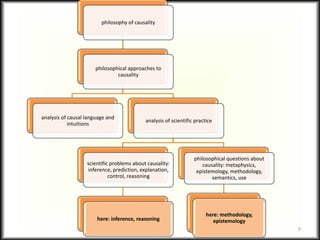
philosophy of causality
philosophical approaches to
causality
analysis of causal language and
intuitions
analysis of scientific practice
scientific problems about causality:
inference, prediction, explanation,
control, reasoning
here: inference, reasoning
philosophical questions about
causality: metaphysics,
epistemology, methodology,
semantics, use
here: methodology,
epistemology
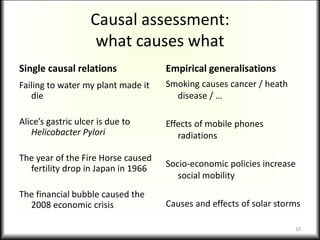
Causal assessment:
what causes what
Single causal relations
Failing to water my plant made it
die
Alice’s gastric ulcer is due to
Helicobacter Pylori
The year of the Fire Horse caused
fertility drop in Japan in 1966
The financial bubble caused the
2008 economic crisis
Empirical generalisations
Smoking causes cancer / heath
disease / …
Effects of mobile phones
radiations
Socio-economic policies increase
social mobility
Causes and effects of solar storms
10
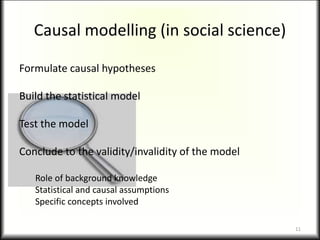
Causal modelling (in social science)
Formulate causal hypotheses
Build the statistical model
Test the model
Conclude to the validity/invalidity of the model
Role of background knowledge
Statistical and causal assumptions
Specific concepts involved
11
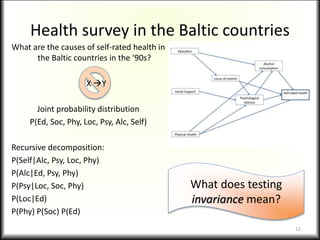
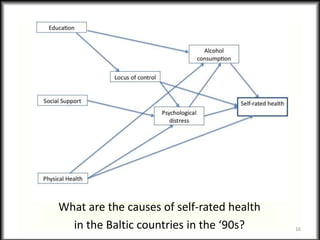
What are the causes of self-rated health in
the Baltic countries in the ‘90s?
X Y
Joint probability distribution
P(Ed, Soc, Phy, Loc, Psy, Alc, Self)
Recursive decomposition:
P(Self|Alc, Psy, Loc, Phy)
P(Alc|Ed, Psy, Phy)
P(Psy|Loc, Soc, Phy)
P(Loc|Ed)
P(Phy) P(Soc) P(Ed)
Health survey in the Baltic countries
12
What does testing
invariance mean?
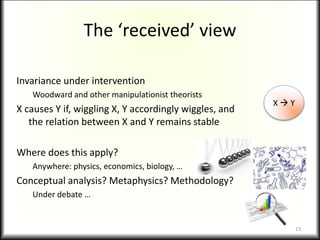
The ‘received’ view
Invariance under intervention
Woodward and other manipulationist theorists
X causes Y if, wiggling X, Y accordingly wiggles, and
the relation between X and Y remains stable
Where does this apply?
Anywhere: physics, economics, biology, …
Conceptual analysis? Metaphysics? Methodology?
Under debate …
13
X  Y
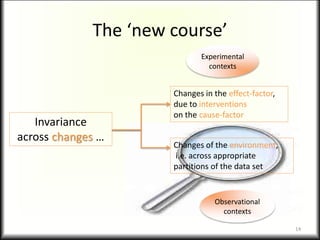
The ‘new course’
14
Invariance
across changes …
Changes in the effect-factor,
due to interventions
on the cause-factor
Changes of the environment,
i.e. across appropriate
partitions of the data set
Experimental
contexts
Observational
contexts
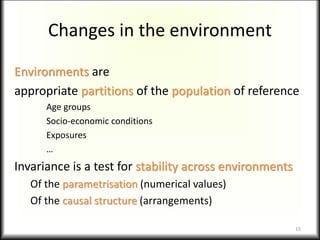
Changes in the environment
Environments are
appropriate partitions of the population of reference
Age groups
Socio-economic conditions
Exposures
…
Invariance is a test for stability across environments
Of the parametrisation (numerical values)
Of the causal structure (arrangements)
15
What are the causes of self-rated health
in the Baltic countries in the ‘90s? 16
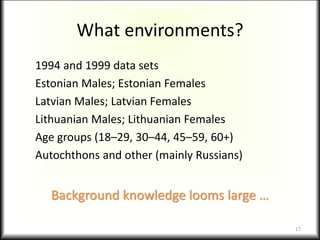
What environments?
1994 and 1999 data sets
Estonian Males; Estonian Females
Latvian Males; Latvian Females
Lithuanian Males; Lithuanian Females
Age groups (18–29, 30–44, 45–59, 60+)
Autochthons and other (mainly Russians)
Background knowledge looms large …
17
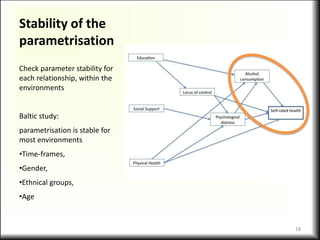
Stability of the
parametrisation
Check parameter stability for
each relationship, within the
environments
Baltic study:
parametrisation is stable for
most environments
•Time-frames,
•Gender,
•Ethnical groups,
•Age
18
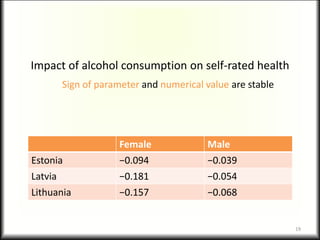
Impact of alcohol consumption on self-rated health
Sign of parameter and numerical value are stable
19
Female Male
Estonia −0.094 −0.039
Latvia −0.181 −0.054
Lithuania −0.157 −0.068
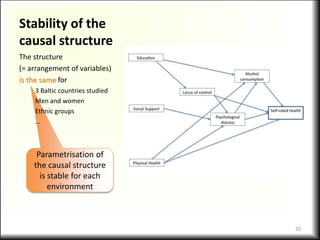
Parametrisation of
the causal structure
is stable for each
environment
Stability of the
causal structure
The structure
(= arrangement of variables)
is the same for
3 Baltic countries studied
Men and women
Ethnic groups
…
20
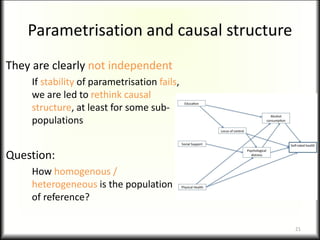
Parametrisation and causal structure
They are clearly not independent
If stability of parametrisation fails,
we are led to rethink causal
structure, at least for some sub-
populations
Question:
How homogenous /
heterogeneous is the population
of reference?
21
What has to be invariant?
Joint variations that are regular enough
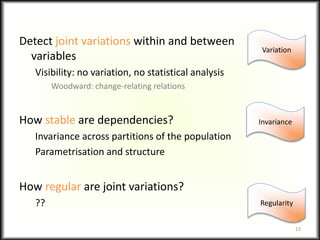
Detect joint variations within and between
variables
Visibility: no variation, no statistical analysis
Woodward: change-relating relations
How stable are dependencies?
Invariance across partitions of the population
Parametrisation and structure
How regular are joint variations?
??
Variation
Regularity
Invariance
23
REGULAR CAUSAL RELATIONS
IN CAUSAL MODELLING
24
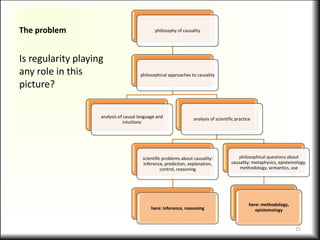
The problem philosophy of causality
philosophical approaches to causality
analysis of causal language and
intuitions
analysis of scientific practice
scientific problems about causality:
inference, prediction, explanation,
control, reasoning
here: inference, reasoning
philosophical questions about
causality: metaphysics, epistemology,
methodology, semantics, use
here: methodology,
epistemology
Is regularity playing
any role in this
picture?
25
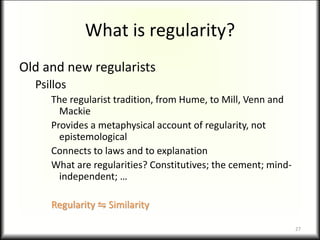
What is regularity?
Old and new regularists
Does Hume hold a Humean view?
“We may define a cause to be 'An object precedent and
contiguous to another, and where all the objects
resembling the former are plac'd in like relations of
precedency and contiguity to those objects, that
resemble the latter’”
Two readings, epistemological and metaphysical
26
What is regularity?
Old and new regularists
Psillos
The regularist tradition, from Hume, to Mill, Venn and
Mackie
Provides a metaphysical account of regularity, not
epistemological
Connects to laws and to explanation
What are regularities? Constitutives; the cement; mind-
independent; …
Regularity ⇋ Similarity
27
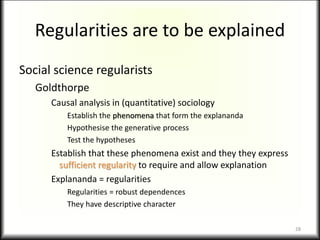
Regularities are to be explained
Social science regularists
Goldthorpe
Causal analysis in (quantitative) sociology
Establish the phenomena that form the explananda
Hypothesise the generative process
Test the hypotheses
Establish that these phenomena exist and they they express
sufficient regularity to require and allow explanation
Explananda = regularities
Regularities = robust dependences
They have descriptive character
28
Formulate causal hypotheses
?? Regularity [Goldthorpe]
Build the statistical model
Test the model
Invariance across changes of the environment
?? Regularity [My first intuition]
Conclude to the validity/invalidity of the model
Regularity in
causal modelling (in social science)
29
Regularity – Similarity
Psillos (via Venn and Hume)
Regularity has to do with things that are similar
Same types of causes, same types of effect; same token cause, same
token effect
Goldthorpe
Regularity means robust dependence (in a statistical
framework)
Similar things happen again
30
Regularity – Repetition
Repetition of a pattern
The pattern is about change, joint change
The change is repeated
Bottom up: from epistemology to metaphysics
We establish regularity because we observe a pattern
Psillos: the pattern is part of the regularity, which is a
‘perduring entity’
31
TO SUM UP AND CONCLUDE
32
The perspective of the causal mosaic
Choose your questions and your domain first
Here: causal modelling, testing causal relations in
quantitative social science
33
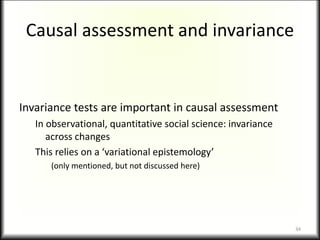
Causal assessment and invariance
Invariance tests are important in causal assessment
In observational, quantitative social science: invariance
across changes
This relies on a ‘variational epistemology’
(only mentioned, but not discussed here)
34
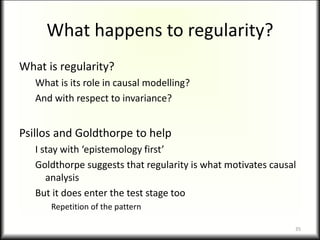
What happens to regularity?
What is regularity?
What is its role in causal modelling?
And with respect to invariance?
Psillos and Goldthorpe to help
I stay with ‘epistemology first’
Goldthorpe suggests that regularity is what motivates causal
analysis
But it does enter the test stage too
Repetition of the pattern
35
Questions? Comments?
Suggestions?
f.russo@uva.nl
@federicarusso
http://russofederica.wordpress.com
36

Are causal relations invariant or regular? Or both

  • 1.
    Are causal relationsinvariant or regular? Or both. Federica Russo Philosophy | Humanities | Amsterdam russofederica.wordpress.com | @federicarusso
  • 2.
    Overview Preliminaries The causal mosaicapproach Causal assessment Causal modelling in social science Invariant causal relations in causal modelling Invariance across changes Are invariant causal relations also regular? If so, in which sense? 2
  • 3.
  • 4.
    4 philosophy of causality philosophicalapproaches to causality analysis of causal language and intuitions analysis of scientific practice scientific problems about causality: inference, prediction, explanation, control, reasoning philosophical questions about causality: metaphysics, epistemology, methodology, semantics, use
  • 5.
    5 philosophical questions Metaphysics Whatis causality? What kind of things are causes and effects? Semantics What does it mean that C causes E? Epistemology What notions guide causal reasoning? How can we use C to explain E? Methodology How to establish whether C causes E? Or how much of C causes E? Use What to do once we know that C causes E? 5 scientific problems Inference Does C cause E? To what extent? Prediction What to expect if C does (not) cause E? Explanation How does C cause or prevent E? Control What factors to hold fixed to study the relation between C and E? Reasoning What considerations enter in establishing whether / how / to what extent C causes E? 5
  • 6.
    Tiles for the CausalMosaic … necessary and sufficient; levels; evidence; probabilistic causality; counterfactuals; manipulation and invariance; processes; mechanisms; information exogeneity; Simpson’s paradox; dispositions; regularity; variation; action; inference; validity; truth; … To be arranged by Philosophical Questions Metaphysics, Semantics, Epistemology, Methodology, Use Scientific Problems Inference, Prediction, Explanation, Control, Reasoning 6
  • 7.
    Placing tiles ina ‘causal mosaic’ A (causal) mosaic is picture made of tiles Each tile has a role that Is determined by the scientific challenge / philosophical question it addresses Stands in a relation with neighboring concepts The causal mosaic is dynamic, partly depends on scientists’ / philosophers’ perspectives 7
  • 8.
  • 9.
    9 philosophy of causality philosophicalapproaches to causality analysis of causal language and intuitions analysis of scientific practice scientific problems about causality: inference, prediction, explanation, control, reasoning here: inference, reasoning philosophical questions about causality: metaphysics, epistemology, methodology, semantics, use here: methodology, epistemology
  • 10.
    Causal assessment: what causeswhat Single causal relations Failing to water my plant made it die Alice’s gastric ulcer is due to Helicobacter Pylori The year of the Fire Horse caused fertility drop in Japan in 1966 The financial bubble caused the 2008 economic crisis Empirical generalisations Smoking causes cancer / heath disease / … Effects of mobile phones radiations Socio-economic policies increase social mobility Causes and effects of solar storms 10
  • 11.
    Causal modelling (insocial science) Formulate causal hypotheses Build the statistical model Test the model Conclude to the validity/invalidity of the model Role of background knowledge Statistical and causal assumptions Specific concepts involved 11
  • 12.
    What are thecauses of self-rated health in the Baltic countries in the ‘90s? X Y Joint probability distribution P(Ed, Soc, Phy, Loc, Psy, Alc, Self) Recursive decomposition: P(Self|Alc, Psy, Loc, Phy) P(Alc|Ed, Psy, Phy) P(Psy|Loc, Soc, Phy) P(Loc|Ed) P(Phy) P(Soc) P(Ed) Health survey in the Baltic countries 12 What does testing invariance mean?
  • 13.
    The ‘received’ view Invarianceunder intervention Woodward and other manipulationist theorists X causes Y if, wiggling X, Y accordingly wiggles, and the relation between X and Y remains stable Where does this apply? Anywhere: physics, economics, biology, … Conceptual analysis? Metaphysics? Methodology? Under debate … 13 X  Y
  • 14.
    The ‘new course’ 14 Invariance acrosschanges … Changes in the effect-factor, due to interventions on the cause-factor Changes of the environment, i.e. across appropriate partitions of the data set Experimental contexts Observational contexts
  • 15.
    Changes in theenvironment Environments are appropriate partitions of the population of reference Age groups Socio-economic conditions Exposures … Invariance is a test for stability across environments Of the parametrisation (numerical values) Of the causal structure (arrangements) 15
  • 16.
    What are thecauses of self-rated health in the Baltic countries in the ‘90s? 16
  • 17.
    What environments? 1994 and1999 data sets Estonian Males; Estonian Females Latvian Males; Latvian Females Lithuanian Males; Lithuanian Females Age groups (18–29, 30–44, 45–59, 60+) Autochthons and other (mainly Russians) Background knowledge looms large … 17
  • 18.
    Stability of the parametrisation Checkparameter stability for each relationship, within the environments Baltic study: parametrisation is stable for most environments •Time-frames, •Gender, •Ethnical groups, •Age 18
  • 19.
    Impact of alcoholconsumption on self-rated health Sign of parameter and numerical value are stable 19 Female Male Estonia −0.094 −0.039 Latvia −0.181 −0.054 Lithuania −0.157 −0.068
  • 20.
    Parametrisation of the causalstructure is stable for each environment Stability of the causal structure The structure (= arrangement of variables) is the same for 3 Baltic countries studied Men and women Ethnic groups … 20
  • 21.
    Parametrisation and causalstructure They are clearly not independent If stability of parametrisation fails, we are led to rethink causal structure, at least for some sub- populations Question: How homogenous / heterogeneous is the population of reference? 21
  • 22.
    What has tobe invariant? Joint variations that are regular enough
  • 23.
    Detect joint variationswithin and between variables Visibility: no variation, no statistical analysis Woodward: change-relating relations How stable are dependencies? Invariance across partitions of the population Parametrisation and structure How regular are joint variations? ?? Variation Regularity Invariance 23
  • 24.
    REGULAR CAUSAL RELATIONS INCAUSAL MODELLING 24
  • 25.
    The problem philosophyof causality philosophical approaches to causality analysis of causal language and intuitions analysis of scientific practice scientific problems about causality: inference, prediction, explanation, control, reasoning here: inference, reasoning philosophical questions about causality: metaphysics, epistemology, methodology, semantics, use here: methodology, epistemology Is regularity playing any role in this picture? 25
  • 26.
    What is regularity? Oldand new regularists Does Hume hold a Humean view? “We may define a cause to be 'An object precedent and contiguous to another, and where all the objects resembling the former are plac'd in like relations of precedency and contiguity to those objects, that resemble the latter’” Two readings, epistemological and metaphysical 26
  • 27.
    What is regularity? Oldand new regularists Psillos The regularist tradition, from Hume, to Mill, Venn and Mackie Provides a metaphysical account of regularity, not epistemological Connects to laws and to explanation What are regularities? Constitutives; the cement; mind- independent; … Regularity ⇋ Similarity 27
  • 28.
    Regularities are tobe explained Social science regularists Goldthorpe Causal analysis in (quantitative) sociology Establish the phenomena that form the explananda Hypothesise the generative process Test the hypotheses Establish that these phenomena exist and they they express sufficient regularity to require and allow explanation Explananda = regularities Regularities = robust dependences They have descriptive character 28
  • 29.
    Formulate causal hypotheses ??Regularity [Goldthorpe] Build the statistical model Test the model Invariance across changes of the environment ?? Regularity [My first intuition] Conclude to the validity/invalidity of the model Regularity in causal modelling (in social science) 29
  • 30.
    Regularity – Similarity Psillos(via Venn and Hume) Regularity has to do with things that are similar Same types of causes, same types of effect; same token cause, same token effect Goldthorpe Regularity means robust dependence (in a statistical framework) Similar things happen again 30
  • 31.
    Regularity – Repetition Repetitionof a pattern The pattern is about change, joint change The change is repeated Bottom up: from epistemology to metaphysics We establish regularity because we observe a pattern Psillos: the pattern is part of the regularity, which is a ‘perduring entity’ 31
  • 32.
    TO SUM UPAND CONCLUDE 32
  • 33.
    The perspective ofthe causal mosaic Choose your questions and your domain first Here: causal modelling, testing causal relations in quantitative social science 33
  • 34.
    Causal assessment andinvariance Invariance tests are important in causal assessment In observational, quantitative social science: invariance across changes This relies on a ‘variational epistemology’ (only mentioned, but not discussed here) 34
  • 35.
    What happens toregularity? What is regularity? What is its role in causal modelling? And with respect to invariance? Psillos and Goldthorpe to help I stay with ‘epistemology first’ Goldthorpe suggests that regularity is what motivates causal analysis But it does enter the test stage too Repetition of the pattern 35
  • 36.

Editor's Notes

  • #2 Are causal relations be invariant or regular? Or both. In the philosophy of causality lots of attention has been paid to the role of ‘invariance’ . Simply put, this is the idea that, in order to be causal, relations between variables have to show a certain level of stability (i.e., invariance) under interventions or across environments. I begin by reviewing the existing literature, explaining why the notion of invariance plays a vital role in causal assessment and offering my own preferred version which I label ‘invariance across changes’. I then contrast and compare the notion of invariance with that of ‘regularity’. In the philosophy of causality, regularity has a lengthy pedigree, tracing back to Hume: effects regularly follow causes in space and time. In recent times, regularity accounts have been supported by other scholars, for instance Psillos or Baumgartner. I then evaluate whether, and to what extent, the practice of causal modelling makes use of the notion of regularity, in the Humean or some other sense. This investigation is part of a larger project: building the ‘mosaic’ of causal theory, where different notions have different, but nonetheless complementary, roles.