Causal models and
evidential pluralism*
Federica Russo
Philosophy | Humanities | Amsterdam
russofederica.wordpress.com | @federicarusso
*Based on joint work with Alessio Moneta:
Causal models and evidential pluralism in econometrics, Journal of Economic Methodology,
DOI: 10.1080/1350178X.2014.886473
© Federica Russo
Staff for a
New University
@rethinkuva
Rethink UvA
2
Examples of causal claims
in economics/econometrics
Keynesian economics
Employment is a function of demand, not of supply
Keynesian policy
Government actions can change unemployment, by intervening on fiscal
deficit (e.g. tax cuts) and monetary policy (e.g. interests rates)
Friedman’s monetary theory
Price inflation and money supply are (causally) related
Phillips’ curve
The lower the unemployment in an economy, the higher the inflation
rates
…
3
Overview
Background
Approaches to causality
The ‘causal modelling’ tradition
Associational Models vs Causal Models
Statistical vs Causal information
Causal models
Validity and Evidential pluralism
4
APPROACHES TO CAUSALITY
5
Conceptual analysis
What explicates the concept of ‘causality’
What makes causal claims true
What is causality, metaphysically
6
How good are intuitions?
Exploit everyday intuitions to draw conclusions about the
metaphysics of causation from everyday or toy examples
Examples
The ‘Billy and Suzy’ saga
The assassins
…
Some conclusions
There are two concepts of cause: production and dependence
Counterfactual accounts are seriously flawed
…
7
Analysis of scientific practice
Growing!
CitS / PSP / PI
Philosophical questions about causation (and other topics) are motivated by
methodological and practical problems in real science
Start from scientific practice to bottom up philosophy
Partly descriptive and partly normative
Examples
Causal assessment in medicine
Causal reasoning in quantitative social science
…
Some conclusions
Causal assessment has two evidential components: mechanisms and difference-
making
‘Variation’ (rather than regularity) guides causal reasoning
…
8
Causal modelling has a long tradition
Staunch causalists
Quetelet, Durkheim, Wright …, Blalock, Duncan, …
Quantitative causal models make social sciences objective
Moderate skeptics
Pearl, Heckman, Hoover, …
Quantitative models do not ipso facto guarantee causality
… and the evergreen question:
When / how / under what conditions can we infer causation
from correlation?
9
METHODOLOGY OF CAUSALITY
10
Analysis of scientific practice
Quantitative methods
Models that establish
associations
Models that establish
causal relations
Information having
mere statistical import
Information having
causal import
11
Associational Models Causal Models
Background
Knowledge
Choice of variables
Causal context;
Theoretical
knowledge;
Institutional
knowledge;
…
Assumptions Statistical
Statistical;
Extra-statistical;
Causal
Methodology
Model-based
statistical induction
Hypothetico-
deduction
12
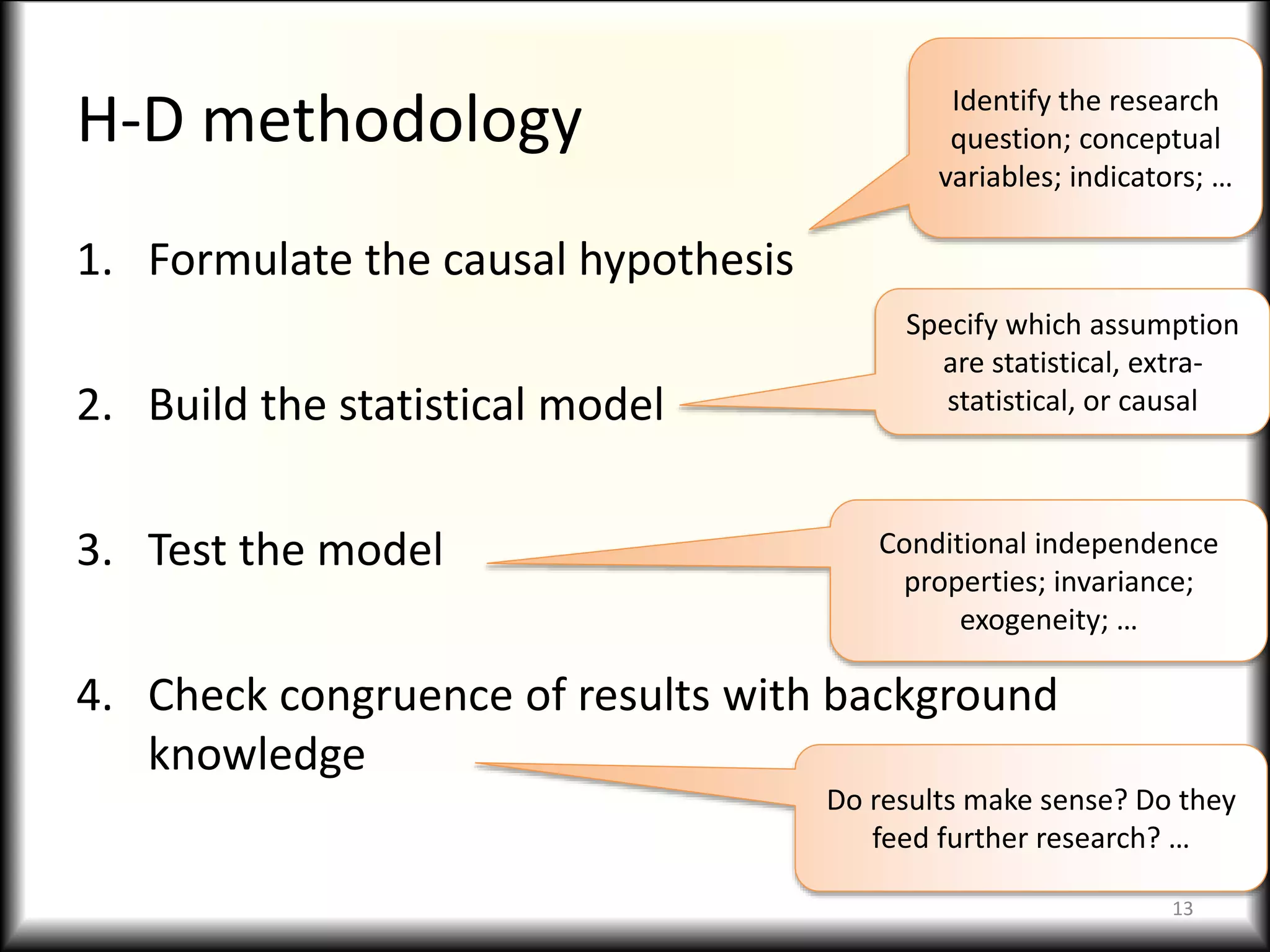
H-D methodology
1. Formulate the causal hypothesis
2. Build the statistical model
3. Test the model
4. Check congruence of results with background
knowledge
Identify the research
question; conceptual
variables; indicators; …
Conditional independence
properties; invariance;
exogeneity; …
Do results make sense? Do they
feed further research? …
Specify which assumption
are statistical, extra-
statistical, or causal
13
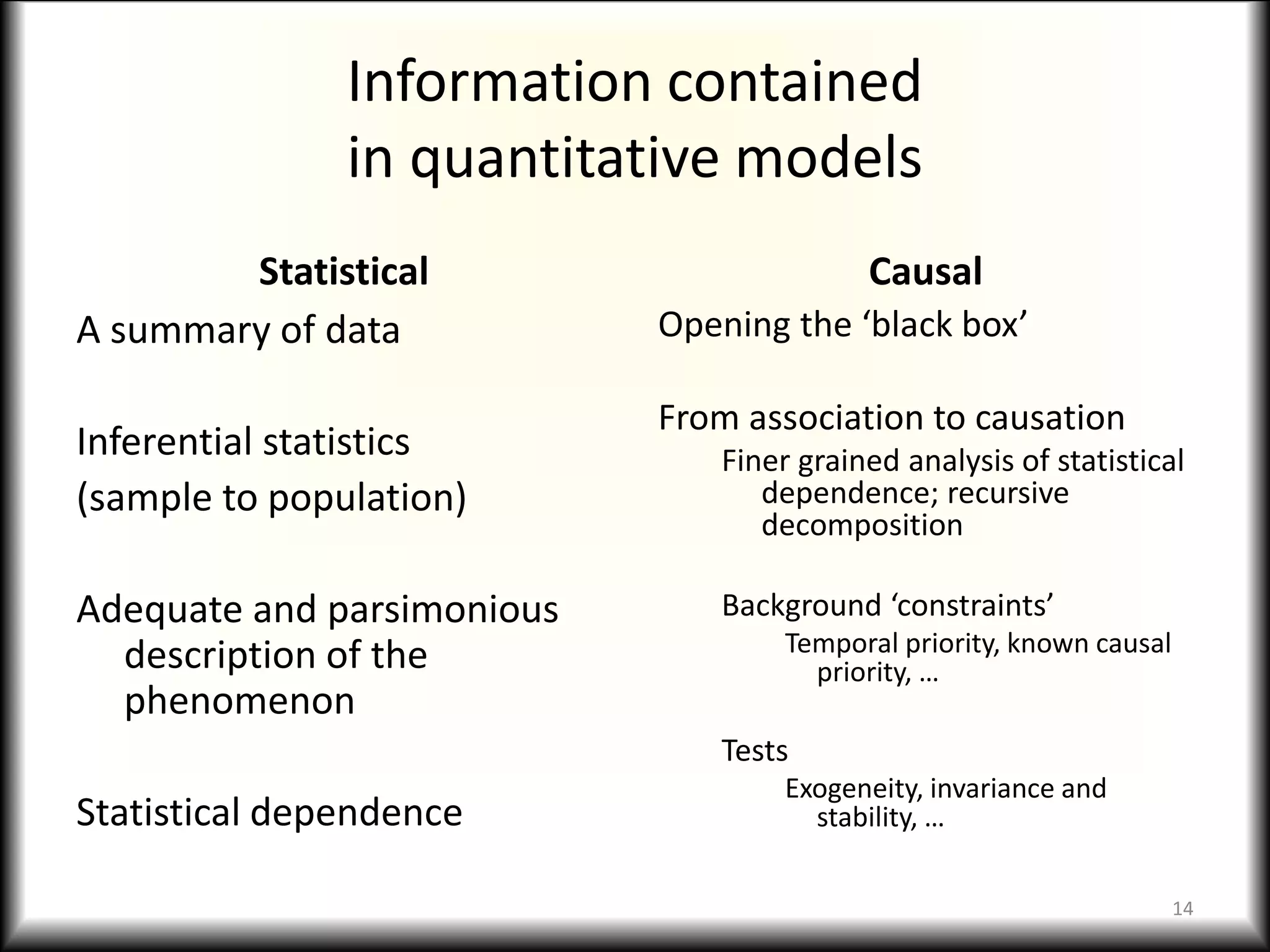
Information contained
in quantitative models
Statistical
A summary of data
Inferential statistics
(sample to population)
Adequate and parsimonious
description of the
phenomenon
Statistical dependence
Causal
Opening the ‘black box’
From association to causation
Finer grained analysis of statistical
dependence; recursive
decomposition
Background ‘constraints’
Temporal priority, known causal
priority, …
Tests
Exogeneity, invariance and
stability, …
14
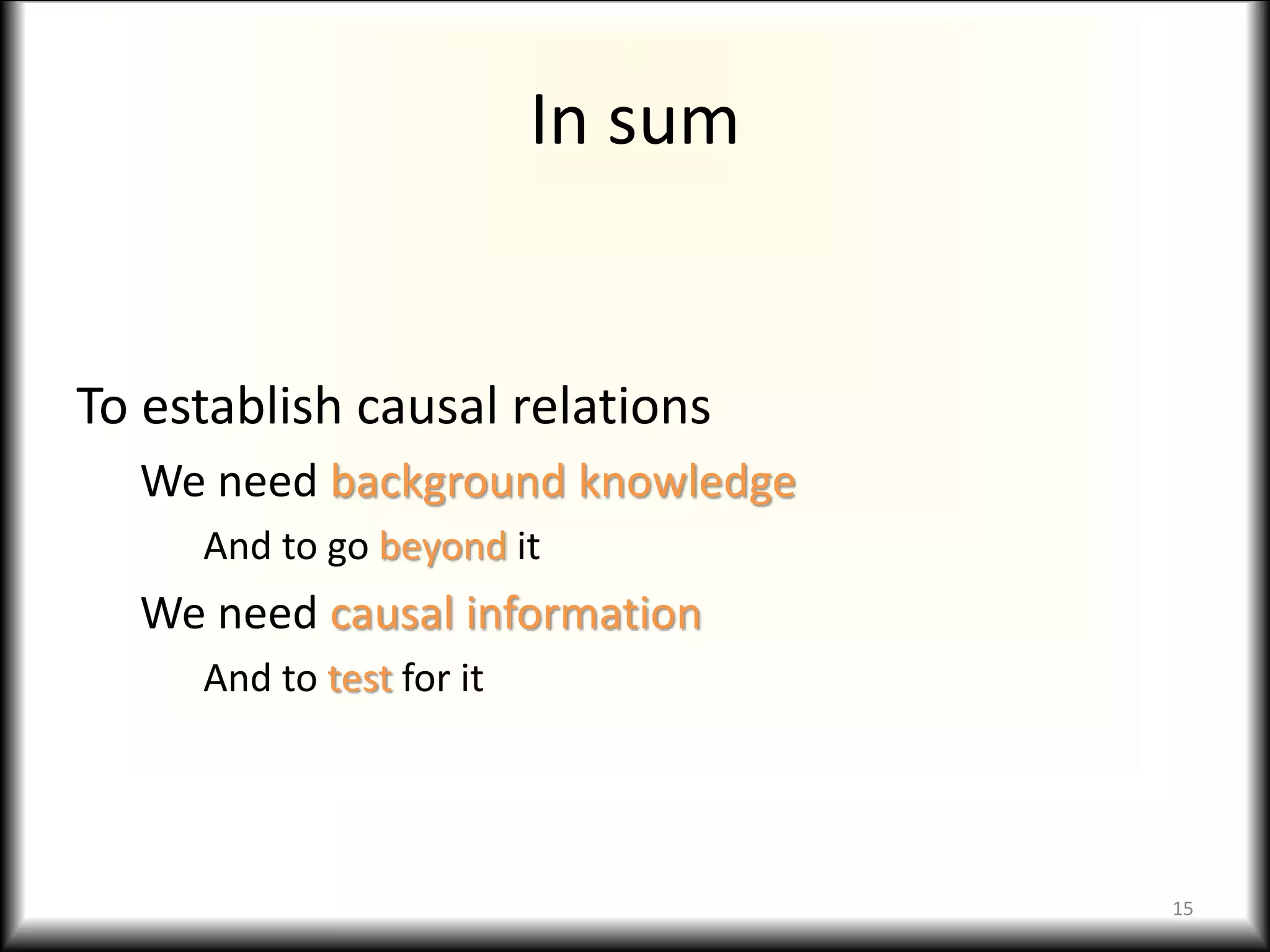
In sum
To establish causal relations
We need background knowledge
And to go beyond it
We need causal information
And to test for it
15
Nice but …
How much background knowledge?
Just the right amount …
What kind of causal information?
Just the relevant one …
A vicious circle introduced?
Not quite …
16
WHAT MAKES A CAUSAL MODEL
CAUSAL
17
A question of validity
A methodological concern thoroughly analysed
since the late ‘60s
Cook & Campbell
Decide whether a model is valid
Successful inferences
Correlations, causal relations, prediction, control, …
18
Types of validity are about whether:
Statistical conclusion validity
The correlation (covariation) between treatment and
outcome is validly inferred
Internal
Observed covariation between treatment and outcome
reflects a causal relationship, as those variables are
manipulated or measured
Construct and External
The cause-effect relationship holds over variation in
persons, settings, treatment variables, and measurement
variables
19
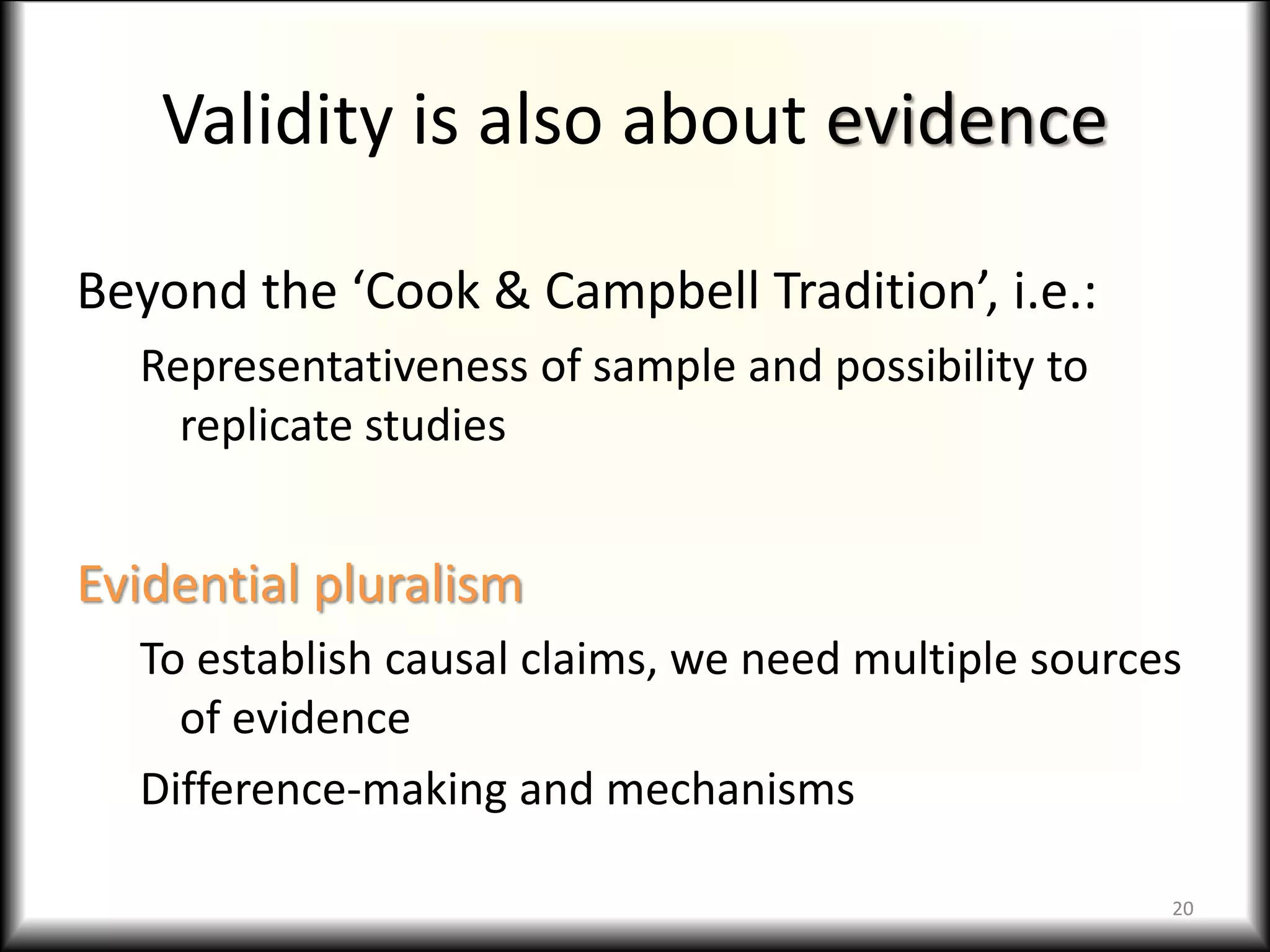
Validity is also about evidence
Beyond the ‘Cook & Campbell Tradition’, i.e.:
Representativeness of sample and possibility to
replicate studies
Evidential pluralism
To establish causal claims, we need multiple sources
of evidence
Difference-making and mechanisms
20
Evidence of difference-making
Associational models
Statistical information
Dependencies
Supports the claim that E (causally) depends on C
Needs to be complemented with story about how
21
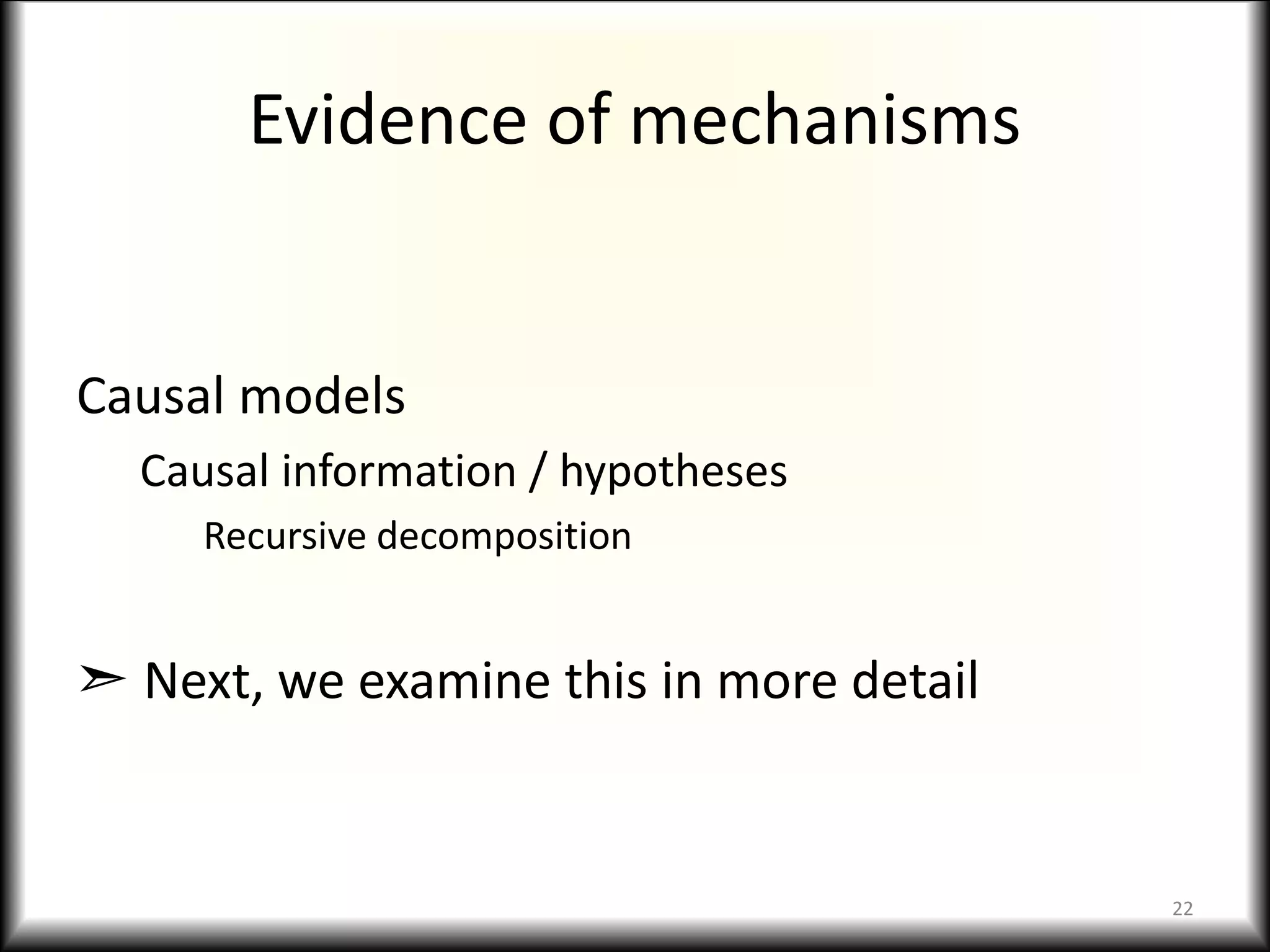
Evidence of mechanisms
Causal models
Causal information / hypotheses
Recursive decomposition
➣ Next, we examine this in more detail
22
What are the causes of self-rated health in
the Baltic countries in the ‘90s?
X Y
Joint probability distribution
P(Ed, Soc, Phy, Loc, Psy, Alc, Self)
Recursive decomposition:
P(Self|Alc, Psy, Loc, Phy)
P(Alc|Ed, Psy, Phy)
P(Psy|Loc, Soc, Phy)
P(Loc|Ed)
P(Phy) P(Soc) P(Ed)
Health survey in the Baltic countries
Why does this represent
a mechanism?
23
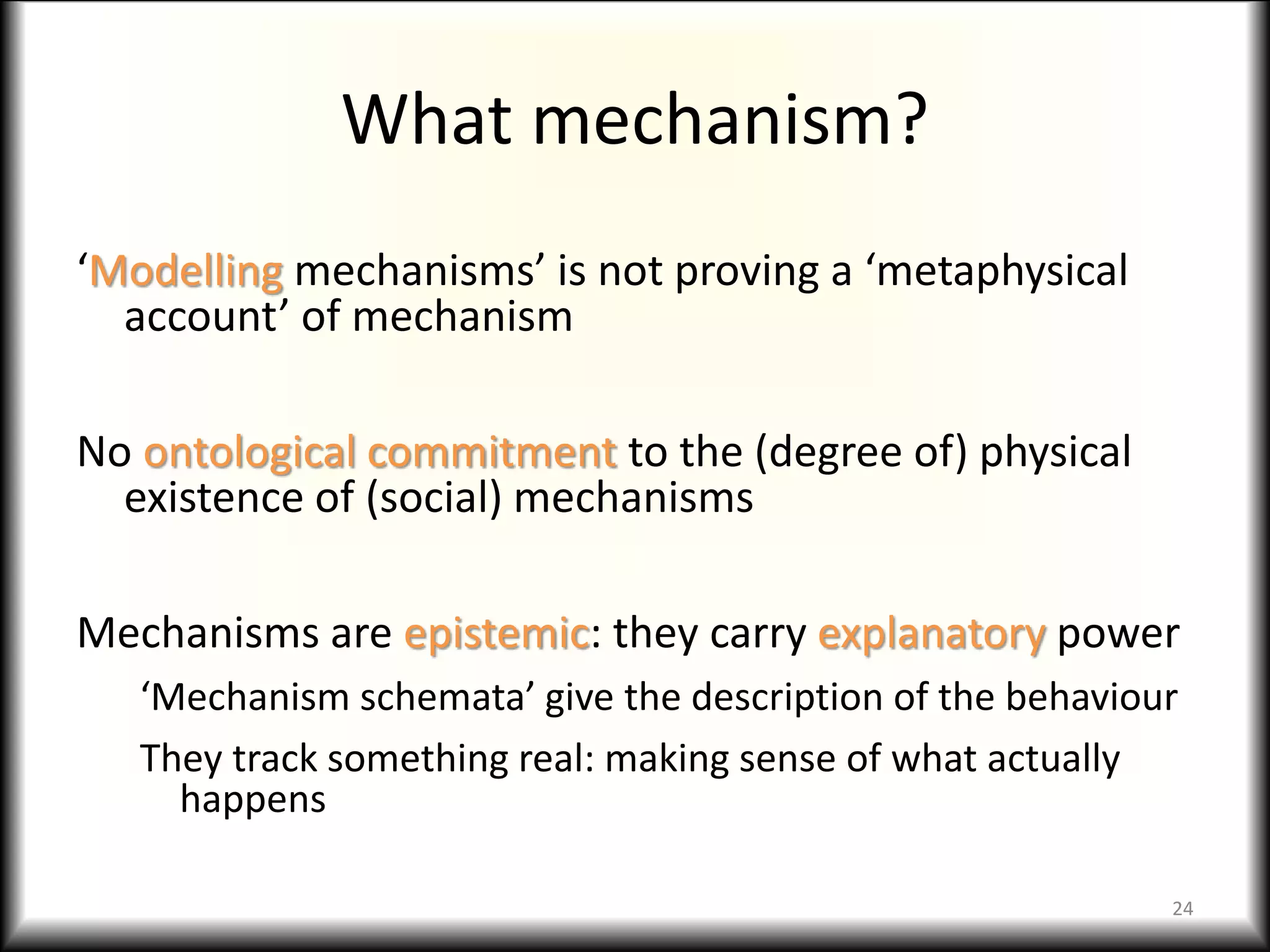
What mechanism?
‘Modelling mechanisms’ is not proving a ‘metaphysical
account’ of mechanism
No ontological commitment to the (degree of) physical
existence of (social) mechanisms
Mechanisms are epistemic: they carry explanatory power
‘Mechanism schemata’ give the description of the behaviour
They track something real: making sense of what actually
happens
24
Mechanistic explanation
Illari & Williamson:
“A mechanism for a phenomenon is composed of entities and activities
organized so that they are responsible for the phenomenon.”
Mechanistic explanation:
Identification of the phenomenon
Identification of entities and activities involved
Identification of the organisation
The recursive decomposition spells out the functioning of the mechanism
Spelling out the functioning of the mechanism means identifying the
causes, their actions, and their effect  organisation
25
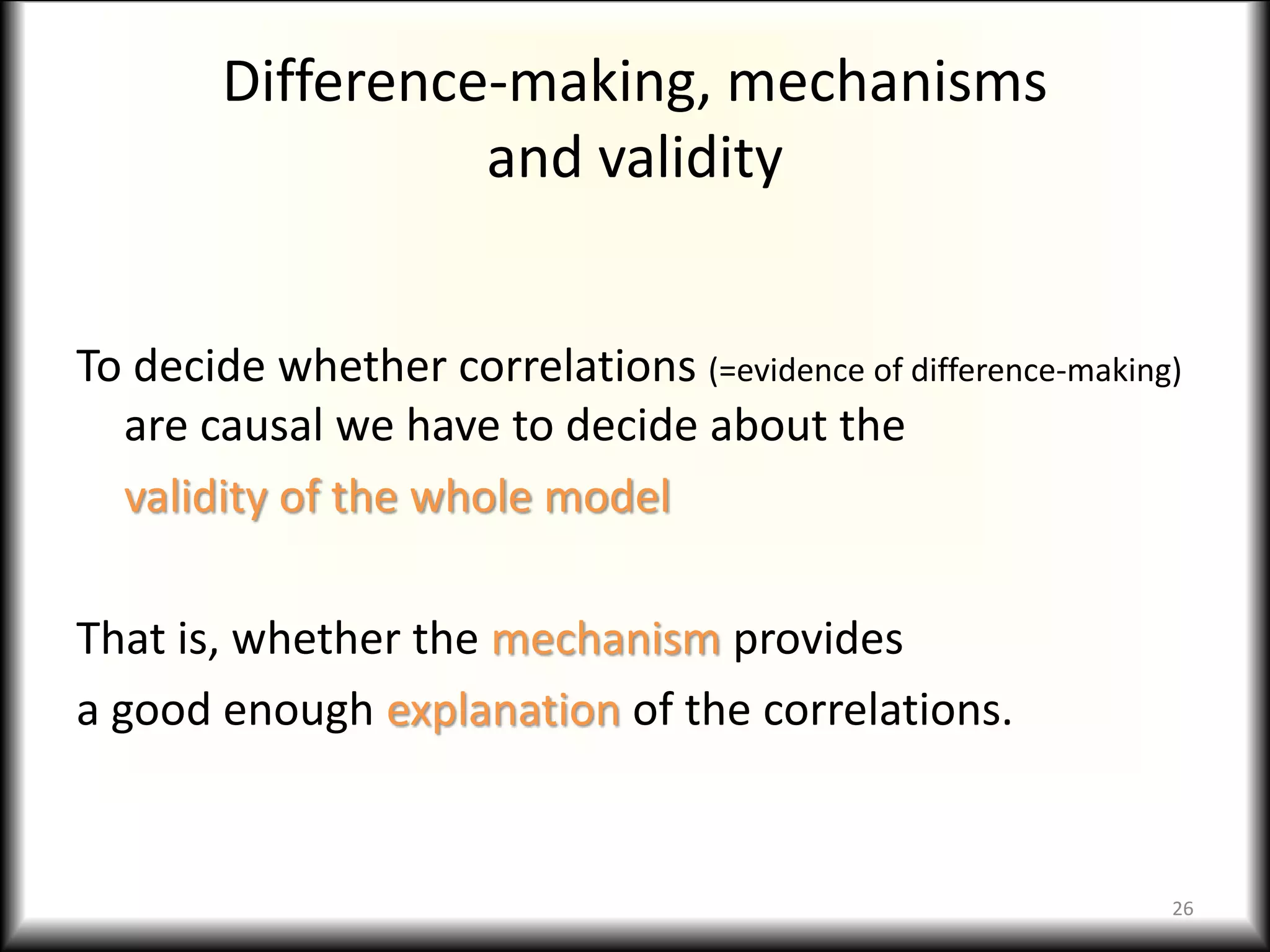
Difference-making, mechanisms
and validity
To decide whether correlations (=evidence of difference-making)
are causal we have to decide about the
validity of the whole model
That is, whether the mechanism provides
a good enough explanation of the correlations.
26
The causal interpretation is
model-dependent
Causal conclusions depend on the whole
‘model set up’ from which they are inferred
Statistical information + background knowledge +
causal information
Not a bad thing after all
Causation is not a ‘all or nothing’ affair
Nor a ‘once and for all’ affair
27
TO SUM UP AND CONCLUDE
28
Correlation is not causation
An evergreen question
from the staunch causalists to the moderate skeptics
Analysis of scientific practice
Associational vs Causal Models
Statistical vs Causal Information
A different philosophical look at causation in
quantitative models
Validity
Evidential pluralism
29

Venezia management

  • 1.
    Causal models and evidentialpluralism* Federica Russo Philosophy | Humanities | Amsterdam russofederica.wordpress.com | @federicarusso *Based on joint work with Alessio Moneta: Causal models and evidential pluralism in econometrics, Journal of Economic Methodology, DOI: 10.1080/1350178X.2014.886473 © Federica Russo
  • 2.
    Staff for a NewUniversity @rethinkuva Rethink UvA 2
  • 3.
    Examples of causalclaims in economics/econometrics Keynesian economics Employment is a function of demand, not of supply Keynesian policy Government actions can change unemployment, by intervening on fiscal deficit (e.g. tax cuts) and monetary policy (e.g. interests rates) Friedman’s monetary theory Price inflation and money supply are (causally) related Phillips’ curve The lower the unemployment in an economy, the higher the inflation rates … 3
  • 4.
    Overview Background Approaches to causality The‘causal modelling’ tradition Associational Models vs Causal Models Statistical vs Causal information Causal models Validity and Evidential pluralism 4
  • 5.
  • 6.
    Conceptual analysis What explicatesthe concept of ‘causality’ What makes causal claims true What is causality, metaphysically 6
  • 7.
    How good areintuitions? Exploit everyday intuitions to draw conclusions about the metaphysics of causation from everyday or toy examples Examples The ‘Billy and Suzy’ saga The assassins … Some conclusions There are two concepts of cause: production and dependence Counterfactual accounts are seriously flawed … 7
  • 8.
    Analysis of scientificpractice Growing! CitS / PSP / PI Philosophical questions about causation (and other topics) are motivated by methodological and practical problems in real science Start from scientific practice to bottom up philosophy Partly descriptive and partly normative Examples Causal assessment in medicine Causal reasoning in quantitative social science … Some conclusions Causal assessment has two evidential components: mechanisms and difference- making ‘Variation’ (rather than regularity) guides causal reasoning … 8
  • 9.
    Causal modelling hasa long tradition Staunch causalists Quetelet, Durkheim, Wright …, Blalock, Duncan, … Quantitative causal models make social sciences objective Moderate skeptics Pearl, Heckman, Hoover, … Quantitative models do not ipso facto guarantee causality … and the evergreen question: When / how / under what conditions can we infer causation from correlation? 9
  • 10.
  • 11.
    Analysis of scientificpractice Quantitative methods Models that establish associations Models that establish causal relations Information having mere statistical import Information having causal import 11
  • 12.
    Associational Models CausalModels Background Knowledge Choice of variables Causal context; Theoretical knowledge; Institutional knowledge; … Assumptions Statistical Statistical; Extra-statistical; Causal Methodology Model-based statistical induction Hypothetico- deduction 12
  • 13.
    H-D methodology 1. Formulatethe causal hypothesis 2. Build the statistical model 3. Test the model 4. Check congruence of results with background knowledge Identify the research question; conceptual variables; indicators; … Conditional independence properties; invariance; exogeneity; … Do results make sense? Do they feed further research? … Specify which assumption are statistical, extra- statistical, or causal 13
  • 14.
    Information contained in quantitativemodels Statistical A summary of data Inferential statistics (sample to population) Adequate and parsimonious description of the phenomenon Statistical dependence Causal Opening the ‘black box’ From association to causation Finer grained analysis of statistical dependence; recursive decomposition Background ‘constraints’ Temporal priority, known causal priority, … Tests Exogeneity, invariance and stability, … 14
  • 15.
    In sum To establishcausal relations We need background knowledge And to go beyond it We need causal information And to test for it 15
  • 16.
    Nice but … Howmuch background knowledge? Just the right amount … What kind of causal information? Just the relevant one … A vicious circle introduced? Not quite … 16
  • 17.
    WHAT MAKES ACAUSAL MODEL CAUSAL 17
  • 18.
    A question ofvalidity A methodological concern thoroughly analysed since the late ‘60s Cook & Campbell Decide whether a model is valid Successful inferences Correlations, causal relations, prediction, control, … 18
  • 19.
    Types of validityare about whether: Statistical conclusion validity The correlation (covariation) between treatment and outcome is validly inferred Internal Observed covariation between treatment and outcome reflects a causal relationship, as those variables are manipulated or measured Construct and External The cause-effect relationship holds over variation in persons, settings, treatment variables, and measurement variables 19
  • 20.
    Validity is alsoabout evidence Beyond the ‘Cook & Campbell Tradition’, i.e.: Representativeness of sample and possibility to replicate studies Evidential pluralism To establish causal claims, we need multiple sources of evidence Difference-making and mechanisms 20
  • 21.
    Evidence of difference-making Associationalmodels Statistical information Dependencies Supports the claim that E (causally) depends on C Needs to be complemented with story about how 21
  • 22.
    Evidence of mechanisms Causalmodels Causal information / hypotheses Recursive decomposition ➣ Next, we examine this in more detail 22
  • 23.
    What are thecauses of self-rated health in the Baltic countries in the ‘90s? X Y Joint probability distribution P(Ed, Soc, Phy, Loc, Psy, Alc, Self) Recursive decomposition: P(Self|Alc, Psy, Loc, Phy) P(Alc|Ed, Psy, Phy) P(Psy|Loc, Soc, Phy) P(Loc|Ed) P(Phy) P(Soc) P(Ed) Health survey in the Baltic countries Why does this represent a mechanism? 23
  • 24.
    What mechanism? ‘Modelling mechanisms’is not proving a ‘metaphysical account’ of mechanism No ontological commitment to the (degree of) physical existence of (social) mechanisms Mechanisms are epistemic: they carry explanatory power ‘Mechanism schemata’ give the description of the behaviour They track something real: making sense of what actually happens 24
  • 25.
    Mechanistic explanation Illari &Williamson: “A mechanism for a phenomenon is composed of entities and activities organized so that they are responsible for the phenomenon.” Mechanistic explanation: Identification of the phenomenon Identification of entities and activities involved Identification of the organisation The recursive decomposition spells out the functioning of the mechanism Spelling out the functioning of the mechanism means identifying the causes, their actions, and their effect  organisation 25
  • 26.
    Difference-making, mechanisms and validity Todecide whether correlations (=evidence of difference-making) are causal we have to decide about the validity of the whole model That is, whether the mechanism provides a good enough explanation of the correlations. 26
  • 27.
    The causal interpretationis model-dependent Causal conclusions depend on the whole ‘model set up’ from which they are inferred Statistical information + background knowledge + causal information Not a bad thing after all Causation is not a ‘all or nothing’ affair Nor a ‘once and for all’ affair 27
  • 28.
    TO SUM UPAND CONCLUDE 28
  • 29.
    Correlation is notcausation An evergreen question from the staunch causalists to the moderate skeptics Analysis of scientific practice Associational vs Causal Models Statistical vs Causal Information A different philosophical look at causation in quantitative models Validity Evidential pluralism 29

Editor's Notes

  • #12 chance regularity patterns’ (Spanos, 1999) statistical dependence. statistical model postulates a stochastic mechanism, but does not describe it in full detail: opens the ‘black box’ ‘augmented’ statistical information: it allows additional interpretation so that an association between, say, two variables X and Y can be viewed as, for example, a causal influence from X to Y. extra-statistical assumptions which, as we have seen, rely on different kinds of ‘background knowledge’, for instance theoretical knowledge, information about institutional mechanisms, or views on the nature of causality (e.g. temporal priority of cause) and its relations with the notion of statistical dependence. recursive-decomposition
  • #13 statistical information delivers an adequate and parsimonious description of phenomena