The mosaic of causal theory*
Federica Russo
Philosophy | Humanities | Amsterdam
russofederica.wordpress.com | @federicarusso
*Joint work with Phyllis Illari
Overview
Approaches to causality
Conceptual analysis, analysis of scientific practice
Causal pluralism
A plurality of pluralism
How to build a causal mosaic
Manipulationism in the mosaic
Assessing the debate and suggesting a way forward
2
APPROACHES TO CAUSALITY
3
Conceptual analysis
What explicates the concept of ‘causality’
What makes causal claims true
What is causality / are causes, metaphysically
>> Causal language | >> Causal intuitions
4
Causal language
Analyse occurrences of cause / causality in everyday language to
draw conclusions about meaning and use of the concept
A heir of Oxon phil language
Examples
Short-circuit and fire (Mackie’s INUS)
…
Some conclusions
Distinction between causes and conditions
…
5
Causal intuitions
Exploit intuitions to draw conclusions about the metaphysics
of causation from everyday or toy examples
A heir of the ‘Canberra Plan’
Examples
The ‘Billy and Suzy’ episodes
The assassins
…
Some conclusions
Two concepts of cause: production and dependence
Counterexamples undermine the counterfactual approach
…
6
Analysis of scientific practice
Growing
CitS / PSP / PI
Philosophical questions about causation (and other topics) are motivated by
methodological and practical problems in real science
Start from scientific practice to bottom up philosophy
Partly descriptive and partly normative
Examples
Causal assessment in medicine
Causal reasoning in quantitative social science
…
Some conclusions
Evidential components in causal assessment: mechanisms and difference-making
‘Variation’ (rather than regularity) guides causal reasoning
…
7
CAUSAL PLURALISM
8
Making sense of
a vast intellectual enterprise
Diversity in philosophical theorising about causes
Long history, ups and downs
Many concepts
Expansion of philosophical theorising about causes
Beyond physics, attention to the special sciences, and medicine
Attention for questions about use, besides traditional metaphysics,
epistemology, and semantics
9
How many concepts? Many!
Causality
Polysemic, thick concept
Causal verbs
Pulling, pushing, binding, …
Causal methods
Tracking what varies with what
Understanding what produces what, and how, and when
Different sources of evidence
Evidence of difference making, of production
…
10
Causal pluralism:
causality cannot be reduced
to one single concept
but has to be analysed using several concepts
11
PLURALITY OF PLURALISMS
12
Ad hoc pluralism
A concept for each scientific domain
Physics  ?
Social science  ?
Medicine  ?
Biology  ?
Any unifying concept? Irreducible different concepts?
13
Ad hoc monism?
The ‘epistemic’ turn:
From concepts of cause to evidential components
From causings in the world to causal beliefs
14
Pluralisms, de facto
Types of causing
Anscombian pluralism:
pulling, pushing, binding, …
Aristotelian causes
Concepts of causation
Hall: Dependence vs
production
Types of inferences
Inferential bases, inferential
targets, practices
Sources of evidence
Difference-making and
mechanisms
Methods for causal
inference
Quantitative, qualitative,
observational,
experimental, …
15
Anything does not go,
but something does
Look at the scientific practice:
Diversity of causes
Production and difference-making
Evidence
Causal methods
16
FRAGMENTING CAUSAL THEORY
17
Philosophical Questions
Metaphysics
What is causality? What kind of things
are causes and effects?
Semantics
What does it mean that C causes E?
Epistemology
What notions guide causal reasoning?
How can we use C to explain E?
Methodology
How to establish whether C causes E?
Or how much of C causes E?
Use
What to do once we know that C
causes E?
Scientific Problems
Inference
Does C cause E? To what extent?
Prediction
What to expect if C does (not) cause E?
Explanation
How does C cause or prevent E?
Control
What factors to hold fixed to study the
relation between C and E?
Reasoning
What considerations about whether /
how / to what extent C causes E?
18
19
THE CAUSAL MOSAIC
20
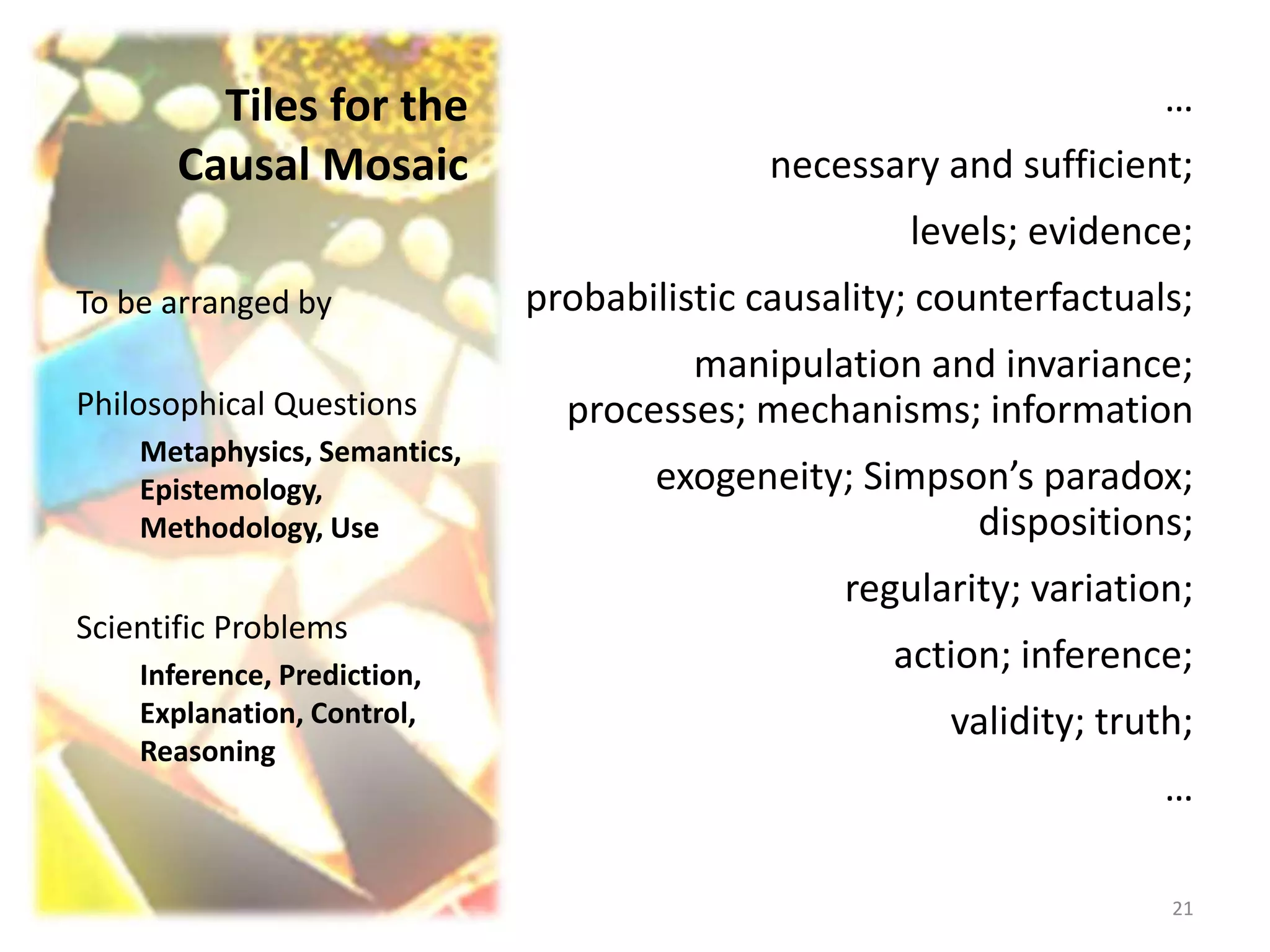
Tiles for the
Causal Mosaic
…
necessary and sufficient;
levels; evidence;
probabilistic causality; counterfactuals;
manipulation and invariance;
processes; mechanisms; information
exogeneity; Simpson’s paradox;
dispositions;
regularity; variation;
action; inference;
validity; truth;
…
To be arranged by
Philosophical Questions
Metaphysics, Semantics,
Epistemology,
Methodology, Use
Scientific Problems
Inference, Prediction,
Explanation, Control,
Reasoning
21
Unifying the fragments
into the causal mosaic
A (causal) mosaic is picture made of tiles
Each fragment has a role that
Is determined by the scientific challenge / philosophical
question it addresses
Stands in a relation with neighboring concepts
The causal mosaic is dynamic, partly depends on
scientists’ / philosophers’ perspectives
22
PHILOSOPHICAL METHODOLOGY
AND PHILOSOPHY OF CAUSALITY
23
Philosophical consequences of
causal pluralism
Conceptual analysis
Building networks of concepts
No winning concepts
Epistemology
Constructionism
Philosophical argumentation
Use of examples and counterexamples
24
Accounts of causality Counterexamples
Scope Relevant questions How many Found in the literature
All possible worlds.
What does causation
logically/metaphysically
mean?
One logically possible
example.
Witches casting spells;
Angels protecting
glasses.
Worlds close to the
actual world.
What is causation
metaphysically?
One metaphysically
possible example.
World with reverse
temporal direction;
Salmon’s moving spot of
light.
This world.
What is causation in this
world?
One or more real
examples.
Kinetic theory of gases /
quantum mechanics;
Billy and Suzy / bombing
the enemy town.
Some region in this
world.
What is causation in
biochemistry, or
physics?
A few real examples in
the relevant domain.
Causality in protein
synthesis mechanisms.
Some region of this
world at some time.
What kind of causal
explanation can we give
of the economic crisis in
1929? Can we give the
same kind of
explanation of the
economic crisis now?
A few real examples in
the relevant domain at
the relevant time;
Typical not skewed
examples.
Causality in the
discovery of protein
synthesis. Causality in
systems biological
approaches to protein
synthesis. 25
MANIPULATIONISM
IN THE CAUSAL MOSAIC
26
Manipulationism
Information about the results of interventions
is of utmost importance
for explanation or causal assessment
‘Standard’ manipulationism
Causality is / means invariance under intervention
X causes Y if, wiggling X, Y wiggles, and the relation between
X and Y remains stable
X causes Y if, were we to wiggle X, Y would wiggle, and the
relation between X and Y would remain stable
28
P V = n R T
Manipulationism under debate
Where does this apply?
Physics, economics, biology, …, anywhere?
What intervention?
Possible, feasible, real, ideal, imaginary?
What philosophical questions does it answer?
Conceptual analysis, metaphysics, methodology?
What scientific problem does it address?
Inference, control, reasoning?
29
30
Manipulationism
Invariance under
intervention
✓Methodological
✓Experimental
✓ Possible, feasible, real ✗Ideal, imaginary
✗Observational
✗ Conceptual
TO SUM UP AND CONCLUDE
31
Pluralisms
Two traditions in philosophical investigation about
causality
Conceptual analysis
Analysis of scientific practice
Analyses of scientific practices report a plurality of
pluralisms
In the methods, concepts, meanings, sources of evidence,
…
Can we make (philosophical) sense of such pluralism?
32
Causal mosaics
(Re)Locate causal tiles according to the
philosophical questions and scientific
problems addressed
Causal mosaics: many, and changing
33
Liberalising methodologies
Philosophical traditions and methodological approaches
in context
Non-neutral philosophical methodology
Philosophy (of causality)
Inclusive, collaborative, engaging (with the sciences)
34
35
36

The mosaic of causal theory

  • 1.
    The mosaic ofcausal theory* Federica Russo Philosophy | Humanities | Amsterdam russofederica.wordpress.com | @federicarusso *Joint work with Phyllis Illari
  • 2.
    Overview Approaches to causality Conceptualanalysis, analysis of scientific practice Causal pluralism A plurality of pluralism How to build a causal mosaic Manipulationism in the mosaic Assessing the debate and suggesting a way forward 2
  • 3.
  • 4.
    Conceptual analysis What explicatesthe concept of ‘causality’ What makes causal claims true What is causality / are causes, metaphysically >> Causal language | >> Causal intuitions 4
  • 5.
    Causal language Analyse occurrencesof cause / causality in everyday language to draw conclusions about meaning and use of the concept A heir of Oxon phil language Examples Short-circuit and fire (Mackie’s INUS) … Some conclusions Distinction between causes and conditions … 5
  • 6.
    Causal intuitions Exploit intuitionsto draw conclusions about the metaphysics of causation from everyday or toy examples A heir of the ‘Canberra Plan’ Examples The ‘Billy and Suzy’ episodes The assassins … Some conclusions Two concepts of cause: production and dependence Counterexamples undermine the counterfactual approach … 6
  • 7.
    Analysis of scientificpractice Growing CitS / PSP / PI Philosophical questions about causation (and other topics) are motivated by methodological and practical problems in real science Start from scientific practice to bottom up philosophy Partly descriptive and partly normative Examples Causal assessment in medicine Causal reasoning in quantitative social science … Some conclusions Evidential components in causal assessment: mechanisms and difference-making ‘Variation’ (rather than regularity) guides causal reasoning … 7
  • 8.
  • 9.
    Making sense of avast intellectual enterprise Diversity in philosophical theorising about causes Long history, ups and downs Many concepts Expansion of philosophical theorising about causes Beyond physics, attention to the special sciences, and medicine Attention for questions about use, besides traditional metaphysics, epistemology, and semantics 9
  • 10.
    How many concepts?Many! Causality Polysemic, thick concept Causal verbs Pulling, pushing, binding, … Causal methods Tracking what varies with what Understanding what produces what, and how, and when Different sources of evidence Evidence of difference making, of production … 10
  • 11.
    Causal pluralism: causality cannotbe reduced to one single concept but has to be analysed using several concepts 11
  • 12.
  • 13.
    Ad hoc pluralism Aconcept for each scientific domain Physics  ? Social science  ? Medicine  ? Biology  ? Any unifying concept? Irreducible different concepts? 13
  • 14.
    Ad hoc monism? The‘epistemic’ turn: From concepts of cause to evidential components From causings in the world to causal beliefs 14
  • 15.
    Pluralisms, de facto Typesof causing Anscombian pluralism: pulling, pushing, binding, … Aristotelian causes Concepts of causation Hall: Dependence vs production Types of inferences Inferential bases, inferential targets, practices Sources of evidence Difference-making and mechanisms Methods for causal inference Quantitative, qualitative, observational, experimental, … 15
  • 16.
    Anything does notgo, but something does Look at the scientific practice: Diversity of causes Production and difference-making Evidence Causal methods 16
  • 17.
  • 18.
    Philosophical Questions Metaphysics What iscausality? What kind of things are causes and effects? Semantics What does it mean that C causes E? Epistemology What notions guide causal reasoning? How can we use C to explain E? Methodology How to establish whether C causes E? Or how much of C causes E? Use What to do once we know that C causes E? Scientific Problems Inference Does C cause E? To what extent? Prediction What to expect if C does (not) cause E? Explanation How does C cause or prevent E? Control What factors to hold fixed to study the relation between C and E? Reasoning What considerations about whether / how / to what extent C causes E? 18
  • 19.
  • 20.
  • 21.
    Tiles for the CausalMosaic … necessary and sufficient; levels; evidence; probabilistic causality; counterfactuals; manipulation and invariance; processes; mechanisms; information exogeneity; Simpson’s paradox; dispositions; regularity; variation; action; inference; validity; truth; … To be arranged by Philosophical Questions Metaphysics, Semantics, Epistemology, Methodology, Use Scientific Problems Inference, Prediction, Explanation, Control, Reasoning 21
  • 22.
    Unifying the fragments intothe causal mosaic A (causal) mosaic is picture made of tiles Each fragment has a role that Is determined by the scientific challenge / philosophical question it addresses Stands in a relation with neighboring concepts The causal mosaic is dynamic, partly depends on scientists’ / philosophers’ perspectives 22
  • 23.
  • 24.
    Philosophical consequences of causalpluralism Conceptual analysis Building networks of concepts No winning concepts Epistemology Constructionism Philosophical argumentation Use of examples and counterexamples 24
  • 25.
    Accounts of causalityCounterexamples Scope Relevant questions How many Found in the literature All possible worlds. What does causation logically/metaphysically mean? One logically possible example. Witches casting spells; Angels protecting glasses. Worlds close to the actual world. What is causation metaphysically? One metaphysically possible example. World with reverse temporal direction; Salmon’s moving spot of light. This world. What is causation in this world? One or more real examples. Kinetic theory of gases / quantum mechanics; Billy and Suzy / bombing the enemy town. Some region in this world. What is causation in biochemistry, or physics? A few real examples in the relevant domain. Causality in protein synthesis mechanisms. Some region of this world at some time. What kind of causal explanation can we give of the economic crisis in 1929? Can we give the same kind of explanation of the economic crisis now? A few real examples in the relevant domain at the relevant time; Typical not skewed examples. Causality in the discovery of protein synthesis. Causality in systems biological approaches to protein synthesis. 25
  • 26.
  • 27.
    Manipulationism Information about theresults of interventions is of utmost importance for explanation or causal assessment
  • 28.
    ‘Standard’ manipulationism Causality is/ means invariance under intervention X causes Y if, wiggling X, Y wiggles, and the relation between X and Y remains stable X causes Y if, were we to wiggle X, Y would wiggle, and the relation between X and Y would remain stable 28 P V = n R T
  • 29.
    Manipulationism under debate Wheredoes this apply? Physics, economics, biology, …, anywhere? What intervention? Possible, feasible, real, ideal, imaginary? What philosophical questions does it answer? Conceptual analysis, metaphysics, methodology? What scientific problem does it address? Inference, control, reasoning? 29
  • 30.
    30 Manipulationism Invariance under intervention ✓Methodological ✓Experimental ✓ Possible,feasible, real ✗Ideal, imaginary ✗Observational ✗ Conceptual
  • 31.
    TO SUM UPAND CONCLUDE 31
  • 32.
    Pluralisms Two traditions inphilosophical investigation about causality Conceptual analysis Analysis of scientific practice Analyses of scientific practices report a plurality of pluralisms In the methods, concepts, meanings, sources of evidence, … Can we make (philosophical) sense of such pluralism? 32
  • 33.
    Causal mosaics (Re)Locate causaltiles according to the philosophical questions and scientific problems addressed Causal mosaics: many, and changing 33
  • 34.
    Liberalising methodologies Philosophical traditionsand methodological approaches in context Non-neutral philosophical methodology Philosophy (of causality) Inclusive, collaborative, engaging (with the sciences) 34
  • 35.
  • 36.

Editor's Notes

  • #2 Philosophers have long tried to pin down the one meaning of causality. Invariably, other philosophers offered counterexamples to undermine these monist accounts. Thus, to overcome these difficulties, other philosophers still have proposed pluralist approaches to causality. But is causal pluralism a viable solution? In this talk I argue that we need an altogether different approach to causal pluralism. I suggest that philosophical theorising about causation has to support scientific methodology in providing answers to key challenges: inference, explanation, prediction, control, and reasoning. To do so, philosophical theorising has to carefully distinguish epistemological, metaphysical, and methodological questions about causality. This leads me to delineate a pluralistic understanding of causal theory, in analogy with the construction of a mosaic. In a mosaic, each single tile is essential to build a picture, and each single tile is meaningful when lodged in the appropriate position. I offer a reassessment of the debate on manipulationist theories of causation to show how to build a causal mosaic.