Trusting AI-
generated
content: a
techno-scientific
approach
Federica Russo
Philosophy & ILLC, UvA | SOLARIS – Project Coordinator
@federicarusso | @solaris_eu
New wine and
new bottles?
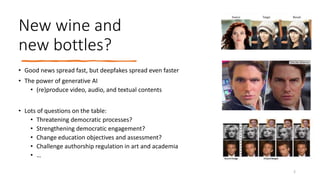
• Good news spread fast, but deepfakes spread even faster
• The power of generative AI
• (re)produce video, audio, and textual contents
• Lots of questions on the table:
• Threatening democratic processes?
• Strengthening democratic engagement?
• Change education objectives and assessment?
• Challenge authorship regulation in art and academia
• …
2
Understanding
deepfakes
• Why users ‘trust’ deepfakes, from a system
perspective
• How do deepfakes ‘travel’ on social media?
• What is the appropriate level of intervention to
diminish the effects of infodemics?
• What is the good use of deepfakes?
3
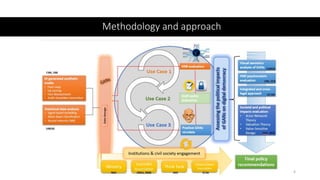
Methodology and approach
4
A system
perspective
on
deepfakes
Deepfakes are not all alike …
The
network
What makes this
approach ‘techno-
scientific’?
Poiêsis:
the
partnership
between
humans and
artefacts
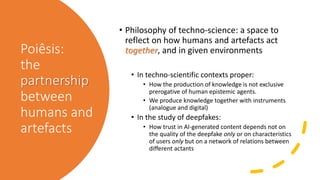
• Philosophy of techno-science: a space to
reflect on how humans and artefacts act
together, and in given environments
• In techno-scientific contexts proper:
• How the production of knowledge is not exclusive
prerogative of human epistemic agents.
• We produce knowledge together with instruments
(analogue and digital)
• In the study of deepfakes:
• How trust in AI-generated content depends not on
the quality of the deepfake only or on characteristics
of users only but on a network of relations between
different actants
Why does it matter?
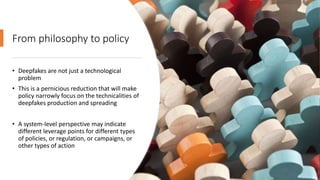
From philosophy to policy
• Deepfakes are not just a technological
problem
• This is a pernicious reduction that will make
policy narrowly focus on the technicalities of
deepfakes production and spreading
• A system-level perspective may indicate
different leverage points for different types
of policies, or regulation, or campaigns, or
other types of action
Trusting AI-
generated
content: a
techno-scientific
approach
Federica Russo
Philosophy & ILLC, UvA | SOLARIS – Project Coordinator
@federicarusso | @solaris_eu
Thanks to Powerpoint Designer for some design ideas 
And to my SOLARIS colleagues for taking poiêsis from theory to practice

Trusting AI-generated contents: a techno-scientific approach

  • 1.
    Trusting AI- generated content: a techno-scientific approach FedericaRusso Philosophy & ILLC, UvA | SOLARIS – Project Coordinator @federicarusso | @solaris_eu
  • 2.
    New wine and newbottles? • Good news spread fast, but deepfakes spread even faster • The power of generative AI • (re)produce video, audio, and textual contents • Lots of questions on the table: • Threatening democratic processes? • Strengthening democratic engagement? • Change education objectives and assessment? • Challenge authorship regulation in art and academia • … 2
  • 3.
    Understanding deepfakes • Why users‘trust’ deepfakes, from a system perspective • How do deepfakes ‘travel’ on social media? • What is the appropriate level of intervention to diminish the effects of infodemics? • What is the good use of deepfakes? 3
  • 4.
  • 5.
  • 6.
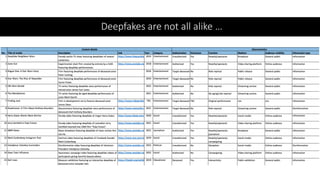
    Deepfakes are notall alike …
  • 7.
  • 8.
    What makes this approach‘techno- scientific’?
  • 9.
    Poiêsis: the partnership between humans and artefacts • Philosophyof techno-science: a space to reflect on how humans and artefacts act together, and in given environments • In techno-scientific contexts proper: • How the production of knowledge is not exclusive prerogative of human epistemic agents. • We produce knowledge together with instruments (analogue and digital) • In the study of deepfakes: • How trust in AI-generated content depends not on the quality of the deepfake only or on characteristics of users only but on a network of relations between different actants
  • 10.
    Why does itmatter?
  • 11.
    From philosophy topolicy • Deepfakes are not just a technological problem • This is a pernicious reduction that will make policy narrowly focus on the technicalities of deepfakes production and spreading • A system-level perspective may indicate different leverage points for different types of policies, or regulation, or campaigns, or other types of action
  • 12.
    Trusting AI- generated content: a techno-scientific approach FedericaRusso Philosophy & ILLC, UvA | SOLARIS – Project Coordinator @federicarusso | @solaris_eu Thanks to Powerpoint Designer for some design ideas  And to my SOLARIS colleagues for taking poiêsis from theory to practice

Editor's Notes

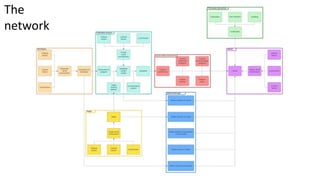
  • #7 Categories: entertainment, social, journalism, educational … Authorization: yes, no, target deceseased Disclosure: yes, no Function: novelty, role reprisal, campaigning, … Medium: broadcast, public release, social media,… Audience visibility: general public, online audience, .. Information type: dis mis -information
  • #8 Developer Publication process Target Social media environemnt Media landscape Viewer Third party interventions e.g. fact-checkers / debunkers For each: several characteristics, some technical some socio-demographic … Some of these to be tested in the platform, some other to be studied in focus groups etc