Causality, regularity, and variation.
A reassessment
Federica Russo
Philosophy | Humanities | Amsterdam
russofederica.wordpress.com | @federicarusso
Overview
The mosaic of causal theory
Fragmentation and unification of causal theory
Regularity and variation in causal discovery
2
THE MOSAIC OF CAUSAL THEORY
3
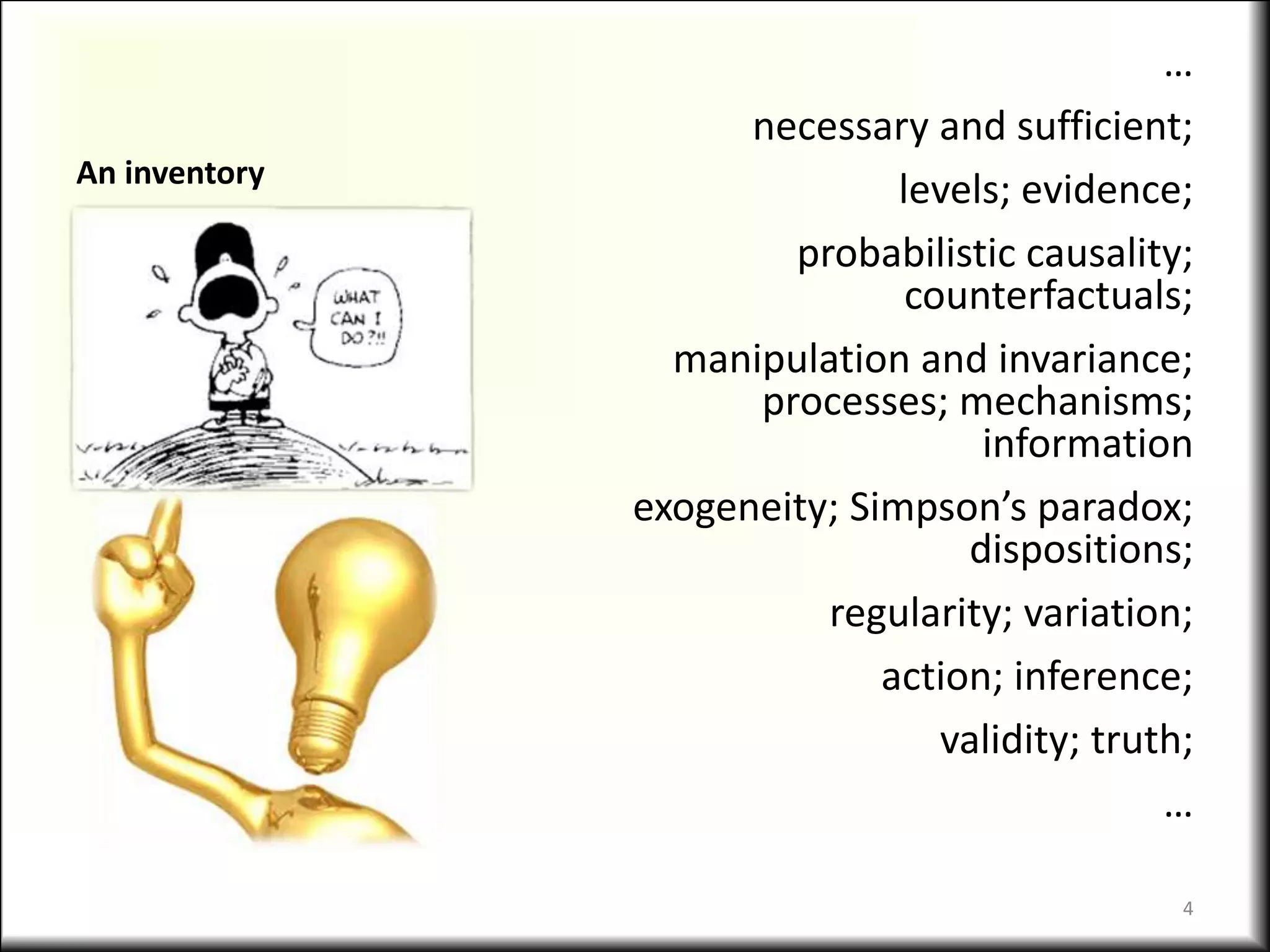
An inventory
…
necessary and sufficient;
levels; evidence;
probabilistic causality;
counterfactuals;
manipulation and invariance;
processes; mechanisms;
information
exogeneity; Simpson’s paradox;
dispositions;
regularity; variation;
action; inference;
validity; truth;
…
4
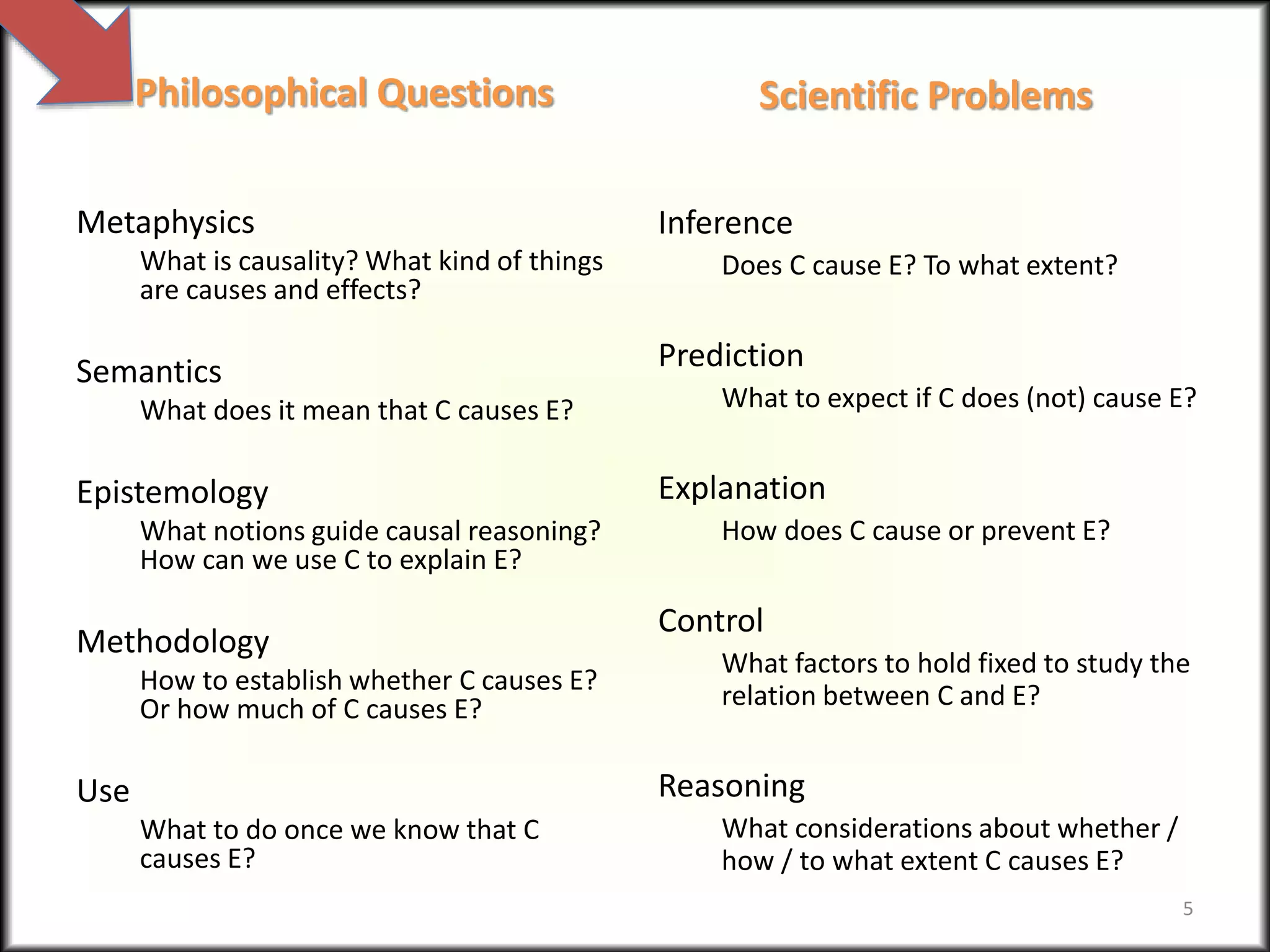
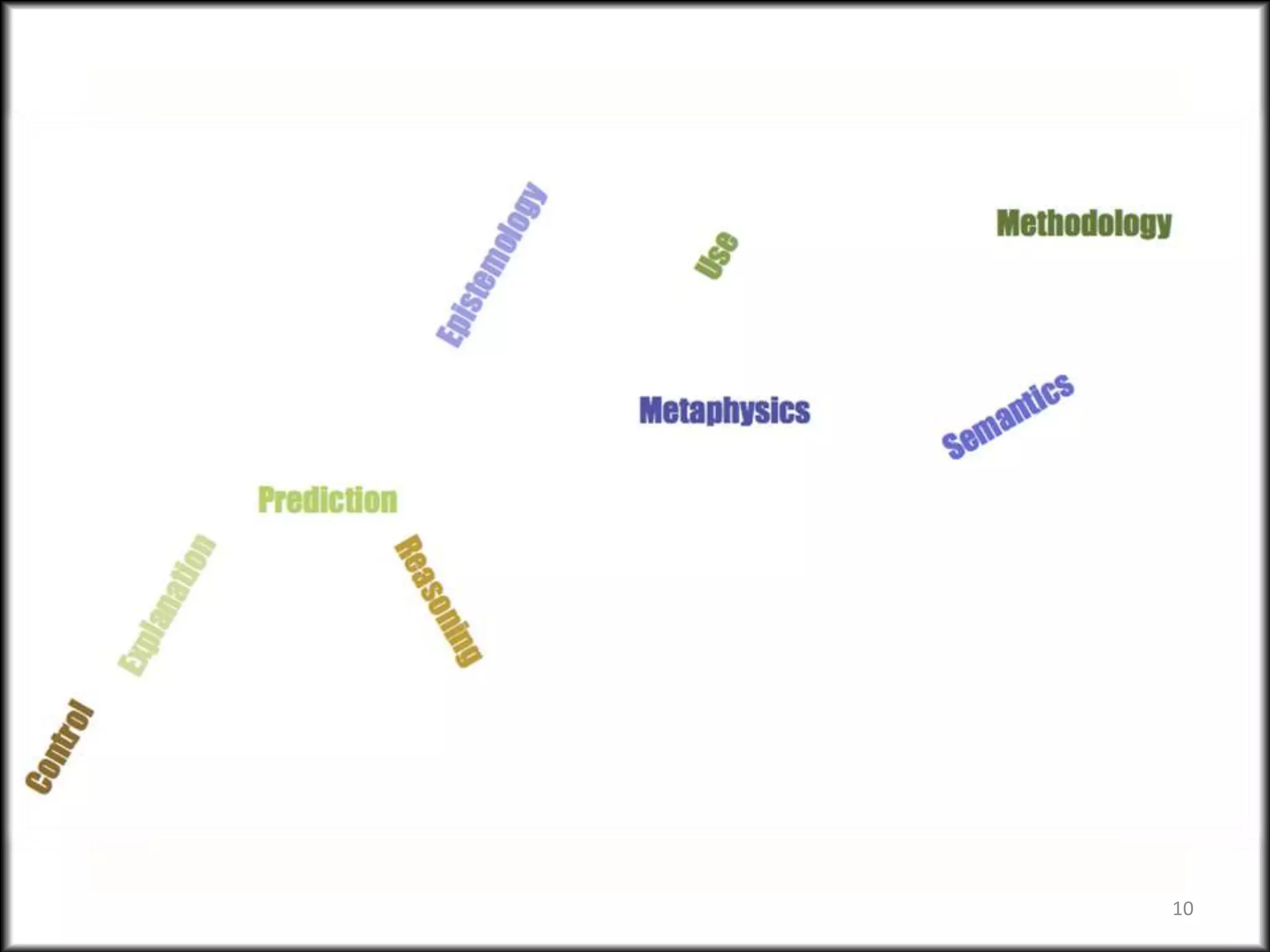
Philosophical Questions
Metaphysics
What is causality? What kind of things
are causes and effects?
Semantics
What does it mean that C causes E?
Epistemology
What notions guide causal reasoning?
How can we use C to explain E?
Methodology
How to establish whether C causes E?
Or how much of C causes E?
Use
What to do once we know that C
causes E?
Scientific Problems
Inference
Does C cause E? To what extent?
Prediction
What to expect if C does (not) cause E?
Explanation
How does C cause or prevent E?
Control
What factors to hold fixed to study the
relation between C and E?
Reasoning
What considerations about whether /
how / to what extent C causes E?
5
6
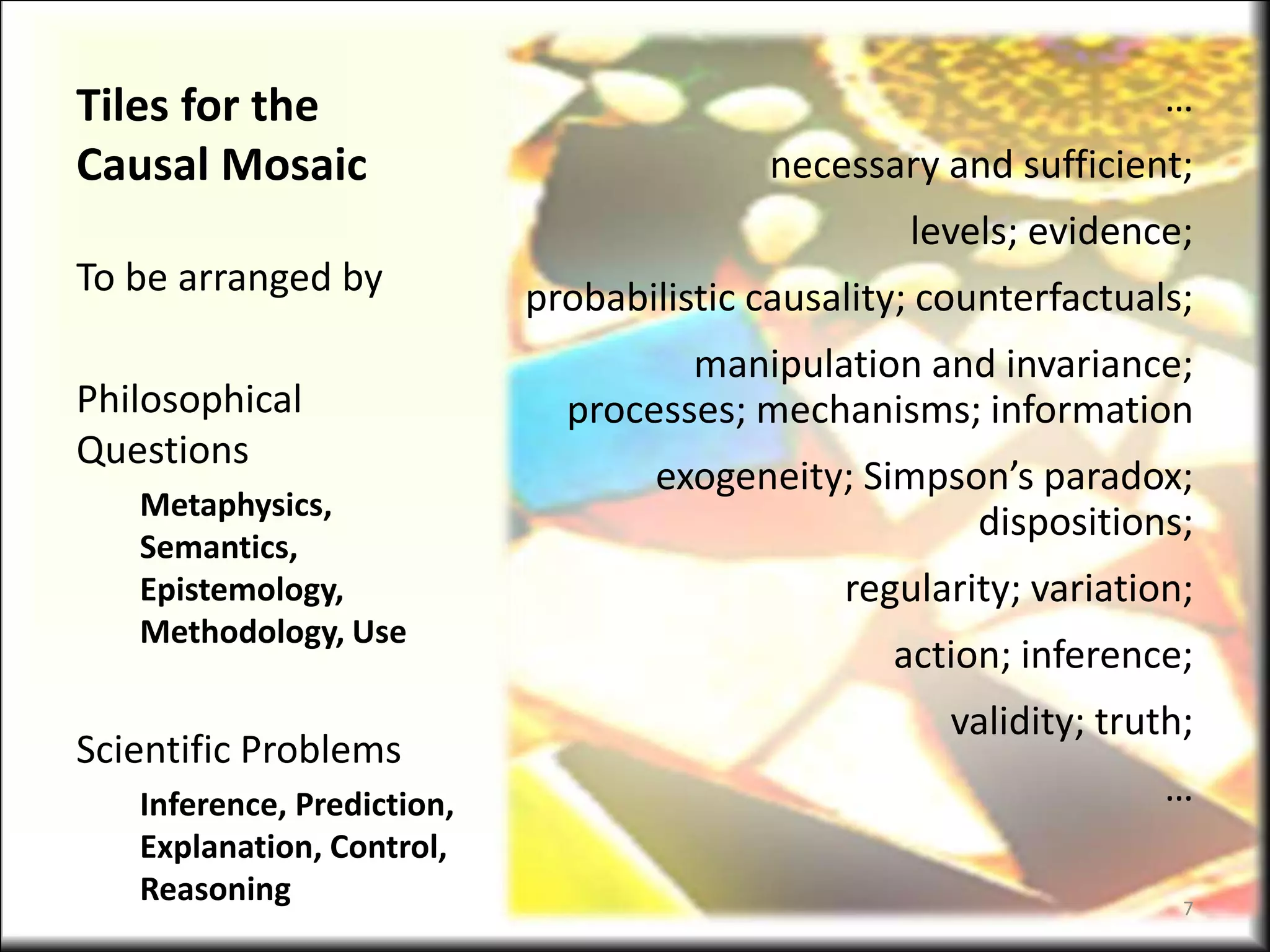
Tiles for the
Causal Mosaic
…
necessary and sufficient;
levels; evidence;
probabilistic causality; counterfactuals;
manipulation and invariance;
processes; mechanisms; information
exogeneity; Simpson’s paradox;
dispositions;
regularity; variation;
action; inference;
validity; truth;
…
To be arranged by
Philosophical
Questions
Metaphysics,
Semantics,
Epistemology,
Methodology, Use
Scientific Problems
Inference, Prediction,
Explanation, Control,
Reasoning 7
A causal mosaic
A picture made of tiles
Each tile has a role that
Is determined by the scientific problem / philosophical
question it addresses
Stands in a relation with neighbouring concepts
A causal mosaic is dynamic, partly depends on
scientists’ / philosophers’ perspectives
8
FRAGMENTATION AND
UNIFICATION OF CAUSAL THEORY
9
10
11
REGULARITY AND VARIATION
IN CAUSAL DISCOVERY
12
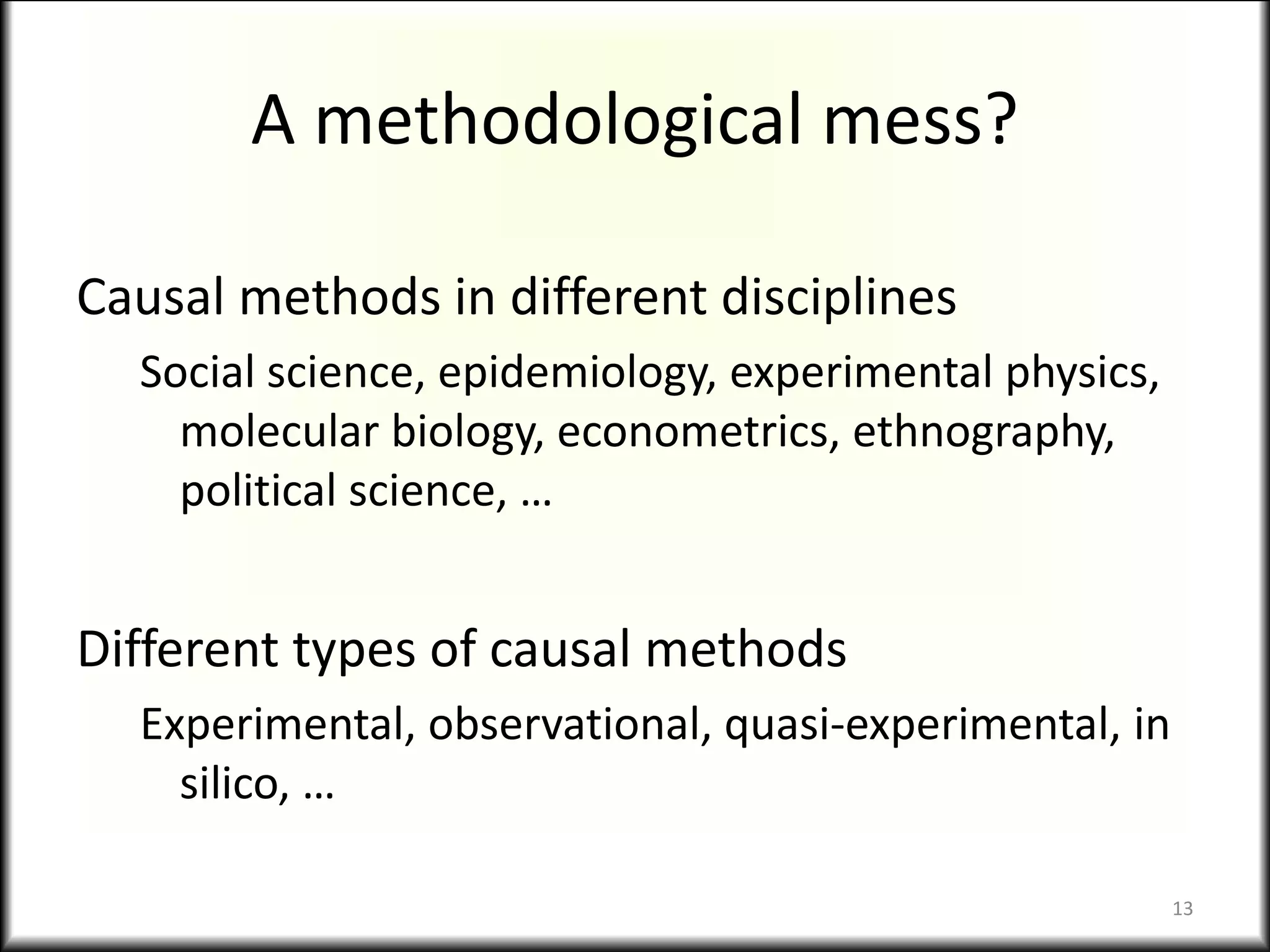
A methodological mess?
Causal methods in different disciplines
Social science, epidemiology, experimental physics,
molecular biology, econometrics, ethnography,
political science, …
Different types of causal methods
Experimental, observational, quasi-experimental, in
silico, …
13
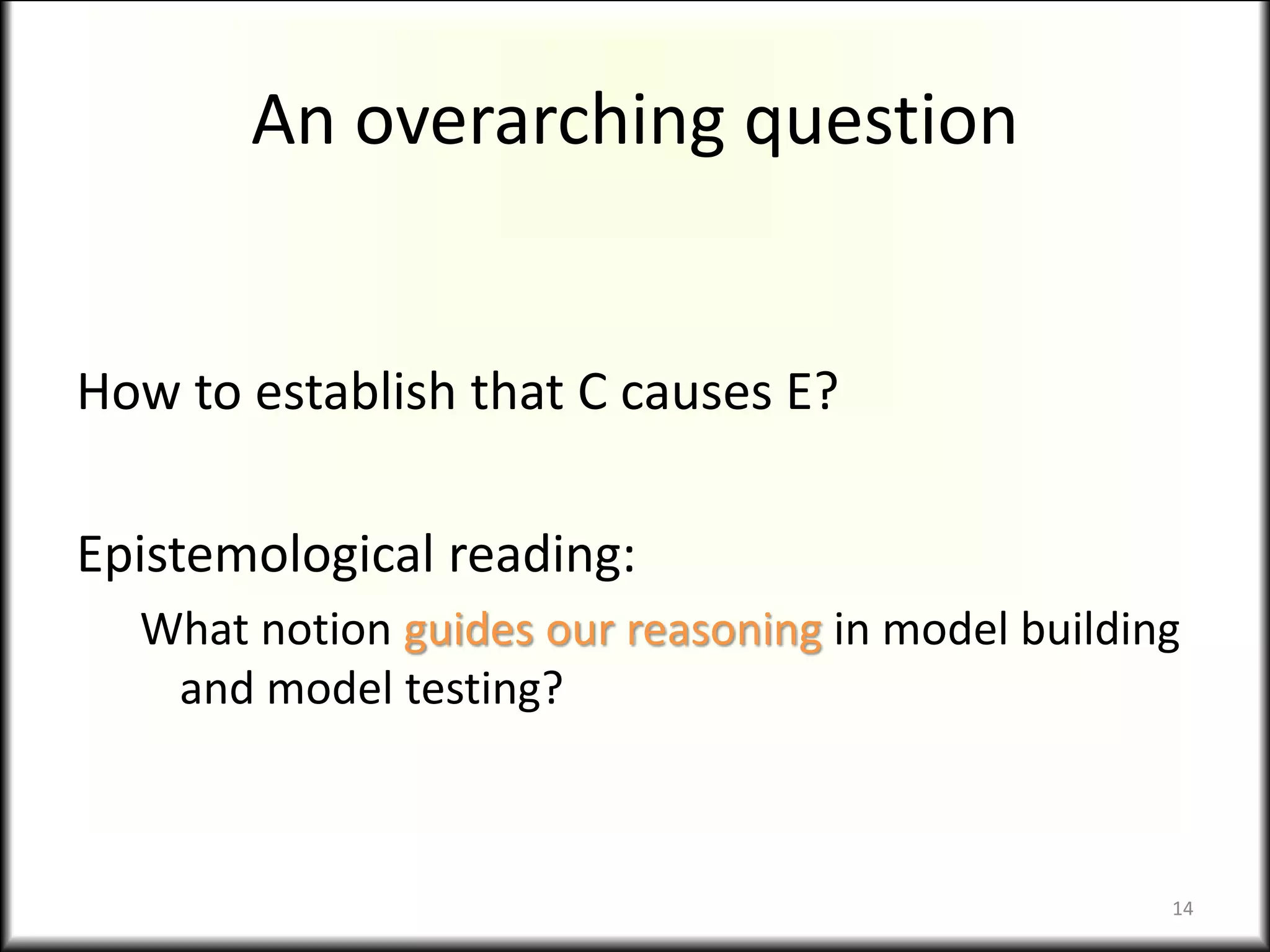
An overarching question
How to establish that C causes E?
Epistemological reading:
What notion guides our reasoning in model building
and model testing?
14
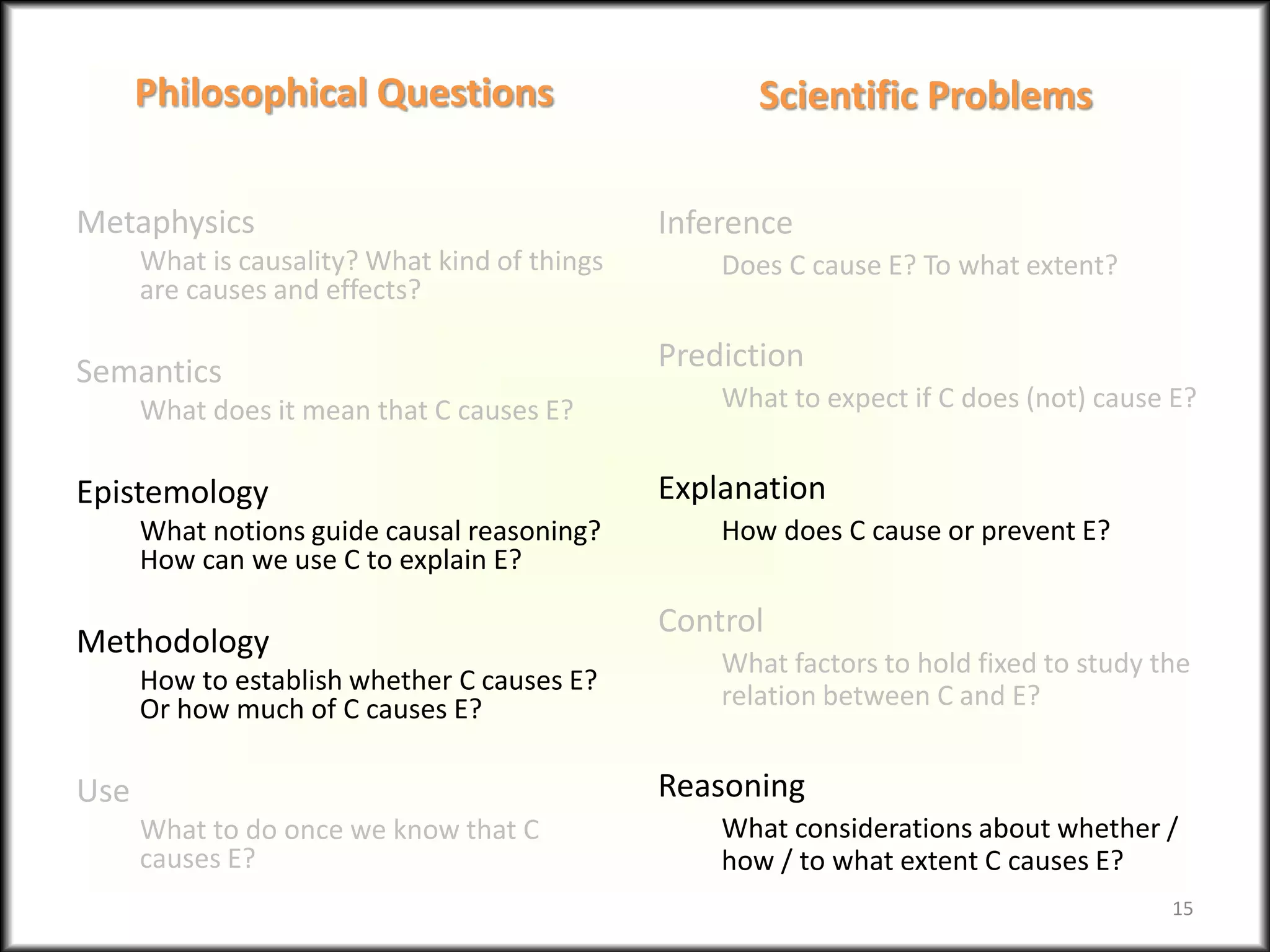
Philosophical Questions
Metaphysics
What is causality? What kind of things
are causes and effects?
Semantics
What does it mean that C causes E?
Epistemology
What notions guide causal reasoning?
How can we use C to explain E?
Methodology
How to establish whether C causes E?
Or how much of C causes E?
Use
What to do once we know that C
causes E?
Scientific Problems
Inference
Does C cause E? To what extent?
Prediction
What to expect if C does (not) cause E?
Explanation
How does C cause or prevent E?
Control
What factors to hold fixed to study the
relation between C and E?
Reasoning
What considerations about whether /
how / to what extent C causes E?
15
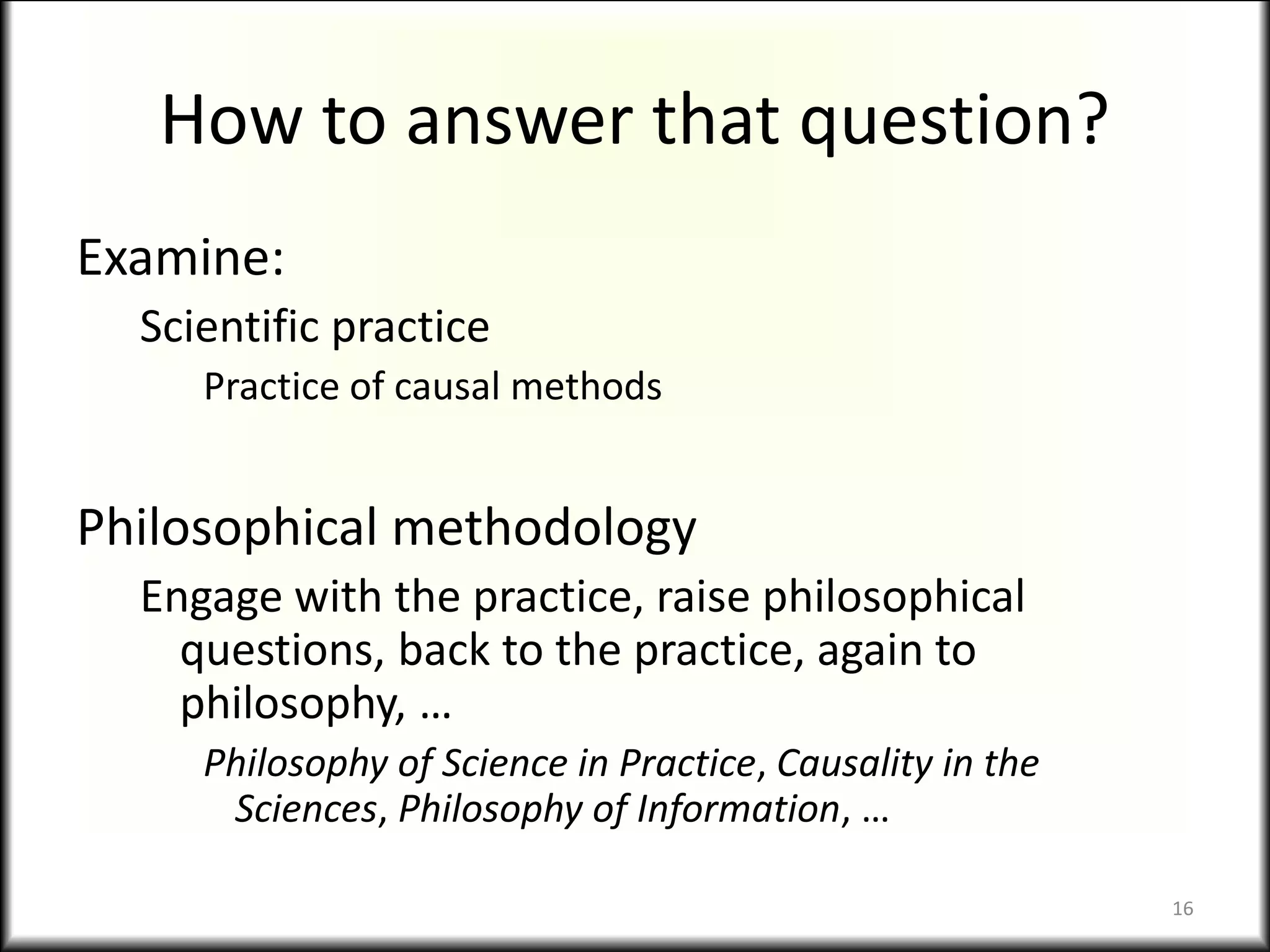
How to answer that question?
Examine:
Scientific practice
Practice of causal methods
Philosophical methodology
Engage with the practice, raise philosophical
questions, back to the practice, again to
philosophy, …
Philosophy of Science in Practice, Causality in the
Sciences, Philosophy of Information, …
16
The Humean precept
Thou shalt observe effects regularly following
their causes
Thou shalt find the constant conjunction
17
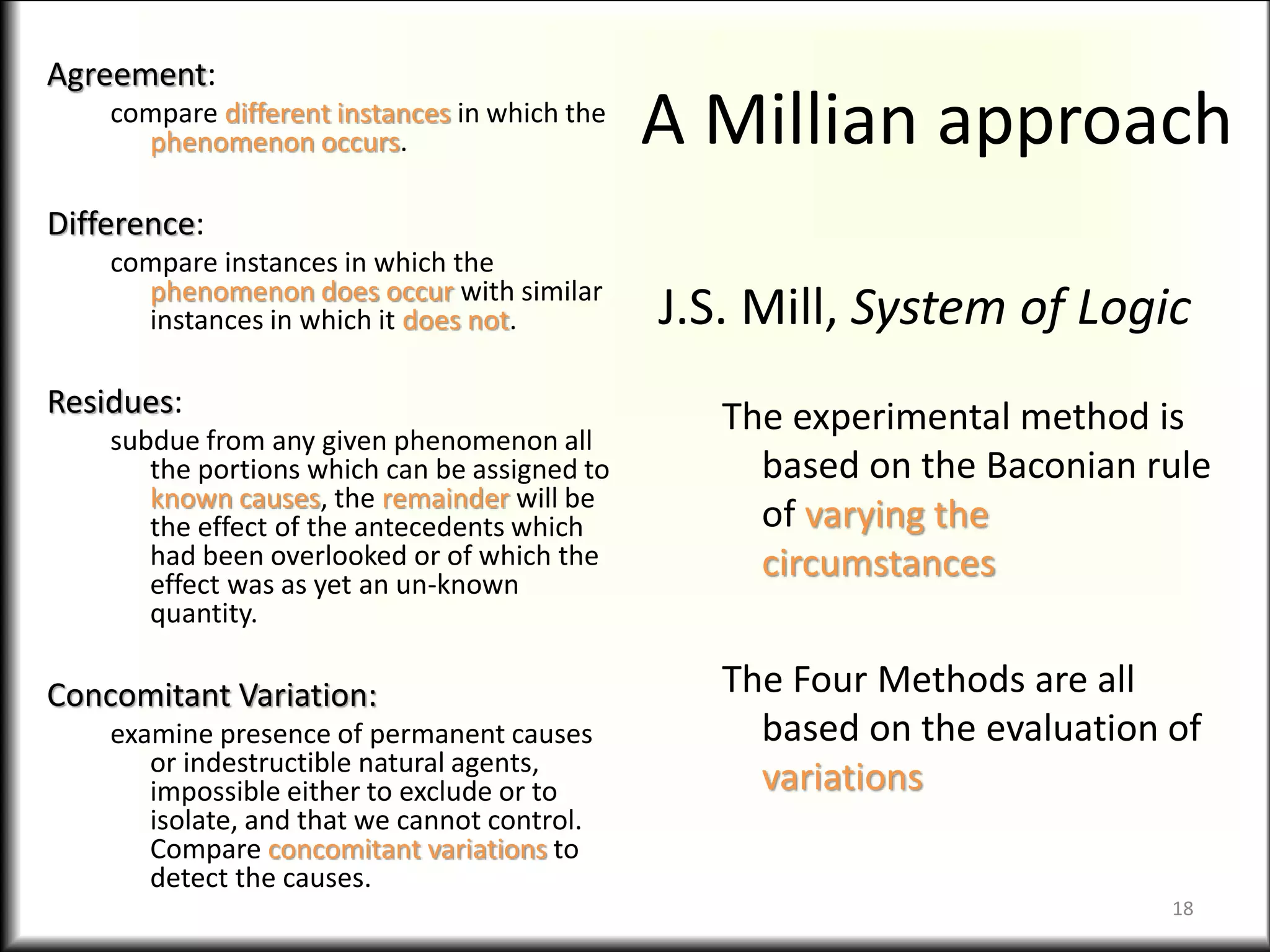
A Millian approach
Agreement:
compare different instances in which the
phenomenon occurs.
Difference:
compare instances in which the
phenomenon does occur with similar
instances in which it does not.
Residues:
subdue from any given phenomenon all
the portions which can be assigned to
known causes, the remainder will be
the effect of the antecedents which
had been overlooked or of which the
effect was as yet an un-known
quantity.
Concomitant Variation:
examine presence of permanent causes
or indestructible natural agents,
impossible either to exclude or to
isolate, and that we cannot control.
Compare concomitant variations to
detect the causes.
J.S. Mill, System of Logic
The experimental method is
based on the Baconian rule
of varying the
circumstances
The Four Methods are all
based on the evaluation of
variations
18
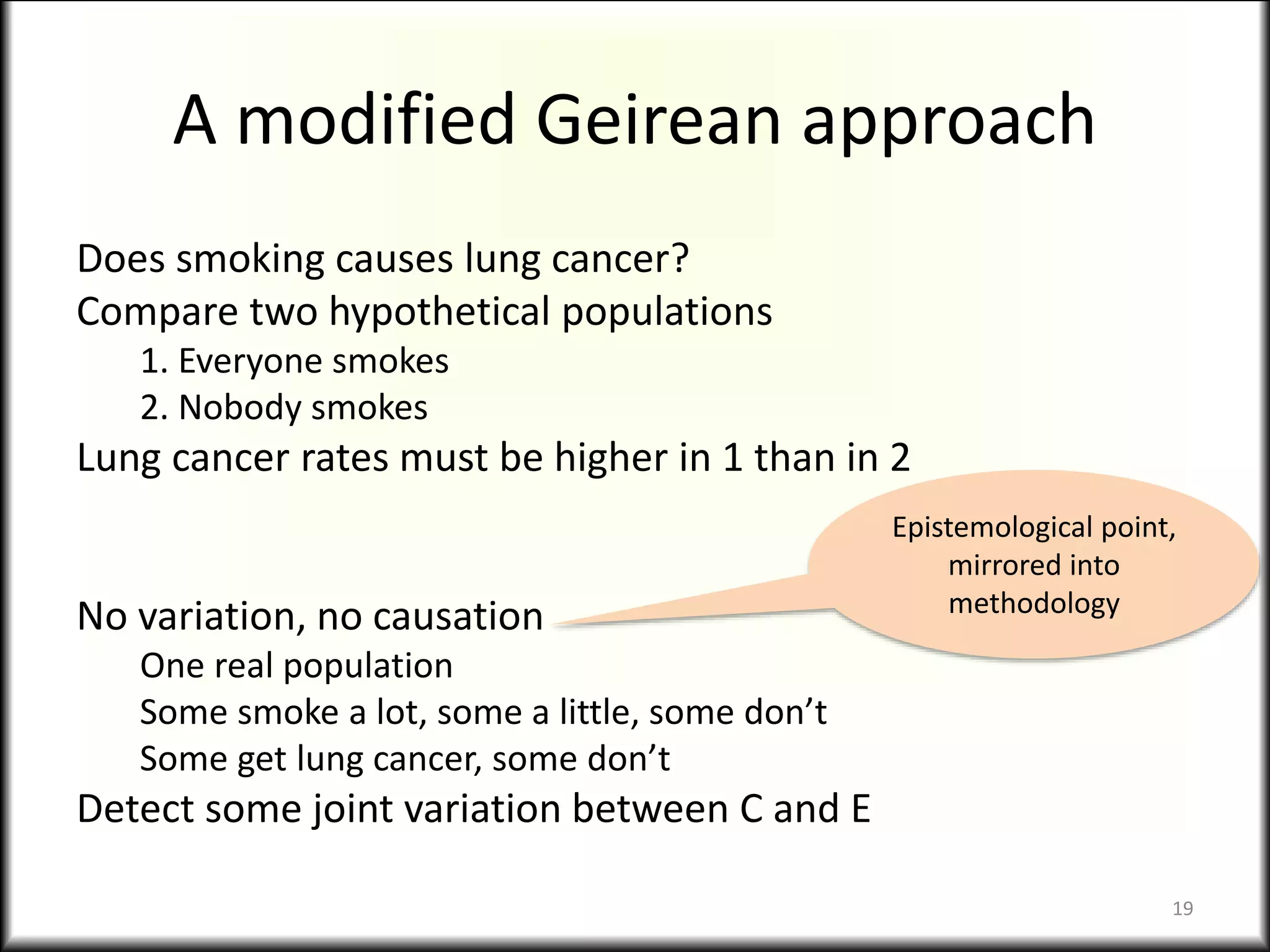
A modified Geirean approach
Does smoking causes lung cancer?
Compare two hypothetical populations
1. Everyone smokes
2. Nobody smokes
Lung cancer rates must be higher in 1 than in 2
No variation, no causation
One real population
Some smoke a lot, some a little, some don’t
Some get lung cancer, some don’t
Detect some joint variation between C and E
Epistemological point,
mirrored into
methodology
19
Variational
epistemology and methodology
Causal discovery (experiments, statistics)
Search for differences
Probability of the outcome given the cause; effects of manipulations;
…
Causal explanation
Most causes are ‘difference-makers’ in mechanisms
regulating phenomena (e.g. health and behaviour)
20
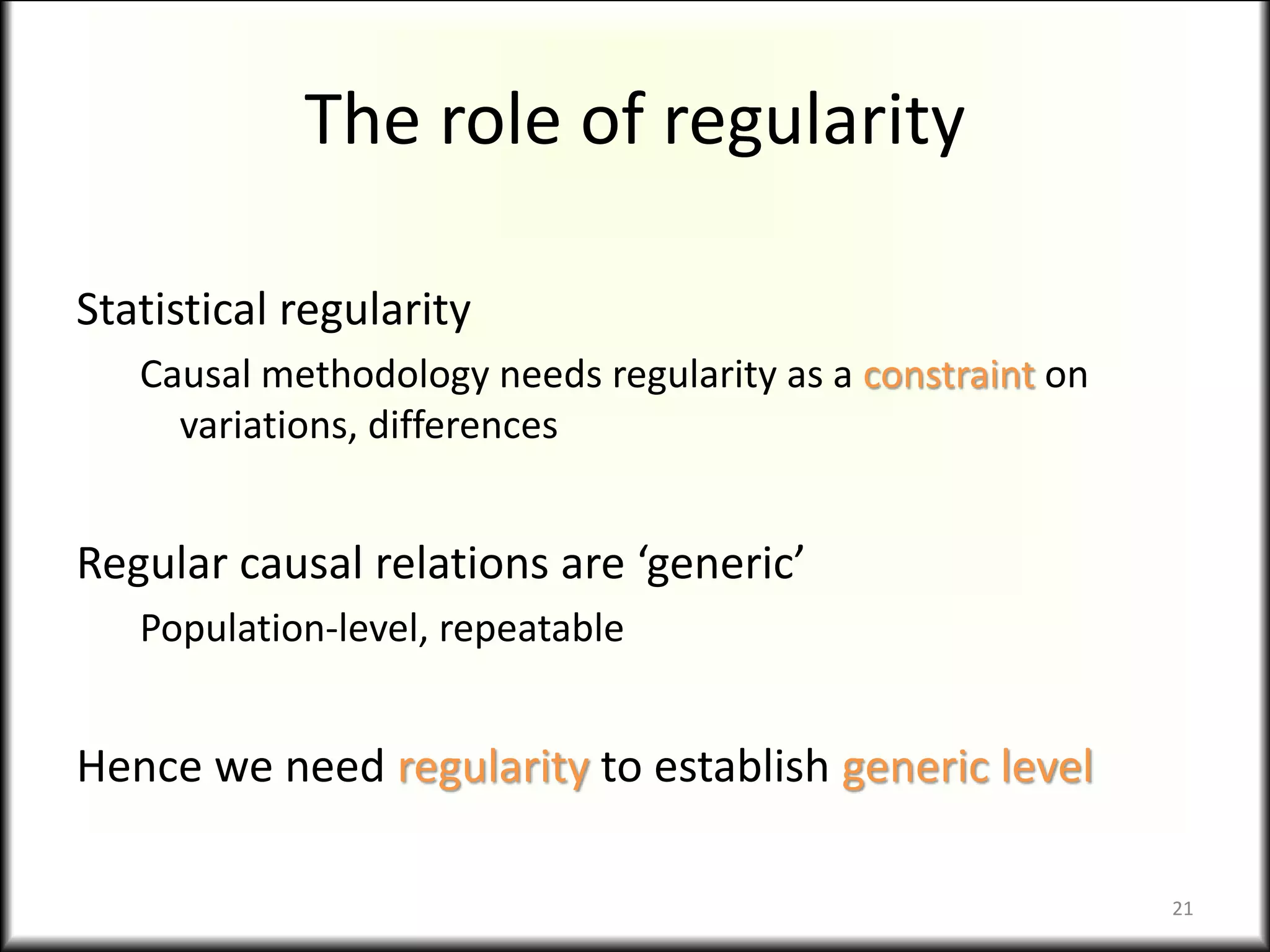
The role of regularity
Statistical regularity
Causal methodology needs regularity as a constraint on
variations, differences
Regular causal relations are ‘generic’
Population-level, repeatable
Hence we need regularity to establish generic level
21
FRAGMENTATION AND
UNIFICATION AGAIN
22
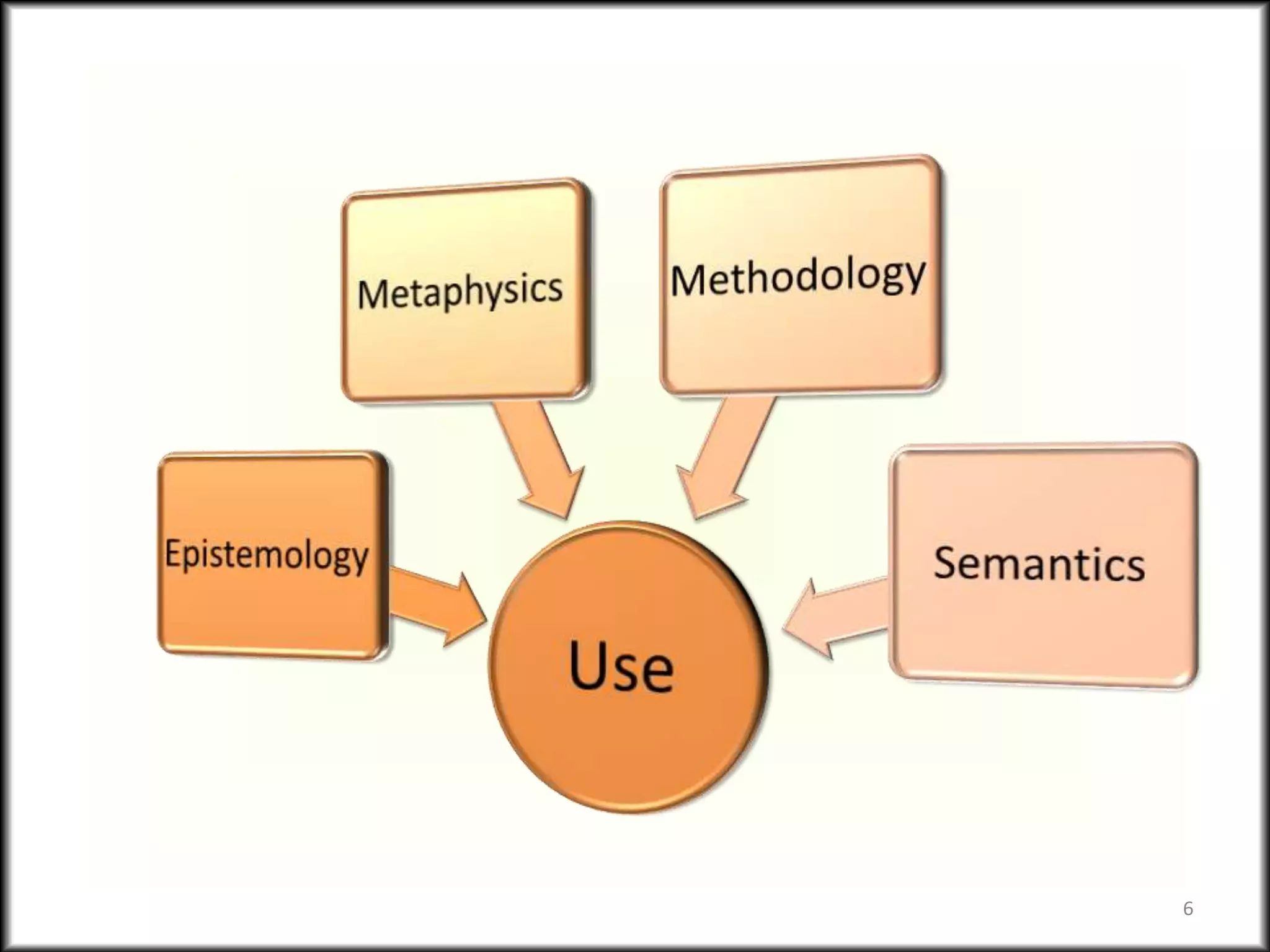
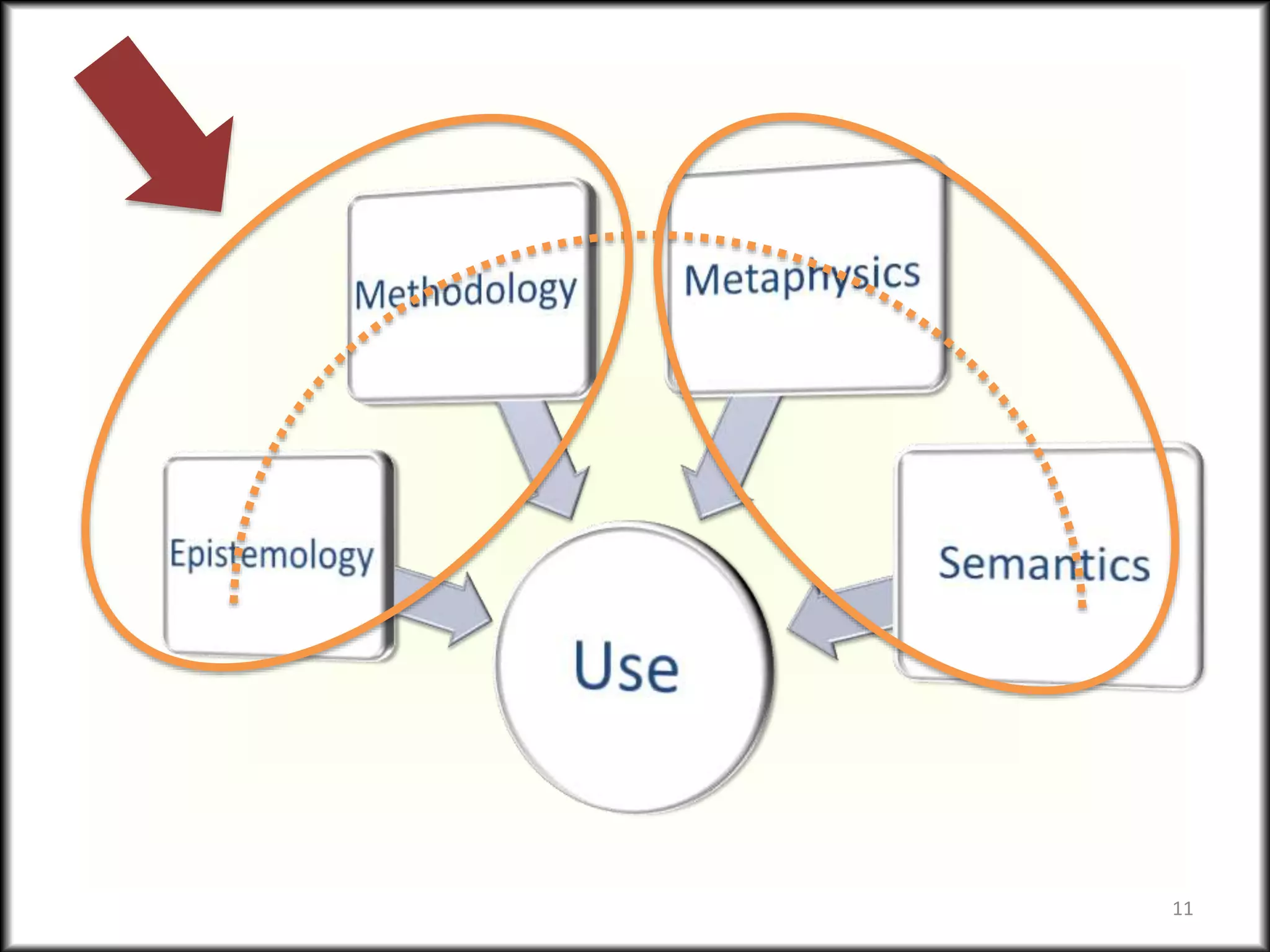
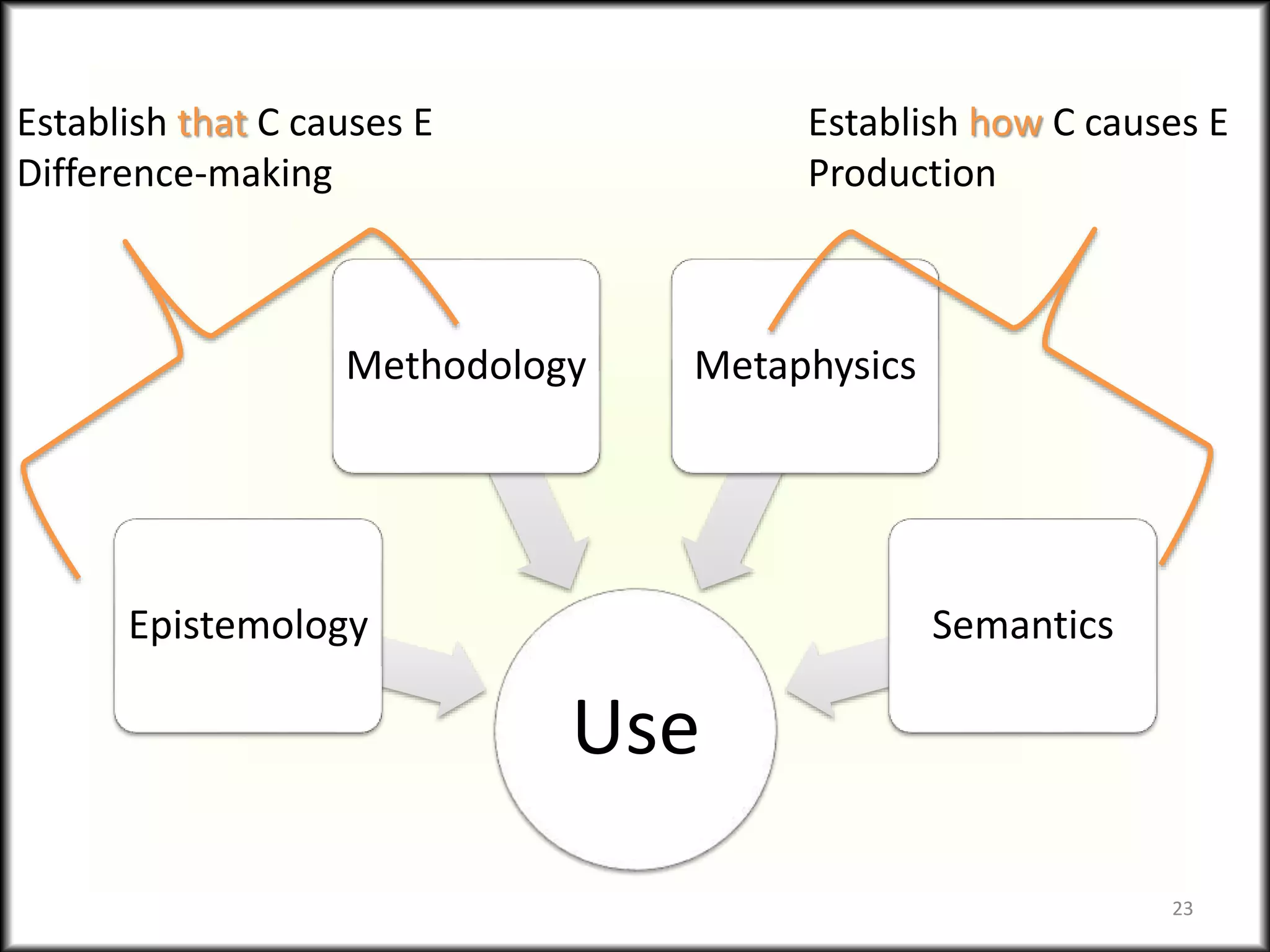
Use
Epistemology
Methodology Metaphysics
Semantics
23
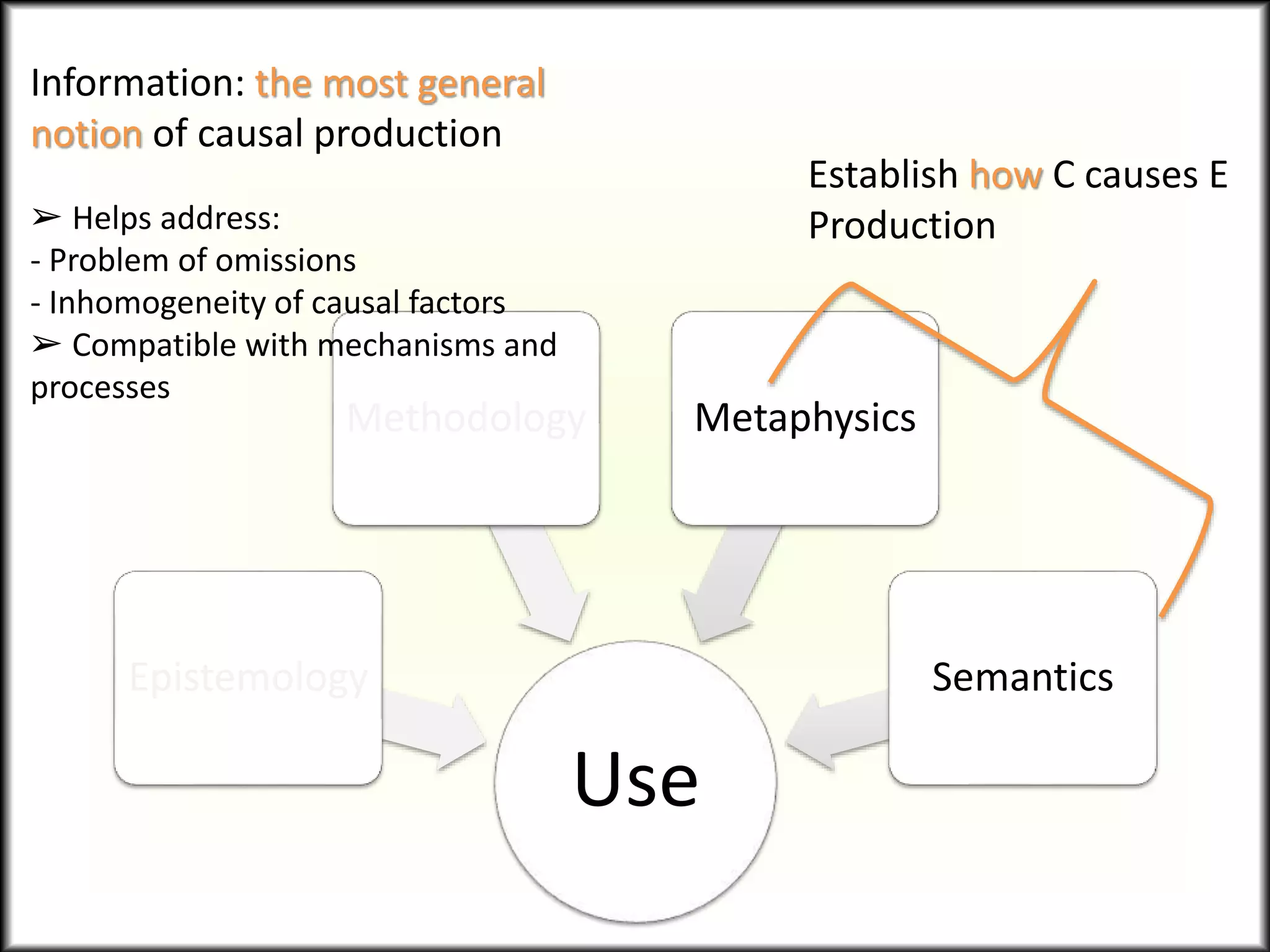
Establish that C causes E
Difference-making
Establish how C causes E
Production
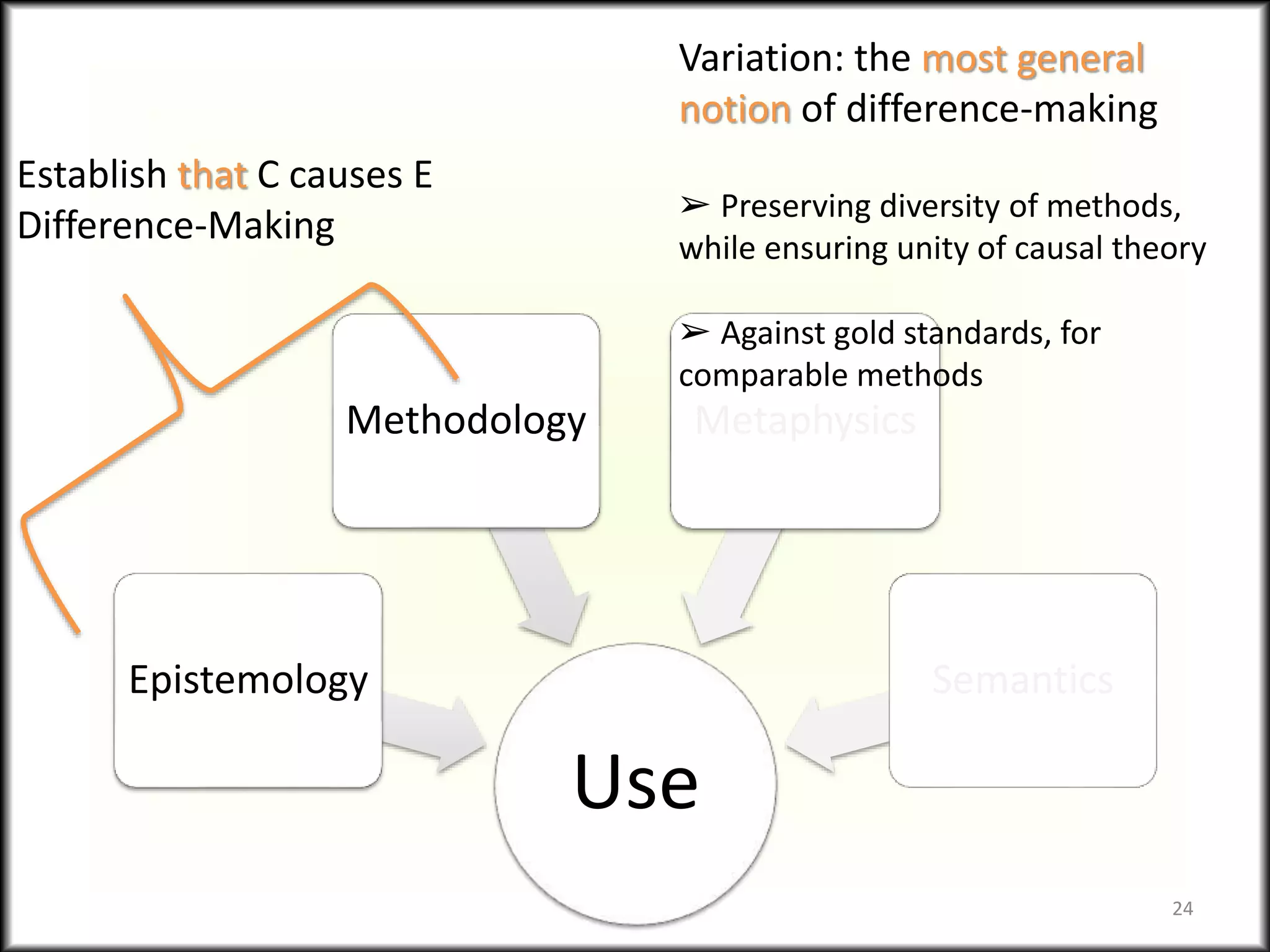
Use
Epistemology
Methodology Metaphysics
Semantics
24
Establish that C causes E
Difference-Making
Variation: the most general
notion of difference-making
➢ Preserving diversity of methods,
while ensuring unity of causal theory
➢ Against gold standards, for
comparable methods
Use
Epistemology
Methodology Metaphysics
Semantics
Establish how C causes E
Production
Information: the most general
notion of causal production
➢ Helps address:
- Problem of omissions
- Inhomogeneity of causal factors
➢ Compatible with mechanisms and
processes
TO SUM UP AND CONCLUDE
26
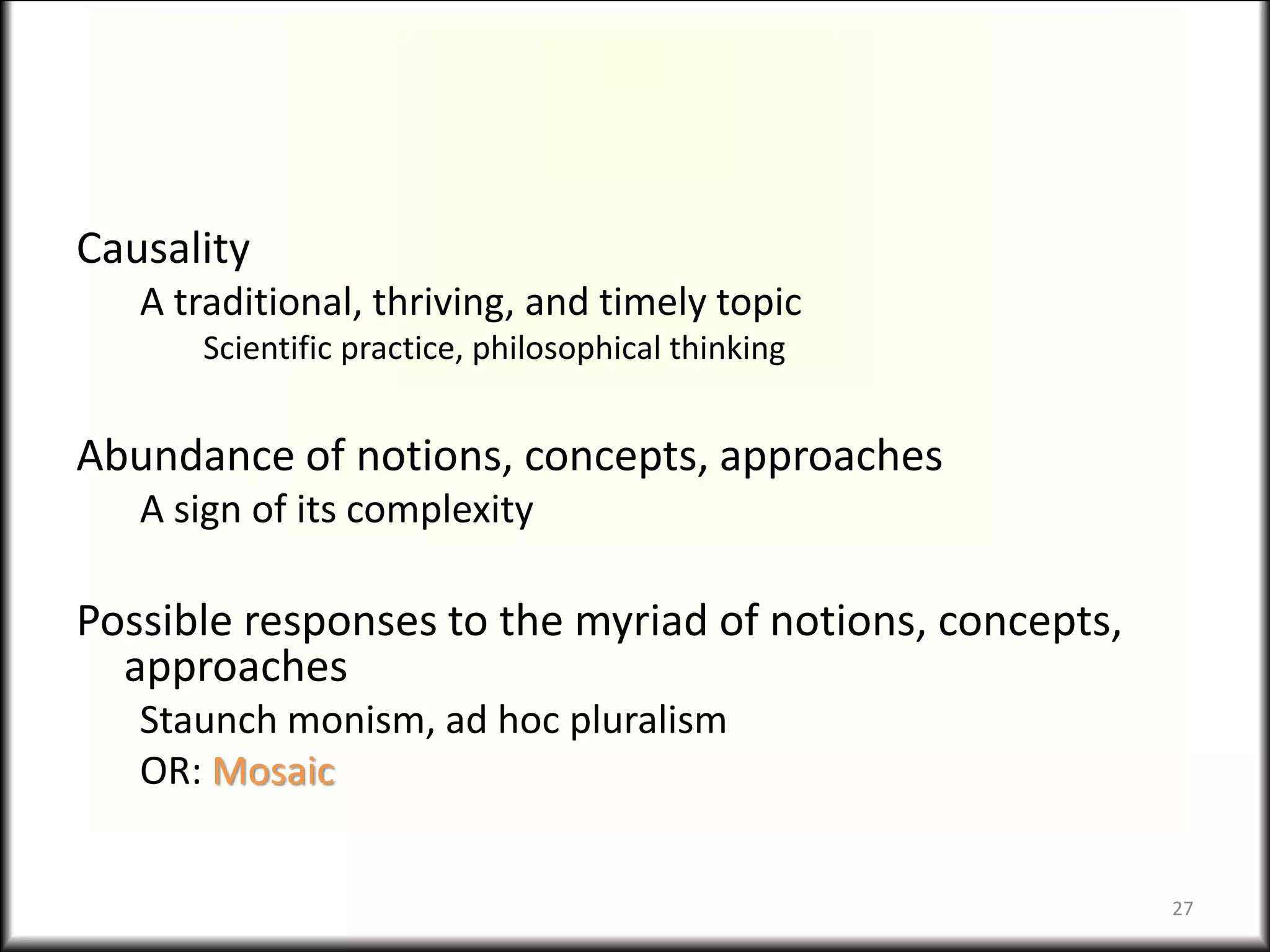
Causality
A traditional, thriving, and timely topic
Scientific practice, philosophical thinking
Abundance of notions, concepts, approaches
A sign of its complexity
Possible responses to the myriad of notions, concepts,
approaches
Staunch monism, ad hoc pluralism
OR: Mosaic
27
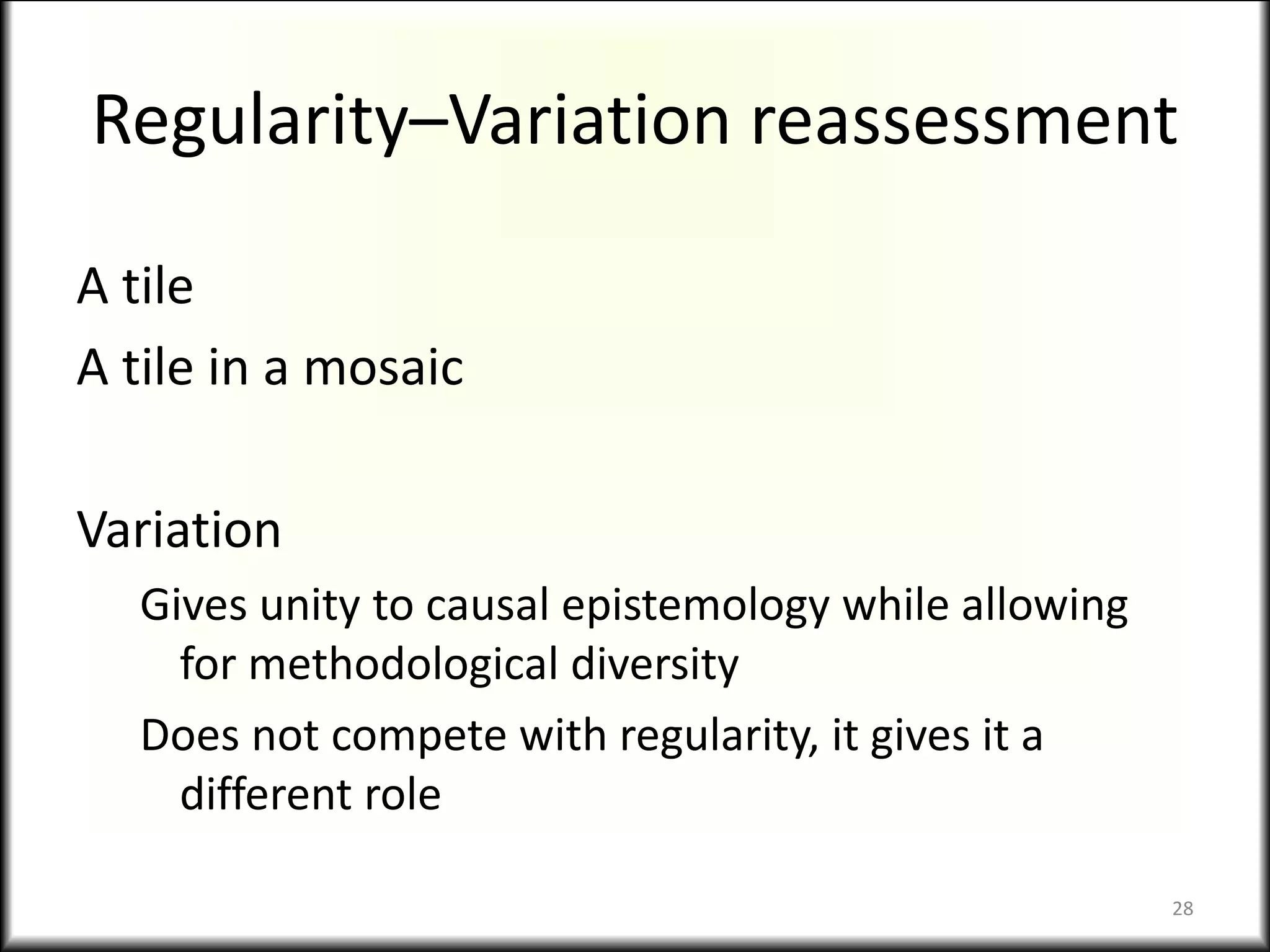
Regularity–Variation reassessment
A tile
A tile in a mosaic
Variation
Gives unity to causal epistemology while allowing
for methodological diversity
Does not compete with regularity, it gives it a
different role
28
The causal mosaic
as a philosophical enterprise
Not ‘anything goes’
Timely philosophy
Science in practice, conceptual design
Collaborative
No counterexample factory,
Distributed philosophical achievement
29
Further readings
P. Illari and F. Russo, Causality: Philosophical Theory Meets Scientific
Practice, OUP 2014
F. Russo, Causality and Causal Modelling in the Social Sciences.
Measuring Variations, Springer 2009
P. Illari and F. Russo, ‘Causality and information’, in The Routledge
Handbook of Philosophy of Information, 2016
P. Illari and F. Russo, ‘Information channels and biomarkers of disease’,
Topoi 2014
L. Floridi, ‘What is a philosophical question?’, Metaphilosophy 2013
L. Floridi, ‘A defence of constructionism: philosophy as conceptual
engineering’, Metaphilosophy, 2011
30

Causality, regularity, and variation. A reassessment

  • 1.
    Causality, regularity, andvariation. A reassessment Federica Russo Philosophy | Humanities | Amsterdam russofederica.wordpress.com | @federicarusso
  • 2.
    Overview The mosaic ofcausal theory Fragmentation and unification of causal theory Regularity and variation in causal discovery 2
  • 3.
    THE MOSAIC OFCAUSAL THEORY 3
  • 4.
    An inventory … necessary andsufficient; levels; evidence; probabilistic causality; counterfactuals; manipulation and invariance; processes; mechanisms; information exogeneity; Simpson’s paradox; dispositions; regularity; variation; action; inference; validity; truth; … 4
  • 5.
    Philosophical Questions Metaphysics What iscausality? What kind of things are causes and effects? Semantics What does it mean that C causes E? Epistemology What notions guide causal reasoning? How can we use C to explain E? Methodology How to establish whether C causes E? Or how much of C causes E? Use What to do once we know that C causes E? Scientific Problems Inference Does C cause E? To what extent? Prediction What to expect if C does (not) cause E? Explanation How does C cause or prevent E? Control What factors to hold fixed to study the relation between C and E? Reasoning What considerations about whether / how / to what extent C causes E? 5
  • 6.
  • 7.
    Tiles for the CausalMosaic … necessary and sufficient; levels; evidence; probabilistic causality; counterfactuals; manipulation and invariance; processes; mechanisms; information exogeneity; Simpson’s paradox; dispositions; regularity; variation; action; inference; validity; truth; … To be arranged by Philosophical Questions Metaphysics, Semantics, Epistemology, Methodology, Use Scientific Problems Inference, Prediction, Explanation, Control, Reasoning 7
  • 8.
    A causal mosaic Apicture made of tiles Each tile has a role that Is determined by the scientific problem / philosophical question it addresses Stands in a relation with neighbouring concepts A causal mosaic is dynamic, partly depends on scientists’ / philosophers’ perspectives 8
  • 9.
  • 10.
  • 11.
  • 12.
    REGULARITY AND VARIATION INCAUSAL DISCOVERY 12
  • 13.
    A methodological mess? Causalmethods in different disciplines Social science, epidemiology, experimental physics, molecular biology, econometrics, ethnography, political science, … Different types of causal methods Experimental, observational, quasi-experimental, in silico, … 13
  • 14.
    An overarching question Howto establish that C causes E? Epistemological reading: What notion guides our reasoning in model building and model testing? 14
  • 15.
    Philosophical Questions Metaphysics What iscausality? What kind of things are causes and effects? Semantics What does it mean that C causes E? Epistemology What notions guide causal reasoning? How can we use C to explain E? Methodology How to establish whether C causes E? Or how much of C causes E? Use What to do once we know that C causes E? Scientific Problems Inference Does C cause E? To what extent? Prediction What to expect if C does (not) cause E? Explanation How does C cause or prevent E? Control What factors to hold fixed to study the relation between C and E? Reasoning What considerations about whether / how / to what extent C causes E? 15
  • 16.
    How to answerthat question? Examine: Scientific practice Practice of causal methods Philosophical methodology Engage with the practice, raise philosophical questions, back to the practice, again to philosophy, … Philosophy of Science in Practice, Causality in the Sciences, Philosophy of Information, … 16
  • 17.
    The Humean precept Thoushalt observe effects regularly following their causes Thou shalt find the constant conjunction 17
  • 18.
    A Millian approach Agreement: comparedifferent instances in which the phenomenon occurs. Difference: compare instances in which the phenomenon does occur with similar instances in which it does not. Residues: subdue from any given phenomenon all the portions which can be assigned to known causes, the remainder will be the effect of the antecedents which had been overlooked or of which the effect was as yet an un-known quantity. Concomitant Variation: examine presence of permanent causes or indestructible natural agents, impossible either to exclude or to isolate, and that we cannot control. Compare concomitant variations to detect the causes. J.S. Mill, System of Logic The experimental method is based on the Baconian rule of varying the circumstances The Four Methods are all based on the evaluation of variations 18
  • 19.
    A modified Geireanapproach Does smoking causes lung cancer? Compare two hypothetical populations 1. Everyone smokes 2. Nobody smokes Lung cancer rates must be higher in 1 than in 2 No variation, no causation One real population Some smoke a lot, some a little, some don’t Some get lung cancer, some don’t Detect some joint variation between C and E Epistemological point, mirrored into methodology 19
  • 20.
    Variational epistemology and methodology Causaldiscovery (experiments, statistics) Search for differences Probability of the outcome given the cause; effects of manipulations; … Causal explanation Most causes are ‘difference-makers’ in mechanisms regulating phenomena (e.g. health and behaviour) 20
  • 21.
    The role ofregularity Statistical regularity Causal methodology needs regularity as a constraint on variations, differences Regular causal relations are ‘generic’ Population-level, repeatable Hence we need regularity to establish generic level 21
  • 22.
  • 23.
    Use Epistemology Methodology Metaphysics Semantics 23 Establish thatC causes E Difference-making Establish how C causes E Production
  • 24.
    Use Epistemology Methodology Metaphysics Semantics 24 Establish thatC causes E Difference-Making Variation: the most general notion of difference-making ➢ Preserving diversity of methods, while ensuring unity of causal theory ➢ Against gold standards, for comparable methods
  • 25.
    Use Epistemology Methodology Metaphysics Semantics Establish howC causes E Production Information: the most general notion of causal production ➢ Helps address: - Problem of omissions - Inhomogeneity of causal factors ➢ Compatible with mechanisms and processes
  • 26.
    TO SUM UPAND CONCLUDE 26
  • 27.
    Causality A traditional, thriving,and timely topic Scientific practice, philosophical thinking Abundance of notions, concepts, approaches A sign of its complexity Possible responses to the myriad of notions, concepts, approaches Staunch monism, ad hoc pluralism OR: Mosaic 27
  • 28.
    Regularity–Variation reassessment A tile Atile in a mosaic Variation Gives unity to causal epistemology while allowing for methodological diversity Does not compete with regularity, it gives it a different role 28
  • 29.
    The causal mosaic asa philosophical enterprise Not ‘anything goes’ Timely philosophy Science in practice, conceptual design Collaborative No counterexample factory, Distributed philosophical achievement 29
  • 30.
    Further readings P. Illariand F. Russo, Causality: Philosophical Theory Meets Scientific Practice, OUP 2014 F. Russo, Causality and Causal Modelling in the Social Sciences. Measuring Variations, Springer 2009 P. Illari and F. Russo, ‘Causality and information’, in The Routledge Handbook of Philosophy of Information, 2016 P. Illari and F. Russo, ‘Information channels and biomarkers of disease’, Topoi 2014 L. Floridi, ‘What is a philosophical question?’, Metaphilosophy 2013 L. Floridi, ‘A defence of constructionism: philosophy as conceptual engineering’, Metaphilosophy, 2011 30

Editor's Notes

  • #2 The sciences, ranging from the biomedical to the social and to physical sciences, deploy a variety of methods to unveil causal relations and to model phenomena. In this talk, I will argue that the common denominator of causal reasoning in  different scientific domains is the notion of variation.  The point is epistemological in character. I will be focusing on how we reason about cause-effect relationships, namely about what it is that we ‘look for’ and put forward for further testing and evaluation. I shall argue that causality needs difference, or variations, because in a situation of indifferentiation we would not be able to perceive, or recognise, the presence of causes. Since Hume, we are acquainted to associate causality with regularity. I contend that even when we try to find causal explanation for regularities, it is via difference and variation that we reason. In this sense, the notion of variation is what grounds causal reasoning across different methods of scientific enquiry.
  • #20 Giere’s book: Understanding scientific reasoning