APA
Formatting and Style
Guide
What is APA?
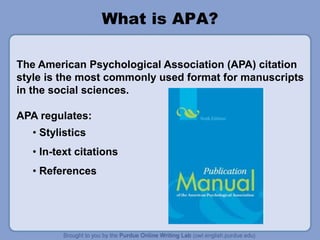
The American Psychological Association (APA) citation
style is the most commonly used format for manuscripts
in the social sciences.
APA regulates:
• Stylistics
• In-text citations
• References
APA Style: Point of View and Voice
• personal pronouns where appropriate
Try: We conducted an experiment…
Avoid: The authors conducted an
experiment….
• the active voice rather than passive voice
Try: We asked participants questions.
Avoid: The participants have been asked
questions by the researchers.
Use:
• clear: be specific in descriptions and explanations
• concise: condense information when you can
• plain: use simple, descriptive adjectives and
minimize figurative language
APA Style: Language
Language in an APA paper is:
Types of APA Papers
The literature review:
• Contains a summary of what the scientific
literature says about the topic of your research
• Includes a title page, introduction, and list of
references
The experimental report:
• Describes your experimental research
• Includes a title page, abstract, introduction,
method, results, discussion, list of references,
appendices, tables, and figures
Types of APA Papers
• follow the general format
• consult the instructor
• consult the APA Publication Manual
If your paper fits neither of the categories above:
General Format
• be typed and double-spaced be printed on
standard-sized paper (8.5”x11”)
• use 1” margins on all sides
• use 10-12 pt. Times New Roman or a similar font
• include a page header (title) in the upper left-hand
of every page and a page number in the upper right-
hand side of every page
Note: If you are writing a manuscript draft, APA
suggests using two spaces between sentences to aid
readability (see pp. 87-88 in the APA manual).
Your essay should:
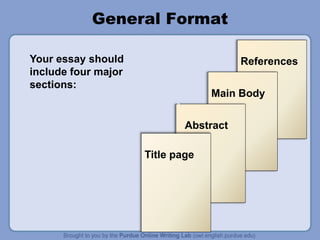
References
Main Body
Abstract
General Format
Title page
Your essay should
include four major
sections:
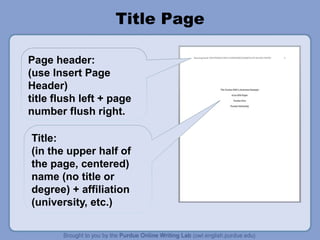
Title Page
Page header:
(use Insert Page
Header)
title flush left + page
number flush right.
Title:
(in the upper half of
the page, centered)
name (no title or
degree) + affiliation
(university, etc.)
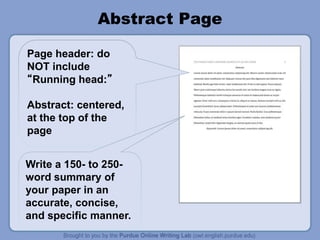
Abstract Page
Page header: do
NOT include
“Running head:”
Abstract: centered,
at the top of the
page
Write a 150- to 250-
word summary of
your paper in an
accurate, concise,
and specific manner.
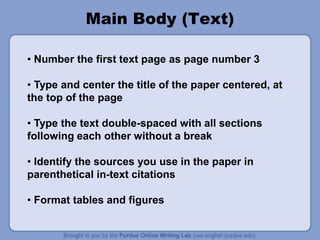
Main Body (Text)
• Number the first text page as page number 3
• Type and center the title of the paper centered, at
the top of the page
• Type the text double-spaced with all sections
following each other without a break
• Identify the sources you use in the paper in
parenthetical in-text citations
• Format tables and figures
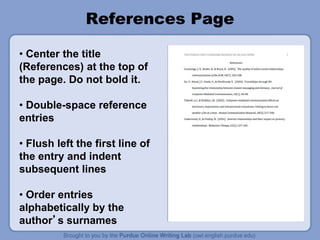
References Page
• Center the title
(References) at the top of
the page. Do not bold it.
• Double-space reference
entries
• Flush left the first line of
the entry and indent
subsequent lines
• Order entries
alphabetically by the
author’s surnames
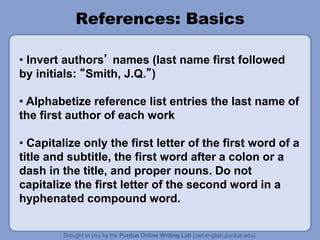
References: Basics
• Invert authors’ names (last name first followed
by initials: “Smith, J.Q.”)
• Alphabetize reference list entries the last name of
the first author of each work
• Capitalize only the first letter of the first word of a
title and subtitle, the first word after a colon or a
dash in the title, and proper nouns. Do not
capitalize the first letter of the second word in a
hyphenated compound word.
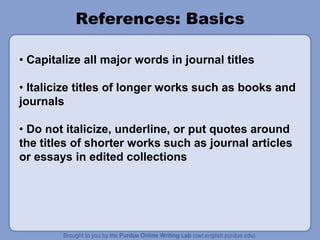
References: Basics
• Capitalize all major words in journal titles
• Italicize titles of longer works such as books and
journals
• Do not italicize, underline, or put quotes around
the titles of shorter works such as journal articles
or essays in edited collections
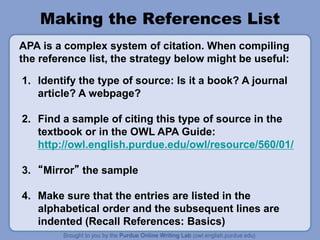
Making the References List
1. Identify the type of source: Is it a book? A journal
article? A webpage?
2. Find a sample of citing this type of source in the
textbook or in the OWL APA Guide:
http://owl.english.purdue.edu/owl/resource/560/01/
3. “Mirror” the sample
4. Make sure that the entries are listed in the
alphabetical order and the subsequent lines are
indented (Recall References: Basics)
APA is a complex system of citation. When compiling
the reference list, the strategy below might be useful:
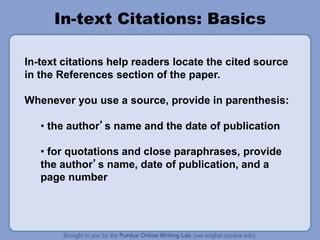
In-text Citations: Basics
In-text citations help readers locate the cited source
in the References section of the paper.
Whenever you use a source, provide in parenthesis:
• the author’s name and the date of publication
• for quotations and close paraphrases, provide
the author’s name, date of publication, and a
page number
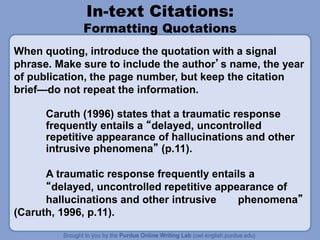
In-text Citations:
Formatting Quotations
Caruth (1996) states that a traumatic response
frequently entails a “delayed, uncontrolled
repetitive appearance of hallucinations and other
intrusive phenomena” (p.11).
A traumatic response frequently entails a
“delayed, uncontrolled repetitive appearance of
hallucinations and other intrusive phenomena”
(Caruth, 1996, p.11).
When quoting, introduce the quotation with a signal
phrase. Make sure to include the author’s name, the year
of publication, the page number, but keep the citation
brief—do not repeat the information.
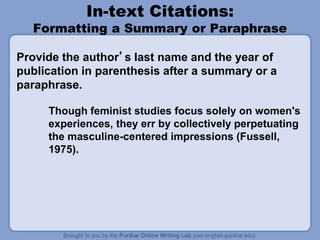
In-text Citations:
Formatting a Summary or Paraphrase
Provide the author’s last name and the year of
publication in parenthesis after a summary or a
paraphrase.
Though feminist studies focus solely on women's
experiences, they err by collectively perpetuating
the masculine-centered impressions (Fussell,
1975).
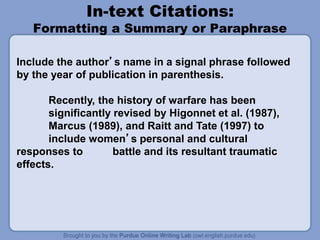
In-text Citations:
Formatting a Summary or Paraphrase
Include the author’s name in a signal phrase followed
by the year of publication in parenthesis.
Recently, the history of warfare has been
significantly revised by Higonnet et al. (1987),
Marcus (1989), and Raitt and Tate (1997) to
include women’s personal and cultural
responses to battle and its resultant traumatic
effects.
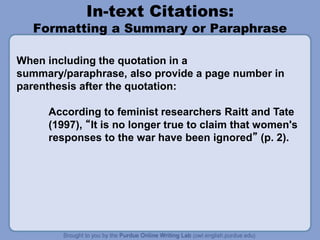
In-text Citations:
Formatting a Summary or Paraphrase
When including the quotation in a
summary/paraphrase, also provide a page number in
parenthesis after the quotation:
According to feminist researchers Raitt and Tate
(1997), “It is no longer true to claim that women's
responses to the war have been ignored” (p. 2).
In-text Citations:
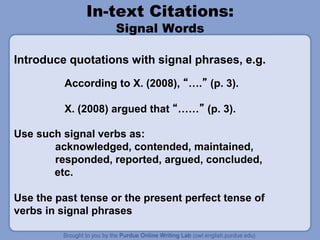
Signal Words
Introduce quotations with signal phrases, e.g.
According to X. (2008), “….” (p. 3).
X. (2008) argued that “……” (p. 3).
Use such signal verbs as:
acknowledged, contended, maintained,
responded, reported, argued, concluded,
etc.
Use the past tense or the present perfect tense of
verbs in signal phrases
In-text Citations:
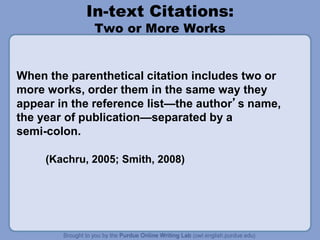
Two or More Works
When the parenthetical citation includes two or
more works, order them in the same way they
appear in the reference list—the author’s name,
the year of publication—separated by a
semi-colon.
(Kachru, 2005; Smith, 2008)
In-text Citations:
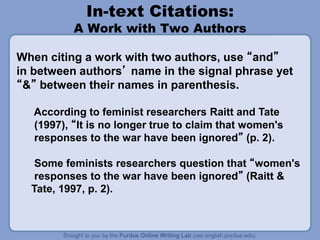
A Work with Two Authors
When citing a work with two authors, use “and”
in between authors’ name in the signal phrase yet
“&” between their names in parenthesis.
According to feminist researchers Raitt and Tate
(1997), “It is no longer true to claim that women's
responses to the war have been ignored” (p. 2).
Some feminists researchers question that “women's
responses to the war have been ignored” (Raitt &
Tate, 1997, p. 2).
In-text Citations:
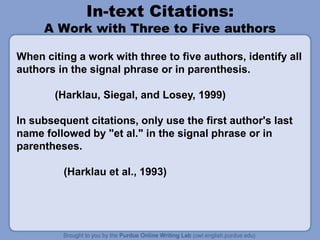
A Work with Three to Five authors
When citing a work with three to five authors, identify all
authors in the signal phrase or in parenthesis.
(Harklau, Siegal, and Losey, 1999)
In subsequent citations, only use the first author's last
name followed by "et al." in the signal phrase or in
parentheses.
(Harklau et al., 1993)
In-text Citations:
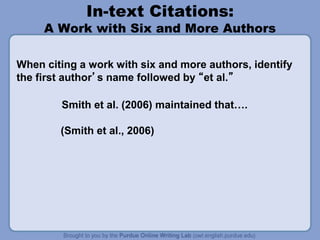
A Work with Six and More Authors
When citing a work with six and more authors, identify
the first author’s name followed by “et al.”
Smith et al. (2006) maintained that….
(Smith et al., 2006)
In-text Citations:
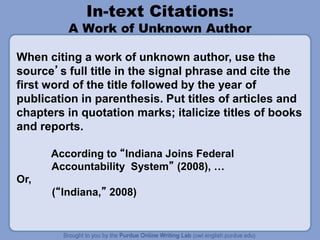
A Work of Unknown Author
When citing a work of unknown author, use the
source’s full title in the signal phrase and cite the
first word of the title followed by the year of
publication in parenthesis. Put titles of articles and
chapters in quotation marks; italicize titles of books
and reports.
According to “Indiana Joins Federal
Accountability System” (2008), …
Or,
(“Indiana,” 2008)
In-text Citations:
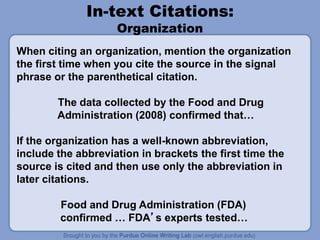
Organization
When citing an organization, mention the organization
the first time when you cite the source in the signal
phrase or the parenthetical citation.
The data collected by the Food and Drug
Administration (2008) confirmed that…
If the organization has a well-known abbreviation,
include the abbreviation in brackets the first time the
source is cited and then use only the abbreviation in
later citations.
Food and Drug Administration (FDA)
confirmed … FDA’s experts tested…
In-text Citations:
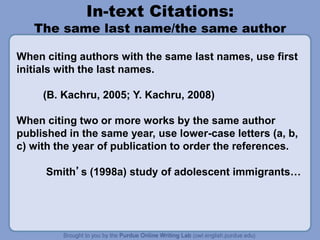
The same last name/the same author
When citing authors with the same last names, use first
initials with the last names.
(B. Kachru, 2005; Y. Kachru, 2008)
When citing two or more works by the same author
published in the same year, use lower-case letters (a, b,
c) with the year of publication to order the references.
Smith’s (1998a) study of adolescent immigrants…
In-text Citations:
Personal communication
When citing interviews, letters, e-mails, etc., include the
communicator’s name, the fact that it was personal
communication, and the date of the communication. Do
not include personal communication in the reference list.
A. P. Smith also claimed that many of her students
had difficulties with APA style (personal
communication, November 3, 2002).
Or,
(E. Robbins, personal communication, January 4,
2001).
In-text Citations:
Electronic sources
When citing an electronic document, whenever
possible, cite it in the author-date style. If electronic
source lacks page numbers, locate and identify
paragraph number/paragraph heading.
According to Smith (1997), ... (Mind over Matter
section, para. 6).
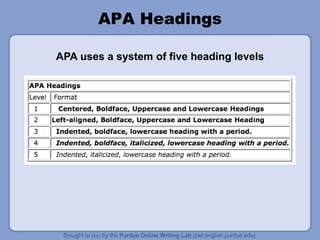
APA Headings
APA uses a system of five heading levels
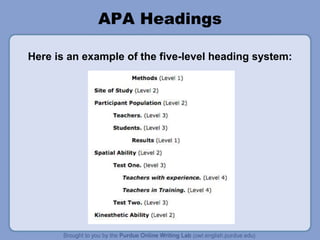
APA Headings
Here is an example of the five-level heading system:
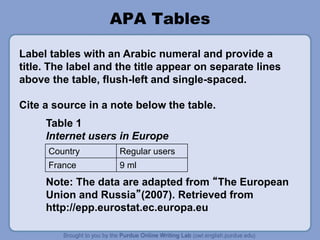
APA Tables
Label tables with an Arabic numeral and provide a
title. The label and the title appear on separate lines
above the table, flush-left and single-spaced.
Cite a source in a note below the table.
Country Regular users
France 9 ml
Table 1
Internet users in Europe
Note: The data are adapted from “The European
Union and Russia”(2007). Retrieved from
http://epp.eurostat.ec.europa.eu
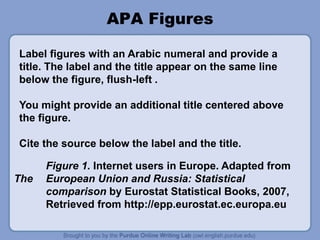
APA Figures
Label figures with an Arabic numeral and provide a
title. The label and the title appear on the same line
below the figure, flush-left .
You might provide an additional title centered above
the figure.
Cite the source below the label and the title.
Figure 1. Internet users in Europe. Adapted from
The European Union and Russia: Statistical
comparison by Eurostat Statistical Books, 2007,
Retrieved from http://epp.eurostat.ec.europa.eu
Additional APA Resources
• The Purdue OWL http://owl.english.purdue.edu
• Purdue Writing Lab @ HEAV 226
• Composition textbooks
• Publication Manual of the American Psychological
Association, 6th ed.
• APA’s website http://www.apastyle.org
The End

Week 10 apa powerpoint

  • 1.
  • 2.
    What is APA? TheAmerican Psychological Association (APA) citation style is the most commonly used format for manuscripts in the social sciences. APA regulates: • Stylistics • In-text citations • References
  • 3.
    APA Style: Pointof View and Voice • personal pronouns where appropriate Try: We conducted an experiment… Avoid: The authors conducted an experiment…. • the active voice rather than passive voice Try: We asked participants questions. Avoid: The participants have been asked questions by the researchers. Use:
  • 4.
    • clear: bespecific in descriptions and explanations • concise: condense information when you can • plain: use simple, descriptive adjectives and minimize figurative language APA Style: Language Language in an APA paper is:
  • 5.
    Types of APAPapers The literature review: • Contains a summary of what the scientific literature says about the topic of your research • Includes a title page, introduction, and list of references The experimental report: • Describes your experimental research • Includes a title page, abstract, introduction, method, results, discussion, list of references, appendices, tables, and figures
  • 6.
    Types of APAPapers • follow the general format • consult the instructor • consult the APA Publication Manual If your paper fits neither of the categories above:
  • 7.
    General Format • betyped and double-spaced be printed on standard-sized paper (8.5”x11”) • use 1” margins on all sides • use 10-12 pt. Times New Roman or a similar font • include a page header (title) in the upper left-hand of every page and a page number in the upper right- hand side of every page Note: If you are writing a manuscript draft, APA suggests using two spaces between sentences to aid readability (see pp. 87-88 in the APA manual). Your essay should:
  • 8.
    References Main Body Abstract General Format Titlepage Your essay should include four major sections:
  • 9.
    Title Page Page header: (useInsert Page Header) title flush left + page number flush right. Title: (in the upper half of the page, centered) name (no title or degree) + affiliation (university, etc.)
  • 10.
    Abstract Page Page header:do NOT include “Running head:” Abstract: centered, at the top of the page Write a 150- to 250- word summary of your paper in an accurate, concise, and specific manner.
  • 11.
    Main Body (Text) •Number the first text page as page number 3 • Type and center the title of the paper centered, at the top of the page • Type the text double-spaced with all sections following each other without a break • Identify the sources you use in the paper in parenthetical in-text citations • Format tables and figures
  • 12.
    References Page • Centerthe title (References) at the top of the page. Do not bold it. • Double-space reference entries • Flush left the first line of the entry and indent subsequent lines • Order entries alphabetically by the author’s surnames
  • 13.
    References: Basics • Invertauthors’ names (last name first followed by initials: “Smith, J.Q.”) • Alphabetize reference list entries the last name of the first author of each work • Capitalize only the first letter of the first word of a title and subtitle, the first word after a colon or a dash in the title, and proper nouns. Do not capitalize the first letter of the second word in a hyphenated compound word.
  • 14.
    References: Basics • Capitalizeall major words in journal titles • Italicize titles of longer works such as books and journals • Do not italicize, underline, or put quotes around the titles of shorter works such as journal articles or essays in edited collections
  • 15.
    Making the ReferencesList 1. Identify the type of source: Is it a book? A journal article? A webpage? 2. Find a sample of citing this type of source in the textbook or in the OWL APA Guide: http://owl.english.purdue.edu/owl/resource/560/01/ 3. “Mirror” the sample 4. Make sure that the entries are listed in the alphabetical order and the subsequent lines are indented (Recall References: Basics) APA is a complex system of citation. When compiling the reference list, the strategy below might be useful:
  • 16.
    In-text Citations: Basics In-textcitations help readers locate the cited source in the References section of the paper. Whenever you use a source, provide in parenthesis: • the author’s name and the date of publication • for quotations and close paraphrases, provide the author’s name, date of publication, and a page number
  • 17.
    In-text Citations: Formatting Quotations Caruth(1996) states that a traumatic response frequently entails a “delayed, uncontrolled repetitive appearance of hallucinations and other intrusive phenomena” (p.11). A traumatic response frequently entails a “delayed, uncontrolled repetitive appearance of hallucinations and other intrusive phenomena” (Caruth, 1996, p.11). When quoting, introduce the quotation with a signal phrase. Make sure to include the author’s name, the year of publication, the page number, but keep the citation brief—do not repeat the information.
  • 18.
    In-text Citations: Formatting aSummary or Paraphrase Provide the author’s last name and the year of publication in parenthesis after a summary or a paraphrase. Though feminist studies focus solely on women's experiences, they err by collectively perpetuating the masculine-centered impressions (Fussell, 1975).
  • 19.
    In-text Citations: Formatting aSummary or Paraphrase Include the author’s name in a signal phrase followed by the year of publication in parenthesis. Recently, the history of warfare has been significantly revised by Higonnet et al. (1987), Marcus (1989), and Raitt and Tate (1997) to include women’s personal and cultural responses to battle and its resultant traumatic effects.
  • 20.
    In-text Citations: Formatting aSummary or Paraphrase When including the quotation in a summary/paraphrase, also provide a page number in parenthesis after the quotation: According to feminist researchers Raitt and Tate (1997), “It is no longer true to claim that women's responses to the war have been ignored” (p. 2).
  • 21.
    In-text Citations: Signal Words Introducequotations with signal phrases, e.g. According to X. (2008), “….” (p. 3). X. (2008) argued that “……” (p. 3). Use such signal verbs as: acknowledged, contended, maintained, responded, reported, argued, concluded, etc. Use the past tense or the present perfect tense of verbs in signal phrases
  • 22.
    In-text Citations: Two orMore Works When the parenthetical citation includes two or more works, order them in the same way they appear in the reference list—the author’s name, the year of publication—separated by a semi-colon. (Kachru, 2005; Smith, 2008)
  • 23.
    In-text Citations: A Workwith Two Authors When citing a work with two authors, use “and” in between authors’ name in the signal phrase yet “&” between their names in parenthesis. According to feminist researchers Raitt and Tate (1997), “It is no longer true to claim that women's responses to the war have been ignored” (p. 2). Some feminists researchers question that “women's responses to the war have been ignored” (Raitt & Tate, 1997, p. 2).
  • 24.
    In-text Citations: A Workwith Three to Five authors When citing a work with three to five authors, identify all authors in the signal phrase or in parenthesis. (Harklau, Siegal, and Losey, 1999) In subsequent citations, only use the first author's last name followed by "et al." in the signal phrase or in parentheses. (Harklau et al., 1993)
  • 25.
    In-text Citations: A Workwith Six and More Authors When citing a work with six and more authors, identify the first author’s name followed by “et al.” Smith et al. (2006) maintained that…. (Smith et al., 2006)
  • 26.
    In-text Citations: A Workof Unknown Author When citing a work of unknown author, use the source’s full title in the signal phrase and cite the first word of the title followed by the year of publication in parenthesis. Put titles of articles and chapters in quotation marks; italicize titles of books and reports. According to “Indiana Joins Federal Accountability System” (2008), … Or, (“Indiana,” 2008)
  • 27.
    In-text Citations: Organization When citingan organization, mention the organization the first time when you cite the source in the signal phrase or the parenthetical citation. The data collected by the Food and Drug Administration (2008) confirmed that… If the organization has a well-known abbreviation, include the abbreviation in brackets the first time the source is cited and then use only the abbreviation in later citations. Food and Drug Administration (FDA) confirmed … FDA’s experts tested…
  • 28.
    In-text Citations: The samelast name/the same author When citing authors with the same last names, use first initials with the last names. (B. Kachru, 2005; Y. Kachru, 2008) When citing two or more works by the same author published in the same year, use lower-case letters (a, b, c) with the year of publication to order the references. Smith’s (1998a) study of adolescent immigrants…
  • 29.
    In-text Citations: Personal communication Whenciting interviews, letters, e-mails, etc., include the communicator’s name, the fact that it was personal communication, and the date of the communication. Do not include personal communication in the reference list. A. P. Smith also claimed that many of her students had difficulties with APA style (personal communication, November 3, 2002). Or, (E. Robbins, personal communication, January 4, 2001).
  • 30.
    In-text Citations: Electronic sources Whenciting an electronic document, whenever possible, cite it in the author-date style. If electronic source lacks page numbers, locate and identify paragraph number/paragraph heading. According to Smith (1997), ... (Mind over Matter section, para. 6).
  • 31.
    APA Headings APA usesa system of five heading levels
  • 32.
    APA Headings Here isan example of the five-level heading system:
  • 33.
    APA Tables Label tableswith an Arabic numeral and provide a title. The label and the title appear on separate lines above the table, flush-left and single-spaced. Cite a source in a note below the table. Country Regular users France 9 ml Table 1 Internet users in Europe Note: The data are adapted from “The European Union and Russia”(2007). Retrieved from http://epp.eurostat.ec.europa.eu
  • 34.
    APA Figures Label figureswith an Arabic numeral and provide a title. The label and the title appear on the same line below the figure, flush-left . You might provide an additional title centered above the figure. Cite the source below the label and the title. Figure 1. Internet users in Europe. Adapted from The European Union and Russia: Statistical comparison by Eurostat Statistical Books, 2007, Retrieved from http://epp.eurostat.ec.europa.eu
  • 35.
    Additional APA Resources •The Purdue OWL http://owl.english.purdue.edu • Purdue Writing Lab @ HEAV 226 • Composition textbooks • Publication Manual of the American Psychological Association, 6th ed. • APA’s website http://www.apastyle.org
  • 36.