-Definition of Cataract
- Epidemiology
-Etiology
-Pathophysiology
-Sign & Symptoms
-Diagnosis
-Prevention
-Complication
-Treatment
Cataract" is derived from the Latin cataracta,
meaning "waterfall“ Early in the development
of age-related cataract the power of the lens
may be increased, causing near-sightedness
(myopia), and the gradual yellowing and
opacification of the lens may reduce the
perception of blue colors
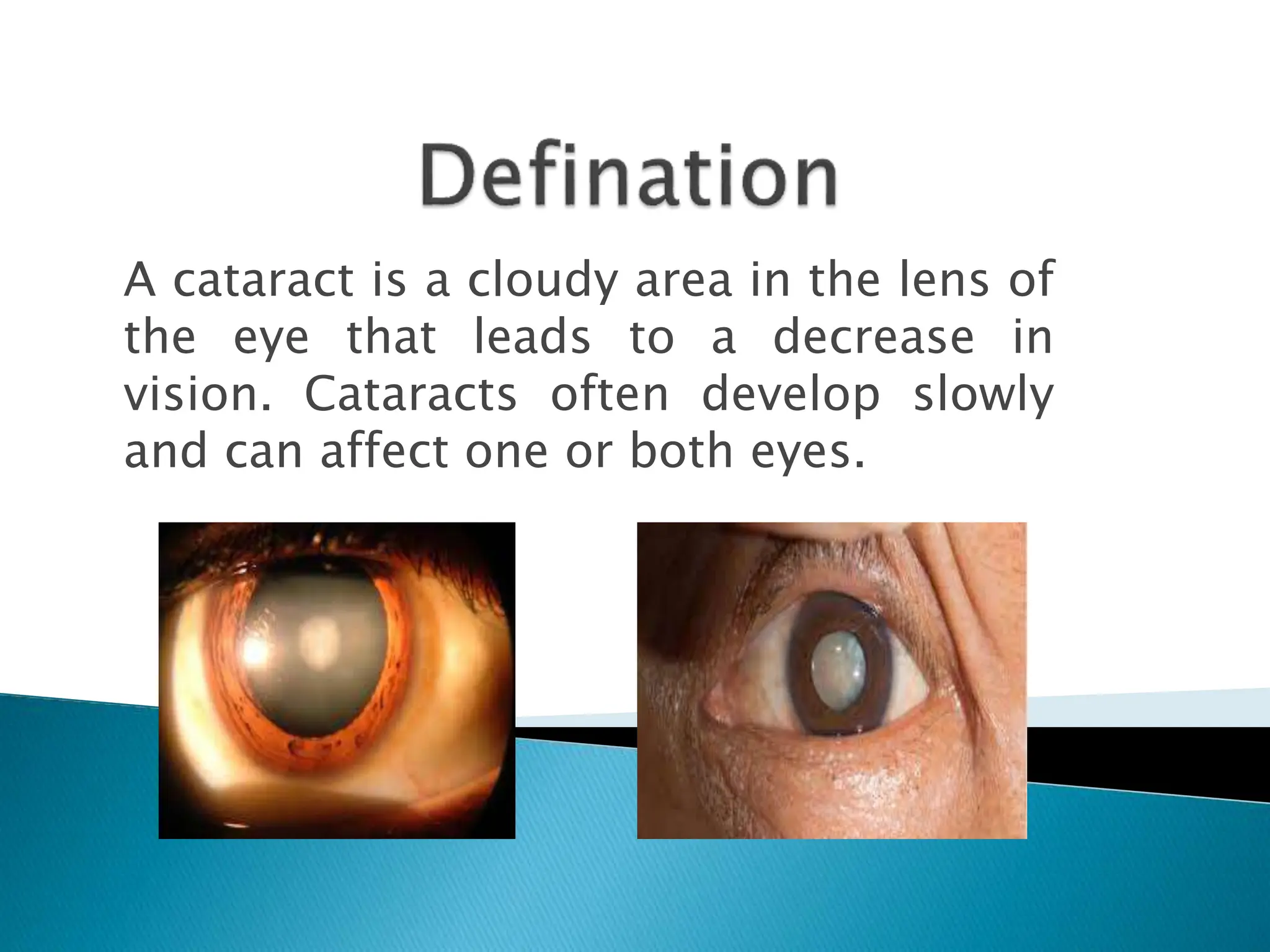
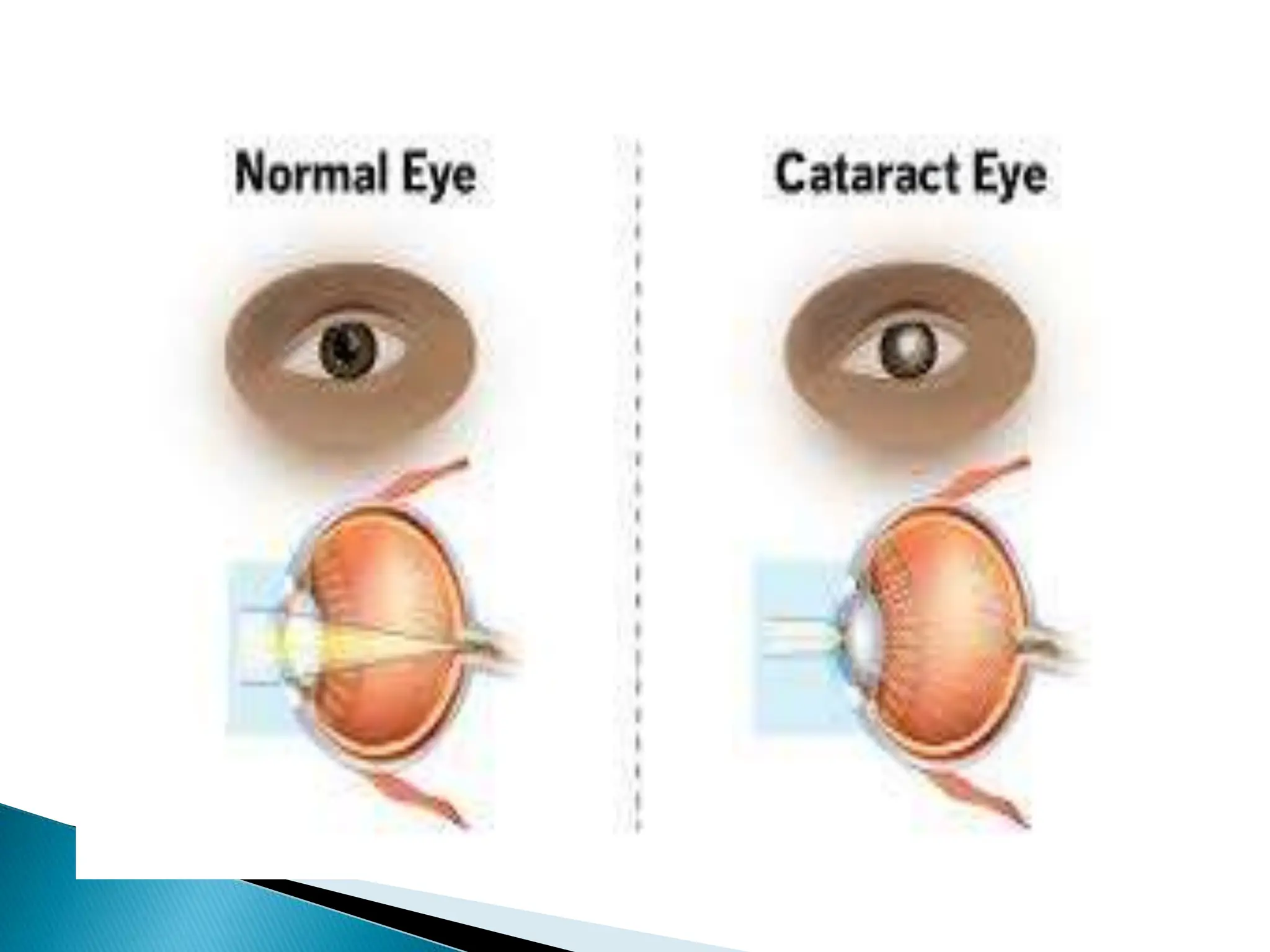
A cataract is a cloudy area in the lens of
the eye that leads to a decrease in
vision. Cataracts often develop slowly
and can affect one or both eyes.
1-Nuclear Sclerotic Cataract: A nuclear
sclerotic cataract refers to the
hardening of the nucleus, the center, of
the lens of the eye. In the early stages
of this condition, the lens becomes
cloudy and yellow before eventually
hardening (sclerosis is the medical term
for hardening).
1-Nuclear Sclerotic Cataract: A nuclear
sclerotic cataract refers to the
hardening of the nucleus, the center, of
the lens of the eye. In the early stages
of this condition, the lens becomes
cloudy and yellow before eventually
hardening (sclerosis is the medical term
for hardening).
 2-Cortical Cataract: A cortical cataract is a
condition in which areas of white cloudiness
will develop in the outer edges of the lens
called the cortex spreading inward and
having the appearance of a spoke wheel or a
star pattern.
 3-Posterior Subcapsular Cataract: Posterior
subcapsular cataracts begin as a small,
cloudy or opaque area on the back (posterior)
of the lens. It is called subcapsular because it
develops on the underside or beneath the
lens capsule.
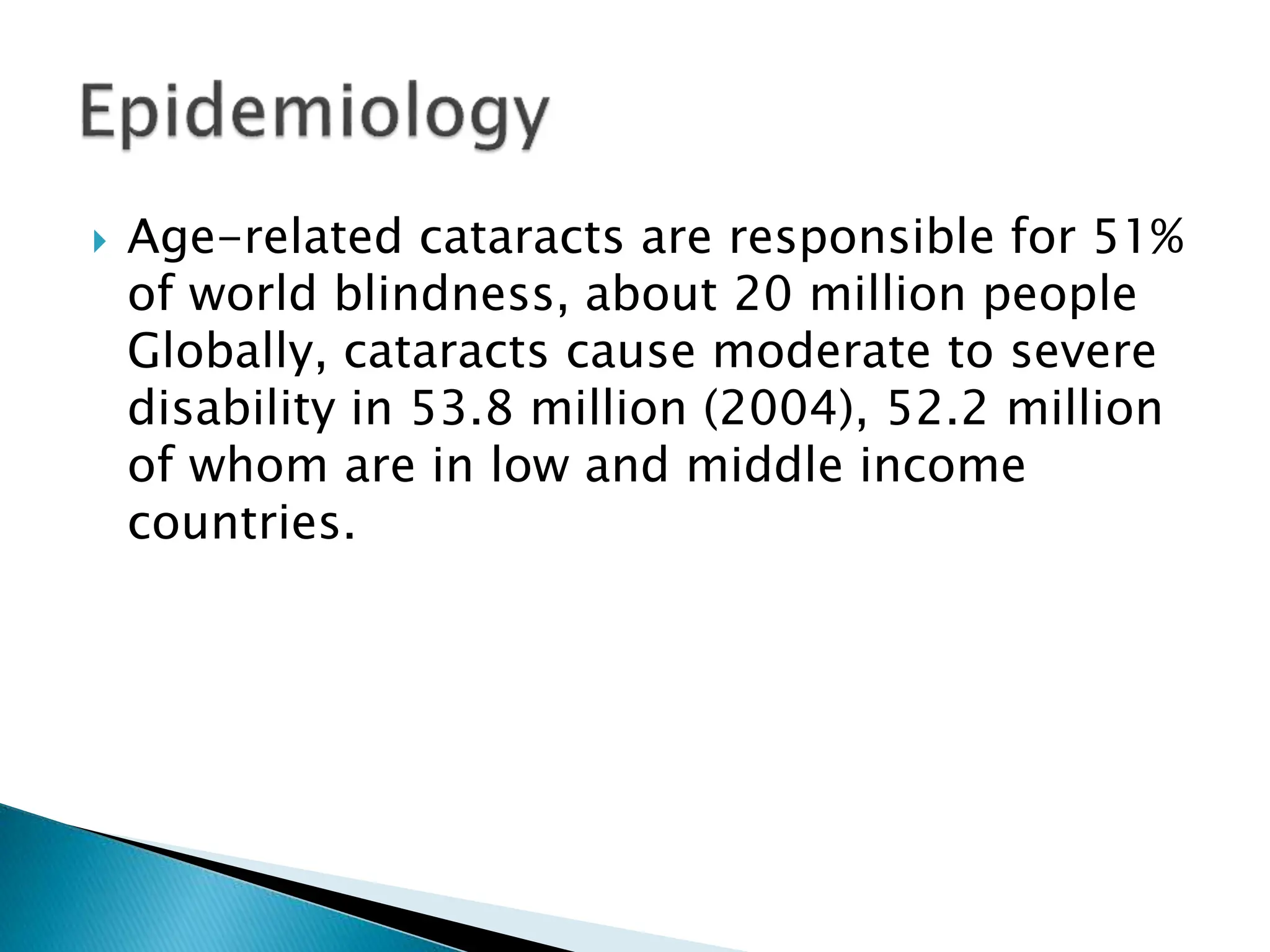
 Age-related cataracts are responsible for 51%
of world blindness, about 20 million people
Globally, cataracts cause moderate to severe
disability in 53.8 million (2004), 52.2 million
of whom are in low and middle income
countries.
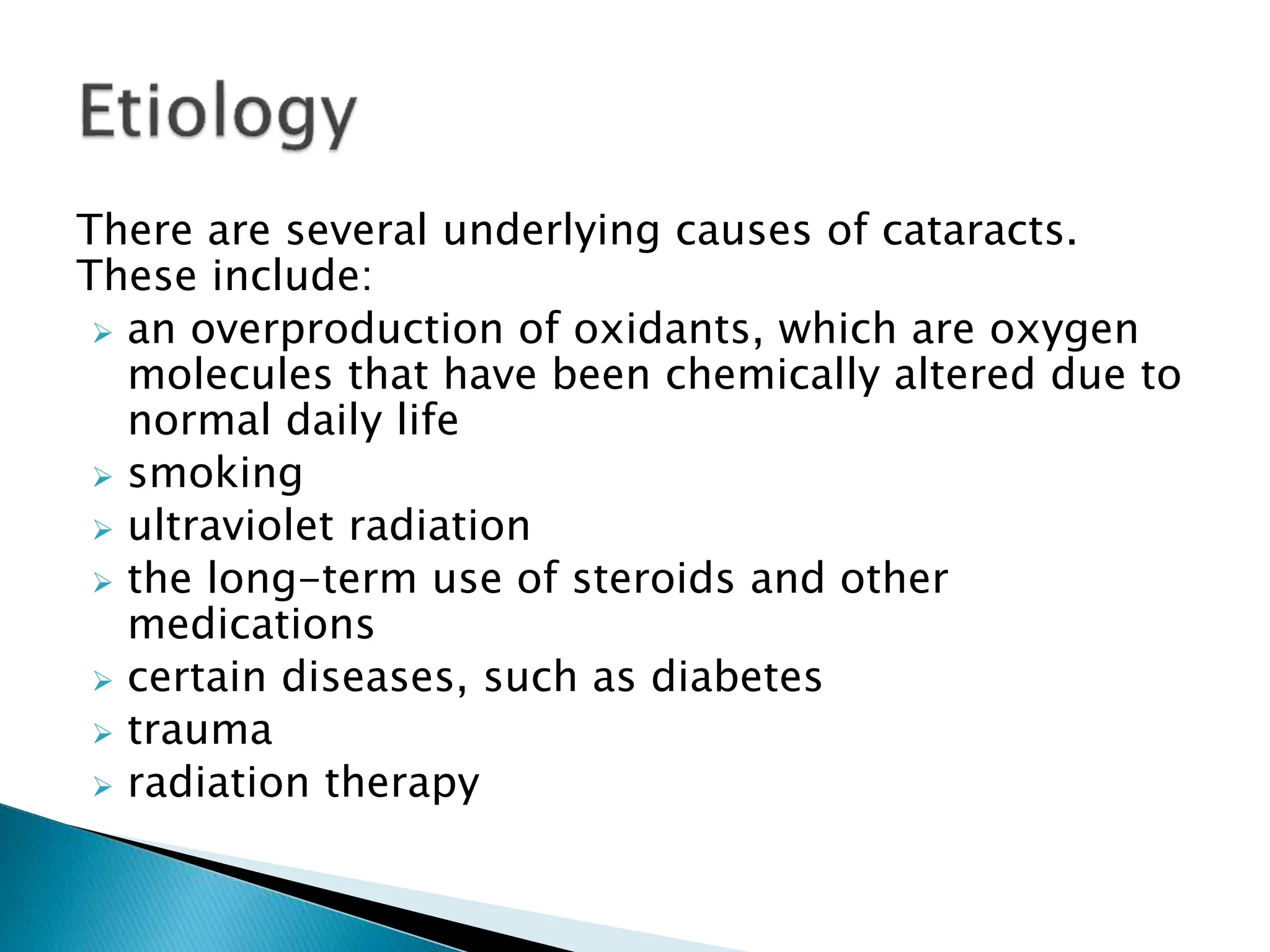
There are several underlying causes of cataracts.
These include:
 an overproduction of oxidants, which are oxygen
molecules that have been chemically altered due to
normal daily life
 smoking
 ultraviolet radiation
 the long-term use of steroids and other
medications
 certain diseases, such as diabetes
 trauma
 radiation therapy
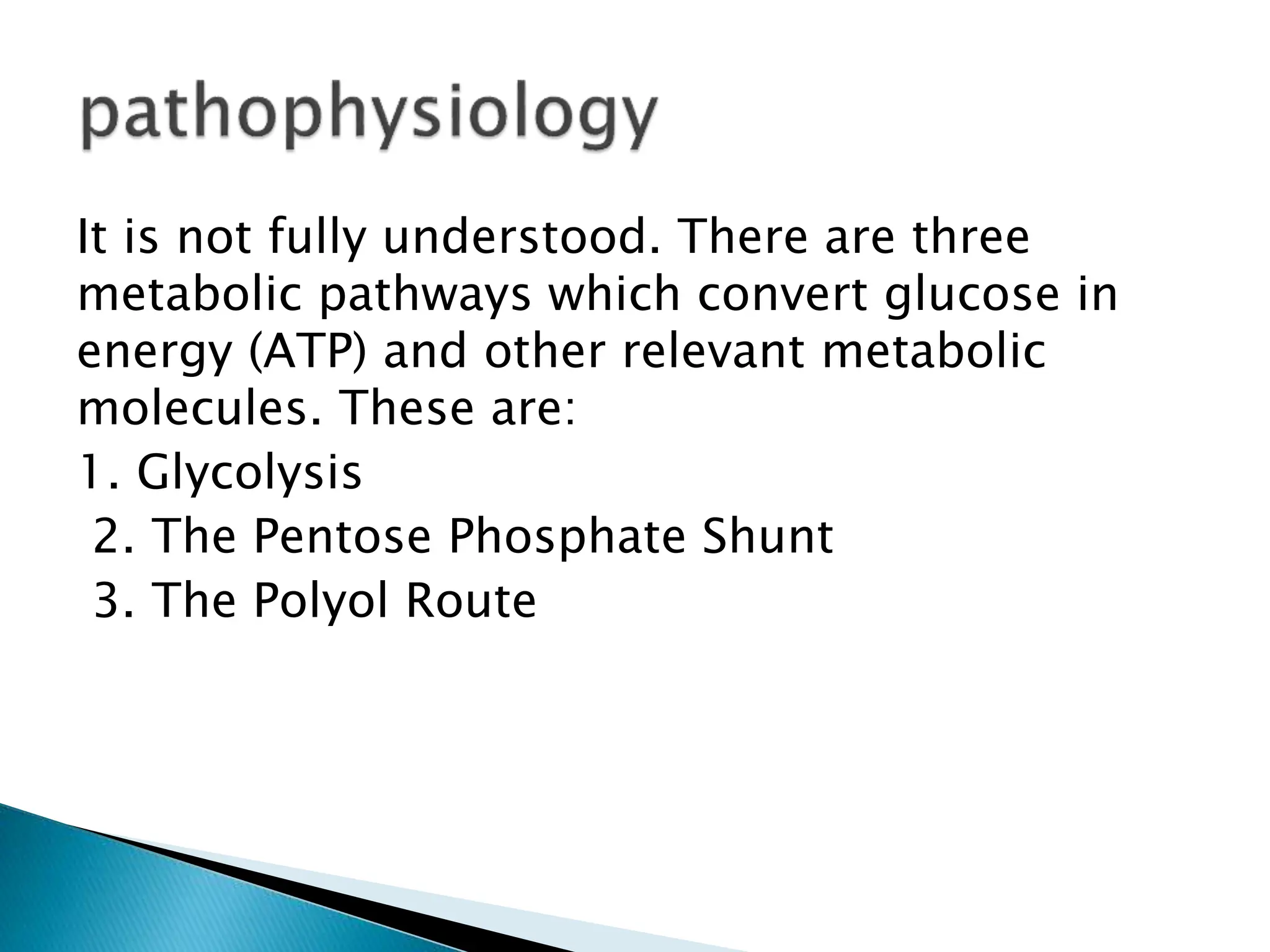
It is not fully understood. There are three
metabolic pathways which convert glucose in
energy (ATP) and other relevant metabolic
molecules. These are:
1. Glycolysis
2. The Pentose Phosphate Shunt
3. The Polyol Route
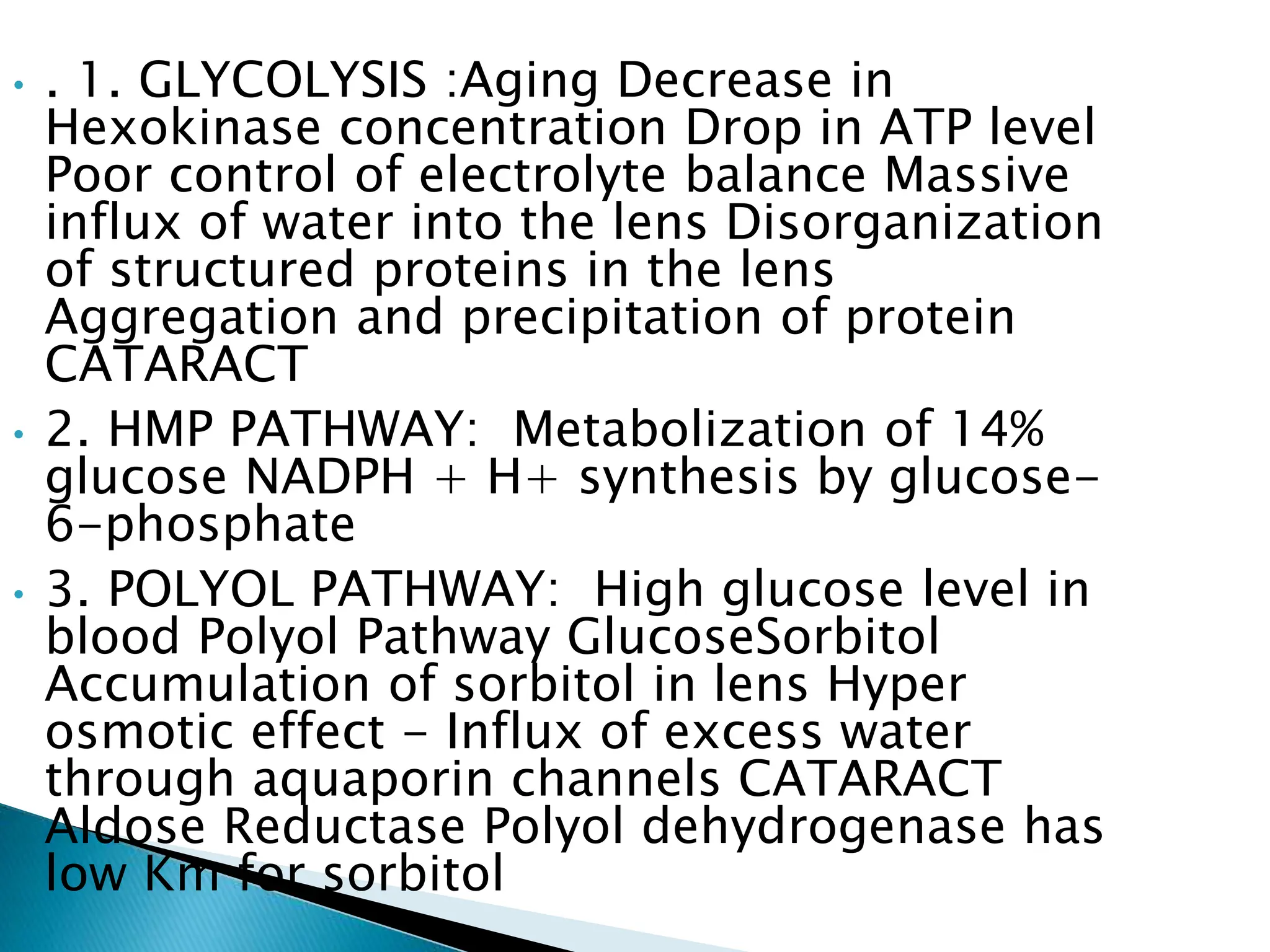
• . 1. GLYCOLYSIS :Aging Decrease in
Hexokinase concentration Drop in ATP level
Poor control of electrolyte balance Massive
influx of water into the lens Disorganization
of structured proteins in the lens
Aggregation and precipitation of protein
CATARACT
• 2. HMP PATHWAY: Metabolization of 14%
glucose NADPH + H+ synthesis by glucose-
6-phosphate
• 3. POLYOL PATHWAY: High glucose level in
blood Polyol Pathway GlucoseSorbitol
Accumulation of sorbitol in lens Hyper
osmotic effect - Influx of excess water
through aquaporin channels CATARACT
Aldose Reductase Polyol dehydrogenase has
low Km for sorbitol
 Cataracts are a common part of the eye’s
aging process. Eventually, they can cause:
 Vision that’s cloudy, blurry, foggy or filmy.
 Sensitivity to bright sunlight, lamps or
headlights.
 Glare (seeing a halo around lights), especially
when you drive at night with oncoming
headlights.
 Prescription changes in glasses, including
sudden nearsightedness.
 Double vision.

 Need for brighter light to read.
 Difficulty seeing at night (poor night vision).
 Changes in the way you see color.
 Visual acuity test. This is a fancy way of
saying "eye chart exam." Your doctor will ask
you to read letters from a distance to find out
how sharp your vision is. First you'll try it with
one eye and then the other.
 Slit-lamp exam. This uses a special
microscope with a bright light that lets your
doctor check different parts of your eye.
 Retinal exam. Your doctor puts drops in your
eyes to widen your pupils, the dark spots in
the middle that control how much light gets
in. This lets them get a good look at the
retina -- the tissue around the back of your
eyes -- and a better view of the cataract.
 Have regular eye examinations. Eye
examinations can help detect cataracts and
other eye problems at their earliest stages.
...
 Quit smoking. ...
 Manage other health problems. ...
 Choose a healthy diet that includes plenty
of fruits and vegetables. ...
 Wear sunglasses. ...
 Reduce alcohol use.
 Inflammation.
 Infection.
 Bleeding.
 Swelling.
 Drooping eyelid.
 Dislocation of artificial lens.
 Retinal detachment.
 Glaucoma.
 The three most common types of medicated
eye drops for cataracts are antibiotics,
corticosteroids and anti-inflammatories.
Surgery is currently the only method of
cataract treatment that can successfully
restore vision for someone who suffers from
cataracts.
 Aspirin: The drug decreases the substances
that cause pain and inflammation.
 Diclofenac Sodium Ophthalmic Solution :
Diclofenac Sodium Ophthalmic Solution is a
topical, nonsteroidal anti-inflammatory drug,
prescribed for the treatment of postoperative
inflammation in patients who have undergone
cataract extraction.
 Nepafenac Ophthalmic: Nepafenac
Ophthalmic is a non-steroidal anti-
inflammatory drug (NSAID), prescribed for
eye pain, redness, and swelling in
patients who are recovering from cataract
surgery
 Lens replacement. There are three lens
replacement options:
 Phacoemulsification. A portion of the anterior
capsule is removed, allowing extraction of the
lens nucleus and cortex while the posterior
capsule and zonular support are left intact.
 Aphakic glasses. In aphakic glasses, objects are
magnified by 25%, making them appear closer
than they actually are.
 Contact lenses. Contact lenses provide patients
with almost normal vision, but because contact
lenses need to be removed occasionally, the
patient also needs a pair pf aphakic glasses.
 IOL implants. The most common IOL is the single
focus lens or monofocal IOL that cannot alter the
visual shape; multifocal IOLs reduce the need for
eyeglasses; accommodative IOLS mimic the
accommodative response of the eye.
 Recent medication intake. It is a common
practice to withhold any anticoagulant
therapy to reduce the risk of retrobulbar
hemorrhage.
 Preoperative tests. The standard battery of
preoperative tests such as complete blood
count, electrocardiogram, and urinalysis are
prescribed only if they are indicated by the
patient’s medical history.
 Vital signs. Stable vital signs are needed
before the patient is subjected to surgery.
 Visual acuity test results. Test results from
Snellen’s and other visual acuity tests are
assessed.
 Patient’s medical history. The nurse assesses
the patient’s medical history to determine the
preoperative tests to be required.
 The major goals for the patient include:
 Regaining of usual level of cognition.
 Recognizing awareness of sensory needs.
 Be free of injury.
 Identifying potential risk factors in the
environment.
 Appearing relaxed and reporting anxiety is
reduced at manageable level.
 Verbalizing feelings of anxiety.
 Identifying healthy ways to deal with and
express anxiety.
 Care for a patient with cataract includes:
 Providing preoperative care. Use of
anticoagulants is withheld to reduce the
risk of retrobulbar hemorrhage.
 Providing postoperative care. Before
discharge, the patient receives verbal and
written instructions about how to protect
the eye, administer medications, recognize
signs of complications, and obtain
emergency care.
 Regained usual level of cognition.
 Recognized awareness of sensory needs.
 Free of injury.
 Identified potential risk factors in the
environment.
 Appeared relaxed and reporting anxiety is
reduced ti a manageable level.
 Verbalized feelings of anxiety.
 Identified healthy ways to deal with and
express anxiety.
 1.Bobrow JC Breadsley TL Jick SL et al.
 Lens and cataract.
 American Academy of Ophthalmology, San
Francisco2015–16
https://nurseslabs.com › cataract
Web results
Cataract Nursing Care Management:
Study Guide for Nurses - Nurseslabs
Cataract by Grp 5.ppt                           ..

Cataract by Grp 5.ppt ..

  • 2.
    -Definition of Cataract -Epidemiology -Etiology -Pathophysiology -Sign & Symptoms -Diagnosis -Prevention -Complication -Treatment
  • 3.
    Cataract" is derivedfrom the Latin cataracta, meaning "waterfall“ Early in the development of age-related cataract the power of the lens may be increased, causing near-sightedness (myopia), and the gradual yellowing and opacification of the lens may reduce the perception of blue colors
  • 4.
    A cataract isa cloudy area in the lens of the eye that leads to a decrease in vision. Cataracts often develop slowly and can affect one or both eyes.
  • 6.
    1-Nuclear Sclerotic Cataract:A nuclear sclerotic cataract refers to the hardening of the nucleus, the center, of the lens of the eye. In the early stages of this condition, the lens becomes cloudy and yellow before eventually hardening (sclerosis is the medical term for hardening).
  • 7.
    1-Nuclear Sclerotic Cataract:A nuclear sclerotic cataract refers to the hardening of the nucleus, the center, of the lens of the eye. In the early stages of this condition, the lens becomes cloudy and yellow before eventually hardening (sclerosis is the medical term for hardening).
  • 8.
     2-Cortical Cataract:A cortical cataract is a condition in which areas of white cloudiness will develop in the outer edges of the lens called the cortex spreading inward and having the appearance of a spoke wheel or a star pattern.  3-Posterior Subcapsular Cataract: Posterior subcapsular cataracts begin as a small, cloudy or opaque area on the back (posterior) of the lens. It is called subcapsular because it develops on the underside or beneath the lens capsule.
  • 9.
     Age-related cataractsare responsible for 51% of world blindness, about 20 million people Globally, cataracts cause moderate to severe disability in 53.8 million (2004), 52.2 million of whom are in low and middle income countries.
  • 10.
    There are severalunderlying causes of cataracts. These include:  an overproduction of oxidants, which are oxygen molecules that have been chemically altered due to normal daily life  smoking  ultraviolet radiation  the long-term use of steroids and other medications  certain diseases, such as diabetes  trauma  radiation therapy
  • 11.
    It is notfully understood. There are three metabolic pathways which convert glucose in energy (ATP) and other relevant metabolic molecules. These are: 1. Glycolysis 2. The Pentose Phosphate Shunt 3. The Polyol Route
  • 12.
    • . 1.GLYCOLYSIS :Aging Decrease in Hexokinase concentration Drop in ATP level Poor control of electrolyte balance Massive influx of water into the lens Disorganization of structured proteins in the lens Aggregation and precipitation of protein CATARACT • 2. HMP PATHWAY: Metabolization of 14% glucose NADPH + H+ synthesis by glucose- 6-phosphate • 3. POLYOL PATHWAY: High glucose level in blood Polyol Pathway GlucoseSorbitol Accumulation of sorbitol in lens Hyper osmotic effect - Influx of excess water through aquaporin channels CATARACT Aldose Reductase Polyol dehydrogenase has low Km for sorbitol
  • 13.
     Cataracts area common part of the eye’s aging process. Eventually, they can cause:  Vision that’s cloudy, blurry, foggy or filmy.  Sensitivity to bright sunlight, lamps or headlights.  Glare (seeing a halo around lights), especially when you drive at night with oncoming headlights.
  • 14.
     Prescription changesin glasses, including sudden nearsightedness.  Double vision.  Need for brighter light to read.  Difficulty seeing at night (poor night vision).  Changes in the way you see color.
  • 15.
     Visual acuitytest. This is a fancy way of saying "eye chart exam." Your doctor will ask you to read letters from a distance to find out how sharp your vision is. First you'll try it with one eye and then the other.  Slit-lamp exam. This uses a special microscope with a bright light that lets your doctor check different parts of your eye.
  • 16.
     Retinal exam.Your doctor puts drops in your eyes to widen your pupils, the dark spots in the middle that control how much light gets in. This lets them get a good look at the retina -- the tissue around the back of your eyes -- and a better view of the cataract.
  • 17.
     Have regulareye examinations. Eye examinations can help detect cataracts and other eye problems at their earliest stages. ...  Quit smoking. ...  Manage other health problems. ...  Choose a healthy diet that includes plenty of fruits and vegetables. ...  Wear sunglasses. ...  Reduce alcohol use.
  • 18.
     Inflammation.  Infection. Bleeding.  Swelling.  Drooping eyelid.  Dislocation of artificial lens.  Retinal detachment.  Glaucoma.
  • 19.
     The threemost common types of medicated eye drops for cataracts are antibiotics, corticosteroids and anti-inflammatories. Surgery is currently the only method of cataract treatment that can successfully restore vision for someone who suffers from cataracts.
  • 20.
     Aspirin: Thedrug decreases the substances that cause pain and inflammation.  Diclofenac Sodium Ophthalmic Solution : Diclofenac Sodium Ophthalmic Solution is a topical, nonsteroidal anti-inflammatory drug, prescribed for the treatment of postoperative inflammation in patients who have undergone cataract extraction.
  • 21.
     Nepafenac Ophthalmic:Nepafenac Ophthalmic is a non-steroidal anti- inflammatory drug (NSAID), prescribed for eye pain, redness, and swelling in patients who are recovering from cataract surgery
  • 22.
     Lens replacement.There are three lens replacement options:  Phacoemulsification. A portion of the anterior capsule is removed, allowing extraction of the lens nucleus and cortex while the posterior capsule and zonular support are left intact.
  • 23.
     Aphakic glasses.In aphakic glasses, objects are magnified by 25%, making them appear closer than they actually are.  Contact lenses. Contact lenses provide patients with almost normal vision, but because contact lenses need to be removed occasionally, the patient also needs a pair pf aphakic glasses.  IOL implants. The most common IOL is the single focus lens or monofocal IOL that cannot alter the visual shape; multifocal IOLs reduce the need for eyeglasses; accommodative IOLS mimic the accommodative response of the eye.
  • 24.
     Recent medicationintake. It is a common practice to withhold any anticoagulant therapy to reduce the risk of retrobulbar hemorrhage.  Preoperative tests. The standard battery of preoperative tests such as complete blood count, electrocardiogram, and urinalysis are prescribed only if they are indicated by the patient’s medical history.
  • 25.
     Vital signs.Stable vital signs are needed before the patient is subjected to surgery.  Visual acuity test results. Test results from Snellen’s and other visual acuity tests are assessed.  Patient’s medical history. The nurse assesses the patient’s medical history to determine the preoperative tests to be required.
  • 26.
     The majorgoals for the patient include:  Regaining of usual level of cognition.  Recognizing awareness of sensory needs.  Be free of injury.  Identifying potential risk factors in the environment.  Appearing relaxed and reporting anxiety is reduced at manageable level.
  • 27.
     Verbalizing feelingsof anxiety.  Identifying healthy ways to deal with and express anxiety.
  • 28.
     Care fora patient with cataract includes:  Providing preoperative care. Use of anticoagulants is withheld to reduce the risk of retrobulbar hemorrhage.  Providing postoperative care. Before discharge, the patient receives verbal and written instructions about how to protect the eye, administer medications, recognize signs of complications, and obtain emergency care.
  • 29.
     Regained usuallevel of cognition.  Recognized awareness of sensory needs.  Free of injury.  Identified potential risk factors in the environment.  Appeared relaxed and reporting anxiety is reduced ti a manageable level.  Verbalized feelings of anxiety.  Identified healthy ways to deal with and express anxiety.
  • 30.
     1.Bobrow JCBreadsley TL Jick SL et al.  Lens and cataract.  American Academy of Ophthalmology, San Francisco2015–16 https://nurseslabs.com › cataract Web results Cataract Nursing Care Management: Study Guide for Nurses - Nurseslabs