





CASE STUDY
RESEARCH
Presented by
Hamna Binat Ali (2016-
1815)
Content
• Introduction
• Definition of Case
Study Research
• Example of case study
• Use of case study
research approach
• Advantages of case
study
• Disadvantages of
case study
• Case Study Research
Design
• Design examples
• Sample selection and
example
• Data collection
technique
• Technique example
• Types of case study
• Characteristics of case
study
What is Case study?
o A case study is an
EMPIRICAL study
that investigates a
contemporary
phenomenon in
depth and with its
real-life context.
Definition of Case Study
Research
Case study research is a qualitative
research approach in which
researcher focus on a unit of study
known as bounded system .
(Educational Research)
by L.R GAY
-Ch 17 , pg443
For Example A classroom
When and why to use case study
research approach?
• Case study research is appropriate when
a researcher wants to answer descriptive
questions.
For example
What happened ? Or an explanatory question
(e.g., how and why did something happen?)
Advantages
• The most important advantage of using case
study is that it simplifies complex concepts.
Advantages cont…..
• Case study expose the participants to real life
situation which otherwise is difficult.
Advantages cont…
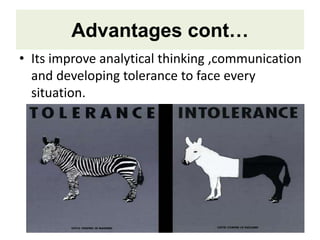
• Its improve analytical thinking ,communication
and developing tolerance to face every
situation.
Disadvantages…
• It might be difficult to find an appropriate
case study to suit to all subject.
• Case study consume more time.
• Since there is no one right answer, the
problem arises in validation of the
solutions because there are more than
one way to look at things.
How to design or conduct case study
Research ?
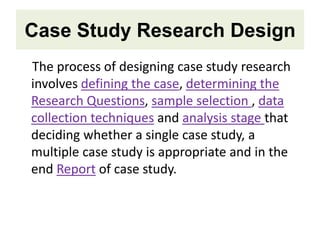
Case Study Research Design
The process of designing case study research
involves defining the case, determining the
Research Questions, sample selection , data
collection techniques and analysis stage that
deciding whether a single case study, a
multiple case study is appropriate and in the
end Report of case study.
For example Define case
Case study on IER
Teachers behavior
Psychological
case study
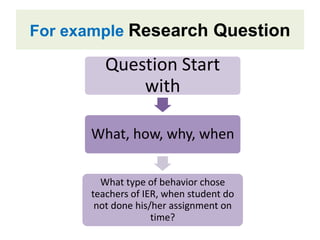
For example Research Question
Question Start
with
What, how, why, when
What type of behavior chose
teachers of IER, when student do
not done his/her assignment on
time?
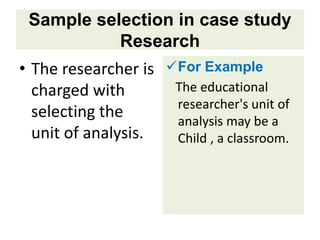
Sample selection in case study
Research
• The researcher is
charged with
selecting the
unit of analysis.
For Example
The educational
researcher's unit of
analysis may be a
Child , a classroom.
Sample selection cont…..
• The most common form of sampling is
purposive or purposeful sampling.
• Screening helps the researcher determine
whether a case study participant has the
necessary experience or knowledge of the
phenomenon under investigation.
Data collection technique
• Case study researchers use the same
data collection techniques used by
researcher conducting other genres of
qualitative research with aim of seeking
understanding about the case under
investigation.
• Case study researcher must also be
concerned with triangulation.
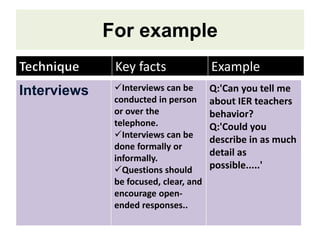
For example
Key facts Example
Interviews Interviews can be
conducted in person
or over the
telephone.
Interviews can be
done formally or
informally.
Questions should
be focused, clear, and
encourage open-
ended responses..
Q:'Can you tell me
about IER teachers
behavior?
Q:'Could you
describe in as much
detail as
possible.....'
Type of Case study
• Historical
One type of qualitative research is historical
research, which involves examining past
events to draw conclusions and make
predictions about the future.
The steps in historical research are:
formulate an idea, formulate a plan, gather
data, analyze data, and analyze the sources of
data.
Cont…. For example
Three main Characteristics of
case study Research
I. Particularistic
Focuses on a particular situation, event,
program or phenomenon.
II. Descriptive
The end product is a rich, thick
description of the phenomenon being
studied.
Characteristics Cont…
III. Heuristic
The cases studied illuminate the reader’s
understanding of the phenomenon under
study .
• brings about the discovery of new meanings
• extend the reader’s experience
• confirm what is already known
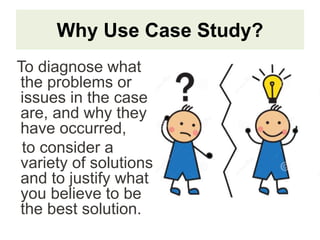
Why Use Case Study?
To diagnose what
the problems or
issues in the case
are, and why they
have occurred,
to consider a
variety of solutions
and to justify what
you believe to be
the best solution.
Case study  for research student

Case study for research student

  • 2.
  • 3.
    Content • Introduction • Definitionof Case Study Research • Example of case study • Use of case study research approach • Advantages of case study • Disadvantages of case study • Case Study Research Design • Design examples • Sample selection and example • Data collection technique • Technique example • Types of case study • Characteristics of case study
  • 4.
    What is Casestudy? o A case study is an EMPIRICAL study that investigates a contemporary phenomenon in depth and with its real-life context.
  • 5.
    Definition of CaseStudy Research Case study research is a qualitative research approach in which researcher focus on a unit of study known as bounded system . (Educational Research) by L.R GAY -Ch 17 , pg443
  • 6.
    For Example Aclassroom
  • 7.
    When and whyto use case study research approach? • Case study research is appropriate when a researcher wants to answer descriptive questions. For example What happened ? Or an explanatory question (e.g., how and why did something happen?)
  • 8.
    Advantages • The mostimportant advantage of using case study is that it simplifies complex concepts.
  • 9.
    Advantages cont….. • Casestudy expose the participants to real life situation which otherwise is difficult.
  • 10.
    Advantages cont… • Itsimprove analytical thinking ,communication and developing tolerance to face every situation.
  • 11.
    Disadvantages… • It mightbe difficult to find an appropriate case study to suit to all subject. • Case study consume more time. • Since there is no one right answer, the problem arises in validation of the solutions because there are more than one way to look at things.
  • 12.
    How to designor conduct case study Research ?
  • 13.
    Case Study ResearchDesign The process of designing case study research involves defining the case, determining the Research Questions, sample selection , data collection techniques and analysis stage that deciding whether a single case study, a multiple case study is appropriate and in the end Report of case study.
  • 14.
    For example Definecase Case study on IER Teachers behavior Psychological case study
  • 15.
    For example ResearchQuestion Question Start with What, how, why, when What type of behavior chose teachers of IER, when student do not done his/her assignment on time?
  • 16.
    Sample selection incase study Research • The researcher is charged with selecting the unit of analysis. For Example The educational researcher's unit of analysis may be a Child , a classroom.
  • 17.
    Sample selection cont….. •The most common form of sampling is purposive or purposeful sampling. • Screening helps the researcher determine whether a case study participant has the necessary experience or knowledge of the phenomenon under investigation.
  • 18.
    Data collection technique •Case study researchers use the same data collection techniques used by researcher conducting other genres of qualitative research with aim of seeking understanding about the case under investigation. • Case study researcher must also be concerned with triangulation.
  • 19.
    For example Key factsExample Interviews Interviews can be conducted in person or over the telephone. Interviews can be done formally or informally. Questions should be focused, clear, and encourage open- ended responses.. Q:'Can you tell me about IER teachers behavior? Q:'Could you describe in as much detail as possible.....'
  • 20.
    Type of Casestudy • Historical One type of qualitative research is historical research, which involves examining past events to draw conclusions and make predictions about the future. The steps in historical research are: formulate an idea, formulate a plan, gather data, analyze data, and analyze the sources of data.
  • 21.
  • 22.
    Three main Characteristicsof case study Research I. Particularistic Focuses on a particular situation, event, program or phenomenon. II. Descriptive The end product is a rich, thick description of the phenomenon being studied.
  • 23.
    Characteristics Cont… III. Heuristic Thecases studied illuminate the reader’s understanding of the phenomenon under study . • brings about the discovery of new meanings • extend the reader’s experience • confirm what is already known
  • 24.
    Why Use CaseStudy? To diagnose what the problems or issues in the case are, and why they have occurred, to consider a variety of solutions and to justify what you believe to be the best solution.