Wordles
What’s the Word
NEXT SLIDE >>
Qualitative Research Method
Case Study
History
Please Click
on the Arrows
to View
Content
Previous
Slide
Next
Slide
Qualitative Research Method
Case Study
Topic of the Day: CASE STUDY
History of Case Study:
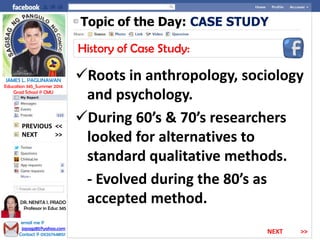
Roots in anthropology, sociology
and psychology.
During 60’s & 70’s researchers
looked for alternatives to
standard qualitative methods.
- Evolved during the 80’s as
accepted method.
NEXT >>
PREVIOUS <<
JAMES L. PAGLINAWAN
Education 345_Summer 2014
Grad School @ CMU
email me @
jopagz85@yahoo.com
Contact @ 09267648151
DR. NENITA I. PRADO
Professor in Educ 345
NEXT >>
Topic of the Day: CASE STUDY
History of Case Study:
 Prominently used by physicians,
historians, social workers, teachers, etc.,
as a learning tool:
Through careful examination and
discussion of various cases, “[researchers]
learn to identify actual problems, to
recognize key players and their agendas,
and to become aware of those aspects of
the situation that contribute to the
problem. . ."
(Merseth, 1991 in http://writing.colostate.edu/guides/research/casestudy/com2a3.cfm )
NEXT >>
PREVIOUS <<
JAMES L. PAGLINAWAN
Education 345_Summer 2014
Grad School @ CMU
email me @
jopagz85@yahoo.com
Contact @ 09267648151
DR. NENITA I. PRADO
Professor in Educ 345
>>>>>>
Previous
Slide
Next
Slide
Qualitative Research Method
Case Study
Topic of the Day: CASE STUDY
Definitions of Case Study:
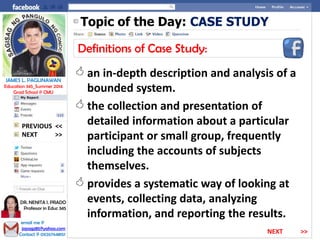
 an in-depth description and analysis of a
bounded system.
 the collection and presentation of
detailed information about a particular
participant or small group, frequently
including the accounts of subjects
themselves.
 provides a systematic way of looking at
events, collecting data, analyzing
information, and reporting the results.
NEXT >>
PREVIOUS <<
JAMES L. PAGLINAWAN
Education 345_Summer 2014
Grad School @ CMU
email me @
jopagz85@yahoo.com
Contact @ 09267648151
DR. NENITA I. PRADO
Professor in Educ 345
NEXT >>
Topic of the Day: CASE STUDY
Definitions of Case Study:
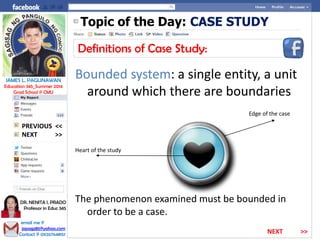
Bounded system: a single entity, a unit
around which there are boundaries
Edge of the case
Heart of the study
The phenomenon examined must be bounded in
order to be a case.
NEXT >>
PREVIOUS <<
JAMES L. PAGLINAWAN
Education 345_Summer 2014
Grad School @ CMU
email me @
jopagz85@yahoo.com
Contact @ 09267648151
DR. NENITA I. PRADO
Professor in Educ 345
NEXT >>
Topic of the Day: CASE STUDY
Definitions of Case Study:
Bounded system example:
Qualitative study: How older people
learn to use a computer
Case study: How one older person
learns to use a computer
- one particular program
- one classroom of learners
NEXT >>
PREVIOUS <<
JAMES L. PAGLINAWAN
Education 345_Summer 2014
Grad School @ CMU
email me @
jopagz85@yahoo.com
Contact @ 09267648151
DR. NENITA I. PRADO
Professor in Educ 345
>>>>>>
Previous
Slide
Next
Slide
Qualitative Research Method
Case Study
Topic of the Day: CASE STUDY
3 Characteristics of Case Study:
1. Particularistic: focuses on a particular
situation, event, program or phenomenon
2. Descriptive: the end product is a rich, thick
description of the phenomenon being studied.
3. Heuristic: the cases studied illuminate the
reader’s understanding of the phenomenon
under study
- brings about the discovery of new
meanings
- extend the reader’s experience
- confirm what is already known
NEXT >>
PREVIOUS <<
JAMES L. PAGLINAWAN
Education 345_Summer 2014
Grad School @ CMU
email me @
jopagz85@yahoo.com
Contact @ 09267648151
DR. NENITA I. PRADO
Professor in Educ 345
NEXT >>
Topic of the Day: CASE STUDY
Characteristics of Case Study:
 Scientific
 Reliable
 Valid method
 It is the best method to use for diagnostics and
further remedial teaching so very important for the
teachers.
 It provides complete information about individual’s
behavior his environment, insight to the nature of
the cases of suffering personal, social, emotional,
and educational abnormalities
 (e.g.: the movie taare zameen par (Every Child Is
Special) is an example of studying a problem of
dyslexia child and the remedial teaching done by
Aamir khan his teacher.)
NEXT >>
PREVIOUS <<
JAMES L. PAGLINAWAN
Education 345_Summer 2014
Grad School @ CMU
email me @
jopagz85@yahoo.com
Contact @ 09267648151
DR. NENITA I. PRADO
Professor in Educ 345
>>>>>>
Previous
Slide
Next
Slide
Qualitative Research Method
Case Study
Topic of the Day: CASE STUDY
Types of Case Study:
Historical:
The study of the development of a particular
phenomenon over time
1. Holistic analysis and description from a historical
perspective
2. Preferred when there’s virtually no access or control
(i.e. an evening school for working adults in the early
1900s)
Observational:
The primary data collection method is participant
observation supplemented with formal and informal
interviews
(i.e., the staff break room of an organization)
NEXT >>
PREVIOUS <<
JAMES L. PAGLINAWAN
Education 345_Summer 2014
Grad School @ CMU
email me @
jopagz85@yahoo.com
Contact @ 09267648151
DR. NENITA I. PRADO
Professor in Educ 345
NEXT >>
Topic of the Day: CASE STUDY
Types of Case Study:
Illustrative Case Studies:
Primarily descriptive studies
1. Utilizes one or two instances of an event to show
what a situation is like
2. Tries to make the unfamiliar familiar and to give
readers a common language about the topic in
question
Exploratory (or pilot) Case Studies:
Condensed case studies performed before implementing a
large scale investigation
1. Basic function is to help identify questions and select
types of measurement prior to the main investigation
2. Primary pitfall is that initial findings may seem
convincing enough to be released prematurely as
conclusions
NEXT >>
PREVIOUS <<
JAMES L. PAGLINAWAN
Education 345_Summer 2014
Grad School @ CMU
email me @
jopagz85@yahoo.com
Contact @ 09267648151
DR. NENITA I. PRADO
Professor in Educ 345
NEXT >>
Topic of the Day: CASE STUDY
Types of Case Study:
Cumulative Case Studies:
Serves to aggregate information from several sites
collected at different times
1. The collection of past studies will allow for
greater generalization without additional cost or
time being expended on new, possibly repetitive
studies
Critical Instance Case Studies:
Examines one or more sites for either the purpose of
examining a situation of unique interest with little to
no interest in generalizability, or to call into question
or challenge a highly generalized or universal
assertion
1. Useful for answering cause and effect questions
NEXT >>
PREVIOUS <<
JAMES L. PAGLINAWAN
Education 345_Summer 2014
Grad School @ CMU
email me @
jopagz85@yahoo.com
Contact @ 09267648151
DR. NENITA I. PRADO
Professor in Educ 345
>>>>>>
Previous
Slide
Next
Slide
Qualitative Research Method
Case Study
Topic of the Day: CASE STUDY
Why Use Case Study:
To diagnose what the
problems or issues in the
case are, and why they have
occurred, to consider a
variety of solutions; and to
justify what you believe to be
the best solution.
NEXT >>
PREVIOUS <<
JAMES L. PAGLINAWAN
Education 345_Summer 2014
Grad School @ CMU
email me @
jopagz85@yahoo.com
Contact @ 09267648151
DR. NENITA I. PRADO
Professor in Educ 345
NEXT >>
Topic of the Day: CASE STUDY
Why Use Case Study:
Knowledge is:
- More concrete
- More contextual
- More developed by reader interpretation
- Based more on reference populations
determined by the reader
 Depends on what the researcher wants to know
1. Specific “how” and “why” questions
2. When you have less control of the events
3. When variables are so embedded in the situation
that they’re impossible to identify ahead of time
4. Uniqueness of the situation
NEXT >>
PREVIOUS <<
JAMES L. PAGLINAWAN
Education 345_Summer 2014
Grad School @ CMU
email me @
jopagz85@yahoo.com
Contact @ 09267648151
DR. NENITA I. PRADO
Professor in Educ 345
>>>>>>
Previous
Slide
Next
Slide
Qualitative Research Method
Case Study
Topic of the Day: CASE STUDY
Steps in Conducting Case Study:
1. Determine topic
2. Determine type of case study method used and
mode of data collection:
- Documents
- Archival records
- Interviews
- Direct observation
- Participant observation
- Artifacts
3. Select participants
4. Collect data
5. Data Analysis
- Typically done holistically or through coding
6. Write up report
NEXT >>
PREVIOUS <<
JAMES L. PAGLINAWAN
Education 345_Summer 2014
Grad School @ CMU
email me @
jopagz85@yahoo.com
Contact @ 09267648151
DR. NENITA I. PRADO
Professor in Educ 345
>>>>>>
Previous
Slide
Next
Slide
Qualitative Research Method
Case Study
Topic of the Day: CASE STUDY
Strengths and Weaknesses:
Strengths:
1. Anchored in real-life situations
2. Holistic account of the phenomenon
3. Advances a field’s knowledge base
4. Flexible
5. Contextualization of the phenomenon
Weaknesses:
1. Difficult to generalize
2. Some say it’s too subjective
3. May be costly
- hard to rationalize cost in a budget request
4. Some ethical considerations
- financial - researcher integrity
5. Time consuming
NEXT >>
PREVIOUS <<
JAMES L. PAGLINAWAN
Education 345_Summer 2014
Grad School @ CMU
email me @
jopagz85@yahoo.com
Contact @ 09267648151
DR. NENITA I. PRADO
Professor in Educ 345
>>>>>>
Previous
Slide
Next
Slide
Qualitative Research Method
Case Study
Topic of the Day: CASE STUDY
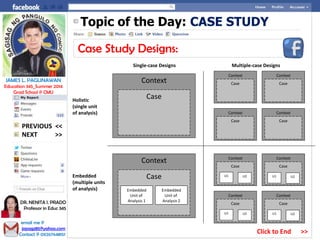
Case Study Designs:
• Single vs. Multiple case
–Single case appropriate in certain
conditions
–Multiple case design better in
general
• Embedded vs. Holistic
–Holistic = one unit of analysis
–Embedded = several units of
analysis
NEXT >>
PREVIOUS <<
JAMES L. PAGLINAWAN
Education 345_Summer 2014
Grad School @ CMU
email me @
jopagz85@yahoo.com
Contact @ 09267648151
DR. NENITA I. PRADO
Professor in Educ 345
NEXT >>
Topic of the Day: CASE STUDY
Case Study Designs:
NEXT >>
PREVIOUS <<
JAMES L. PAGLINAWAN
Education 345_Summer 2014
Grad School @ CMU
email me @
jopagz85@yahoo.com
Contact @ 09267648151
DR. NENITA I. PRADO
Professor in Educ 345
Click to End >>
Context
Case
Context
Case
Embedded
Unit of
Analysis 1
Embedded
Unit of
Analysis 2
Context
Case
Context
Case
Context
Case
Context
Case
Context
Case
Context
Case
Context
Case
Context
Case
U1 U2
U1 U2
U1 U2
U1 U2
Embedded
(multiple units
of analysis)
Holistic
(single unit
of analysis)
Single-case Designs Multiple-case Designs
Topic of the Day: CASE STUDY
End of Report
Log out
JAMES L. PAGLINAWAN
Education 345_Summer 2014
Grad School @ CMU
email me @
jopagz85@yahoo.com
Contact @ 09267648151
DR. NENITA I. PRADO
Professor in Educ 345
NEXT >>
PREVIOUS <<
All About Case Study, Types, Characteristics and Other Details

All About Case Study, Types, Characteristics and Other Details

  • 1.
  • 2.
    Qualitative Research Method CaseStudy History Please Click on the Arrows to View Content
  • 3.
  • 4.
    Topic of theDay: CASE STUDY History of Case Study: Roots in anthropology, sociology and psychology. During 60’s & 70’s researchers looked for alternatives to standard qualitative methods. - Evolved during the 80’s as accepted method. NEXT >> PREVIOUS << JAMES L. PAGLINAWAN Education 345_Summer 2014 Grad School @ CMU email me @ jopagz85@yahoo.com Contact @ 09267648151 DR. NENITA I. PRADO Professor in Educ 345 NEXT >>
  • 5.
    Topic of theDay: CASE STUDY History of Case Study:  Prominently used by physicians, historians, social workers, teachers, etc., as a learning tool: Through careful examination and discussion of various cases, “[researchers] learn to identify actual problems, to recognize key players and their agendas, and to become aware of those aspects of the situation that contribute to the problem. . ." (Merseth, 1991 in http://writing.colostate.edu/guides/research/casestudy/com2a3.cfm ) NEXT >> PREVIOUS << JAMES L. PAGLINAWAN Education 345_Summer 2014 Grad School @ CMU email me @ jopagz85@yahoo.com Contact @ 09267648151 DR. NENITA I. PRADO Professor in Educ 345 >>>>>>
  • 6.
  • 7.
    Topic of theDay: CASE STUDY Definitions of Case Study:  an in-depth description and analysis of a bounded system.  the collection and presentation of detailed information about a particular participant or small group, frequently including the accounts of subjects themselves.  provides a systematic way of looking at events, collecting data, analyzing information, and reporting the results. NEXT >> PREVIOUS << JAMES L. PAGLINAWAN Education 345_Summer 2014 Grad School @ CMU email me @ jopagz85@yahoo.com Contact @ 09267648151 DR. NENITA I. PRADO Professor in Educ 345 NEXT >>
  • 8.
    Topic of theDay: CASE STUDY Definitions of Case Study: Bounded system: a single entity, a unit around which there are boundaries Edge of the case Heart of the study The phenomenon examined must be bounded in order to be a case. NEXT >> PREVIOUS << JAMES L. PAGLINAWAN Education 345_Summer 2014 Grad School @ CMU email me @ jopagz85@yahoo.com Contact @ 09267648151 DR. NENITA I. PRADO Professor in Educ 345 NEXT >>
  • 9.
    Topic of theDay: CASE STUDY Definitions of Case Study: Bounded system example: Qualitative study: How older people learn to use a computer Case study: How one older person learns to use a computer - one particular program - one classroom of learners NEXT >> PREVIOUS << JAMES L. PAGLINAWAN Education 345_Summer 2014 Grad School @ CMU email me @ jopagz85@yahoo.com Contact @ 09267648151 DR. NENITA I. PRADO Professor in Educ 345 >>>>>>
  • 10.
  • 11.
    Topic of theDay: CASE STUDY 3 Characteristics of Case Study: 1. Particularistic: focuses on a particular situation, event, program or phenomenon 2. Descriptive: the end product is a rich, thick description of the phenomenon being studied. 3. Heuristic: the cases studied illuminate the reader’s understanding of the phenomenon under study - brings about the discovery of new meanings - extend the reader’s experience - confirm what is already known NEXT >> PREVIOUS << JAMES L. PAGLINAWAN Education 345_Summer 2014 Grad School @ CMU email me @ jopagz85@yahoo.com Contact @ 09267648151 DR. NENITA I. PRADO Professor in Educ 345 NEXT >>
  • 12.
    Topic of theDay: CASE STUDY Characteristics of Case Study:  Scientific  Reliable  Valid method  It is the best method to use for diagnostics and further remedial teaching so very important for the teachers.  It provides complete information about individual’s behavior his environment, insight to the nature of the cases of suffering personal, social, emotional, and educational abnormalities  (e.g.: the movie taare zameen par (Every Child Is Special) is an example of studying a problem of dyslexia child and the remedial teaching done by Aamir khan his teacher.) NEXT >> PREVIOUS << JAMES L. PAGLINAWAN Education 345_Summer 2014 Grad School @ CMU email me @ jopagz85@yahoo.com Contact @ 09267648151 DR. NENITA I. PRADO Professor in Educ 345 >>>>>>
  • 13.
  • 14.
    Topic of theDay: CASE STUDY Types of Case Study: Historical: The study of the development of a particular phenomenon over time 1. Holistic analysis and description from a historical perspective 2. Preferred when there’s virtually no access or control (i.e. an evening school for working adults in the early 1900s) Observational: The primary data collection method is participant observation supplemented with formal and informal interviews (i.e., the staff break room of an organization) NEXT >> PREVIOUS << JAMES L. PAGLINAWAN Education 345_Summer 2014 Grad School @ CMU email me @ jopagz85@yahoo.com Contact @ 09267648151 DR. NENITA I. PRADO Professor in Educ 345 NEXT >>
  • 15.
    Topic of theDay: CASE STUDY Types of Case Study: Illustrative Case Studies: Primarily descriptive studies 1. Utilizes one or two instances of an event to show what a situation is like 2. Tries to make the unfamiliar familiar and to give readers a common language about the topic in question Exploratory (or pilot) Case Studies: Condensed case studies performed before implementing a large scale investigation 1. Basic function is to help identify questions and select types of measurement prior to the main investigation 2. Primary pitfall is that initial findings may seem convincing enough to be released prematurely as conclusions NEXT >> PREVIOUS << JAMES L. PAGLINAWAN Education 345_Summer 2014 Grad School @ CMU email me @ jopagz85@yahoo.com Contact @ 09267648151 DR. NENITA I. PRADO Professor in Educ 345 NEXT >>
  • 16.
    Topic of theDay: CASE STUDY Types of Case Study: Cumulative Case Studies: Serves to aggregate information from several sites collected at different times 1. The collection of past studies will allow for greater generalization without additional cost or time being expended on new, possibly repetitive studies Critical Instance Case Studies: Examines one or more sites for either the purpose of examining a situation of unique interest with little to no interest in generalizability, or to call into question or challenge a highly generalized or universal assertion 1. Useful for answering cause and effect questions NEXT >> PREVIOUS << JAMES L. PAGLINAWAN Education 345_Summer 2014 Grad School @ CMU email me @ jopagz85@yahoo.com Contact @ 09267648151 DR. NENITA I. PRADO Professor in Educ 345 >>>>>>
  • 17.
  • 18.
    Topic of theDay: CASE STUDY Why Use Case Study: To diagnose what the problems or issues in the case are, and why they have occurred, to consider a variety of solutions; and to justify what you believe to be the best solution. NEXT >> PREVIOUS << JAMES L. PAGLINAWAN Education 345_Summer 2014 Grad School @ CMU email me @ jopagz85@yahoo.com Contact @ 09267648151 DR. NENITA I. PRADO Professor in Educ 345 NEXT >>
  • 19.
    Topic of theDay: CASE STUDY Why Use Case Study: Knowledge is: - More concrete - More contextual - More developed by reader interpretation - Based more on reference populations determined by the reader  Depends on what the researcher wants to know 1. Specific “how” and “why” questions 2. When you have less control of the events 3. When variables are so embedded in the situation that they’re impossible to identify ahead of time 4. Uniqueness of the situation NEXT >> PREVIOUS << JAMES L. PAGLINAWAN Education 345_Summer 2014 Grad School @ CMU email me @ jopagz85@yahoo.com Contact @ 09267648151 DR. NENITA I. PRADO Professor in Educ 345 >>>>>>
  • 20.
  • 21.
    Topic of theDay: CASE STUDY Steps in Conducting Case Study: 1. Determine topic 2. Determine type of case study method used and mode of data collection: - Documents - Archival records - Interviews - Direct observation - Participant observation - Artifacts 3. Select participants 4. Collect data 5. Data Analysis - Typically done holistically or through coding 6. Write up report NEXT >> PREVIOUS << JAMES L. PAGLINAWAN Education 345_Summer 2014 Grad School @ CMU email me @ jopagz85@yahoo.com Contact @ 09267648151 DR. NENITA I. PRADO Professor in Educ 345 >>>>>>
  • 22.
  • 23.
    Topic of theDay: CASE STUDY Strengths and Weaknesses: Strengths: 1. Anchored in real-life situations 2. Holistic account of the phenomenon 3. Advances a field’s knowledge base 4. Flexible 5. Contextualization of the phenomenon Weaknesses: 1. Difficult to generalize 2. Some say it’s too subjective 3. May be costly - hard to rationalize cost in a budget request 4. Some ethical considerations - financial - researcher integrity 5. Time consuming NEXT >> PREVIOUS << JAMES L. PAGLINAWAN Education 345_Summer 2014 Grad School @ CMU email me @ jopagz85@yahoo.com Contact @ 09267648151 DR. NENITA I. PRADO Professor in Educ 345 >>>>>>
  • 24.
  • 25.
    Topic of theDay: CASE STUDY Case Study Designs: • Single vs. Multiple case –Single case appropriate in certain conditions –Multiple case design better in general • Embedded vs. Holistic –Holistic = one unit of analysis –Embedded = several units of analysis NEXT >> PREVIOUS << JAMES L. PAGLINAWAN Education 345_Summer 2014 Grad School @ CMU email me @ jopagz85@yahoo.com Contact @ 09267648151 DR. NENITA I. PRADO Professor in Educ 345 NEXT >>
  • 26.
    Topic of theDay: CASE STUDY Case Study Designs: NEXT >> PREVIOUS << JAMES L. PAGLINAWAN Education 345_Summer 2014 Grad School @ CMU email me @ jopagz85@yahoo.com Contact @ 09267648151 DR. NENITA I. PRADO Professor in Educ 345 Click to End >> Context Case Context Case Embedded Unit of Analysis 1 Embedded Unit of Analysis 2 Context Case Context Case Context Case Context Case Context Case Context Case Context Case Context Case U1 U2 U1 U2 U1 U2 U1 U2 Embedded (multiple units of analysis) Holistic (single unit of analysis) Single-case Designs Multiple-case Designs
  • 27.
    Topic of theDay: CASE STUDY End of Report Log out JAMES L. PAGLINAWAN Education 345_Summer 2014 Grad School @ CMU email me @ jopagz85@yahoo.com Contact @ 09267648151 DR. NENITA I. PRADO Professor in Educ 345 NEXT >> PREVIOUS <<