6TH NERVE PALSY
Hasnain Pasha | Final Year – BSVS | 26th September, 2020
LATERAL RECTUS MUSCLE
Anatomy
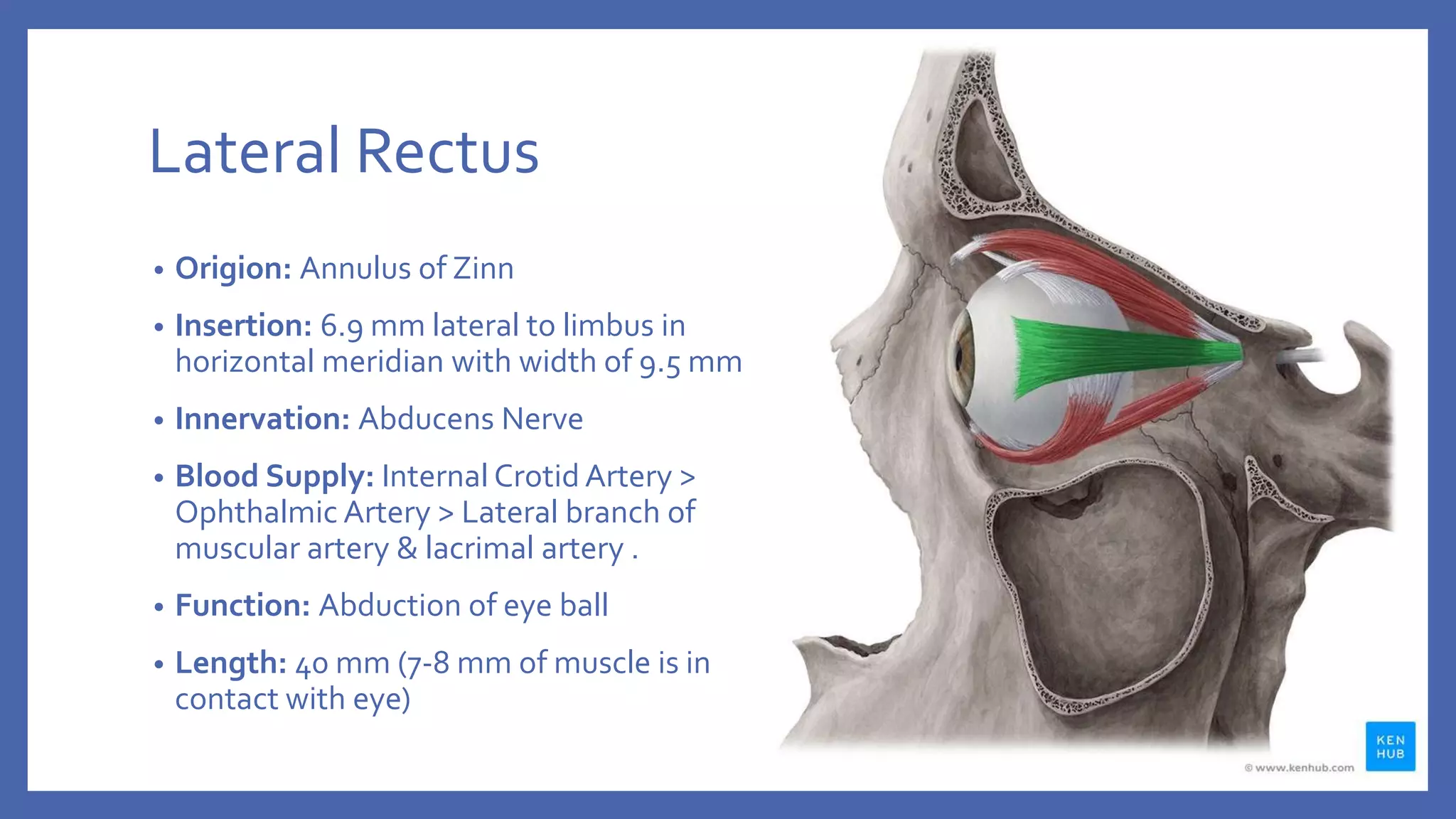
Lateral Rectus
• Origion: Annulus of Zinn
• Insertion: 6.9 mm lateral to limbus in
horizontal meridian with width of 9.5 mm
• Innervation: Abducens Nerve
• Blood Supply: Internal Crotid Artery >
Ophthalmic Artery > Lateral branch of
muscular artery & lacrimal artery .
• Function: Abduction of eye ball
• Length: 40 mm (7-8 mm of muscle is in
contact with eye)
6TH CRANIAL NERVE
Anatomy
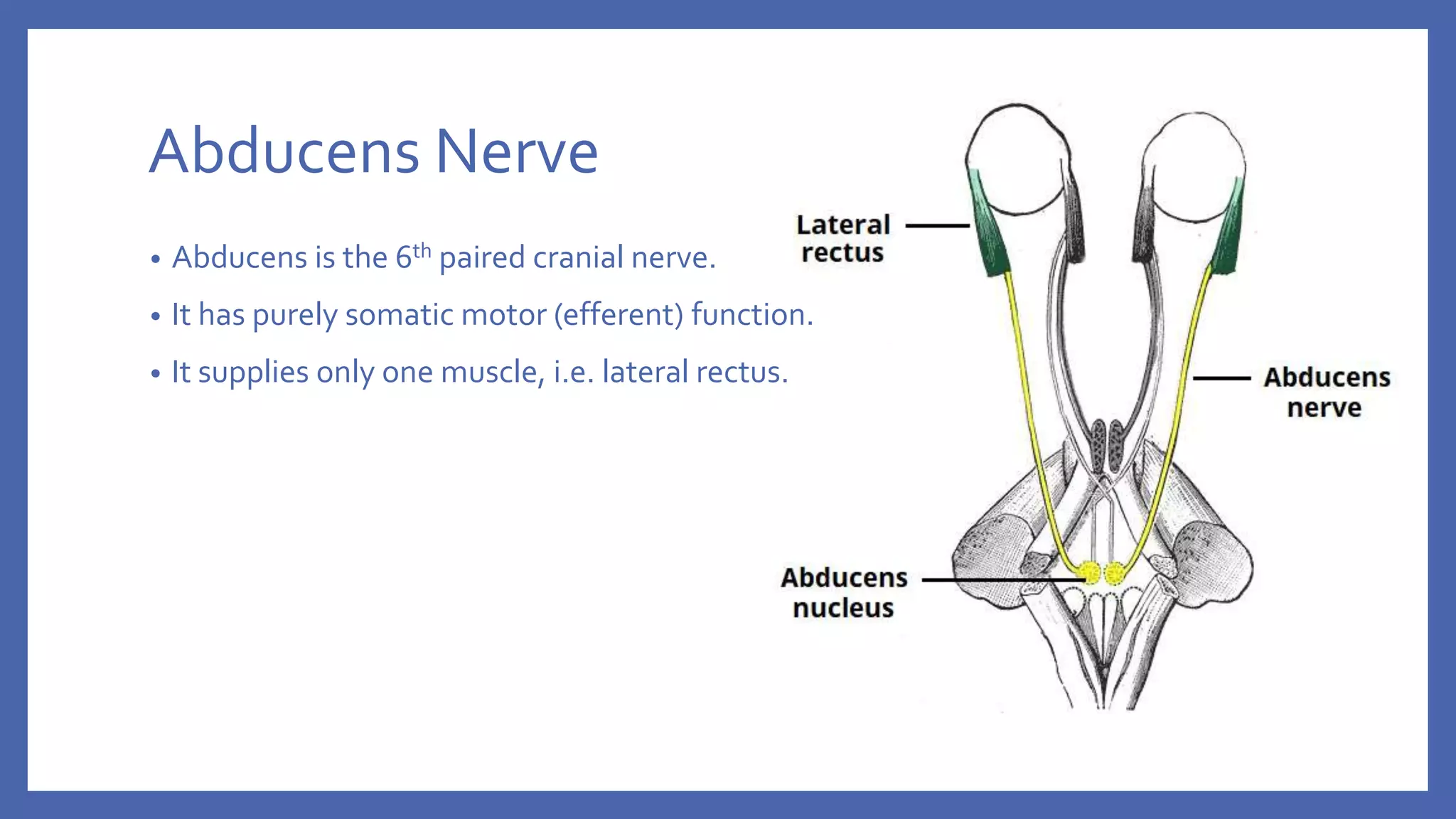
Abducens Nerve
• Abducens is the 6th paired cranial nerve.
• It has purely somatic motor (efferent) function.
• It supplies only one muscle, i.e. lateral rectus.
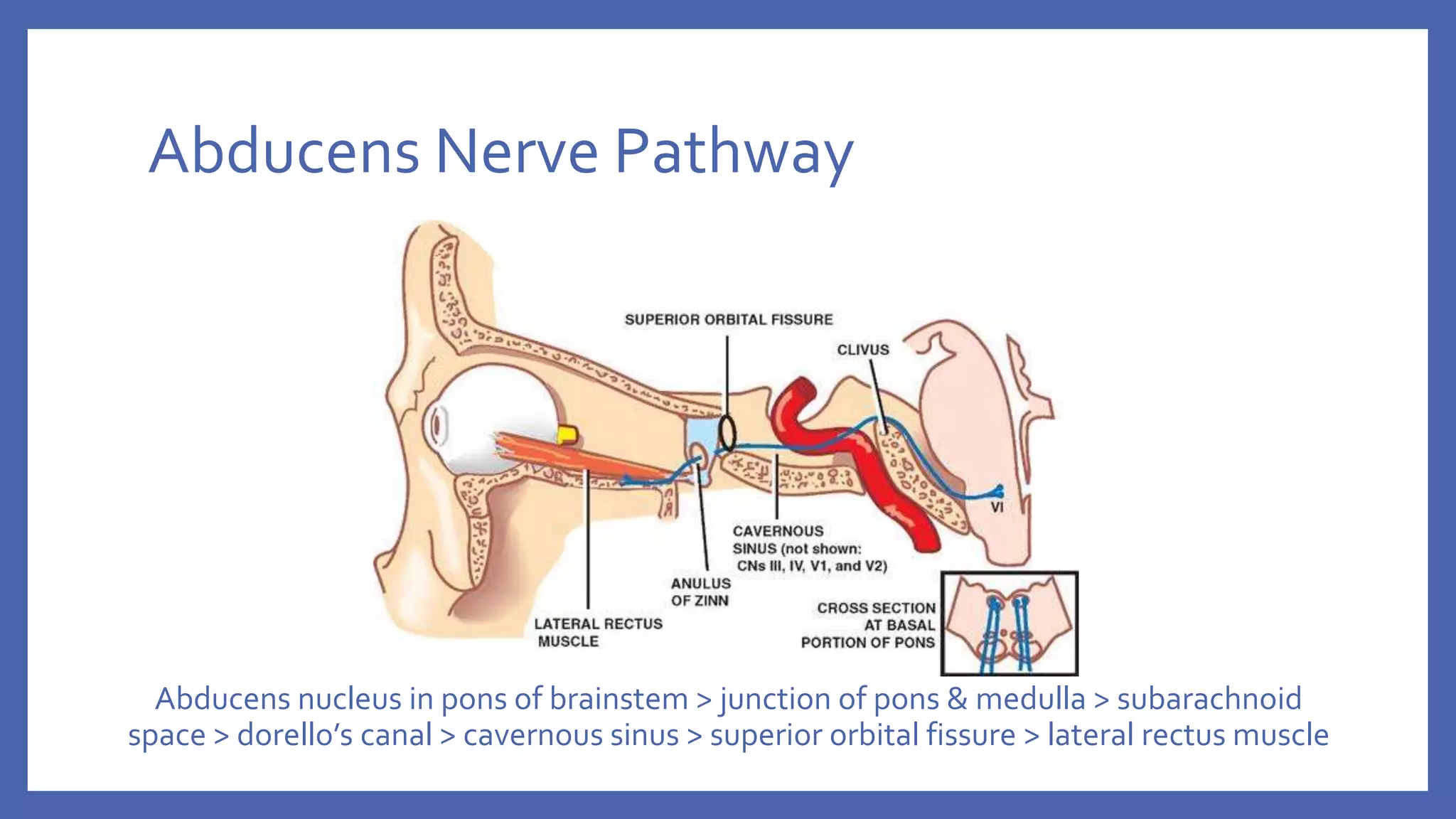
Abducens Nerve Pathway
Abducens nucleus in pons of brainstem > junction of pons & medulla > subarachnoid
space > dorello’s canal > cavernous sinus > superior orbital fissure > lateral rectus muscle
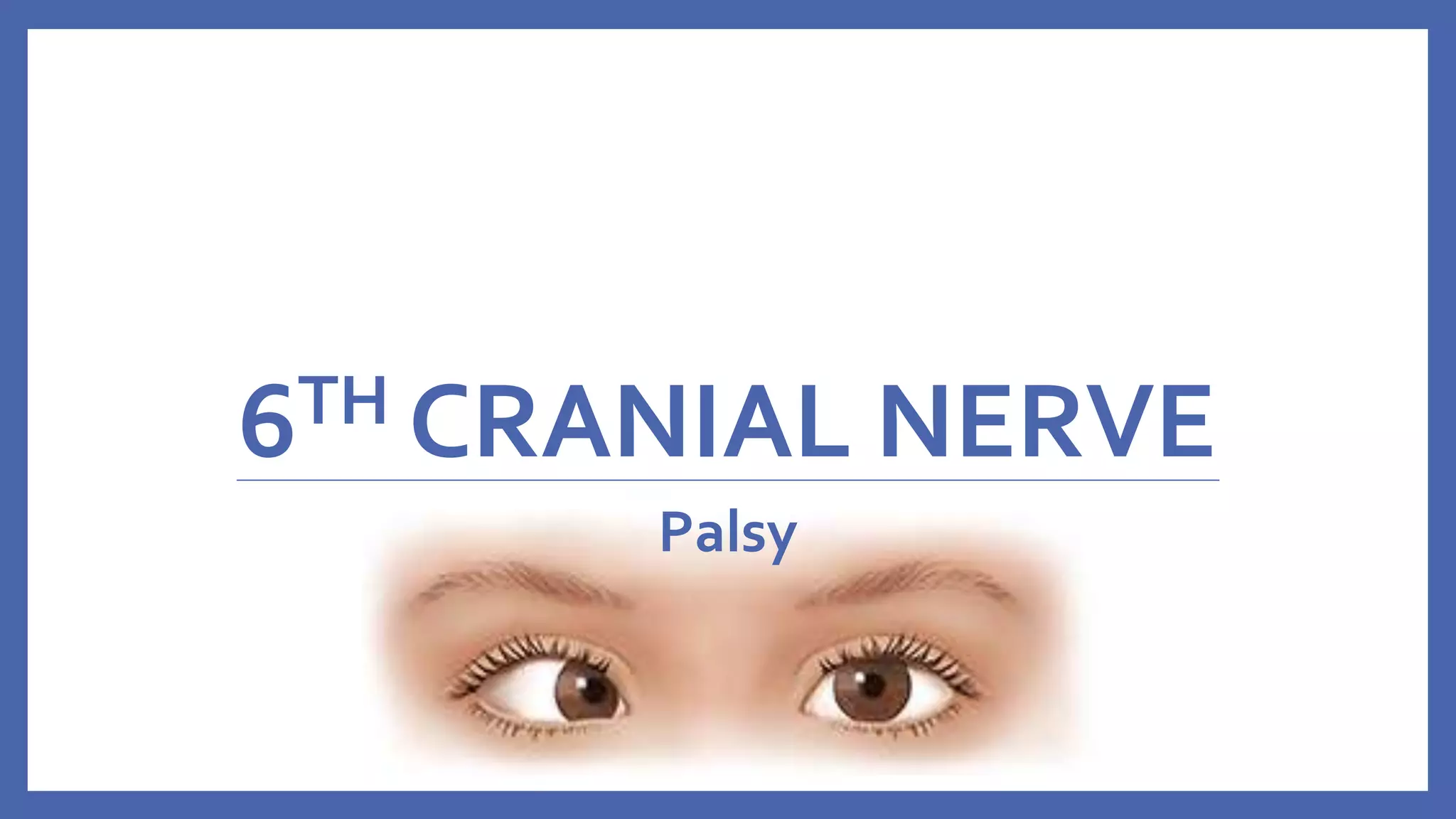
6TH CRANIAL NERVE
Palsy
Etiology
Congenital Acquired (Children) Acquired (Young Adults) Acquired (Older Adults)
Following birth trauma Space occupying lesions Trauma Vascular
Hereditary Trauma Space-occupying lesions Diabetes
Infection (maternal) Infections (Bacterial/Viral) Post-viral inflammation Space-occupying lesions
Failure of lateral rectus
development
Infantile esotropia with
cross fixation
Multiple Sclerosis Senile lateral rectus
weakness
Increased ICP Diabetes
Decompensated esophoria High myopia
Mobius Syndrome Ophthalmoplegic migraine
Duane’s Retraction
Syndrome
Clinical Features
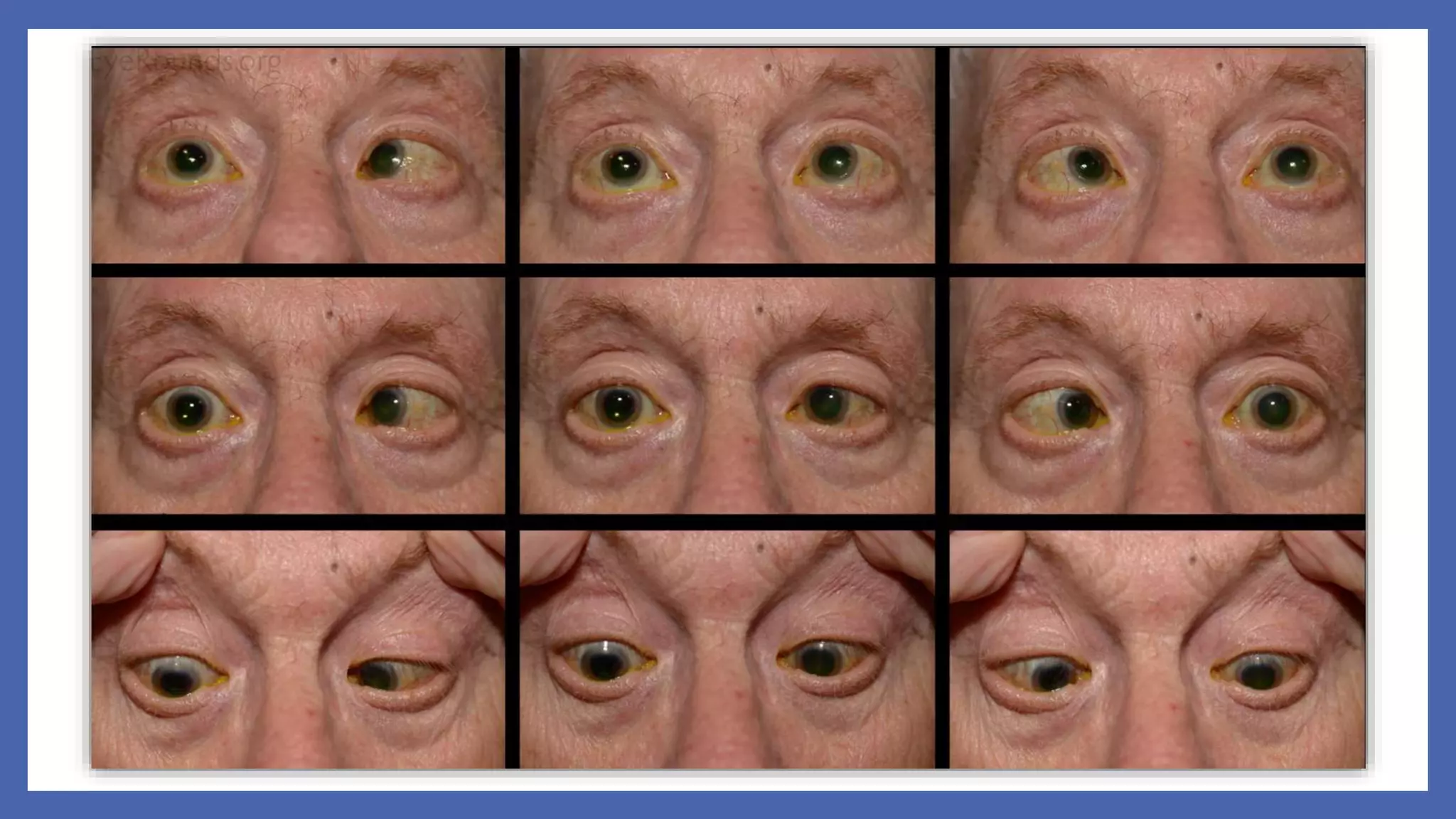
• An eso deviation which increases in distance & towards affected side.
• Limited abduction in affected eye.
• Uncrossed horizontal diplopia, worsens for distance fixation and towards affected side
• A face turn towards affected side.
• Patients with mild degree of palsy can maintain BSV.
• Secondary changes in other horizontal rectus muscles if muscle sequelae have fully
developed.
Muscle Sequalae
Unilateral Palsy:
1. Overaction of the contralateral medial rectus.
2. Contracture of the ipsilateral medial rectus.
3. Secondary inhibitional palsy of contralateral lateral rectus.
Bilateral Palsy:
1. Contracture of medial rectus muscles.
Total vs Partial 6th Nerve Palsy
• Presence of abduction past mid line, indicates residual lateral rectus function.
• Failure to abduct past mid line may be due to total palsy or mechanical
restrictions.
• In above scenario, force generation test or botulinum toxin injection is used for
discrimination.
• Electromyography: Increased signal of action potential when eye attempts to
abduct, indicated residual function.
Unilateral vs Bilateral 6th Nerve Palsy
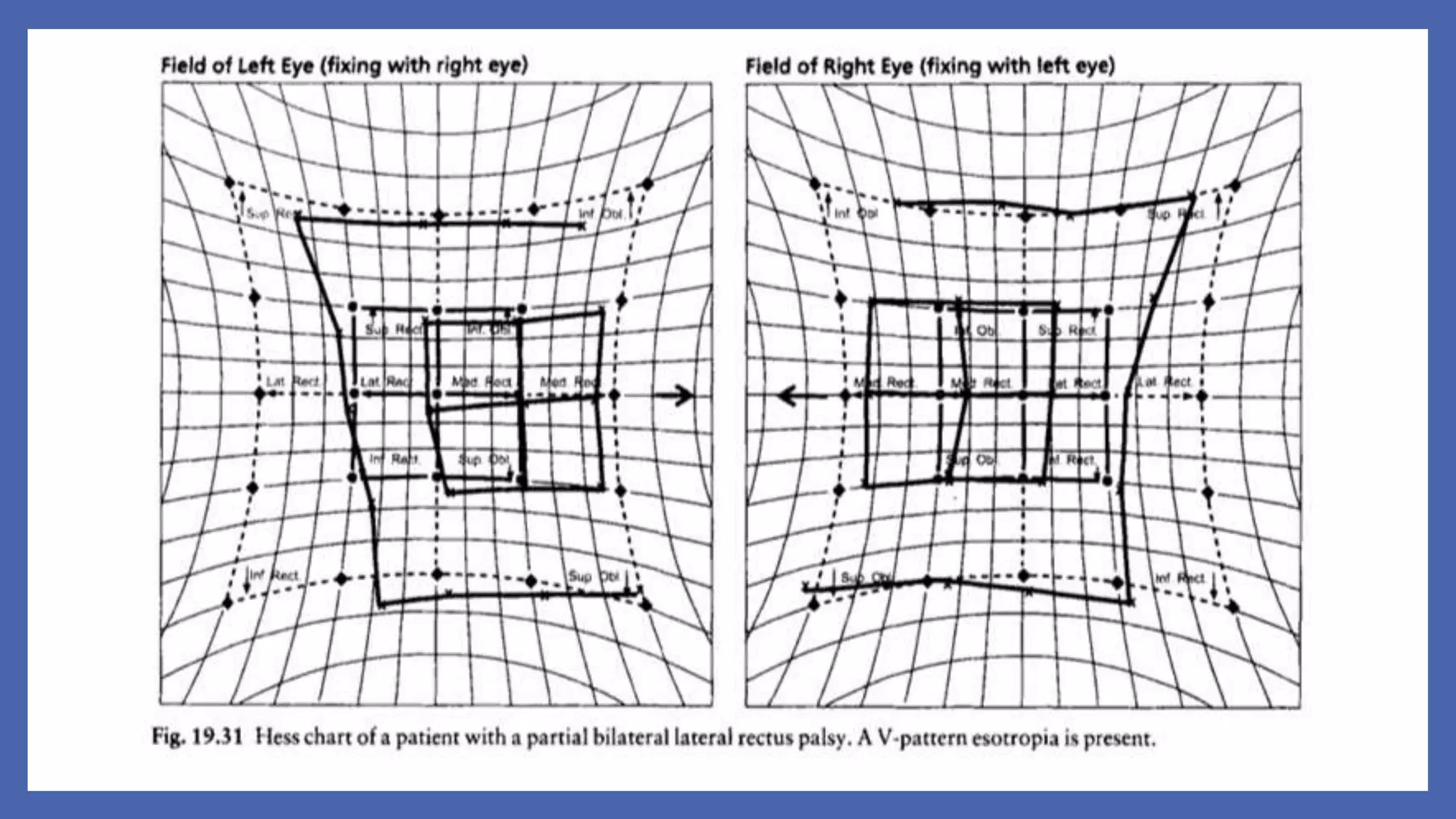
• Incomitant esotropia increasing in both left and right gaze indicates bilateral
palsy.
• Full development of muscle sequelae in unilateral cases that simulates
asymmetrical bilateral lateral rectus palsy.
• Contracture of medial recti in longstanding bilateral cases.
• V pattern esotropia is present in bilateral palsy.
Differential Diagnosis
• Duane’s Syndrome
• High myopia
• Thyroid eye disease
• Orbital trauma involving a blow-out fracture of the medial orbital wall.
• Infantile esotropia.
Management
ConservativeTreatment
• Acquired palsies should be managed conservatively for the first 9 to 12 months or until
stabilization
• Primary aim is to relief the symptoms, that includes diplopia & uncomfortable
(abnormal) head posture.
• The options used are occlusion, prisms, & botulinum toxin.
Management
SurgicalTreatment
• Surgery may be employed once the condition is stable and static with a minimum of 6
months of stable measurements.
• Depending on the size of deviation, unilateral or bilateral recession of medial rectus with
resection of lateral rectus of affected eye.
• In complete palsy, medial rectus recession is combined with transposition of superior
and inferior recti to the affected lateral rectus.
Level Up Optometry!

6th Nerve Palsy

  • 1.
    6TH NERVE PALSY HasnainPasha | Final Year – BSVS | 26th September, 2020
  • 2.
  • 3.
    Lateral Rectus • Origion:Annulus of Zinn • Insertion: 6.9 mm lateral to limbus in horizontal meridian with width of 9.5 mm • Innervation: Abducens Nerve • Blood Supply: Internal Crotid Artery > Ophthalmic Artery > Lateral branch of muscular artery & lacrimal artery . • Function: Abduction of eye ball • Length: 40 mm (7-8 mm of muscle is in contact with eye)
  • 6.
  • 7.
    Abducens Nerve • Abducensis the 6th paired cranial nerve. • It has purely somatic motor (efferent) function. • It supplies only one muscle, i.e. lateral rectus.
  • 8.
    Abducens Nerve Pathway Abducensnucleus in pons of brainstem > junction of pons & medulla > subarachnoid space > dorello’s canal > cavernous sinus > superior orbital fissure > lateral rectus muscle
  • 9.
  • 10.
    Etiology Congenital Acquired (Children)Acquired (Young Adults) Acquired (Older Adults) Following birth trauma Space occupying lesions Trauma Vascular Hereditary Trauma Space-occupying lesions Diabetes Infection (maternal) Infections (Bacterial/Viral) Post-viral inflammation Space-occupying lesions Failure of lateral rectus development Infantile esotropia with cross fixation Multiple Sclerosis Senile lateral rectus weakness Increased ICP Diabetes Decompensated esophoria High myopia Mobius Syndrome Ophthalmoplegic migraine Duane’s Retraction Syndrome
  • 11.
    Clinical Features • Aneso deviation which increases in distance & towards affected side. • Limited abduction in affected eye. • Uncrossed horizontal diplopia, worsens for distance fixation and towards affected side • A face turn towards affected side. • Patients with mild degree of palsy can maintain BSV. • Secondary changes in other horizontal rectus muscles if muscle sequelae have fully developed.
  • 12.
    Muscle Sequalae Unilateral Palsy: 1.Overaction of the contralateral medial rectus. 2. Contracture of the ipsilateral medial rectus. 3. Secondary inhibitional palsy of contralateral lateral rectus. Bilateral Palsy: 1. Contracture of medial rectus muscles.
  • 15.
    Total vs Partial6th Nerve Palsy • Presence of abduction past mid line, indicates residual lateral rectus function. • Failure to abduct past mid line may be due to total palsy or mechanical restrictions. • In above scenario, force generation test or botulinum toxin injection is used for discrimination. • Electromyography: Increased signal of action potential when eye attempts to abduct, indicated residual function.
  • 16.
    Unilateral vs Bilateral6th Nerve Palsy • Incomitant esotropia increasing in both left and right gaze indicates bilateral palsy. • Full development of muscle sequelae in unilateral cases that simulates asymmetrical bilateral lateral rectus palsy. • Contracture of medial recti in longstanding bilateral cases. • V pattern esotropia is present in bilateral palsy.
  • 20.
    Differential Diagnosis • Duane’sSyndrome • High myopia • Thyroid eye disease • Orbital trauma involving a blow-out fracture of the medial orbital wall. • Infantile esotropia.
  • 21.
    Management ConservativeTreatment • Acquired palsiesshould be managed conservatively for the first 9 to 12 months or until stabilization • Primary aim is to relief the symptoms, that includes diplopia & uncomfortable (abnormal) head posture. • The options used are occlusion, prisms, & botulinum toxin.
  • 22.
    Management SurgicalTreatment • Surgery maybe employed once the condition is stable and static with a minimum of 6 months of stable measurements. • Depending on the size of deviation, unilateral or bilateral recession of medial rectus with resection of lateral rectus of affected eye. • In complete palsy, medial rectus recession is combined with transposition of superior and inferior recti to the affected lateral rectus.
  • 23.

Editor's Notes

  • #2 Are your classroom colors different than what you see in this template? That’s OK! Click on Design -> Variants (the down arrow) -> Pick the color scheme that works for you! Feel free to change any “You will…” and “I will…” statements to ensure they align with your classroom procedures and rules!