Clinical approach to uveitis
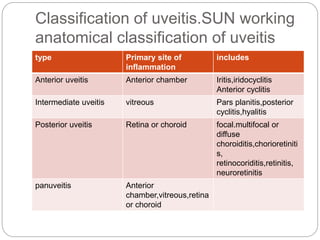
Classification of uveitis.SUN working
anatomical classification of uveitis
type Primary site of
inflammation
includes
Anterior uveitis Anterior chamber Iritis,iridocyclitis
Anterior cyclitis
Intermediate uveitis vitreous Pars planitis,posterior
cyclitis,hyalitis
Posterior uveitis Retina or choroid focal.multifocal or
diffuse
choroiditis,chorioretiniti
s,
retinocoriditis,retinitis,
neuroretinitis
panuveitis Anterior
chamber,vitreous,retina
or choroid
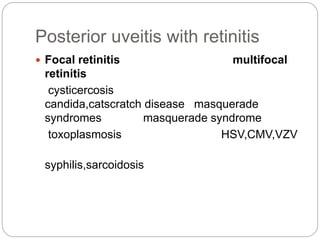
Posterior uveitis with retinitis
 Focal retinitis multifocal
retinitis
cysticercosis
candida,catscratch disease masquerade
syndromes masquerade syndrome
toxoplasmosis HSV,CMV,VZV
syphilis,sarcoidosis
Posterior uveitis with a focal [solitary]
chorioretinal lesion
 With vitreal cells without vitreal
cells
Toxocarisis tumour
Tuberculosis serpenginous
choroidopathy Sarcoidosis
Cat scratch disease
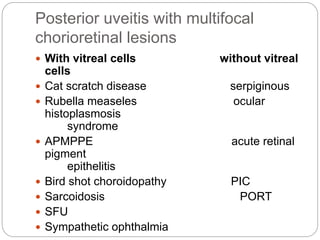
Posterior uveitis with multifocal
chorioretinal lesions
 With vitreal cells without vitreal
cells
 Cat scratch disease serpiginous
 Rubella measeles ocular
histoplasmosis
syndrome
 APMPPE acute retinal
pigment
epithelitis
 Bird shot choroidopathy PIC
 Sarcoidosis PORT
 SFU
 Sympathetic ophthalmia
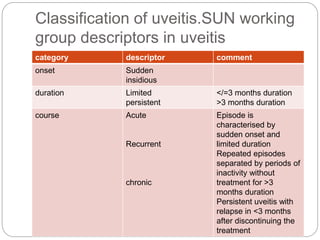
Classification of uveitis.SUN working
group descriptors in uveitis
category descriptor comment
onset Sudden
insidious
duration Limited
persistent
</=3 months duration
>3 months duration
course Acute
Recurrent
chronic
Episode is
characterised by
sudden onset and
limited duration
Repeated episodes
separated by periods of
inactivity without
treatment for >3
months duration
Persistent uveitis with
relapse in <3 months
after discontinuing the
treatment
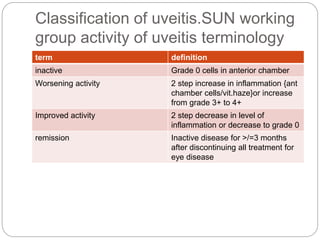
Classification of uveitis.SUN working
group activity of uveitis terminology
term definition
inactive Grade 0 cells in anterior chamber
Worsening activity 2 step increase in inflammation {ant
chamber cells/vit.haze}or increase
from grade 3+ to 4+
Improved activity 2 step decrease in level of
inflammation or decrease to grade 0
remission Inactive disease for >/=3 months
after discontinuing all treatment for
eye disease
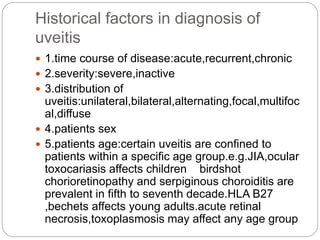
Historical factors in diagnosis of
uveitis
 1.time course of disease:acute,recurrent,chronic
 2.severity:severe,inactive
 3.distribution of
uveitis:unilateral,bilateral,alternating,focal,multifoc
al,diffuse
 4.patients sex
 5.patients age:certain uveitis are confined to
patients within a specific age group.e.g.JIA,ocular
toxocariasis affects children birdshot
chorioretinopathy and serpiginous choroiditis are
prevalent in fifth to seventh decade.HLA B27
,bechets affects young adults.acute retinal
necrosis,toxoplasmosis may affect any age group
 Note:it is less common for primary uveitis to first
manifest in old age,suspect a masquerade
syndrome especially introcular lymphoma
 6.patients race:bechets seen in china
,turkey.birdshot choroidopathy is more common in
western europe.VKH is seen in china.TB in india.
 7.past ocular history:recurrent attacks of
unilateral uveitis suggest HLA B27 related
disease.history of previous trauma ,surgery point
to the diagnosis of sympathetic ophthalmia,lens
induced uveitis
 8.past medical history:h/o systemic medications ,oral
ulcers,genital ulcers.
 9.hygiene and dietary habits:history of
pica[toxocariasis],undercooked meat,ingestion of
water in rural areas[toxoplasmosis],ingestion of pork
in endemic areas[cystecercosis]
 10.history of sexual practices:for diagnosis of HIV and
syphilis
 11.recreational drugs:for HIV infection,fungal
endophthalmitis
 12.pets:cats are associated with transmission of
toxoplasmosis,cat scratch disease,while puppies are
associated to toxocariasis
Clinical features: Acute anterior
uveitis
 Signs and symptoms depend on the uveal tract
inflammed,rapidity of onset,duration of
disease,course of disease
 Acute anterior uveitis:
 Symptoms:sudden onset of
pain,photophobia,redness,lacrimation.
 Signs:decrease in VA
 Ciliary congestion
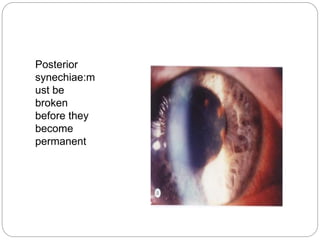
 Miosis due to sphincter spasm may predispose to
formation of posterior synaechia unless the pupil
is dilated.
 Endothelial dusting by myriad of cells that gives
rise to a dirty appearance .true KP appear after
few days.
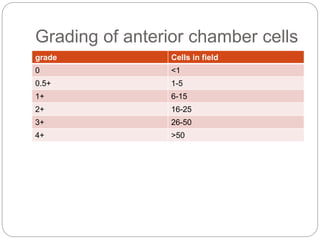
 Aqueous cells indicate disease activity and
number reflects disease severity.grading is
performed with 2 mm long and 1 mm wide slit
with maximal light intensity and magnification
Grading of anterior chamber cells
grade Cells in field
0 <1
0.5+ 1-5
1+ 6-15
2+ 16-25
3+ 26-50
4+ >50
 Anterior vitreous cells indicate iridocyclitis
 Aqueous flare:reflects precence of proteins due to
breakdown of blood retinal barrier.flare can be
graded by laser interferometry using a flare meter
or clinically with same settings as used for the
cells
grade description
0 nil
1+ Faint[just detectable]
2+ Moderate[iris lens details are clear]
3+ Marked[iris,lens details are hazy]
4+ Intense[fibrinous exudates]
 Aqueous fibrinous exudates:occurs typically in
HLA B27 associated uveitis
 Hypopyon:is a feature of intense inflammation in
which cells settle down in inferior part of anterior
chamber and form a horizontal level.in HLA B27
uveitis ,the hypopyon has high fibrin content
which makes it dense ,immobile and slow to
absorb. in patients with bechet syndrome the
hypopyon has minimal fibrin and therefore shifts
according to patients head position and may
disappear quickly.hypopyon associated with blood
occurs in herpetic infection and eyes with
rubeosis iridis.
Hypopyon in Bechet syndrome
Posterior
synechiae:m
ust be
broken
before they
become
permanent
 Low intraocular pressure :is a rule as a result of
reduced secretion of aqueous by ciliary
epithelium.occasionally the intraocular pressure
may be elevated if meshwork is blocked with
inflammatory cells ,in case of trabeculitis.pupillary
block with iris bombe and secondary angle
closure may lead to an acute rise in IOP
 Although fundus examination is usually normal ,it
should always be performed to exclude spill over
anterior uveitis associated with posterior focus
most notably toxoplasmosis.
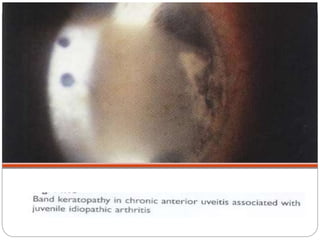
Chronic anterior uveitis
 Simultaneous bilateral involvement is more
common than in AAU.
 Symptoms:patients are asymptomatic until the
development of complications such as cataract or
band keratopathy
 Signs:usually white,or ocasionally pink during
periods of exacerbation.
 Aqueous cells and flare:flare may be more
marked than cells in eyes with prolonged activity
and its severity may act as an indicator of disease
activity.
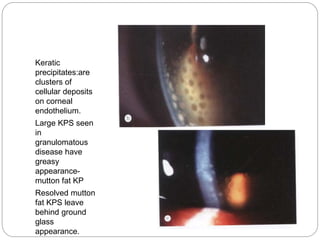
Keratic
precipitates:are
clusters of
cellular deposits
on corneal
endothelium.
Large KPS seen
in
granulomatous
disease have
greasy
appearance-
mutton fat KP
Resolved mutton
fat KPS leave
behind ground
glass
appearance.
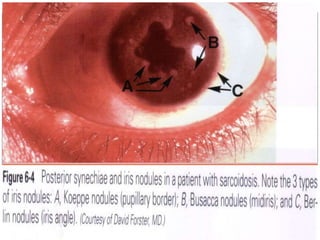
Iris nodules:
Koeppe
nodules:small
situated at
pupillary border
Busacca
nodule:stromal.lar
ge pink nodules
are characteristic
of sarcoid
nodules
Berlin nodules
seen at the angle
Other features of
iris
involvement:heter
ochromia,stromal
atrophy,iris
granuloma
Posterior uveitis
 Symptoms:painless decrease visual
acuity,floaters,photopsia,metamorphopsia,scotom
a, nyctalopia.
 Signs:
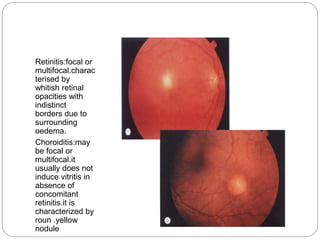
Retinitis:focal or
multifocal.charac
terised by
whitish retinal
opacities with
indistinct
borders due to
surrounding
oedema.
Choroiditis:may
be focal or
multifocal.it
usually does not
induce vitritis in
absence of
concomitant
retinitis.it is
characterized by
roun .yellow
nodule
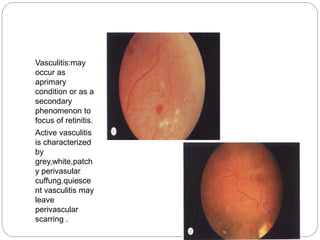
Vasculitis:may
occur as
aprimary
condition or as a
secondary
phenomenon to
focus of retinitis.
Active vasculitis
is characterized
by
grey,white,patch
y perivasular
cuffung.quiesce
nt vasculitis may
leave
perivascular
scarring .
Intermediate uveitis
 Symptoms:blurred vision,floaters.initial symptoms
are unilateral ,but the condition is bilateral and
asymmetrical.
 Signs:
 Anterior uveitis
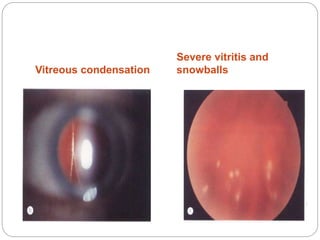
 Vitreous:vitreous cells,vitreous
condensation,snow balls often inferiorly.
Vitreous condensation
Severe vitritis and
snowballs
 Posterior segment:peripheral
periphlebitis,perivascular sheathing.
 Snowbanking:exudates over pars plana.active
lesions have fluffy ,shaggy appearance.
 Neovascularisation on snowbank or optic nerve
head.
 Subtle disc oedema.
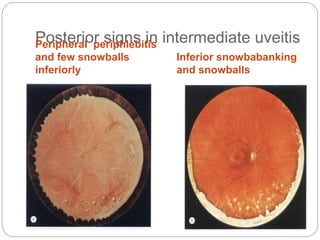
Posterior signs in intermediate uveitisPeripheral periphlebitis
and few snowballs
inferiorly
Inferior snowbabanking
and snowballs
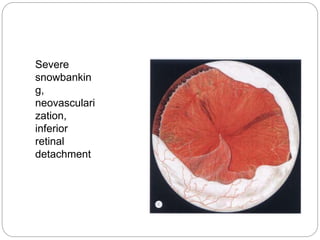
Severe
snowbankin
g,
neovasculari
zation,
inferior
retinal
detachment
Complications
 CMO
 ERM
 Cataract,glaucoma
 RD,retinoschisis
 Vitreous haemorrhage
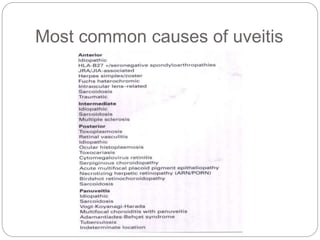
Most common causes of uveitis
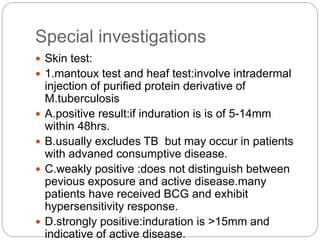
Special investigations
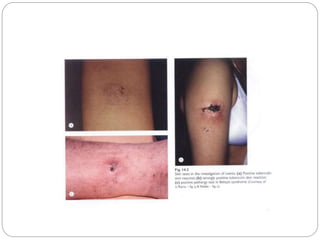
 Skin test:
 1.mantoux test and heaf test:involve intradermal
injection of purified protein derivative of
M.tuberculosis
 A.positive result:if induration is is of 5-14mm
within 48hrs.
 B.usually excludes TB but may occur in patients
with advaned consumptive disease.
 C.weakly positive :does not distinguish between
pevious exposure and active disease.many
patients have received BCG and exhibit
hypersensitivity response.
 D.strongly positive:induration is >15mm and
indicative of active disease.
 Pathergy test:increased dermal sensitivity to
needle truma is a criterion for the diagnosis of
Bechet syndrome.
serology
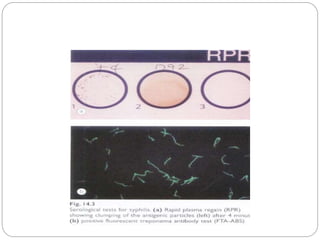
 Syphilis:serology test depend on detection of non
specific antibodies [cardiolipin]or specific treponemal
antibodies .
 1.non treponema test:RPR,VDRL are best used to
diagnose primary infection,monitor disease
actvity,response to therapy based on the titre.the
results may be negative in 30% of the patients with
documented syphilitic uveitis.they tend to become –ve
6-18 months after therapy
 2.treponema antibody test:higly senitive and specific
to prove past infection,secondary or tertiry form of
infections.fluorescent treponema antibody absorption
test[FTA-ABS],microhaemagglutination treponema
pallidium test[MHA-TP]are commonlu used.it cannot
be titrated.it is either –ve or +ve.
 Toxoplasmosis:
 1.dye test:sabin feldman test:gold standard for
the diagnosis.
 2.immunofluorescent antibody test
 3.haemagglutination
 4.ELISA
 Antinuclear antibody:used to identify children
with JIA who are at high risk of developing
anterior uveitis and therefore require close
followup.rheumatoid factor is relevant only when
investigating aetiology of scleritis .it should not be
ordered in workup of patients with uveitis alone.
 Enzyme assay:
 1.angiotensin converting enzyme:non specific test
which indicates presence of granulomatous
disease like sarcoidosis,TB or leprosy.it is
normally elevated in children and of less
diagnostic value.
 Lyzozymes:high sensitivity less specificity for
sarcoidosis.
HLA tissue typing
HLA type Associated disease
B27 Spondyloarthropathies,particularly
ankylosing spondylitis
A29 Birdshot chorioretinopathy
B51 Bechet syndrome
HLA B7 and HLA DR2 POHS & APMPPE
IMAGINGS
 1.FLUORESCEIN ANGIOGRAPHY:useful in following
condition:
 Diagnosis and assesment of severity of retinal
vasculitis
 Diagnosis of CMO
 Demonstrating macular ischaemia as cause of visual
loss rather than CMO
 Differentiating inflammatory and ischaemic cause of
retinal neovascularisation.
 Diagnosing and monitoring choroidal
neovascularisation.
 FA is less appropriate in choroiditis because deep
lesion will be hidden by choroidal flush.hence,more
lesions are seen clinically than angiographically in
bird shot chorioretinopathy
 ICG:better suited for choroidal lesions
 US:is of value in opaque media which hampers
the fundus examination ,to exclude RD or
intraocular mass.
 OCT:is effective in detecting CMO or indetifying
vitreoretinal traction
Biopsy
 Histopathology remains the gold standard for
diagnosis of many conditions.biopsy of skin and
other organs may establish the diagnosis of a
systemic disorder associated with ocular
manifestation.
 Conjunctiva and lacrimal gland biopsy:for
sarcoidosis
 Aqueous samples:for PCR for diagnosis of viral
retinitis
 Vitreous biopsy:endophthalmitis,intraocular
tumors
 Choroidal and retinal biopsy:in cases where
radiology
 1.chest radiographs:to exclude TB and
sarcoidosis.
 Sacro-iliac joint X ray:helpful in diagnosis of
spondyloartropathy in presence of symptoms of
low back pain and uveitis.
 CT and MRI:of the brain and thorax may be
appropriate in the investigation of sarcoiodsis
,MS,primary intraocular lymphoma.
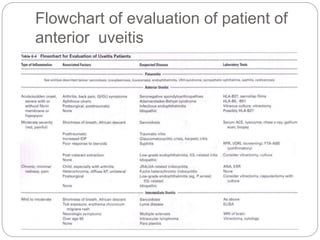
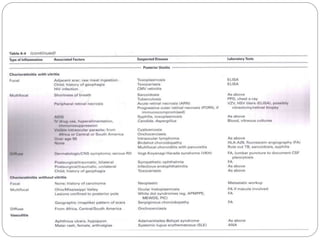
Flowchart of evaluation of patient of
anterior uveitis
thankyou

Clinical approach to uveitis

  • 1.
  • 2.
    Classification of uveitis.SUNworking anatomical classification of uveitis type Primary site of inflammation includes Anterior uveitis Anterior chamber Iritis,iridocyclitis Anterior cyclitis Intermediate uveitis vitreous Pars planitis,posterior cyclitis,hyalitis Posterior uveitis Retina or choroid focal.multifocal or diffuse choroiditis,chorioretiniti s, retinocoriditis,retinitis, neuroretinitis panuveitis Anterior chamber,vitreous,retina or choroid
  • 3.
    Posterior uveitis withretinitis  Focal retinitis multifocal retinitis cysticercosis candida,catscratch disease masquerade syndromes masquerade syndrome toxoplasmosis HSV,CMV,VZV syphilis,sarcoidosis
  • 4.
    Posterior uveitis witha focal [solitary] chorioretinal lesion  With vitreal cells without vitreal cells Toxocarisis tumour Tuberculosis serpenginous choroidopathy Sarcoidosis Cat scratch disease
  • 5.
    Posterior uveitis withmultifocal chorioretinal lesions  With vitreal cells without vitreal cells  Cat scratch disease serpiginous  Rubella measeles ocular histoplasmosis syndrome  APMPPE acute retinal pigment epithelitis  Bird shot choroidopathy PIC  Sarcoidosis PORT  SFU  Sympathetic ophthalmia
  • 6.
    Classification of uveitis.SUNworking group descriptors in uveitis category descriptor comment onset Sudden insidious duration Limited persistent </=3 months duration >3 months duration course Acute Recurrent chronic Episode is characterised by sudden onset and limited duration Repeated episodes separated by periods of inactivity without treatment for >3 months duration Persistent uveitis with relapse in <3 months after discontinuing the treatment
  • 7.
    Classification of uveitis.SUNworking group activity of uveitis terminology term definition inactive Grade 0 cells in anterior chamber Worsening activity 2 step increase in inflammation {ant chamber cells/vit.haze}or increase from grade 3+ to 4+ Improved activity 2 step decrease in level of inflammation or decrease to grade 0 remission Inactive disease for >/=3 months after discontinuing all treatment for eye disease
  • 8.
    Historical factors indiagnosis of uveitis  1.time course of disease:acute,recurrent,chronic  2.severity:severe,inactive  3.distribution of uveitis:unilateral,bilateral,alternating,focal,multifoc al,diffuse  4.patients sex  5.patients age:certain uveitis are confined to patients within a specific age group.e.g.JIA,ocular toxocariasis affects children birdshot chorioretinopathy and serpiginous choroiditis are prevalent in fifth to seventh decade.HLA B27 ,bechets affects young adults.acute retinal necrosis,toxoplasmosis may affect any age group
  • 9.
     Note:it isless common for primary uveitis to first manifest in old age,suspect a masquerade syndrome especially introcular lymphoma  6.patients race:bechets seen in china ,turkey.birdshot choroidopathy is more common in western europe.VKH is seen in china.TB in india.  7.past ocular history:recurrent attacks of unilateral uveitis suggest HLA B27 related disease.history of previous trauma ,surgery point to the diagnosis of sympathetic ophthalmia,lens induced uveitis
  • 10.
     8.past medicalhistory:h/o systemic medications ,oral ulcers,genital ulcers.  9.hygiene and dietary habits:history of pica[toxocariasis],undercooked meat,ingestion of water in rural areas[toxoplasmosis],ingestion of pork in endemic areas[cystecercosis]  10.history of sexual practices:for diagnosis of HIV and syphilis  11.recreational drugs:for HIV infection,fungal endophthalmitis  12.pets:cats are associated with transmission of toxoplasmosis,cat scratch disease,while puppies are associated to toxocariasis
  • 11.
    Clinical features: Acuteanterior uveitis  Signs and symptoms depend on the uveal tract inflammed,rapidity of onset,duration of disease,course of disease  Acute anterior uveitis:  Symptoms:sudden onset of pain,photophobia,redness,lacrimation.  Signs:decrease in VA  Ciliary congestion  Miosis due to sphincter spasm may predispose to formation of posterior synaechia unless the pupil is dilated.
  • 12.
     Endothelial dustingby myriad of cells that gives rise to a dirty appearance .true KP appear after few days.  Aqueous cells indicate disease activity and number reflects disease severity.grading is performed with 2 mm long and 1 mm wide slit with maximal light intensity and magnification
  • 13.
    Grading of anteriorchamber cells grade Cells in field 0 <1 0.5+ 1-5 1+ 6-15 2+ 16-25 3+ 26-50 4+ >50
  • 14.
     Anterior vitreouscells indicate iridocyclitis  Aqueous flare:reflects precence of proteins due to breakdown of blood retinal barrier.flare can be graded by laser interferometry using a flare meter or clinically with same settings as used for the cells
  • 15.
    grade description 0 nil 1+Faint[just detectable] 2+ Moderate[iris lens details are clear] 3+ Marked[iris,lens details are hazy] 4+ Intense[fibrinous exudates]
  • 16.
     Aqueous fibrinousexudates:occurs typically in HLA B27 associated uveitis  Hypopyon:is a feature of intense inflammation in which cells settle down in inferior part of anterior chamber and form a horizontal level.in HLA B27 uveitis ,the hypopyon has high fibrin content which makes it dense ,immobile and slow to absorb. in patients with bechet syndrome the hypopyon has minimal fibrin and therefore shifts according to patients head position and may disappear quickly.hypopyon associated with blood occurs in herpetic infection and eyes with rubeosis iridis.
  • 17.
  • 18.
  • 19.
     Low intraocularpressure :is a rule as a result of reduced secretion of aqueous by ciliary epithelium.occasionally the intraocular pressure may be elevated if meshwork is blocked with inflammatory cells ,in case of trabeculitis.pupillary block with iris bombe and secondary angle closure may lead to an acute rise in IOP  Although fundus examination is usually normal ,it should always be performed to exclude spill over anterior uveitis associated with posterior focus most notably toxoplasmosis.
  • 20.
    Chronic anterior uveitis Simultaneous bilateral involvement is more common than in AAU.  Symptoms:patients are asymptomatic until the development of complications such as cataract or band keratopathy  Signs:usually white,or ocasionally pink during periods of exacerbation.  Aqueous cells and flare:flare may be more marked than cells in eyes with prolonged activity and its severity may act as an indicator of disease activity.
  • 22.
    Keratic precipitates:are clusters of cellular deposits oncorneal endothelium. Large KPS seen in granulomatous disease have greasy appearance- mutton fat KP Resolved mutton fat KPS leave behind ground glass appearance.
  • 23.
    Iris nodules: Koeppe nodules:small situated at pupillaryborder Busacca nodule:stromal.lar ge pink nodules are characteristic of sarcoid nodules Berlin nodules seen at the angle Other features of iris involvement:heter ochromia,stromal atrophy,iris granuloma
  • 25.
    Posterior uveitis  Symptoms:painlessdecrease visual acuity,floaters,photopsia,metamorphopsia,scotom a, nyctalopia.  Signs:
  • 26.
    Retinitis:focal or multifocal.charac terised by whitishretinal opacities with indistinct borders due to surrounding oedema. Choroiditis:may be focal or multifocal.it usually does not induce vitritis in absence of concomitant retinitis.it is characterized by roun .yellow nodule
  • 27.
    Vasculitis:may occur as aprimary condition oras a secondary phenomenon to focus of retinitis. Active vasculitis is characterized by grey,white,patch y perivasular cuffung.quiesce nt vasculitis may leave perivascular scarring .
  • 28.
    Intermediate uveitis  Symptoms:blurredvision,floaters.initial symptoms are unilateral ,but the condition is bilateral and asymmetrical.  Signs:  Anterior uveitis  Vitreous:vitreous cells,vitreous condensation,snow balls often inferiorly.
  • 29.
  • 30.
     Posterior segment:peripheral periphlebitis,perivascularsheathing.  Snowbanking:exudates over pars plana.active lesions have fluffy ,shaggy appearance.  Neovascularisation on snowbank or optic nerve head.  Subtle disc oedema.
  • 31.
    Posterior signs inintermediate uveitisPeripheral periphlebitis and few snowballs inferiorly Inferior snowbabanking and snowballs
  • 32.
  • 33.
    Complications  CMO  ERM Cataract,glaucoma  RD,retinoschisis  Vitreous haemorrhage
  • 34.
  • 35.
    Special investigations  Skintest:  1.mantoux test and heaf test:involve intradermal injection of purified protein derivative of M.tuberculosis  A.positive result:if induration is is of 5-14mm within 48hrs.  B.usually excludes TB but may occur in patients with advaned consumptive disease.  C.weakly positive :does not distinguish between pevious exposure and active disease.many patients have received BCG and exhibit hypersensitivity response.  D.strongly positive:induration is >15mm and indicative of active disease.
  • 36.
     Pathergy test:increaseddermal sensitivity to needle truma is a criterion for the diagnosis of Bechet syndrome.
  • 38.
    serology  Syphilis:serology testdepend on detection of non specific antibodies [cardiolipin]or specific treponemal antibodies .  1.non treponema test:RPR,VDRL are best used to diagnose primary infection,monitor disease actvity,response to therapy based on the titre.the results may be negative in 30% of the patients with documented syphilitic uveitis.they tend to become –ve 6-18 months after therapy  2.treponema antibody test:higly senitive and specific to prove past infection,secondary or tertiry form of infections.fluorescent treponema antibody absorption test[FTA-ABS],microhaemagglutination treponema pallidium test[MHA-TP]are commonlu used.it cannot be titrated.it is either –ve or +ve.
  • 40.
     Toxoplasmosis:  1.dyetest:sabin feldman test:gold standard for the diagnosis.  2.immunofluorescent antibody test  3.haemagglutination  4.ELISA  Antinuclear antibody:used to identify children with JIA who are at high risk of developing anterior uveitis and therefore require close followup.rheumatoid factor is relevant only when investigating aetiology of scleritis .it should not be ordered in workup of patients with uveitis alone.
  • 41.
     Enzyme assay: 1.angiotensin converting enzyme:non specific test which indicates presence of granulomatous disease like sarcoidosis,TB or leprosy.it is normally elevated in children and of less diagnostic value.  Lyzozymes:high sensitivity less specificity for sarcoidosis.
  • 42.
    HLA tissue typing HLAtype Associated disease B27 Spondyloarthropathies,particularly ankylosing spondylitis A29 Birdshot chorioretinopathy B51 Bechet syndrome HLA B7 and HLA DR2 POHS & APMPPE
  • 43.
    IMAGINGS  1.FLUORESCEIN ANGIOGRAPHY:usefulin following condition:  Diagnosis and assesment of severity of retinal vasculitis  Diagnosis of CMO  Demonstrating macular ischaemia as cause of visual loss rather than CMO  Differentiating inflammatory and ischaemic cause of retinal neovascularisation.  Diagnosing and monitoring choroidal neovascularisation.  FA is less appropriate in choroiditis because deep lesion will be hidden by choroidal flush.hence,more lesions are seen clinically than angiographically in bird shot chorioretinopathy
  • 44.
     ICG:better suitedfor choroidal lesions  US:is of value in opaque media which hampers the fundus examination ,to exclude RD or intraocular mass.  OCT:is effective in detecting CMO or indetifying vitreoretinal traction
  • 45.
    Biopsy  Histopathology remainsthe gold standard for diagnosis of many conditions.biopsy of skin and other organs may establish the diagnosis of a systemic disorder associated with ocular manifestation.  Conjunctiva and lacrimal gland biopsy:for sarcoidosis  Aqueous samples:for PCR for diagnosis of viral retinitis  Vitreous biopsy:endophthalmitis,intraocular tumors  Choroidal and retinal biopsy:in cases where
  • 46.
    radiology  1.chest radiographs:toexclude TB and sarcoidosis.  Sacro-iliac joint X ray:helpful in diagnosis of spondyloartropathy in presence of symptoms of low back pain and uveitis.  CT and MRI:of the brain and thorax may be appropriate in the investigation of sarcoiodsis ,MS,primary intraocular lymphoma.
  • 47.
    Flowchart of evaluationof patient of anterior uveitis
  • 49.