OCCULOMOTOR
NERVE PALSY
DR ANSHUMALEE PATEL
Occulomotor nerve
• Entirely motor
• Somatic efferent - moves eyeball
• Viceral efferent - accomodation and miosis
• Somatic afferent - proprioception
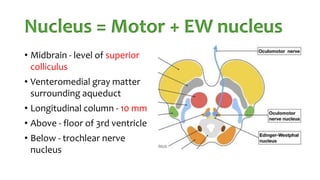
Nucleus = Motor + EW nucleus
• Midbrain - level of superior
colliculus
• Venteromedial gray matter
surrounding aqueduct
• Longitudinal column - 10 mm
• Above - floor of 3rd ventricle
• Below - trochlear nerve
nucleus
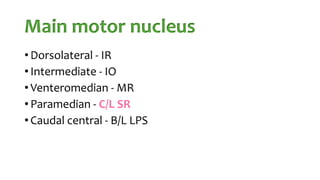
Main motor nucleus
• Dorsolateral - IR
• Intermediate - IO
• Venteromedian - MR
• Paramedian - C/L SR
• Caudal central - B/L LPS
Edinger Westphal nucleus
• Preganglionic parasympathetic
• Cranial part - Light reflex
• Caudal part - Accomodation reflex
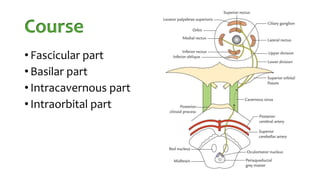
Course
• Fascicular part
• Basilar part
• Intracavernous part
• Intraorbital part
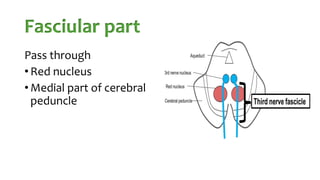
Fasciular part
Pass through
• Red nucleus
• Medial part of cerebral
peduncle
Basilar part
• Lateral root & Medial root unite
• B/W Superior Cerebellar Artery and Posterior
Cerebral Artery
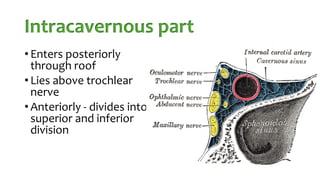
Intracavernous part
• Enters posteriorly
through roof
• Lies above trochlear
nerve
• Anteriorly - divides into
superior and inferior
division
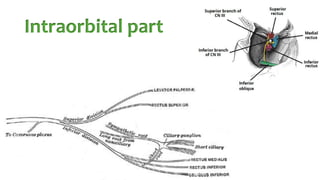
Intraorbital part
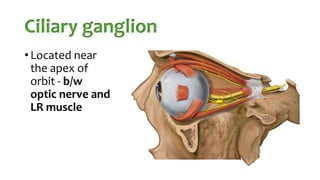
Ciliary ganglion
• Located near
the apex of
orbit - b/w
optic nerve and
LR muscle
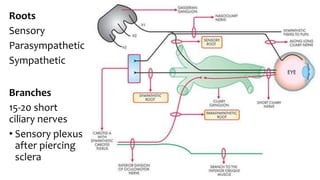
Roots
Sensory
Parasympathetic
Sympathetic
Branches
15-20 short
ciliary nerves
• Sensory plexus
after piercing
sclera
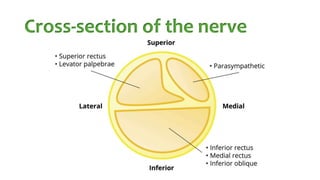
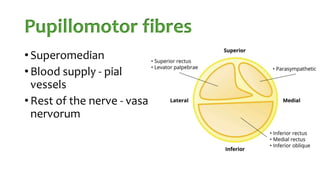
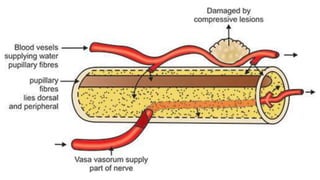
Cross-section of the nerve
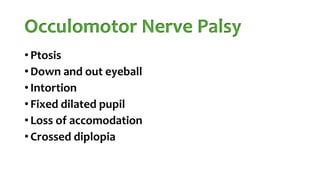
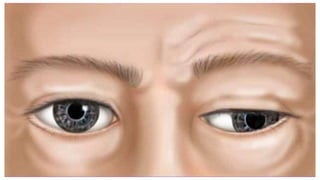
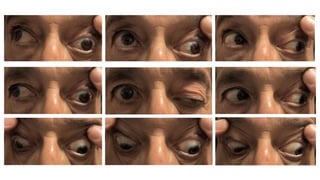
Occulomotor Nerve Palsy
• Ptosis
• Down and out eyeball
• Intortion
• Fixed dilated pupil
• Loss of accomodation
• Crossed diplopia
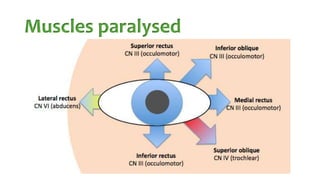
Muscles paralysed
Supranuclear lesions
• Cerebral cortex is involved
• Conjugate paresis - both eyes affected equally
• Relative position of eyes maintained - no diplopia
Nuclear lesions
• 3rd + 4th nerve nucleus = I/L sparing of elevation +
C/L weakness of elevation
• Medial Longitudinal Fasciculus = WEBINO syndrome
(adduction defect)
• Pure third nerve nuclear lesion - uncommon
Causes: Vascular, tumor, demylinating disorders
Lesions of fascicular part
• Benedikt syndrome - I/L 3rd N palsy + C/L tremors &
jerky movements
• Weber syndrome - I/L 3rd N palsy + C/L hemiplegia &
UMN 7th N palsy
• Nothnagel syndrome - I/L or B/L 3rd N palsy +
cerebellar ataxia
• Claude syndrome - Benedict + Nothnagel
Lesions of basilar part
Frequently cause isolated 3rd N palsy
• Aneurysm of posterior cerebral artery - pupil
involving
• Extradural hematoma - pupil involving
• Diabetes - pupil sparing
Lesions of intracavernous part
Frequently involves 3, 4, 6 nerves
• Pitutary apoplexy
• Meningioma
• Carotico-cavernous fistula
• Tolosa Hunt syndrome
Lesions of intraorbital part
• Trauma to orbital bones
• Vascular lesions
• Orbital tumors
Pupillomotor fibres
• Superomedian
• Blood supply - pial
vessels
• Rest of the nerve - vasa
nervorum
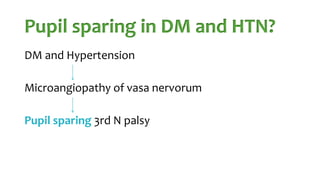
Pupil sparing in DM and HTN?
DM and Hypertension
Microangiopathy of vasa nervorum
Pupil sparing 3rd N palsy
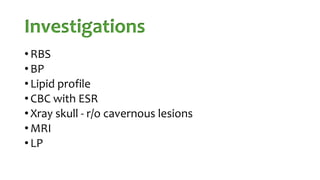
Investigations
• RBS
• BP
• Lipid profile
• CBC with ESR
• Xray skull - r/o cavernous lesions
• MRI
• LP
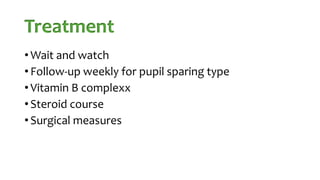
Treatment
• Wait and watch
• Follow-up weekly for pupil sparing type
• Vitamin B complexx
• Steroid course
• Surgical measures

OCCULOMOTOR NERVE PALSY.pptx