A  RARE CASE OF PERIPHERAL NEUROPATHY By: Dr Jami Swathi Prof Dr Gowrishankarโ€™s unit
A  41 yr old male patient came with complaints of: Numbness of both lower limbs โ€“ since 1& half yrs urinary retention  - 6months H/ O presenting complaint: Pt  was apparently normal 1 & half yrs ago when he noticed numbness and decreased  appreciation of  sensations of both the lower limbs,  insidious onset, symmetrical, slowly progressive, was present in the soles of  both the feet to  begin with & gradually ascended up to above  the knee level
h/o slipping of chappals without knowledge + No h/o buckling of  knees No h/o- difficulty in getting up from squatting position - weakness or sensory symptoms in upper limbs - involuntary movements - trauma - seizures/ LOC he also gives history of increased frequency of micturition with the need to strain to micturate, decreased appreciation of bladder filling, a feeling of incomplete evacuation of  bladder
He also noticed decreased sweating of both the lower limbs h/o erectile dysfunction + h/o vomiting +, repeated episodes between 2-6 am in the morning, postprandial fullness+ h/o loose stools+ No h/s/o postural hypotension No h/s/o any cranial nerve involvement No h/o- weight loss - cough with expectoration/ hemoptysis -skin rash, photosensitivity, oral ulcers No h/o chest pain, palpitations
past history: no h/o HTN, DM, TB, BA personal history: non alcoholic/ non smoker Family history: father died of a neurological illness at the age of 45yrs ( had similar complaints)
O/E:  Conscious  oriented afebrile No pallor, icterus, cyanosis, clubbing,  lymphadenopathy, edema Vitals:  BP: 120/80 mm Hg PR: 80/ min, regular Systemic examination: CVS: WNL RS: WNL
CNS: HIGHER MENTAL FUNCTIONS:  normal CRANIAL NERVES:  normal MOTOR SYSTEM:  Right  left bulk:  normal  normal tone:  normal  normal power:  UL:  5/5  5/5 LL:  mild weakness of  EHL Bilaterally rest โ€“ 5/5 PLANTAR  flexor  flexor
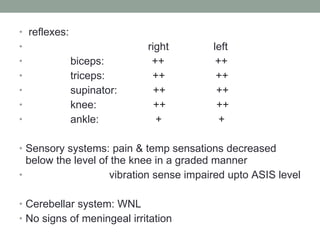
reflexes:  right  left biceps:  ++  ++ triceps:  ++  ++ supinator:  ++  ++ knee:  ++  ++ ankle:  +  + Sensory systems: pain & temp sensations decreased below the level of the knee in a graded manner vibration sense impaired upto ASIS level Cerebellar system: WNL No signs of meningeal irritation
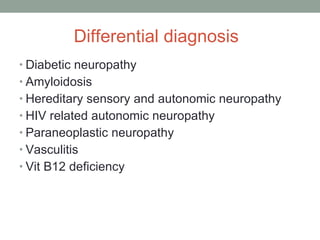
Differential diagnosis Diabetic neuropathy Amyloidosis  Hereditary sensory and autonomic neuropathy HIV related autonomic neuropathy Paraneoplastic neuropathy Vasculitis  Vit B12 deficiency
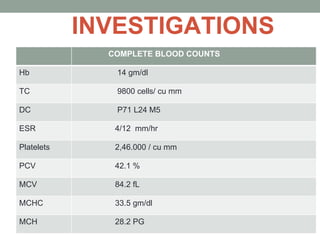
INVESTIGATIONS COMPLETE BLOOD COUNTS Hb 14 gm/dl TC 9800 cells/ cu mm DC P71 L24 M5 ESR 4/12  mm/hr Platelets 2,46.000 / cu mm PCV 42.1 % MCV 84.2 fL MCHC 33.5 gm/dl MCH 28.2 PG
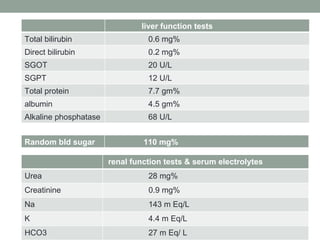
liver function tests Total bilirubin 0.6 mg% Direct bilirubin 0.2 mg% SGOT 20 U/L SGPT 12 U/L Total protein 7.7 gm% albumin 4.5 gm% Alkaline phosphatase 68 U/L Random bld sugar 110 mg% renal function tests & serum electrolytes Urea 28 mg% Creatinine 0.9 mg% Na 143 m Eq/L K 4.4 m Eq/L HCO3 27 m Eq/ L
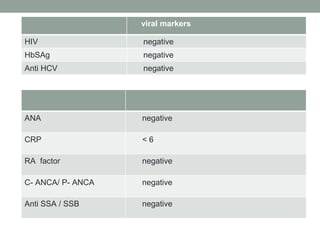
viral markers HIV negative HbSAg negative Anti HCV negative ANA negative CRP < 6 RA  factor negative C- ANCA/ P- ANCA negative Anti SSA / SSB negative
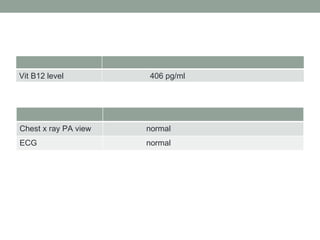
Vit B12 level 406 pg/ml Chest x ray PA view normal ECG normal
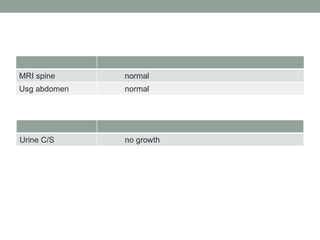
MRI spine normal Usg abdomen normal Urine C/S no growth
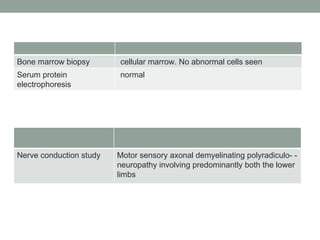
Bone marrow biopsy cellular marrow. No abnormal cells seen Serum protein electrophoresis normal Nerve conduction study Motor sensory axonal demyelinating polyradiculo- -neuropathy involving predominantly both the lower limbs
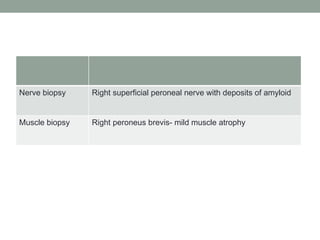
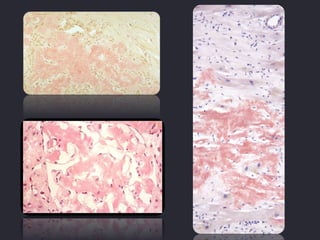
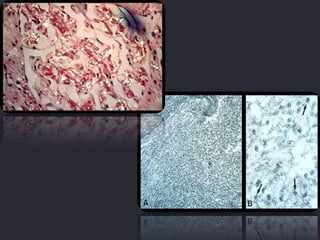
Nerve biopsy Right superficial peroneal nerve with deposits of amyloid Muscle biopsy Right peroneus brevis- mild muscle atrophy
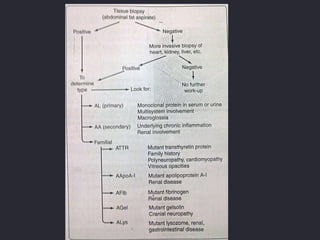
DIAGNOSIS AMYLOID POLYRADICULONEUROPATHY- PROBABLY FAMILIAL
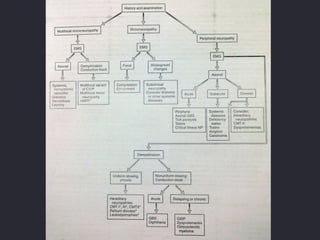
APPROACH TO  PERIPHERAL    NEUROPATHY Peripheral neuropathy describes the disorder of peripheral nerves including the: dorsal & ventral nerve roots,  dorsal root ganglia,  nerve plexuses ( brachial & lumbosacral) cranial nerves (except I & II), &  other sensory, motor & autonomic nerves
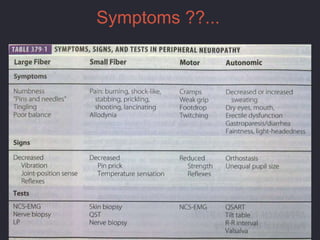
Symptoms ??...
Is it a polyneuropathy or mononeuropathy??... Is it small fiber or large fiber??..
ย 
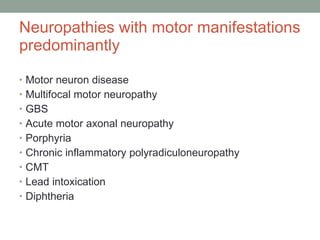
Neuropathies with motor manifestations predominantly Motor neuron disease Multifocal motor neuropathy GBS Acute motor axonal neuropathy Porphyria Chronic inflammatory polyradiculoneuropathy CMT Lead intoxication Diphtheria
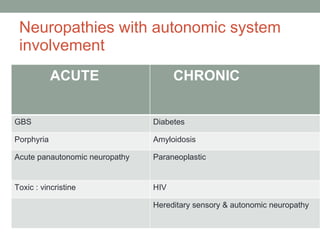
Neuropathies with autonomic system involvement ACUTE CHRONIC GBS Diabetes Porphyria Amyloidosis Acute panautonomic neuropathy Paraneoplastic Toxic : vincristine HIV Hereditary sensory & autonomic neuropathy
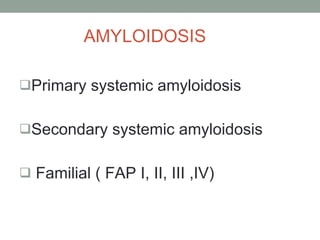
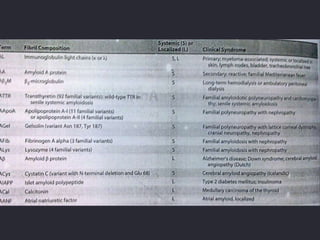
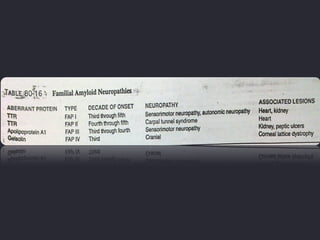
AMYLOIDOSIS Primary systemic amyloidosis Secondary systemic amyloidosis Familial ( FAP I, II, III ,IV)
ย 
ย 
ย 
ย 
ย 
TREATMENT
ย 
ย 
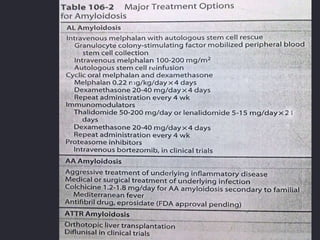
Presse Med. 2010 Jan;39(1):17-25. Epub 2009 May 5. [Liver transplantation for familial amyloid polyneuropathy]. [Article in French]  Adams D ,  Slama M ,  Samuel D . Liver transplantation has been proposed as a treatment for FAP because the liver is the main source of variant amyloidogenic TTR. Transplantation makes it possible to eliminate 98% of the variant TTR in the serum,  doubles median survival for variant TTRMet30 carriers, and halts the progress of the sensorimotor neuropathy over the long term in 62% of cases. No regression or recurrence has been observed. Poor prognostic factors after liver transplantation are a mutation other than the TTRMet30 variant, severe neuropathy, and late onset. Liver transplantation must be proposed to the symptomatic patients as early as possible
Liver Transpl. 2010 Apr;16(4):470-3. Poor outcome after liver transplantation for transthyretin amyloid neuropathy in a family with an Ala36Pro transthyretin mutation: case report. Muller KR ,  Padbury R ,  Jeffrey GP ,  Poplawski NK ,  Thompson P ,  Tonkin A ,  Harley HA . South Australian Liver Transplant Unit, Flinders Medical Centre, Bedford Park, South Australia, Australia .  transthyretin amyloid polyneuropathy secondary to an infrequently reported transthyretin mutation (Ala36Pro) who underwent liver transplantation with poor outcomes.
Neurology. 2010 Jul 27;75(4):324-7. Progression of transthyretin amyloid neuropathy after liver transplantation. Liepnieks JJ ,  Zhang LQ ,  Benson MD . Indiana University School of Medicine, Department of Pathology and Laboratory Medicine, 635 Barnhill Drive, Indianapolis, IN 46202-5126, USA Survival after liver transplantation for TTR amyloidosis may be associated with progression of neuropathy due to continued deposition of amyloid derived from wild-type TTR.
Transplantation. 2004 Jan 15;77(1):64-71. Ten years of international experience with liver transplantation for familial amyloidotic polyneuropathy: results from the Familial Amyloidotic Polyneuropathy World Transplant Registry. Herlenius G ,  Wilczek HE ,  Larsson M ,  Ericzon BG ;  Familial Amyloidotic Polyneuropathy World Transplant Registry . Karolinska Institute, Stockholm, Sweden . A total of 54 centers in 16 countries have performed OLT for FAP, and today approximately 60 OLTs are performed annually worldwide. During the last decade, a total of 539 patients have undergone 579 OLTs . Patient survival is excellent (overall 5-year patient survival 77%) and comparable to the survival with OLT performed for other chronic liver disorders, but longer follow-up is needed to compare the outcome after OLT with the natural course of the disease. The main cause of death was cardiac related (39%).
THANK YOU

A Case of Peripheral Neuropathy

  • 1.
    A RARECASE OF PERIPHERAL NEUROPATHY By: Dr Jami Swathi Prof Dr Gowrishankarโ€™s unit
  • 2.
    A 41yr old male patient came with complaints of: Numbness of both lower limbs โ€“ since 1& half yrs urinary retention - 6months H/ O presenting complaint: Pt was apparently normal 1 & half yrs ago when he noticed numbness and decreased appreciation of sensations of both the lower limbs, insidious onset, symmetrical, slowly progressive, was present in the soles of both the feet to begin with & gradually ascended up to above the knee level
  • 3.
    h/o slipping ofchappals without knowledge + No h/o buckling of knees No h/o- difficulty in getting up from squatting position - weakness or sensory symptoms in upper limbs - involuntary movements - trauma - seizures/ LOC he also gives history of increased frequency of micturition with the need to strain to micturate, decreased appreciation of bladder filling, a feeling of incomplete evacuation of bladder
  • 4.
    He also noticeddecreased sweating of both the lower limbs h/o erectile dysfunction + h/o vomiting +, repeated episodes between 2-6 am in the morning, postprandial fullness+ h/o loose stools+ No h/s/o postural hypotension No h/s/o any cranial nerve involvement No h/o- weight loss - cough with expectoration/ hemoptysis -skin rash, photosensitivity, oral ulcers No h/o chest pain, palpitations
  • 5.
    past history: noh/o HTN, DM, TB, BA personal history: non alcoholic/ non smoker Family history: father died of a neurological illness at the age of 45yrs ( had similar complaints)
  • 6.
    O/E: Conscious oriented afebrile No pallor, icterus, cyanosis, clubbing, lymphadenopathy, edema Vitals: BP: 120/80 mm Hg PR: 80/ min, regular Systemic examination: CVS: WNL RS: WNL
  • 7.
    CNS: HIGHER MENTALFUNCTIONS: normal CRANIAL NERVES: normal MOTOR SYSTEM: Right left bulk: normal normal tone: normal normal power: UL: 5/5 5/5 LL: mild weakness of EHL Bilaterally rest โ€“ 5/5 PLANTAR flexor flexor
  • 8.
    reflexes: right left biceps: ++ ++ triceps: ++ ++ supinator: ++ ++ knee: ++ ++ ankle: + + Sensory systems: pain & temp sensations decreased below the level of the knee in a graded manner vibration sense impaired upto ASIS level Cerebellar system: WNL No signs of meningeal irritation
  • 9.
    Differential diagnosis Diabeticneuropathy Amyloidosis Hereditary sensory and autonomic neuropathy HIV related autonomic neuropathy Paraneoplastic neuropathy Vasculitis Vit B12 deficiency
  • 10.
    INVESTIGATIONS COMPLETE BLOODCOUNTS Hb 14 gm/dl TC 9800 cells/ cu mm DC P71 L24 M5 ESR 4/12 mm/hr Platelets 2,46.000 / cu mm PCV 42.1 % MCV 84.2 fL MCHC 33.5 gm/dl MCH 28.2 PG
  • 11.
    liver function testsTotal bilirubin 0.6 mg% Direct bilirubin 0.2 mg% SGOT 20 U/L SGPT 12 U/L Total protein 7.7 gm% albumin 4.5 gm% Alkaline phosphatase 68 U/L Random bld sugar 110 mg% renal function tests & serum electrolytes Urea 28 mg% Creatinine 0.9 mg% Na 143 m Eq/L K 4.4 m Eq/L HCO3 27 m Eq/ L
  • 12.
    viral markers HIVnegative HbSAg negative Anti HCV negative ANA negative CRP < 6 RA factor negative C- ANCA/ P- ANCA negative Anti SSA / SSB negative
  • 13.
    Vit B12 level406 pg/ml Chest x ray PA view normal ECG normal
  • 14.
    MRI spine normalUsg abdomen normal Urine C/S no growth
  • 15.
    Bone marrow biopsycellular marrow. No abnormal cells seen Serum protein electrophoresis normal Nerve conduction study Motor sensory axonal demyelinating polyradiculo- -neuropathy involving predominantly both the lower limbs
  • 16.
    Nerve biopsy Rightsuperficial peroneal nerve with deposits of amyloid Muscle biopsy Right peroneus brevis- mild muscle atrophy
  • 17.
  • 18.
    APPROACH TO PERIPHERAL NEUROPATHY Peripheral neuropathy describes the disorder of peripheral nerves including the: dorsal & ventral nerve roots, dorsal root ganglia, nerve plexuses ( brachial & lumbosacral) cranial nerves (except I & II), & other sensory, motor & autonomic nerves
  • 19.
  • 20.
    Is it apolyneuropathy or mononeuropathy??... Is it small fiber or large fiber??..
  • 21.
  • 22.
    Neuropathies with motormanifestations predominantly Motor neuron disease Multifocal motor neuropathy GBS Acute motor axonal neuropathy Porphyria Chronic inflammatory polyradiculoneuropathy CMT Lead intoxication Diphtheria
  • 23.
    Neuropathies with autonomicsystem involvement ACUTE CHRONIC GBS Diabetes Porphyria Amyloidosis Acute panautonomic neuropathy Paraneoplastic Toxic : vincristine HIV Hereditary sensory & autonomic neuropathy
  • 24.
    AMYLOIDOSIS Primary systemicamyloidosis Secondary systemic amyloidosis Familial ( FAP I, II, III ,IV)
  • 25.
  • 26.
  • 27.
  • 28.
  • 29.
  • 30.
  • 31.
  • 32.
  • 33.
    Presse Med. 2010Jan;39(1):17-25. Epub 2009 May 5. [Liver transplantation for familial amyloid polyneuropathy]. [Article in French] Adams D , Slama M , Samuel D . Liver transplantation has been proposed as a treatment for FAP because the liver is the main source of variant amyloidogenic TTR. Transplantation makes it possible to eliminate 98% of the variant TTR in the serum, doubles median survival for variant TTRMet30 carriers, and halts the progress of the sensorimotor neuropathy over the long term in 62% of cases. No regression or recurrence has been observed. Poor prognostic factors after liver transplantation are a mutation other than the TTRMet30 variant, severe neuropathy, and late onset. Liver transplantation must be proposed to the symptomatic patients as early as possible
  • 34.
    Liver Transpl. 2010Apr;16(4):470-3. Poor outcome after liver transplantation for transthyretin amyloid neuropathy in a family with an Ala36Pro transthyretin mutation: case report. Muller KR , Padbury R , Jeffrey GP , Poplawski NK , Thompson P , Tonkin A , Harley HA . South Australian Liver Transplant Unit, Flinders Medical Centre, Bedford Park, South Australia, Australia . transthyretin amyloid polyneuropathy secondary to an infrequently reported transthyretin mutation (Ala36Pro) who underwent liver transplantation with poor outcomes.
  • 35.
    Neurology. 2010 Jul27;75(4):324-7. Progression of transthyretin amyloid neuropathy after liver transplantation. Liepnieks JJ , Zhang LQ , Benson MD . Indiana University School of Medicine, Department of Pathology and Laboratory Medicine, 635 Barnhill Drive, Indianapolis, IN 46202-5126, USA Survival after liver transplantation for TTR amyloidosis may be associated with progression of neuropathy due to continued deposition of amyloid derived from wild-type TTR.
  • 36.
    Transplantation. 2004 Jan15;77(1):64-71. Ten years of international experience with liver transplantation for familial amyloidotic polyneuropathy: results from the Familial Amyloidotic Polyneuropathy World Transplant Registry. Herlenius G , Wilczek HE , Larsson M , Ericzon BG ; Familial Amyloidotic Polyneuropathy World Transplant Registry . Karolinska Institute, Stockholm, Sweden . A total of 54 centers in 16 countries have performed OLT for FAP, and today approximately 60 OLTs are performed annually worldwide. During the last decade, a total of 539 patients have undergone 579 OLTs . Patient survival is excellent (overall 5-year patient survival 77%) and comparable to the survival with OLT performed for other chronic liver disorders, but longer follow-up is needed to compare the outcome after OLT with the natural course of the disease. The main cause of death was cardiac related (39%).
  • 37.