CASE PRESENTATIONON CEREBRAL PALSY
Presented by-
Dr. Jaishree(PT)
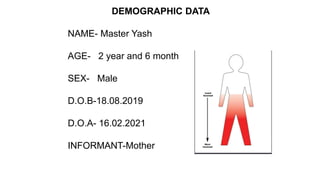
DEMOGRAPHIC DATA
NAME- Master Yash
AGE- 2 year and 6 month
SEX- Male
D.O.B-18.08.2019
D.O.A- 16.02.2021
INFORMANT-Mother
Growth Parameter
Head circumference- 43cm
Neck circumference- 41cm
Limb length –True Lt. 36cm Rt. 36.4cm
Apparent Lt. 37.9cm Rt. 37.2cm
Chief complaint- Unable to sit without support ,
Unable to walk and stand since 1.5 years
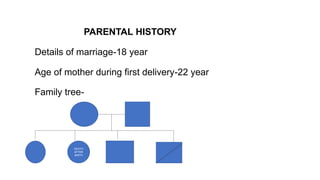
PARENTAL HISTORY
Details of marriage-18 year
Age of mother during first delivery-22 year
Family tree-
DEATH
AFTER
BIRTH
Continued
1.History of illness in the family- No similar history
2.Any addictions- No history
3.H/o previous abortions- 2nd child death after birth
4.H/o multiple pregnancies- No history present
5.Any other relevant details –no similar history
2.PRENATAL HISTORY
• Pregnancy- Pregnancy confirmed at hospital by gynaecologist
• Antenatal check-up- 5 USG done during the gestational period
• Quickening- Felt at 4 month of gestation
• Malnutrition- No
• Hypoglycaemia- No
• Maternal infection-No
CONTINUED
• Maternal hypertension/diabetes/cardiovascular abnormality-
No history
• Exposure to x-ray- No history
• Epilepsy jaundice/any infection- No relevant history
• Any drugs taken pregnancy- Iron and folic acid intake started in
3rd month of gestation
POSTNATAL HISTORY
POSTNATAL HISTORY OF MOTHER
• ANY INFECTION - No history
• BREAST FED- Start after 2 days ,initially mother was
not lactating
• ANY OTHER COMPLICATION- No history
POSTNATAL HISTORY OF CHILD
• Whether the infant was floppy /spastic- Spastic
• Head injury /trauma- No history
• Epilepsy- No history
• Fever/hydrocephalus- No history
• Neonatal jaundice - No history
• Hypoglycaemia- No history
• Age of child when disability was notice -Around 6 month
3.PERINATAL HISTORY
• Nature of delivery- Lower segment caesarean section
• Prolonged labour/asphyxia- Birth asphyxia present
• Birth cry (p/a loudness) - Cried after 5 minutes of birth
• Birth weight- Around 2 kg
• Any complications during birth- No history
• Child presentation (breech/vertex)- Breech
• APGAR score- Not known
DEVELOPMENT MILESTONE
GROSS MOTOR
• Neck holding –Not achieved
• Rolls over-Segmental rolling present, supine to prone
• Sits with support-Only with moderate support
• Sits without support-Not achieved
• Stand with support-Not achieved
• Not able to stand without support-Not achieved
FINE MOTOR
• Bidexterous reach present since 1 and 3 month
• Unidexterous reach –Not achieved
• Pincer grasp –Not achieved
SOCIAL MILESTONE
• Recognise mother- Since 1 year
• Stranger anxiety - Not observed
• Waves bye bye - Not achieved
• Social smile - Achieved since
• Handle spoon well- Not achieved
LANGUAGE
COOS- After 1.5 years
MONOSYLLABLES- Not achieved
BISYLLABLES- Not achieved
2-3 WORD SENTENCE- Not achieved
STORY TELLING- Not achieved
CRANIAL NERVE EXAMINATION
I. First cranial nerve Normal
II. Second cranial nerve Normal
III. Third cranial nerve Abnormal
IV. Fourth cranial nerve Abnormal
V. Fifth cranial nerve Abnormal
VI. Sixth cranial nerve Abnormal
VII. Seventh cranial nerve Normal
VIII. Eighth cranial nerve Normal
IX. Ninth cranial nerve Normal
X. Tenth cranial nerve Normal
XI. Eleventh cranial nerve Normal
XII. Twelfth cranial nerve Normal
SENSORY EXAMINATION
• SUPERFICIAL SENSATION- Not assessed
• DEEP SENSATION – Not assessed
• CORTICAL – Not assessed
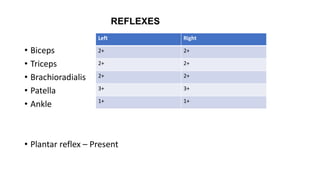
REFLEXES
• Biceps
• Triceps
• Brachioradialis
• Patella
• Ankle
• Plantar reflex – Present
Left Right
2+ 2+
2+ 2+
2+ 2+
3+ 3+
1+ 1+
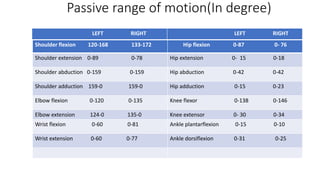
Passive range of motion(In degree)
Shoulder flexion 120-168 133-172 Hip flexion 0-87 0- 76
Shoulder extension 0-89 0-78 Hip extension 0- 15 0-18
Shoulder abduction 0-159 0-159 Hip abduction 0-42 0-42
Shoulder adduction 159-0 159-0 Hip adduction 0-15 0-23
Elbow flexion 0-120 0-135 Knee flexor 0-138 0-146
Elbow extension 124-0 135-0 Knee extensor 0- 30 0-34
Wrist flexion 0-60 0-81 Ankle plantarflexion 0-15 0-10
Wrist extension 0-60 0-77 Ankle dorsiflexion 0-31 0-25
LEFT RIGHT LEFT RIGHT
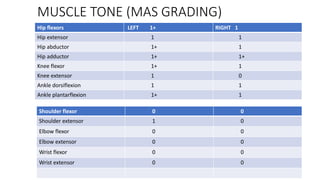
MUSCLE TONE (MAS GRADING)
Hip flexors LEFT 1+ RIGHT 1
Hip extensor 1 1
Hip abductor 1+ 1
Hip adductor 1+ 1+
Knee flexor 1+ 1
Knee extensor 1 0
Ankle dorsiflexion 1 1
Ankle plantarflexion 1+ 1
Shoulder flexor 0 0
Shoulder extensor 1 0
Elbow flexor 0 0
Elbow extensor 0 0
Wrist flexor 0 0
Wrist extensor 0 0
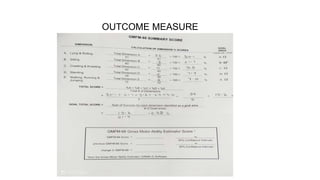
OUTCOME MEASURE
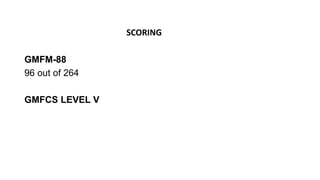
SCORING
GMFM-88
96 out of 264
GMFCS LEVEL V
PROBLEM LIST
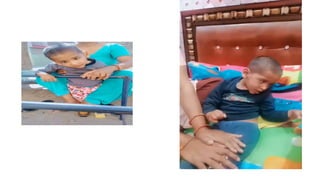
• Development milestone delay
• Uncoordinated movement of upper limb and eye
• Tonic labyrinthine reflex (TLR) persist
• Hip abductors, Achilles tendon ,knee flexor and extensor tightness
• Unable to do functional activity – Independent walking ,
sitting, standing ,eating ,grooming ,personal hygiene
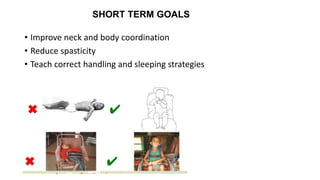
SHORT TERM GOALS
• Improve neck and body coordination
• Reduce spasticity
• Teach correct handling and sleeping strategies
Short term goals
• Prevent and improve range of motion by releasing tight muscles
(Achilles tendon, calf muscle ,hamstring ,Tensor fasciae latae
,gluteus Medius and gluteus minimus)
• Reduce the caregiver assistance( moderate to minimal
assistance)
• Comprehension of word with meaning
• Improve grasping
LONG TERM GOALS
• Improve strength and range of lower limb
• Improve functional limitation of ambulation
• Independent self care activities ( eating, grooming , dressing,
hygiene)
INTERVENTION
• Hydrocollator pack for 20 min
• Prolonged stretching of calf ,hamstring ,hip adductors ,hip abductors(10reps
x 60 sec. hold x 1 set )
• Soft tissue release -Achilles tendon release -5 reps, 5 days/week for 6 weeks.
• Functional reach activity at wall corner with pillow support for 20 min
• Effect of combining passive muscle stretching on spasticity and physical performance of children and adolescents with cerebral
palsy. J Phys Ther Sci. 2016 Jan; 28(1): 7–13.Published online 2018 Jan 30. doi: 10.1589/jpts.28.7
CONTINUED
• Vestibular stimulation exercises using Swiss ball:To and fro: 10 mins and spinning
for 10 mins.
• Head lifting activity over the swiss ball in prone lying with auditory , tactile
stimulus (10 mins . upward And side ways)
• Standing over the CP chair with neck ,trunk and lower limb support for 45 min
Standing Programs to Promote Hip Flexibility in Children With Spastic Diplegic Cerebral Palsy. Pediatric Physical Therapy: Fall 2015 - Volume 27 - Issue 3
- p 243-249
Effect of Swiss Ball on Balance in Children with Spastic Diplegia: A Case Study. ARC Journal of Pediatrics Volume 1, Issue 1, April-June 2020, PP 8-11
PROPOSED FOLLOW-UP
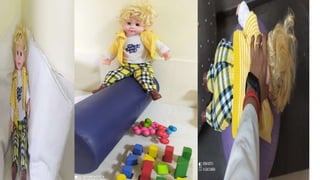
• Straddle roll activity with support for 10 min
• Throwing basketball with support for trunk and upper limb mobility -10 rep.
• Unidexterous functional activity for 10 min.
• Management of musculoskeletal condition –physical therapy for children ,Campbell's 5th edition page no.236
HOME ADVICE
• Corner wall sitting with support ,in long sitting including functional
activity - 20 min ,3 time a day
• Prone lying - Stimulate to rolling in supine
• Stretching of all the major muscle of lower limb as taught
THANK YOU

Cerebral palsy case presentation

  • 1.
    CASE PRESENTATIONON CEREBRALPALSY Presented by- Dr. Jaishree(PT)
  • 2.
    DEMOGRAPHIC DATA NAME- MasterYash AGE- 2 year and 6 month SEX- Male D.O.B-18.08.2019 D.O.A- 16.02.2021 INFORMANT-Mother
  • 3.
    Growth Parameter Head circumference-43cm Neck circumference- 41cm Limb length –True Lt. 36cm Rt. 36.4cm Apparent Lt. 37.9cm Rt. 37.2cm Chief complaint- Unable to sit without support , Unable to walk and stand since 1.5 years
  • 4.
    PARENTAL HISTORY Details ofmarriage-18 year Age of mother during first delivery-22 year Family tree- DEATH AFTER BIRTH
  • 5.
    Continued 1.History of illnessin the family- No similar history 2.Any addictions- No history 3.H/o previous abortions- 2nd child death after birth 4.H/o multiple pregnancies- No history present 5.Any other relevant details –no similar history
  • 6.
    2.PRENATAL HISTORY • Pregnancy-Pregnancy confirmed at hospital by gynaecologist • Antenatal check-up- 5 USG done during the gestational period • Quickening- Felt at 4 month of gestation • Malnutrition- No • Hypoglycaemia- No • Maternal infection-No
  • 7.
    CONTINUED • Maternal hypertension/diabetes/cardiovascularabnormality- No history • Exposure to x-ray- No history • Epilepsy jaundice/any infection- No relevant history • Any drugs taken pregnancy- Iron and folic acid intake started in 3rd month of gestation
  • 8.
    POSTNATAL HISTORY POSTNATAL HISTORYOF MOTHER • ANY INFECTION - No history • BREAST FED- Start after 2 days ,initially mother was not lactating • ANY OTHER COMPLICATION- No history
  • 9.
    POSTNATAL HISTORY OFCHILD • Whether the infant was floppy /spastic- Spastic • Head injury /trauma- No history • Epilepsy- No history • Fever/hydrocephalus- No history • Neonatal jaundice - No history • Hypoglycaemia- No history • Age of child when disability was notice -Around 6 month
  • 10.
    3.PERINATAL HISTORY • Natureof delivery- Lower segment caesarean section • Prolonged labour/asphyxia- Birth asphyxia present • Birth cry (p/a loudness) - Cried after 5 minutes of birth • Birth weight- Around 2 kg • Any complications during birth- No history • Child presentation (breech/vertex)- Breech • APGAR score- Not known
  • 11.
    DEVELOPMENT MILESTONE GROSS MOTOR •Neck holding –Not achieved • Rolls over-Segmental rolling present, supine to prone • Sits with support-Only with moderate support • Sits without support-Not achieved • Stand with support-Not achieved • Not able to stand without support-Not achieved
  • 12.
    FINE MOTOR • Bidexterousreach present since 1 and 3 month • Unidexterous reach –Not achieved • Pincer grasp –Not achieved
  • 13.
    SOCIAL MILESTONE • Recognisemother- Since 1 year • Stranger anxiety - Not observed • Waves bye bye - Not achieved • Social smile - Achieved since • Handle spoon well- Not achieved
  • 14.
    LANGUAGE COOS- After 1.5years MONOSYLLABLES- Not achieved BISYLLABLES- Not achieved 2-3 WORD SENTENCE- Not achieved STORY TELLING- Not achieved
  • 15.
    CRANIAL NERVE EXAMINATION I.First cranial nerve Normal II. Second cranial nerve Normal III. Third cranial nerve Abnormal IV. Fourth cranial nerve Abnormal V. Fifth cranial nerve Abnormal VI. Sixth cranial nerve Abnormal VII. Seventh cranial nerve Normal VIII. Eighth cranial nerve Normal IX. Ninth cranial nerve Normal X. Tenth cranial nerve Normal XI. Eleventh cranial nerve Normal XII. Twelfth cranial nerve Normal
  • 16.
    SENSORY EXAMINATION • SUPERFICIALSENSATION- Not assessed • DEEP SENSATION – Not assessed • CORTICAL – Not assessed
  • 17.
    REFLEXES • Biceps • Triceps •Brachioradialis • Patella • Ankle • Plantar reflex – Present Left Right 2+ 2+ 2+ 2+ 2+ 2+ 3+ 3+ 1+ 1+
  • 18.
    Passive range ofmotion(In degree) Shoulder flexion 120-168 133-172 Hip flexion 0-87 0- 76 Shoulder extension 0-89 0-78 Hip extension 0- 15 0-18 Shoulder abduction 0-159 0-159 Hip abduction 0-42 0-42 Shoulder adduction 159-0 159-0 Hip adduction 0-15 0-23 Elbow flexion 0-120 0-135 Knee flexor 0-138 0-146 Elbow extension 124-0 135-0 Knee extensor 0- 30 0-34 Wrist flexion 0-60 0-81 Ankle plantarflexion 0-15 0-10 Wrist extension 0-60 0-77 Ankle dorsiflexion 0-31 0-25 LEFT RIGHT LEFT RIGHT
  • 19.
    MUSCLE TONE (MASGRADING) Hip flexors LEFT 1+ RIGHT 1 Hip extensor 1 1 Hip abductor 1+ 1 Hip adductor 1+ 1+ Knee flexor 1+ 1 Knee extensor 1 0 Ankle dorsiflexion 1 1 Ankle plantarflexion 1+ 1 Shoulder flexor 0 0 Shoulder extensor 1 0 Elbow flexor 0 0 Elbow extensor 0 0 Wrist flexor 0 0 Wrist extensor 0 0
  • 20.
  • 21.
    SCORING GMFM-88 96 out of264 GMFCS LEVEL V
  • 22.
    PROBLEM LIST • Developmentmilestone delay • Uncoordinated movement of upper limb and eye • Tonic labyrinthine reflex (TLR) persist • Hip abductors, Achilles tendon ,knee flexor and extensor tightness • Unable to do functional activity – Independent walking , sitting, standing ,eating ,grooming ,personal hygiene
  • 24.
    SHORT TERM GOALS •Improve neck and body coordination • Reduce spasticity • Teach correct handling and sleeping strategies
  • 25.
    Short term goals •Prevent and improve range of motion by releasing tight muscles (Achilles tendon, calf muscle ,hamstring ,Tensor fasciae latae ,gluteus Medius and gluteus minimus) • Reduce the caregiver assistance( moderate to minimal assistance) • Comprehension of word with meaning • Improve grasping
  • 26.
    LONG TERM GOALS •Improve strength and range of lower limb • Improve functional limitation of ambulation • Independent self care activities ( eating, grooming , dressing, hygiene)
  • 27.
    INTERVENTION • Hydrocollator packfor 20 min • Prolonged stretching of calf ,hamstring ,hip adductors ,hip abductors(10reps x 60 sec. hold x 1 set ) • Soft tissue release -Achilles tendon release -5 reps, 5 days/week for 6 weeks. • Functional reach activity at wall corner with pillow support for 20 min • Effect of combining passive muscle stretching on spasticity and physical performance of children and adolescents with cerebral palsy. J Phys Ther Sci. 2016 Jan; 28(1): 7–13.Published online 2018 Jan 30. doi: 10.1589/jpts.28.7
  • 28.
    CONTINUED • Vestibular stimulationexercises using Swiss ball:To and fro: 10 mins and spinning for 10 mins. • Head lifting activity over the swiss ball in prone lying with auditory , tactile stimulus (10 mins . upward And side ways) • Standing over the CP chair with neck ,trunk and lower limb support for 45 min Standing Programs to Promote Hip Flexibility in Children With Spastic Diplegic Cerebral Palsy. Pediatric Physical Therapy: Fall 2015 - Volume 27 - Issue 3 - p 243-249 Effect of Swiss Ball on Balance in Children with Spastic Diplegia: A Case Study. ARC Journal of Pediatrics Volume 1, Issue 1, April-June 2020, PP 8-11
  • 29.
    PROPOSED FOLLOW-UP • Straddleroll activity with support for 10 min • Throwing basketball with support for trunk and upper limb mobility -10 rep. • Unidexterous functional activity for 10 min. • Management of musculoskeletal condition –physical therapy for children ,Campbell's 5th edition page no.236
  • 31.
    HOME ADVICE • Cornerwall sitting with support ,in long sitting including functional activity - 20 min ,3 time a day • Prone lying - Stimulate to rolling in supine • Stretching of all the major muscle of lower limb as taught
  • 32.