WELCOME
A middle aged man
with Limb Weakness
and Dysarthria
Presented By:
Dr. AHMED TANJIMUL ISLAM
MD (Thesis Student) Neuromedicine
Department of Neuromedicine, RMCH
PARTICULARS OF THE PATIENT:
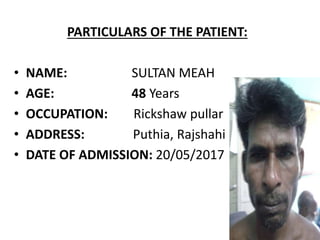
• NAME: SULTAN MEAH
• AGE: 48 Years
• OCCUPATION: Rickshaw pullar
• ADDRESS: Puthia, Rajshahi
• DATE OF ADMISSION: 20/05/2017
CHIEF COMPLAINTS :
• 1. Weakness of all four limbs for 8 months.
• 2. Difficulty in speech for 4 months.
• 3. Difficulty in swallowing for 4 months.
History of Presenting Illness :
• According to the statement of the patient he was reasonably
alright 8 months back. Then he developed weakness in both
lower limbs which was insidious in onset, gradually progressive
associated with muscle wasting and twitching. 4 months later
he noticed weakness in both hands like difficulty in grip and
lifting hands above shoulder. These were followed by difficulty
in swallowing more for liquids. He had also complains of nasal
voice & nasal regurgitation.
• The patient also developed slowness of voice and
slurring of speech for last 4 months. He is
unemployed and was dependent for most of his
daily activities by the end of 5th month. He had also
episodes of night cramps in the calf muscles.
• He gave no history of any Radiating pain in upper or
lower limbs, Diurnal variation , Sensory loss, Seizure,
Headache, vomiting, bowel Bladder involvement,
trauma (head, neck & back), Fever, memory &
cognition loss.
• With the above complaints the patient was admitted
to RMCH for better management.
History of Presenting Illness :
• Weakness (upper & lower limbs).
• Wasting of muscles (upper & lower limbs).
• Difficulty to Grip, lifting hands above shoulder
• Slurring of Speech, Nasal Voice.
• Difficulty in swallowing.
Limb Weakness
• Gradually progressive
• Twitching of muscles in trunk, arm, neck &
shoulder (Occasional).
• Leg Cramps
Speech and Swallowing:
• Dysarthria
• Slurring of speech
• Difficulty in Swallowing (liquids> Solid).
Video
NO HISTORY of
• Radiating pain (upper or lower limbs).
• Diurnal variation
• Sensory loss
• Seizure
• Trauma (Head, neck & back)
• Bowel & Bladder involvement
• Fever
• Memory & Cognitive loss.
History of Past Illness:
NO history of
• Diabetes Mallitus
• Hypertension
• Tuberculosis
• Asthma
• Jaundice
Family History:
• All his family members are well.
• Married. 3 children.
• No family history of same illness.
Drug History:
• Proton pump inhibitor (PPI) irregularly
Personal History:
• Smoker : 20 years. 10 sticks/ day.
Socio economic History:
• Lives in Semi pakka House.
• Rickshaw puller. Lower class.
Immunization History:
• Can not give history about immunization.
Allergy History:
• No history of allergy.
General
Examination
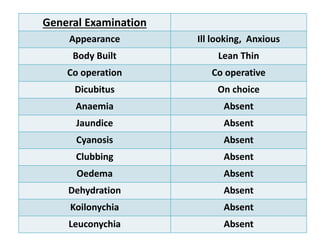
General Examination
Appearance Ill looking, Anxious
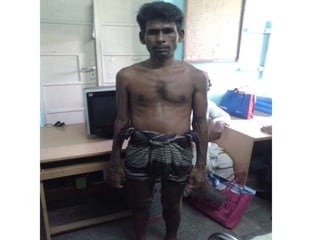
Body Built Lean Thin
Co operation Co operative
Dicubitus On choice
Anaemia Absent
Jaundice Absent
Cyanosis Absent
Clubbing Absent
Oedema Absent
Dehydration Absent
Koilonychia Absent
Leuconychia Absent
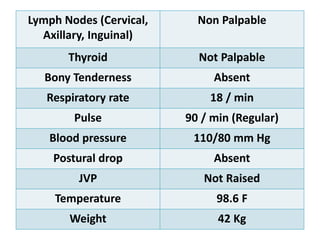
Lymph Nodes (Cervical,
Axillary, Inguinal)
Non Palpable
Thyroid Not Palpable
Bony Tenderness Absent
Respiratory rate 18 / min
Pulse 90 / min (Regular)
Blood pressure 110/80 mm Hg
Postural drop Absent
JVP Not Raised
Temperature 98.6 F
Weight 42 Kg
SYSTEMIC
EXAMINATION
NERVOUS SYSTEM
EXAMINATION
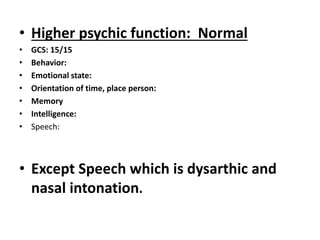
• Higher psychic function: Normal
• GCS: 15/15
• Behavior:
• Emotional state:
• Orientation of time, place person:
• Memory
• Intelligence:
• Speech:
• Except Speech which is dysarthic and
nasal intonation.
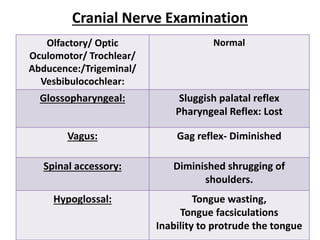
Cranial Nerve Examination
Olfactory/ Optic
Oculomotor/ Trochlear/
Abducence:/Trigeminal/
Vesbibulocochlear:
Normal
Glossopharyngeal: Sluggish palatal reflex
Pharyngeal Reflex: Lost
Vagus: Gag reflex- Diminished
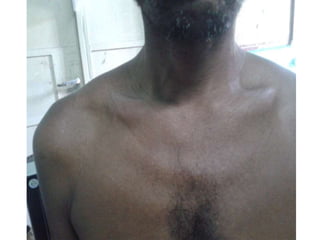
Spinal accessory: Diminished shrugging of
shoulders.
Hypoglossal: Tongue wasting,
Tongue facsiculations
Inability to protrude the tongue
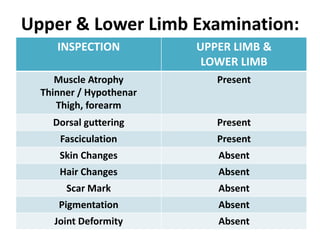
Upper & Lower Limb Examination:
• Inspection
INSPECTION UPPER LIMB &
LOWER LIMB
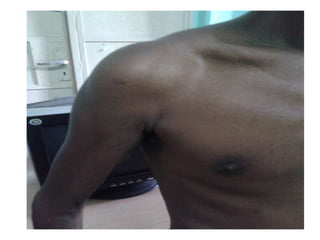
Muscle Atrophy
Thinner / Hypothenar
Thigh, forearm
Present
Dorsal guttering Present
Fasciculation Present
Skin Changes Absent
Hair Changes Absent
Scar Mark Absent
Pigmentation Absent
Joint Deformity Absent
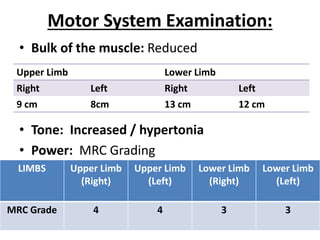
Motor System Examination:
• Bulk of the muscle: Reduced
• Tone: Increased / hypertonia
• Power: MRC Grading
Upper Limb Lower Limb
Right Left Right Left
9 cm 8cm 13 cm 12 cm
LIMBS Upper Limb
(Right)
Upper Limb
(Left)
Lower Limb
(Right)
Lower Limb
(Left)
MRC Grade 4 4 3 3
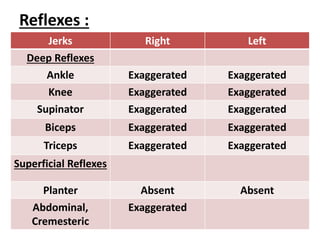
Reflexes :
Jerks Right Left
Deep Reflexes
Ankle Exaggerated Exaggerated
Knee Exaggerated Exaggerated
Supinator Exaggerated Exaggerated
Biceps Exaggerated Exaggerated
Triceps Exaggerated Exaggerated
Superficial Reflexes
Planter Absent Absent
Abdominal,
Cremesteric
Exaggerated
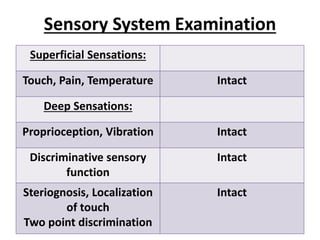
Sensory System Examination
Superficial Sensations:
Touch, Pain, Temperature Intact
Deep Sensations:
Proprioception, Vibration Intact
Discriminative sensory
function
Intact
Steriognosis, Localization
of touch
Two point discrimination
Intact
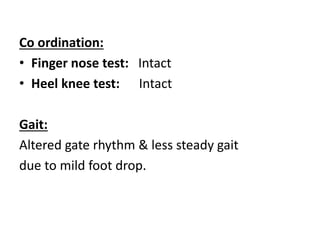
Co ordination:
• Finger nose test: Intact
• Heel knee test: Intact
Gait:
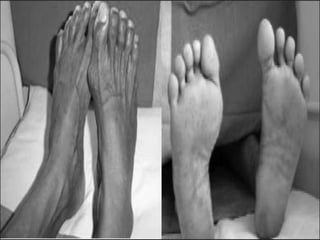
Altered gate rhythm & less steady gait
due to mild foot drop.
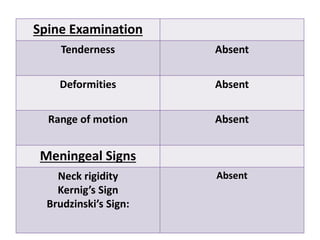
Spine Examination
Tenderness Absent
Deformities Absent
Range of motion Absent
Meningeal Signs
Neck rigidity
Kernig’s Sign
Brudzinski’s Sign:
Absent
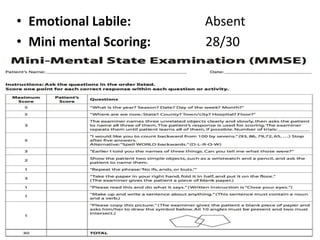
• Emotional Labile: Absent
• Mini mental Scoring: 28/30
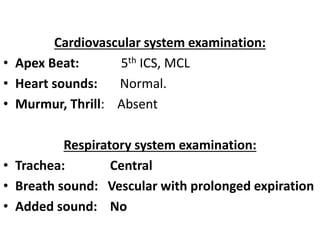
Cardiovascular system examination:
• Apex Beat: 5th ICS, MCL
• Heart sounds: Normal.
• Murmur, Thrill: Absent
Respiratory system examination:
• Trachea: Central
• Breath sound: Vescular with prolonged expiration
• Added sound: No
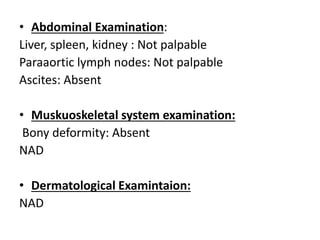
• Abdominal Examination:
Liver, spleen, kidney : Not palpable
Paraaortic lymph nodes: Not palpable
Ascites: Absent
• Muskuoskeletal system examination:
Bony deformity: Absent
NAD
• Dermatological Examintaion:
NAD
Provisional
Diagnosis
?
DIFFERENTIAL
DIAGNOSIS
?
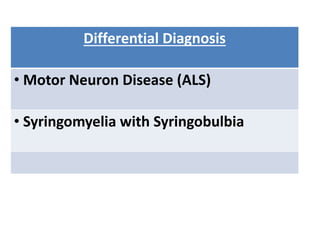
Differential Diagnosis
• Motor Neuron Disease (ALS)
Differential Diagnosis
• Motor Neuron Disease (ALS)
• Syringomyelia with Syringobulbia
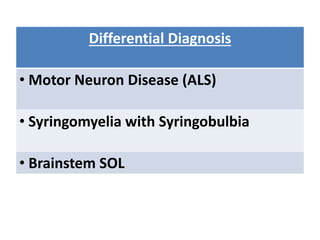
Differential Diagnosis
• Motor Neuron Disease (ALS)
• Syringomyelia with Syringobulbia
• Brainstem SOL
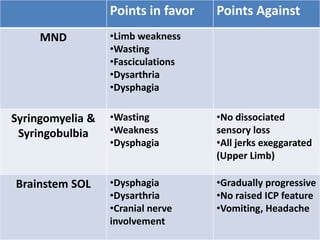
Points in favor Points Against
MND •Limb weakness
•Wasting
•Fasciculations
•Dysarthria
•Dysphagia
Syringomyelia &
Syringobulbia
•Wasting
•Weakness
•Dysphagia
•No dissociated
sensory loss
•All jerks exeggarated
(Upper Limb)
Brainstem SOL •Dysphagia
•Dysarthria
•Cranial nerve
involvement
•Gradually progressive
•No raised ICP feature
•Vomiting, Headache
INVESTIGATIONS
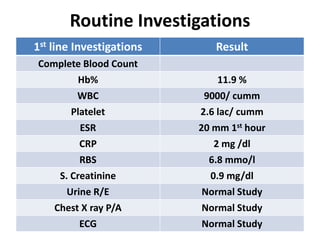
Routine Investigations
1st line Investigations Result
Complete Blood Count
Hb% 11.9 %
WBC 9000/ cumm
Platelet 2.6 lac/ cumm
ESR 20 mm 1st hour
CRP 2 mg /dl
RBS 6.8 mmo/l
S. Creatinine 0.9 mg/dl
Urine R/E Normal Study
Chest X ray P/A Normal Study
ECG Normal Study
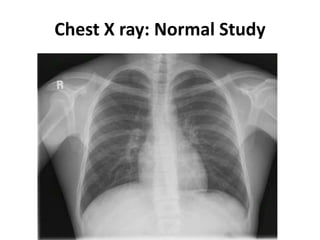
Chest X ray: Normal Study
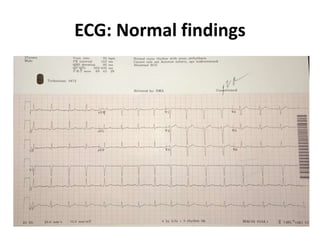
ECG: Normal findings
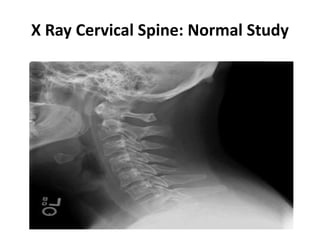
X Ray Cervical Spine: Normal Study
Investigations
2nd Line Investigations
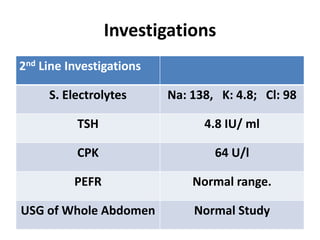
S. Electrolytes Na: 138, K: 4.8; Cl: 98
TSH 4.8 IU/ ml
CPK 64 U/l
PEFR Normal range.
USG of Whole Abdomen Normal Study
Investigations:
Specific Investigations:
• MRI Brain
• MRI Cervical Spine
• Nerve Conduction Study (NCS)
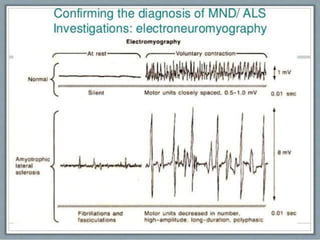
• Electromyography (EMG)
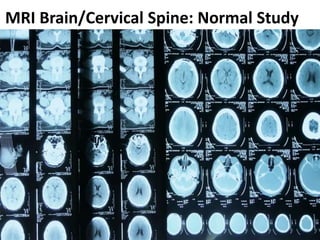
MRI Brain/Cervical Spine: Normal Study
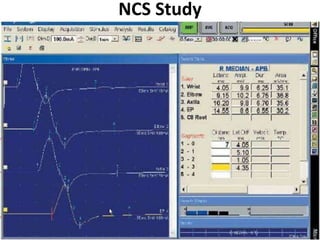
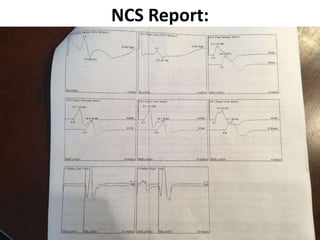
NCS Study
NCS Report:
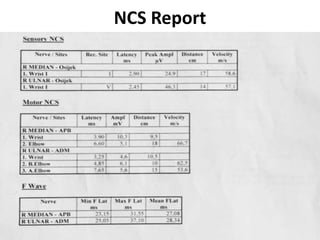
NCS Report
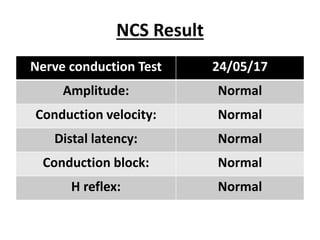
NCS Result
Nerve conduction Test 24/05/17
Amplitude: Normal
Conduction velocity: Normal
Distal latency: Normal
Conduction block: Normal
H reflex: Normal
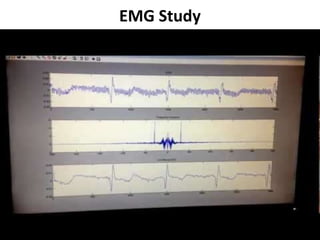
EMG Study
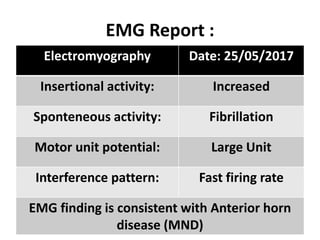
EMG Report :
Electromyography Date: 25/05/2017
Insertional activity: Increased
Sponteneous activity: Fibrillation
Motor unit potential: Large Unit
Interference pattern: Fast firing rate
EMG finding is consistent with Anterior horn
disease (MND)
Confirmed Diagnosis:
‘Motor Neuron Disease’
(MND)
‘Amyotrophic Lateral Sclerosis’
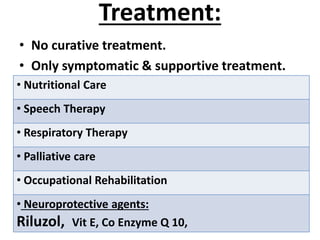
Treatment:
• No curative treatment.
• Only symptomatic & supportive treatment.
• Nutritional Care
• Speech Therapy
• Respiratory Therapy
• Palliative care
• Occupational Rehabilitation
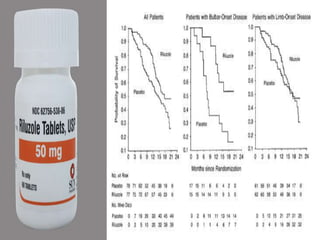
• Neuroprotective agents:
Riluzol, Vit E, Co Enzyme Q 10,
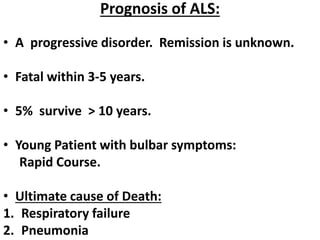
Prognosis of ALS:
• A progressive disorder. Remission is unknown.
• Fatal within 3-5 years.
• 5% survive > 10 years.
• Young Patient with bulbar symptoms:
Rapid Course.
• Ultimate cause of Death:
1. Respiratory failure
2. Pneumonia
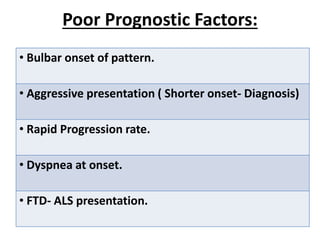
Poor Prognostic Factors:
• Bulbar onset of pattern.
• Aggressive presentation ( Shorter onset- Diagnosis)
• Rapid Progression rate.
• Dyspnea at onset.
• FTD- ALS presentation.
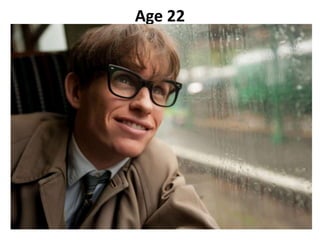
Age 22
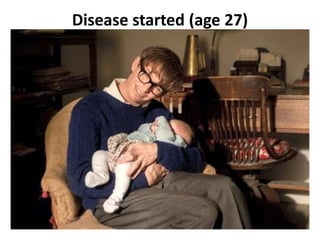
Disease started (age 27)
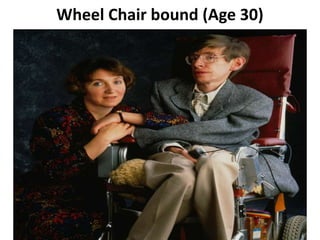
Wheel Chair bound (Age 30)
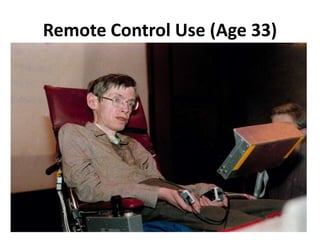
Remote Control Use (Age 33)
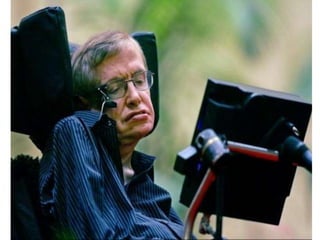
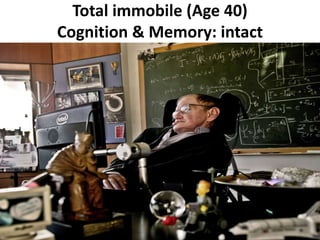
Total immobile (Age 40)
Cognition & Memory: intact
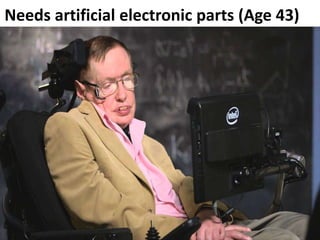
Needs artificial electronic parts (Age 43)
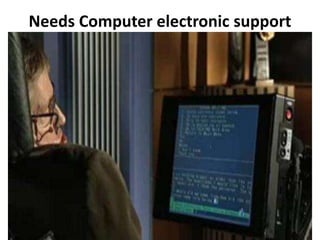
Needs Computer electronic support
THANK YOU

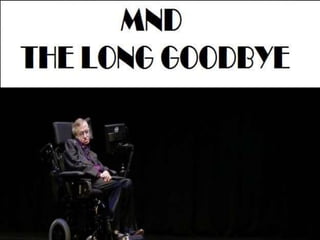
Motor Neuron Disease, ALS (Ideal Case Presentation)

  • 1.
  • 2.
    A middle agedman with Limb Weakness and Dysarthria Presented By: Dr. AHMED TANJIMUL ISLAM MD (Thesis Student) Neuromedicine Department of Neuromedicine, RMCH
  • 3.
    PARTICULARS OF THEPATIENT: • NAME: SULTAN MEAH • AGE: 48 Years • OCCUPATION: Rickshaw pullar • ADDRESS: Puthia, Rajshahi • DATE OF ADMISSION: 20/05/2017
  • 4.
    CHIEF COMPLAINTS : •1. Weakness of all four limbs for 8 months. • 2. Difficulty in speech for 4 months. • 3. Difficulty in swallowing for 4 months.
  • 6.
    History of PresentingIllness : • According to the statement of the patient he was reasonably alright 8 months back. Then he developed weakness in both lower limbs which was insidious in onset, gradually progressive associated with muscle wasting and twitching. 4 months later he noticed weakness in both hands like difficulty in grip and lifting hands above shoulder. These were followed by difficulty in swallowing more for liquids. He had also complains of nasal voice & nasal regurgitation.
  • 7.
    • The patientalso developed slowness of voice and slurring of speech for last 4 months. He is unemployed and was dependent for most of his daily activities by the end of 5th month. He had also episodes of night cramps in the calf muscles. • He gave no history of any Radiating pain in upper or lower limbs, Diurnal variation , Sensory loss, Seizure, Headache, vomiting, bowel Bladder involvement, trauma (head, neck & back), Fever, memory & cognition loss. • With the above complaints the patient was admitted to RMCH for better management.
  • 8.
    History of PresentingIllness : • Weakness (upper & lower limbs). • Wasting of muscles (upper & lower limbs). • Difficulty to Grip, lifting hands above shoulder • Slurring of Speech, Nasal Voice. • Difficulty in swallowing.
  • 9.
    Limb Weakness • Graduallyprogressive • Twitching of muscles in trunk, arm, neck & shoulder (Occasional). • Leg Cramps
  • 10.
    Speech and Swallowing: •Dysarthria • Slurring of speech • Difficulty in Swallowing (liquids> Solid).
  • 15.
  • 16.
    NO HISTORY of •Radiating pain (upper or lower limbs). • Diurnal variation • Sensory loss • Seizure • Trauma (Head, neck & back) • Bowel & Bladder involvement • Fever • Memory & Cognitive loss.
  • 17.
    History of PastIllness: NO history of • Diabetes Mallitus • Hypertension • Tuberculosis • Asthma • Jaundice
  • 18.
    Family History: • Allhis family members are well. • Married. 3 children. • No family history of same illness. Drug History: • Proton pump inhibitor (PPI) irregularly
  • 19.
    Personal History: • Smoker: 20 years. 10 sticks/ day. Socio economic History: • Lives in Semi pakka House. • Rickshaw puller. Lower class. Immunization History: • Can not give history about immunization. Allergy History: • No history of allergy.
  • 20.
  • 21.
    General Examination Appearance Illlooking, Anxious Body Built Lean Thin Co operation Co operative Dicubitus On choice Anaemia Absent Jaundice Absent Cyanosis Absent Clubbing Absent Oedema Absent Dehydration Absent Koilonychia Absent Leuconychia Absent
  • 22.
    Lymph Nodes (Cervical, Axillary,Inguinal) Non Palpable Thyroid Not Palpable Bony Tenderness Absent Respiratory rate 18 / min Pulse 90 / min (Regular) Blood pressure 110/80 mm Hg Postural drop Absent JVP Not Raised Temperature 98.6 F Weight 42 Kg
  • 23.
  • 24.
  • 25.
    • Higher psychicfunction: Normal • GCS: 15/15 • Behavior: • Emotional state: • Orientation of time, place person: • Memory • Intelligence: • Speech: • Except Speech which is dysarthic and nasal intonation.
  • 26.
    Cranial Nerve Examination Olfactory/Optic Oculomotor/ Trochlear/ Abducence:/Trigeminal/ Vesbibulocochlear: Normal Glossopharyngeal: Sluggish palatal reflex Pharyngeal Reflex: Lost Vagus: Gag reflex- Diminished Spinal accessory: Diminished shrugging of shoulders. Hypoglossal: Tongue wasting, Tongue facsiculations Inability to protrude the tongue
  • 27.
    Upper & LowerLimb Examination: • Inspection INSPECTION UPPER LIMB & LOWER LIMB Muscle Atrophy Thinner / Hypothenar Thigh, forearm Present Dorsal guttering Present Fasciculation Present Skin Changes Absent Hair Changes Absent Scar Mark Absent Pigmentation Absent Joint Deformity Absent
  • 28.
    Motor System Examination: •Bulk of the muscle: Reduced • Tone: Increased / hypertonia • Power: MRC Grading Upper Limb Lower Limb Right Left Right Left 9 cm 8cm 13 cm 12 cm LIMBS Upper Limb (Right) Upper Limb (Left) Lower Limb (Right) Lower Limb (Left) MRC Grade 4 4 3 3
  • 29.
    Reflexes : Jerks RightLeft Deep Reflexes Ankle Exaggerated Exaggerated Knee Exaggerated Exaggerated Supinator Exaggerated Exaggerated Biceps Exaggerated Exaggerated Triceps Exaggerated Exaggerated Superficial Reflexes Planter Absent Absent Abdominal, Cremesteric Exaggerated
  • 30.
    Sensory System Examination SuperficialSensations: Touch, Pain, Temperature Intact Deep Sensations: Proprioception, Vibration Intact Discriminative sensory function Intact Steriognosis, Localization of touch Two point discrimination Intact
  • 31.
    Co ordination: • Fingernose test: Intact • Heel knee test: Intact Gait: Altered gate rhythm & less steady gait due to mild foot drop.
  • 32.
    Spine Examination Tenderness Absent DeformitiesAbsent Range of motion Absent Meningeal Signs Neck rigidity Kernig’s Sign Brudzinski’s Sign: Absent
  • 33.
    • Emotional Labile:Absent • Mini mental Scoring: 28/30
  • 34.
    Cardiovascular system examination: •Apex Beat: 5th ICS, MCL • Heart sounds: Normal. • Murmur, Thrill: Absent Respiratory system examination: • Trachea: Central • Breath sound: Vescular with prolonged expiration • Added sound: No
  • 35.
    • Abdominal Examination: Liver,spleen, kidney : Not palpable Paraaortic lymph nodes: Not palpable Ascites: Absent • Muskuoskeletal system examination: Bony deformity: Absent NAD • Dermatological Examintaion: NAD
  • 36.
  • 37.
  • 38.
  • 39.
    Differential Diagnosis • MotorNeuron Disease (ALS) • Syringomyelia with Syringobulbia
  • 40.
    Differential Diagnosis • MotorNeuron Disease (ALS) • Syringomyelia with Syringobulbia • Brainstem SOL
  • 41.
    Points in favorPoints Against MND •Limb weakness •Wasting •Fasciculations •Dysarthria •Dysphagia Syringomyelia & Syringobulbia •Wasting •Weakness •Dysphagia •No dissociated sensory loss •All jerks exeggarated (Upper Limb) Brainstem SOL •Dysphagia •Dysarthria •Cranial nerve involvement •Gradually progressive •No raised ICP feature •Vomiting, Headache
  • 42.
  • 43.
    Routine Investigations 1st lineInvestigations Result Complete Blood Count Hb% 11.9 % WBC 9000/ cumm Platelet 2.6 lac/ cumm ESR 20 mm 1st hour CRP 2 mg /dl RBS 6.8 mmo/l S. Creatinine 0.9 mg/dl Urine R/E Normal Study Chest X ray P/A Normal Study ECG Normal Study
  • 44.
    Chest X ray:Normal Study
  • 45.
  • 46.
    X Ray CervicalSpine: Normal Study
  • 47.
    Investigations 2nd Line Investigations S.Electrolytes Na: 138, K: 4.8; Cl: 98 TSH 4.8 IU/ ml CPK 64 U/l PEFR Normal range. USG of Whole Abdomen Normal Study
  • 48.
    Investigations: Specific Investigations: • MRIBrain • MRI Cervical Spine • Nerve Conduction Study (NCS) • Electromyography (EMG)
  • 49.
  • 50.
  • 51.
  • 52.
  • 53.
    NCS Result Nerve conductionTest 24/05/17 Amplitude: Normal Conduction velocity: Normal Distal latency: Normal Conduction block: Normal H reflex: Normal
  • 54.
  • 55.
    EMG Report : ElectromyographyDate: 25/05/2017 Insertional activity: Increased Sponteneous activity: Fibrillation Motor unit potential: Large Unit Interference pattern: Fast firing rate EMG finding is consistent with Anterior horn disease (MND)
  • 56.
    Confirmed Diagnosis: ‘Motor NeuronDisease’ (MND) ‘Amyotrophic Lateral Sclerosis’
  • 57.
    Treatment: • No curativetreatment. • Only symptomatic & supportive treatment. • Nutritional Care • Speech Therapy • Respiratory Therapy • Palliative care • Occupational Rehabilitation • Neuroprotective agents: Riluzol, Vit E, Co Enzyme Q 10,
  • 61.
    Prognosis of ALS: •A progressive disorder. Remission is unknown. • Fatal within 3-5 years. • 5% survive > 10 years. • Young Patient with bulbar symptoms: Rapid Course. • Ultimate cause of Death: 1. Respiratory failure 2. Pneumonia
  • 62.
    Poor Prognostic Factors: •Bulbar onset of pattern. • Aggressive presentation ( Shorter onset- Diagnosis) • Rapid Progression rate. • Dyspnea at onset. • FTD- ALS presentation.
  • 63.
  • 65.
  • 66.
  • 67.
  • 68.
    Total immobile (Age40) Cognition & Memory: intact
  • 69.
  • 70.
  • 72.