
Case Presentation
By
Dr Hania Afzal
Resident Medicine

 Biodata
 Name: Ahsan
 Age: 14 years
 Education: student of 8th class
 Resident: village near sargodha

 Presenting Complain:
 Difficulty walking 7 yrs
 Outward bulge in chest 4-5 yrs
 Inability to walk 3 months

 HOPC
My patient was in his usual state of health 7 yrs back when he
gradually started developing difficulty in walking and used to
walk on his toes initially for which visited multiple doctors
who prescribed multivitamins but condition continued to
progress. He used to sit from a standing position like a
sudden fall and arising from sitting position was quite
difficult for him. He was unable to use indian toilets due to
that very reason and is using commode for last 7 years. He
was unable to go upstairs and for going downstairs he used to
jump with support.

 HOPC
His condition continued deteriorating and started affecting his
posture with formation of a bulge (about 4 yrs back), in his
anterior chest which made walking more difficult for him and
he used to walk in school with his back pack on as it helped
him support his back and maintain an inclined posture. His
difficulty in walk lead to multiple falls from standing position
and one of such event lead to knee joint injury 4 months back
after which he could never walk and needs wheel chair or an
attendant to go to bathroom.

HOPC
He still can comb his hair with slight difficulty
and can eat with both of his hands.
He never had a rash, an episode of LOC, ASOC,
urine or fecal incontinence or mental disability.
His condition was not preceded by fever, flu,
diarrhea or any other ailment or drug use.

 Birth and Developmental Hx
He is 3rd product of non consanguinous marriage,
Born via SVD, breast fed for 2 yrs and achieved
developmental milestones as a normal kid, with walk at 1.5 to
2 yrs of age but his speech was delayed to almost 3 yrs of
age.
 Past Medical Hx
He had chicken pox in early infancy, no other medical Hx of
significance

 Past Surgical Hx
Not significant
 Drug Hx
Calcium and vitamin supplements with occasional analgesics
 Vaccination Hx
 Fully vaccinated with EPI vaccines
 Received single dose of covid vaccine

 Family Hx
He has 2 alive healthy brothers and a sister.
His maternal cousin(son of his aunt) who is younger than him
has similar pattern of disease(not yet diagnosed). His
maternal uncle died of a similar condition in his late 20s and
his mother’s maternal cousin also had similar disease. Rest of
the family Hx is insignificant.

 Personal Hx
 Normal appetite
 normal sleep wake cycle
 Normal bowel habits
 No hx of blood transfusions,
 No hx of allergies or addictions
 He has chicken as pets at home

 Travel Hx: Nil
 Socioeconomic Hx
He belongs to a lower middle class family where father is the
only earner(pipe fitter in PAF). He lives in a quarter with his
parents and 3 siblings.
 Systemic Inquiry:
Insignificant

 Clinical examination
A teenager male patient, lying on hospital bed, well oriented
in time, place and person (GCS 15/15) with vitals of
 BP: 100/60mmHg, Pulse: 68/min, SaO2: 98% on air
RR: 16/min, Temp: afebrile,
Regular pulse
GPE

Jaundice: -ive
Palor: +ive
Clubbing: -ive
Koilonychia: -ive
Edema: -ive
Neck Swelling: -ive
Lymph Nodes: -ive
Visible Pectus carinatum and lumbar lordosis

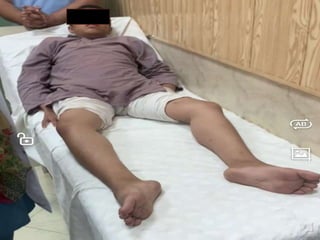
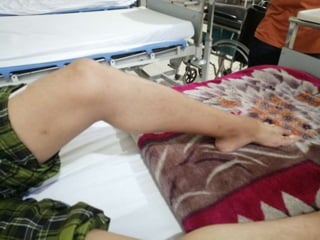
Lower limbs:
Inspection revealed visible genu valgus at B/L knee
joints, B/L foot drop, prominent ankle joint and
visible hypertrophy of calf muscles. Bandage on
lateral aspect of left thigh with no visible
fasciculations, tremors, involuntary movements or
wasting. Clonus was negative.
Bulk B/L equal and above normal in calf muscles i.e
12 inches on area of maximum bulge(6cm below
knee), 13 inches B/L(10cm above knee)
CNS & Musculoskeletal

Tone: Decreased in proximal muscles, rest normal
Power: 3/5 in bilateral lower limbs
Reflexes: Ankle jerk normal with hyporeflexia of knee jerk
Plantars: B/L downgoing
Gait: Patient is unable to walk
Gower’s sign: positive
Coordination: couldn’t be assessed
Sensations: Intact crude touch, fine touch, 2 point
descrimination, temperature, vibration and proprioception

Upper limbs:
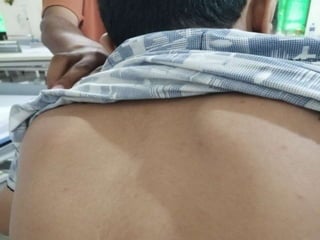
Inspection revealed winging of right scapula, inward shoulders
with no visible scars, fasciculations, tremors, involuntary
movements or wasting.
Bulk B/L equal and normal
Tone: normal
Power: 4/5 in proximal muscles, 5/5 in distal muscles including
small muscles of hands.
Reflexes: Normal
Coordination: normal with no past pointing/dysdiadochokinesia
Sensations: Intact crude touch, fine touch, 2 point descrimination,
temperature, vibration and proprioception

Cranial Nerves: Normal examination of all 12
cranial nerves

Chest:
Inspection: Pigeon chest with abdominothoracic type of
breathing,
Normal palpation, chest expansion, percussion with normal
vesicular breathing on auscultation.
Abdomen
Soft, non tender
CVS
Audible 1st and 2nd heart sound
Respiratory,Abdomen & CVS




 Proximal Myopathy d/t
 Duchenne Muscular Dystrophy
 Becker’s Muscular Dystrophy
 Endocrine disorders
 Idiopathic inflammatory myopathies including
dermatomyositis and polymyositis
DDs

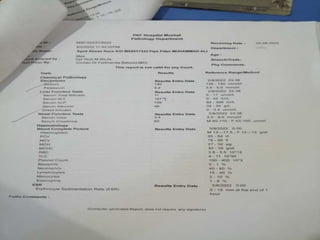
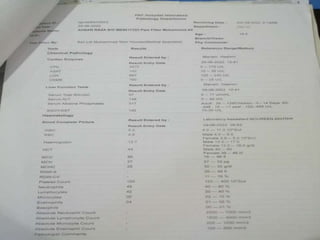
 Hb: 11.7 with MCV: 87
 TLC: 6.3
 Plt: 229
 CPK: 3470
 AST: 142
 LDH:687
 CKMB: 160
 ALT: 107, ALP: 705, Bilirubin: 11, Alb: 48
 RFTs, S/E Normal
Investigations

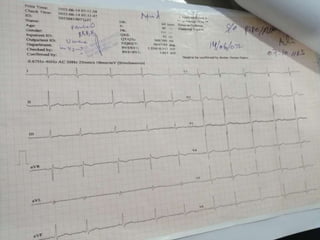
 ECG sinus arrythmia
 2D Echo Normal
 Usg of proximal lower limb muscles showed echogenicity
predominantly at rectus femoris and bicep femoris long
head
 MRI of Right thigh shows marked fatty replacement of
perineal muscle and muscle of anterior compartment of
thigh
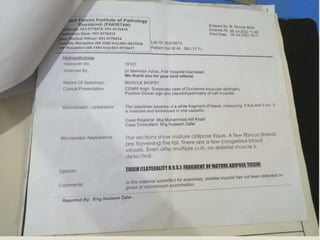
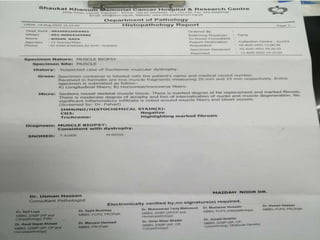
 Muscle biopsy is consistent with dystrophy
Investigations






 Physiotherapy
 Multi Vitamins
Management

Duchenne Muscular
Dystrophy

 An inherited progressive myopathic disorder
 X-linked recessive form of muscular dystrophy
 Affects 1 in 3600 boys
 Caused by mutation in Dystrophin gene hence called
‘Dystrophinopathy’
 Duchenne muscular dystrophy (DMD) is associated with
the most severe clinical symptoms of Dystrophinopathies
What it is…..

 Mutation of Dystrophin gene on short arm of
chromosome X (Xp21)
 Reduced or absent Dystrophin
Etiology

Dystrophin
 Dystrophin is located on the plasma membrane of
muscle fibers, functioning as a component of
Glycoprotein complex.
 Shields sarcolemma and glycoprotein complex
 Prevents digestion of glycoprotein complex by
proteases
 Absence leads to degeneration of muscle fibres
Pathophysiology

 Clinical onset b/w 2 to 3 yrs of age
 Proximal Muscles before Distal
 Pelvic, shoulder girdle, later limb and respiratory
muscles
 Difficulty running, jumping, walking upstairs
 Waddling gait
 Lumbar lordosis
 Pseudohypertrophy of calf
Features

 Wheel chair bound by the age of 12
 Positive Gower sign
 Cardiac manifestations
 DCM
 Arrythmias(especially SVT), atrial conduction defects
 Respiratory manifestations
 Respiratory insufficiency d/t restrictive lung disease
 Obstructive sleep apnea
 Hypoventilation
Features

 Intellectual disability in 30% pts
 ADHD(higher incidence)
 Orthopedic Complications
 long bone fractures
 Osteoporosis
 Progressive scoliosis
 Malignant Hyperthermia(dantrolene is antidote)
 Death within 15 yrs of onset
Features

 Clinical with positive family Hx
 Increased Creatinine Kinase
 Elevated , AST, Aldolase, LDH
 Myopathic changes on EMG (low amplitude then becomes
silent)and biopsy
 Molecular Genetic testing
Diagnosis

 Cardiac
 surveillance
 Treatment of DCM with ACE inhibitors and beta blockers
 Respiratory
 Spirometry
 Polysomnography
 Influenza and pneumococcal vaccine
 Early Management of chest infections
 NIPPV
Management

 Orthopedic
 Stretching/physiotherapy
 Avoid bed rest
 Night splints
 Surveillance radiographs
 Calcium and Vit D supplementation
Management

 Corticosteroid Therapy
 Prednisone 0.75mg/kg daily
 Or prednisone 10mg/kg over 2 days per week
 Deflazacort(0.9mg/kg daily)
 Eteplirsen(antisense oligonucleotide)
 Gene Therapy
Management


Duchene muscular dystrophy

  • 2.
     Case Presentation By Dr HaniaAfzal Resident Medicine
  • 3.
      Biodata  Name:Ahsan  Age: 14 years  Education: student of 8th class  Resident: village near sargodha
  • 4.
      Presenting Complain: Difficulty walking 7 yrs  Outward bulge in chest 4-5 yrs  Inability to walk 3 months
  • 5.
      HOPC My patientwas in his usual state of health 7 yrs back when he gradually started developing difficulty in walking and used to walk on his toes initially for which visited multiple doctors who prescribed multivitamins but condition continued to progress. He used to sit from a standing position like a sudden fall and arising from sitting position was quite difficult for him. He was unable to use indian toilets due to that very reason and is using commode for last 7 years. He was unable to go upstairs and for going downstairs he used to jump with support.
  • 6.
      HOPC His conditioncontinued deteriorating and started affecting his posture with formation of a bulge (about 4 yrs back), in his anterior chest which made walking more difficult for him and he used to walk in school with his back pack on as it helped him support his back and maintain an inclined posture. His difficulty in walk lead to multiple falls from standing position and one of such event lead to knee joint injury 4 months back after which he could never walk and needs wheel chair or an attendant to go to bathroom.
  • 7.
     HOPC He still cancomb his hair with slight difficulty and can eat with both of his hands. He never had a rash, an episode of LOC, ASOC, urine or fecal incontinence or mental disability. His condition was not preceded by fever, flu, diarrhea or any other ailment or drug use.
  • 8.
      Birth andDevelopmental Hx He is 3rd product of non consanguinous marriage, Born via SVD, breast fed for 2 yrs and achieved developmental milestones as a normal kid, with walk at 1.5 to 2 yrs of age but his speech was delayed to almost 3 yrs of age.  Past Medical Hx He had chicken pox in early infancy, no other medical Hx of significance
  • 9.
      Past SurgicalHx Not significant  Drug Hx Calcium and vitamin supplements with occasional analgesics  Vaccination Hx  Fully vaccinated with EPI vaccines  Received single dose of covid vaccine
  • 10.
      Family Hx Hehas 2 alive healthy brothers and a sister. His maternal cousin(son of his aunt) who is younger than him has similar pattern of disease(not yet diagnosed). His maternal uncle died of a similar condition in his late 20s and his mother’s maternal cousin also had similar disease. Rest of the family Hx is insignificant.
  • 11.
      Personal Hx Normal appetite  normal sleep wake cycle  Normal bowel habits  No hx of blood transfusions,  No hx of allergies or addictions  He has chicken as pets at home
  • 12.
      Travel Hx:Nil  Socioeconomic Hx He belongs to a lower middle class family where father is the only earner(pipe fitter in PAF). He lives in a quarter with his parents and 3 siblings.  Systemic Inquiry: Insignificant
  • 13.
      Clinical examination Ateenager male patient, lying on hospital bed, well oriented in time, place and person (GCS 15/15) with vitals of  BP: 100/60mmHg, Pulse: 68/min, SaO2: 98% on air RR: 16/min, Temp: afebrile, Regular pulse GPE
  • 14.
     Jaundice: -ive Palor: +ive Clubbing:-ive Koilonychia: -ive Edema: -ive Neck Swelling: -ive Lymph Nodes: -ive Visible Pectus carinatum and lumbar lordosis
  • 15.
     Lower limbs: Inspection revealedvisible genu valgus at B/L knee joints, B/L foot drop, prominent ankle joint and visible hypertrophy of calf muscles. Bandage on lateral aspect of left thigh with no visible fasciculations, tremors, involuntary movements or wasting. Clonus was negative. Bulk B/L equal and above normal in calf muscles i.e 12 inches on area of maximum bulge(6cm below knee), 13 inches B/L(10cm above knee) CNS & Musculoskeletal
  • 16.
     Tone: Decreased inproximal muscles, rest normal Power: 3/5 in bilateral lower limbs Reflexes: Ankle jerk normal with hyporeflexia of knee jerk Plantars: B/L downgoing Gait: Patient is unable to walk Gower’s sign: positive Coordination: couldn’t be assessed Sensations: Intact crude touch, fine touch, 2 point descrimination, temperature, vibration and proprioception
  • 17.
     Upper limbs: Inspection revealedwinging of right scapula, inward shoulders with no visible scars, fasciculations, tremors, involuntary movements or wasting. Bulk B/L equal and normal Tone: normal Power: 4/5 in proximal muscles, 5/5 in distal muscles including small muscles of hands. Reflexes: Normal Coordination: normal with no past pointing/dysdiadochokinesia Sensations: Intact crude touch, fine touch, 2 point descrimination, temperature, vibration and proprioception
  • 18.
     Cranial Nerves: Normalexamination of all 12 cranial nerves
  • 19.
     Chest: Inspection: Pigeon chestwith abdominothoracic type of breathing, Normal palpation, chest expansion, percussion with normal vesicular breathing on auscultation. Abdomen Soft, non tender CVS Audible 1st and 2nd heart sound Respiratory,Abdomen & CVS
  • 20.
  • 21.
  • 22.
  • 23.
      Proximal Myopathyd/t  Duchenne Muscular Dystrophy  Becker’s Muscular Dystrophy  Endocrine disorders  Idiopathic inflammatory myopathies including dermatomyositis and polymyositis DDs
  • 24.
      Hb: 11.7with MCV: 87  TLC: 6.3  Plt: 229  CPK: 3470  AST: 142  LDH:687  CKMB: 160  ALT: 107, ALP: 705, Bilirubin: 11, Alb: 48  RFTs, S/E Normal Investigations
  • 25.
      ECG sinusarrythmia  2D Echo Normal  Usg of proximal lower limb muscles showed echogenicity predominantly at rectus femoris and bicep femoris long head  MRI of Right thigh shows marked fatty replacement of perineal muscle and muscle of anterior compartment of thigh  Muscle biopsy is consistent with dystrophy Investigations
  • 26.
  • 27.
  • 28.
  • 29.
  • 30.
  • 31.
  • 32.
  • 33.
      An inheritedprogressive myopathic disorder  X-linked recessive form of muscular dystrophy  Affects 1 in 3600 boys  Caused by mutation in Dystrophin gene hence called ‘Dystrophinopathy’  Duchenne muscular dystrophy (DMD) is associated with the most severe clinical symptoms of Dystrophinopathies What it is…..
  • 34.
      Mutation ofDystrophin gene on short arm of chromosome X (Xp21)  Reduced or absent Dystrophin Etiology
  • 35.
     Dystrophin  Dystrophin islocated on the plasma membrane of muscle fibers, functioning as a component of Glycoprotein complex.  Shields sarcolemma and glycoprotein complex  Prevents digestion of glycoprotein complex by proteases  Absence leads to degeneration of muscle fibres Pathophysiology
  • 36.
      Clinical onsetb/w 2 to 3 yrs of age  Proximal Muscles before Distal  Pelvic, shoulder girdle, later limb and respiratory muscles  Difficulty running, jumping, walking upstairs  Waddling gait  Lumbar lordosis  Pseudohypertrophy of calf Features
  • 37.
      Wheel chairbound by the age of 12  Positive Gower sign  Cardiac manifestations  DCM  Arrythmias(especially SVT), atrial conduction defects  Respiratory manifestations  Respiratory insufficiency d/t restrictive lung disease  Obstructive sleep apnea  Hypoventilation Features
  • 38.
      Intellectual disabilityin 30% pts  ADHD(higher incidence)  Orthopedic Complications  long bone fractures  Osteoporosis  Progressive scoliosis  Malignant Hyperthermia(dantrolene is antidote)  Death within 15 yrs of onset Features
  • 39.
      Clinical withpositive family Hx  Increased Creatinine Kinase  Elevated , AST, Aldolase, LDH  Myopathic changes on EMG (low amplitude then becomes silent)and biopsy  Molecular Genetic testing Diagnosis
  • 40.
      Cardiac  surveillance Treatment of DCM with ACE inhibitors and beta blockers  Respiratory  Spirometry  Polysomnography  Influenza and pneumococcal vaccine  Early Management of chest infections  NIPPV Management
  • 41.
      Orthopedic  Stretching/physiotherapy Avoid bed rest  Night splints  Surveillance radiographs  Calcium and Vit D supplementation Management
  • 42.
      Corticosteroid Therapy Prednisone 0.75mg/kg daily  Or prednisone 10mg/kg over 2 days per week  Deflazacort(0.9mg/kg daily)  Eteplirsen(antisense oligonucleotide)  Gene Therapy Management
  • 43.