 
2
,
4

 
5
,
1
-5
-5
5
5
 
2
,
2 

 
1
,
7 
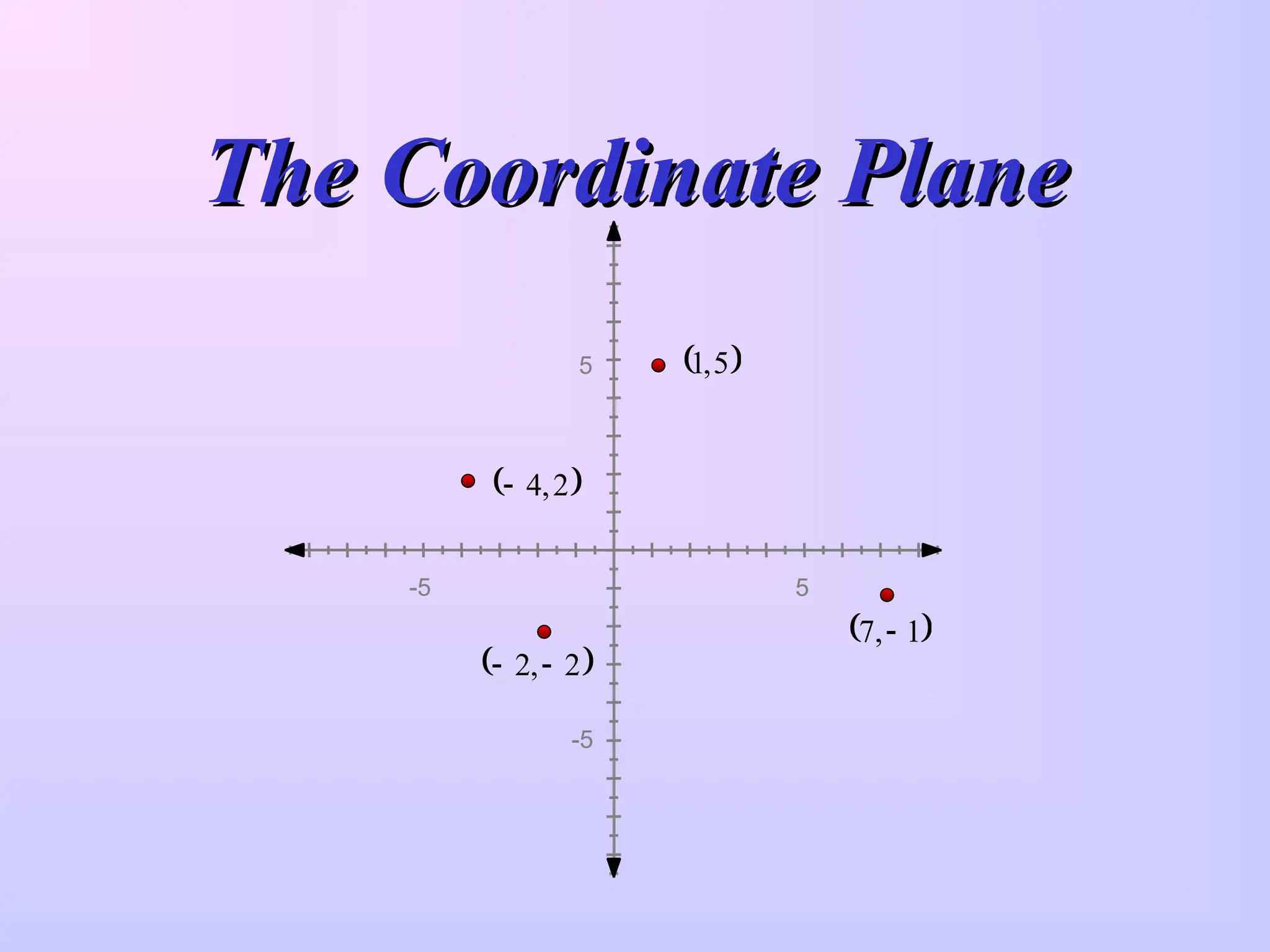
The Coordinate Plane
In Algebra, we often use
the coordinate plane.
In mathematics, a plane is a
flat surface that goes on
forever in every direction.
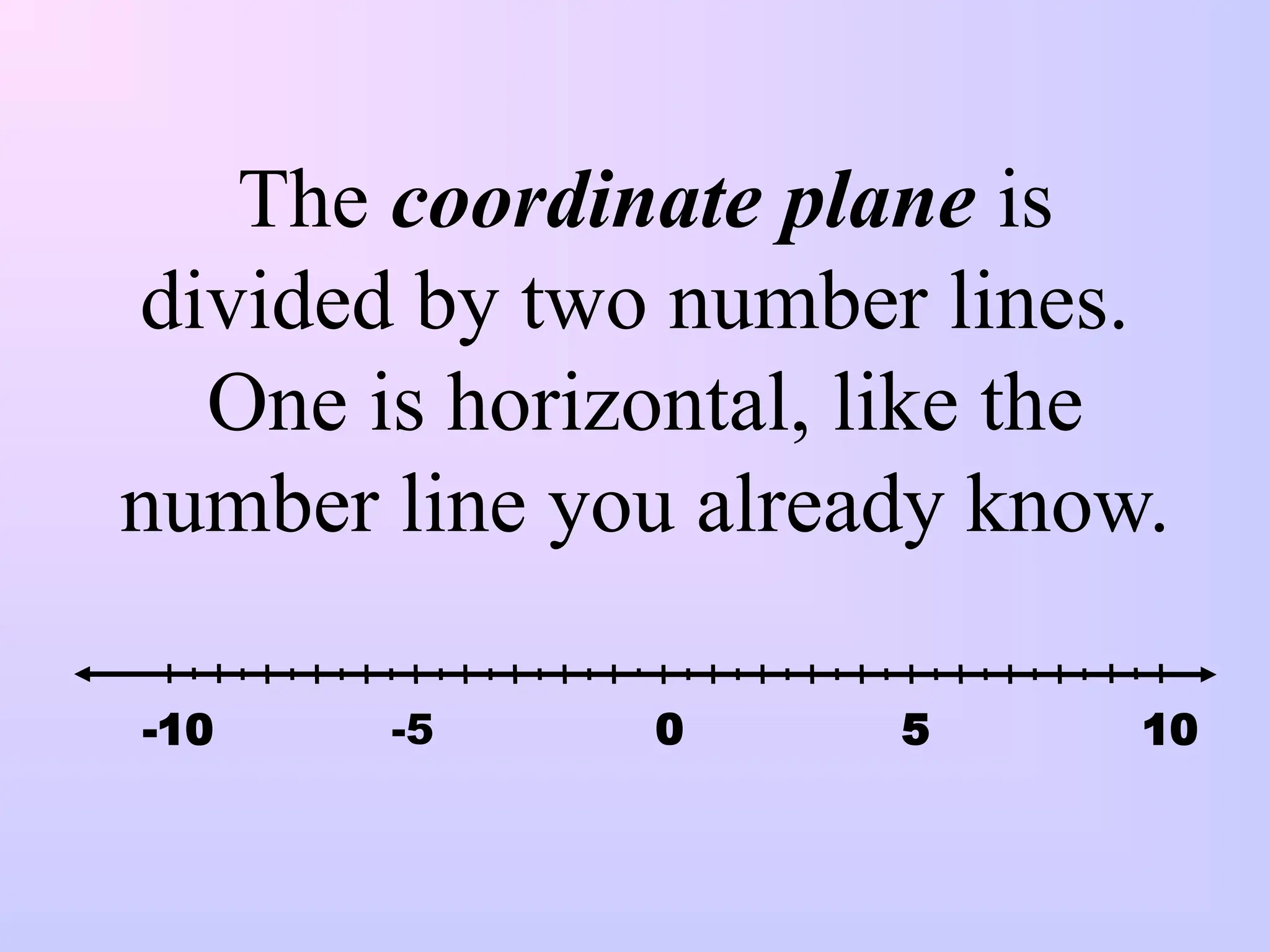
The coordinate plane is
divided by two number lines.
One is horizontal, like the
number line you already know.
-5 5
0 10
-10
The other is vertical, with up
being the positive direction
and down being the negative
direction.
-5 5
0 10
-10
5
-5
The coordinate plane is filled
with points . . .
. . . infinitely many points.
And somewhere among
all those points is the
point we call the origin.
-5 5
0 10
-10
5
-5
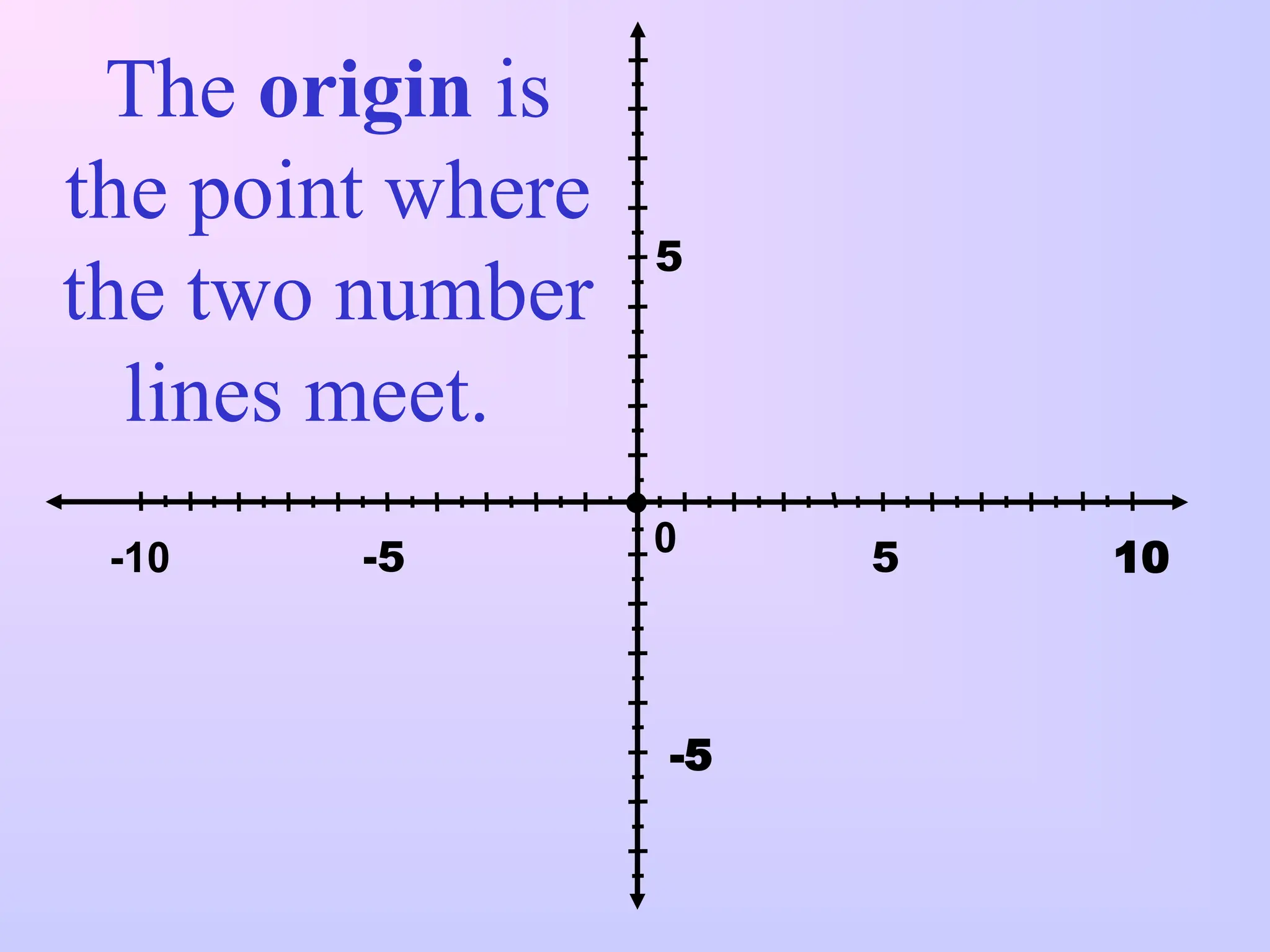
The origin is
the point where
the two number
lines meet.
-5 5
0 10
-10
5
-5
The two number lines have special names.
The horizontal number
line is called the x-axis.
The vertical
number line
is called the
y-axis.
y
x
-5 5
0 10
-10
5
-5
The plural of axis
is axes. We often
talk about the
coordinate axes.
To study a point, we need to
know where to find it. So we
give it coordinates.
Coordinates are like an address.
They tell you how you can get to
a point if you start at the origin.
y
 
y
x,
x
-5 5
0 10
-10
5
-5
Coordinates are
always written in
parentheses, with
the x-value first.
y
 
y
x,
x
-5 5
0 10
-10
5
-5
Coordinates written
in parentheses are
called an ordered
pair.
-5 5
0 10
-10
5
-5
The first number
tells you how far
to move along
the x-axis.
Consider the point
which has
coordinates, (4, -2).
So the 4 in (4, -2)
says we need to move
4 units to the right.
Remember to start
at the origin!
 
2
,
4 
-5 5
0 10
-10
5
-5
The second number
tells you how far to
move up or down.
The –2 in (4, -2)
tells you to
move down two
units.
 
0
,
0
-5 5
0 10
-10
5
-5
To get to the origin
from the origin, we
don’t move at all.
So the origin is
designated by
the ordered
pair, (0, 0)
The two number lines
divide the plane into
four regions.
Quadrants are labeled
with Roman Numerals.
We call the regions
quadrants.
In Quadrant I, all values
are positive.
In Quadrant II, x-values are
negative, while y-values are
positive.
In Quadrant III, x- and y-
values are both negative.
In Quadrant IV, x-values
are positive and y-values
are negative.
I
II
III IV
-5 5
0 10
-10
5
-5
 
3
,
2
 
2
,
3 
  
4
,
2 
 
1
,
5

Give the coordinates of each point:
1. (8,–7)
2. (4,0)
3. (–4,–5)
4. (0,–9)
5. (7,12)
Plot each point and describe how to get
to the point from the origin.
From the origin, move to the right
8 units, then down 7 units.
From the origin, move to the right 4
units, then stop (Stay on the x-axis.).
From the origin, move to the left 4
units, then down 5 units.
From the origin, don’t move to the right or left (stay
on the y-axis), then move down 9 units.
From the origin, move to the right
7 units, then up 12 units.

The Coordinate Plane for elementary students

  • 1.
      2 , 4    5 , 1 -5 -5 5 5  2 , 2     1 , 7  The Coordinate Plane The Coordinate Plane
  • 2.
    In Algebra, weoften use the coordinate plane. In mathematics, a plane is a flat surface that goes on forever in every direction.
  • 3.
    The coordinate planeis divided by two number lines. One is horizontal, like the number line you already know. -5 5 0 10 -10
  • 4.
    The other isvertical, with up being the positive direction and down being the negative direction.
  • 5.
  • 6.
    The coordinate planeis filled with points . . .
  • 7.
    . . .infinitely many points. And somewhere among all those points is the point we call the origin.
  • 8.
    -5 5 0 10 -10 5 -5 Theorigin is the point where the two number lines meet.
  • 9.
    -5 5 0 10 -10 5 -5 Thetwo number lines have special names. The horizontal number line is called the x-axis. The vertical number line is called the y-axis.
  • 10.
    y x -5 5 0 10 -10 5 -5 Theplural of axis is axes. We often talk about the coordinate axes.
  • 11.
    To study apoint, we need to know where to find it. So we give it coordinates. Coordinates are like an address. They tell you how you can get to a point if you start at the origin.
  • 12.
    y   y x, x -5 5 010 -10 5 -5 Coordinates are always written in parentheses, with the x-value first.
  • 13.
    y   y x, x -5 5 010 -10 5 -5 Coordinates written in parentheses are called an ordered pair.
  • 14.
    -5 5 0 10 -10 5 -5 Thefirst number tells you how far to move along the x-axis. Consider the point which has coordinates, (4, -2). So the 4 in (4, -2) says we need to move 4 units to the right. Remember to start at the origin!
  • 15.
      2 , 4  -55 0 10 -10 5 -5 The second number tells you how far to move up or down. The –2 in (4, -2) tells you to move down two units.
  • 16.
      0 , 0 -5 5 010 -10 5 -5 To get to the origin from the origin, we don’t move at all. So the origin is designated by the ordered pair, (0, 0)
  • 17.
    The two numberlines divide the plane into four regions. Quadrants are labeled with Roman Numerals. We call the regions quadrants. In Quadrant I, all values are positive. In Quadrant II, x-values are negative, while y-values are positive. In Quadrant III, x- and y- values are both negative. In Quadrant IV, x-values are positive and y-values are negative. I II III IV -5 5 0 10 -10 5 -5
  • 18.
      3 , 2   2 , 3    4 , 2    1 , 5  Give the coordinates of each point:
  • 19.
    1. (8,–7) 2. (4,0) 3.(–4,–5) 4. (0,–9) 5. (7,12) Plot each point and describe how to get to the point from the origin. From the origin, move to the right 8 units, then down 7 units. From the origin, move to the right 4 units, then stop (Stay on the x-axis.). From the origin, move to the left 4 units, then down 5 units. From the origin, don’t move to the right or left (stay on the y-axis), then move down 9 units. From the origin, move to the right 7 units, then up 12 units.