CLASS-IX
MATHEMATICS
COORDINATE GEOMETRY
D.A.V.C. PUBLIC SCHOOL ,JIND
HISTORY
The idea of this system was developed in 1637 in writings
by Descartes and independently by Pierre de Fermat,
although Fermat also worked in three dimensions and did
not publish the discovery. Both authors used a single axis
in their treatments and have a variable length measured
in reference to this axis. The concept of using a pairof axes
was introduced later, after Descartes' La Géométrie was
translated into Latin in 1649 by Frans van Schooten and
his students. These commentators introduced several
concepts while trying to clarify the ideas contained in
Descartes' work.
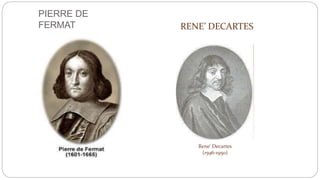
PIERRE DE
FERMAT RENE’ DECARTES
Rene’ Decartes
(1596-1950)
INTRODUCTION
Coordinate Geometry or the system of coordinate
geometry has been derived from the correspondence of
the points on the number lineand real number. A very
unique number coordinate can be represented on a number
line and any of the real number can be located on the number
line. The number line represents the whole of the real
number. By the way of the convection the number line is a
horizontal placed line at its right hand side the positive
Numbers are placed and on the left hand side the negative
numberare placed and they both are separated by the 0 orwe
can say zero is placed in the middle of them.
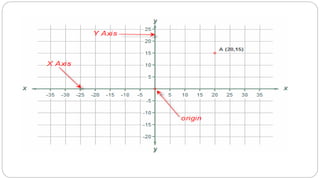
COORDINATE PLANE
 A two-dimensional surface on which points are plotted
and located by their x and y coordinates
It has two scales, called the x-axis and y-axis, at right
angles to each other.
The plural of axis is 'axes' (pronounced "AXE-ease").
Points on the plane are located using two numbers the x
and y coordinates.
These are the horizontal and vertical distances of the
point from a specific location called theorigin.
X axis
The horizontal scale is called the x-axis. As you go to the right
on the scale from zero, the values are positive and get larger. As
you go to the left from zero, they get more and more negative.
Y axis
The vertical scale is called the y-axis. As you go up from zero the
numbers are increasing in a positive direction. As you go down
from zero they get more and more negative.
Origin
The point where the two axes cross (at zero on both scales)
is called the origin. The origin is the point from which all
distances along the x and y axes are measured.
Quadrants
The two axes divide the plane into four areas called
quadrants. The first quadrant, by convention, is the top right,
and then they go around counter-clockwise. They are labelled
Quadrant 1,2 etc. It is conventional to label them with
numerals but we talk about them as "first, second, third, and
fourth quadrant". They are also sometimes labelled with
Roman numerals: I, II, III and IV.
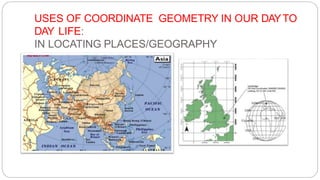
USES OF COORDINATE GEOMETRY IN OUR DAYTO
DAY LIFE:
IN LOCATING PLACES/GEOGRAPHY
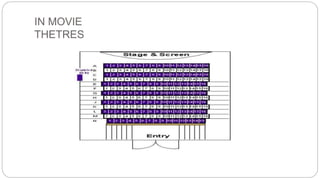
IN MOVIE
THETRES
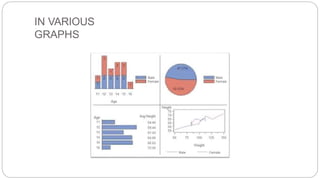
IN VARIOUS
GRAPHS
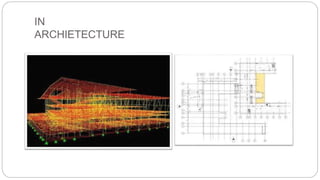
IN
ARCHIETECTURE
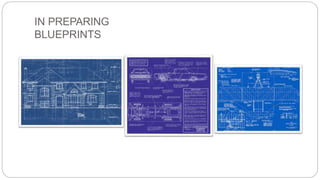
IN PREPARING
BLUEPRINTS
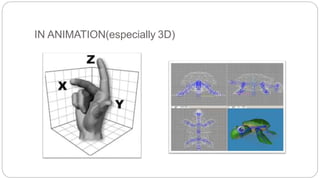
IN ANIMATION(especially 3D)
NCERT EX 3.1
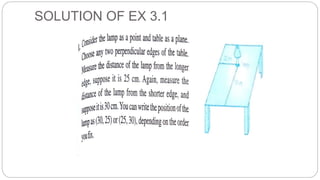
1. How will you describe the position of a table lamp on your study table to another
person?
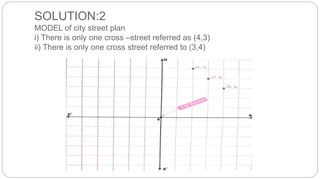
2. (Street Plan) : A city has two main roads which cross each other at the centre of the
city. These two roads are along the North-South direction and East-West direction.
All the other streets of the city run parallel to these roads and are 200 m apart. There
are about 5 streets in each direction. Using 1cm = 200 m, draw a model of the city
on your notebook. Represent the roads/ streets by single lines. There are many
cross- streets in your model. A particular cross-street is made by two streets, one
running in the North - South direction and another in the East - West direction. Each
cross street is referred to in the following manner : If the 2nd street running in the
North - South direction and 5th in the East - West direction meet at some crossing,
then we will call this cross-street (2, 5). Using this convention, find:
(i) how many cross - streets can be referred to as (4, 3).
(ii) how many cross - streets can be referred to as (3, 4).
SOLUTION OF EX 3.1
SOLUTION:2
MODEL of city street plan
i) There is only one cross –street referred as (4,3)
ii) There is only one cross street referred to (3,4)
Cartesian System
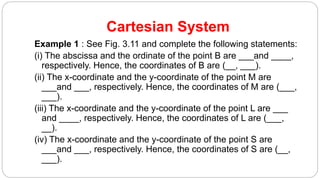
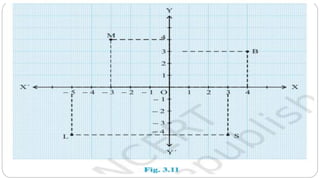
Example 1 : See Fig. 3.11 and complete the following statements:
(i) The abscissa and the ordinate of the point B are ___and ____,
respectively. Hence, the coordinates of B are (__, ___).
(ii) The x-coordinate and the y-coordinate of the point M are
___and ___, respectively. Hence, the coordinates of M are (___,
___).
(iii) The x-coordinate and the y-coordinate of the point L are ___
and ____, respectively. Hence, the coordinates of L are (___,
__).
(iv) The x-coordinate and the y-coordinate of the point S are
___and ___, respectively. Hence, the coordinates of S are (__,
___).
SOLUTION OF EXAMPLE 1
Solution :
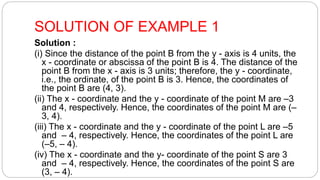
(i) Since the distance of the point B from the y - axis is 4 units, the
x - coordinate or abscissa of the point B is 4. The distance of the
point B from the x - axis is 3 units; therefore, the y - coordinate,
i.e., the ordinate, of the point B is 3. Hence, the coordinates of
the point B are (4, 3).
(ii) The x - coordinate and the y - coordinate of the point M are –3
and 4, respectively. Hence, the coordinates of the point M are (–
3, 4).
(iii) The x - coordinate and the y - coordinate of the point L are –5
and – 4, respectively. Hence, the coordinates of the point L are
(–5, – 4).
(iv) The x - coordinate and the y- coordinate of the point S are 3
and – 4, respectively. Hence, the coordinates of the point S are
(3, – 4).
Cartesian System
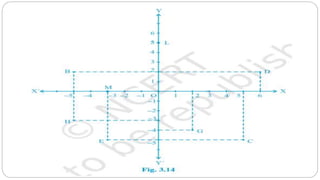
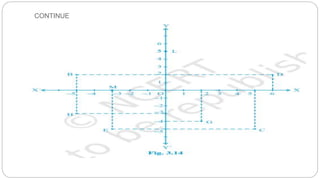
Example:1 See Fig.3.14, and write the following:
I. The coordinates of B.
II. The coordinates of C.
III. The point identified by the coordinates (–3, –5).
IV. The point identified by the coordinates (2, – 4).
V. The abscissa of the point D.
VI. The ordinate of the point H.
VII. The coordinates of the point L.
VIII. The coordinates of the point M.
Solution of Example 1:
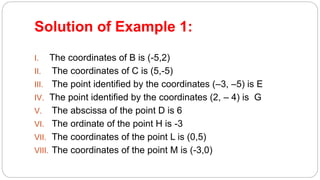
I. The coordinates of B is (-5,2)
II. The coordinates of C is (5,-5)
III. The point identified by the coordinates (–3, –5) is E
IV. The point identified by the coordinates (2, – 4) is G
V. The abscissa of the point D is 6
VI. The ordinate of the point H is -3
VII. The coordinates of the point L is (0,5)
VIII. The coordinates of the point M is (-3,0)
EX 3.2
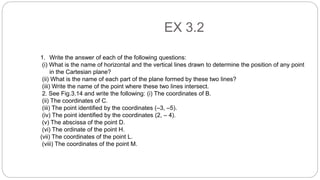
1. Write the answer of each of the following questions:
(i) What is the name of horizontal and the vertical lines drawn to determine the position of any point
in the Cartesian plane?
(ii) What is the name of each part of the plane formed by these two lines?
(iii) Write the name of the point where these two lines intersect.
2. See Fig.3.14 and write the following: (i) The coordinates of B.
(ii) The coordinates of C.
(iii) The point identified by the coordinates (–3, –5).
(iv) The point identified by the coordinates (2, – 4).
(v) The abscissa of the point D.
(vi) The ordinate of the point H.
(vii) The coordinates of the point L.
(viii) The coordinates of the point M.
CONTINUE
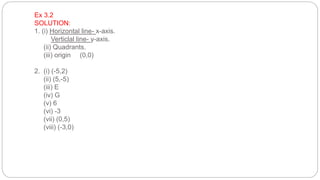
Ex 3.2
SOLUTION:
1. (i) Horizontal line- x-axis.
Verticlal line- y-axis.
(ii) Quadrants.
(iii) origin (0,0)
2. (i) (-5,2)
(ii) (5,-5)
(iii) E
(iv) G
(v) 6
(vi) -3
(vii) (0,5)
(viii) (-3,0)
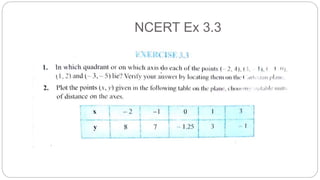
NCERT Ex 3.3
Solution:
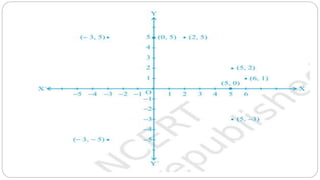
1. (-2,4) – 2nd Quadrant
(3,-1) – 4th Quadrant
(-1,0) – y’ axis or negative side of y-axis
(1,2) - 1st Quadrant
(-3,-5) – 3rd Quadrant
Now plot these points on graph
2. Plot the points(-2,8), (-1,7), (1,3), (3,-1) and (0,-1.25)
on graph
MIND MAP
Co-ordinate geometry
ch-3 coordinate geometry.pptx