2-1 – Solving Equations Using 
Addition and Subtraction
2-1 – Solving Equations Using 
Addition and Subtraction 
Goals: 
1. I can solve one step linear equations 
using addition and subtraction. 
2. I can use linear equations to solve 
real-life problems such as finding a 
record temperature.
Special Vocab (notebook please… 
Equation – a mathematical statement that two expressions are 
equal. 
A solution of an equation is a value of the variable that makes 
the equation true. 
To find solutions, we isolate the variable. A variable is 
isolated when it appears by itself (no coefficients) on one side 
of the equation.
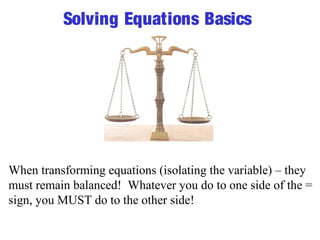
Solving Equations Basics 
When transforming equations (isolating the variable) – they 
must remain balanced! Whatever you do to one side of the = 
sign, you MUST do to the other side!
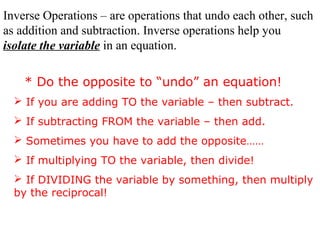
Inverse Operations – are operations that undo each other, such 
as addition and subtraction. Inverse operations help you 
isolate the variable in an equation. 
* Do the opposite to “undo” an equation! 
 If you are adding TO the variable – then subtract. 
 If subtracting FROM the variable – then add. 
 Sometimes you have to add the opposite…… 
 If multiplying TO the variable, then divide! 
 If DIVIDING the variable by something, then multiply 
by the reciprocal!
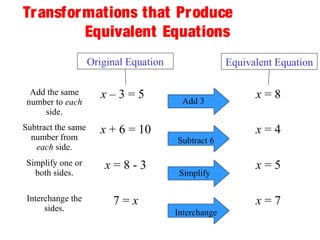
Transformations that Produce 
Equivalent Equations 
Add the same 
number to each 
side. 
Original Equation Equivalent Equation 
x – 3 = 5 x = 8 
Subtract the same 
number from 
each side. 
x + 6 = 10 x = 4 
Simplify one or 
both sides. x = 8 - 3 x = 5 
sides. 7 = x x = 7 
Interchange the 
Add 3 
Subtract 6 
Simplify 
Interchange
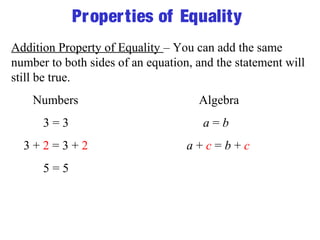
Properties of Equality 
Addition Property of Equality – You can add the same 
number to both sides of an equation, and the statement will 
still be true. 
Numbers Algebra 
3 = 3 a = b 
3 + 2 = 3 + 2 a + c = b + c 
5 = 5
Properties of Equality 
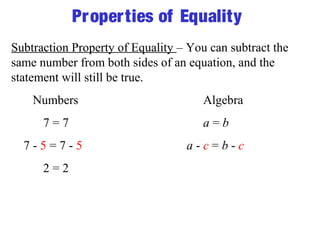
Subtraction Property of Equality – You can subtract the 
same number from both sides of an equation, and the 
statement will still be true. 
Numbers Algebra 
7 = 7 a = b 
7 - 5 = 7 - 5 a - c = b - c 
2 = 2
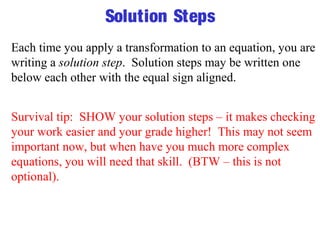
Solution Steps 
Each time you apply a transformation to an equation, you are 
writing a solution step. Solution steps may be written one 
below each other with the equal sign aligned. 
Survival tip: SHOW your solution steps – it makes checking 
your work easier and your grade higher! This may not seem 
important now, but when have you much more complex 
equations, you will need that skill. (BTW – this is not 
optional).
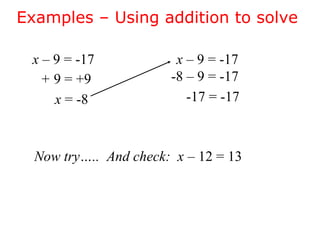
Examples – Using addition to solve 
x – 9 = -17 
+ 9 = +9 
x = -8 
x – 9 = -17 
-8 – 9 = -17 
-17 = -17 
Now try….. And check: x – 12 = 13
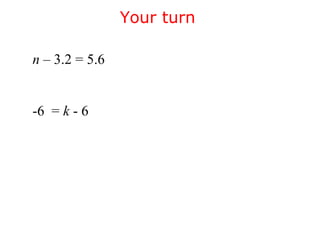
Your turn 
n – 3.2 = 5.6 
-6 = k - 6
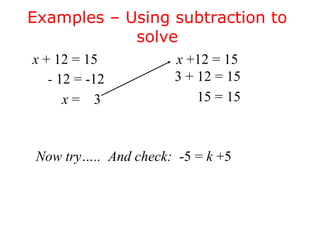
Examples – Using subtraction to 
solve 
x + 12 = 15 
- 12 = -12 
x = 3 
x +12 = 15 
3 + 12 = 15 
15 = 15 
Now try….. And check: -5 = k +5
Your turn 
1 1 
2 2 
d + = 
6 + t =14
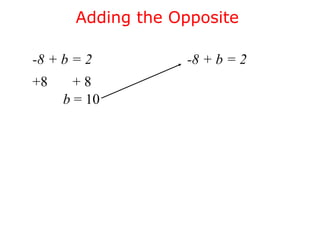
Adding the Opposite 
-8 + b = 2 
+8 + 8 
b = 10 
-8 + b = 2
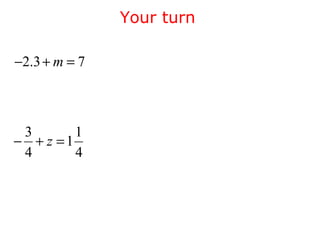
Your turn 
-2.3+ m = 7 
3 11 
4 4 
- + z =
Examples – Simplifying First 
-9 = n – (-4) 
-9 = n + 4 
- 4 = -4 
-13 = n 
-9 = n – (-4) 
-9 = -13 – (-4) 
-9 = -13 +4 
-9 = -9
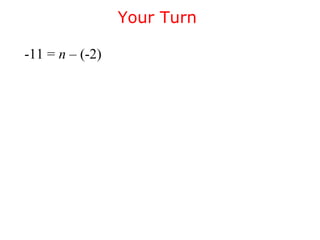
Your Turn 
-11 = n – (-2)
Your turn 
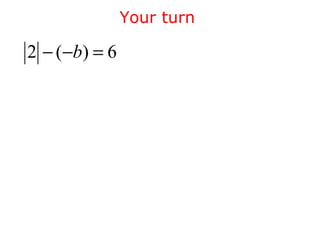
2 - (-b) = 6
Real World Problem 
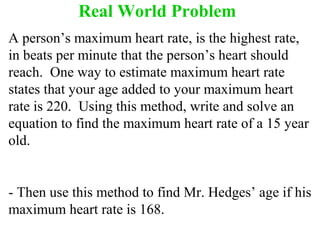
A person’s maximum heart rate, is the highest rate, 
in beats per minute that the person’s heart should 
reach. One way to estimate maximum heart rate 
states that your age added to your maximum heart 
rate is 220. Using this method, write and solve an 
equation to find the maximum heart rate of a 15 year 
old. 
- Then use this method to find Mr. Hedges’ age if his 
maximum heart rate is 168.
Quick Review 
What are Equivalent Equations? 
What are inverse operations? Give me an example.
2-1 – Homework 
P80, 22 - 74 even

Simple Equations I

  • 1.
    2-1 – SolvingEquations Using Addition and Subtraction
  • 2.
    2-1 – SolvingEquations Using Addition and Subtraction Goals: 1. I can solve one step linear equations using addition and subtraction. 2. I can use linear equations to solve real-life problems such as finding a record temperature.
  • 3.
    Special Vocab (notebookplease… Equation – a mathematical statement that two expressions are equal. A solution of an equation is a value of the variable that makes the equation true. To find solutions, we isolate the variable. A variable is isolated when it appears by itself (no coefficients) on one side of the equation.
  • 4.
    Solving Equations Basics When transforming equations (isolating the variable) – they must remain balanced! Whatever you do to one side of the = sign, you MUST do to the other side!
  • 5.
    Inverse Operations –are operations that undo each other, such as addition and subtraction. Inverse operations help you isolate the variable in an equation. * Do the opposite to “undo” an equation!  If you are adding TO the variable – then subtract.  If subtracting FROM the variable – then add.  Sometimes you have to add the opposite……  If multiplying TO the variable, then divide!  If DIVIDING the variable by something, then multiply by the reciprocal!
  • 6.
    Transformations that Produce Equivalent Equations Add the same number to each side. Original Equation Equivalent Equation x – 3 = 5 x = 8 Subtract the same number from each side. x + 6 = 10 x = 4 Simplify one or both sides. x = 8 - 3 x = 5 sides. 7 = x x = 7 Interchange the Add 3 Subtract 6 Simplify Interchange
  • 7.
    Properties of Equality Addition Property of Equality – You can add the same number to both sides of an equation, and the statement will still be true. Numbers Algebra 3 = 3 a = b 3 + 2 = 3 + 2 a + c = b + c 5 = 5
  • 8.
    Properties of Equality Subtraction Property of Equality – You can subtract the same number from both sides of an equation, and the statement will still be true. Numbers Algebra 7 = 7 a = b 7 - 5 = 7 - 5 a - c = b - c 2 = 2
  • 9.
    Solution Steps Eachtime you apply a transformation to an equation, you are writing a solution step. Solution steps may be written one below each other with the equal sign aligned. Survival tip: SHOW your solution steps – it makes checking your work easier and your grade higher! This may not seem important now, but when have you much more complex equations, you will need that skill. (BTW – this is not optional).
  • 10.
    Examples – Usingaddition to solve x – 9 = -17 + 9 = +9 x = -8 x – 9 = -17 -8 – 9 = -17 -17 = -17 Now try….. And check: x – 12 = 13
  • 11.
    Your turn n– 3.2 = 5.6 -6 = k - 6
  • 12.
    Examples – Usingsubtraction to solve x + 12 = 15 - 12 = -12 x = 3 x +12 = 15 3 + 12 = 15 15 = 15 Now try….. And check: -5 = k +5
  • 13.
    Your turn 11 2 2 d + = 6 + t =14
  • 14.
    Adding the Opposite -8 + b = 2 +8 + 8 b = 10 -8 + b = 2
  • 15.
    Your turn -2.3+m = 7 3 11 4 4 - + z =
  • 16.
    Examples – SimplifyingFirst -9 = n – (-4) -9 = n + 4 - 4 = -4 -13 = n -9 = n – (-4) -9 = -13 – (-4) -9 = -13 +4 -9 = -9
  • 17.
    Your Turn -11= n – (-2)
  • 18.
    Your turn 2- (-b) = 6
  • 19.
    Real World Problem A person’s maximum heart rate, is the highest rate, in beats per minute that the person’s heart should reach. One way to estimate maximum heart rate states that your age added to your maximum heart rate is 220. Using this method, write and solve an equation to find the maximum heart rate of a 15 year old. - Then use this method to find Mr. Hedges’ age if his maximum heart rate is 168.
  • 20.
    Quick Review Whatare Equivalent Equations? What are inverse operations? Give me an example.
  • 21.
    2-1 – Homework P80, 22 - 74 even